

ASTM E1863-18
(Test Method)Standard Test Method for Analysis of Acrylonitrile by Gas Chromatography
General Information
- Abstract
SIGNIFICANCE AND USE
4.1 This test method is designed to obtain acrylonitrile purity on the basis of impurities normally present in acrylonitrile and may be useful for final product inspection and process control.
4.2 This test method will measure the following impurities: acetone, acrolein, acetonitrile, and acetaldehyde. It also will allow calibration of other impurities including benzene, methacrylonitrile, oxazole, propionitrile, cis-crotononitrile, trans-crotononitrile, and others where specific impurity standards are available.
SCOPE
1.1 This test method covers the determination of the impurities in, and the purity of, acrylonitrile by flame ionization detector gas chromatography. It is applicable to acrylonitrile in the range of 99 to 100 % purity.
1.2 The values stated in SI units are to be regarded as standard. The values given in parentheses are for information only.
1.3 This standard does not purport to address all of the safety concerns, if any, associated with its use. It is the responsibility of the user of this standard to establish appropriate safety, health, and environmental practices and determine the applicability of regulatory limitations prior to use. Specific hazard statements are given in Sections 6 and 7.
1.4 Review the current MSDS for detailed information concerning toxicity, first aid procedures, and safety precautions.
1.5 This international standard was developed in accordance with internationally recognized principles on standardization established in the Decision on Principles for the Development of International Standards, Guides and Recommendations issued by the World Trade Organization Technical Barriers to Trade (TBT) Committee.
- Status
- Published
- Publication Date
- 30-Sep-2018
- Technical Committee
- D20 - Plastics
- Drafting Committee
- D20.15 - Thermoplastic Materials

Overview
ASTM E1863-18: Standard Test Method for Analysis of Acrylonitrile by Gas Chromatography provides a reliable procedure for determining the purity of acrylonitrile and identifying and quantifying key impurities using flame ionization detector gas chromatography (GC-FID). This standard plays a critical role in quality control, product inspection, and process monitoring in industries where high purity acrylonitrile is essential. The method is designed for acrylonitrile samples within the 99-100% purity range and is recognized internationally for its application in laboratories focused on chemical analysis, manufacturing, and regulatory compliance.
Key Topics
Gas Chromatography for Acrylonitrile: The method utilizes a capillary gas chromatograph equipped with a flame ionization detector, ensuring accurate separation and detection of acrylonitrile and its impurities.
Target Impurities: Common impurities quantified by this method include acetone, acrolein, acetonitrile, and acetaldehyde. The method also supports calibration for other contaminants such as benzene, methacrylonitrile, oxazole, propionitrile, cis- and trans-crotononitrile, and more, when corresponding impurity standards are available.
Internal Standard Technique: The use of toluene or another suitable internal standard is required for reliable quantification, enhancing result accuracy and repeatability.
Safety and Compliance: Users are responsible for adhering to appropriate safety, health, and environmental protocols, and for determining the applicability of local and international regulations. Consulting the latest Material Safety Data Sheet (MSDS) and reviewing the specific hazard notes in Sections 6 and 7 of the standard are essential.
Reporting Requirements: The method specifies detailed instructions for reporting impurity concentrations and acrylonitrile purity, ensuring traceability and comparability of results across different laboratories and applications.
Applications
ASTM E1863-18 is widely used in:
- Final Product Inspection: Ensuring that acrylonitrile meets stringent purity requirements before shipment or further processing, especially for polymer production (e.g., plastics, synthetic fibers).
- Process Control: Supporting manufacturing processes by facilitating regular monitoring and adjustment to maintain high purity levels and minimize impurities.
- Regulatory Compliance: Demonstrating adherence to international standards and safety regulations by providing validated laboratory results.
- Research and Development: Providing a benchmark analytical method for laboratory studies aimed at improving acrylonitrile production or developing new applications.
By implementing this standard, organizations benefit from improved product quality, greater operational consistency, and streamlined regulatory interactions, particularly in industries such as chemical manufacturing, pharmaceuticals, and petrochemicals.
Related Standards
- ASTM E1178: Former test methods for the analysis of acrylonitrile, now withdrawn, but referenced for complementary impurity determination such as water content.
- ASTM E180: Practice for determining the precision of ASTM methods for analysis and testing of industrial and specialty chemicals (withdrawn 2009).
- International Standards: Developed in alignment with globally recognized standardization principles, including those established by the World Trade Organization (WTO) Technical Barriers to Trade (TBT) Committee.
Keywords: acrylonitrile analysis, gas chromatography, ASTM E1863-18, chemical purity, impurities detection, quality control, GC-FID, internal standard, regulatory compliance, chemical testing standards.
Relations
- Effective Date
- 15-Dec-2008
Get Certified
Connect with accredited certification bodies for this standard

ECOCERT
Organic and sustainability certification.

Eurofins Food Testing Global
Global leader in food, environment, and pharmaceutical product testing.

Intertek Bangladesh
Intertek certification and testing services in Bangladesh.
Sponsored listings
Frequently Asked Questions
ASTM E1863-18 is a standard published by ASTM International. Its full title is "Standard Test Method for Analysis of Acrylonitrile by Gas Chromatography". This standard covers: SIGNIFICANCE AND USE 4.1 This test method is designed to obtain acrylonitrile purity on the basis of impurities normally present in acrylonitrile and may be useful for final product inspection and process control. 4.2 This test method will measure the following impurities: acetone, acrolein, acetonitrile, and acetaldehyde. It also will allow calibration of other impurities including benzene, methacrylonitrile, oxazole, propionitrile, cis-crotononitrile, trans-crotononitrile, and others where specific impurity standards are available. SCOPE 1.1 This test method covers the determination of the impurities in, and the purity of, acrylonitrile by flame ionization detector gas chromatography. It is applicable to acrylonitrile in the range of 99 to 100 % purity. 1.2 The values stated in SI units are to be regarded as standard. The values given in parentheses are for information only. 1.3 This standard does not purport to address all of the safety concerns, if any, associated with its use. It is the responsibility of the user of this standard to establish appropriate safety, health, and environmental practices and determine the applicability of regulatory limitations prior to use. Specific hazard statements are given in Sections 6 and 7. 1.4 Review the current MSDS for detailed information concerning toxicity, first aid procedures, and safety precautions. 1.5 This international standard was developed in accordance with internationally recognized principles on standardization established in the Decision on Principles for the Development of International Standards, Guides and Recommendations issued by the World Trade Organization Technical Barriers to Trade (TBT) Committee.
SIGNIFICANCE AND USE 4.1 This test method is designed to obtain acrylonitrile purity on the basis of impurities normally present in acrylonitrile and may be useful for final product inspection and process control. 4.2 This test method will measure the following impurities: acetone, acrolein, acetonitrile, and acetaldehyde. It also will allow calibration of other impurities including benzene, methacrylonitrile, oxazole, propionitrile, cis-crotononitrile, trans-crotononitrile, and others where specific impurity standards are available. SCOPE 1.1 This test method covers the determination of the impurities in, and the purity of, acrylonitrile by flame ionization detector gas chromatography. It is applicable to acrylonitrile in the range of 99 to 100 % purity. 1.2 The values stated in SI units are to be regarded as standard. The values given in parentheses are for information only. 1.3 This standard does not purport to address all of the safety concerns, if any, associated with its use. It is the responsibility of the user of this standard to establish appropriate safety, health, and environmental practices and determine the applicability of regulatory limitations prior to use. Specific hazard statements are given in Sections 6 and 7. 1.4 Review the current MSDS for detailed information concerning toxicity, first aid procedures, and safety precautions. 1.5 This international standard was developed in accordance with internationally recognized principles on standardization established in the Decision on Principles for the Development of International Standards, Guides and Recommendations issued by the World Trade Organization Technical Barriers to Trade (TBT) Committee.
ASTM E1863-18 is classified under the following ICS (International Classification for Standards) categories: 71.040.40 - Chemical analysis. The ICS classification helps identify the subject area and facilitates finding related standards.
ASTM E1863-18 has the following relationships with other standards: It is inter standard links to ASTM E1178-08. Understanding these relationships helps ensure you are using the most current and applicable version of the standard.
ASTM E1863-18 is available in PDF format for immediate download after purchase. The document can be added to your cart and obtained through the secure checkout process. Digital delivery ensures instant access to the complete standard document.
Standards Content (Sample)
This international standard was developed in accordance with internationally recognized principles on standardization established in the Decision on Principles for the
Development of International Standards, Guides and Recommendations issued by the World Trade Organization Technical Barriers to Trade (TBT) Committee.
Designation: E1863 − 18
Standard Test Method for
Analysis of Acrylonitrile by Gas Chromatography
This standard is issued under the fixed designation E1863; the number immediately following the designation indicates the year of
original adoption or, in the case of revision, the year of last revision.Anumber in parentheses indicates the year of last reapproval.A
superscript epsilon (´) indicates an editorial change since the last revision or reapproval.
1. Scope 3. Summary of Test Method
1.1 This test method covers the determination of the impu- 3.1 In this test method, a representative sample of acrylo-
rities in, and the purity of, acrylonitrile by flame ionization nitrile is introduced in a gas chromatograph equipped with a
detector gas chromatography. It is applicable to acrylonitrile in flameionizationdetectorandacapillarycolumnwherespecific
the range of 99 to 100% purity. impurities are separated from the acrylonitrile. The chromato-
graphic area for each impurity is compared to the area of the
1.2 The values stated in SI units are to be regarded as
internalstandard,tolueneorothersuitableknown,addedtothe
standard. The values given in parentheses are for information
sample. From response factors of these impurities relative to
only.
that of the internal standard and the amount of the standard
1.3 This standard does not purport to address all of the
added,theconcentrationoftheimpuritiesarecalculated.Other
safety concerns, if any, associated with its use. It is the
impurities, such as water, are obtained by use of Test Methods
responsibility of the user of this standard to establish appro-
E1178. The acrylonitrile content is obtained by subtracting the
priate safety, health, and environmental practices and deter-
total amount of all impurities from 100.0.
mine the applicability of regulatory limitations prior to use.
Specific hazard statements are given in Sections 6 and 7.
4. Significance and Use
1.4 Review the current MSDS for detailed information
4.1 This test method is designed to obtain acrylonitrile
concerning toxicity, first aid procedures, and safety precau-
purity on the basis of impurities normally present in acryloni-
tions.
trileandmaybeusefulforfinalproductinspectionandprocess
1.5 This international standard was developed in accor-
control.
dance with internationally recognized principles on standard-
4.2 This test method will measure the following impurities:
ization established in the Decision on Principles for the
acetone, acrolein, acetonitrile, and acetaldehyde. It also will
Development of International Standards, Guides and Recom-
allow calibration of other impurities including benzene,
mendations issued by the World Trade Organization Technical
methacrylonitrile, oxazole, propionitrile, cis-crotononitrile,
Barriers to Trade (TBT) Committee.
trans-crotononitrile, and others where specific impurity stan-
dards are available.
2. Referenced Documents
2.1 ASTM Standards:
5. Apparatus
E180Practice for Determining the Precision of ASTM
5.1 Capillary Gas Chromatograph—Any gas chromato-
Methods for Analysis and Testing of Industrial and Spe-
graph equipped with a flame ionization detector and a split
cialty Chemicals (Withdrawn 2009)
injection system for use with capillary columns that can be
E1178Test Methods for Analysis of Acrylonitrile (With-
operated at the conditions given in Table 1.
drawn 2016)
5.2 Column—The column, such as Supelcowax 10, must
give satisfactory resolution and proper peak shapes for the
ThistestmethodisunderthejurisdictionofASTMCommitteeD20onPlastics
components listed in Fig. 1.
and is the direct responsibility of Subcommittee D20.15 on Thermoplastic Materi-
5.3 Recorder/Integrator—Electronic integration is recom-
als.
Current edition approved Oct. 1, 2018. Published October 2018. Originally
mended for this analysis.
approvedin1997.Lastpreviouseditionapprovedin2007asE1863–07,whichwas
5.4 Syringe, 10 µL capacity.
withdrawn January 2016 and reinstated in October 2018. DOI: 10.1520/E1863-18.
For referenced ASTM standards, visit the ASTM website, www.astm.org, or
contact ASTM Customer Service at service@astm.org. For Annual Book of ASTM
Standards volume information, refer to the standard’s Document Summary page on
the ASTM website. ASupelcowax 10 fused silica capillary column (60 m by 0.32 mm ID by 1 µm
The last approved version of this historical standard is referenced on film thickness), has been found to be suitable, but similar polar wax columns from
www.astm.org. other vendors may be used after shown to be suitable.
Copyright © ASTM International, 100 Barr Harbor Drive, PO Box C700, West Conshohocken, PA 19428-2959. United States
E1863 − 18
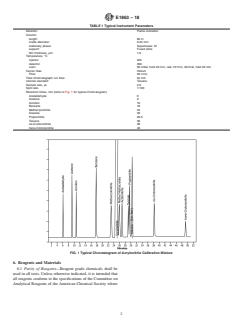
TABLE 1 Typical Instrument Parameters
Detector: Flame ionization
Column:
length: 60 m
inside diameter: 0.32 mm
stationary phase: Supelcowax 10
support: Fused silica
film thickness, µm: 1.0
Temperature, °C
injector: 225
detector: 350
oven: 50 initial, hold 25 min, rate 10°/min, 90 final, hold 20 min
Carrier Gas: Helium
Flow: 20 cm/s
Total chromatograph run time: 54 min
Internal standard: Toluene
Sample size, µL 2.0
Split ratio 1:100
Retention times, min (refer to Fig. 1 for typical chromatogram)
Acetaldehyde 6
Acetone 9
Acrolein 10
Benzene 18
Methacrylonitrile 23
Oxazole 29
Propionitrile 29.5
Toluene 30
cis-Crotononitrile 38
trans-Crotononitrile 49
FIG. 1 Typical Chromatogram of Acrylonitrile Calibration Mixture
6. Reagents and Materials
6.1 Purity of Reagents—Reagent grade chemicals shall be
used in all tests. Unless otherwise indicated, it is intended that
all reagents conform to the specifications of the Committee on
Analytical Reagents of theAmerican Chemical Society where
E1863 − 18
such specifications are available. Other grades may be used, usingadensityof0.867fortolueneand0.806foracrylonitrile,
provided it is first ascertained that the reagent is of sufficiently this solution will contain 0.011 mass % toluene.
high purity to permit its use without lessening the accuracy of
8.2 Inject an appropriate amount of sample into the chro-
the determination.
matograph and obtain a chromatogram.Approximate retention
6.2 Carrier Gas, helium minimum purity 99.995 mol%. times are given in Table 1. A typical chromatograph is shown
in Fig. 1.
6.3 Hydrogen, high purity.
8.3 Measure the areas of all peaks, except the acrylonitrile
6.4 Air, hydrogen free, high purity.
peak, including the toluene (internal standard) peak.
6.5 Toluene, 99.0% min purity or other internal standard,
8.4 Calculate the response factor for each impurity relative
previously analyzed free of compounds coeluting with impu-
to the internal standard as follows:
rities in the sample.
As 3 Fs 3 Wi
6.6 Acrylonitrile, highest purity available.
Ri 5 (1)
Ai 3 Fi 3 Ws
NOTE 1—High purity acrylonitrile can be obtained by fractional
where:
distillation.
Ri = response factor relative to the internal standard,
6.7 Acetone, at least 96% pure.
As = area of internal standard peak,
6.8 Acrolein, at least 96% pure.
Ai = area of impurity peak,
Fi = attenuation factor for impurit
...