


ASTM D3588-98(2017)
(Practice)Standard Practice for Calculating Heat Value, Compressibility Factor, and Relative Density of Gaseous Fuels
Standard Practice for Calculating Heat Value, Compressibility Factor, and Relative Density of Gaseous Fuels
SIGNIFICANCE AND USE
5.1 The heating value is a measure of the suitability of a pure gas or a gas mixture for use as a fuel; it indicates the amount of energy that can be obtained as heat by burning a unit of gas. For use as heating agents, the relative merits of gases from different sources and having different compositions can be compared readily on the basis of their heating values. Therefore, the heating value is used as a parameter for determining the price of gas in custody transfer. It is also an essential factor in calculating the efficiencies of energy conversion devices such as gas-fired turbines. The heating values of a gas depend not only upon the temperature and pressure, but also upon the degree of saturation with water vapor. However, some calorimetric methods for measuring heating values are based upon the gas being saturated with water at the specified conditions.
5.2 The relative density (specific gravity) of a gas quantifies the density of the gas as compared with that of air under the same conditions.
SCOPE
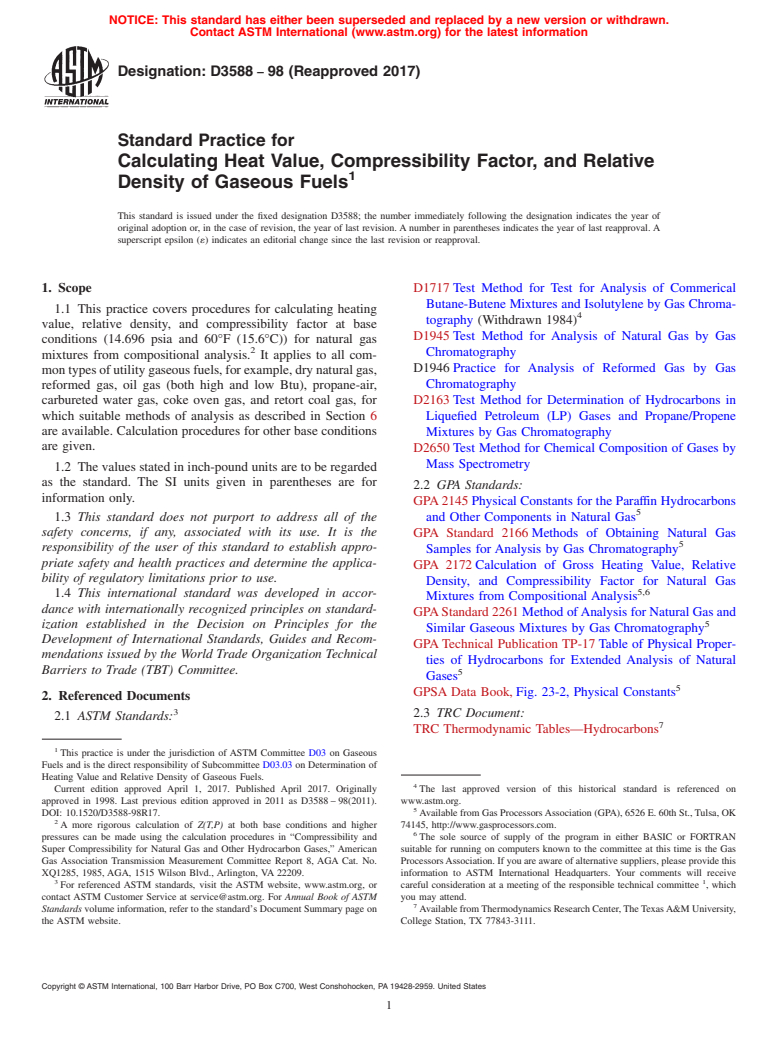
1.1 This practice covers procedures for calculating heating value, relative density, and compressibility factor at base conditions (14.696 psia and 60°F (15.6°C)) for natural gas mixtures from compositional analysis.2 It applies to all common types of utility gaseous fuels, for example, dry natural gas, reformed gas, oil gas (both high and low Btu), propane-air, carbureted water gas, coke oven gas, and retort coal gas, for which suitable methods of analysis as described in Section 6 are available. Calculation procedures for other base conditions are given.
1.2 The values stated in inch-pound units are to be regarded as the standard. The SI units given in parentheses are for information only.
1.3 This standard does not purport to address all of the safety concerns, if any, associated with its use. It is the responsibility of the user of this standard to establish appropriate safety and health practices and determine the applicability of regulatory limitations prior to use.
1.4 This international standard was developed in accordance with internationally recognized principles on standardization established in the Decision on Principles for the Development of International Standards, Guides and Recommendations issued by the World Trade Organization Technical Barriers to Trade (TBT) Committee.
General Information
Buy Standard
Standards Content (Sample)
NOTICE: This standard has either been superseded and replaced by a new version or withdrawn.
Contact ASTM International (www.astm.org) for the latest information
Designation: D3588 − 98 (Reapproved 2017)
Standard Practice for
Calculating Heat Value, Compressibility Factor, and Relative
Density of Gaseous Fuels
This standard is issued under the fixed designation D3588; the number immediately following the designation indicates the year of
original adoption or, in the case of revision, the year of last revision.Anumber in parentheses indicates the year of last reapproval.A
superscript epsilon (´) indicates an editorial change since the last revision or reapproval.
1. Scope D1717Test Method for Test for Analysis of Commerical
Butane-Butene Mixtures and Isolutylene by Gas Chroma-
1.1 This practice covers procedures for calculating heating
tography (Withdrawn 1984)
value, relative density, and compressibility factor at base
D1945Test Method for Analysis of Natural Gas by Gas
conditions (14.696 psia and 60°F (15.6°C)) for natural gas
Chromatography
mixtures from compositional analysis. It applies to all com-
D1946Practice for Analysis of Reformed Gas by Gas
montypesofutilitygaseousfuels,forexample,drynaturalgas,
Chromatography
reformed gas, oil gas (both high and low Btu), propane-air,
carbureted water gas, coke oven gas, and retort coal gas, for D2163Test Method for Determination of Hydrocarbons in
which suitable methods of analysis as described in Section 6 Liquefied Petroleum (LP) Gases and Propane/Propene
are available. Calculation procedures for other base conditions
Mixtures by Gas Chromatography
are given.
D2650Test Method for Chemical Composition of Gases by
Mass Spectrometry
1.2 The values stated in inch-pound units are to be regarded
as the standard. The SI units given in parentheses are for
2.2 GPA Standards:
information only.
GPA2145Physical Constants for the Paraffin Hydrocarbons
1.3 This standard does not purport to address all of the and Other Components in Natural Gas
safety concerns, if any, associated with its use. It is the GPA Standard 2166Methods of Obtaining Natural Gas
responsibility of the user of this standard to establish appro- Samples for Analysis by Gas Chromatography
priate safety and health practices and determine the applica-
GPA 2172Calculation of Gross Heating Value, Relative
bility of regulatory limitations prior to use.
Density, and Compressibility Factor for Natural Gas
5,6
1.4 This international standard was developed in accor-
Mixtures from Compositional Analysis
dance with internationally recognized principles on standard-
GPAStandard2261MethodofAnalysisforNaturalGasand
ization established in the Decision on Principles for the
Similar Gaseous Mixtures by Gas Chromatography
Development of International Standards, Guides and Recom-
GPATechnical Publication TP-17Table of Physical Proper-
mendations issued by the World Trade Organization Technical
ties of Hydrocarbons for Extended Analysis of Natural
Barriers to Trade (TBT) Committee.
Gases
GPSA Data Book,Fig. 23-2, Physical Constants
2. Referenced Documents
2.3 TRC Document:
2.1 ASTM Standards:
TRC Thermodynamic Tables—Hydrocarbons
This practice is under the jurisdiction of ASTM Committee D03 on Gaseous
Fuels and is the direct responsibility of Subcommittee D03.03 on Determination of
Heating Value and Relative Density of Gaseous Fuels.
Current edition approved April 1, 2017. Published April 2017. Originally The last approved version of this historical standard is referenced on
approved in 1998. Last previous edition approved in 2011 as D3588–98(2011). www.astm.org.
DOI: 10.1520/D3588-98R17. AvailablefromGasProcessorsAssociation(GPA),6526E.60thSt.,Tulsa,OK
A more rigorous calculation of Z(T,P) at both base conditions and higher 74145, http://www.gasprocessors.com.
pressures can be made using the calculation procedures in “Compressibility and The sole source of supply of the program in either BASIC or FORTRAN
Super Compressibility for Natural Gas and Other Hydrocarbon Gases,” American suitable for running on computers known to the committee at this time is the Gas
Gas Association Transmission Measurement Committee Report 8, AGA Cat. No. ProcessorsAssociation.Ifyouareawareofalternativesuppliers,pleaseprovidethis
XQ1285, 1985, AGA, 1515 Wilson Blvd., Arlington, VA 22209. information to ASTM International Headquarters. Your comments will receive
3 1
For referenced ASTM standards, visit the ASTM website, www.astm.org, or careful consideration at a meeting of the responsible technical committee , which
contact ASTM Customer Service at service@astm.org. For Annual Book of ASTM you may attend.
Standards volume information, refer to the standard’s Document Summary page on AvailablefromThermodynamicsResearchCenter,TheTexasA&MUniversity,
the ASTM website. College Station, TX 77843-3111.
Copyright © ASTM International, 100 Barr Harbor Drive, PO Box C700, West Conshohocken, PA 19428-2959. United States
D3588 − 98 (2017)
2.4 ANSI Standard:
3.2.1.2 =β —summation factor for calculating real gas
ij
ANSI Z 132.1-1969:Base Conditions of Pressure and Tem-
correction (alternate method)
perature for the Volumetric Measurement of Natural
3.2.1.3 (cor)—corrected for water content
8,9
Gas
3.2.1.4 (dry)—value on water-free basis
3.2.1.5 d—density for gas relative to the density of air.
3. Terminology
id
3.2.1.6 d —ideal relative density or relative molar mass,
3.1 Definitions:
that is, molar mass of gas relative to molar mass of air
id
3.1.1 British thermal unit—the defined International Tables
3.2.1.7 G —molar mass ratio
id
British thermal unit (Btu).
3.2.1.8 H —gross heating value per unit mass
m
3.1.1.1 Discussion—The defining relationships are:
id
3.2.1.9 H —gross heating value per unit volume
–1 –1 v
1 Btu•lb = 2.326 J•g (exact)
id
3.2.1.10 H —gross heating value per unit mole
1 lb = 453.592 37 g (exact)
n
id
Bytheserelationships,1Btu=1055.05585262J(exact).For
3.2.1.11 h —net heating value per unit mass
m
most purposes, the value (rounded) 1 Btu = 1055.056 J is
id
3.2.1.12 h —net heating value per unit volume
v
adequate.
id
3.2.1.13 h —net heating value per unit mole
n
3.1.2 compressibility factor (z)—the ratio of the actual
volume of a given mass of gas at a specified temperature and 3.2.1.14 a, b, c—in Eq 1, integers required to balance the
pressure to its volume calculated from the ideal gas law under equation: C, carbon; H, hydrogen; S, sulfur; O, oxygen
the same conditions. 3.2.1.15 (id)—ideal gas state
3.2.1.16 (l)—liquid phase
3.1.3 gross heating value—theamountofenergytransferred
3.2.1.17 M—molar mass
asheatfromthecomplete,idealcombustionofthegaswithair,
3.2.1.18 m—mass flow rate
at standard temperature, in which all the water formed by the
3.2.1.19 n—number of components
reaction condenses to liquid. The values for the pure gases
3.2.1.20 P—pressure in absolute units (psia)
appear in GPAStandard 2145, which is revised annually. If the
id
3.2.1.21 Q —ideal energy per unit time released as heat
gross heating value has a volumetric rather than a mass or
upon combustion
molar basis, a base pressure must also be specified.
3.2.1.22 R—gasconstant,10.7316psia.ft /(lbmol•R)inthis
3.1.4 netheatingvalue—theamountofenergytransferredas
practice (based upon R = 8.31448 J/(mol•K))
heat from the total, ideal combustion of the gas at standard
3.2.1.23 (sat)—denotes saturation value
temperature in which all the water formed by the reaction
3.2.1.24 T—absolute temperature, °R = °F + 459.67 or K =
remains in the vapor state. Condensation of any “spectator”
°C + 273.15
water does not contribute to the net heating value. If the net
3.2.1.25 (T, P)—value dependent upon temperature and
heating value has a volumetric rather than a mass or molar
pressure
basis, a base pressure must also be specified.
3.2.1.26 V—gas volumetric flow rate
3.1.5 relativedensity—theratioofthedensityofthegaseous
3.2.1.27 x—mole fraction
fuel,underobservedconditionsoftemperatureandpressure,to
3.2.1.28 Z—gascompressibilityfactorrepeatabilityofprop-
the density of dry air (of normal carbon dioxide content) at the
erty
same temperature and pressure.
3.2.1.29 δ—repeatability of property
3.1.6 standard cubic foot of gas—the amount of gas that
3.2.1.30 ρ—density in mass per unit volume
3 3 n
occupies 1 ft (0.028 m ) at a temperature of 60°F (15.6°C)
3.2.1.31 —property summed for Components 1 through
(
under a given base pressure and either saturated with water j51
n, where n represents the total number of components in the
vapor(wet)orfreeofwatervapor(dry)asspecified(seeANSI
mixture
Z 132.1). In this practice, calculations have been made at
14.696 psia and 60°F (15.6°C), because the yearly update of
3.2.2 Superscripts:
GPA2145 by theThermodynamics Research Center, on which
3.2.2.1 id—ideal gas value
these calculations are based, are given for this base pressure.
3.2.2.2 l—liquid
Conversionstootherbaseconditionsshouldbemadeattheend
3.2.2.3 σ—value at saturation (vapor pressure)
of the calculation to reduce roundoff errors.
3.2.2.4 '—reproducibility
3.2.3 Subscripts:
3.1.7 standard temperature (USA)—60°F (15.6°C).
3.2.3.1 a—value for air
3.2 Symbols:
3.2.3.2 a—relative number of atoms of carbon in Eq 1
3.2.1 Nomenclature:
3.2.3.3 b—relative number of atoms of hydrogen in Eq 1
3.2.1.1 B—second virial coefficient for gas mixture
3.2.3.4 c—relative number of atoms of sulfur in Eq 1
3.2.3.5 j—property for component j
3.2.3.6 ii—non-ideal gas property for component i
Available fromAmerican National Standards Institute (ANSI), 25 W. 43rd St.,
3.2.3.7 ij—non-ideal gas property for mixture of i and j
4th Floor, New York, NY 10036, http://www.ansi.org.
3.2.3.8 jj—non-ideal gas property for component j
Supporting data have been filed atASTM International Headquarters and may
be obtained by requesting Research Report RR:D03-1007. 3.2.3.9 w—value for water
D3588 − 98 (2017)
y l
3.2.3.10 1—property for Component 1 larger than the enthalpy of vaporization H – H ' .
w w
3.2.3.11 2—property for Component 2
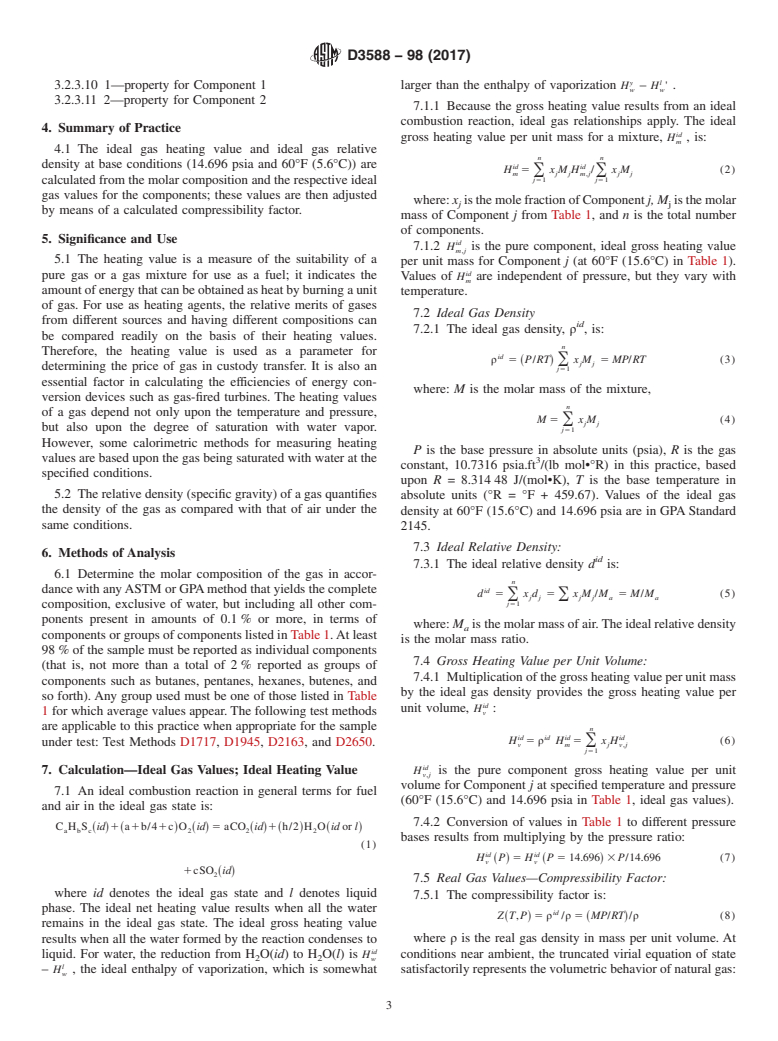
7.1.1 Because the gross heating value results from an ideal
combustion reaction, ideal gas relationships apply. The ideal
4. Summary of Practice
id
gross heating value per unit mass for a mixture, H , is:
m
4.1 The ideal gas heating value and ideal gas relative
n n
density at base conditions (14.696 psia and 60°F (5.6°C)) are
id id
H 5 x M H / x M (2)
m ( j j m,j ( j j
j51 j51
calculatedfromthemolarcompositionandtherespectiveideal
gas values for the components; these values are then adjusted
where:x isthemolefractionofComponentj,M isthemolar
j j
by means of a calculated compressibility factor.
mass of Component j from Table 1, and n is the total number
of components.
5. Significance and Use
id
7.1.2 H is the pure component, ideal gross heating value
m,j
5.1 The heating value is a measure of the suitability of a
per unit mass for Component j (at 60°F (15.6°C) in Table 1).
id
pure gas or a gas mixture for use as a fuel; it indicates the
Values of H are independent of pressure, but they vary with
m
amountofenergythatcanbeobtainedasheatbyburningaunit
temperature.
of gas. For use as heating agents, the relative merits of gases
7.2 Ideal Gas Density
from different sources and having different compositions can
id
7.2.1 The ideal gas density, ρ , is:
be compared readily on the basis of their heating values.
n
Therefore, the heating value is used as a parameter for
id
ρ 5 P/RT x M 5 MP/RT (3)
~ !
( j j
determining the price of gas in custody transfer. It is also an j51
essential factor in calculating the efficiencies of energy con-
where: M is the molar mass of the mixture,
version devices such as gas-fired turbines. The heating values
n
of a gas depend not only upon the temperature and pressure,
M 5 x M (4)
j j
(
but also upon the degree of saturation with water vapor. j51
However, some calorimetric methods for measuring heating
P is the base pressure in absolute units (psia), R is the gas
valuesarebaseduponthegasbeingsaturatedwithwateratthe
constant, 10.7316 psia.ft /(lb mol•°R) in this practice, based
specified conditions.
upon R = 8.31448 J/(mol•K), T is the base temperature in
5.2 Therelativedensity(specificgravity)ofagasquantifies
absolute units (°R = °F + 459.67). Values of the ideal gas
the density of the gas as compared with that of air under the
density at 60°F (15.6°C) and 14.696 psia are in GPAStandard
same conditions.
2145.
7.3 Ideal Relative Density:
6. Methods of Analysis
id
7.3.1 The ideal relative density d is:
6.1 Determine the molar composition of the gas in accor-
n
dancewithanyASTMorGPAmethodthatyieldsthecomplete id
d 5 x d 5 x M /M 5 M/M (5)
j j j j a a
( (
j51
composition, exclusive of water, but including all other com-
ponents present in amounts of 0.1% or more, in terms of
where: M isthemolarmassofair.Theidealrelativedensity
a
componentsorgroupsofcomponentslistedinTable1.Atleast
is the molar mass ratio.
98%ofthesamplemustbereportedasindividualcomponents
7.4 Gross Heating Value per Unit Volume:
(that is, not more than a total of 2% reported as groups of
7.4.1 Multiplicationofthegrossheatingvalueperunitmass
components such as butanes, pentanes, hexanes, butenes, and
by the ideal gas density provides the gross heating value per
so forth).Any group used must be one of those listed in Table
id
unit volume, H :
1 for which average values appear.The following test methods v
are applicable to this practice when appropriate for the sample n
id id id id
H 5 ρ H 5 x H (6)
under test: Test Methods D1717, D1945, D2163, and D2650.
v m j v,j
(
j51
id
7. Calculation—Ideal Gas Values; Ideal Heating Value H is the pure component gross heating value per unit
v,j
volume for Component j at specified temperature and pressure
7.1 An ideal combustion reaction in general terms for fuel
(60°F (15.6°C) and 14.696 psia in Table 1, ideal gas values).
and air in the ideal gas state is:
7.4.2 Conversion of values in Table 1 to different pressure
C H S id 1 a1b/41c O id 5aCO id 1 h/2 H O idor l
~ ! ~ ! ~ ! ~ ! ~ ! ~ !
a b c 2 2 2
bases results from multiplying by the pressure ratio:
(1)
id id
H P 5 H P 5 14.696 3P/14.696 (7)
~ ! ~ !
v v
1cSO ~id!
7.5 Real Gas Values—Compressibility Factor:
where id denotes the ideal gas state and l denotes liquid
7.5.1 The compressibility factor is:
phase. The ideal net heating value results when all the water
id
Z T,P 5 ρ /ρ 5 MP/RT /ρ (8)
~ ! ~ !
remains in the ideal gas state. The ideal gross heating value
results when all the water formed by the reaction condenses to where ρ is the real gas density in mass per unit volume. At
id
liquid. For water, the reduction from H O(id)toH O(l)is H conditions near ambient, the truncated virial equation of state
2 2 w
l
– H , the ideal enthalpy of vaporization, which is somewhat satisfactorilyrepresentsthevolumetricbehaviorofnaturalgas:
w
D3588 − 98 (20
...
This document is not an ASTM standard and is intended only to provide the user of an ASTM standard an indication of what changes have been made to the previous version. Because
it may not be technically possible to adequately depict all changes accurately, ASTM recommends that users consult prior editions as appropriate. In all cases only the current version
of the standard as published by ASTM is to be considered the official document.
Designation: D3588 − 98 (Reapproved 2011) D3588 − 98 (Reapproved 2017)
Standard Practice for
Calculating Heat Value, Compressibility Factor, and Relative
Density of Gaseous Fuels
This standard is issued under the fixed designation D3588; the number immediately following the designation indicates the year of
original adoption or, in the case of revision, the year of last revision. A number in parentheses indicates the year of last reapproval. A
superscript epsilon (´) indicates an editorial change since the last revision or reapproval.
1. Scope
1.1 This practice covers procedures for calculating heating value, relative density, and compressibility factor at base conditions
(14.696 psia and 60°F (15.6°C)) for natural gas mixtures from compositional analysis. It applies to all common types of utility
gaseous fuels, for example, dry natural gas, reformed gas, oil gas (both high and low Btu), propane-air, carbureted water gas, coke
oven gas, and retort coal gas, for which suitable methods of analysis as described in Section 6 are available. Calculation procedures
for other base conditions are given.
1.2 The values stated in inch-pound units are to be regarded as the standard. The SI units given in parentheses are for
information only.
1.3 This standard does not purport to address all of the safety concerns, if any, associated with its use. It is the responsibility
of the user of this standard to establish appropriate safety and health practices and determine the applicability of regulatory
limitations prior to use.
1.4 This international standard was developed in accordance with internationally recognized principles on standardization
established in the Decision on Principles for the Development of International Standards, Guides and Recommendations issued
by the World Trade Organization Technical Barriers to Trade (TBT) Committee.
2. Referenced Documents
2.1 ASTM Standards:
D1717 Test Method for Test for Analysis of Commerical Butane-Butene Mixtures and Isolutylene by Gas Chromatography
(Withdrawn 1984)
D1945 Test Method for Analysis of Natural Gas by Gas Chromatography
D1946 Practice for Analysis of Reformed Gas by Gas Chromatography
D2163 Test Method for Determination of Hydrocarbons in Liquefied Petroleum (LP) Gases and Propane/Propene Mixtures by
Gas Chromatography
D2650 Test Method for Chemical Composition of Gases by Mass Spectrometry
2.2 GPA Standards:
GPA 2145 Physical Constants for the Paraffin Hydrocarbons and Other Components in Natural Gas
GPA Standard 2166 Methods of Obtaining Natural Gas Samples for Analysis by Gas Chromatography
GPA 2172 Calculation of Gross Heating Value, Relative Density, and Compressibility Factor for Natural Gas Mixtures from
5,6
Compositional Analysis
GPA Standard 2261 Method of Analysis for Natural Gas and Similar Gaseous Mixtures by Gas Chromatography
This practice is under the jurisdiction of ASTM Committee D03 on Gaseous Fuels and is the direct responsibility of Subcommittee D03.03 on Determination of Heating
Value and Relative Density of Gaseous Fuels.
Current edition approved Nov. 1, 2011April 1, 2017. Published May 2012April 2017. Originally approved in 1998. Last previous edition approved in 20032011 as
D3588 – 98(2003).(2011). DOI: 10.1520/D3588-98R11.10.1520/D3588-98R17.
A more rigorous calculation of Z(T,P) at both base conditions and higher pressures can be made using the calculation procedures in “Compressibility and Super
Compressibility for Natural Gas and Other Hydrocarbon Gases,” American Gas Association Transmission Measurement Committee Report 8, AGA Cat. No. XQ1285, 1985,
AGA, 1515 Wilson Blvd., Arlington, VA 22209.
For referenced ASTM standards, visit the ASTM website, www.astm.org, or contact ASTM Customer Service at service@astm.org. For Annual Book of ASTM Standards
volume information, refer to the standard’s Document Summary page on the ASTM website.
The last approved version of this historical standard is referenced on www.astm.org.
Available from Gas Processors Association (GPA), 6526 E. 60th St., Tulsa, OK 74145, http://www.gasprocessors.com.
The sole source of supply of the program in either BASIC or FORTRAN suitable for running on computers known to the committee at this time is the Gas Processors
Association. If you are aware of alternative suppliers, please provide this information to ASTM International Headquarters. Your comments will receive careful consideration
at a meeting of the responsible technical committee , which you may attend.
Copyright © ASTM International, 100 Barr Harbor Drive, PO Box C700, West Conshohocken, PA 19428-2959. United States
D3588 − 98 (2017)
GPA Technical Publication TP-17 Table of Physical Properties of Hydrocarbons for Extended Analysis of Natural Gases
GPSA Data Book, Fig. 23-2, Physical Constants
2.3 TRC Document:
TRC Thermodynamic Tables—Hydrocarbons
2.4 ANSI Standard:
8,9
ANSI Z 132.1-1969: Base Conditions of Pressure and Temperature for the Volumetric Measurement of Natural Gas
3. Terminology
3.1 Definitions:
3.1.1 British thermal unit—the defined International Tables British thermal unit (Btu).
Available from Thermodynamics Research Center, The Texas A&M University, College Station, TX 77843-3111.
Available from American National Standards Institute (ANSI), 25 W. 43rd St., 4th Floor, New York, NY 10036, http://www.ansi.org.
Supporting data have been filed at ASTM International Headquarters and may be obtained by requesting Research Report RR:D03-1007.
3.1.1.1 Discussion—
The defining relationships are:
–1 –1
1 Btu•lb = 2.326 J•g (exact)
1 lb = 453.592 37 g (exact)
By these relationships, 1 Btu = 1 055.055 852 62 J (exact). For most purposes, the value (rounded) 1 Btu = 1055.056 J is adequate.
3.1.2 compressibility factor (z)—the ratio of the actual volume of a given mass of gas at a specified temperature and pressure
to its volume calculated from the ideal gas law under the same conditions.
3.1.3 gross heating value—the amount of energy transferred as heat from the complete, ideal combustion of the gas with air,
at standard temperature, in which all the water formed by the reaction condenses to liquid. The values for the pure gases appear
in GPA Standard 2145, which is revised annually. If the gross heating value has a volumetric rather than a mass or molar basis,
a base pressure must also be specified.
3.1.4 net heating value—the amount of energy transferred as heat from the total, ideal combustion of the gas at standard
temperature in which all the water formed by the reaction remains in the vapor state. Condensation of any “spectator” water does
not contribute to the net heating value. If the net heating value has a volumetric rather than a mass or molar basis, a base pressure
must also be specified.
3.1.5 relative density—the ratio of the density of the gaseous fuel, under observed conditions of temperature and pressure, to
the density of dry air (of normal carbon dioxide content) at the same temperature and pressure.
3 3
3.1.6 standard cubic foot of gas—the amount of gas that occupies 1 ft (0.028 m ) at a temperature of 60°F (15.6°C) under a
given base pressure and either saturated with water vapor (wet) or free of water vapor (dry) as specified (see ANSI Z 132.1). In
this practice, calculations have been made at 14.696 psia and 60°F (15.6°C), because the yearly update of GPA 2145 by the
Thermodynamics Research Center, on which these calculations are based, are given for this base pressure. Conversions to other
base conditions should be made at the end of the calculation to reduce roundoff errors.
3.1.7 standard temperature (USA)—60°F (15.6°C).
3.2 Symbols:
3.2.1 Nomenclature:
3.2.1.1 B—second virial coefficient for gas mixture
3.2.1.2 =β —summation factor for calculating real gas correction (alternate method)
ij
3.2.1.3 (cor)—corrected for water content
3.2.1.4 (dry)—value on water-free basis
3.2.1.5 d—density for gas relative to the density of air.
id
3.2.1.6 d —ideal relative density or relative molar mass, that is, molar mass of gas relative to molar mass of air
id
3.2.1.7 G —molar mass ratio
id
3.2.1.8 H —gross heating value per unit mass
m
id
3.2.1.9 H —gross heating value per unit volume
v
id
3.2.1.10 H —gross heating value per unit mole
n
id
3.2.1.11 h —net heating value per unit mass
m
id
3.2.1.12 h —net heating value per unit volume
v
id
3.2.1.13 h —net heating value per unit mole
n
D3588 − 98 (2017)
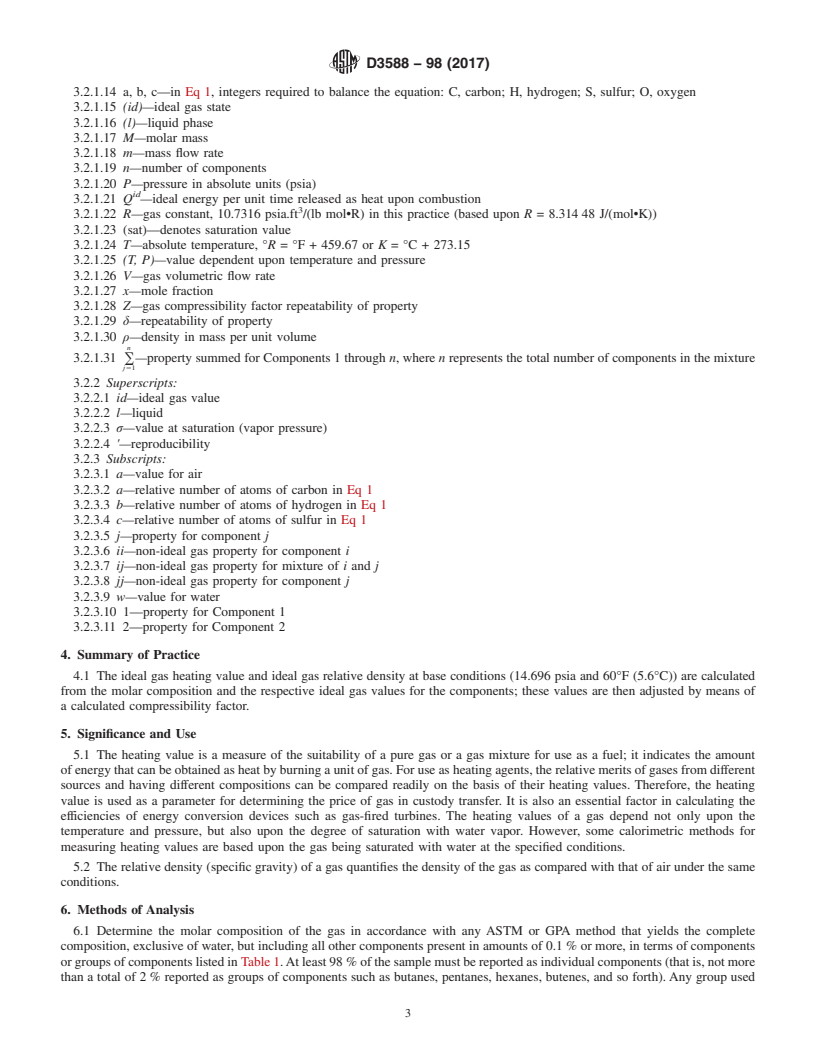
3.2.1.14 a, b, c—in Eq 1, integers required to balance the equation: C, carbon; H, hydrogen; S, sulfur; O, oxygen
3.2.1.15 (id)—ideal gas state
3.2.1.16 (l)—liquid phase
3.2.1.17 M—molar mass
3.2.1.18 m—mass flow rate
3.2.1.19 n—number of components
3.2.1.20 P—pressure in absolute units (psia)
id
3.2.1.21 Q —ideal energy per unit time released as heat upon combustion
3.2.1.22 R—gas constant, 10.7316 psia.ft /(lb mol•R) in this practice (based upon R = 8.314 48 J/(mol•K))
3.2.1.23 (sat)—denotes saturation value
3.2.1.24 T—absolute temperature, °R = °F + 459.67 or K = °C + 273.15
3.2.1.25 (T, P)—value dependent upon temperature and pressure
3.2.1.26 V—gas volumetric flow rate
3.2.1.27 x—mole fraction
3.2.1.28 Z—gas compressibility factor repeatability of property
3.2.1.29 δ—repeatability of property
3.2.1.30 ρ—density in mass per unit volume
n
3.2.1.31 —property summed for Components 1 through n, where n represents the total number of components in the mixture
(
j51
3.2.2 Superscripts:
3.2.2.1 id—ideal gas value
3.2.2.2 l—liquid
3.2.2.3 σ—value at saturation (vapor pressure)
3.2.2.4 '—reproducibility
3.2.3 Subscripts:
3.2.3.1 a—value for air
3.2.3.2 a—relative number of atoms of carbon in Eq 1
3.2.3.3 b—relative number of atoms of hydrogen in Eq 1
3.2.3.4 c—relative number of atoms of sulfur in Eq 1
3.2.3.5 j—property for component j
3.2.3.6 ii—non-ideal gas property for component i
3.2.3.7 ij—non-ideal gas property for mixture of i and j
3.2.3.8 jj—non-ideal gas property for component j
3.2.3.9 w—value for water
3.2.3.10 1—property for Component 1
3.2.3.11 2—property for Component 2
4. Summary of Practice
4.1 The ideal gas heating value and ideal gas relative density at base conditions (14.696 psia and 60°F (5.6°C)) are calculated
from the molar composition and the respective ideal gas values for the components; these values are then adjusted by means of
a calculated compressibility factor.
5. Significance and Use
5.1 The heating value is a measure of the suitability of a pure gas or a gas mixture for use as a fuel; it indicates the amount
of energy that can be obtained as heat by burning a unit of gas. For use as heating agents, the relative merits of gases from different
sources and having different compositions can be compared readily on the basis of their heating values. Therefore, the heating
value is used as a parameter for determining the price of gas in custody transfer. It is also an essential factor in calculating the
efficiencies of energy conversion devices such as gas-fired turbines. The heating values of a gas depend not only upon the
temperature and pressure, but also upon the degree of saturation with water vapor. However, some calorimetric methods for
measuring heating values are based upon the gas being saturated with water at the specified conditions.
5.2 The relative density (specific gravity) of a gas quantifies the density of the gas as compared with that of air under the same
conditions.
6. Methods of Analysis
6.1 Determine the molar composition of the gas in accordance with any ASTM or GPA method that yields the complete
composition, exclusive of water, but including all other components present in amounts of 0.1 % or more, in terms of components
or groups of components listed in Table 1. At least 98 % of the sample must be reported as individual components (that is, not more
than a total of 2 % reported as groups of components such as butanes, pentanes, hexanes, butenes, and so forth). Any group used
D3588 − 98 (2017)
A
TABLE 1 Properties of Natural Gas Components at 60°F and 14.696 psia
D
Ideal Gross Heating Value Ideal Net Heating Value
Summation
Molar Mass, Molar Mass,
id id id id id id
Compound Formula Factor, b ,
–1B idC i
H , H , H , h , h , h ,
lb·lbmol Ratio, G n m v n m v
−1
–1 –1 –3 –1 –1 –3 psia
kJ · mol Btu · lbm Btu · ft kJ · mol Btu · lbm Btu · ft
Hydrogen H 2.0159 0.069 60 286.20 6 1022 324.2 241.79 51 566 273.93 0
Helium He 4.0026 0.138 20 0 0 0 0 0 0 0
Water H O 18.0153 0.622 02 44.409 1059.8 50.312 0 0 0 0.0623
Carbon monoxide CO 28.010 0.967 11 282.9 4342 320.5 282.9 4 342 320.5 0.0053
Nitrogen N 28.0134 0.967 23 0 0 0 0 0 0 0.0044
Oxygen O 31.9988 1.104 8 0 0 0 0 0 0 0.0073
Hydrogen sulfide H S 34.08 1.176 7 562.4 7 094.2 637.1 517.99 6 534 586.8 0.0253
Argon Ar 39.948 1.379 3 0 0 0 0 0 0 0.0071
Carbon dioxide CO 44.010 1.519 6 0 0 0 0 0 0 0.0197
E
Air 28.9625 1.000 0 0 0 0 0 0 0 0.0050
Methane CH 16.043 0.553 92 891.63 23 891 1010.0 802.71 21 511 909.4 0.0116
Ethane C H 30.070 1.038 2 1562.06 22 333 1769.7 1428.83 20 429 1618.7 0.0239
2 6
Propane C H 44.097 1.522 6 2220.99 21 653 2516.1 2043.3 19 922 2314.9 0.0344
3 8
i-Butane C H 58.123 2.006 8 2870.45 21 232 3251.9 2648.4 19 590 3000.4 0.0458
4 10
n-Butane C H 58.123 2.006 8 2879.63 21 300 3262.3 2657.6 19 658 3010.8 0.0478
4 10
i-Pentane C H 72.150 2.491 2 3531.5 21 043 4000.9 3265.0 19 456 3699.0 0.0581
5 12
n-Pentane C H 72.150 2.491 2 3535.8 21 085 4008.9 3269.3 19 481 3703.9 0.0631
5 12
n-Hexane C H 86.177 2.975 5 4198.1 20 943 4755.9 3887.2 19 393 4403.9 0.0802
6 14
n-Heptane C H 100.204 3.459 8 4857.2 20 839 5502.5 4501.9 19 315 5100.3 0.0944
7 16
n-Octane C H 114.231 3.944 1 5515.9 20 759 6248.9 5116.2 19 256 5796.2 0.1137
8 18
n-Nonane C H 128.258 4.428 4 6175.9 20 701 6996.5 5731.8 19 213 6493.6 0.1331
9 20
n-Decane C H 142.285 4.912 7 6834.9 20 651 7742.9 6346.4 19 176 7189.9 0.1538
10 22
Neopentane C H 72.015 2.491 2 3517.27 20 958 3985 3250.8 19 371 3683
5 12
2-Methylpentane C H 86.177 2.975 5 4190.43 20 905 4747 3879.6 19 355 4395 0.080
6 14
3-Methylpentane C H 86.177 2.975 5 4193.03 20 918 4750 3882.2 19 367 4398 0.080
6 14
2,2-Dimethylbutane C H 86.177 2.975 5 4180.63 20 856 4736 3869.8 19 306 4384 0.080
6 14
2,3-Dimethylbutane C H 86.177 2.975 5 4188.41 20 895 4745 3877.5 19 344 4393 0.080
6 14
Cyclopropane C H 42.081 1.452 9 2092.78 21 381 2371 1959.6 20 020 2220 . . .
3 6
Cyclobutane C H 56.108 1.937 3 2747.08 21 049 2747 2569.4 19 688 2
...
Questions, Comments and Discussion
Ask us and Technical Secretary will try to provide an answer. You can facilitate discussion about the standard in here.