

ASTM E2110-17
(Terminology)Standard Terminology for Exterior Insulation and Finish Systems (EIFS)
General Information
- Abstract
SCOPE
1.1 This terminology covers terms and definitions pertaining to materials and processes used in the design and application of exterior insulation and finish systems (EIFS).
- Status
- Published
- Publication Date
- 14-Jan-2017
- Technical Committee
- E06 - Performance of Buildings
- Drafting Committee
- E06.58 - Exterior Insulation and Finish Systems (EIFS)




Overview
ASTM E2110-17: Standard Terminology for Exterior Insulation and Finish Systems (EIFS) provides a comprehensive vocabulary for materials and processes used in the design and application of EIFS. Developed by ASTM International, this standard enables clear and consistent communication across the construction industry concerning non-load bearing exterior wall cladding systems. By establishing agreed-upon definitions for common terms, the standard supports the effective specification, installation, and inspection of EIFS assemblies in building envelopes.
Key Topics
- Exterior Insulation and Finish Systems (EIFS): Defines the system as a nonload-bearing exterior cladding made up of an insulation board attached to a substrate, a reinforced base coat, and a protective finish coat.
- System Components: Includes terminology for accessories, insulation boards, base coats, finish coats, drainage mats, primers, nonmetallic reinforcing mesh, mechanical fasteners, and weather-resistive barriers.
- Process Terms: Covers key procedures such as embedding mesh, back wrapping, edge wrapping, curing, drying, and tempering of wet-state materials.
- Assembly Types: Clarifies differences between barrier wall assemblies (where EIFS cladding provides weather resistance) and drainage wall assemblies (which include space for moisture drainage).
- Installation Practices: Addresses terms such as cold joint, expansion joint, running bond, and wet edge to support standardized installation and detail execution.
- Performance and Maintenance: Defines durability, initial set, flash set, pot life, and related attributes affecting EIFS serviceability and lifecycle.
Applications
ASTM E2110-17 is an essential resource for professionals involved in the design, construction, inspection, and maintenance of EIFS-clad buildings. Key applications include:
- Design Specifications: Architects and designers refer to the standard to ensure accurate and consistent use of terminology in project documents and product specifications for EIFS systems.
- Construction & Installation: Contractors and installers use these definitions to communicate details regarding component installation, system layering, control joints, and finish applications.
- Inspection & Quality Control: Building inspectors rely on these terms to accurately assess EIFS assemblies, ensuring compliance with relevant codes, performance requirements, and industry best practices.
- Product Development: EIFS manufacturers utilize the terminology standard to align product datasheets, installation guides, and marketing materials with industry standards.
- Training & Education: Educators, trainers, and professional organizations incorporate the vocabulary into their curricula, helping to foster industry-wide understanding and consistent practice.
Related Standards
For comprehensive EIFS system knowledge, ASTM E2110-17 should be used in conjunction with related ASTM standards, including:
- ASTM E2112: Practice for Installation of Exterior Windows, Doors, and Skylights - referenced for the specification of weather-resistive barriers in EIFS systems.
- Additional EIFS Standards: Consult ASTM E2568 (Standard Specification for PB EIFS) and other ASTM documents relevant to exterior wall assemblies and building envelope performance.
By promoting consistent language for EIFS systems, ASTM E2110-17 enhances communication among architects, specifiers, contractors, and inspectors-supporting higher quality construction, improved building performance, and reduced risk of misunderstandings in both residential and commercial projects. For more information, visit the ASTM International website at www.astm.org.
Keywords: EIFS terminology, exterior insulation, finish systems, ASTM E2110, building envelope, construction standards, wall cladding, reinforced base coat, insulation board, weather-resistive barrier.
Relations
- Effective Date
- 15-Jan-2017
- Effective Date
- 15-Apr-2019
- Effective Date
- 01-Apr-2019
- Effective Date
- 01-Jan-2019
- Effective Date
- 15-Nov-2018
- Effective Date
- 01-Nov-2018
- Effective Date
- 01-Apr-2018
- Refers
ASTM E2112-07(2016) - Standard Practice for Installation of Exterior Windows, Doors and Skylights - Effective Date
- 01-Jan-2016
- Effective Date
- 01-Feb-2007
- Effective Date
- 10-Jul-2001
- Effective Date
- 15-Jan-2017
- Effective Date
- 15-Jan-2017
- Effective Date
- 15-Jan-2017
- Referred By
ASTM E2511-17(2023) - Standard Guide for Detailing of EIFS-Clad Barrier and Drainage Wall Assemblies - Effective Date
- 15-Jan-2017
- Effective Date
- 15-Jan-2017
Get Certified
Connect with accredited certification bodies for this standard

DIBt (Deutsches Institut für Bautechnik)
German Institute for Building Technology.
DIN CERTCO
DIN Group product certification.

Aboma Certification B.V.
Specialized in construction, metal, and transport sectors.
Sponsored listings
Frequently Asked Questions
ASTM E2110-17 is a standard published by ASTM International. Its full title is "Standard Terminology for Exterior Insulation and Finish Systems (EIFS)". This standard covers: SCOPE 1.1 This terminology covers terms and definitions pertaining to materials and processes used in the design and application of exterior insulation and finish systems (EIFS).
SCOPE 1.1 This terminology covers terms and definitions pertaining to materials and processes used in the design and application of exterior insulation and finish systems (EIFS).
ASTM E2110-17 is classified under the following ICS (International Classification for Standards) categories: 01.040.91 - Construction materials and building (Vocabularies); 91.100.99 - Other construction materials. The ICS classification helps identify the subject area and facilitates finding related standards.
ASTM E2110-17 has the following relationships with other standards: It is inter standard links to ASTM E2110-11, ASTM E2112-19b, ASTM E2112-19a, ASTM E2112-19, ASTM E2112-18b, ASTM E2112-18a, ASTM E2112-18, ASTM E2112-07(2016), ASTM E2112-07, ASTM E2112-01, ASTM E2359/E2359M-13(2018), ASTM E2430/E2430M-19, ASTM E2321-03(2019), ASTM E2511-17(2023), ASTM E2485/E2485M-13(2018). Understanding these relationships helps ensure you are using the most current and applicable version of the standard.
ASTM E2110-17 is available in PDF format for immediate download after purchase. The document can be added to your cart and obtained through the secure checkout process. Digital delivery ensures instant access to the complete standard document.
Standards Content (Sample)
This international standard was developed in accordance with internationally recognized principles on standardization established in the Decision on Principles for the
Development of International Standards, Guides and Recommendations issued by the World Trade Organization Technical Barriers to Trade (TBT) Committee.
Designation: E2110 − 17
Standard Terminology for
Exterior Insulation and Finish Systems (EIFS)
This standard is issued under the fixed designation E2110; the number immediately following the designation indicates the year of
original adoption or, in the case of revision, the year of last revision. A number in parentheses indicates the year of last reapproval. A
superscript epsilon (´) indicates an editorial change since the last revision or reapproval.
1. Scope cold joint, n—the visible junction in a finish coat.
1.1 This terminology covers terms and definitions pertain-
cure, v—to develop the ultimate properties of a wet-state
ing to materials and processes used in the design and applica-
material by a chemical process.
tion of exterior insulation and finish systems (EIFS).
drainage mat, n—component used in some EIFS-clad drain-
age wall assemblies, a corrosion resistive material used as a
2. Referenced Documents
spacer to provide a drainage path between the EIFS and the
2.1 ASTM Standards:
weather resistive barrier.
E2112 Practice for Installation of Exterior Windows, Doors
and Skylights dry, v—to develop the ultimate properties of a wet-state
material solely by evaporation of volatile ingredients.
3. Terminology
durability, n—the capability of a building assembly,
3.1 Definitions:
component, product, or construction to maintain serviceabil-
accessories, n—preformed metal, fiberglass, or plastic mem-
ity over not less than a specified time.
bers for use to form corners, edges, control joints, or
edge wrap, n—the condition of the perimeter at the EIFS
decorative effects.
where the reinforced base coat is terminated by wrapping the
aesthetic joint, n—a deprecated term. See aesthetic reveal.
reinforced base coat onto the edge of the substrate. (See Fig.
2.)
aesthetic reveal, n—a groove cut into the insulation board
which serves the function of decoration or to provide a
EIFS, n—see exterior insulation and finish system (EIFS).
starting or stopping point for finish-coat application, or both.
EIFS-clad barrier wall assembly, n—a wall assembly for
back wrap, n—a means of terminating an EIFS by continuing
which the EIFS cladding provides weather resistance for the
the reinforced base coat from the exterior side of the
EIFS clad portion of the assembly.
insulation board around its edge to the substrate. In the
EIFS-clad drainage wall assembly, n—a wall assembly
process of back wrapping, the reinforcing mesh is mechani-
incorporating a means of drainage between the EIFS and a
cally or adhesively secured to the substrate prior to installa-
weather resistive barrier, for incidental moisture resulting
tion of the insulation board. (See Fig. 1.)
from a breach in the EIFS, to the exterior of the EIFS clad
DISCUSSION—Asanalternativemethod,backwrappingisachievedby
wrapping the edge, back, and exterior side of the insulation board with
portion of the assembly.
reinforced base coat prior to fastening the insulation board to the
embed, v—to encapsulate the nonmetallic reinforcing mesh in
substrate. This is referred to as prewrap.
the base coat.
base coat, n—the initial wet-state material, either factory or
expansion joint, n—a structural separation between building
field-mixed, used to encapsulate the nonmetallic reinforcing
elements that allow independent movement without damage
mesh or fasten the insulation to the substrate.
to the assembly.
exterior insulation and finish system (EIFS), n—nonload
This terminology is under the jurisdiction of ASTM Committee E06 on
bearing, exterior wall cladding system that consists of an
Performance of Buildings and is the direct responsibility of Subcommittee E06.58
on Exterior Insulation and Finish Systems (EIFS). insulation board attached either adhesively or mechanically,
Current edition approved Jan. 15, 2017. Published January 2017. Originally
or both, to the substrate; an integrally reinforced base coat;
approved in 2000. Last previous edition approved in 2011 as E2110 – 11. DOI:
and a textured protective finish coat.
10.1520/E2110-17.
For referenced ASTM standards, visit the ASTM website, www.astm.org, or
factory mix, n—a material that is prepared at the point of
contact ASTM Customer Service at service@astm.org. For Annual Book of ASTM
manufacture and is ready to use w
...
This document is not an ASTM standard and is intended only to provide the user of an ASTM standard an indication of what changes have been made to the previous version. Because
it may not be technically possible to adequately depict all changes accurately, ASTM recommends that users consult prior editions as appropriate. In all cases only the current version
of the standard as published by ASTM is to be considered the official document.
Designation: E2110 − 11 E2110 − 17
Standard Terminology for
Exterior Insulation and Finish Systems (EIFS)
This standard is issued under the fixed designation E2110; the number immediately following the designation indicates the year of
original adoption or, in the case of revision, the year of last revision. A number in parentheses indicates the year of last reapproval. A
superscript epsilon (´) indicates an editorial change since the last revision or reapproval.
1. Scope
1.1 This terminology covers terms and definitions pertaining to materials and processes used in the design and application of
exterior insulation and finish systems (EIFS).
2. Referenced Documents
2.1 ASTM Standards:
E2112 Practice for Installation of Exterior Windows, Doors and Skylights
3. Terminology
3.1 Definitions:
accessories, n—preformed metal, fiberglass, or plastic members for use to form corners, edges, control joints, or decorative effects.
aesthetic joint, n—a deprecated term. See aesthetic reveal.
aesthetic reveal, n—a groove cut into the insulation board which serves the function of decoration or to provide a starting or
stopping point for finish-coat application, or both.
back wrapping,wrap, n—a deprecated term. Seemeans of terminating wrap.an EIFS by continuing the reinforced base coat from
the exterior side of the insulation board around its edge to the substrate. In the process of back wrapping, the reinforcing mesh
is mechanically or adhesively secured to the substrate prior to installation of the insulation board. (See Fig. 1.)
This terminology is under the jurisdiction of ASTM Committee E06 on Performance of Buildings and is the direct responsibility of Subcommittee E06.58 on Exterior
Insulation and Finish Systems (EIFS).
Current edition approved Nov. 1, 2011Jan. 15, 2017. Published November 2011January 2017. Originally approved in 2000. Last previous edition approved in 20092011
ε1
as E2110 – 09E2110 – 11. . DOI: 10.1520/E2110-11.10.1520/E2110-17.
For referenced ASTM standards, visit the ASTM website, www.astm.org, or contact ASTM Customer Service at service@astm.org. For Annual Book of ASTM
Standardsvolume information, refer to the standard’s Document Summary page on the ASTM website.
DISCUSSION—
As an alternative method, back wrapping is achieved by wrapping the edge, back, and exterior side of the insulation board with reinforced base coat
prior to fastening the insulation board to the substrate. This is referred to as prewrap.
base coat, n—the initial wet-state material, either factory or field-mixed, used to encapsulate the nonmetallic reinforcing mesh or
fasten the insulation to the substrate.
cold joint, n—the visible junction in a finish coat.
cure, v—to develop the ultimate properties of a wet-state material by a chemical process.
drainage mat, n—component used in some EIFS-clad drainage wall assemblies, a corrosion resistive material used as a spacer to
provide a drainage path between the EIFS and the weather resistive barrier.
dry, v—to develop the ultimate properties of a wet-state material solely by evaporation of volatile ingredients.
durability, n—the capability of a building assembly, component, product, or construction to maintain serviceability over not less
than a specified time.
edge wrap, n—the condition of the perimeter at the EIFS where the reinforced base coat is terminated by wrapping the reinforced
base coat onto the edge of the substrate. (See Fig. 12.)
Copyright © ASTM International, 100 Barr Harbor Drive, PO Box C700, West Conshohocken, PA 19428-2959. United States
E2110 − 17
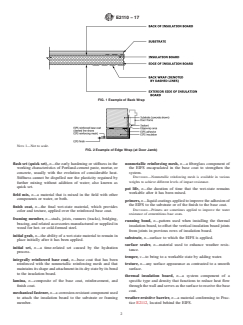
FIG. 1 Example of Back Wrap
NOTE 1—Not to scale.
FIG. 12 Example of an Edge Wrap (At(at Door Jam)Jamb)
EIFS, n—see exterior insulation and finish system (EIFS).
EIFS-clad barrier wall assembly, n—a wall assembly for which the EIFS cladding provides weather resistance for the EIFS clad
portion of the assembly.
EIFS-clad drainage wall assembly, n—a wall assembly incorporating a means of drainage between the EIFS and a weather
resistive barrier, for incidental moisture resulting from a breach in the EIFS, to the exterior of the EIFS clad portion of the
assembly.
embed, v—to encapsulate the nonmetallic reinforcing mesh in the base coat.
expansion joint, n—a structural separation between build
...