

ASTM E1898-21
(Test Method)Standard Test Method for Determination of Silver in Copper Concentrates by Flame Atomic Absorption Spectrometry
General Information
- Abstract
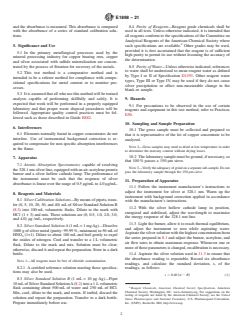
SIGNIFICANCE AND USE
5.1 In the primary metallurgical processes used by the mineral processing industry for copper bearing ores, copper and silver associated with sulfide mineralization are concentrated by the process of flotation for recovery of the metals.
5.2 This test method is a comparative method and is intended to be a referee method for compliance with compositional specifications for metal content or to monitor processes.
5.3 It is assumed that all who use this method will be trained analysts capable of performing skillfully and safely. It is expected that work will be performed in a properly equipped laboratory and that proper waste disposal procedures will be followed. Appropriate quality control practices must be followed such as those described in Guide E882.
SCOPE
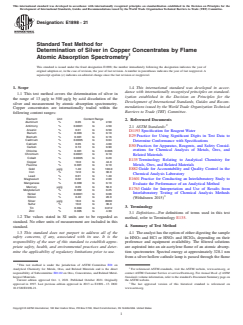
1.1 This test method covers the determination of silver in the range of 13 μg/g to 500 μg/g by acid dissolution of the silver and measurement by atomic absorption spectrometry. Copper concentrates are internationally traded within the following content ranges:
Element
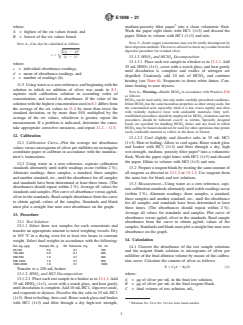
Unit
Content Range
Aluminum
%
0.05
to
2.50
Antimony
%
0.0001
to
4.50
Arsenic
%
0.01
to
0.50
Barium
%
0.003
to
0.10
Bismuth
%
0.001
to
0.16
Cadmium
%
0.0005
to
0.04
Calcium
%
0.05
to
4.00
Carbon
%
0.10
to
0.90
Chlorine
%
0.001
to
0.006
Chromium
%
0.0001
to
0.10
Cobalt
%
0.0005
to
0.20
Copper
%
10.0
to
44.0
Fluorine
%
0.001
to
0.10
Gold
μg/g
1.40
to
100.0
Iron
%
12.0
to
30.0
Lead
%
0.01
to
1.40
Magnesium
%
0.02
to
2.00
Manganese
%
0.009
to
0.10
Mercury
μg/g
0.05
to
50.0
Molybdenum
%
0.002
to
0.25
Nickel
%
0.0001
to
0.08
Silicon
%
0.40
to
20.0
Silver
μg/g
18.0
to
8000
Sulfur
%
10.0
to
36.0
Tin
%
0.004
to
0.012
Zinc
%
0.005
to
4.30
1.2 The values stated in SI units are to be regarded as standard. No other units of measurement are included in this standard.
1.3 This standard does not purport to address all of the safety concerns, if any, associated with its use. It is the responsibility of the user of this standard to establish appropriate safety, health, and environmental practices and determine the applicability of regulatory limitations prior to use.
1.4 This international standard was developed in accordance with internationally recognized principles on standardization established in the Decision on Principles for the Development of International Standards, Guides and Recommendations issued by the World Trade Organization Technical Barriers to Trade (TBT) Committee.
- Status
- Published
- Publication Date
- 30-Sep-2021
- Technical Committee
- E01 - Analytical Chemistry for Metals, Ores, and Related Materials
- Drafting Committee
- E01.02 - Ores, Concentrates, and Related Metallurgical Materials
Buy Documents
ASTM E1898-21 - Standard Test Method for Determination of Silver in Copper Concentrates by Flame Atomic Absorption Spectrometry
REDLINE ASTM E1898-21 - Standard Test Method for Determination of Silver in Copper Concentrates by Flame Atomic Absorption Spectrometry
Overview
ASTM E1898-21, titled "Standard Test Method for Determination of Silver in Copper Concentrates by Flame Atomic Absorption Spectrometry," is an essential standard from ASTM International. It specifies a comparative analytical method for quantifying silver content in copper concentrates. The method is designed as a referee test for ensuring compliance with metal content specifications and for process monitoring in the mineral processing industry, particularly when copper-bearing ores are processed by flotation.
This standard covers the determination of silver in the concentration range of 13 μg/g to 500 μg/g through acid dissolution followed by measurement via atomic absorption spectrometry (AAS), with applications for internationally traded copper concentrates.
Key Topics
- Analytical Method (AAS): The standard outlines the use of flame atomic absorption spectrometry at the specific wavelength (328.1 nm) for the measurement of dissolved silver in copper concentrates.
- Sample Preparation: Procedures for acid dissolution (either HNO3 and HCl or HNO3 and HClO4 methods) are included to ensure complete silver extraction from samples.
- Calibration and Measurement: Detailed steps cover calibration curve creation using prepared silver standards, precise absorbance measurement, and result calculations.
- Quality Control: Emphasizes the importance of following proper laboratory practices, including quality controls as outlined in ASTM Guide E882.
- Precision and Bias: Interlaboratory studies are referenced, demonstrating reproducibility and bias information, confirming the method's reliability as a referee test.
- Safety Considerations: The standard assumes that users are trained analysts operating in compliant laboratories, following all required safety, health, and waste disposal procedures.
Applications
The ASTM E1898-21 method is widely applicable in:
- Mineral Processing and Metallurgical Industry: Used during primary metallurgical operations for evaluating silver and copper content in concentrated ores.
- Trade and Compliance Testing: Provides a referee method for verifying that copper concentrate shipments meet international trading specifications for silver content.
- Process Control: Monitors extraction and refining efficiency by checking silver levels in process streams and end products.
- Laboratory Analysis: Serves as a reliable method for laboratories tasked with certifying product composition, ensuring methodologies withstand regulatory or contractual scrutiny.
Copper concentrates are complex materials containing a broad range of elements, including silver, gold, lead, arsenic, zinc, and others. Accurate silver determination through flame atomic absorption spectrometry, as facilitated by ASTM E1898-21, is vital to both economic evaluation and technological control in copper mining and metallurgy.
Related Standards
ASTM E1898-21 references and aligns with several other key ASTM standards to ensure accuracy and safety in chemical analysis, including:
- ASTM D1193: Specification for Reagent Water
- ASTM E29: Practice for Using Significant Digits in Test Data to Determine Conformance with Specifications
- ASTM E50: Practices for Apparatus, Reagents, and Safety Considerations for Chemical Analysis of Metals, Ores, and Related Materials
- ASTM E135: Terminology Relating to Analytical Chemistry for Metals, Ores, and Related Materials
- ASTM E882: Guide for Accountability and Quality Control in the Chemical Analysis Laboratory
- ASTM E1601: Practice for Conducting Interlaboratory Study to Evaluate the Performance of an Analytical Method
Adhering to these related standards in conjunction with ASTM E1898-21 ensures reliable, repeatable, and internationally recognized silver content determinations in copper concentrates.
Keywords: ASTM E1898-21, silver determination, copper concentrates, atomic absorption spectrometry, flame AAS, metallurgical analysis, compositional specifications, mineral processing, standard test method.
Relations
- Effective Date
- 01-Jan-2020
- Effective Date
- 01-Nov-2019
- Effective Date
- 15-May-2019
- Effective Date
- 01-Sep-2017
- Effective Date
- 01-Dec-2016
- Effective Date
- 01-Dec-2016
- Effective Date
- 01-Aug-2016
- Effective Date
- 15-May-2016
- Effective Date
- 01-Jul-2015
- Effective Date
- 15-May-2015
- Effective Date
- 15-Aug-2014
- Effective Date
- 01-Apr-2014
- Effective Date
- 15-Feb-2014
- Effective Date
- 01-Dec-2013
- Effective Date
- 15-Dec-2012
Buy Documents
ASTM E1898-21 - Standard Test Method for Determination of Silver in Copper Concentrates by Flame Atomic Absorption Spectrometry
REDLINE ASTM E1898-21 - Standard Test Method for Determination of Silver in Copper Concentrates by Flame Atomic Absorption Spectrometry
Get Certified
Connect with accredited certification bodies for this standard

ECOCERT
Organic and sustainability certification.

Eurofins Food Testing Global
Global leader in food, environment, and pharmaceutical product testing.

Intertek Bangladesh
Intertek certification and testing services in Bangladesh.
Sponsored listings
Frequently Asked Questions
ASTM E1898-21 is a standard published by ASTM International. Its full title is "Standard Test Method for Determination of Silver in Copper Concentrates by Flame Atomic Absorption Spectrometry". This standard covers: SIGNIFICANCE AND USE 5.1 In the primary metallurgical processes used by the mineral processing industry for copper bearing ores, copper and silver associated with sulfide mineralization are concentrated by the process of flotation for recovery of the metals. 5.2 This test method is a comparative method and is intended to be a referee method for compliance with compositional specifications for metal content or to monitor processes. 5.3 It is assumed that all who use this method will be trained analysts capable of performing skillfully and safely. It is expected that work will be performed in a properly equipped laboratory and that proper waste disposal procedures will be followed. Appropriate quality control practices must be followed such as those described in Guide E882. SCOPE 1.1 This test method covers the determination of silver in the range of 13 μg/g to 500 μg/g by acid dissolution of the silver and measurement by atomic absorption spectrometry. Copper concentrates are internationally traded within the following content ranges: Element Unit Content Range Aluminum % 0.05 to 2.50 Antimony % 0.0001 to 4.50 Arsenic % 0.01 to 0.50 Barium % 0.003 to 0.10 Bismuth % 0.001 to 0.16 Cadmium % 0.0005 to 0.04 Calcium % 0.05 to 4.00 Carbon % 0.10 to 0.90 Chlorine % 0.001 to 0.006 Chromium % 0.0001 to 0.10 Cobalt % 0.0005 to 0.20 Copper % 10.0 to 44.0 Fluorine % 0.001 to 0.10 Gold μg/g 1.40 to 100.0 Iron % 12.0 to 30.0 Lead % 0.01 to 1.40 Magnesium % 0.02 to 2.00 Manganese % 0.009 to 0.10 Mercury μg/g 0.05 to 50.0 Molybdenum % 0.002 to 0.25 Nickel % 0.0001 to 0.08 Silicon % 0.40 to 20.0 Silver μg/g 18.0 to 8000 Sulfur % 10.0 to 36.0 Tin % 0.004 to 0.012 Zinc % 0.005 to 4.30 1.2 The values stated in SI units are to be regarded as standard. No other units of measurement are included in this standard. 1.3 This standard does not purport to address all of the safety concerns, if any, associated with its use. It is the responsibility of the user of this standard to establish appropriate safety, health, and environmental practices and determine the applicability of regulatory limitations prior to use. 1.4 This international standard was developed in accordance with internationally recognized principles on standardization established in the Decision on Principles for the Development of International Standards, Guides and Recommendations issued by the World Trade Organization Technical Barriers to Trade (TBT) Committee.
SIGNIFICANCE AND USE 5.1 In the primary metallurgical processes used by the mineral processing industry for copper bearing ores, copper and silver associated with sulfide mineralization are concentrated by the process of flotation for recovery of the metals. 5.2 This test method is a comparative method and is intended to be a referee method for compliance with compositional specifications for metal content or to monitor processes. 5.3 It is assumed that all who use this method will be trained analysts capable of performing skillfully and safely. It is expected that work will be performed in a properly equipped laboratory and that proper waste disposal procedures will be followed. Appropriate quality control practices must be followed such as those described in Guide E882. SCOPE 1.1 This test method covers the determination of silver in the range of 13 μg/g to 500 μg/g by acid dissolution of the silver and measurement by atomic absorption spectrometry. Copper concentrates are internationally traded within the following content ranges: Element Unit Content Range Aluminum % 0.05 to 2.50 Antimony % 0.0001 to 4.50 Arsenic % 0.01 to 0.50 Barium % 0.003 to 0.10 Bismuth % 0.001 to 0.16 Cadmium % 0.0005 to 0.04 Calcium % 0.05 to 4.00 Carbon % 0.10 to 0.90 Chlorine % 0.001 to 0.006 Chromium % 0.0001 to 0.10 Cobalt % 0.0005 to 0.20 Copper % 10.0 to 44.0 Fluorine % 0.001 to 0.10 Gold μg/g 1.40 to 100.0 Iron % 12.0 to 30.0 Lead % 0.01 to 1.40 Magnesium % 0.02 to 2.00 Manganese % 0.009 to 0.10 Mercury μg/g 0.05 to 50.0 Molybdenum % 0.002 to 0.25 Nickel % 0.0001 to 0.08 Silicon % 0.40 to 20.0 Silver μg/g 18.0 to 8000 Sulfur % 10.0 to 36.0 Tin % 0.004 to 0.012 Zinc % 0.005 to 4.30 1.2 The values stated in SI units are to be regarded as standard. No other units of measurement are included in this standard. 1.3 This standard does not purport to address all of the safety concerns, if any, associated with its use. It is the responsibility of the user of this standard to establish appropriate safety, health, and environmental practices and determine the applicability of regulatory limitations prior to use. 1.4 This international standard was developed in accordance with internationally recognized principles on standardization established in the Decision on Principles for the Development of International Standards, Guides and Recommendations issued by the World Trade Organization Technical Barriers to Trade (TBT) Committee.
ASTM E1898-21 is classified under the following ICS (International Classification for Standards) categories: 71.040.50 - Physicochemical methods of analysis. The ICS classification helps identify the subject area and facilitates finding related standards.
ASTM E1898-21 has the following relationships with other standards: It is inter standard links to ASTM E135-20, ASTM E1601-19, ASTM E135-19, ASTM E50-17, ASTM E882-10(2016)e1, ASTM E882-10(2016), ASTM E50-11(2016), ASTM E135-16, ASTM E135-15a, ASTM E135-15, ASTM E135-14b, ASTM E135-14a, ASTM E135-14, ASTM E135-13a, ASTM E1601-12. Understanding these relationships helps ensure you are using the most current and applicable version of the standard.
ASTM E1898-21 is available in PDF format for immediate download after purchase. The document can be added to your cart and obtained through the secure checkout process. Digital delivery ensures instant access to the complete standard document.
Standards Content (Sample)
This international standard was developed in accordance with internationally recognized principles on standardization established in the Decision on Principles for the
Development of International Standards, Guides and Recommendations issued by the World Trade Organization Technical Barriers to Trade (TBT) Committee.
Designation: E1898 − 21
Standard Test Method for
Determination of Silver in Copper Concentrates by Flame
Atomic Absorption Spectrometry
This standard is issued under the fixed designation E1898; the number immediately following the designation indicates the year of
original adoption or, in the case of revision, the year of last revision. A number in parentheses indicates the year of last reapproval. A
superscript epsilon (´) indicates an editorial change since the last revision or reapproval.
1. Scope 1.4 This international standard was developed in accor-
dance with internationally recognized principles on standard-
1.1 This test method covers the determination of silver in
ization established in the Decision on Principles for the
the range of 13 µg/g to 500 µg/g by acid dissolution of the
Development of International Standards, Guides and Recom-
silver and measurement by atomic absorption spectrometry.
mendations issued by the World Trade Organization Technical
Copper concentrates are internationally traded within the
Barriers to Trade (TBT) Committee.
following content ranges:
Element Unit Content Range
2. Referenced Documents
Aluminum % 0.05 to 2.50
Antimony % 0.0001 to 4.50
2.1 ASTM Standards:
Arsenic % 0.01 to 0.50
D1193 Specification for Reagent Water
Barium % 0.003 to 0.10
E29 Practice for Using Significant Digits in Test Data to
Bismuth % 0.001 to 0.16
Cadmium % 0.0005 to 0.04
Determine Conformance with Specifications
Calcium % 0.05 to 4.00
E50 Practices for Apparatus, Reagents, and Safety Consid-
Carbon % 0.10 to 0.90
erations for Chemical Analysis of Metals, Ores, and
Chlorine % 0.001 to 0.006
Chromium % 0.0001 to 0.10
Related Materials
Cobalt % 0.0005 to 0.20
E135 Terminology Relating to Analytical Chemistry for
Copper % 10.0 to 44.0
Metals, Ores, and Related Materials
Fluorine % 0.001 to 0.10
Gold µg/g 1.40 to 100.0
E882 Guide for Accountability and Quality Control in the
Iron % 12.0 to 30.0
Chemical Analysis Laboratory
Lead % 0.01 to 1.40
Magnesium % 0.02 to 2.00 E1601 Practice for Conducting an Interlaboratory Study to
Manganese % 0.009 to 0.10
Evaluate the Performance of an Analytical Method
Mercury µg/g 0.05 to 50.0
E1763 Guide for Interpretation and Use of Results from
Molybdenum % 0.002 to 0.25
Interlaboratory Testing of Chemical Analysis Methods
Nickel % 0.0001 to 0.08
Silicon % 0.40 to 20.0
(Withdrawn 2015)
Silver µg/g 18.0 to 8000
Sulfur % 10.0 to 36.0
3. Terminology
Tin % 0.004 to 0.012
Zinc % 0.005 to 4.30
3.1 Definitions—For definitions of terms used in this test
1.2 The values stated in SI units are to be regarded as
method, refer to Terminology E135.
standard. No other units of measurement are included in this
4. Summary of Test Method
standard.
1.3 This standard does not purport to address all of the 4.1 The analyst has the option of either digesting the sample
safety concerns, if any, associated with its use. It is the in HNO and HCl or HNO and HClO , depending on their
3 3 4
responsibility of the user of this standard to establish appro- preference and equipment availability. The filtered solutions
priate safety, health, and environmental practices and deter- are aspirated into an air-acetylene flame of an atomic absorp-
mine the applicability of regulatory limitations prior to use.
tion spectrometer. Spectral energy at approximately 328.1 nm
from a silver hollow cathode lamp is passed through the flame
This test method is under the jurisdiction of ASTM Committee E01 on
Analytical Chemistry for Metals, Ores, and Related Materials and is the direct For referenced ASTM standards, visit the ASTM website, www.astm.org, or
responsibility of Subcommittee E01.02 on Ores, Concentrates, and Related Metal- contact ASTM Customer Service at service@astm.org. For Annual Book of ASTM
lurgical Materials. Standards volume information, refer to the standard’s Document Summary page on
Current edition approved Oct. 1, 2021. Published October 2021. Originally the ASTM website.
approved in 1997. Last previous edition approved in 2013 as E1898 – 13. DOI: The last approved version of this historical standard is referenced on
10.1520/E1898-21. www.astm.org.
Copyright © ASTM International, 100 Barr Harbor Drive, PO Box C700, West Conshohocken, PA 19428-2959. United States
E1898 − 21
and the absorbance is measured. This absorbance is compared 8.4 Purity of Reagents—Reagent grade chemicals shall be
with the absorbance of a series of standard calibration solu- used in all tests. Unless otherwise indicated, it is intended that
tions. all reagents conform to the specifications of the Committee on
Analytical Reagents of the American Chemical Society where
such specifications are available. Other grades may be used,
5. Significance and Use
provided it is first ascertained that the reagent is of sufficient
5.1 In the primary metallurgical processes used by the
high purity to permit its use without lessening the accuracy of
mineral processing industry for copper bearing ores, copper
the determination.
and silver associated with sulfide mineralization are concen-
8.5 Purity of Water—Unless otherwise indicated, references
trated by the process of flotation for recovery of the metals.
to water shall be understood to mean reagent water as defined
5.2 This test method is a comparative method and is
by Type I or II of Specification D1193. Other reagent water
intended to be a referee method for compliance with compo-
types, Type III or Type IV, may be used if they do not cause
sitional specifications for metal content or to monitor pro-
silver precipitation or effect non-measurable change in the
cesses.
blank or sample.
5.3 Itisassumedthatallwhousethismethodwillbetrained
analysts capable of performing skillfully and safely. It is 9. Hazards
expected that work will be performed in a properly equipped
9.1 For precautions to be observed in the use of certain
laboratory and that proper waste disposal procedures will be
reagents and equipment in this test method, refer to Practices
followed. Appropriate quality control practices must be fol-
E50.
lowed such as those described in Guide E882.
10. Sampling and Sample Preparation
6. Interferences
10.1 The gross sample must be collected and prepared so
6.1 Elements normally found in copper concentrates do not
that it is representative of the lot of copper concentrate to be
interfere. Use of instrumental background correction is re-
analyzed.
quired to compensate for non specific absorption interferences
NOTE 2—Gross samples may need to dried at low temperature in order
in the flame.
to determine the mercury content without drying losses.
10.2 The laboratory sample must be ground, if necessary, so
7. Apparatus
that 100 % passes a 150 µm sieve.
7.1 Atomic Absorption Spectrometer, capable of resolving
NOTE3—Verifytheadequacyofgrindonaseparatesub-sample.Donot
the328.1nmsilverline,equippedwithanair-acetylenepremix
pass the laboratory sample through the 150 µm sieve.
burner and a silver hollow cathode lamp. The performance of
the instrument must be such that the response of silver
11. Preparation of Apparatus
absorbance is linear over the range of 0.5 µg/mLto 4.0 µg/mL.
11.1 Follow the instrument manufacturer’s instructions to
adjust the instrument for silver at 328.1 nm. Warm up the
8. Reagents and Materials
instrument with background correction applied in accordance
8.1 Silver Calibration Solutions—Bymeansofpipets,trans-
with the manufacturer’s instructions.
fer (0, 5, 10, 20, 30, and 40) mLof Silver Standard Solution B
11.2 With the silver hollow cathode lamp in position,
(8.3) into 100 mL volumetric flasks. Dilute to the mark with
energized and stabilized, adjust the wavelength to maximize
HC1 (1 + 3) and mix. These solutions are (0, 0.5, 1.0, 2.0, 3.0,
the energy response of the 328.1 nm line.
and 4.0) µg /mL, respectively.
11.3 Light the burner, allow it to reach thermal equilibrium,
8.2 Silver Standard SolutionA(1mL=1mgAg)—Dissolve
and adjust the instrument to zero while aspirating water.
1000 g of silver metal (purity: 99.99 %, minimum) in 50 mLof
Aspiratethesilversolutionwiththehighestconcentrationfrom
HNO (1+1). Dilute to about 100 mL and boil gently to expel
the series prepared in 8.1 and adjust the burner, acetylene, and
the oxides of nitrogen. Cool and transfer to a 1 L volumetric
air flow rates to obtain maximum response. Whenever one or
flask. Dilute to the mark and mix. Solution must be clear;
moreoftheseparametersischanged,recalibrationisnecessary.
otherwise, discard it and repeat the preparation. Store in a dark
11.4 Aspirate the silver solution used in 11.3 to ensure that
bottle.
the absorbance reading is repeatable. Record six absorbance
NOTE 1—All reagents must be free of chloride contamination.
readings, and calculate the standard deviation, s, of the
8.2.1 Acertified reference solution meeting these specifica-
readings, as follows:
tions may also be used.
s 5 0.40 A 2 B (1)
~ !
8.3 Silver Standard Solution B (1 mL = 10 µg Ag)—Pipet
10 mLofSilverStandardSolutionA(8.2)intoa1 Lvolumetric
Reagent Chemicals, American Chemical Society Specifications, American
flask containing about 500 mL of water and 250 mL of HCl.
Chemical Society, Washington, DC, www.chemistry.org. For suggestions on the
Mix, cool, dilute to the mark, and remix. If turbid, discard the
testing of reagents not listed by the American Chemical Society, see the United
solution and repeat the preparation. Transfer to a dark bottle.
States Pharmacopeia and National Formulary, U.S. Pharmacopeial Convention,
Prepare immediately before use. Inc. (USPC), Rockville, MD, http://www.usp.
E1898 − 21
where: medium-porosity filter paper into a clean volumetric flask.
Wash the paper eight times with HC1 (1+3) and discard the
A = highest of the six values found, and
paper. Dilute to volume with HC1 (1+3) and mix.
B = lowest of the six values found.
NOTE 5—Some copper concentrates may not be totally decomposed by
NOTE 4—Can also be calculated as follows:
thesedigestionmethods.Theuserisadvisedtocheckanyresiduefromthe
digestion procedure for residual silver.
Σ~c 2 d!
s 5
Œ
e 2 1
~ ! 13.1.3 HNO and HClO Decomposition:
3 4
13.1.3.1 Placeeachtestsampleinabeakerasin13.1.1.Add
where:
35 mL HNO (1+1), cover with a
...
This document is not an ASTM standard and is intended only to provide the user of an ASTM standard an indication of what changes have been made to the previous version. Because
it may not be technically possible to adequately depict all changes accurately, ASTM recommends that users consult prior editions as appropriate. In all cases only the current version
of the standard as published by ASTM is to be considered the official document.
Designation: E1898 − 13 E1898 − 21
Standard Test Method for
Determination of Silver in Copper Concentrates by Flame
Atomic Absorption Spectrometry
This standard is issued under the fixed designation E1898; the number immediately following the designation indicates the year of
original adoption or, in the case of revision, the year of last revision. A number in parentheses indicates the year of last reapproval. A
superscript epsilon (´) indicates an editorial change since the last revision or reapproval.
1. Scope
1.1 This test method covers the determination of silver in the range of 13 μg/g to 500 μg/g by acid dissolution of the silver and
measurement by atomic absorption spectrometry. Copper concentrates are internationally traded within the following content
ranges:
Element Unit Content Range
Aluminum % 0.05 to 2.50
Antimony % 0.0001 to 4.50
Arsenic % 0.01 to 0.50
Barium % 0.003 to 0.10
Bismuth % 0.001 to 0.16
Cadmium % 0.0005 to 0.04
Calcium % 0.05 to 4.00
Carbon % 0.10 to 0.90
Chlorine % 0.001 to 0.006
Chromium % 0.0001 to 0.10
Cobalt % 0.0005 to 0.20
Copper % 10.0 to 44.0
Fluorine % 0.001 to 0.10
Gold μg/g 1.40 to 100.0
Iron % 12.0 to 30.0
Lead % 0.01 to 1.40
Magnesium % 0.02 to 2.00
Manganese % 0.009 to 0.10
Mercury μg/g 0.05 to 50.0
Molybdenum % 0.002 to 0.25
Nickel % 0.0001 to 0.08
Silicon % 0.40 to 20.0
Silver μg/g 18.0 to 8000
Sulfur % 10.0 to 36.0
Tin % 0.004 to 0.012
Zinc % 0.005 to 4.30
1.2 The values stated in SI units are to be regarded as standard. No other units of measurement are included in this standard.
1.3 This standard does not purport to address all of the safety concerns, if any, associated with its use. It is the responsibility
of the user of this standard to establish appropriate safety safety, health, and healthenvironmental practices and determine the
applicability of regulatory limitations prior to its use.
This test method is under the jurisdiction of ASTM Committee E01 on Analytical Chemistry for Metals, Ores, and Related Materials and is the direct responsibility of
Subcommittee E01.02 on Ores, Concentrates, and Related Metallurgical Materials.
Current edition approved April 1, 2013Oct. 1, 2021. Published June 2013October 2021. Originally approved in 1997. Last previous edition approved in 20072013 as
E1898 - 07.E1898 – 13. DOI: 10.1520/E1898-13.10.1520/E1898-21.
Copyright © ASTM International, 100 Barr Harbor Drive, PO Box C700, West Conshohocken, PA 19428-2959. United States
E1898 − 21
1.4 This international standard was developed in accordance with internationally recognized principles on standardization
established in the Decision on Principles for the Development of International Standards, Guides and Recommendations issued
by the World Trade Organization Technical Barriers to Trade (TBT) Committee.
2. Referenced Documents
2.1 ASTM Standards:
D1193 Specification for Reagent Water
E29 Practice for Using Significant Digits in Test Data to Determine Conformance with Specifications
E50 Practices for Apparatus, Reagents, and Safety Considerations for Chemical Analysis of Metals, Ores, and Related Materials
E135 Terminology Relating to Analytical Chemistry for Metals, Ores, and Related Materials
E882 Guide for Accountability and Quality Control in the Chemical Analysis Laboratory
E1601 Practice for Conducting an Interlaboratory Study to Evaluate the Performance of an Analytical Method
E1763 Guide for Interpretation and Use of Results from Interlaboratory Testing of Chemical Analysis Methods (Withdrawn
2015)
3. Terminology
3.1 Definitions—For definitions of terms used in this test method, refer to Terminology E135.
4. Summary of Test Method
4.1 The analyst has the option of either digesting the sample in HNO and HCl or HNO and HClO , depending on their preference
3 3 4
and equipment availability. The filtered solutions are aspirated into an air-acetylene flame of an atomic absorption spectrometer.
Spectral energy at approximately 328.1 nm from a silver hollow cathode lamp is passed through the flame and the absorbance is
measured. This absorbance is compared with the absorbance of a series of standard calibration solutions.
5. Significance and Use
5.1 In the primary metallurgical processes used by the mineral processing industry for copper bearing ores, copper and silver
associated with sulfide mineralization are concentrated by the process of flotation for recovery of the metals.
5.2 This test method is a comparative method and is intended to be a referee method for compliance with compositional
specifications for metal content or to monitor processes.
5.3 It is assumed that all who use this method will be trained analysts capable of performing skillfully and safely. It is expected
that work will be performed in a properly equipped laboratory and that proper waste disposal procedures will be followed.
Appropriate quality control practices must be followed such as those described in Guide E882.
6. Interferences
6.1 Elements normally found in copper concentrates do not interfere. Use of instrumental background correction is required to
compensate for non specific absorption interferences in the flame.
7. Apparatus
7.1 Atomic Absorption Spectrometer, capable of resolving the 328.1 nm silver line, equipped with an air-acetylene premix burner
and a silver hollow cathode lamp. The performance of the instrument must be such that the response of silver absorbance is linear
over the range of 0.5 μg/mL to 4.0 μg/mL.
8. Reagents and Materials
8.1 Silver Calibration Solutions—By means of pipets, transfer (0, 5, 10, 20, 30, and 40) mL of Silver Standard Solution B (8.3)
into 100-mL100 mL volumetric flasks. Dilute to the mark with HC1 (1 + 3) and mix. These solutions are (0, 0.5, 1.0, 2.0, 3.0, and
4.0) μg /mL, respectively.
For referenced ASTM standards, visit the ASTM website, www.astm.org, or contact ASTM Customer Service at service@astm.org. For Annual Book of ASTM Standards
volume information, refer to the standard’s Document Summary page on the ASTM website.
The last approved version of this historical standard is referenced on www.astm.org.
E1898 − 21
8.2 Silver Standard Solution A (1 mL = 1 mg Ag)—Dissolve 1000 g of silver metal (purity: 99.99 %, minimum) in 50 mL of
HNO (1+1). Dilute to about 100 mL and boil gently to expel the oxides of nitrogen. Cool and transfer to a 1-L1 L volumetric flask.
Dilute to the mark and mix. Solution must be clear,clear; otherwise, discard it and repeat the preparation. Store in a dark bottle.
NOTE 1—All reagents must be free of chloride contamination.
8.2.1 A certified reference solution meeting these specifications may also be used.
8.3 Silver Standard Solution B (1 mL = 10 μg Ag)—Pipet 10 mL 10 mL of Silver Standard Solution A (8.2) into a 1-L1 L
volumetric flask containing about 500 mL 500 mL of water and 250 mL of HCl. Mix, cool, dilute to the mark, and remix. If turbid,
discard the solution and repeat the preparation. Transfer to a dark bottle. Prepare immediately before use.
8.4 Purity of Reagents—Reagent grade chemicals shall be used in all tests. Unless otherwise indicated, it is intended that all
reagents conform to the specifications of the Committee on Analytical Reagents of the American Chemical Society where such
specifications are available. Other grades may be used, provided it is first ascertained that the reagent is of sufficient high purity
to permit its use without lessening the accuracy of the determination.
8.5 Purity of Water—Unless otherwise indicated, references to water shall be understood to mean reagent water as defined by Type
I or II of Specification D1193. Other reagent water types, Type III or Type IV, may be used if they do not cause silver precipitation
or effect non-measurable change in the blank or sample.
9. Hazards
9.1 For precautions to be observed in the use of certain reagents and equipment in this test method, refer to Practices E50.
10. Sampling and Sample Preparation
10.1 The gross sample must be collected and prepared so that it is representative of the lot of copper concentrate to be analyzed.
NOTE 2—Gross samples may need to dried at low temperature in order to determine the mercury content without drying losses.
10.2 The laboratory sample must be ground, if necessary, so that 100 % passes a 150 μm sieve.
NOTE 3—Verify the adequacy of grind on a separate sub-sample. Do not pass the laboratory sample through the 150 μm sieve.
11. Preparation of Apparatus
11.1 Follow the instrument manufacturer’s instructions to adjust the instrument for silver at 328.1 nm. Warm up the instrument
with background correction applied in accordance with the manufacturer’s instructions.
11.2 With the silver hollow cathode lamp in position, energized and stabilized, adjust the wavelength to maximize the energy
response of the 328.1 nm line.
11.3 Light the burner, allow it to reach thermal equilibrium, and adjust the instrument to zero while aspirating water. Aspirate the
silver solution with the highest concentration from the series prepared in 8.1 and adjust the burner, acetylene, and air flow rates
to obtain maximum response. Whenever one or more of these parameters is changed, recalibration is necessary.
11.4 Aspirate the silver solution used in 11.3 to ensure that the absorbance reading is repeatable. Record six absorbance readings,
and calculate the standard deviation, s, of the readings, as follows:
Reagent Chemicals, American Chemical Society Specifications, American Chemical Society, Washington, DC. DC, www.chemistry.org. For suggestions on the testing
of reagents not listed by the American Chemical Society, see Reagent Chemicals and Standards, by Joseph Rosin, D. Nostrand Co., Inc., New York, NY, and the United States
Pharmacopeia and National Formulary, U.S. Pharmacopeial Convention, Inc. (USPC), Rockville, MD.MD, http://www.usp.
E1898 − 21
s 5 0.40 A 2 B (1)
~ !
where:
A = highest of the six values found, and
B = lowest of the six values found.
NOTE 4—Can also be calculated as follows:
Σ c 2 d
~ !
s 5Œ
~e 2 1!
where:
c = individual absorbance readings,
d = mean of absorbance readings, and
e = number of readings (6).
11.5 Using water as a zero reference, and beginning with the solution to which no addition of silver was made in 8.1, aspirate each
calibration solution in ascending order of concentration, and record its absorbance. If the value of the solution with the highest
concentration used in 8.1 differs from the average of the six values in 11.4 by more than twice the standard deviation, or by more
than 0.01 multiplied by the average of the six values, whichever is greater, repeat the measurement. If a problem is indicated,
determine the cause, take appropriate corrective measures, and
...