

ASTM E508-21
(Test Method)Standard Test Method for Determination of Calcium and Magnesium in Iron Ores by Flame Atomic Absorption Spectrometry
General Information
- Abstract
SIGNIFICANCE AND USE
5.1 This test method is intended as a referee method for compliance with compositional specifications for impurity content. It is assumed that all who use this procedure will be trained analysts capable of performing common laboratory practices skillfully and safely. It is expected that work will be performed in a properly equipped laboratory and that proper waste disposal procedures will be followed. Follow appropriate quality control practices such as those described in Guide E882.
SCOPE
1.1 This test method covers the determination of calcium and magnesium in iron ores, concentrates, and agglomerates in the mass fraction (%) range from 0.05 % to 5 % of calcium and 0.05 % to 3 % of magnesium.
1.2 The values stated in SI units are to be regarded as standard. No other units of measurement are included in this standard.
1.3 This standard does not purport to address all of the safety concerns, if any, associated with its use. It is the responsibility of the user of this standard to establish appropriate safety, health, and environmental practices and determine the applicability of regulatory limitations prior to use.
1.4 This international standard was developed in accordance with internationally recognized principles on standardization established in the Decision on Principles for the Development of International Standards, Guides and Recommendations issued by the World Trade Organization Technical Barriers to Trade (TBT) Committee.
- Status
- Published
- Publication Date
- 30-Sep-2021
- Technical Committee
- E01 - Analytical Chemistry for Metals, Ores, and Related Materials
- Drafting Committee
- E01.02 - Ores, Concentrates, and Related Metallurgical Materials
Buy Documents
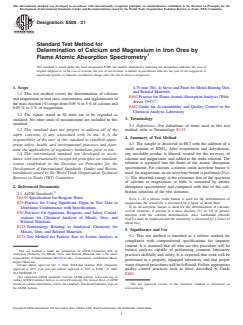
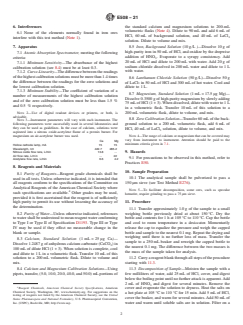
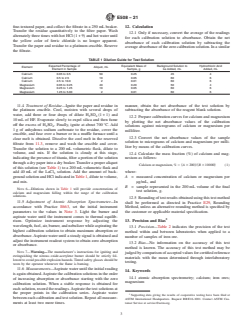

ASTM E508-21 - Standard Test Method for Determination of Calcium and Magnesium in Iron Ores by Flame Atomic Absorption Spectrometry
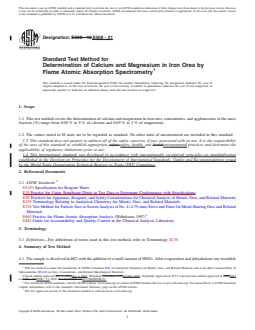
REDLINE ASTM E508-21 - Standard Test Method for Determination of Calcium and Magnesium in Iron Ores by Flame Atomic Absorption Spectrometry
Overview
ASTM E508-21: Standard Test Method for Determination of Calcium and Magnesium in Iron Ores by Flame Atomic Absorption Spectrometry specifies procedures for accurately measuring calcium and magnesium content in iron ores, concentrates, and agglomerates. This standard is essential for laboratories verifying impurity levels for compositional specifications, using flame atomic absorption spectrometry-a precise and sensitive analytical technique.
ASTM E508-21 provides guidance for trained analysts on safe laboratory practices and encourages adherence to established quality control measures. The method covers a determination range of 0.05% to 5% for calcium and 0.05% to 3% for magnesium, supporting compliance with industry and regulatory requirements in iron ore analysis.
Key Topics
- Analytical Range: Addresses calcium content from 0.05% to 5% and magnesium from 0.05% to 3%.
- Sample Preparation: Specifies steps for pulverizing, drying, and decomposing samples for analysis, ensuring consistent results.
- Atomic Absorption Spectrometry: Details on instrument calibration, required burners (nitrous oxide-acetylene for calcium, air-acetylene for magnesium), and measurement protocols.
- Precision and Quality Control: Emphasizes the importance of repeating measurements, use of reagent blanks, and calibration curves to maintain analytical integrity.
- Interferences: Asserts that, with appropriate preparation, typical elements in iron ores do not interfere with accurate detection of calcium and magnesium.
- Safety and Environmental Concerns: Stresses proper laboratory safety, chemical handling, and waste disposal procedures.
Applications
The ASTM E508-21 standard is widely used in mineral testing laboratories, mining operations, and metallurgical facilities that require reliable measurement of calcium and magnesium impurities in iron ores. Its detailed methodology is critical for:
- Quality Assurance: Ensuring iron ore batches meet strict specification limits for chemical composition.
- Regulatory Compliance: Satisfying governmental and industry-mandated impurity thresholds in iron ore processing and export.
- Process Optimization: Enabling mines and processors to monitor ore characteristics, optimize beneficiation, and improve end-product quality.
- Referee Analysis: Serving as a referee method in situations where accuracy and reproducibility of impurity results are essential for dispute resolution or contract verification.
Related Standards
ASTM E508-21 references and aligns with several related ASTM standards to ensure comprehensive chemical analysis of metals and ores. Relevant documents include:
- ASTM D1193 - Specification for Reagent Water.
- ASTM E29 - Practice for Using Significant Digits in Test Data.
- ASTM E50 - Practices for Apparatus, Reagents, and Safety Considerations for Chemical Analysis of Metals, Ores, and Related Materials.
- ASTM E135 - Terminology Relating to Analytical Chemistry for Metals, Ores, and Related Materials.
- ASTM E276 - Test Method for Particle Size or Screen Analysis.
- ASTM E882 - Guide for Accountability and Quality Control in the Chemical Analysis Laboratory.
These standards support robust laboratory practices and bolster the reliability of results generated under ASTM E508-21.
Keywords: ASTM E508-21, iron ore analysis, calcium determination, magnesium determination, flame atomic absorption spectrometry, impurity testing, mineral laboratory standards, quality control, iron ore compositional analysis, laboratory safety.
Relations
- Effective Date
- 01-Jan-2020
- Effective Date
- 15-May-2019
- Effective Date
- 01-Sep-2017
- Effective Date
- 01-Dec-2016
- Effective Date
- 01-Dec-2016
- Effective Date
- 01-Aug-2016
- Effective Date
- 15-May-2016
- Effective Date
- 01-Jul-2015
- Effective Date
- 15-May-2015
- Effective Date
- 15-Aug-2014
- Effective Date
- 01-Apr-2014
- Effective Date
- 15-Feb-2014
- Effective Date
- 01-Dec-2013
- Effective Date
- 15-Oct-2011
- Effective Date
- 15-Sep-2011
Buy Documents
ASTM E508-21 - Standard Test Method for Determination of Calcium and Magnesium in Iron Ores by Flame Atomic Absorption Spectrometry
REDLINE ASTM E508-21 - Standard Test Method for Determination of Calcium and Magnesium in Iron Ores by Flame Atomic Absorption Spectrometry
Get Certified
Connect with accredited certification bodies for this standard

ECOCERT
Organic and sustainability certification.

Bureau Veritas Chile
Bureau Veritas certification services in Chile.
Bureau Veritas Peru
Bureau Veritas certification services in Peru.
Sponsored listings
Frequently Asked Questions
ASTM E508-21 is a standard published by ASTM International. Its full title is "Standard Test Method for Determination of Calcium and Magnesium in Iron Ores by Flame Atomic Absorption Spectrometry". This standard covers: SIGNIFICANCE AND USE 5.1 This test method is intended as a referee method for compliance with compositional specifications for impurity content. It is assumed that all who use this procedure will be trained analysts capable of performing common laboratory practices skillfully and safely. It is expected that work will be performed in a properly equipped laboratory and that proper waste disposal procedures will be followed. Follow appropriate quality control practices such as those described in Guide E882. SCOPE 1.1 This test method covers the determination of calcium and magnesium in iron ores, concentrates, and agglomerates in the mass fraction (%) range from 0.05 % to 5 % of calcium and 0.05 % to 3 % of magnesium. 1.2 The values stated in SI units are to be regarded as standard. No other units of measurement are included in this standard. 1.3 This standard does not purport to address all of the safety concerns, if any, associated with its use. It is the responsibility of the user of this standard to establish appropriate safety, health, and environmental practices and determine the applicability of regulatory limitations prior to use. 1.4 This international standard was developed in accordance with internationally recognized principles on standardization established in the Decision on Principles for the Development of International Standards, Guides and Recommendations issued by the World Trade Organization Technical Barriers to Trade (TBT) Committee.
SIGNIFICANCE AND USE 5.1 This test method is intended as a referee method for compliance with compositional specifications for impurity content. It is assumed that all who use this procedure will be trained analysts capable of performing common laboratory practices skillfully and safely. It is expected that work will be performed in a properly equipped laboratory and that proper waste disposal procedures will be followed. Follow appropriate quality control practices such as those described in Guide E882. SCOPE 1.1 This test method covers the determination of calcium and magnesium in iron ores, concentrates, and agglomerates in the mass fraction (%) range from 0.05 % to 5 % of calcium and 0.05 % to 3 % of magnesium. 1.2 The values stated in SI units are to be regarded as standard. No other units of measurement are included in this standard. 1.3 This standard does not purport to address all of the safety concerns, if any, associated with its use. It is the responsibility of the user of this standard to establish appropriate safety, health, and environmental practices and determine the applicability of regulatory limitations prior to use. 1.4 This international standard was developed in accordance with internationally recognized principles on standardization established in the Decision on Principles for the Development of International Standards, Guides and Recommendations issued by the World Trade Organization Technical Barriers to Trade (TBT) Committee.
ASTM E508-21 is classified under the following ICS (International Classification for Standards) categories: 71.040.50 - Physicochemical methods of analysis; 73.060.10 - Iron ores. The ICS classification helps identify the subject area and facilitates finding related standards.
ASTM E508-21 has the following relationships with other standards: It is inter standard links to ASTM E135-20, ASTM E135-19, ASTM E50-17, ASTM E882-10(2016)e1, ASTM E882-10(2016), ASTM E50-11(2016), ASTM E135-16, ASTM E135-15a, ASTM E135-15, ASTM E135-14b, ASTM E135-14a, ASTM E135-14, ASTM E135-13a, ASTM E50-11, ASTM E135-11b. Understanding these relationships helps ensure you are using the most current and applicable version of the standard.
ASTM E508-21 is available in PDF format for immediate download after purchase. The document can be added to your cart and obtained through the secure checkout process. Digital delivery ensures instant access to the complete standard document.
Standards Content (Sample)
This international standard was developed in accordance with internationally recognized principles on standardization established in the Decision on Principles for the
Development of International Standards, Guides and Recommendations issued by the World Trade Organization Technical Barriers to Trade (TBT) Committee.
Designation: E508 − 21
Standard Test Method for
Determination of Calcium and Magnesium in Iron Ores by
Flame Atomic Absorption Spectrometry
This standard is issued under the fixed designation E508; the number immediately following the designation indicates the year of
original adoption or, in the case of revision, the year of last revision. A number in parentheses indicates the year of last reapproval. A
superscript epsilon (´) indicates an editorial change since the last revision or reapproval.
1. Scope 4.75 mm (No. 4) Sieve and Finer for Metal-Bearing Ores
and Related Materials
1.1 This test method covers the determination of calcium
E663 Practice for FlameAtomicAbsorptionAnalysis (With-
and magnesium in iron ores, concentrates, and agglomerates in
drawn 1997)
themassfraction(%)rangefrom0.05 %to5 %ofcalciumand
E882 Guide for Accountability and Quality Control in the
0.05 % to 3 % of magnesium.
Chemical Analysis Laboratory
1.2 The values stated in SI units are to be regarded as
3. Terminology
standard. No other units of measurement are included in this
standard.
3.1 Definitions—For definitions of terms used in this test
method, refer to Terminology E135.
1.3 This standard does not purport to address all of the
safety concerns, if any, associated with its use. It is the
4. Summary of Test Method
responsibility of the user of this standard to establish appro-
4.1 The sample is dissolved in HCl with the addition of a
priate safety, health, and environmental practices and deter-
small amount of HNO . After evaporation and dehydration,
mine the applicability of regulatory limitations prior to use.
any insoluble residue is filtered, treated for the recovery of
1.4 This international standard was developed in accor-
calcium and magnesium, and added to the main solution. The
dance with internationally recognized principles on standard-
solution is aspirated into the flame of the atomic absorption
ization established in the Decision on Principles for the
spectrometer. For calcium, a nitrous oxide-acetylene burner is
Development of International Standards, Guides and Recom-
used,formagnesium,anair-acetyleneburnerispreferred(Note
mendations issued by the World Trade Organization Technical
1). The absorbed energy at the resonance line of the spectrum
Barriers to Trade (TBT) Committee.
of calcium or magnesium, or both, is measured by atomic
2. Referenced Documents absorption spectrometry and compared with that of the cali-
bration solutions of the two elements.
2.1 ASTM Standards:
D1193 Specification for Reagent Water
NOTE 1—If a nitrous oxide burner is used for the determination of
magnesium, the sensitivity is decreased by a factor of about three.
E29 Practice for Using Significant Digits in Test Data to
If an air-acetylene burner is used for the determination of calcium,
Determine Conformance with Specifications
several elements, if present in a mass fraction (%) of 1.0 or greater,
E50 Practices for Apparatus, Reagents, and Safety Consid-
interfere with the calcium determination. Also, lanthanum chloride
erations for Chemical Analysis of Metals, Ores, and
(LaCl ) must be employed and the sensitivity is decreased by a factor of
Related Materials
about two.
E135 Terminology Relating to Analytical Chemistry for
5. Significance and Use
Metals, Ores, and Related Materials
5.1 This test method is intended as a referee method for
E276 Test Method for Particle Size or Screen Analysis at
compliance with compositional specifications for impurity
content. It is assumed that all who use this procedure will be
This test method is under the jurisdiction of ASTM Committee E01 on trained analysts capable of performing common laboratory
Analytical Chemistry for Metals, Ores, and Related Materials and is the direct
practices skillfully and safely. It is expected that work will be
responsibility of Subcommittee E01.02 on Ores, Concentrates, and Related Metal-
performed in a properly equipped laboratory and that proper
lurgical Materials.
wastedisposalprocedureswillbefollowed.Followappropriate
Current edition approved Oct. 1, 2021. Published October 2021. Originally
approved in 1973. Last previous edition approved in 2013 as E508 – 13. DOI:
quality control practices such as those described in Guide
10.1520/E0508-21.
E882.
For referenced ASTM standards, visit the ASTM website, www.astm.org, or
contact ASTM Customer Service at service@astm.org. For Annual Book of ASTM
Standards volume information, refer to the standard’s Document Summary page on The last approved version of this historical standard is referenced on
the ASTM website. www.astm.org.
Copyright © ASTM International, 100 Barr Harbor Drive, PO Box C700, West Conshohocken, PA 19428-2959. United States
E508 − 21
6. Interferences the standard calcium and magnesium solutions to 200-mL
volumetric flasks (Note 4). Dilute to 90 mL and add 6 mL of
6.1 None of the elements normally found in iron ores
HCl, 60 mL of background solution, and 40 mL of LaCl
interfere with this test method (Note 1).
solution. Dilute to volume and mix.
7. Apparatus
8.5 Iron, Background Solution (10 g⁄L )—Dissolve 10 g of
high-purity iron in 50 mLof HCl, and oxidize by the dropwise
7.1 Atomic Absorption Spectrometer, meeting the following
addition of HNO . Evaporate to a syrupy consistency. Add
criteria:
20 mL of HCl and dilute to 200 mL with water. Add 20 g of
7.1.1 Minimum Sensitivity—The absorbance of the highest
sodium chloride dissolved in 200 mL water and dilute to 1 L
calibration solution (see 8.4) must be at least 0.3.
with water.
7.1.2 Curve-Linearity—Thedifferencebetweenthereadings
ofthehighestcalibrationsolutionsmustbemorethan1.4times
8.6 Lanthanum Chloride Solution (50 g⁄L)—Dissolve 50 g
the difference between the readings for the zero solutions and
of LaCl in 50 mL of HCl and 300 mL of hot water. Cool and
the lowest calibration solution.
dilute to 1 L.
7.1.3 Minimum Stability—The coefficient of variation of a
8.7 Magnesium, Standard Solution (1 mL = 17.5 µg Mg)—
number of measurements of the highest calibration solution
Dissolve 0.3500 g of high-purity magnesium by slowly adding
and of the zero calibration solution must be less than 1.5 %
75 mLofHCl (1 + 3).Whendissolved,dilutewithwaterto1 L
and 0.5 % respectively.
in a volumetric flask. Transfer 10 mL of this solution to a
NOTE 2—Use of digital readout devices or printers, or both, is 200 mL volumetric flask, dilute to volume, and mix.
advisable.
8.8 Zero Calibration Solution—Transfer 60 mLof the back-
NOTE 3—Instrument parameters will vary with each instrument. The
ground solution to a 200 mL volumetric flask, add 6 mL of
following parameters were successfully used in several laboratories and
they can be used as guidelines. In the case of calcium, solutions were
HCl, 40 mL of LaCl solution, dilute to volume, and mix.
aspirated into a nitrous oxide-acetylene flame of a premix burner. For
NOTE 4—The range of calcium or magnesium that can be covered may
magnesium an air-acetylene burner was used.
vary from instrument to instrument. Attention should be paid to the
Ca Mg
minimum criteria given in 7.1.
Hollow cathode lamp, mA 15 15
Wavelength, nm 422.7 285.2
9. Hazards
Nitrous oxide flow rate, L/min 13.8 .
Air flow rate, L/min . 22
9.1 For precautions to be observed in this method, refer to
Acetylene flow rate, L/min 6.6 4.2
Practices E50.
8. Reagents and Materials
10. Sample Preparation
8.1 Purity of Reagents—Reagent grade chemicals shall be
used in all tests. Unless otherwise indicated, it is intended that 10.1 The analytical sample shall be pulverized to pass a
150 µm sieve (see Test Method E276).
all reagents conform to the specifications of the Committee on
Analytical Reagents of the American Chemical Society where
NOTE 5—To facilitate decomposition, some ores, such as specular
such specifications are available. Other grades may be used,
hematite, require grinding to pass a 75 µm sieve.
provided it is first ascertained that the reagent is of sufficiently
high purity to permit its use without lessening the accuracy of 11. Procedure
the determination.
11.1 Transfer approximately 1.0 g of the sample to a small
8.2 Purity of Water—Unless otherwise indicated, references weighing bottle previously dried at about 150 °C. Dry the
to water shall be understood to mean reagent water conforming bottle and contents for 1 h at 105 °C to 110 °C. Cap the bottle
and cool to room temperature in a desiccator. Momentarily
to Type I or Type II of Specification D1193. Type III or Type
IV may be used if they effect no measurable change in the release the cap to equalize the pressure and weigh the capped
bottle and sample to the nearest 0.1 mg. Repeat the drying and
blank or
...
This document is not an ASTM standard and is intended only to provide the user of an ASTM standard an indication of what changes have been made to the previous version. Because
it may not be technically possible to adequately depict all changes accurately, ASTM recommends that users consult prior editions as appropriate. In all cases only the current version
of the standard as published by ASTM is to be considered the official document.
Designation: E508 − 13 E508 − 21
Standard Test Method for
Determination of Calcium and Magnesium in Iron Ores by
Flame Atomic Absorption Spectrometry
This standard is issued under the fixed designation E508; the number immediately following the designation indicates the year of
original adoption or, in the case of revision, the year of last revision. A number in parentheses indicates the year of last reapproval. A
superscript epsilon (´) indicates an editorial change since the last revision or reapproval.
1. Scope
1.1 This test method covers the determination of calcium and magnesium in iron ores, concentrates, and agglomerates in the mass
fraction (%) range from 0.05 % to 5 % of calcium and 0.05 % to 3 % of magnesium.
1.2 The values stated in SI units are to be regarded as standard. No other units of measurement are included in this standard.
1.3 This standard does not purport to address all of the safety concerns, if any, associated with its use. It is the responsibility
of the user of this standard to establish appropriate safety safety, health, and healthenvironmental practices and determine the
applicability of regulatory limitations prior to use.
1.4 This international standard was developed in accordance with internationally recognized principles on standardization
established in the Decision on Principles for the Development of International Standards, Guides and Recommendations issued
by the World Trade Organization Technical Barriers to Trade (TBT) Committee.
2. Referenced Documents
2.1 ASTM Standards:
D1193 Specification for Reagent Water
E29 Practice for Using Significant Digits in Test Data to Determine Conformance with Specifications
E50 Practices for Apparatus, Reagents, and Safety Considerations for Chemical Analysis of Metals, Ores, and Related Materials
E135 Terminology Relating to Analytical Chemistry for Metals, Ores, and Related Materials
E276 Test Method for Particle Size or Screen Analysis at No. 4 (4.75-mm) Sieve and Finer for Metal-Bearing Ores and Related
Materials
E663 Practice for Flame Atomic Absorption Analysis (Withdrawn 1997)
E882 Guide for Accountability and Quality Control in the Chemical Analysis Laboratory
3. Terminology
3.1 Definitions—For definitions of terms used in this test method, refer to Terminology E135.
4. Summary of Test Method
4.1 The sample is dissolved in HCl with the addition of a small amount of HNO . After evaporation and dehydration, any insoluble
This test method is under the jurisdiction of ASTM Committee E01 on Analytical Chemistry for Metals, Ores, and Related Materials and is the direct responsibility of
Subcommittee E01.02 on Ores, Concentrates, and Related Metallurgical Materials.
Current edition approved Oct. 1, 2013Oct. 1, 2021. Published November 2013October 2021. Originally approved in 1973. Last previous edition approved in 20092013
as E508 – 09.E508 – 13. DOI: 10.1520/E0508-13.10.1520/E0508-21.
For referenced ASTM standards, visit the ASTM website, www.astm.org, or contact ASTM Customer Service at service@astm.org. For Annual Book of ASTM Standards
volume information, refer to the standard’s Document Summary page on the ASTM website.
The last approved version of this historical standard is referenced on www.astm.org.
Copyright © ASTM International, 100 Barr Harbor Drive, PO Box C700, West Conshohocken, PA 19428-2959. United States
E508 − 21
residue is filtered, treated for the recovery of calcium and magnesium, and added to the main solution. The solution is aspirated
into the flame of the atomic absorption spectrometer. For calcium, a nitrous oxide-acetylene burner is used, for magnesium, an
air-acetylene burner is preferred (Note 1). The absorbed energy at the resonance line of the spectrum of calcium or magnesium,
or both, is measured by atomic absorption spectrometry and compared with that of the calibration solutions of the two elements.
NOTE 1—If a nitrous oxide burner is used for the determination of magnesium, the sensitivity is decreased by a factor of about three.
If an air-acetylene burner is used for the determination of calcium, several elements, if present in a mass fraction (%) of 1.0 or greater, interfere with
the calcium determination. Also, lanthanum chloride (LaCl ) must be employed and the sensitivity is decreased by a factor of about two.
5. Significance and Use
5.1 This test method is intended as a referee method for compliance with compositional specifications for impurity content. It is
assumed that all who use this procedure will be trained analysts capable of performing common laboratory practices skillfully and
safely. It is expected that work will be performed in a properly equipped laboratory and that proper waste disposal procedures will
be followed. Follow appropriate quality control practices such as those described in Guide E882.
6. Interferences
6.1 None of the elements normally found in iron ores interfere with this test method (Note 1).
7. Apparatus
7.1 Atomic Absorption Spectrometer, meeting the following criteria:
7.1.1 Minimum Sensitivity—The absorbance of the highest calibration solution (see 8.4) must be at least 0.3.
7.1.2 Curve-Linearity—The difference between the readings of the highest calibration solutions must be more than 1.4 times the
difference between the readings for the zero solutions and the lowest calibration solution.
7.1.3 Minimum Stability—The coefficient of variation of a number of measurements of the highest calibration solution and of the
zero calibration solution must be less than 1.5 % and 0.5 % respectively.
NOTE 2—Use of digital readout devices or printers, or both, is advisable.
NOTE 3—Instrument parameters will vary with each instrument. The following parameters were successfully used in several laboratories and they can be
used as guidelines. In the case of calcium, solutions were aspirated into a nitrous oxide-acetylene flame of a premix burner. For magnesium an
air-acetylene burner was used.
Ca Mg
Hollow cathode lamp, mA 15 15
Wavelength, nm 422.7 285.2
Nitrous oxide flow rate, L/min 13.8 .
Air flow rate, L/min . 22
Acetylene flow rate, L/min 6.6 4.2
8. Reagents and Materials
8.1 Purity of Reagents—Reagent grade chemicals shall be used in all tests. Unless otherwise indicated, it is intended that all
reagents conform to the specifications of the Committee on Analytical Reagents of the American Chemical Society where such
specifications are available. Other grades may be used, provided it is first ascertained that the reagent is of sufficiently high purity
to permit its use without lessening the accuracy of the determination.
8.2 Purity of Water—Unless otherwise indicated, references to water shall be understood to mean reagent water conforming to
Type I or Type II of Specification D1193. Type III or Type IV may be used if they effect no measurable change in the blank or
sample.
Reagent Chemicals, American Chemical Society Specifications, American Chemical Society, Washington, DC. DC, www.chemistry.org. For suggestions on the testing
of reagents not listed by the American Chemical Society, see the United States Pharmacopeia and National Formulary, U.S. Pharmacopeial Convention, Inc. (USPC),
Rockville, MD.MD, http://www.usp.
E508 − 21
8.3 Calcium, Standard Solution (1 mL = 25 μg Ca)—Dissolve 1.2487 g of anhydrous calcium carbonate (CaCO ) in 100 mL of
dilute HCl (1 + 3). When solution is complete, cool and dilute to 1 L in a volumetric flask. Transfer 10 mL of this solution to a
200-mL200 mL volumetric flask. Dilute to volume and mix.
8.4 Calcium and Magnesium Calibration Solutions—Using pipets, transfer, (5.0, 10.0, 20.0, 40.0, and 50.0)-mL50.0) mL portions
of the standard calcium and magnesium solutions to 200-mL volumetric flasks (Note 4). Dilute to 90 mL and add 6 mL of HCl,
60 mL of background solution, and 40 mL of LaCl solution. Dilute to volume and mix.
8.5 Iron, Background Solution (10 g ⁄L )—Dissolve 10 g of high-purity iron in 50 mL of HCl, and oxidize by the dropwise addition
of HNO . Evaporate to a syrupy consistency. Add 20 mL of HCl and dilute to 200 mL with water. Add 20 g of sodium chloride
dissolved in 200 mL water and dilute to 1 L with water.
8.6 Lanthanum Chloride Solution (50 g ⁄L)—Dissolve 50 g of LaCl in 50 mL of HCl and 300 mL of hot water. Cool and dilute
to 1 L.
8.7 Magnesium, Standard Solution (1 mL = 17.5 μg Mg)—Dissolve 0.3500 g of high-purity magnesium by slowly adding 75 mL
of HCl (1 + 3). When dissolved, dilute with water to 1 L in a volumetric flask. Transfer 10 mL of this solution to a 200-mL200 mL
volumetric flask, dilute to volume, and mix.
8.8 Zero Calibration Solution—Transfer 60 mL of the background solution to a 200-mL200 mL volumetric flask, add 6 mL of
HCl, 40 mL of LaCl solution, dilute to volume, and mix.
NOTE 4—The range of calcium or magnesium that can be covered may vary from instrument to instrument. Attention should be paid to the minimum
criteria given in 7.1.
9. Haz
...