


ASTM A101-04(2019)
(Specification)Standard Specification for Ferrochromium
Standard Specification for Ferrochromium
ABSTRACT
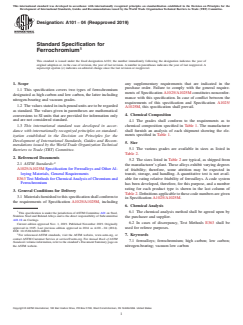
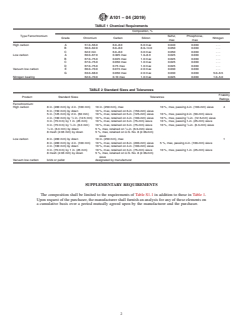
This specification covers two types of ferrochromium designated as high carbon and low carbon, the latter including nitrogen-bearing and vacuum grades. The grades which are available in different sizes shall conform to the required chemical composition for chromium, carbon, silicon, sulfur, phosphorus, and nitrogen.
SCOPE
1.1 This specification covers two types of ferrochromium designated as high carbon and low carbon, the latter including nitrogen-bearing and vacuum grades.
1.2 The values stated in inch-pound units are to be regarded as standard. The values given in parentheses are mathematical conversions to SI units that are provided for information only and are not considered standard.
1.3 This international standard was developed in accordance with internationally recognized principles on standardization established in the Decision on Principles for the Development of International Standards, Guides and Recommendations issued by the World Trade Organization Technical Barriers to Trade (TBT) Committee.
General Information
- Status
- Published
- Publication Date
- 31-Oct-2019
- Technical Committee
- A01 - Steel, Stainless Steel and Related Alloys
- Drafting Committee
- A01.18 - Castings
Relations
- Effective Date
- 01-Nov-2019
- Effective Date
- 01-Nov-2015
- Effective Date
- 01-Oct-2010
- Effective Date
- 01-Oct-2009
- Refers
ASTM E363-83(2003)e1 - Standard Test Methods for Chemical Analysis of Chromium and Ferrochromium - Effective Date
- 10-Jun-2003
- Effective Date
- 01-Nov-2019
- Effective Date
- 01-Nov-2019
Overview
ASTM A101-04(2019): Standard Specification for Ferrochromium is an international standard developed by ASTM International. This specification covers the requirements for two major types of ferrochromium - high carbon and low carbon. Low carbon ferrochromium includes nitrogen-bearing and vacuum grades, each available in various sizes. The standard defines chemical composition requirements for elements such as chromium, carbon, silicon, sulfur, phosphorus, and nitrogen, along with guidelines for product sizing, analysis methods, and conformity requirements.
Ferrochromium is a crucial alloying material in steelmaking and metallurgical industries due to its high chromium content and the ability to control carbon and other elements. Compliance with ASTM A101-04(2019) ensures consistent quality, traceable properties, and compatibility in global supply chains.
Key Topics
Product Types and Grades:
- High Carbon Ferrochromium (Grades A, B, C): Contains higher carbon content, with chromium typically above 51%.
- Low Carbon Ferrochromium (Grades A-D): Characterized by reduced carbon, with nitrogen-bearing and vacuum grades designed for specialized applications.
- Nitrogen-Bearing and Vacuum Grades: For advanced metallurgical processes where precise nitrogen or ultra-low carbon levels are required.
Chemical Composition:
- All grades must conform to strict chemical analysis requirements for chromium, carbon, silicon, sulfur, phosphorus, and nitrogen.
- Additional limits apply to supplementary elements such as manganese, nickel, vanadium, cobalt, and trace elements, enhancing product suitability for various applications.
Standard Sizes and Friability:
- Ferrochromium is available in standardized sizes, with tolerances specified to maintain consistency during shipping, storage, and handling.
- The standard recognizes the friability (tendency to break into smaller pieces), providing guidance for quality during physical handling.
General Delivery Conditions:
- Compliance with ASTM A1025/A1025M is required for general requirements and delivery.
- Documentation and conformity testing must be in accordance with agreed-upon test methods and referee procedures as detailed in ASTM E363.
Applications
Steel and Stainless Steel Manufacturing:
- Enhances corrosion resistance, hardness, and strength in alloy steels.
- Essential for producing stainless steels and specialty alloys.
Metallurgical Industry:
- Used in the production of superalloys, tool steels, and high-performance materials requiring specific chemical properties.
Advanced Manufacturing:
- Nitrogen-bearing and vacuum low carbon grades are utilized in critical applications with stringent purity and performance criteria, such as aerospace, automotive, and high-precision components.
Quality Assurance in Procurement:
- Provides a benchmarks for buyers and suppliers, ensuring transparent quality and performance expectations in ferrochromium procurement.
Related Standards
- ASTM A1025/A1025M: General requirements for ferroalloys, including documentation, delivery, and supplementary criteria.
- ASTM E363: Standard test methods for chemical analysis of chromium and ferrochromium.
- International Practices: Developed in accordance with WTO TBT Committee guidelines for global compatibility.
Practical Value
Implementing ASTM A101-04(2019) in material sourcing or production guarantees that ferrochromium meets industry-accepted criteria for chemical composition and sizing. Adhering to this specification supports the consistency, performance, and compliance of finished metal products, allowing businesses to operate confidently in global supply chains and deliver reliable results across critical industries.
Keywords: ferrochromium specification, ASTM A101, high carbon ferrochromium, low carbon ferrochromium, nitrogen-bearing ferrochromium, vacuum grade, chemical composition, ferroalloys standard, steelmaking alloys, ASTM standards.


Get Certified
Connect with accredited certification bodies for this standard

Element Materials Technology
Materials testing and product certification.

Inštitut za kovinske materiale in tehnologije
Institute of Metals and Technology. Materials testing, metallurgical analysis, NDT.
Sponsored listings
Frequently Asked Questions
ASTM A101-04(2019) is a technical specification published by ASTM International. Its full title is "Standard Specification for Ferrochromium". This standard covers: ABSTRACT This specification covers two types of ferrochromium designated as high carbon and low carbon, the latter including nitrogen-bearing and vacuum grades. The grades which are available in different sizes shall conform to the required chemical composition for chromium, carbon, silicon, sulfur, phosphorus, and nitrogen. SCOPE 1.1 This specification covers two types of ferrochromium designated as high carbon and low carbon, the latter including nitrogen-bearing and vacuum grades. 1.2 The values stated in inch-pound units are to be regarded as standard. The values given in parentheses are mathematical conversions to SI units that are provided for information only and are not considered standard. 1.3 This international standard was developed in accordance with internationally recognized principles on standardization established in the Decision on Principles for the Development of International Standards, Guides and Recommendations issued by the World Trade Organization Technical Barriers to Trade (TBT) Committee.
ABSTRACT This specification covers two types of ferrochromium designated as high carbon and low carbon, the latter including nitrogen-bearing and vacuum grades. The grades which are available in different sizes shall conform to the required chemical composition for chromium, carbon, silicon, sulfur, phosphorus, and nitrogen. SCOPE 1.1 This specification covers two types of ferrochromium designated as high carbon and low carbon, the latter including nitrogen-bearing and vacuum grades. 1.2 The values stated in inch-pound units are to be regarded as standard. The values given in parentheses are mathematical conversions to SI units that are provided for information only and are not considered standard. 1.3 This international standard was developed in accordance with internationally recognized principles on standardization established in the Decision on Principles for the Development of International Standards, Guides and Recommendations issued by the World Trade Organization Technical Barriers to Trade (TBT) Committee.
ASTM A101-04(2019) is classified under the following ICS (International Classification for Standards) categories: 77.100 - Ferroalloys. The ICS classification helps identify the subject area and facilitates finding related standards.
ASTM A101-04(2019) has the following relationships with other standards: It is inter standard links to ASTM A101-04(2014)e1, ASTM A1025/A1025M-10(2015), ASTM A1025/A1025M-10, ASTM E363-09, ASTM E363-83(2003)e1, ASTM A1025/A1025M-10(2020), ASTM E363-23. Understanding these relationships helps ensure you are using the most current and applicable version of the standard.
ASTM A101-04(2019) is available in PDF format for immediate download after purchase. The document can be added to your cart and obtained through the secure checkout process. Digital delivery ensures instant access to the complete standard document.
Standards Content (Sample)
This international standard was developed in accordance with internationally recognized principles on standardization established in the Decision on Principles for the
Development of International Standards, Guides and Recommendations issued by the World Trade Organization Technical Barriers to Trade (TBT) Committee.
Designation: A101 −04 (Reapproved 2019)
Standard Specification for
Ferrochromium
This standard is issued under the fixed designation A101; the number immediately following the designation indicates the year of
original adoption or, in the case of revision, the year of last revision. A number in parentheses indicates the year of last reapproval. A
superscript epsilon (´) indicates an editorial change since the last revision or reapproval.
1. Scope any supplementary requirements that are indicated in the
purchase order. Failure to comply with the general require-
1.1 This specification covers two types of ferrochromium
ments of Specification A1025/A1025M constitutes nonconfor-
designated as high carbon and low carbon, the latter including
mance with this specification. In case of conflict between the
nitrogen-bearing and vacuum grades.
requirements of this specification and Specification A1025/
1.2 The values stated in inch-pound units are to be regarded
A1025M, this specification shall prevail.
as standard. The values given in parentheses are mathematical
4. Chemical Composition
conversions to SI units that are provided for information only
and are not considered standard.
4.1 The grades shall conform to the requirements as to
chemical composition specified in Table 1. The manufacturer
1.3 This international standard was developed in accor-
shall furnish an analysis of each shipment showing the ele-
dance with internationally recognized principles on standard-
ments specified in Table 1.
ization established in the Decision on Principles for the
Development of International Standards, Guides and Recom-
5. Size
mendations issued by the World Trade Organization Technical
5.1 The various grades are available in sizes as listed in
Barriers to Trade (TBT) Committee.
Table 2.
2. Referenced Documents
5.2 The sizes listed in Table 2 are typical, as shipped from
2.1 ASTM Standards:
the manufacturer’s plant. These alloys exhibit varying degrees
A1025/A1025M Specification for Ferroalloys and Other Al-
of friability; therefore, some attrition may be expected in
loying Materials, General Requirements
transit, storage, and handling. A quantitative test is not avail-
E363 Test Methods for ChemicalAnalysis of Chromium and
able for rating relative friability of ferroalloys. A code system
Ferrochromium
has been developed, therefore, for this purpose, and a number
rating for each product type is shown in the last column of
3. General Conditions for Delivery
Table 2. Definitions applicable to these code numbers are given
3.1 Materials furnished to this specification shall conform to
in Specification A1025/A1025M.
the requirements of Specification A1025/A1025M, including
6. Chemical Analysis
6.1 The chemical analysis method shall be agreed upon by
This specification is under the jurisdiction of ASTM Committee A01 on Steel,
Stainless Steel and Related Alloys and is the direct responsibility of Subcommittee
the purchaser and supplier.
A01.18 on Castings.
6.2 In cases of discrepancy, Test Methods E363 shall be
Current edition approved Nov. 1, 2019. Published November 2019. Originally
approved in 1925. Last previous edition approved in 2014 as A101 – 04 (2014).
used for referee purposes.
DOI: 10.1520/A0101-04R19.
For referenced ASTM standards, visit the ASTM website, www.astm.org, or 7. Keywords
contact ASTM Customer Service at service@astm.org. For Annual Book of ASTM
7.1 ferroalloys; ferrochromium; high carbon; low carbon;
Standards volume information, refer to the standard’s Document Summary page on
the ASTM website. nitrogen-bearing; vacuum low carbon
Copyright © ASTM International, 100 Barr Harbor Drive, PO Box C700, West Conshohocken, PA 19428-2959. United States
A101 − 04 (2019)
TABLE 1 Chemical Requirements
Composition, %
Type Ferrochromium
Sulfur, Phosphorus,
Grade Chromium Carbon Silicon Nitrogen
max max
High carbon A 51.0–56.0 6.0–8.0 6.0 max 0.040 0.030 .
B 56.0–62.0 6.0–8.0 8.0–14.0 0.050 0.030 .
C 62.0 min 6.0–8.0 3.0 max 0.050 0.030 .
Low carbon A 60.0–67.0 0.025 max 1.0–8.0 0.025 0.030 . . .
B 67.0–75.0 0.025 max 1.0 max 0.025 0.030 . . .
C 67.0–75.0 0.050 max 1.0 max 0.025 0.030 . . .
D 67.0–75.0 0.75 max 1.0 max 0.025 0.030 . . .
Vacuum low carbon E 66.0–70.0
...
Questions, Comments and Discussion
Ask us and Technical Secretary will try to provide an answer. You can facilitate discussion about the standard in here.
Loading comments...