

ASTM A1025/A1025M-10(2020)
(Specification)Standard Specification for Ferroalloys and Other Alloying Materials, General Requirements
General Information
- Abstract
ABSTRACT
This specification covers a group of common requirements that, unless otherwise specified in an individual specification, shall apply to ferroalloys and other alloying materials. The chemical analysis method shall be agreed upon by the purchaser and supplier. Unless otherwise specified, the material shall be sampled for determination of chemical composition and size.
SCOPE
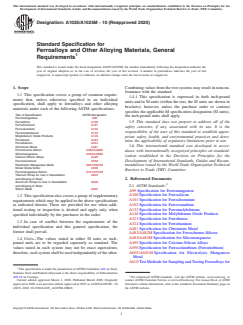
1.1 This specification covers a group of common requirements that, unless otherwise specified in an individual specification, shall apply to ferroalloys and other alloying materials under each of the following ASTM specifications:
Title of Specification
ASTM Designation
Ferromanganese
A99
Ferrosilicon
A100
Ferrochromium
A101
Ferrovanadium
A102
Ferromolybdenum
A132
Molybdenum Oxide Products
A146
Ferroboron
A323
Ferrotitanium
A324
Chromium Metal
A481
Ferrochrome-Silicon
A482/A482M
Silicomanganese
A483/A483M
Calcium-Silicon Alloys
A495
Ferrocolumbium
A550
Electrolytic Manganese Metal
A601/A601M
Nickel Oxide Sinter
A636
Ferromanganese Silicon
A701/A701M
Titanium Scrap for Use in Deoxidation and Alloying of Steel
A845
Aluminum Scrap for Use in Deoxidation and Alloying of Steel
A846
Silicon Metal
A922
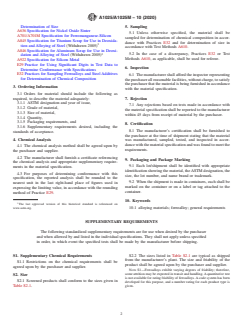
1.2 This specification also covers a group of supplementary requirements which may be applied to the above specifications as indicated therein. These are provided for use when additional testing or inspection is desired and apply only when specified individually by the purchaser in the order.
1.3 In case of conflict between the requirements of the individual specification and this general specification, the former shall prevail.
1.4 Units—The values stated in either SI units or inch-pound units are to be regarded separately as standard. The values stated in each system may not be exact equivalents; therefore, each system shall be used independently of the other. Combining values from the two systems may result in nonconformance with the standard.
1.4.1 This specification is expressed in both inch-pound units and in SI units (within the text, the SI units are shown in brackets); however, unless the purchase order or contract specifies the applicable M specification designation (SI units), the inch-pound units shall apply.
1.5 This standard does not purport to address all of the safety concerns, if any, associated with its use. It is the responsibility of the user of this standard to establish appropriate safety, health, and environmental practices and determine the applicability of regulatory limitations prior to use.
1.6 This international standard was developed in accordance with internationally recognized principles on standardization established in the Decision on Principles for the Development of International Standards, Guides and Recommendations issued by the World Trade Organization Technical Barriers to Trade (TBT) Committee.
- Status
- Published
- Publication Date
- 29-Feb-2020
- Technical Committee
- A01 - Steel, Stainless Steel and Related Alloys
- Drafting Committee
- A01.18 - Castings

Overview
ASTM A1025/A1025M-10(2020), Standard Specification for Ferroalloys and Other Alloying Materials, General Requirements, establishes a set of common requirements for a wide range of ferroalloys and other alloying materials used in steel manufacturing and related industries. Developed by ASTM International, this standard ensures consistent product quality, clear supplier-purchaser expectations, and traceability for chemical composition, size, packaging, and identification.
These general requirements serve as a baseline for several specific ASTM ferroalloy standards. They address key considerations such as order information, chemical analysis, sampling methods, acceptance criteria, certification, and marking. When supplementary requirements or additional testing is needed, this standard provides a framework for incorporating such specifications.
Key Topics
- Applicability: This standard applies to ferroalloys and alloying materials covered by numerous ASTM specifications, including ferromanganese, ferrosilicon, ferrochromium, ferrovanadium, ferromolybdenum, chromium metal, silicomanganese, ferrotitanium, ferrocolumbium, and silicon metal, among others.
- Units of Measurement: Requirements may be stated in either SI (metric) or inch-pound units; only one system may be used per order.
- Ordering Information: Purchasers must specify details such as ASTM designation, grade, size, quantity, packaging, and any supplementary requirements to ensure proper fulfillment.
- Chemical Analysis: The chemical analysis method is determined by agreement between supplier and purchaser. Certification of chemical composition is required for each shipment.
- Sampling and Testing: Sampling for chemical composition follows standard ASTM procedures, with referee methods specified for dispute resolution.
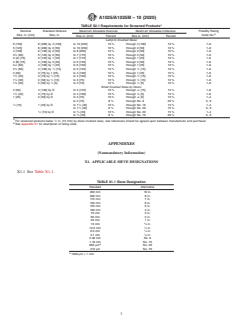
- Screened Product Sizing: Standard size tolerances for lump and crushed products are outlined, along with friability ratings to describe the tendency of materials to break or produce fines during handling.
- Inspection and Certification: The manufacturer must allow reasonable access for inspection and must provide certification that materials have been manufactured and tested in accordance with relevant specifications.
- Packaging and Marking: Clear identification of material, size, lot, and ASTM designation must be provided on shipments and containers.
Applications
ASTM A1025/A1025M-10(2020) supports procurement and production processes in industries that depend on consistent, high-quality ferroalloys and alloying materials, including:
- Steel production: Ensures reliable delivery and quality of alloying agents necessary for meeting steel composition requirements.
- Quality assurance and control: Provides repeatable methods for inspecting, sampling, and testing materials, supporting traceability and conformance to customer or regulatory requirements.
- Supply chain consistency: Facilitates clear agreements and documentation between suppliers and purchasers, minimizing disputes and ensuring reliable product performance.
By following this standard, organizations reduce risk, ensure compliance, and consistently produce or receive materials that meet stringent metallurgical and operational standards.
Related Standards
ASTM A1025/A1025M-10(2020) is referenced by, and relevant to, many specific ASTM standards for alloying materials, including:
- ASTM A99: Ferromanganese
- ASTM A100: Ferrosilicon
- ASTM A101: Ferrochromium
- ASTM A102: Ferrovanadium
- ASTM A132: Ferromolybdenum
- ASTM A146: Molybdenum Oxide Products
- ASTM A323: Ferroboron
- ASTM A324: Ferrotitanium
- ASTM A481: Chromium Metal
- ASTM A482/A482M: Ferrochrome-Silicon
- ASTM A483/A483M: Silicomanganese
- ASTM A495: Calcium-Silicon Alloys
- ASTM A550: Ferrocolumbium (Ferroniobium)
- ASTM A601/A601M: Electrolytic Manganese Metal
- ASTM A636: Nickel Oxide Sinter
- ASTM A701/A701M: Ferromanganese Silicon
- ASTM A845/A846: Scrap for Deoxidation/Alloying of Steel
- ASTM A922: Silicon Metal
Other relevant standards include ASTM E29 (Round-off Methods), Practices E32 (Sampling of Ferroalloys), and Test Methods A610 (Sampling and Testing of Ferroalloys for Size).
Keywords: ferroalloys, alloying materials, ASTM A1025/A1025M, standardized requirements, chemical analysis, sizing, supplementary testing, steel manufacturing.
Relations
- Effective Date
- 01-Mar-2020
- Effective Date
- 01-Mar-2024
- Effective Date
- 01-Mar-2020
- Effective Date
- 01-Mar-2020
- Effective Date
- 01-Mar-2020
- Effective Date
- 01-Mar-2020
- Effective Date
- 01-Mar-2020
- Effective Date
- 01-Mar-2020
- Effective Date
- 01-Nov-2019
- Effective Date
- 01-Nov-2019
- Effective Date
- 01-Nov-2019
- Effective Date
- 01-Nov-2019
- Effective Date
- 01-Nov-2019
- Effective Date
- 01-Nov-2019
- Effective Date
- 01-Nov-2019
Get Certified
Connect with accredited certification bodies for this standard

Element Materials Technology
Materials testing and product certification.

Inštitut za kovinske materiale in tehnologije
Institute of Metals and Technology. Materials testing, metallurgical analysis, NDT.
Sponsored listings
Frequently Asked Questions
ASTM A1025/A1025M-10(2020) is a technical specification published by ASTM International. Its full title is "Standard Specification for Ferroalloys and Other Alloying Materials, General Requirements". This standard covers: ABSTRACT This specification covers a group of common requirements that, unless otherwise specified in an individual specification, shall apply to ferroalloys and other alloying materials. The chemical analysis method shall be agreed upon by the purchaser and supplier. Unless otherwise specified, the material shall be sampled for determination of chemical composition and size. SCOPE 1.1 This specification covers a group of common requirements that, unless otherwise specified in an individual specification, shall apply to ferroalloys and other alloying materials under each of the following ASTM specifications: Title of Specification ASTM Designation Ferromanganese A99 Ferrosilicon A100 Ferrochromium A101 Ferrovanadium A102 Ferromolybdenum A132 Molybdenum Oxide Products A146 Ferroboron A323 Ferrotitanium A324 Chromium Metal A481 Ferrochrome-Silicon A482/A482M Silicomanganese A483/A483M Calcium-Silicon Alloys A495 Ferrocolumbium A550 Electrolytic Manganese Metal A601/A601M Nickel Oxide Sinter A636 Ferromanganese Silicon A701/A701M Titanium Scrap for Use in Deoxidation and Alloying of Steel A845 Aluminum Scrap for Use in Deoxidation and Alloying of Steel A846 Silicon Metal A922 1.2 This specification also covers a group of supplementary requirements which may be applied to the above specifications as indicated therein. These are provided for use when additional testing or inspection is desired and apply only when specified individually by the purchaser in the order. 1.3 In case of conflict between the requirements of the individual specification and this general specification, the former shall prevail. 1.4 Units—The values stated in either SI units or inch-pound units are to be regarded separately as standard. The values stated in each system may not be exact equivalents; therefore, each system shall be used independently of the other. Combining values from the two systems may result in nonconformance with the standard. 1.4.1 This specification is expressed in both inch-pound units and in SI units (within the text, the SI units are shown in brackets); however, unless the purchase order or contract specifies the applicable M specification designation (SI units), the inch-pound units shall apply. 1.5 This standard does not purport to address all of the safety concerns, if any, associated with its use. It is the responsibility of the user of this standard to establish appropriate safety, health, and environmental practices and determine the applicability of regulatory limitations prior to use. 1.6 This international standard was developed in accordance with internationally recognized principles on standardization established in the Decision on Principles for the Development of International Standards, Guides and Recommendations issued by the World Trade Organization Technical Barriers to Trade (TBT) Committee.
ABSTRACT This specification covers a group of common requirements that, unless otherwise specified in an individual specification, shall apply to ferroalloys and other alloying materials. The chemical analysis method shall be agreed upon by the purchaser and supplier. Unless otherwise specified, the material shall be sampled for determination of chemical composition and size. SCOPE 1.1 This specification covers a group of common requirements that, unless otherwise specified in an individual specification, shall apply to ferroalloys and other alloying materials under each of the following ASTM specifications: Title of Specification ASTM Designation Ferromanganese A99 Ferrosilicon A100 Ferrochromium A101 Ferrovanadium A102 Ferromolybdenum A132 Molybdenum Oxide Products A146 Ferroboron A323 Ferrotitanium A324 Chromium Metal A481 Ferrochrome-Silicon A482/A482M Silicomanganese A483/A483M Calcium-Silicon Alloys A495 Ferrocolumbium A550 Electrolytic Manganese Metal A601/A601M Nickel Oxide Sinter A636 Ferromanganese Silicon A701/A701M Titanium Scrap for Use in Deoxidation and Alloying of Steel A845 Aluminum Scrap for Use in Deoxidation and Alloying of Steel A846 Silicon Metal A922 1.2 This specification also covers a group of supplementary requirements which may be applied to the above specifications as indicated therein. These are provided for use when additional testing or inspection is desired and apply only when specified individually by the purchaser in the order. 1.3 In case of conflict between the requirements of the individual specification and this general specification, the former shall prevail. 1.4 Units—The values stated in either SI units or inch-pound units are to be regarded separately as standard. The values stated in each system may not be exact equivalents; therefore, each system shall be used independently of the other. Combining values from the two systems may result in nonconformance with the standard. 1.4.1 This specification is expressed in both inch-pound units and in SI units (within the text, the SI units are shown in brackets); however, unless the purchase order or contract specifies the applicable M specification designation (SI units), the inch-pound units shall apply. 1.5 This standard does not purport to address all of the safety concerns, if any, associated with its use. It is the responsibility of the user of this standard to establish appropriate safety, health, and environmental practices and determine the applicability of regulatory limitations prior to use. 1.6 This international standard was developed in accordance with internationally recognized principles on standardization established in the Decision on Principles for the Development of International Standards, Guides and Recommendations issued by the World Trade Organization Technical Barriers to Trade (TBT) Committee.
ASTM A1025/A1025M-10(2020) is classified under the following ICS (International Classification for Standards) categories: 77.100 - Ferroalloys. The ICS classification helps identify the subject area and facilitates finding related standards.
ASTM A1025/A1025M-10(2020) has the following relationships with other standards: It is inter standard links to ASTM A1025/A1025M-10(2015), ASTM A100-07(2024), ASTM A601/A601M-10(2020), ASTM A495-06(2020), ASTM A483/A483M-10(2020), ASTM A701/A701M-10(2020), ASTM A323-05(2020), ASTM A481-05(2020), ASTM A101-04(2019), ASTM A146-04(2019), ASTM A102-04(2019), ASTM A610-79(2019), ASTM A132-04(2019), ASTM A99-03(2019), ASTM A324-08(2019). Understanding these relationships helps ensure you are using the most current and applicable version of the standard.
ASTM A1025/A1025M-10(2020) is available in PDF format for immediate download after purchase. The document can be added to your cart and obtained through the secure checkout process. Digital delivery ensures instant access to the complete standard document.
Standards Content (Sample)
This international standard was developed in accordance with internationally recognized principles on standardization established in the Decision on Principles for the
Development of International Standards, Guides and Recommendations issued by the World Trade Organization Technical Barriers to Trade (TBT) Committee.
Designation: A1025/A1025M −10 (Reapproved 2020)
Standard Specification for
Ferroalloys and Other Alloying Materials, General
Requirements
This standard is issued under the fixed designation A1025/A1025M; the number immediately following the designation indicates the
year of original adoption or, in the case of revision, the year of last revision. A number in parentheses indicates the year of last
reapproval. A superscript epsilon (´) indicates an editorial change since the last revision or reapproval.
1. Scope Combining values from the two systems may result in noncon-
formance with the standard.
1.1 This specification covers a group of common require-
1.4.1 This specification is expressed in both inch-pound
ments that, unless otherwise specified in an individual
units and in SI units (within the text, the SI units are shown in
specification, shall apply to ferroalloys and other alloying
brackets); however, unless the purchase order or contract
materials under each of the following ASTM specifications:
specifies the applicable M specification designation (SI units),
Title of Specification ASTM Designation
the inch-pound units shall apply.
Ferromanganese A99
Ferrosilicon A100
1.5 This standard does not purport to address all of the
Ferrochromium A101
safety concerns, if any, associated with its use. It is the
Ferrovanadium A102
responsibility of the user of this standard to establish appro-
Ferromolybdenum A132
Molybdenum Oxide Products A146
priate safety, health, and environmental practices and deter-
Ferroboron A323
mine the applicability of regulatory limitations prior to use.
Ferrotitanium A324
1.6 This international standard was developed in accor-
Chromium Metal A481
Ferrochrome-Silicon A482/A482M
dance with internationally recognized principles on standard-
Silicomanganese A483/A483M
ization established in the Decision on Principles for the
Calcium-Silicon Alloys A495
Development of International Standards, Guides and Recom-
Ferrocolumbium A550
Electrolytic Manganese Metal A601/A601M
mendations issued by the World Trade Organization Technical
Nickel Oxide Sinter A636
Barriers to Trade (TBT) Committee.
Ferromanganese Silicon A701/A701M
Titanium Scrap for Use in Deoxidation A845
and Alloying of Steel
2. Referenced Documents
Aluminum Scrap for Use in Deoxidation A846
and Alloying of Steel 2.1 ASTM Standards:
Silicon Metal A922
A99 Specification for Ferromanganese
A100 Specification for Ferrosilicon
1.2 This specification also covers a group of supplementary
A101 Specification for Ferrochromium
requirements which may be applied to the above specifications
A102 Specification for Ferrovanadium
as indicated therein. These are provided for use when addi-
A132 Specification for Ferromolybdenum
tional testing or inspection is desired and apply only when
A146 Specification for Molybdenum Oxide Products
specified individually by the purchaser in the order.
A323 Specification for Ferroboron
1.3 In case of conflict between the requirements of the
A324 Specification for Ferrotitanium
individual specification and this general specification, the
A481 Specification for Chromium Metal
former shall prevail.
A482/A482M Specification for Ferrochrome-Silicon
A483/A483M Specification for Silicomanganese
1.4 Units—The values stated in either SI units or inch-
A495 Specification for Calcium-Silicon Alloys
pound units are to be regarded separately as standard. The
A550 Specification for Ferrocolumbium (Ferroniobium)
values stated in each system may not be exact equivalents;
A601/A601M Specification for Electrolytic Manganese
therefore,eachsystemshallbeusedindependentlyoftheother.
Metal
A610 TestMethodsforSamplingandTestingFerroalloysfor
This specification is under the jurisdiction of ASTM Committee A01 on Steel,
Stainless Steel and Related Alloysand is the direct responsibility of Subcommittee
A01.18 on Castings. For referenced ASTM standards, visit the ASTM website, www.astm.org, or
Current edition approved March 1, 2020. Published March 2020. Originally contact ASTM Customer Service at service@astm.org. For Annual Book of ASTM
approved in 2002. Last previous edition approved in 2015 as A1025/A1025M – 10 Standards volume information, refer to the standard’s Document Summary page on
(2015). DOI: 10.1520/A1025_A1025M-10R20. the ASTM website.
Copyright © ASTM International, 100 Barr Harbor Drive, PO Box C700, West Conshohocken, PA 19428-2959. United States
A1025/A1025M − 10 (2020)
Determination of Size 5. Sampling
A636 Specification for Nickel Oxide Sinter
5.1 Unless otherwise specified, the material shall be
A701/A701M Specification for Ferromanganese-Silicon
sampled for determination of chemical composition in accor-
A845 Specification for Titanium Scrap for Use in Deoxida-
dance with Practices E32 and for determination of size in
tion and Alloying of Steel (Withdrawn 2005)
accordance with Test Methods A610.
A846 Specification for Aluminum Scrap for Use in Deoxi-
5.2 In the case of a discrepancy, Practices E32 or Test
dation and Alloying of Steel (Withdrawn 2005)
Methods A610, as applicable, shall be used for referee.
A922 Specification for Silicon Metal
E29 Practice for Using Significant Digits in Test Data to
6. Inspection
Determine Conformance with Specifications
E32 Practices for Sampling Ferroalloys and Steel Additives
6.1 The manufacturer shall afford the inspector representing
for Determination of Chemical Composition thepurchaserallreasonablefacilities,withoutcharge,tosatisfy
the purchaser that the material is being furnished in accordance
3. Ordering Information
with the material specification.
3.1 Orders for material should include the following as
required, to describe the material adequately:
7. Rejection
3.1.1 ASTM designation and year of issue,
7.1 Any rejections based on tests made in accordance with
3.1.2 Grade of material,
the material specification shall be reported to the manufacturer
3.1.3 Size of material,
within 45 days from receipt of material by the purchaser.
3.1.4 Quantity,
3.1.5 Packaging requirements, and
8. Certification
3.1.6 Supplementary requirements desired, including the
8.1 The manufacturer’s certification shall be furnished to
standards of acceptance.
the purchaser at the time of shipment stating that the material
4. Chemical Analysis
was manufactured, sampled, tested, and inspected in accor-
dancewiththematerialspecificationandwasfoundtomeetthe
4.1 The chemical analysis method shall be agreed upon by
requirements.
the purchaser and supplier.
4.2 The manufacturer
...