

ASTM D4327-17
(Test Method)Standard Test Method for Anions in Water by Suppressed Ion Chromatography
General Information
- Abstract
SIGNIFICANCE AND USE
5.1 Ion chromatography provides for both qualitative and quantitative determination of seven common anions, F−, Cl−, NO2−, HPO4 −2, Br−, NO3−, and SO4−2, in the milligram per litre range from a single analytical operation requiring only a few millilitres of sample and taking approximately 10 to 15 min for completion. Additional anions, such as carboxylic acids, can also be quantified.
Note 2: This test method may be used to determine fluoride if its peak is in the water dip by adding 1 mL of eluent (at 100× the concentration in 8.3) to all 100-mL volumes of samples and standards to negate the effect of the water dip. (See 6.3, and also see 6.4.) The quantitation of unretained peaks should be avoided. Anions such as low molecular weight organic acids (formate, acetate, propionate, etc.) that are conductive coelute with fluoride and would bias fluoride quantitation in some drinking waters and most wastewaters. The water dip can be further minimized if measures are taken to remove carbonic acid which remain in the eluent after suppression using carbonate based eluents. There is no water dip if hydroxide eluents are used.
5.2 Anion combinations such as Cl−/Br − and NO2−/NO3−, which may be difficult to distinguish by other analytical methods, are readily separated by ion chromatography.
SCOPE
1.1 This test method2,3 covers the sequential determination of fluoride, chloride, nitrite, ortho-phosphate, bromide, nitrate, and sulfate ions in water by suppressed ion chromatography.
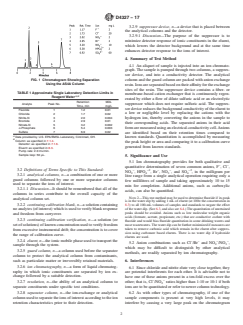
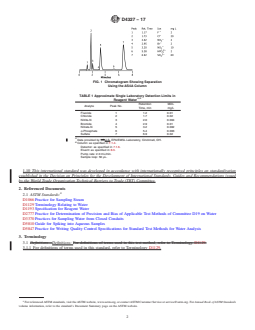
Note 1: Order of elution is dependent upon the column used; see Fig. 1.
1.3 It is the user's responsibility to ensure the validity of this test method for other matrices.
1.4 Concentrations as low as 0.01 mg/L were determined depending upon the anions to be quantified, in single laboratory work. Utilizing a 50-μL sample volume loop and a sensitivity of 3000 μS/cm full scale, the approximate detection limits shown in Table 1 can be achieved. Lower detection limits have been observed with newer instrumentation, column technology and eluents. The analyst must assure optimum instrument performance to maintain a stable baseline at more sensitive conductivity full-scale settings. (A) Data provided by U.S. EPA/EMSL Laboratory, Cincinnati, OH.(B) Column: as specified in 7.1.4.
Detector: as specified in 7.1.6.
Eluent: as specified in 8.3.
Pump rate: 2.0 mL/min.
Sample loop: 50 μL.
1.5 The upper limit of this test method is dependent upon total anion concentration and may be determined experimentally as described in Annex A1. These limits may be extended by appropriate dilution or by use of a smaller injection volume.
1.6 Using alternate separator column and eluents may permit additional anions such as acetate, formate, or citrate to be determined. This is not the subject of this test method.
1.7 This test method update approves the use of electrolytically generated eluent, electrolytically regenerated eluent, electrolytic suppression (not autozeroing), and electrolytic trap columns also known as reagent-free ion chromatography. This approval is based on acceptance by the U.S. EPA as referenced in Appendix X2.
1.8 The values stated in SI units are to be regarded as standard. No other units of measurement are included in this standard.
1.9 This standard does not purport to address all of the safety concerns, if any, associated with its use. It is the responsibility of the user of this standard to establish appropriate safety, health, and environmental practices and determine the applicability of regulatory limitations prior to use.
1.10 This international standard was developed in accordance with internationally recognized principles on standardization established in the Decision on Principles for the Development of International Standards, Guides and Recommendations issued by the World Trade Organization Technical Barriers to Trade (TBT) Committee.
- Status
- Published
- Publication Date
- 30-Nov-2017
- Technical Committee
- D19 - Water
- Drafting Committee
- D19.05 - Inorganic Constituents in Water
Overview
ASTM D4327-17, issued by ASTM International, is the standard test method for the determination of seven common anions in water by suppressed ion chromatography. The method quantifies fluoride, chloride, nitrite, bromide, nitrate, ortho-phosphate, and sulfate ions, with the capability to detect concentrations in the milligram per litre range. This standard is highly significant for laboratories and industries monitoring water quality, supporting regulatory compliance and process control.
Key Topics
- Anion Quantification: The method enables both qualitative and quantitative analysis of F−, Cl−, NO2−, HPO4−2, Br−, NO3−, and SO4−2.
- Detection Limits: Laboratory detection limits as low as 0.01 mg/L, with higher sensitivity possible using advanced instrumentation and techniques.
- Single Analytical Operation: Measurement of all target anions is achieved from a single, small-volume sample, streamlining workflow and reducing analysis time to approximately 10–15 minutes.
- Flexibility: Additional anions, such as certain carboxylic acids, may be quantified with alternative columns and eluents.
- Matrix Compatibility: The method is validated for drinking water and wastewater, with concentration ranges tested for each target anion.
- Performance Verification: The standard includes provisions for calibration, quality control, and assessment of precision and bias.
- Advanced Techniques: Approval for electrolytically generated eluents and reagent-free ion chromatography aligns with modern, automated laboratory practices.
Applications
Adoption of ASTM D4327-17 is essential in contexts requiring reliable, reproducible anion analysis in aqueous samples, including:
- Drinking Water Monitoring: Ensures compliance with public health requirements and water safety standards through regular quantification of key anions.
- Wastewater Analysis: Facilitates pollution control and discharge compliance by tracking potential contaminants such as nitrate and sulfate.
- Environmental Testing: Vital for environmental impact assessments, studies of water sources, and ecosystem health evaluations.
- Industrial Water Quality Control: Used for monitoring cooling water, boiler water, and process effluents in industries such as power generation, pharmaceuticals, and food processing.
- Research Laboratories: Supports detailed study of ionic composition in various water samples for academic or applied research.
Related Standards
The following ASTM standards and guides are commonly referenced alongside ASTM D4327-17 for comprehensive water analysis and quality assurance:
- ASTM D1066: Practice for Sampling Steam
- ASTM D1129: Terminology Relating to Water
- ASTM D1193: Specification for Reagent Water
- ASTM D2777: Practice for Determination of Precision and Bias of Applicable Test Methods of Committee D19 on Water
- ASTM D3370: Practices for Sampling Water from Closed Conduits
- ASTM D5810: Guide for Spiking into Aqueous Samples
- ASTM D5847: Practice for Writing Quality Control Specifications for Standard Test Methods for Water Analysis
These standards collectively support robust water testing programs, from sample collection through to laboratory reporting.
Practical Value
Implementing ASTM D4327-17 delivers the following benefits:
- High-throughput Analysis: Rapid, sequential detection of multiple anions from minimal sample volumes increases laboratory efficiency.
- Data Quality: Comprehensive quality control recommendations help laboratories maintain data defensibility and compliance.
- Flexibility and Accuracy: The method is readily adaptable to changing regulatory requirements and advances in analytical technology.
- Regulatory Alignment: Accepted by agencies such as the U.S. EPA for regulatory monitoring, strengthening its authority and reliability.
By adhering to this standard, organizations ensure precise, consistent, and efficient anion analysis in a wide range of water quality applications.
Relations
- Effective Date
- 01-May-2020
- Effective Date
- 01-Aug-2018
- Effective Date
- 01-Aug-2018
- Effective Date
- 15-Jun-2012
- Effective Date
- 15-Jun-2011
- Effective Date
- 01-May-2011
- Effective Date
- 01-Dec-2010
- Effective Date
- 01-Mar-2010
- Effective Date
- 01-Oct-2008
- Effective Date
- 15-Jan-2008
- Effective Date
- 01-Dec-2007
- Effective Date
- 15-Dec-2006
- Effective Date
- 01-Sep-2006
- Effective Date
- 01-Sep-2006
- Effective Date
- 15-Aug-2006
Get Certified
Connect with accredited certification bodies for this standard

ECOCERT
Organic and sustainability certification.

Eurofins Food Testing Global
Global leader in food, environment, and pharmaceutical product testing.

Intertek Bangladesh
Intertek certification and testing services in Bangladesh.
Sponsored listings
Frequently Asked Questions
ASTM D4327-17 is a standard published by ASTM International. Its full title is "Standard Test Method for Anions in Water by Suppressed Ion Chromatography". This standard covers: SIGNIFICANCE AND USE 5.1 Ion chromatography provides for both qualitative and quantitative determination of seven common anions, F−, Cl−, NO2−, HPO4 −2, Br−, NO3−, and SO4−2, in the milligram per litre range from a single analytical operation requiring only a few millilitres of sample and taking approximately 10 to 15 min for completion. Additional anions, such as carboxylic acids, can also be quantified. Note 2: This test method may be used to determine fluoride if its peak is in the water dip by adding 1 mL of eluent (at 100× the concentration in 8.3) to all 100-mL volumes of samples and standards to negate the effect of the water dip. (See 6.3, and also see 6.4.) The quantitation of unretained peaks should be avoided. Anions such as low molecular weight organic acids (formate, acetate, propionate, etc.) that are conductive coelute with fluoride and would bias fluoride quantitation in some drinking waters and most wastewaters. The water dip can be further minimized if measures are taken to remove carbonic acid which remain in the eluent after suppression using carbonate based eluents. There is no water dip if hydroxide eluents are used. 5.2 Anion combinations such as Cl−/Br − and NO2−/NO3−, which may be difficult to distinguish by other analytical methods, are readily separated by ion chromatography. SCOPE 1.1 This test method2,3 covers the sequential determination of fluoride, chloride, nitrite, ortho-phosphate, bromide, nitrate, and sulfate ions in water by suppressed ion chromatography. Note 1: Order of elution is dependent upon the column used; see Fig. 1. 1.3 It is the user's responsibility to ensure the validity of this test method for other matrices. 1.4 Concentrations as low as 0.01 mg/L were determined depending upon the anions to be quantified, in single laboratory work. Utilizing a 50-μL sample volume loop and a sensitivity of 3000 μS/cm full scale, the approximate detection limits shown in Table 1 can be achieved. Lower detection limits have been observed with newer instrumentation, column technology and eluents. The analyst must assure optimum instrument performance to maintain a stable baseline at more sensitive conductivity full-scale settings. (A) Data provided by U.S. EPA/EMSL Laboratory, Cincinnati, OH.(B) Column: as specified in 7.1.4. Detector: as specified in 7.1.6. Eluent: as specified in 8.3. Pump rate: 2.0 mL/min. Sample loop: 50 μL. 1.5 The upper limit of this test method is dependent upon total anion concentration and may be determined experimentally as described in Annex A1. These limits may be extended by appropriate dilution or by use of a smaller injection volume. 1.6 Using alternate separator column and eluents may permit additional anions such as acetate, formate, or citrate to be determined. This is not the subject of this test method. 1.7 This test method update approves the use of electrolytically generated eluent, electrolytically regenerated eluent, electrolytic suppression (not autozeroing), and electrolytic trap columns also known as reagent-free ion chromatography. This approval is based on acceptance by the U.S. EPA as referenced in Appendix X2. 1.8 The values stated in SI units are to be regarded as standard. No other units of measurement are included in this standard. 1.9 This standard does not purport to address all of the safety concerns, if any, associated with its use. It is the responsibility of the user of this standard to establish appropriate safety, health, and environmental practices and determine the applicability of regulatory limitations prior to use. 1.10 This international standard was developed in accordance with internationally recognized principles on standardization established in the Decision on Principles for the Development of International Standards, Guides and Recommendations issued by the World Trade Organization Technical Barriers to Trade (TBT) Committee.
SIGNIFICANCE AND USE 5.1 Ion chromatography provides for both qualitative and quantitative determination of seven common anions, F−, Cl−, NO2−, HPO4 −2, Br−, NO3−, and SO4−2, in the milligram per litre range from a single analytical operation requiring only a few millilitres of sample and taking approximately 10 to 15 min for completion. Additional anions, such as carboxylic acids, can also be quantified. Note 2: This test method may be used to determine fluoride if its peak is in the water dip by adding 1 mL of eluent (at 100× the concentration in 8.3) to all 100-mL volumes of samples and standards to negate the effect of the water dip. (See 6.3, and also see 6.4.) The quantitation of unretained peaks should be avoided. Anions such as low molecular weight organic acids (formate, acetate, propionate, etc.) that are conductive coelute with fluoride and would bias fluoride quantitation in some drinking waters and most wastewaters. The water dip can be further minimized if measures are taken to remove carbonic acid which remain in the eluent after suppression using carbonate based eluents. There is no water dip if hydroxide eluents are used. 5.2 Anion combinations such as Cl−/Br − and NO2−/NO3−, which may be difficult to distinguish by other analytical methods, are readily separated by ion chromatography. SCOPE 1.1 This test method2,3 covers the sequential determination of fluoride, chloride, nitrite, ortho-phosphate, bromide, nitrate, and sulfate ions in water by suppressed ion chromatography. Note 1: Order of elution is dependent upon the column used; see Fig. 1. 1.3 It is the user's responsibility to ensure the validity of this test method for other matrices. 1.4 Concentrations as low as 0.01 mg/L were determined depending upon the anions to be quantified, in single laboratory work. Utilizing a 50-μL sample volume loop and a sensitivity of 3000 μS/cm full scale, the approximate detection limits shown in Table 1 can be achieved. Lower detection limits have been observed with newer instrumentation, column technology and eluents. The analyst must assure optimum instrument performance to maintain a stable baseline at more sensitive conductivity full-scale settings. (A) Data provided by U.S. EPA/EMSL Laboratory, Cincinnati, OH.(B) Column: as specified in 7.1.4. Detector: as specified in 7.1.6. Eluent: as specified in 8.3. Pump rate: 2.0 mL/min. Sample loop: 50 μL. 1.5 The upper limit of this test method is dependent upon total anion concentration and may be determined experimentally as described in Annex A1. These limits may be extended by appropriate dilution or by use of a smaller injection volume. 1.6 Using alternate separator column and eluents may permit additional anions such as acetate, formate, or citrate to be determined. This is not the subject of this test method. 1.7 This test method update approves the use of electrolytically generated eluent, electrolytically regenerated eluent, electrolytic suppression (not autozeroing), and electrolytic trap columns also known as reagent-free ion chromatography. This approval is based on acceptance by the U.S. EPA as referenced in Appendix X2. 1.8 The values stated in SI units are to be regarded as standard. No other units of measurement are included in this standard. 1.9 This standard does not purport to address all of the safety concerns, if any, associated with its use. It is the responsibility of the user of this standard to establish appropriate safety, health, and environmental practices and determine the applicability of regulatory limitations prior to use. 1.10 This international standard was developed in accordance with internationally recognized principles on standardization established in the Decision on Principles for the Development of International Standards, Guides and Recommendations issued by the World Trade Organization Technical Barriers to Trade (TBT) Committee.
ASTM D4327-17 is classified under the following ICS (International Classification for Standards) categories: 71.040.40 - Chemical analysis. The ICS classification helps identify the subject area and facilitates finding related standards.
ASTM D4327-17 has the following relationships with other standards: It is inter standard links to ASTM D1129-13(2020)e2, ASTM D1066-18e1, ASTM D1066-18, ASTM D2777-12, ASTM D1066-11, ASTM D5810-96(2011), ASTM D3370-10, ASTM D1129-10, ASTM D3370-08, ASTM D2777-08, ASTM D3370-07, ASTM D1066-06, ASTM D1129-06a, ASTM D1129-06ae1, ASTM D2777-06. Understanding these relationships helps ensure you are using the most current and applicable version of the standard.
ASTM D4327-17 is available in PDF format for immediate download after purchase. The document can be added to your cart and obtained through the secure checkout process. Digital delivery ensures instant access to the complete standard document.
Standards Content (Sample)
This international standard was developed in accordance with internationally recognized principles on standardization established in the Decision on Principles for the
Development of International Standards, Guides and Recommendations issued by the World Trade Organization Technical Barriers to Trade (TBT) Committee.
Designation: D4327 − 17
Standard Test Method for
Anions in Water by Suppressed Ion Chromatography
This standard is issued under the fixed designation D4327; the number immediately following the designation indicates the year of
original adoption or, in the case of revision, the year of last revision.Anumber in parentheses indicates the year of last reapproval.A
superscript epsilon (´) indicates an editorial change since the last revision or reapproval.
1. Scope* 1.7 This test method update approves the use of electrolyti-
2,3 cally generated eluent, electrolytically regenerated eluent,
1.1 This test method covers the sequential determination
electrolyticsuppression(notautozeroing),andelectrolytictrap
of fluoride, chloride, nitrite, ortho-phosphate, bromide, nitrate,
columns also known as reagent-free ion chromatography. This
and sulfate ions in water by suppressed ion chromatography.
approvalisbasedonacceptancebytheU.S.EPAasreferenced
NOTE 1—Order of elution is dependent upon the column used; see Fig.
in Appendix X2.
1.
1.8 The values stated in SI units are to be regarded as
1.2 This test method is applicable to drinking and wastewa-
standard. No other units of measurement are included in this
ters.Therangestestedforthistestmethodforeachanionwere
standard.
as follows (measured in mg/L):
1.9 This standard does not purport to address all of the
Fluoride 0.26 to 8.49
safety concerns, if any, associated with its use. It is the
Chloride 0.78 to 26.0
Nitrite-N 0.36 to 12.0
responsibility of the user of this standard to establish appro-
Bromide 0.63 to 21.0
priate safety, health, and environmental practices and deter-
Nitrate-N 0.42 to 14.0
mine the applicability of regulatory limitations prior to use.
o-Phosphate 0.69 to 23.1
Sulfate 2.85 to 95.0
1.10 This international standard was developed in accor-
dance with internationally recognized principles on standard-
1.3 Itistheuser’sresponsibilitytoensurethevalidityofthis
ization established in the Decision on Principles for the
test method for other matrices.
Development of International Standards, Guides and Recom-
1.4 Concentrations as low as 0.01 mg/L were determined
mendations issued by the World Trade Organization Technical
depending upon the anions to be quantified, in single labora-
Barriers to Trade (TBT) Committee.
tory work. Utilizing a 50-µL sample volume loop and a
sensitivity of 3000 µS/cm full scale, the approximate detection
2. Referenced Documents
limits shown in Table 1 can be achieved. Lower detection
2.1 ASTM Standards:
limitshavebeenobservedwithnewerinstrumentation,column
D1066Practice for Sampling Steam
technology and eluents. The analyst must assure optimum
D1129Terminology Relating to Water
instrument performance to maintain a stable baseline at more
D1193Specification for Reagent Water
sensitive conductivity full-scale settings.
D2777Practice for Determination of Precision and Bias of
1.5 The upper limit of this test method is dependent upon
Applicable Test Methods of Committee D19 on Water
total anion concentration and may be determined experimen-
D3370Practices for Sampling Water from Flowing Process
tally as described in AnnexA1. These limits may be extended
Streams
byappropriatedilutionorbyuseofasmallerinjectionvolume.
D5810Guide for Spiking into Aqueous Samples
D5847Practice for Writing Quality Control Specifications
1.6 Using alternate separator column and eluents may per-
for Standard Test Methods for Water Analysis
mit additional anions such as acetate, formate, or citrate to be
determined. This is not the subject of this test method.
3. Terminology
3.1 Definitions:
This test method is under the jurisdiction ofASTM Committee D19 on Water
3.1.1 For definitions of terms used in this standard, refer to
and is the direct responsibility of Subcommittee D19.05 on Inorganic Constituents
in Water.
Terminology D1129.
Current edition approved Dec. 1, 2017. Published December 2017. Originally
approved in 1984. Last previous edition approved in 2011 as D4327–11. DOI:
10.1520/D4327-17. For referenced ASTM standards, visit the ASTM website, www.astm.org, or
Refs. (1-7) may be consulted for additional information. contact ASTM Customer Service at service@astm.org. For Annual Book of ASTM
The boldface numbers in parentheses refer to a list of references at the end of Standards volume information, refer to the standard’s Document Summary page on
this standard. the ASTM website.
*A Summary of Changes section appears at the end of this standard
Copyright © ASTM International, 100 Barr Harbor Drive, PO Box C700, West Conshohocken, PA 19428-2959. United States
D4327 − 17
3.2.9 suppressor device, n—a device that is placed between
the analytical columns and the detector.
3.2.9.1 Discussion—The purpose of the suppressor is to
minimize detector response of ionic constituents in the eluent,
which lowers the detector background and at the same time
enhances detector response to the ions of interest.
4. Summary of Test Method
4.1 An aliquot of sample is injected into an ion chromato-
graph.Thesampleispumpedthroughtwocolumns,asuppres-
sor device, and into a conductivity detector. The analytical
FIG. 1 Chromatogram Showing Separation
column and the guard column are packed with anion exchange
Using the AS4A Column
resin.Ionsareseparatedbasedontheiraffinityfortheexchange
sites of the resin. The suppressor device contains a fiber- or
TABLE 1 Approximate Single Laboratory Detection Limits in
membrane-based cation exchanger that is continuously regen-
A,B
Reagent Water
erated by either a flow of dilute sulfuric acid or an electrolytic
Retention MDL
Analyte Peak No. suppressor which does not require sulfuric acid. The suppres-
Time, min mg/L
sordevicereducesthebackgroundconductivityoftheeluentto
Fluoride 1 1.2 0.01
a low or negligible level by replacing the cations with the
Chloride 2 1.7 0.02
Nitrite-N 3 2.0 0.004
hydrogen ion, thereby converting the anions in the sample to
Bromide 4 2.9 0.01
their corresponding acids. The separated anions in their acid
Nitrate-N 5 3.2 0.002
formaremeasuredusinganelectrical-conductivitycell.Anions
o-Phosphate 6 5.4 0.003
Sulfate 7 6.9 0.02
are identified based on their retention times compared to
A
Data provided by U.S. EPA/EMSL Laboratory, Cincinnati, OH. known standards. Quantitation is accomplished by measuring
B
Column: as specified in 7.1.4.
the peak height or area and comparing it to a calibration curve
Detector: as specified in 7.1.6.
generated from known standards.
Eluent: as specified in 8.3.
Pump rate: 2.0 mL/min.
Sample loop: 50 µL.
5. Significance and Use
5.1 Ion chromatography provides for both qualitative and
− −
quantitative determination of seven common anions, F,Cl ,
− −2 − − −2
3.2 Definitions of Terms Specific to This Standard:
NO , HPO ,Br,NO , and SO , in the milligram per
2 4 3 4
3.2.1 analytical columns, n—a combination of one or more
litre range from a single analytical operation requiring only a
guard columns followed by one or more separator columns
few millilitres of sample and taking approximately 10 to 15
used to separate the ions of interest.
min for completion. Additional anions, such as carboxylic
3.2.1.1 Discussion—It should be remembered that all of the
acids, can also be quantified.
columns in series contribute to the overall capacity of the
NOTE2—Thistestmethodmaybeusedtodeterminefluorideifitspeak
analytical column set.
is in the water dip by adding 1 mLof eluent (at 100× the concentration in
3.2.2 continuing calibration blank, n—asolutioncontaining
8.3) to all 100-mL volumes of samples and standards to negate the effect
ofthewaterdip.(See6.3,andalsosee6.4.)Thequantitationofunretained
no analytes (of interest) which is used to verify blank response
peaks should be avoided. Anions such as low molecular weight organic
and freedom from carryover.
acids (formate, acetate, propionate, etc.) that are conductive coelute with
3.2.3 continuing calibration verification, n—a solution (or
fluoride and would bias fluoride quantitation in some drinking waters and
setofsolutions)ofknownconcentrationusedtoverifyfreedom mostwastewaters.Thewaterdipcanbefurtherminimizedifmeasuresare
taken to remove carbonic acid which remain in the eluent after suppres-
fromexcessiveinstrumentaldrift;theconcentrationistocover
sion using carbonate based eluents. There is no water dip if hydroxide
the range of calibration curve.
eluents are used.
3.2.4 eluent, n—theionicmobilephaseusedtotransportthe
− − − −
5.2 Anion combinations such as Cl /Br and NO /NO ,
2 3
sample through the system.
which may be difficult to distinguish by other analytical
3.2.5 guard column, n—a column used before the separator
methods, are readily separated by ion chromatography.
column to protect the analytical column from contaminants,
such as particulate matter or irreversibly retained materials.
6. Interferences
3.2.6 ion chromatography, n—a form of liquid chromatog-
6.1 Since chloride and nitrite elute very close together, they
raphy in which ionic constituents are separated by ion ex-
are potential interferents for each other. It is advisable not to
change followed by a suitable detection.
have one of these anions present in a ten-fold excess over the
− −
other; that is, Cl /NO ratios higher than 1:10 or 10:1 if both
3.2.7 resolution, n—the ability of an analytical column to
ionsaretobequantitatedorrefertonewercolumntechnology.
separate constituents under specific test conditions.
3.2.8 separator column, n—the ion-exchange or analytical 6.2 As with other types of chromatography, if one of the
columnusedtoseparatetheionsofinterestaccordingtotheion sample components is present at very high levels, it may
retention characteristics prior to their detection. interfere by causing a very large peak on the chromatogram
D4327 − 17
that could mask other peaks present. This type of interference 7.1.3 Guard Column—Anionexchangecolumn,typicallyof
is normally minimized by dilution of the sample (see Annex the same anion exchange material used in the separator
A1) and in some instances may be corrected if the concentra- column.Thepurposeofthiscolumnistoprotecttheanalytical
tion of that anion is of interest. However, care should be taken column from particulate matter and irreversibly retained ma-
not to dilute the analyte concentration below its detectable terials.
limit. 7.1.4 Analytical Column—Anion exchange column capable
of separating chloride from the injection void volume, as well
6.3 Water from the sample injection will cause a negative
as resolving the anions chloride through sulfate.
peak or dip in the chromatogram when it elutes, because its
conductivityislessthanthatofthesuppressedeluent.Thisdip
NOTE3—Anyanalyticalcolumnmaybeused.However,theusershould
−
be able to achieve the resolution and separation as shown in Fig. 1.
usuallyoccursbeforeCl .Anypeakofinterestelutingnearthe
water dip must be sufficiently resolved from the dip to be
7.1.5 Suppressor Device—A suppressor device based upon
accurately quantified. Some suggested techniques for elimina-
cation-exchange principles. In this test method a membrane-
tion of the water dip are described in Appendix X1.
based self-regenerating suppressor device was used. An
equivalent suppressor device may be used provided that
6.4 Theremaybeawaterdipandtheinterferenceoforganic
comparable method detection limits are achieved and that
acidsandduetothepresenceofcarbonateionsintheseparator
adequate baseline stability is attained.An electrolytic suppres-
column, the user of this test method is urged to use caution
sor device can be used which does not require the addition of
whendeterminingfluoride(seeNote2).Iftheuserwishestobe
an acid but is a plug in electrolytic device. The suppressed
certainofgoodresultsandhasinterferinganionspresentwhen
eluent (water) is simply recirculated from the conductivity cell
determining fluoride, the eluent can be diluted until separation
back to the electrolytic suppressor to back flush the suppressor
of fluoride and carbonate is accomplished. This will cause an
device. Alternative pumps are also typically not required.
increase in retention time for anions such as sulfate to elute.
7.1.6 Detector—A low-volume, flow through, temperature-
Additional steps to avoid the water dip are mentioned in
compensatedelectricalconductivitycellequippedwithameter
Appendix X1.
capable of reading from 0 to 1000 µS/cm on a linear scale or
7. Apparatus
greater if applicable.
7.1.7 Recorder, Integrator, Computer—Adevice compatible
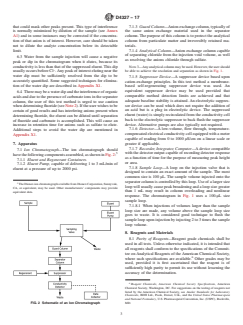
7.1 Ion Chromatograph—The ion chromatograph should
withthedetectoroutputcapableofrecordingdetectorresponse
havethefollowingcomponentsassembled,asshowninFig.2:
as a function of time for the purpose of measuring peak height
7.1.1 Eluent and Regenerant Containers.
or area.
7.1.2 Eluent Pump, capable of delivering 1 to 3 mL/min of
7.1.8 Sample Loop—A loop on the injection valve that is
eluent at a pressure of up to 2000 psi.
designed to contain an exact amount of the sample. The most
common size is 100 µL. The sample volume injected onto the
separatorcolumniscontrolledbythisloop.Useofalargersize
TheDionexionchromatographavailablefromDionexCorporation,Sunnyvale,
loopwillusuallycausepeakbroadeningandaloopsizegreater
CA, or equivalent, may be used. Other manufacturers’ components may provide
than 1 mL may result in column overloading and nonlinear
equivalent data.
response. The chromatogram in Fig. 1 uses a 100-µL size
sample loop.
7.1.8.1 When injections of volumes larger than the sample
loop size are made, any volume above the sample loop size
goes to waste. It is considered good technique to flush the
sampleloopuponinjectionbyinjecting2to3timesthesample
loop volume.
8. Reagents and Materials
8.1 Purity of Reagents—Reagent grade chemicals shall be
used in all tests. Unless otherwise indicated, it is intended that
all reagents shall conform to the specifications of the Commit-
tee onAnalytical Reagents of theAmerican Chemical Society,
where such specifications are available. Other grades may be
used, provided it is first ascertained that the reagent is of
sufficiently high purity to permit its use without lessening the
accuracy of the determination.
Reagent Chemicals, American Chemical Society Specifications, American
Chemical Society, Washington, DC. For suggestions on the testing of reagents not
listed by the American Chemical Society, see Analar Standards for Laboratory
Chemicals, BDH Ltd., Poole, Dorset, U.K., and the United States Pharmacopeia
and National Formulary, U.S. Pharmacopeial Convention, Inc. (USPC), Rockville,
FIG. 2 Schematic of an Ion Chromatograph MD.
D4327 − 17
−
8.2 Purity of Water—Unless otherwise indicated, references 8.5.4 Nitrate Stock Solution (1.00 mL=1.00 mg NO )—
towatershallbeunderstoodtomeanreagentwaterconforming Dryapproximately2gofsodiumnitrate(NaNO )at105°Cfor
to Specification D1193, Type II; Type I may also be used. 48 h. Dissolve exactly 1.371 g of the dried salt in water and
ColumnlifemaybeextendedbypassingTypeIIwaterthrough dilute to 1 L with water. Alternatively, certified nitrate stock
a 0.22-µm filter prior to use. Freshly prepared water should be solutions are commercially available through chemical supply
used for making the standards intended for calibration. The vendors and may be used.
−
detectionlimitsofthistestmethodwillbelimitedbythepurity 8.5.5 Nitrite Stock Solution (1.00 mL=1.00 mg NO )—
of the water and reagents used to make the standards. The Place approximately2gof sodium nitrite (NaNO)ina
purity of the water may be checked by use of this test method. 125-mL beaker and dry to constant weight (about 24 h) in a
Anion concentrations of less than 0.2 µg/L each are typical of desiccatorcontainingconcentratedH SO .Dissolve1.500gof
2 4
this type of water. the dried salt in water and dilute to 1 L with water. Store in a
sterilized glass bottle. Refrigerate and prepare monthly.
8.3 Eluent—Dissolve 0.2856 g of sodium bicarbonate (1.7
Alternatively, certified nitrite stock solutions are commercially
mM) and 0.3816 g of sodium carbonate (1.8 mM) in water and
available through chemical supply vendors and may be used.
dilute to 2 L with water. Other eluents may also prove to be
acceptable, provided they give the proper resolution between NOTE 5—Nitrite is easily oxidized, especially in the presence of
moisture, and only fresh reagents are to be used.
the component peaks. This eluent will act as a growth media
NOTE 6—Prepare sterile bottles for storing nitrite solutions by heating
for algae. For this reason the eluent should not be kept for
for1hat 170°C in an air oven.
longer than one month.
8.5.6 Phosphate Stock Solution(1.00 mL = 1.00 mg
8.3.1 Hydroxide Eluent—If NaOH is manually prepared as
−2
HPO )—Dissolve 1.433 g of potassium dihydrogen phos-
50 % (w/w) NaOH using degassed, deionized water (18.2
phate (KH PO ) in water and dilute to 1 L with water.
2 4
megaohm-cm)toafinalvolumeof1000µLusingavolumetric
Alternatively, certified phosphate stock solutions are commer-
flask.Avoidtheintroductionofcarbondioxidefromtheairinto
cially available through chemical supply vendors and may be
the 50 % NaOH or the distilled water being used to make the
used.
eluent. Do not shake the 50 % NaOH or pipette the required
−2
8.5.7 Sulfate Stock Solution (1.00 mL=1.00 mg SO )—
aliquot from the top of the solution where sodium carbonate
Dry sodium sulfate (Na SO)for1hat 105°C and cool in a
may have formed. Eight grams or 5.25 mL of 50 % NaOH 2 4
desiccator.Dissolve1.479gofthedriedsaltinwateranddilute
makes a 100 mM solution. A positive pressure of an inert gas
to1Lwithwater.Alternatively,certifiedsulfatestocksolutions
should be maintained over the headspace to avoid carbon
are commercially available through chemical supply vendors
dioxide contamination. The use of electrolytically generated
and may be used.
hydroxide by reagent-free ion chromatography to generate
carbonate free hydroxide is also acceptable. In addition,
8.6 Anion Working Solutions—Prepareablankandatleast3
electrolyticallygeneratedcarbonateeluentisalsoacceptable.If
different working standards containing the anions of interest.
using electrolytically prepared eluents only distilled water
The combination anion solutions should be prepared in volu-
needs to be added to the system.
metric flasks. These standards must be prepared fresh daily.
The concentration range for the three standards will be
NOTE 4—Use of other eluents may change the order of elution of the
dependent on the levels expected in the samples. If desired, a
anions from that using the carbonate-bicarbonate eluent.
single standard may be prepared that contains all six anions.
8.4 Fiber or Membrane Suppressor Regenerant Solution—
8.6.1 The user should select the ranges of the three stan-
Cautiously add 3 mL of H SO (sp gr 1.84) to 4 L of water.
2 4
dards so as to cover the entire range of the chart. The ranges
Not required for electrolytic or electronic based suppression.
chosen should all fall into one attenuation setting. If a second
8.5 Stock Solutions:
attenuation setting must be used, it must be calibrated using
−
8.5.1 Bromide Stock Solution (1.00 mL=1.00 mg Br )— threestandardsandablank.Thestandardconcentrationsgiven
Dry approximately2gof sodium bromide (NaBr) for6hat in Table 2 and Table 3 are for example purposes.
150°C and cool in a desiccator. Dissolve 1.2877 g of the dried
8.7 Filter Paper—Purchase suitable filter paper or filters in
salt in water and dilute to 1 L with water. Alternatively,
a plastic housing with a luer lock syringe. Typically the filter
certified bromide stock solutions are commercially available
papershaveaporesizeof0.22-µmmembrane.Materialsuchas
through chemical supply vendors and may be used.
fine-textured,ashlesspaper,orglassfiberpaperareacceptable.
−
8.5.2 Chloride Stock Solution (1.00 mL=1.00 mg Cl )—
The user must first ascertain that the filter paper is of sufficient
Dry sodium chloride (NaCl) for1hat 100°C and cool in a
purity to use without adversely affecting the bias and precision
desiccator. Dissolve 1.648 g of the dry salt in water and dilute
of the test method.
to 1 L with water. Alternatively, certified chloride stock
solutions are commercially available through chemical supply
9. Sampling
vendors and may be used.
− 9.1 Collect the sample in accordance with Practices D1066
8.5.3 Fluoride Stock Solution (1.00 mL=1.00 mg F )—
and D3370 as applicable.
Dissolve 2.210 g of sodium fluoride (NaF) in water and dilute
to 1 L with water. Alternatively, certified fluoride stock 9.2 Analyzethesamplesassoonaspossibleaftercollection.
solutions are commercially available through chemical supply Preservation by refrigeration at 4°C is required for nitrite,
vendors and may be used. nitrate, or phosphate.
D4327 − 17
TABLE 2 Preparation of Standard Solutions for Instrument
10.2 Analyze the blank and each of the prepared calibration
Calibration
solutions described in 8.6 in accordance with the defined
High-Range Standard
procedure (see Section 11).
Millilitres of Each
Anion Intermediate- Low-
Stock Solution NOTE 8—If the concentrations of the sample ions of interest are known
Anion
Concen- Range Range
(1.00 mL = 1.00
or estimated, the concentration of standard solutions prepared for instru-
tration, Standard, Standard,
mg), Diluted to
ment calibration may be varied to better approximate or bracket the
mg/L mg/L mg/L
1000 mL
concentration range of interest. Anions of no interest may be omitted.
− NOTE 9—The mid-range combination anion standard may be used to
Fluoride (F ) 10 10 1.0 0.2
− verify resolution of all seven anions.
Chloride (Cl ) 10 10 1.0 0.2
−
Nitrite (NO ) 20 20 2.0 0.4
NOTE 10—Each analytical curve should be established using only one
Phosphate 50 50 5.0 1.0
scale setting. Changing the scale setting may result in a slight change in
−2
(HPO )
the slope of the analytical curve.
−
Bromide (Br ) 10 10 1.0 0.2
−
Nitrate (NO ) 30 30 3.0 0.6
3 10.3 Read directly in concentration if this capability is
−2
Sulfate (SO ) 100 100 10.0 2.0
provided with the instrument or prepare analytical curves for
each anion of interest by plotting on linear graph paper peak
height or peak area versus the nominal concentration of the
TABLE 3 Preparation of Standard Solutions for Determination of
anionstandardsolution.Additionally,aquadraticfitcanalsobe
Retention Times
used.
Volume of
Anion
Stock Solution Stock Solution
Concentration,
NOTE 11—Some operators have reported a shift in slope of the
(1 mL = 1.00 mg) per litre of
−2
mg/L
phosphate calibration curve at approximately 30 mg/LHPO . If such a
Water, mL 4
shiftinslopeisobserved,additionalstandardsolutionscoveringtheentire
Fluoride 4 4
range of concentration should be prepared and analyzed in order to
Chloride 4 4
accurately define the slope of the curve. If an integrator is being used, it
Nitrite 10 10
may be necessary to manually calculate phosphate concentrations above
Phosphate 50 50
−2
Bromide 10 1
...
This document is not an ASTM standard and is intended only to provide the user of an ASTM standard an indication of what changes have been made to the previous version. Because
it may not be technically possible to adequately depict all changes accurately, ASTM recommends that users consult prior editions as appropriate. In all cases only the current version
of the standard as published by ASTM is to be considered the official document.
Designation: D4327 − 11 D4327 − 17
Standard Test Method for
Anions in Water by Suppressed Ion Chromatography
This standard is issued under the fixed designation D4327; the number immediately following the designation indicates the year of
original adoption or, in the case of revision, the year of last revision. A number in parentheses indicates the year of last reapproval. A
superscript epsilon (´) indicates an editorial change since the last revision or reapproval.
1. Scope*
2,3
1.1 This test method covers the sequential determination of fluoride, chloride, nitrite, ortho-phosphate, bromide, nitrate, and
sulfate ions in water by suppressed ion chromatography.
NOTE 1—Order of elution is dependent upon the column used; see Fig. 1.
1.2 This test method is applicable to drinking and wastewaters. The ranges tested for this test method for each anion were as
follows (measured in mg/L):
Fluoride 0.26 to 8.49
Chloride 0.78 to 26.0
Nitrite-N 0.36 to 12.0
Bromide 0.63 to 21.0
Nitrate-N 0.42 to 14.0
o-Phosphate 0.69 to 23.1
Sulfate 2.85 to 95.0
1.3 It is the user’s responsibility to ensure the validity of this test method for other matrices.
1.4 Concentrations as low as 0.01 mg/L were determined depending upon the anions to be quantified, in single laboratory work.
Utilizing a 50-μL sample volume loop and a sensitivity of 33000 μS/cm full scale, the approximate detection limits shown in Table
1 can be achieved. Lower detection limits have been observed with newer instrumentation, column technology and eluents. The
analyst must assure optimum instrument performance to maintain a stable baseline at more sensitive conductivity full-scale
settings.
1.5 The upper limit of this test method is dependent upon total anion concentration and may be determined experimentally as
described in Annex A1. These limits may be extended by appropriate dilution or by use of a smaller injection volume.
1.6 Using alternate separator column and eluents may permit additional anions such as acetate, formate, or citrate to be
determined. This is not the subject of this test method.
1.7 This test method update approves the use of Electrolyticallyelectrolytically generated eluent, electrolytically regenerated
eluent, electrolytic suppression (not autozeroing)autozeroing), and electrolytic trap columns also known as Reagent Free Ion
Chromatography. reagent-free ion chromatography. This approval is based on acceptance by the USU.S. EPA as referenced in
Appendix X2.
1.8 The values stated in SI units are to be regarded as standard. No other units of measurement are included in this standard.
1.9 This standard does not purport to address all of the safety problems,concerns, if any, associated with its use. It is the
responsibility of the user of this standard to establish appropriate safety safety, health, and healthenvironmental practices and
determine the applicability of regulatory limitations prior to use.
This test method is under the jurisdiction of ASTM Committee D19 on Water and is the direct responsibility of Subcommittee D19.05 on Inorganic Constituents in Water.
Current edition approved Jan. 15, 2011Dec. 1, 2017. Published March 2011December 2017. Originally approved in 1984. Last previous edition approved in 20032011
as D4327 – 03.D4327 – 11. DOI: 10.1520/D4327-11.10.1520/D4327-17.
2 3
TheRefs. following(1-7) references may be consulted for additional information: information.
Small, H., Stevens, T. S., and Bauman, W. C., “Novel Ion Exchange Chromatographic Method Using Conductrimetric Detection,” Analytical Chemistry, Vol 47, 1975,
p. 1801.
Stevens, T. S., Turkelson, V. T., and Alve, W. R., “Determination of Anions in Boiler Blow Down Water with Ion Chromatography,” Analytical Chemistry, Vol 49, 1977,
p. 1176.
Sawicki, E., Mulik, J. D., and Witgenstein, E., Editors, Ion Chromatographic Analysis of Environmental Pollutants, Ann Arbor Science Publishers, Ann Arbor, MI, 1978.
Mulik, J. D., and Sawicki, E., Editors, Ion Chromatographic Analysis of Environmental Pollutants, Vol/No. 2, Ann Arbor Science Publishers, Ann Arbor, MI, 1979.
Weiss, J., Handbook of Ion Chromatography, Dionex Corp., Sunnyvale, CA, 1986.
Waters Innovative Methods for Anion Analysis, Waters Chromatography Division of Millipore, Method A 107 and A 116, 1990.
Haddad, P. R., and Jackson, P. E., Ion Chromatography: Principles and Applications, Elsevier Scientific Publishing Co., 1990.
The boldface numbers in parentheses refer to a list of references at the end of this standard.
*A Summary of Changes section appears at the end of this standard
Copyright © ASTM International, 100 Barr Harbor Drive, PO Box C700, West Conshohocken, PA 19428-2959. United States
D4327 − 17
FIG. 1 Chromatogram Showing Separation
Using the AS4A Column
TABLE 1 Approximate Single Laboratory Detection Limits in
A,B
Reagent Water
Retention MDL
Analyte Peak No.
Time, min mg/L
Fluoride 1 1.2 0.01
Chloride 2 1.7 0.02
Nitrite-N 3 2.0 0.004
Bromide 4 2.9 0.01
Nitrate-N 5 3.2 0.002
o-Phosphate 6 5.4 0.003
Sulfate 7 6.9 0.02
A
Data provided by USU.S. EPA/EMSL Laboratory, Cincinnati, OH.
B
Column: as specified in 7.1.4.
Detector: as specified in 7.1.6.
Eluent: as specified in 8.3.
Pump rate: 2.0 mL/min.
Sample loop: 50 μL.
1.10 This international standard was developed in accordance with internationally recognized principles on standardization
established in the Decision on Principles for the Development of International Standards, Guides and Recommendations issued
by the World Trade Organization Technical Barriers to Trade (TBT) Committee.
2. Referenced Documents
2.1 ASTM Standards:
D1066 Practice for Sampling Steam
D1129 Terminology Relating to Water
D1193 Specification for Reagent Water
D2777 Practice for Determination of Precision and Bias of Applicable Test Methods of Committee D19 on Water
D3370 Practices for Sampling Water from Closed Conduits
D5810 Guide for Spiking into Aqueous Samples
D5847 Practice for Writing Quality Control Specifications for Standard Test Methods for Water Analysis
3. Terminology
3.1 Definitions—Definitions: For definitions of terms used in this test method, refer to Terminology D1129.
3.1.1 For definitions of terms used in this standard, refer to Terminology D1129.
For referenced ASTM standards, visit the ASTM website, www.astm.org, or contact ASTM Customer Service at service@astm.org. For Annual Book of ASTM Standards
volume information, refer to the standard’s Document Summary page on the ASTM website.
D4327 − 17
3.2 Definitions of Terms Specific to This Standard:
3.2.1 analytical columns, n—a combination of one or more guard columns followed by one or more separator columns used to
separate the ions of interest.
3.2.1.1 Discussion—
It should be remembered that all of the columns in series contribute to the overall capacity of the analytical column set.
3.2.2 suppressor device, continuing calibration blank, n—a device that is placed between the analytical columns and the
detector. solution containing no analytes (of interest) which is used to verify blank response and freedom from carryover.
3.2.2.1 Discussion—
The purpose of the suppressor is to minimize detector response of ionic constituents in the eluent, which lowers the detector
background and at the same time enhances detector response to the ions of interest.
3.2.3 continuing calibration verification, n—a solution (or set of solutions) of known concentration used to verify freedom from
excessive instrumental drift; the concentration is to cover the range of calibration curve.
3.2.4 eluent, n—the ionic mobile phase used to transport the sample through the system.
3.2.5 guard column, n—a column used before the separator column to protect the analytical column from contaminants, such
as particulate matter or irreversibly retained materials.
3.2.6 ion chromatography, n—a form of liquid chromatography in which ionic constituents are separated by ion exchange
followed by a suitable detection.
3.2.7 resolution, n—the ability of an analytical column to separate constituents under specific test conditions.
3.2.8 separator column, n—the ion-exchange or analytical column used to separate the ions of interest according to the ion
retention characteristics prior to their detection.
3.2.9 suppressor device, n—a device that is placed between the analytical columns and the detector.
3.2.9.1 Discussion—
The purpose of the suppressor is to minimize detector response of ionic constituents in the eluent, which lowers the detector
background and at the same time enhances detector response to the ions of interest.
4. Summary of Test Method
4.1 An aliquot of sample is injected into an ion chromatograph. The sample is pumped through two columns, a suppressor
device, and into a conductivity detector. The analytical column and the guard column are packed with anion exchange resin. Ions
are separated based on their affinity for the exchange sites of the resin. The suppressor device contains a fiber- or membrane-based
cation exchanger that is continuously regenerated by either a flow of dilute sulfuric acid or an electrolytic suppressor which does
not require sulfuric acid. The suppressor device reduces the background conductivity of the eluent to a low or negligible level by
replacing the cations with the hydrogen ion, thereby converting the anions in the sample to their corresponding acids. The separated
anions in their acid form are measured using an electrical-conductivity cell. Anions are identified based on their retention times
compared to known standards. Quantitation is accomplished by measuring the peak height or area and comparing it to a calibration
curve generated from known standards.
5. Significance and Use
− − −
5.1 Ion chromatography provides for both qualitative and quantitative determination of seven common anions, F , Cl , NO ,
−2 − − −2
HPO , Br , NO , and SO , in the milligram per literlitre range from a single analytical operation requiring only a few
4 3 4
millilitersmillilitres of sample and taking approximately 10 to 15 min for completion. Additional anions, such as carboxylic acids,
can also be quantified.
NOTE 2—This test method may be used to determine fluoride if its peak is in the water dip by adding one1 mL of eluent (at 100× the concentration
in 8.3) to all 100-mL volumes of samples and standards to negate the effect of the water dip. (See 6.3, and also see 6.4.) The quantitation of unretained
peaks should be avoided. Anions such as low molecular weight organic acids (formate, acetate, propionate, etc.) that are conductive coelute with fluoride
and would bias fluoride quantitation in some drinking waters and most wastewaters. The water dip can be further minimized if measures are taken to
remove carbonic acid which remain in the eluent after suppression using carbonate based eluents. There is no water dip if hydroxide eluents are used.
− − − −
5.2 Anion combinations such as Cl /Br and NO /NO , which may be difficult to distinguish by other analytical methods,
2 3
are readily separated by ion chromatography.
D4327 − 17
6. Interferences
6.1 Since chloride and nitrite elute very close together, they are potential interferents for each other. It is advisable not to have
− −
one of these anions present in a ten-fold excess over the other; that is, Cl /NO ratios higher than 1:10 or 10:1 if both ions are
to be quantitated or refer to newer column technology.
6.2 As with other types of chromatography, if one of the sample components is present at very high levels, it may interfere by
causing a very large peak on the chromatogram that could mask other peaks present. This type of interference is normally
minimized by dilution of the sample (see Annex A1) and in some instances may be corrected if the concentration of that anion
is of interest. However, care should be taken not to dilute the analyte concentration below its detectable limit.
6.3 Water from the sample injection will cause a negative peak or dip in the chromatogram when it elutes, because its
−
conductivity is less than that of the suppressed eluent. This dip usually occurs before Cl . Any peak of interest eluting near the
water dip must be sufficiently resolved from the dip to be accurately quantified. Some suggested techniques for elimination of the
water dip are described in Appendix X1.
6.4 There may be a water dip and the interference of organic acids and due to the presence of carbonate ions in the separator
column, the user of this test method is urged to use caution when determining fluoride (see Note 2). If the user wishes to be certain
of good results and has interfering anions present when determining fluoride, the eluent can be diluted until separation of fluoride
and carbonate is accomplished. This will cause an increase in retention time for anions such as sulfate to elute. Additional steps
to avoid the water dip are mentioned in Appendix X1.
7. Apparatus
7.1 Ion Chromatograph—The ion chromatograph should have the following components assembled, as shown in Fig. 2:
7.1.1 Eluent and Regenerant Containers.
7.1.2 Eluent Pump, capable of delivering 1 to 3 mL/min of eluent at a pressure of up to 2000 psi.
7.1.3 Guard Column—Anion exchange column, typically of the same anion exchange material used in the separator column.
The purpose of this column is to protect the analytical column from particulate matter and irreversibly retained materials.
7.1.4 Analytical Column—Anion exchange column capable of separating chloride from the injection void volume, as well as
resolving the anions chloride through sulfate.
NOTE 3—Any analytical column may be used. However, the user should be able to achieve the resolution and separation as shown in Fig. 1.
7.1.5 Suppressor Device—A suppressor device based upon cation-exchange principles. In this test method a membrane-based
self-regenerating suppressor device was used. An equivalent suppressor device may be used provided that comparable method
detection limits are achieved and that adequate baseline stability is attained. An electrolytic suppressor device can be used which
FIG. 2 Schematic of an Ion Chromatograph
Available from Dionex Corp., 1228 Titan Way, Sunnyvale, CA 94086. An equivalent The Dionex ion chromatograph available from Dionex Corporation, Sunnyvale, CA,
or equivalent, may be used. Other manufacturers’ components may provide equivalent data.
D4327 − 17
does not require the addition of an acid but is a plug in electrolytic device. The suppressed eluent (water) is simply recirculated
from the conductivity cell back to the electrolytic suppressor to back flush the suppressor device. Alternative pumps are also
typically not required.
7.1.6 Detector—A low-volume, flow through, temperature-compensated electrical conductivity cell equipped with a meter
capable of reading from 0 to 1000 μS/cm on a linear scale or greater if applicable.
7.1.7 Recorder, Integrator, Computer—A device compatible with the detector output capable of recording detector response as
a function of time for the purpose of measuring peak height or area.
7.1.8 Sample Loop—A loop on the injection valve that is designed to contain an exact amount of the sample. The most common
size is 100 μL. The sample volume injected onto the separator column is controlled by this loop. Use of a larger size loop will
usually cause peak broadening and a loop size greater than 1 mL may result in column overloading and nonlinear response. The
chromatogram in Fig. 1 uses a 100-μL size sample loop.
7.1.8.1 When injections of volumes larger than the sample loop size are made, any volume above the sample loop size goes to
waste. It is considered good technique to flush the sample loop upon injection by injecting 2 to 3 times the sample loop volume.
8. Reagents and Materials
8.1 Purity of Reagents—Reagent grade chemicals shall be used in all tests. Unless otherwise indicated, it is intended that all
reagents shall conform to the specifications of the Committee on Analytical Reagents of the American Chemical Society, where
such specifications are available. Other grades may be used, provided it is first ascertained that the reagent is of sufficiently high
purity to permit its use without lessening the accuracy of the determination.
8.2 Purity of Water—Unless otherwise indicated, references to water shall be understood to mean reagent water conforming to
Specification D1193, Type II; Type I may also be used. Column life may be extended by passing Type II water through a 0.22 μm
0.22-μm filter prior to use. Freshly prepared water should be used for making the standards intended for calibration. The detection
limits of this test method will be limited by the purity of the water and reagents used to make the standards. The purity of the water
may be checked by use of this test method. Anion concentrations of less than 0.2 μg/L each are typical of this type of water.
8.3 Eluent—Dissolve 0.2856 g of sodium bicarbonate (1.7 mM) and 0.3816 g of sodium carbonate (1.8 mM) in water and dilute
to 2 L with water. Other eluents may also prove to be acceptable, provided they give the proper resolution between the component
peaks. This eluent will act as a growth media for algae. For this reason the eluent should not be kept for longer than one month.
8.3.1 Hydroxide Eluent—If NaOH is manually prepared us 50% as 50 % (w/w) NaOH using degassed, deionized water (18.2
megaohm-cm) to a final volume of 1000 μL using a volumetric flask. Avoid the introduction of carbon dioxide from the air into
the 50% 50 % NaOH or the distilled water being used to make the eluent. Do not shake the 50% 50 % NaOH or pipette the required
aliquot from the top of the solution where sodium carbonate may have formed. Eight grams or 5.25 mL of 50% 50 % NaOH makes
a 100 mM solution. A positive pressure of an inert gas should be maintained over the headspace to avoid carbon dioxide
contamination. The useduse of electrolytically generated hydroxide by Reagent Free Ion Chromatography® reagent-free ion
chromatography to generate carbonate free hydroxide is also acceptable. In addition, electrolytically generated carbonate eluent is
also acceptable. If using electrolytically prepared eluents only distilled water needs to be added to the system.
NOTE 4—Use of other eluents may change the order of elution of the anions from that using the carbonate-bicarbonate eluent.
8.4 Fiber or Membrane Suppressor Regenerant Solution—Cautiously add 3 mL of H SO (sp gr 1.84) to 4 L of water. Not
2 4
required for electrolytic or electronic based suppression.
8.5 Stock Solutions:
−
8.5.1 Bromide Stock Solution (1.00 mL = 1.00 mg Br )—Dry approximately 2 g of sodium bromide (NaBr) for 6 h at 150°C
and cool in a desiccator. Dissolve 1.2877 g of the dried salt in water and dilute to 1 L with water. Alternatively, certified bromide
stock solutions are commercially available through chemical supply vendors and may be used.
−
8.5.2 Chloride Stock Solution (1.00 mL = 1.00 mg Cl )—Dry sodium chloride (NaCl) for 1 h at 100°C and cool in a desiccator.
Dissolve 1.648 g of the dry salt in water and dilute to 1 L with water. Alternatively, certified chloride stock solutions are
commercially available through chemical supply vendors and may be used.
−
8.5.3 Fluoride Stock Solution (1.00 mL = 1.00 mg F )—Dissolve 2.210 g of sodium fluoride (NaF) in water and dilute to 1 L
with water. Alternatively, certified fluoride stock solutions are commercially available through chemical supply vendors and may
be used.
−
8.5.4 Nitrate Stock Solution (1.00 mL = 1.00 mg NO )—Dry approximately 2 g of sodium nitrate (NaNO ) at 105°C for 48
3 3
h. Dissolve exactly 1.371 g of the dried salt in water and dilute to 1 L with water. Alternatively, certified nitrate stock solutions
are commercially available through chemical supply vendors and may be used.
−
8.5.5 Nitrite Stock Solution (1.00 mL = 1.00 mg NO )—Place approximately 2 g of sodium nitrite (NaNO ) in a 125-mL beaker
2 2
and dry to constant weight (about 24 h) in a desiccator containing concentrated H SO . Dissolve 1.500 g of the dried salt in water
2 4
“ReagentReagent Chemicals, American Chemical Society Specifications,”Specifications, Am.American Chemical Soc.,Society, Washington, DC. For suggestions on the
testing of reagents not listed by the American Chemical Society, see “AnalarAnalar Standards for Laboratory Chemicals,”Chemicals, BDH Ltd., Poole, Dorset, U.K., and
the “United States Pharmacopeia.”United States Pharmacopeia and National Formulary, U.S. Pharmacopeial Convention, Inc. (USPC), Rockville, MD.
D4327 − 17
and dilute to 1 L with water. Store in a sterilized glass bottle. Refrigerate and prepare monthly. Alternatively, certified nitrite stock
solutions are commercially available through chemical supply vendors and may be used.
NOTE 5—Nitrite is easily oxidized, especially in the presence of moisture, and only fresh reagents are to be used.
NOTE 6—Prepare sterile bottles for storing nitrite solutions by heating for 1 h at 170°C in an air oven.
−2
8.5.6 Phosphate Stock Solution(1.00 mL = 1.00 mg HPO )—Dissolve 1.433 g of potassium dihydrogen phosphate (KH PO )
4 2 4
in water and dilute to 1 L with water. Alternatively, certified phosphate stock solutions are commercially available through
chemical supply vendors and may be used.
−2
8.5.7 Sulfate Stock Solution (1.00 mL = 1.00 mg SO )—Dry sodium sulfate (Na SO ) for 1 h at 105°C and cool in a
4 2 4
desiccator. Dissolve 1.479 g of the dried salt in water and dilute to 1 L with water. Alternatively, certified sulfate stock solutions
are commercially available through chemical supply vendors and may be used.
8.6 Anion Working Solutions—Prepare a blank and at least 3 different working standards containing the anions of interest. The
combination anion solutions should be prepared in volumetric flasks. These standards must be prepared fresh daily. The
concentration range for the three standards will be dependent on the levels expected in the samples. If desired, a single standard
may be prepared that contains all six anions.
8.6.1 The user should select the ranges of the three standards so as to cover the entire range of the chart. The ranges chosen
should all fall into one attenuation setting. If a second attenuation setting must be used, it must be calibrated using three standards
and a blank. The standard concentrations given in Table 2 and Table 3 are for example purposes.
8.7 Filter Paper—Purchase suitable filter paper or filters in a plastic housing with a luer lock syringe. Typically the filter papers
have a pore size of 0.22-μm membrane. Material such as fine-textured, ashless paper, or glass fiber paper are acceptable. The user
must first ascertain that the filter paper is of sufficient purity to use without adversely affecting the bias and precision of the test
method.
9. Sampling
9.1 Collect the sample in accordance with Practices D1066 and D3370 as applicable.
9.2 Analyze the samples as soon as possible after collection. Preservation by refrigeration at 4°C is required for nitrite, nitrate,
or phosphate.
9.3 Filter the samples containing particulates through a prewashed 0.22-μm filter (8.7) prior to analysis to avoid fouling or
clogging the resin of the columns.
10. Calibration
10.1 Determination of Retention Times:
10.1.1 The retention time for each anion is determined by injecting a standard solution containing only the anion of interest and
noting the time required for a peak to appear on the chromatogram. Retention times vary with operating conditions and are
influenced by the concentration of ion(s) present. Prepare separate standard solutions in accordance with Table 3 by pipetting the
designated aliquots of stock solutions prepared in Section 8 (8.5.1 through 8.5.7) into separate 1-L volumetric flasks. Analyze each
standard of interest as defined in Section 11. Note the time in minutes for each peak to appear on the chromatogram.
NOTE 7—Some operators have reported unusually large shifts in retention time for nitrate with changes in concentration. If this occurs, care must be
taken to ensure integration of the correct peak when integration is used for calculation.
TABLE 2 Preparation of Standard Solutions for Instrument
Calibration
High-Range Standard
MillilitersMillilitres
of Each Stock Anion Intermediate- Low-
Anion
Solution (1.00 Concen- Range Range
mL = 1.00 mg), tration, Standard, Standard,
Diluted to 1000 mg/L mg/L mg/L
mL
−
Fluoride (F ) 10 10 1.0 0.2
−
Chloride (Cl ) 10 10 1.0 0.2
−
Nitrite (NO ) 20 20 2.0 0.4
Phosphate 50 50 5.0 1.0
−2
(HPO )
−
Bromide (Br ) 10 10 1.0 0.2
−
Nitrate (NO ) 30 30 3.0 0.6
−2
Sulfate (SO ) 100 100 10.0 2.0
...