

ASTM E2994-21
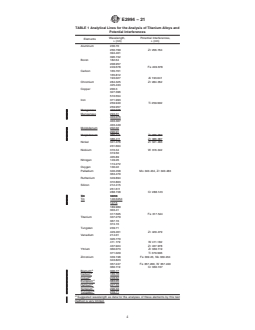
(Test Method)Standard Test Method for Analysis of Titanium and Titanium Alloys by Spark Atomic Emission Spectrometry and Glow Discharge Atomic Emission Spectrometry (Performance-Based Method)
General Information
- Abstract
SIGNIFICANCE AND USE
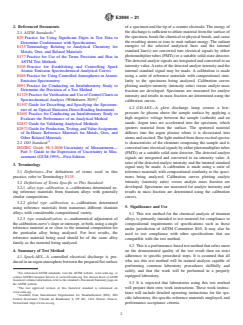
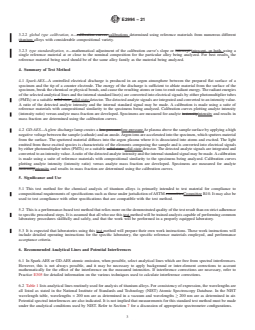
5.1 This test method for the chemical analysis of titanium alloys is primarily intended to test material for compliance to compositional requirements of specifications such as those under jurisdiction of ASTM Committee B10. It may also be used to test compliance with other specifications that are compatible with the test method.
5.2 This is a performance-based test method that relies more on the demonstrated quality of the test result than on strict adherence to specific procedural steps. It is assumed that all who use this test method will be trained analysts capable of performing common laboratory procedures skillfully and safely, and that the work will be performed in a properly equipped laboratory.
5.3 It is expected that laboratories using this test method will prepare their own work instructions. These work instructions will include detailed operating instructions for the specific laboratory, the specific reference materials employed, and performance acceptance criteria.
SCOPE
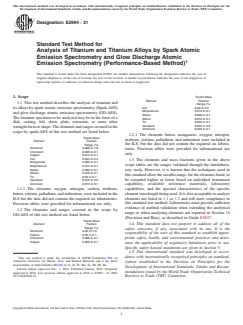
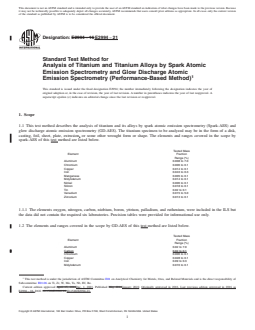
1.1 This test method describes the analysis of titanium and its alloys by spark atomic emission spectrometry (Spark-AES) and glow discharge atomic emission spectrometry (GD-AES). The titanium specimen to be analyzed may be in the form of a disk, casting, foil, sheet, plate, extrusion, or some other wrought form or shape. The elements and ranges covered in the scope by spark-AES of this test method are listed below.
Element
Tested Mass Fraction Range (%)
Aluminum
0.008 to 7.0
Chromium
0.006 to 0.1
Copper
0.014 to 0.1
Iron
0.043 to 0.3
Manganese
0.005 to 0.1
Molybdenum
0.014 to 0.1
Nickel
0.006 to 0.1
Silicon
0.018 to 0.1
Tin
0.02 to 0.1
Vanadium
0.015 to 5.0
Zirconium
0.013 to 0.1
1.1.1 The elements oxygen, nitrogen, carbon, niobium, boron, yttrium, palladium, and ruthenium, were included in the ILS but the data did not contain the required six laboratories. Precision tables were provided for informational use only.
1.2 The elements and ranges covered in the scope by GD-AES of this test method are listed below.
Element
Tested Mass Fraction Range (%)
Aluminum
0.02 to 7.0
Carbon
0.02 to 0.1
Chromium
0.006 to 0.1
Copper
0.028 to 0.1
Iron
0.09 to 0.3
Molybdenum
0.016 to 0.1
Nickel
0.006 to 0.1
Silicon
0.018 to 0.1
Tin
0.022 to 0.1
Vanadium
0.054 to 5.0
Zirconium
0.026 to 0.1
1.2.1 The elements boron, manganese, oxygen, nitrogen, niobium, yttrium, palladium, and ruthenium were included in the ILS, but the data did not contain the required six laboratories. Precision tables were provided for informational use only.
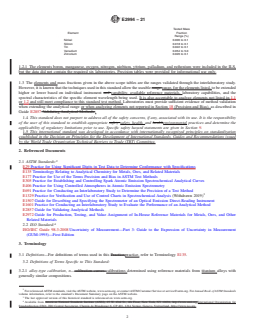
1.3 The elements and mass fractions given in the above scope tables are the ranges validated through the interlaboratory study. However, it is known that the techniques used in this standard allow the useable range, for the elements listed, to be extended higher or lower based on individual instrument capability, available reference materials, laboratory capabilities, and the spectral characteristics of the specific element wavelength being used. It is also acceptable to analyze elements not listed in 1.1 or 1.2 and still meet compliance to this standard test method. Laboratories must provide sufficient evidence of method validation when extending the analytical range or when analyzing elements not reported in Section 18 (Precision and Bias), as described in Guide E2857.
1.4 This standard does not purport to address all of the safety concerns, if any, associated with its use. It is the responsibility of the user of this standard to establish appropriate safety, health, and environmental practices and determine the applicability of regulatory limitations prior to use. Specific safety hazard statements are given in Section 9.
1.5 This international standard was developed in accordance with internationally recognized pri...
- Status
- Published
- Publication Date
- 30-Nov-2021
- Technical Committee
- E01 - Analytical Chemistry for Metals, Ores, and Related Materials
- Drafting Committee
- E01.06 - Ti, Zr, W, Mo, Ta, Nb, Hf, Re
Buy Documents
ASTM E2994-21 - Standard Test Method for Analysis of Titanium and Titanium Alloys by Spark Atomic Emission Spectrometry and Glow Discharge Atomic Emission Spectrometry (Performance-Based Method)
REDLINE ASTM E2994-21 - Standard Test Method for Analysis of Titanium and Titanium Alloys by Spark Atomic Emission Spectrometry and Glow Discharge Atomic Emission Spectrometry (Performance-Based Method)
Overview
ASTM E2994-21 is the internationally recognized standard test method for the analysis of titanium and titanium alloys using Spark Atomic Emission Spectrometry (Spark-AES) and Glow Discharge Atomic Emission Spectrometry (GD-AES). This performance-based standard provides robust procedures for determining the chemical composition of various forms of titanium and its alloys, including disks, castings, foils, sheets, plates, and extrusions.
The primary intent of ASTM E2994-21 is to support compliance with compositional requirements specified under standards from ASTM Committee B10 and any compatible specifications. Laboratories are encouraged to develop work instructions tailored to their equipment, reference materials, and specific performance criteria, ensuring flexibility while maintaining rigorous quality standards.
Key Topics
Scope and Elemental Analysis:
- Spark-AES covers elements such as aluminum, chromium, copper, iron, manganese, molybdenum, nickel, silicon, tin, vanadium, and zirconium in specific mass fraction ranges.
- GD-AES extends analysis to elements like carbon and offers slightly different analytical ranges.
- The methodology allows for the analysis of additional or extended ranges, provided method validation supports the change.
Performance-Based Approach:
- Focus is placed on demonstrated result quality, rather than strict adherence to a single procedure.
- The method requires the use of certified reference materials (CRMs), in-house reference materials when necessary, and thorough method validation.
- Laboratories are expected to apply appropriate quality control, drift correction, and safety practices.
Sample Preparation and Equipment:
- Specimen preparation is critical, involving machining or sanding to achieve a clean, flat surface.
- Detailed guidance on both Spark-AES and GD-AES instrumentation, sample mounting, and conditions is provided.
Quality Assurance and Validation:
- Statistical process control and method validation against established precision and bias data are emphasized.
- Ongoing verification, calibration, and performance monitoring are required to ensure reliable analytical outcomes.
Applications
ASTM E2994-21 is vital for organizations that need precise chemical analysis of titanium and titanium alloys in various product forms. Key application areas include:
Material Certification:
- Used by manufacturers, suppliers, and quality control labs to verify that titanium and its alloys meet specified compositional standards before release or further processing.
Research & Development:
- Essential for alloy development, optimization, and comparative analysis of new titanium-based materials across industries such as aerospace, biomedical, and chemical processing.
Regulatory & Specification Compliance:
- Facilitates conformance with ASTM Committee B10 titanium specifications and other similar standards.
Process Control:
- Supports ongoing manufacturing quality assurance through rapid, accurate routine checks of material composition using Spark-AES and GD-AES technologies.
Related Standards
ASTM E2994-21 references and aligns with a range of standards to ensure accuracy and reliability in elemental analysis of metals:
- ASTM E29: Practice for Using Significant Digits in Test Data
- ASTM E135: Terminology Relating to Analytical Chemistry for Metals, Ores, and Related Materials
- ASTM E305: Practice for Establishing and Controlling Spark Atomic Emission Spectrochemical Analytical Curves
- ASTM E2857: Guide for Validating Analytical Methods
- ASTM E2972: Guide for Production, Testing, and Value Assignment of In-House Reference Materials
- ISO/IEC Guide 98-3: Uncertainty of Measurement-Guide to the Expression of Uncertainty in Measurement (GUM)
By following ASTM E2994-21, laboratories ensure high confidence in the chemical analysis of titanium alloys, supporting global industry needs for material verification, traceability, and consistent product quality.
Relations
- Effective Date
- 01-Jan-2020
- Effective Date
- 01-Nov-2019
- Effective Date
- 01-Oct-2019
- Refers
ASTM E406-19 - Standard Practice for Using Controlled Atmospheres in Atomic Emission Spectrometry - Effective Date
- 01-Oct-2019
- Effective Date
- 15-May-2019
- Effective Date
- 15-May-2016
- Effective Date
- 01-Jul-2015
- Effective Date
- 15-May-2015
- Effective Date
- 15-Feb-2015
- Effective Date
- 15-Aug-2014
- Effective Date
- 01-May-2014
- Effective Date
- 01-Apr-2014
- Effective Date
- 15-Feb-2014
- Effective Date
- 01-Dec-2013
- Effective Date
- 01-May-2013
Buy Documents
ASTM E2994-21 - Standard Test Method for Analysis of Titanium and Titanium Alloys by Spark Atomic Emission Spectrometry and Glow Discharge Atomic Emission Spectrometry (Performance-Based Method)
REDLINE ASTM E2994-21 - Standard Test Method for Analysis of Titanium and Titanium Alloys by Spark Atomic Emission Spectrometry and Glow Discharge Atomic Emission Spectrometry (Performance-Based Method)
Get Certified
Connect with accredited certification bodies for this standard

Element Materials Technology
Materials testing and product certification.

Inštitut za kovinske materiale in tehnologije
Institute of Metals and Technology. Materials testing, metallurgical analysis, NDT.
Sponsored listings
Frequently Asked Questions
ASTM E2994-21 is a standard published by ASTM International. Its full title is "Standard Test Method for Analysis of Titanium and Titanium Alloys by Spark Atomic Emission Spectrometry and Glow Discharge Atomic Emission Spectrometry (Performance-Based Method)". This standard covers: SIGNIFICANCE AND USE 5.1 This test method for the chemical analysis of titanium alloys is primarily intended to test material for compliance to compositional requirements of specifications such as those under jurisdiction of ASTM Committee B10. It may also be used to test compliance with other specifications that are compatible with the test method. 5.2 This is a performance-based test method that relies more on the demonstrated quality of the test result than on strict adherence to specific procedural steps. It is assumed that all who use this test method will be trained analysts capable of performing common laboratory procedures skillfully and safely, and that the work will be performed in a properly equipped laboratory. 5.3 It is expected that laboratories using this test method will prepare their own work instructions. These work instructions will include detailed operating instructions for the specific laboratory, the specific reference materials employed, and performance acceptance criteria. SCOPE 1.1 This test method describes the analysis of titanium and its alloys by spark atomic emission spectrometry (Spark-AES) and glow discharge atomic emission spectrometry (GD-AES). The titanium specimen to be analyzed may be in the form of a disk, casting, foil, sheet, plate, extrusion, or some other wrought form or shape. The elements and ranges covered in the scope by spark-AES of this test method are listed below. Element Tested Mass Fraction Range (%) Aluminum 0.008 to 7.0 Chromium 0.006 to 0.1 Copper 0.014 to 0.1 Iron 0.043 to 0.3 Manganese 0.005 to 0.1 Molybdenum 0.014 to 0.1 Nickel 0.006 to 0.1 Silicon 0.018 to 0.1 Tin 0.02 to 0.1 Vanadium 0.015 to 5.0 Zirconium 0.013 to 0.1 1.1.1 The elements oxygen, nitrogen, carbon, niobium, boron, yttrium, palladium, and ruthenium, were included in the ILS but the data did not contain the required six laboratories. Precision tables were provided for informational use only. 1.2 The elements and ranges covered in the scope by GD-AES of this test method are listed below. Element Tested Mass Fraction Range (%) Aluminum 0.02 to 7.0 Carbon 0.02 to 0.1 Chromium 0.006 to 0.1 Copper 0.028 to 0.1 Iron 0.09 to 0.3 Molybdenum 0.016 to 0.1 Nickel 0.006 to 0.1 Silicon 0.018 to 0.1 Tin 0.022 to 0.1 Vanadium 0.054 to 5.0 Zirconium 0.026 to 0.1 1.2.1 The elements boron, manganese, oxygen, nitrogen, niobium, yttrium, palladium, and ruthenium were included in the ILS, but the data did not contain the required six laboratories. Precision tables were provided for informational use only. 1.3 The elements and mass fractions given in the above scope tables are the ranges validated through the interlaboratory study. However, it is known that the techniques used in this standard allow the useable range, for the elements listed, to be extended higher or lower based on individual instrument capability, available reference materials, laboratory capabilities, and the spectral characteristics of the specific element wavelength being used. It is also acceptable to analyze elements not listed in 1.1 or 1.2 and still meet compliance to this standard test method. Laboratories must provide sufficient evidence of method validation when extending the analytical range or when analyzing elements not reported in Section 18 (Precision and Bias), as described in Guide E2857. 1.4 This standard does not purport to address all of the safety concerns, if any, associated with its use. It is the responsibility of the user of this standard to establish appropriate safety, health, and environmental practices and determine the applicability of regulatory limitations prior to use. Specific safety hazard statements are given in Section 9. 1.5 This international standard was developed in accordance with internationally recognized pri...
SIGNIFICANCE AND USE 5.1 This test method for the chemical analysis of titanium alloys is primarily intended to test material for compliance to compositional requirements of specifications such as those under jurisdiction of ASTM Committee B10. It may also be used to test compliance with other specifications that are compatible with the test method. 5.2 This is a performance-based test method that relies more on the demonstrated quality of the test result than on strict adherence to specific procedural steps. It is assumed that all who use this test method will be trained analysts capable of performing common laboratory procedures skillfully and safely, and that the work will be performed in a properly equipped laboratory. 5.3 It is expected that laboratories using this test method will prepare their own work instructions. These work instructions will include detailed operating instructions for the specific laboratory, the specific reference materials employed, and performance acceptance criteria. SCOPE 1.1 This test method describes the analysis of titanium and its alloys by spark atomic emission spectrometry (Spark-AES) and glow discharge atomic emission spectrometry (GD-AES). The titanium specimen to be analyzed may be in the form of a disk, casting, foil, sheet, plate, extrusion, or some other wrought form or shape. The elements and ranges covered in the scope by spark-AES of this test method are listed below. Element Tested Mass Fraction Range (%) Aluminum 0.008 to 7.0 Chromium 0.006 to 0.1 Copper 0.014 to 0.1 Iron 0.043 to 0.3 Manganese 0.005 to 0.1 Molybdenum 0.014 to 0.1 Nickel 0.006 to 0.1 Silicon 0.018 to 0.1 Tin 0.02 to 0.1 Vanadium 0.015 to 5.0 Zirconium 0.013 to 0.1 1.1.1 The elements oxygen, nitrogen, carbon, niobium, boron, yttrium, palladium, and ruthenium, were included in the ILS but the data did not contain the required six laboratories. Precision tables were provided for informational use only. 1.2 The elements and ranges covered in the scope by GD-AES of this test method are listed below. Element Tested Mass Fraction Range (%) Aluminum 0.02 to 7.0 Carbon 0.02 to 0.1 Chromium 0.006 to 0.1 Copper 0.028 to 0.1 Iron 0.09 to 0.3 Molybdenum 0.016 to 0.1 Nickel 0.006 to 0.1 Silicon 0.018 to 0.1 Tin 0.022 to 0.1 Vanadium 0.054 to 5.0 Zirconium 0.026 to 0.1 1.2.1 The elements boron, manganese, oxygen, nitrogen, niobium, yttrium, palladium, and ruthenium were included in the ILS, but the data did not contain the required six laboratories. Precision tables were provided for informational use only. 1.3 The elements and mass fractions given in the above scope tables are the ranges validated through the interlaboratory study. However, it is known that the techniques used in this standard allow the useable range, for the elements listed, to be extended higher or lower based on individual instrument capability, available reference materials, laboratory capabilities, and the spectral characteristics of the specific element wavelength being used. It is also acceptable to analyze elements not listed in 1.1 or 1.2 and still meet compliance to this standard test method. Laboratories must provide sufficient evidence of method validation when extending the analytical range or when analyzing elements not reported in Section 18 (Precision and Bias), as described in Guide E2857. 1.4 This standard does not purport to address all of the safety concerns, if any, associated with its use. It is the responsibility of the user of this standard to establish appropriate safety, health, and environmental practices and determine the applicability of regulatory limitations prior to use. Specific safety hazard statements are given in Section 9. 1.5 This international standard was developed in accordance with internationally recognized pri...
ASTM E2994-21 is classified under the following ICS (International Classification for Standards) categories: 77.120.50 - Titanium and titanium alloys. The ICS classification helps identify the subject area and facilitates finding related standards.
ASTM E2994-21 has the following relationships with other standards: It is inter standard links to ASTM E135-20, ASTM E1601-19, ASTM E2972-15(2019), ASTM E406-19, ASTM E135-19, ASTM E135-16, ASTM E135-15a, ASTM E135-15, ASTM E2972-15, ASTM E135-14b, ASTM E177-14, ASTM E135-14a, ASTM E135-14, ASTM E135-13a, ASTM E177-13. Understanding these relationships helps ensure you are using the most current and applicable version of the standard.
ASTM E2994-21 is available in PDF format for immediate download after purchase. The document can be added to your cart and obtained through the secure checkout process. Digital delivery ensures instant access to the complete standard document.
Standards Content (Sample)
This international standard was developed in accordance with internationally recognized principles on standardization established in the Decision on Principles for the
Development of International Standards, Guides and Recommendations issued by the World Trade Organization Technical Barriers to Trade (TBT) Committee.
Designation: E2994 − 21
Standard Test Method for
Analysis of Titanium and Titanium Alloys by Spark Atomic
Emission Spectrometry and Glow Discharge Atomic
Emission Spectrometry (Performance-Based Method)
This standard is issued under the fixed designation E2994; the number immediately following the designation indicates the year of
original adoption or, in the case of revision, the year of last revision. A number in parentheses indicates the year of last reapproval. A
superscript epsilon (´) indicates an editorial change since the last revision or reapproval.
1. Scope
Tested Mass
Element Fraction
1.1 This test method describes the analysis of titanium and
Range (%)
Iron 0.09 to 0.3
its alloys by spark atomic emission spectrometry (Spark-AES)
Molybdenum 0.016 to 0.1
and glow discharge atomic emission spectrometry (GD-AES).
Nickel 0.006 to 0.1
The titanium specimen to be analyzed may be in the form of a
Silicon 0.018 to 0.1
disk, casting, foil, sheet, plate, extrusion, or some other Tin 0.022 to 0.1
Vanadium 0.054 to 5.0
wroughtformorshape.Theelementsandrangescoveredinthe
Zirconium 0.026 to 0.1
scope by spark-AES of this test method are listed below.
1.2.1 The elements boron, manganese, oxygen, nitrogen,
Tested Mass
niobium, yttrium, palladium, and ruthenium were included in
Element Fraction
the ILS, but the data did not contain the required six labora-
Range (%)
Aluminum 0.008 to 7.0
tories. Precision tables were provided for informational use
Chromium 0.006 to 0.1
only.
Copper 0.014 to 0.1
Iron 0.043 to 0.3
1.3 The elements and mass fractions given in the above
Manganese 0.005 to 0.1
scope tables are the ranges validated through the interlabora-
Molybdenum 0.014 to 0.1
Nickel 0.006 to 0.1
tory study. However, it is known that the techniques used in
Silicon 0.018 to 0.1
thisstandardallowtheuseablerange,fortheelementslisted,to
Tin 0.02to0.1
be extended higher or lower based on individual instrument
Vanadium 0.015 to 5.0
Zirconium 0.013 to 0.1
capability, available reference materials, laboratory
capabilities, and the spectral characteristics of the specific
1.1.1 The elements oxygen, nitrogen, carbon, niobium,
element wavelength being used. It is also acceptable to analyze
boron, yttrium, palladium, and ruthenium, were included in the
elements not listed in 1.1 or 1.2 and still meet compliance to
ILS but the data did not contain the required six laboratories.
this standard test method. Laboratories must provide sufficient
Precision tables were provided for informational use only.
evidence of method validation when extending the analytical
1.2 The elements and ranges covered in the scope by
range or when analyzing elements not reported in Section 18
GD-AES of this test method are listed below.
(Precision and Bias), as described in Guide E2857.
Tested Mass
1.4 This standard does not purport to address all of the
Element Fraction
Range (%)
safety concerns, if any, associated with its use. It is the
Aluminum 0.02 to 7.0
responsibility of the user of this standard to establish appro-
Carbon 0.02 to 0.1
priate safety, health, and environmental practices and deter-
Chromium 0.006 to 0.1
Copper 0.028 to 0.1
mine the applicability of regulatory limitations prior to use.
Specific safety hazard statements are given in Section 9.
1.5 This international standard was developed in accor-
dance with internationally recognized principles on standard-
This test method is under the jurisdiction of ASTM Committee E01 on
Analytical Chemistry for Metals, Ores, and Related Materials and is the direct
ization established in the Decision on Principles for the
responsibility of Subcommittee E01.06 on Ti, Zr, W, Mo, Ta, Nb, Hf, Re.
Development of International Standards, Guides and Recom-
Current edition approved Dec. 1, 2021. Published January 2022. Originally
mendations issued by the World Trade Organization Technical
approved in 2016. Last previous edition approved in 2016 as E2994 – 16. DOI:
10.1520/E2994-21. Barriers to Trade (TBT) Committee.
Copyright © ASTM International, 100 Barr Harbor Drive, PO Box C700, West Conshohocken, PA 19428-2959. United States
E2994 − 21
2. Referenced Documents of a specimen and the tip of a counter electrode. The energy of
2 the discharge is sufficient to ablate material from the surface of
2.1 ASTM Standards:
the specimen, break the chemical or physical bonds, and cause
E29 Practice for Using Significant Digits in Test Data to
the resulting atoms or ions to emit radiant energy. The radiant
Determine Conformance with Specifications
energies of the selected analytical lines and the internal
E135 Terminology Relating to Analytical Chemistry for
standard line(s) are converted into electrical signals by either
Metals, Ores, and Related Materials
photomultiplier tubes (PMTs) or a suitable solid-state detector.
E177 Practice for Use of the Terms Precision and Bias in
The detected analyte signals are integrated and converted to an
ASTM Test Methods
intensity value.Aratio of the detected analyte intensity and the
E305 Practice for Establishing and Controlling Spark
internal standard signal may be made. A calibration is made
Atomic Emission Spectrochemical Analytical Curves
E406 Practice for Using Controlled Atmospheres in Atomic using a suite of reference materials with compositional simi-
Emission Spectrometry larity to the specimens being analyzed. Calibration curves
E691 Practice for Conducting an Interlaboratory Study to
plotting analyte intensity (intensity ratio) versus analyte mass
Determine the Precision of a Test Method
fraction are developed. Specimens are measured for analyte
E1329 Practice for Verification and Use of Control Charts in
intensity and results in mass fraction are determined using the
Spectrochemical Analysis (Withdrawn 2019)
calibration curves.
E1507 Guide for Describing and Specifying the Spectrom-
4.2 GD-AES—A glow discharge lamp creates a low-
eter of an Optical Emission Direct-Reading Instrument
pressure Ar plasma above the sample surface by applying a
E1601 Practice for Conducting an Interlaboratory Study to
high negative voltage between the sample (cathode) and an
Evaluate the Performance of an Analytical Method
anode. Argon ions are accelerated into the specimen, which
E2857 Guide for Validating Analytical Methods
sputters material from the surface. The sputtered material
E2972 Guide for Production, Testing, and ValueAssignment
diffuses into the argon plasma where it is dissociated into
of In-House Reference Materials for Metals, Ores, and
atomsandexcited.Thelightemittedfromtheseexcitedspecies
Other Related Materials
is characteristic of the elements composing the sample and is
2.2 ISO Standard:
ISO/IEC Guide 98-3:2008 Uncertainty of Measurement— convertedintoelectricalsignalsbyeitherphotomultipliertubes
Part 3: Guide to the Expression of Uncertainty in Mea- (PMTs) or a suitable solid-state detector. The detected analyte
surement (GUM:1995)—First Edition
signals are integrated and converted to an intensity value. A
ratio of the detected analyte intensity and the internal standard
3. Terminology
signal may be made. A calibration is made using a suite of
3.1 Definitions—For definitions of terms used in this
reference materials with compositional similarity to the speci-
practice, refer to Terminology E135.
mens being analyzed. Calibration curves plotting analyte
intensity (intensity ratio) versus analyte mass fraction are
3.2 Definitions of Terms Specific to This Standard:
developed. Specimens are measured for analyte intensity and
3.2.1 alloy-type calibration, n—calibrations determined us-
results in mass fraction are determined using the calibration
ing reference materials from titanium alloys with generally
similar compositions. curves.
3.2.2 global type calibration, n—calibrations determined
5. Significance and Use
using reference materials from numerous different titanium
alloys with considerable compositional variety.
5.1 This test method for the chemical analysis of titanium
3.2.3 type standardization, n—mathematical adjustment of
alloys is primarily intended to test material for compliance to
thecalibrationcurve’sslopeorintercept,orboth,usingasingle
compositional requirements of specifications such as those
reference material at or close to the nominal composition for
under jurisdiction of ASTM Committee B10. It may also be
the particular alloy being analyzed. For best results, the
used to test compliance with other specifications that are
reference material being used should be of the same alloy
compatible with the test method.
family as the material being analyzed.
5.2 Thisisaperformance-basedtestmethodthatreliesmore
4. Summary of Test Method
on the demonstrated quality of the test result than on strict
adherence to specific procedural steps. It is assumed that all
4.1 Spark-AES—A controlled electrical discharge is pro-
who use this test method will be trained analysts capable of
ducedinanargonatmospherebetweenthepreparedflatsurface
performing common laboratory procedures skillfully and
safely, and that the work will be performed in a properly
For referenced ASTM standards, visit the ASTM website, www.astm.org, or
equipped laboratory.
contact ASTM Customer Service at service@astm.org. For Annual Book of ASTM
Standards volume information, refer to the standard’s Document Summary page on
5.3 It is expected that laboratories using this test method
the ASTM website.
The last approved version of this historical standard is referenced on
will prepare their own work instructions. These work instruc-
www.astm.org.
tions will include detailed operating instructions for the spe-
Available from International Organization for Standardization (ISO), ISO
cific laboratory, the specific reference materials employed, and
Central Secretariat, Chemin de Blandonnet 8, CP 401, 1214 Vernier, Geneva,
Switzerland, https://www.iso.org. performance acceptance criteria.
E2994 − 21
TABLE 1 Analytical Lines for the Analysis of Titanium Alloys and
6. Recommended Analytical Lines and Potential
Potential Interferences
Interferences
Wavelength, Potential Interferences,
Elements
6.1 In Spark-AES or GD-AES atomic emission, when
λ (nm) λ (nm)
possible, select analytical lines which are free from spectral
Aluminum 236.70
interferences. However, this is not always possible, and it may 256.799 Zr 256.764
394.401
be necessary to apply background or inter-element corrections
396.152
to account mathematically for the effect of the interference on
Boron 182.64
208.957
the measured intensities. If interference corrections are
249.678 Fe 249.678
necessary, refer to Practice E305 for detailed information on
Carbon 165.701
the various techniques used to calculate interference correc-
165.812
193.027 Al 193.041
tions.
Chromium 284.325 Zr 284.352
6.2 Table 1 lists analytical lines routinely used for analysis 425.433
Copper 200.3
of titanium alloys. For consistency of expression, the wave-
327.396
lengths are all listed as stated in the National Institute of
510.554
Standards and Technology (NIST)Atomic Spectroscopy Data-
Iron 371.993
259.940 Ti 259.992
base. In the NIST wavelength table, wavelengths < 200 nm are
259.957
as determined in a vacuum and wavelengths ≥ 200 nm are as
Manganese 293.31
determined in air. Potential spectral interferences are also
403.076
403.307
indicated. It is not implied that measurements for this standard
403.449
test method must be made under the analytical conditions used
Molybdenum 202.02
by NIST. Refer to Section 7 for a discussion of appropriate 290.91
386.411 Zr 386.387
spectrometer configurations.
Nickel 341.476 Zr 341.466
231.604
7. Apparatus
Niobium 316.34 W 316.342
319.50
7.1 Excitation Source:
405.89
7.1.1 Spark Source, unipolar, triggered capacitor discharge.
Nitrogen 149.26
In today’s instrumentation, the excitation source is computer
174.272
Oxygen 130.22
controlled and is normally programmed to produce: (1) a
Palladium 340.458 Mo 340.434, Zr 340.483
high-energy pre-spark (of some preset duration), (2) a spark-
363.470
type discharge (of some preset duration), (3) an arc type Ruthenium 349.894
372.803
discharge (of some preset duration), and (4) a spark-type
Silicon 212.415
discharge,duringwhich,timeresolvedmeasurementsaremade
251.611
for improved detection limits (this may be optional on some 288.158 Cr 288.123
Tin 140.0454
instruments).
147.5
7.1.2 Glow Discharge Source, capable of producing an
189.989
303.41
argon plasma discharge. With current instrumentation, the
317.505 Fe 317.544
excitation source may be direct current (DC) or radio fre-
Titanium 337.279
quency (RF) based.
367.16
374.16
7.2 Gas Flow System—Designed to deliver pure argon gas
Tungsten 239.71
to the excitation/sample interface region. Use the minimum
429.461 Zr 429.479
Vanadium 214.01
argon purity specified by the instrument manufacturer. Refer to
326.770
Practice E406 for practical guidance on the use of controlled
411.179 W 411.182
atmospheres.
437.924 Zr 437.978
Yttrium 360.073 Zr 360.119
7.3 Spectrometer—Having acceptable dispersion,
371.029 Ti 370.996
resolution, and wavelength coverage for the determination of Zirconium 339.198 Fe 339.23, Nb 339.234
343.823
titanium alloys. As described in Guide E1507.
357.247 Fe 357.200, W 357.240
360.119 Cr 360.167
7.4 Optional Optical Path Purge or Vacuum System—
A
Bismuth 306.77
Designed to enhance vacuum wavelength sensitivity by either
A
Carbon 165.70
A
purging the optical path with a UV-transparent gas or by
Cobalt 228.62
A
Europium 383.05
evacuating the optical path to remove air. The UV-transparent
A
Hafnium 227.33
gas must meet the manufacturer’s minimum suggested purity
A
Tantalum 296.33
A
requirements.
Tungsten 239.71
A
Suggested wavelength as data for the analyses of these elements by this test
7.5 Measuring and Control Systems—Designed to convert
method is very limited.
emittedlightintensitiestoameasurableelectricalsignal.These
systems will consist of either a series of photomultiplier tubes
(PMT) or solid-state photosensitive arrays ((Charge Coupled
E2994 − 21
Device (CCD) or Charge Injection Device (CID)) and integrat- 8.5.1 Reference Materials for Type Standardization—
ing electronics. A dedicated computer is used to control Certified reference materials, reference materials and in-house
analytical method conditions, source operation, data reference materials may be used for type standardization.
acquisition, and the conversion of intensity data to mass Because the materials are used to adjust the slope or intercept
fraction. or both of a calibration curve, the materials used for this
purpose should have values traceable to higher order reference
7.6 Other Software—Designed to coordinate instrument
materials. In-house reference materials are acceptable for use
function. At a minimum, the instrument’s software should
in type standardization provided that these have been devel-
include functions for calibration, routine instrument drift cor-
oped following technically sound development protocols, such
rection (standardization) and routine analysis. Additional soft-
as those described in Guide E2972.
ware features may include functionality for tasks such as
control charting.
8.6 Process Control (Verifiers)—Process control material
should be of similar composition to the unknowns.
7.7 Specimen Preparation Equipment:
Additionally,theyshouldcontainanalytesinsufficientquantity
7.7.1 Lathe, capable of machining a smooth, flat surface on
as to display a significant intensity response when analyzed, in
the reference materials and samples. A variable speed cutter, a
order to verify instrument drift.
cemented carbide or polycrystalline diamond tool bit, and an
automatic cross-feed are highly recommended.
9. Hazards
7.7.2 Milling Machine, a milling machine can be used as an
alternative to a lathe.
9.1 The excitation sources present a potential electrical
7.7.3 Belt/Disk Sanding, a belt sander may be used to
shock hazard.The sample stand or lamp shall be provided with
prepare the surface for analysis.
a safety interlock system to prevent energizing the source
whenever contact with the electrode is possible. The instru-
NOTE 1—Spectrometer manufacturers may have specific specimen
ment should be designed so access to the power supply is also
preparation guidelines which may influence the selection of specimen
preparation equipment. restricted by the use of safety interlocks.
9.2 Exhaust gas containing fine metallic dust generated by
8. Reagents and Materials
the excitation process may be a health hazard. Therefore, the
8.1 Reference Materials:
instrument should be designed with an exhaust system to
8.1.1 Certified reference materials (CRMs) should be used
remove this dust in a safe manner. Some instruments are
as calibration reference materials, if available. These certified
equipped with a filtration system designed for this purpose.An
referencematerialsshallbeofsimilarcompositiontothealloys
acceptable alternative to the filtration system would be a
being analyzed. In cases where CRMs are not available for the
ventilation system that exhausts the powder to a “safe” area
element or alloy, or both, being analyzed or if available CRMs
outside of the laboratory. If a filtration system is used, it should
do not adequately cover the intended analytical range, it is
be maintained according to the manufacturer’s recommenda-
acceptable to use other reference materials for calibration.
tions.
8.2 Other Reference Materials:
9.3 If the filtration system includes filters, the filters used to
8.2.1 In-House Reference Materials—Some laboratories
collect the internal dust are likely exposed to an oxygen-
mayhavetheresourcestoproducein-housereferencematerials
depleted atmosphere. Sudden exposure of the filter to air may
for titanium alloys. It is acceptable to use these reference
create a fire hazard. The lab should assess the risks associated
materials for calibration of Spark-AES and GD-AES instru-
with used filter disposal.
ments provided that the in-house reference materials have been
developed following technically sound development protocols
10. Sampling, Test Specimens, and Sample Preparation
and are accompanied with appropriate documentation. Refer to
10.1 Laboratories shall follow written practices for sam-
Guide E2972.
pling and preparation of test samples.
8.3 Instrument Manufacturer Provided Reference
10.2 Check specimens for porosity or inclusions. Porosity
Materials—Some manufacturers perform factory calibrations
orinclusionsorbothneedtoberemovedduringthepreparation
which may include reference materials owned by the manu-
process.
facturer. The laboratory should make reasonable attempts to
secure certificates of analysis for each of these reference
10.3 The specimen configuration must also be amenable to
materials and to evaluate the acceptability of these certificates
machining using the sample preparation equipment selected.
in conjunction with the laboratory’s quality policies.
Prepare the specimen surface by either sanding, milling, or
lathe turning to produce a clean, flat analytical surface.
8.4 Drift Correction (standardization) Materials—This
Reference materials and samples should be prepared in a
suiteofmaterialsshouldbeofsimilarcompositiontothealloys
similar manner.
being analyzed and should contain analyte levels near the
extremes of the calibration range for each analyte. Refer to
10.4 Testspecimensshouldbeofaconfigurationthatwillfit
Practice E305 for a more detailed discussion of the use of drift
the sample stand being used. The prepared specimen surface
correction (standardization) materials with AES analysis.
must be large enough to cover the sample orifice on the sample
8.5 Type Standards: stand of the instrument.
E2994 − 21
10.5 Dependingonsamplesize,geometricshape,oralloy,it 12.2 Specify the following parameters, as necessary for
may be required to prepare the surface of samples and calibration, into the instrument software. If the manufacturer
reference materials in different manners. When multiple
has provided a factory calibration and associated information,
sample preparations techniques are proposed, the user should check that the steps have been done correctly, with help from
evaluate the equivalence of results obtained from all proposed
the manufacturer as appropriate. For manufacturer provided
preparation techniques during method validation.
calibrations, laboratories should perform method validation to
ensure all results are correct. Refer to Guide E2857.
11. Preparation of Apparatus
12.2.1 The excitation source conditions determined during
11.1 Analytical instrumentation and specimen preparation
method development.
equipment shall be installed in a manner consistent with
12.2.2 The analytical lines and measurement conditions to
manufacturer recommendations.
be used for analysis as determined during method develop-
11.2 Specify the following parameters into the instrument ment.
software.
12.2.3 The internal standards and associated measurement
11.2.1 The excitation source conditions.
parameters if intensity ratio is to be used as the expression for
11.2.2 The analytical lines and measurement conditions to
the measurement response. Typically, titanium is used as the
be used for measurement.
internal standard for the analysis of titanium alloys.
11.2.3 The internal standards and associated measurement
12.2.4 Drift correction (standardization) material identifica-
parameters, if intensity ratio is to be used as the expression for
tion and associated measurement parameters. If possible, each
the measurement response. Titanium is typically used as the
analyte should be assigned a drift correction (standardization)
internal standard for the analysis of titanium alloys.
material containing analyte contents near the anticipated cali-
11.2.4 Drift correction (standardization) sample identifica-
bration extremes. If the software supports the use of multiple
tion and associated measurement parameters. If possible, each
point drift correction (standardization), specify additional drift
analyte should be assigned a drift correction (standardization)
correction (standardization) materials as necessary.
sample containing analyte mass fractions near the anticipated
12.2.5 Calibration reference materials identification, analyte
calibration extremes. If the software supports the use of
mass fraction and associated measurement parameters. The
multiple point drift correction (standardization), specify addi-
calibration reference materials should be of similar composi-
tional drift correction (standardization) samples, as necessary.
tion to the alloys being analyzed and contain the analyte mass
11.2.5 Calibration reference materials identification, analyte
fraction necessary for adequately deriving the calibration
mass fractions and associated measurement parameters.
curves. Refer to Practice E305 for additional guidance in
11.2.6 Appropriate reporting parameters such as result
selection of reference materials necessary for calibration.
format,unitofmeasure,reportingorder,reportdestination,etc.
12.2.6 Appropriate reporting parameters such as result
11.2.7 Optimize source operating conditions, analyte lines,
and measuring conditions by performing test measurements on format,unitofmeasure,reportingorder,reportdestination,etc.
calibration reference materials in order to assess the sensitivity
12.3 Prepare the drift correction (standardization) materials
and precision of the selected measuring conditions.
and test specimens using the same technique.
11.2.8 Acursory examination of intensity data from the test
measurements should suggest that the selected measurement
12.4 Measure each drift correction (standardization) mate-
conditions are acceptable. Examine the intensity data for these rial for a minimum of three excitation cycles. Measurements
attributes.
should be made in a radial pattern, slightly away from the edge
11.2.8.1 Thereisachangeinresponseforincreasinganalyte of the drift correction (standardization) material. If measure-
mass fraction.
ments are to be made near the center of the material, then
11.2.8.2 The % RSD of the intensity multiplied by the
consideration should be given to the metallurgical condition of
analyte concentration of a standard in the analytical range
thematerial,sincecastorwroughtmaterialsmayhavephysical
yieldsanestimatedanalytestandarddeviationthatisconsistent
imperfections or chemical segregation near the center. Labo-
with the laboratories measurement quality objectives.
ratories should determine acceptable levels of precision for the
11.2.8.3 Ultimately, the acceptability of the selected mea-
analyte being measured.
surement method parameters will be demonstrated by the
12.5 Prepare the calibration reference materials and test
method validation study.
specimens using the same technique; see 10.5.
11.2.9 The laboratory should make a copy of the analytical
parametersofflineinordertorecoverintheeventofinstrument
12.6 Measure each calibration reference materials a mini-
database corruption. Analytical instrumentation and sample
mum of three times. Measurement should be made in a radial
preparation equipment shall be installed and operated in a
pattern, slightly away from the from the edge of the calibration
manner consistent with manufacturer and laboratory proce-
material. If measurements are to be made near the center of the
dures.
material, then consideration should be given as to the metal-
lurgical condition of the material, since cast or wrought
12. Calibration
materials may have physical imperfections or chemical segre-
12.1 Set up the instrument for calibration in a manner gation near the center. Laboratories should determine accept-
consistent with the manufacturer’s recommendations. able levels of precision for the analyte being measured.
E2994 − 21
haveshallowpitssurroundedbyawhiteorsilvercoloredring.Usuallythe
12.7 Createcalibrationsusingmultivariateregressionanaly-
intensity of the titanium internal standard channel for a “bad” measure-
sis. As necessary, use background corrections and inter-
ment will be considerably lower than a good measurement.
element corrections to mathematically correct for spectral
NOTE 3—With GD-AES excitation, the differences between “good” and
interferences. See Practice E305 for a detailed discussion on
“bad” measurements are commonly determined by the quality of the
calculating calibrations for atomic emission analyses, particu-
sputter spots. Because GD-AES uses vacuum to hold the sample to the
lamp, a seal leak can cause non-uniform sputtering or prevent the sample
larly as the discussion relates to the use of non-linear models
from being held to the lamp. A “good” measurement should be uniform
with higher order polynomials.
with no ring or marks around the spot where the O-ring seal was present.
12.8 Laboratories may wish to analyze samples by type A “bad” measurement may have uneven sputtering or a discoloration
around the sputter spot.
standardizationtoimproveaccuracyofthecurrentcalibrations.
12.8.1 Laboratories must be aware that reference materials
13.4 Examine the calculated % RSD for the average of the
used for type standardization update must be compositionally
usable measurements. Laboratories should determine accept-
very similar to that of the unknowns. When improperly
able levels of precision for the analyte being measured.
performed, type standardization may produce errant results.
13.5 Analyze process control material as detailed in labo-
12.9 Set up the type standard as required by the software.
ratory procedure(s).
Analyze the reference material a minimum of three excitations
as in 12.6.
14. Maintaining Statistical Process Control
12.10 Verify the type standardization by analyzing a refer-
14.1 The laboratory will establish procedures for control of
ence material to ensure statistical control. The laboratory may
instrument drift. One suggested method involves the use of a
analyzethereferencematerialusedfortypestandardizationbut
control chart to monitor drift. Prepare a control chart for each
a higher confidence of acceptability may be obtained by
control sample. Refer to Practice E1329 for guidance on use of
analyzing an independent reference material. During and upon
control charts. Users of this test method are discouraged from
completion of a period of continuous analyses, laboratories
using certified reference materials as routine control materials.
should perform additional verifications with a frequency to be
14.2 Some instrument software allows the use of program-
established by the laboratory.
mable control sample tolerances. It is acceptable to calculate
12.11 Laboratories choosing to use type standardization
control limits and to use these as
...
This document is not an ASTM standard and is intended only to provide the user of an ASTM standard an indication of what changes have been made to the previous version. Because
it may not be technically possible to adequately depict all changes accurately, ASTM recommends that users consult prior editions as appropriate. In all cases only the current version
of the standard as published by ASTM is to be considered the official document.
Designation: E2994 − 16 E2994 − 21
Standard Test Method for
Analysis of Titanium and Titanium Alloys by Spark Atomic
Emission Spectrometry and Glow Discharge Atomic
Emission Spectrometry (Performance-Based Method)
This standard is issued under the fixed designation E2994; the number immediately following the designation indicates the year of
original adoption or, in the case of revision, the year of last revision. A number in parentheses indicates the year of last reapproval. A
superscript epsilon (´) indicates an editorial change since the last revision or reapproval.
1. Scope
1.1 This test method describes the analysis of titanium and its alloys by spark atomic emission spectrometry (Spark-AES) and
glow discharge atomic emission spectrometry (GD-AES). The titanium specimen to be analyzed may be in the form of a disk,
casting, foil, sheet, plate, extrusion, or some other wrought form or shape. The elements and ranges covered in the scope by
spark-AES of this test method are listed below.
Tested Mass
Element Fraction
Range (%)
Aluminum 0.008 to 7.0
Chromium 0.006 to 0.1
Copper 0.014 to 0.1
Iron 0.043 to 0.3
Manganese 0.005 to 0.1
Molybdenum 0.014 to 0.1
Nickel 0.006 to 0.1
Silicon 0.018 to 0.1
Tin 0.02 to 0.1
Vanadium 0.015 to 5.0
Zirconium 0.013 to 0.1
1.1.1 The elements oxygen, nitrogen, carbon, niobium, boron, yttrium, palladium, and ruthenium, were included in the ILS but
the data did not contain the required six laboratories. Precision tables were provided for informational use only.
1.2 The elements and ranges covered in the scope by GD-AES of this test method are listed below.
Tested Mass
Element Fraction
Range (%)
Aluminum 0.02 to 7.0
Carbon 0.02 to 0.1
Chromium 0.006 to 0.1
Copper 0.028 to 0.1
Iron 0.09 to 0.3
Molybdenum 0.016 to 0.1
This test method is under the jurisdiction of ASTM Committee E01 on Analytical Chemistry for Metals, Ores, and Related Materials and is the direct responsibility of
Subcommittee E01.06 on Ti, Zr, W, Mo, Ta, Nb, Hf, Re.
Current edition approved April 15, 2016Dec. 1, 2021. Published May 2016January 2022. Originally approved in 2016. Last previous edition approved in 2016 as
E2994 – 16. DOI: 10.1520/E2994-16.10.1520/E2994-21.
Copyright © ASTM International, 100 Barr Harbor Drive, PO Box C700, West Conshohocken, PA 19428-2959. United States
E2994 − 21
Tested Mass
Element Fraction
Range (%)
Nickel 0.006 to 0.1
Silicon 0.018 to 0.1
Tin 0.022 to 0.1
Vanadium 0.054 to 5.0
Zirconium 0.026 to 0.1
1.2.1 The elements boron, manganese, oxygen, nitrogen, niobium, yttrium, palladium, and ruthenium were included in the ILS,
but the data did not contain the required six laboratories. Precision tables were provided for informational use only.
1.3 The elements and mass fractions given in the above scope tables are the ranges validated through the interlaboratory study.
However, it is known that the techniques used in this standard allow the useable range range, for the elements listed, to be extended
higher or lower based on individual instrument and capability, available reference materials, laboratory capabilities, and the
spectral characteristics of the specific element wavelength being used. It is also acceptable to analyze elements not listed in 1.1
or 1.2 and still meet compliance to this standard test method. Laboratories must provide sufficient evidence of method validation
when extending the analytical range or when analyzing elements not reported in Section 18 (Precision and Bias), as described in
Guide E2857 Validating Analytical Methods.
1.4 This standard does not purport to address all of the safety concerns, if any, associated with its use. It is the responsibility
of the user of this standard to establish appropriate safety safety, health, and healthenvironmental practices and determine the
applicability of regulatory limitations prior to use. Specific safety hazard statements are given in Section 9.
1.5 This international standard was developed in accordance with internationally recognized principles on standardization
established in the Decision on Principles for the Development of International Standards, Guides and Recommendations issued
by the World Trade Organization Technical Barriers to Trade (TBT) Committee.
2. Referenced Documents
2.1 ASTM Standards:
E29 Practice for Using Significant Digits in Test Data to Determine Conformance with Specifications
E135 Terminology Relating to Analytical Chemistry for Metals, Ores, and Related Materials
E177 Practice for Use of the Terms Precision and Bias in ASTM Test Methods
E305 Practice for Establishing and Controlling Spark Atomic Emission Spectrochemical Analytical Curves
E406 Practice for Using Controlled Atmospheres in Atomic Emission Spectrometry
E691 Practice for Conducting an Interlaboratory Study to Determine the Precision of a Test Method
E1329 Practice for Verification and Use of Control Charts in Spectrochemical Analysis (Withdrawn 2019)
E1507 Guide for Describing and Specifying the Spectrometer of an Optical Emission Direct-Reading Instrument
E1601 Practice for Conducting an Interlaboratory Study to Evaluate the Performance of an Analytical Method
E2857 Guide for Validating Analytical Methods
E2972 Guide for Production, Testing, and Value Assignment of In-House Reference Materials for Metals, Ores, and Other
Related Materials
2.2 ISO Standard:
ISO/IEC Guide 98-3:2008 Uncertainty of Measurement—Part 3: Guide to the Expression of Uncertainty in Measurement
(GUM:1995)—First Edition
3. Terminology
3.1 Definitions—For definitions of terms used in this Practice,practice, refer to Terminology E135.
3.2 Definitions of Terms Specific to This Standard:
3.2.1 alloy-type calibration, n—calibration curves calibrations determined using reference materials from titanium alloys with
generally similar compositions.
For referenced ASTM standards, visit the ASTM website, www.astm.org, or contact ASTM Customer Service at service@astm.org. For Annual Book of ASTM Standards
volume information, refer to the standard’s Document Summary page on the ASTM website.
The last approved version of this historical standard is referenced on www.astm.org.
Available from American National Standards Institute (ANSI), 25 W. 43rd St., 4th Floor, New York, NY 10036, http://www.ansi.org.International Organization for
Standardization (ISO), ISO Central Secretariat, Chemin de Blandonnet 8, CP 401, 1214 Vernier, Geneva, Switzerland, https://www.iso.org.
E2994 − 21
3.2.2 global type calibration, n—calibration curves calibrations determined using reference materials from numerous different
titanium alloys with considerable compositional variety.
3.2.3 type standardization, n—mathematical adjustment of the calibration curve’s slope or intercept intercept, or both, using a
single reference material at or close to the nominal composition for the particular alloy being analyzed. For best results, the
reference material being used should be of the same alloy family as the material being analyzed.
4. Summary of Test Method
4.1 Spark-AES—A controlled electrical discharge is produced in an argon atmosphere between the prepared flat surface of a
specimen and the tip of a counter electrode. The energy of the discharge is sufficient to ablate material from the surface of the
specimen, break the chemical or physical bonds, and cause the resulting atoms or ions to emit radiant energy. The radiant energies
of the selected analytical lines and the internal standard line(s) are converted into electrical signals by either photomultiplier tubes
(PMTs) or a suitable solid state solid-state detector. The detected analyte signals are integrated and converted to an intensity value.
A ratio of the detected analyte intensity and the internal standard signal may be made. A calibration is made using a suite of
reference materials with compositional similarity to the specimens being analyzed. Calibration curves plotting analyte intensity
(intensity ratio) versus analyte mass fraction are developed. Specimens are measured for analyte instensityintensity and results in
mass fraction are determined using the calibration curves.
4.2 GD-AES—A glow discharge lamp creates a low pressure low-pressure Ar plasma above the sample surface by applying a high
negative voltage between the sample (cathode) and an anode. Argon ions are accelerated into the specimen, which sputters material
from the surface. The sputtered material diffuses into the argon plasma where it is dissociated into atoms and excited. The light
emitted from these excited species is characteristic of the elements composing the sample and is converted into electrical signals
by either photomultiplier tubes (PMTs) or a suitable solid state solid-state detector. The detected analyte signals are integrated and
converted to an intensity value. A ratio of the detected analyte intensity and the internal standard signal may be made. A calibration
is made using a suite of reference materials with compositional similarity to the specimens being analyzed. Calibration curves
plotting analyte intensity (intensity ratio) versus analyte mass fraction are developed. Specimens are measured for analyte
instensityintensity and results in mass fraction are determined using the calibration curves.
5. Significance and Use
5.1 This test method for the chemical analysis of titanium alloys is primarily intended to test material for compliance to
compositional requirements of specifications such as those under jurisdiction of ASTM committeeCommittee B10. It may also be
used to test compliance with other specifications that are compatible with the test method.
5.2 This is a performance-based test method that relies more on the demonstrated quality of the test result than on strict adherence
to specific procedural steps. It is assumed that all who use this test method will be trained analysts capable of performing common
laboratory procedures skillfully and safely, and that the work will be performed in a properly equipped laboratory.
5.3 It is expected that laboratories using this test method will prepare their own work instructions. These work instructions will
include detailed operating instructions for the specific laboratory, the specific reference materials employed, and performance
acceptance criteria.
6. Recommended Analytical Lines and Potential Interferences
6.1 In Spark-AES or GD-AES atomic emission, when possible, select analytical lines which are free from spectral interferences.
However, this is not always possible, and it may be necessary to apply background or inter-element corrections to account
mathematically for the effect of the interference on the measured intensities. If interference corrections are necessary, refer to
Practice E305 for detailed information on the various techniques used to calculate interference corrections.
6.2 Table 1 lists analytical lines routinely used for analysis of titanium alloys. For consistency of expression, the wavelengths are
all listed as stated in the National Institute of Standards and Technology (NIST) Atomic Spectroscopy Database. In the NIST
wavelength table, wavelengths < 200 nm are as determined in a vacuum and wavelengths ≥ 200 nm are as determined in air.
Potential spectral interferences are also indicated. It is not implied that measurements for this standard test method must be made
under the analytical conditions used by NIST. Refer to Section 7 for a discussion of appropriate spectrometer configurations.
E2994 − 21
TABLE 1 Analytical Lines for the Analysis of Titanium Alloys and
Potential Interferences
Wavelength, Potential Interferences,
Elements
λ (nm) λ (nm)
Aluminum 236.70
256.799 Zr 256.764
394.401
396.152
Boron 182.64
208.957
249.678 Fe 249.678
Carbon 165.701
165.812
193.027 Al 193.041
Chromium 284.325 Zr 284.352
425.433
Copper 200.3
327.396
510.554
Iron 371.993
259.940 Ti 259.992
259.957
Manganese 403.076
Manganese 293.31
403.076
403.307
403.449
Molybdenum 202.02
290.91
Molybdenum 386.411 Zr 386.387
386.411 Zr 386.387
Nickel 341.476 Zr 341.466
231.604
Niobium 316.34 W 316.342
319.50
405.89
Nitrogen 149.26
174.272
Oxygen 130.22
Palladium 340.458 Mo 340.434, Zr 340.483
363.470
Ruthenium 349.894
372.803
Silicon 212.415
251.611
288.158 Cr 288.123
Tin 147.5
Tin 140.0454
147.5
189.989
303.41
317.505 Fe 317.544
Titanium 337.279
367.16
374.16
Tungsten 239.71
429.461 Zr 429.479
Vanadium 214.01
326.770
411.179 W 411.182
437.924 Zr 437.978
Yttrium 360.073 Zr 360.119
371.029 Ti 370.996
Zirconium 339.198 Fe 339.23, Nb 339.234
343.823
357.247 Fe 357.200, W 357.240
360.119 Cr 360.167
A
Bismuth 306.77
A
Carbon 165.70
A
Cobalt 228.62
A
Europium 383.05
A
Hafnium 227.33
A
Tantalum 296.33
A
Tungsten 239.71
A
Suggested wavelength as data for the analyses of these elements by this test
method is very limited.
E2994 − 21
7. Apparatus
7.1 Excitation Source:
7.1.1 Spark Source, unipolar, triggered capacitor discharge. In today’s instrumentation, the excitation source is computer
controlled and is normally programmed to produce: (1) a high-energy pre-spark (of some preset duration), (2) a spark-type
discharge (of some preset duration), (3) an arc type discharge (of some preset duration), and (4) a spark-type discharge, during
which, time resolved measurements are made for improved detection limits,limits (this may be optional on some instruments).
7.1.2 Glow Discharge Source, capable of producing an argon plasma discharge. With current instrumentation, the excitation source
may be direct current (DC) or radio frequency (RF) based.
7.2 Gas Flow System—Designed to deliver pure argon gas to the excitation/sample interface region. Use the minimum argon purity
specified by the instrument manufacturer. Refer to Practice E406 for practical guidance on the use of controlled atmospheres.
7.3 Spectrometer—Having acceptable dispersion, resolution, and wavelength coverage for the determination of titanium alloys. As
described in Guide E1507.
7.4 Optional Optical Path Purge or Vacuum System—Designed to enhance vacuum wavelength sensitivity by either purging the
optical path with a UV-transparent gas or by evacuating the optical path to remove air. The UV-transparent gas must meet the
manufacturer’s minimum suggested purity requirements.
7.5 Measuring and Control Systems—Designed to convert emitted light intensities to a measureablemeasurable electrical signal.
These systems will consist of either a series of photomultiplier tubes (PMT) or solid-state photosensitive arrays ((Charge Coupled
Device (CCD) or Charge Injection Device (CID)) and integrating electronics. A dedicated computer is used to control analytical
method conditions, source operation, data acquisition, and the conversion of intensity data to mass fraction.
7.6 Other Software—Designed to coordinate instrument function. At a minimum, the instrument’s software should include
functions for calibration, routine instrument drift correction (standardization) and routine analysis. Additional software features
may include functionality for tasks such as control charting.
7.7 Specimen Preparation Equipment:
7.7.1 Lathe, capable of machining a smooth, flat surface on the reference materials and samples. A variable speed cutter, a
cemented carbide or polycrystalline diamond tool bit, and an automatic cross-feed are highly recommended.
7.7.2 Milling Machine, a milling machine can be used as an alternative to a lathe.
7.7.3 Belt/Disk Sanding, a belt sander may be used to prepare the surface for analysis.
NOTE 1—Spectrometer manufacturers may have specific specimen preparation guidelines which may influence the selection of specimen preparation
equipment.
8. Reagents and Materials
8.1 Reference Materials:
8.1.1 Certified reference materials (CRMs) should be used as calibration reference materials, if available. These certified reference
materials shall be of similar composition to the alloys being analyzed. In cases where CRMs are not available for the element
and/or alloy or alloy, or both, being analyzed or if available CRMs do not adequately cover the intended analytical range, it is
acceptable to use other reference materials for calibration.
8.2 Other Reference Materials:
8.2.1 In-House Reference Materials—Some laboratories may have the resources to produce in-house reference materials for
titanium alloys. It is acceptable to use these reference materials for calibration of Spark-AES and GD-AES instruments provided
E2994 − 21
that the in-house reference materials have been developed following technically sound development protocols and are
accompanied with appropriate documentation. Refer to guideGuide E2972 Standard Guide for Production, Testing, and Value
Assignment of In-House Reference Materials for Metals, Ores, and Other Related Materials.
8.3 Instrument Manufacturer Provided Reference Materials—Some manufacturers perform factory calibrations which may
include reference materials owned by the manufacturer. The laboratory should make reasonable attempts to secure certificates of
analysis for each of these reference materials and to evaluate the acceptability of these certificates in conjunction with the
laboratory’s quality policies.
8.4 Drift Correction (standardization) Materials—This suite of materials should be of similar composition to the alloys being
analyzed and should contain analyte levels near the extremes of the calibration range for each analyte. Refer to Practice E305 for
a more detailed discussion of the use of drift correction (standardization) materials with AES analysis.
8.5 Type Standards:
8.5.1 Reference Materials for Type Standardization—Certified reference materials, reference materials and in-house reference
materials may be used for type standardization. Because the materials are used to adjust the slope or intercept or both of a
calibration curve, the materials used for this purpose should have values traceable to higher order reference materials. In-house
reference materials are acceptable for use in type standardization provided that these have been developed following technically
sound development protocols, such as those described in Guide E2972.
8.6 Process Control (verifiers)—(Verifiers)—Process control material should be of similar composition to the unknowns.
Additionally, they should contain analytes in sufficient quantity as to display a significant intensity response when analyzed, in
order to verify instrument drift.
9. Hazards
9.1 The excitation sources present a potential electrical shock hazard. The sample stand or lamp shall be provided with a safety
interlock system to prevent energizing the source whenever contact with the electrode is possible. The instrument should be
designed so access to the power supply is also restricted by the use of safety interlocks.
9.2 Exhaust gas containing fine metallic dust generated by the excitation process may be a health hazard. Therefore, the instrument
should be designed with an exhaust system to remove this dust in a safe manner. Some instruments are equipped with a filtration
system designed for this purpose. An acceptable alternative to the filtration system would be a ventilation system that exhausts the
powder to a “safe” area outside of the laboratory. If a filtration system is used, it should be maintained according to the
manufacturer’s recommendations.
9.3 If the filtration system includes filters, the filters used to collect the internal dust are likely exposed to an oxygen-depleted
atmosphere. Sudden exposure of the filter to air may create a fire hazard. The lab should assess the risks associated with used filter
disposal.
10. Sampling, Test Specimens, and Sample Preparation
10.1 Laboratories shall follow written practices for sampling and preparation of test samples.
10.2 Check specimens for porosity or inclusions. Porosity or inclusions or both need to be removed during the preparation process.
10.3 The specimen configuration must also be amenable to machining using the sample preparation equipment selected. Prepare
the specimen surface by either sanding, milling, or lathe turning to produce a clean, flat analytical surface. Reference materials and
samples should be prepared in a similar manner.
10.4 Test specimens should be of a configuration that will fit the sample stand being used. The prepared specimen surface must
be large enough to cover the sample orifice on the sample stand of the instrument.
10.5 Depending on sample size, geometric shape, or alloy, it may be required to prepare the surface of samples and reference
E2994 − 21
materials in different manners. When multiple sample preparations techniques are proposed, the user should evaluate the
equivalence of results obtained from all proposed preparation techniques during method validation.
11. Preparation of Apparatus
11.1 Analytical instrumentation and specimen preparation equipment shall be installed in a manner consistent with manufacturer
recommendations.
11.2 Specify the following parameters into the instrument software.
11.2.1 The excitation source conditions.
11.2.2 The analytical lines and measurement conditions to be used for measurement.
11.2.3 The internal standards and associated measurement parameters, if intensity ratio is to be used as the expression for the
measurement response. Titanium is typically used as the internal standard for the analysis of titanium alloys.
11.2.4 Drift correction (standardization) sample identification and associated measurement parameters. If possible, each analyte
should be assigned a drift correction (standardization) sample containing analyte mass fractions near the anticipated calibration
extremes. If the software supports the use of multiple point drift correction (standardization), specify additional drift correction
(standardization) samples, as necessary.
11.2.5 Calibration reference materials identification, analyte mass fractions and associated measurement parameters.
11.2.6 Appropriate reporting parameters such as result format, unit of measure, reporting order, report destination, etc.
11.2.7 Optimize source operating conditions, analyte lines, and measuring conditions by performing test measurements on
calibration reference materials in order to assess the sensitivity and precision of the selected measuring conditions.
11.2.8 A cursory examination of intensity data from the test measurements should suggest that the selected measurement
conditions are acceptable. Examine the intensity data for these attributes.
11.2.8.1 There is a change in response for increasing analyte mass fraction.
11.2.8.2 The % RSD of the intensity multiplied by the analyte concentration of a standard in the analytical range yields an
estimated analyte standard deviation that is consistent with the laboratories measurement quality objectives.
11.2.8.3 Ultimately, the acceptability of the selected measurement method parameters will be demonstrated by the method
validation study.
11.2.9 The laboratory should make a copy of the analytical parameters offline in order to recover in the event of instrument
database corruption. Analytical instrumentation and sample preparation equipment shall be installed and operated in a manner
consistent with manufacturer and laboratory procedures.
12. Calibration
12.1 Set up the instrument for calibration in a manner consistent with the manufacturer’s recommendations.
12.2 Specify the following parameters, as necessary for calibration, into the instrument software. If the manufacturer has provided
a factory calibration and associated information, check that the steps have been done correctly, with help from the manufacturer
as appropriate. For manufacturer provided calibrations, laboratories should perform method validation to ensure all results are
correct. Refer to Guide E2857 Validating Analytical Methods.
12.2.1 The excitation source conditions determined during method development.
12.2.2 The analytical lines and measurement conditions to be used for analysis as determined during method development.
E2994 − 21
12.2.3 The internal standards and associated measurement parameters,parameters if intensity ratio is to be used as the expression
for the measurement response. Typically, titanium is used as the internal standard for the analysis of titanium alloys.
12.2.4 Drift correction (standardization) material identification and associated measurement parameters. If possible, each analyte
should be assigned a drift correction (standardization) material containing analyte contents near the anticipated calibration
extremes. If the software supports the use of multiple point drift correction (standardization), specify additional drift correction
(standardization) materials as necessary.
12.2.5 Calibration reference materials identification, analyte mass fraction and associated measurement parameters. The
calibration reference materials should be of similar composition to the alloys being analyzed and contain the analyte mass fraction
necessary for adequately deriving the calibration curves. Refer to Practice E305 for additional guidance in selection of reference
materials necessary for calibration.
12.2.6 Appropriate reporting parameters such as result format, unit of measure, reporting order, report destination, etc.
12.3 Prepare the drift correction (standardization) materials and test specimens using the same technique.
12.4 Measure each drift correction (standardization) material for a minimum of three excitation cycles. Measurements should be
made in a radial pattern, slightly away from the edge of the drift correction (standardization) material. If measurements are to be
made near the center of the material, then consideration should be given to the metallurgical condition of the material, since cast
or wrought materials may have a shrinkage cavity near the center of the casting. physical imperfections or chemical segregation
near the center. Laboratories should determine acceptable levels of precision for the analyte being measured.
12.5 Prepare the calibration reference materials and test specimens using the same technique,technique; see section 10.5.
12.6 Measure each calibration reference materials a minimum of three times. Measurement should be made in a radial pattern,
slightly away from the from the edge of the calibration material. If measurements are to be made near the center of the material,
then consideration should be given as to the metallurgical condition of the material, since cast or wrought materials may have a
shrinkage cavity near the center of the cast. physical imperfections or chemical segregation near the center. Laboratories should
determine acceptable levels of precision for the analyte being measured.
12.7 Create calibration curves calibrations using multivariate regression analysis. As necessary, use background corrections and
inter-element corrections to mathematically correct for spectral interferences. See Practice E305 for a detailed discussion on
calculating calibration curves calibrations for atomic emission analyses, particularly as the discussion relates to the use of
non-linear models with higher order polynomials.
12.8 Laboratories may wish to analyze samples by type standardization to improve accuracy of the current calibration
curves.calibrations.
12.8.1 Laboratories must be aware that reference materials used for type standardization update must be compositionally very
similar to that of the unknowns. When improperly performed, type standardization may produce errant results.
12.9 Set up the type standard as required by the software. Analyze the reference material a minimum of three excitations. For
wrought or cast reference materials, measurements should be made in a radial pattern, slightly away from the from the edge of the
calibration material. If measurements are to be made near the center of the material, then consideration should be given as
toexcitations as in 12.6the metallurgical condition of the material, since cast materials may have a shrinkage cavity near the center
of the cast Laboratories should determine acceptable levels of precision for the analyte(s) being measured.
12.10 Verify the type standardization by analyzing a reference material to ensure statistical control. The laboratory may analyze
the reference material used for type standardization but a higher confidence of acceptability may be obtained by analyzing an
independent reference material. During and upon completion of a period of continuous analyses, laboratories should perform
additional verifications with a frequency to be established by the laboratory.
E2994 − 21
12.11 Laboratories choosing to use type standardization should perform method validation. Refer to Guide E2857 Validating
Analytical Methods.
13. Procedure
13.1 Prepare the specimens for analyses per Section 10.
13.2 Place a prepared specimen over the orifice in the instrument sample stand or lamp. There should not be any gaps between
the specimen and the orifice.
13.3 Perform a minimum of two separate excitation cycles (measurements) on the specimen, repositioning or re-preparing the
specimen between measurements so that the centers of the ablated areas of the measurements do not overlap.
13.3.1 The complexity of the alloy, specimen homogeneity, and the level of confidence required should be considered when
determining the number of repeat measurements. Two to four measurements are recommended for most alloys where homogenei
...