

ASTM E1554/E1554M-13(2023)
(Test Method)Standard Test Methods for Determining Air Leakage of Air Distribution Systems by Fan Pressurization
General Information
- Abstract
SIGNIFICANCE AND USE
5.1 Air leakage between an air distribution system and unconditioned spaces affects the energy losses from the distribution system, the ventilation rate of the building, and the entry rate of air pollutants.
5.2 The determination of infiltration energy loads and ventilation rates of residences and small commercial buildings are typically based on the assumption that the principal driving forces for infiltration and ventilation are the wind and indoor/outdoor temperature differences. This can be an inappropriate assumption for buildings that have distribution systems that pass through unconditioned spaces, because the existence of relatively modest leakage from that system has a relatively large impact on overall ventilation rates. The air leakage characteristics of these exterior distribution systems are needed to determine their ventilation, energy, and pollutant-entry implications.
5.3 Air leakage through the exterior air distribution envelope may be treated in the same manner as air leakage in the building envelope as long as the system is not operating (see Test Method E779). However, when the system blower is on, the pressures across the air distribution system leaks are usually significantly larger than those driving natural infiltration. Depending on the size of the leaks, these pressures can induce much larger flows than natural infiltration. Thus, it is important to be able to isolate these leaks from building envelope leaks. The leakage of air distribution systems must be measured in the field, because it has been shown that workmanship and installation details are more important than design in determining the leakage of these systems.
5.4 For codes, standards, and other compliance or quality control applications, the precision and repeatability at meeting a specified target (for example, air flow at reference pressure) is more important than air leakage flows at operating conditions. Some existing codes, standards, and voluntary programs require ...
SCOPE
1.1 The test methods included in this standard are applicable to the air distribution systems in low-rise residential and commercial buildings.
1.2 These test methods cover four techniques for measuring the air leakage of air distribution systems. The techniques use air flow and pressure measurements to determine the leakage characteristics.
1.3 The test methods for two of the techniques also specify the auxiliary measurements needed to characterize the magnitude of the distribution system air leakage during normal operation.
1.4 A test method for the total recirculating air flow induced by the system blower is included so that the air distribution system leakage can be normalized as is often required for energy calculations.
1.5 The proper use of these test methods requires knowledge of the principles of air flow and pressure measurements.
1.6 Three of these test methods are intended to produce a measure of the air leakage from the air distribution system to outside. The other test method measures total air leakage including air leaks to inside conditioned space.
1.7 The values stated in either SI units or inch-pound units are to be regarded separately as standard. The values stated in each system may not be exact equivalents; therefore, each system shall be used independently of the other. Combining values from the two systems may result in non-conformance with the standard.
1.8 This standard does not purport to address all of the safety concerns, if any, associated with its use. It is the responsibility of the user of this standard to establish appropriate safety, health, and environmental practices and determine the applicability of regulatory limitations prior to use. For specific hazard statements, see Section 7.
1.9 This international standard was developed in accordance with internationally recognized principles on standardization established in the Decision on Principles for the Developme...
- Status
- Published
- Publication Date
- 30-Sep-2023
- Technical Committee
- E06 - Performance of Buildings
- Drafting Committee
- E06.41 - Air Leakage and Ventilation Performance
Overview
ASTM E1554/E1554M-13(2023) is the internationally recognized standard for test methods used to determine air leakage in air distribution systems by means of fan pressurization. Developed by ASTM, this standard applies specifically to low-rise residential and commercial buildings. Proper measurement of air leakage in ductwork and air handling systems is essential to evaluating building energy efficiency, ventilation rates, and indoor air quality.
Air leakage can significantly affect energy loss, the entry of outdoor air pollutants, and overall ventilation effectiveness. This standard provides multiple methodologies to accurately assess leakage rates so that designers, contractors, and building owners can optimize system performance, comply with codes, and improve occupant comfort and safety.
Key Topics
- Purpose of Measurement: Quantifies air leakage between distribution systems (such as HVAC ducts) and unconditioned spaces, which impacts both energy consumption and the intrusion of pollutants into occupied spaces.
- Test Methods: The standard outlines four distinct fan pressurization methods, based primarily on airflow and pressure measurements. These include procedures for measuring both leakage to outside and total leakage, with or without a running blower.
- Some methods isolate supply and return duct leakage.
- Others measure total system leakage at a standard reference pressure.
- Field-Driven Results: Emphasizes that actual leakage is more dictated by workmanship and installation quality than by system design, underscoring the need for field testing.
- Measurement Units: Values are provided in both SI and inch-pound units, but the two should not be interchanged within a single test for compliance.
- Occupant Safety and Procedures: Highlights field safety, equipment accuracy, and proper environmental recording as integral parts of the test process.
Applications
ASTM E1554/E1554M-13(2023) is widely used by:
- HVAC Contractors: To verify duct tightness during commissioning and quality control for new installations or retrofits.
- Energy Auditors: As part of energy assessments to estimate distribution losses and evaluate compliance with energy efficiency codes or federal programs like ENERGY STAR® for homes.
- Building Inspectors: For code compliance verification, especially as more building codes require duct leakage testing in new construction and renovations.
- Facility Managers and Owners: To diagnose unwanted energy losses, excessive infiltration, or pollutant entry in existing buildings.
- Researchers and Consultants: Interested in quantifying ventilation rates and energy use impacts attributable to distribution system leakage.
- Standards Bodies and Policy Makers: When referencing a consistent methodology for evaluating air distribution systems in regulations or voluntary programs.
The standard’s procedures help identify areas for system improvement, reduce operational costs, and enhance ventilation effectiveness, leading to healthier and more efficient buildings.
Related Standards
ASTM E1554/E1554M-13(2023) references and works in conjunction with several other standards, including but not limited to:
- ASTM E779: Test Method for Determining Air Leakage Rate by Fan Pressurization. Provides general techniques for measuring building envelope leakage, complementary to duct leakage tests.
- ASTM E1258: Test Method for Airflow Calibration of Fan Pressurization Devices. Ensures accuracy in airflow measurement devices used during testing.
- ASTM E631: Terminology related to building constructions, ensuring uniform understanding of building science terms.
- ASME MFC-3M: Standard for Measurement of Fluid Flow in Pipes, Orifice, Nozzle, and Venturi, supporting calibration and performance of measurement devices.
By adhering to ASTM E1554/E1554M-13(2023), stakeholders help ensure their approaches to duct testing are robust, reliable, and recognized throughout the industry for managing air distribution system leakage and enhancing building performance.
Relations
- Effective Date
- 01-Oct-2023
- Effective Date
- 01-Oct-2023
Get Certified
Connect with accredited certification bodies for this standard

Institut za varilstvo d.o.o. (Welding Institute)
Slovenia's leading welding institute since 1952. ISO 3834, EN 1090, pressure equipment certification, NDT personnel, welder qualification. Only IIW Au
Sponsored listings
Frequently Asked Questions
ASTM E1554/E1554M-13(2023) is a standard published by ASTM International. Its full title is "Standard Test Methods for Determining Air Leakage of Air Distribution Systems by Fan Pressurization". This standard covers: SIGNIFICANCE AND USE 5.1 Air leakage between an air distribution system and unconditioned spaces affects the energy losses from the distribution system, the ventilation rate of the building, and the entry rate of air pollutants. 5.2 The determination of infiltration energy loads and ventilation rates of residences and small commercial buildings are typically based on the assumption that the principal driving forces for infiltration and ventilation are the wind and indoor/outdoor temperature differences. This can be an inappropriate assumption for buildings that have distribution systems that pass through unconditioned spaces, because the existence of relatively modest leakage from that system has a relatively large impact on overall ventilation rates. The air leakage characteristics of these exterior distribution systems are needed to determine their ventilation, energy, and pollutant-entry implications. 5.3 Air leakage through the exterior air distribution envelope may be treated in the same manner as air leakage in the building envelope as long as the system is not operating (see Test Method E779). However, when the system blower is on, the pressures across the air distribution system leaks are usually significantly larger than those driving natural infiltration. Depending on the size of the leaks, these pressures can induce much larger flows than natural infiltration. Thus, it is important to be able to isolate these leaks from building envelope leaks. The leakage of air distribution systems must be measured in the field, because it has been shown that workmanship and installation details are more important than design in determining the leakage of these systems. 5.4 For codes, standards, and other compliance or quality control applications, the precision and repeatability at meeting a specified target (for example, air flow at reference pressure) is more important than air leakage flows at operating conditions. Some existing codes, standards, and voluntary programs require ... SCOPE 1.1 The test methods included in this standard are applicable to the air distribution systems in low-rise residential and commercial buildings. 1.2 These test methods cover four techniques for measuring the air leakage of air distribution systems. The techniques use air flow and pressure measurements to determine the leakage characteristics. 1.3 The test methods for two of the techniques also specify the auxiliary measurements needed to characterize the magnitude of the distribution system air leakage during normal operation. 1.4 A test method for the total recirculating air flow induced by the system blower is included so that the air distribution system leakage can be normalized as is often required for energy calculations. 1.5 The proper use of these test methods requires knowledge of the principles of air flow and pressure measurements. 1.6 Three of these test methods are intended to produce a measure of the air leakage from the air distribution system to outside. The other test method measures total air leakage including air leaks to inside conditioned space. 1.7 The values stated in either SI units or inch-pound units are to be regarded separately as standard. The values stated in each system may not be exact equivalents; therefore, each system shall be used independently of the other. Combining values from the two systems may result in non-conformance with the standard. 1.8 This standard does not purport to address all of the safety concerns, if any, associated with its use. It is the responsibility of the user of this standard to establish appropriate safety, health, and environmental practices and determine the applicability of regulatory limitations prior to use. For specific hazard statements, see Section 7. 1.9 This international standard was developed in accordance with internationally recognized principles on standardization established in the Decision on Principles for the Developme...
SIGNIFICANCE AND USE 5.1 Air leakage between an air distribution system and unconditioned spaces affects the energy losses from the distribution system, the ventilation rate of the building, and the entry rate of air pollutants. 5.2 The determination of infiltration energy loads and ventilation rates of residences and small commercial buildings are typically based on the assumption that the principal driving forces for infiltration and ventilation are the wind and indoor/outdoor temperature differences. This can be an inappropriate assumption for buildings that have distribution systems that pass through unconditioned spaces, because the existence of relatively modest leakage from that system has a relatively large impact on overall ventilation rates. The air leakage characteristics of these exterior distribution systems are needed to determine their ventilation, energy, and pollutant-entry implications. 5.3 Air leakage through the exterior air distribution envelope may be treated in the same manner as air leakage in the building envelope as long as the system is not operating (see Test Method E779). However, when the system blower is on, the pressures across the air distribution system leaks are usually significantly larger than those driving natural infiltration. Depending on the size of the leaks, these pressures can induce much larger flows than natural infiltration. Thus, it is important to be able to isolate these leaks from building envelope leaks. The leakage of air distribution systems must be measured in the field, because it has been shown that workmanship and installation details are more important than design in determining the leakage of these systems. 5.4 For codes, standards, and other compliance or quality control applications, the precision and repeatability at meeting a specified target (for example, air flow at reference pressure) is more important than air leakage flows at operating conditions. Some existing codes, standards, and voluntary programs require ... SCOPE 1.1 The test methods included in this standard are applicable to the air distribution systems in low-rise residential and commercial buildings. 1.2 These test methods cover four techniques for measuring the air leakage of air distribution systems. The techniques use air flow and pressure measurements to determine the leakage characteristics. 1.3 The test methods for two of the techniques also specify the auxiliary measurements needed to characterize the magnitude of the distribution system air leakage during normal operation. 1.4 A test method for the total recirculating air flow induced by the system blower is included so that the air distribution system leakage can be normalized as is often required for energy calculations. 1.5 The proper use of these test methods requires knowledge of the principles of air flow and pressure measurements. 1.6 Three of these test methods are intended to produce a measure of the air leakage from the air distribution system to outside. The other test method measures total air leakage including air leaks to inside conditioned space. 1.7 The values stated in either SI units or inch-pound units are to be regarded separately as standard. The values stated in each system may not be exact equivalents; therefore, each system shall be used independently of the other. Combining values from the two systems may result in non-conformance with the standard. 1.8 This standard does not purport to address all of the safety concerns, if any, associated with its use. It is the responsibility of the user of this standard to establish appropriate safety, health, and environmental practices and determine the applicability of regulatory limitations prior to use. For specific hazard statements, see Section 7. 1.9 This international standard was developed in accordance with internationally recognized principles on standardization established in the Decision on Principles for the Developme...
ASTM E1554/E1554M-13(2023) is classified under the following ICS (International Classification for Standards) categories: 23.100.50 - Control components. The ICS classification helps identify the subject area and facilitates finding related standards.
ASTM E1554/E1554M-13(2023) has the following relationships with other standards: It is inter standard links to ASTM E1554/E1554M-13(2018), ASTM E631-15. Understanding these relationships helps ensure you are using the most current and applicable version of the standard.
ASTM E1554/E1554M-13(2023) is available in PDF format for immediate download after purchase. The document can be added to your cart and obtained through the secure checkout process. Digital delivery ensures instant access to the complete standard document.
Standards Content (Sample)
This international standard was developed in accordance with internationally recognized principles on standardization established in the Decision on Principles for the
Development of International Standards, Guides and Recommendations issued by the World Trade Organization Technical Barriers to Trade (TBT) Committee.
Designation: E1554/E1554M − 13 (Reapproved 2023)
Standard Test Methods for
Determining Air Leakage of Air Distribution Systems by Fan
Pressurization
This standard is issued under the fixed designation E1554/E1554M; the number immediately following the designation indicates the year
of original adoption or, in the case of revision, the year of last revision. A number in parentheses indicates the year of last reapproval.
A superscript epsilon (´) indicates an editorial change since the last revision or reapproval.
1. Scope 1.9 This international standard was developed in accor-
dance with internationally recognized principles on standard-
1.1 The test methods included in this standard are applicable
ization established in the Decision on Principles for the
to the air distribution systems in low-rise residential and
Development of International Standards, Guides and Recom-
commercial buildings.
mendations issued by the World Trade Organization Technical
1.2 These test methods cover four techniques for measuring
Barriers to Trade (TBT) Committee.
the air leakage of air distribution systems. The techniques use
air flow and pressure measurements to determine the leakage
2. Referenced Documents
characteristics.
2.1 ASTM Standards:
1.3 The test methods for two of the techniques also specify
E631 Terminology of Building Constructions
the auxiliary measurements needed to characterize the magni-
E779 Test Method for Determining Air Leakage Rate by Fan
tude of the distribution system air leakage during normal
Pressurization
operation.
E1258 Test Method for Airflow Calibration of Fan Pressur-
ization Devices
1.4 A test method for the total recirculating air flow induced
2.2 ASME Standard:
by the system blower is included so that the air distribution
MFC-3M Measurement of Fluid Flow in Pipes Using Orifice
system leakage can be normalized as is often required for
Nozzle and Venturi
energy calculations.
1.5 The proper use of these test methods requires knowl-
3. Terminology
edge of the principles of air flow and pressure measurements.
3.1 Definitions—For definitions of general terms related to
1.6 Three of these test methods are intended to produce a
building construction used in these test methods, refer to
measure of the air leakage from the air distribution system to
Terminology E631.
outside. The other test method measures total air leakage
3.2 Definitions of Terms Specific to This Standard:
including air leaks to inside conditioned space.
3.2.1 building envelope—the boundary or barrier separating
the interior volume of a building from the outside environment.
1.7 The values stated in either SI units or inch-pound units
Even when a garage is conditioned, for this standard it is
are to be regarded separately as standard. The values stated in
considered to be outside the building envelope.
each system may not be exact equivalents; therefore, each
system shall be used independently of the other. Combining
3.2.2 blower—the air moving device for a forced air space
values from the two systems may result in non-conformance
conditioning and/or ventilation system.
with the standard.
4. Summary of Test Methods
1.8 This standard does not purport to address all of the
4.1 Four alternative measurement and analysis methods are
safety concerns, if any, associated with its use. It is the
responsibility of the user of this standard to establish appro- specified and labeled A through D, Test Methods A and B give
separate values for supply and return leakage to outside. Test
priate safety, health, and environmental practices and deter-
mine the applicability of regulatory limitations prior to use. Methods C and D do not separate supply and return leakage.
For specific hazard statements, see Section 7.
For referenced ASTM standards, visit the ASTM website, www.astm.org, or
These test methods are under the jurisdiction of ASTM Committee E06 on contact ASTM Customer Service at service@astm.org. For Annual Book of ASTM
Performance of Buildings and are the direct responsibility of Subcommittee E06.41 Standards volume information, refer to the standard’s Document Summary page on
on Air Leakage and Ventilation Performance. the ASTM website.
Current edition approved Oct. 1, 2023. Published October 2023. Originally Available from American Society of Mechanical Engineers (ASME), ASME
approved in 1993. Last previous edition approved in 2018 as E1554/E1554M – 13 International Headquarters, Two Park Ave., New York, NY 10016-5990, http://
(2018). DOI: 10.1520/E1554_E1554M-13R23. www.asme.org.
Copyright © ASTM International, 100 Barr Harbor Drive, PO Box C700, West Conshohocken, PA 19428-2959. United States
E1554/E1554M − 13 (2023)
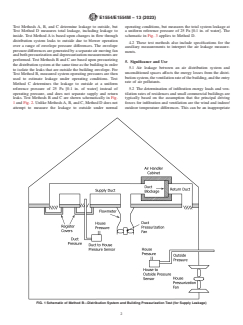
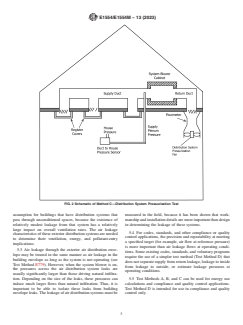
Test Methods A, B, and C determine leakage to outside, but operating conditions, but measures the total system leakage at
Test Method D measures total leakage, including leakage to a uniform reference pressure of 25 Pa [0.1 in. of water]. The
inside. Test Method A is based upon changes in flow through schematic in Fig. 3 applies to Method D.
distribution system leaks to outside due to blower operation
4.2 These test methods also include specifications for the
over a range of envelope pressure differences. The envelope
auxiliary measurements to interpret the air leakage measure-
pressure differences are generated by a separate air moving fan
ments.
and both pressurization and depressurization measurements are
performed. Test Methods B and C are based upon pressurizing
5. Significance and Use
the distribution system at the same time as the building in order
5.1 Air leakage between an air distribution system and
to isolate the leaks that are outside the building envelope. For
unconditioned spaces affects the energy losses from the distri-
Test Method B, measured system operating pressures are then
bution system, the ventilation rate of the building, and the entry
used to estimate leakage under operating conditions. Test
rate of air pollutants.
Method C determines the leakage to outside at a uniform
5.2 The determination of infiltration energy loads and ven-
reference pressure of 25 Pa [0.1 in. of water] instead of
operating pressure, and does not separate supply and return tilation rates of residences and small commercial buildings are
leaks. Test Methods B and C are shown schematically in Fig. typically based on the assumption that the principal driving
1 and Fig. 2. Unlike Methods A, B, and C, Method D does not forces for infiltration and ventilation are the wind and indoor/
attempt to measure the leakage to outside under normal outdoor temperature differences. This can be an inappropriate
FIG. 1 Schematic of Method B—Distribution System and Building Pressurization Test (for Supply Leakage)
E1554/E1554M − 13 (2023)
FIG. 2 Schematic of Method C—Distribution System Pressurization Test
assumption for buildings that have distribution systems that measured in the field, because it has been shown that work-
pass through unconditioned spaces, because the existence of
manship and installation details are more important than design
relatively modest leakage from that system has a relatively in determining the leakage of these systems.
large impact on overall ventilation rates. The air leakage
5.4 For codes, standards, and other compliance or quality
characteristics of these exterior distribution systems are needed
control applications, the precision and repeatability at meeting
to determine their ventilation, energy, and pollutant-entry
a specified target (for example, air flow at reference pressure)
implications.
is more important than air leakage flows at operating condi-
5.3 Air leakage through the exterior air distribution enve-
tions. Some existing codes, standards, and voluntary programs
lope may be treated in the same manner as air leakage in the
require the use of a simpler test method (Test Method D) that
building envelope as long as the system is not operating (see
does not separate supply from return leakage, leakage to inside
Test Method E779). However, when the system blower is on,
from leakage to outside, or estimate leakage pressures at
the pressures across the air distribution system leaks are
operating conditions.
usually significantly larger than those driving natural infiltra-
5.5 Test Methods A, B, and C can be used for energy use
tion. Depending on the size of the leaks, these pressures can
induce much larger flows than natural infiltration. Thus, it is calculations and compliance and quality control applications.
important to be able to isolate these leaks from building Test Method D is intended for use in compliance and quality
envelope leaks. The leakage of air distribution systems must be control only.
E1554/E1554M − 13 (2023)
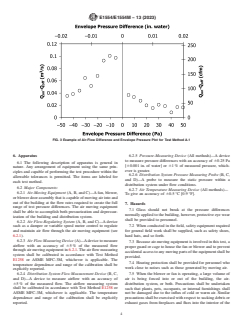
FIG. 3 Example of Air-Flow Difference and Envelope Pressure Plot for Test Method A.1
6. Apparatus 6.2.5 Pressure-Measuring Device (All methods)—A device
to measure pressure differences with an accuracy of 60.25 Pa
6.1 The following description of apparatus is general in
[60.001 in. of water] or 61 % of measured pressure, which-
nature. Any arrangement of equipment using the same prin-
ever is greater.
ciples and capable of performing the test procedure within the
6.2.6 Distribution System Pressure Measuring Probe (B, C,
allowable tolerances is permitted. The items are labeled for
and D)—A probe to measure the static pressure within a
each test method.
distribution system under flow conditions.
6.2 Major Components:
6.2.7 Air Temperature Measuring Device (All methods)—
6.2.1 Air-Moving Equipment (A, B, and C)—A fan, blower,
To give an accuracy of 60.5 °C [0.9 °F].
or blower door assembly that is capable of moving air into and
out of the building at the flow rates required to create the full
7. Hazards
range of test pressure differences. The air moving equipment
7.1 Glass should not break at the pressure differences
shall be able to accomplish both pressurization and depressur-
normally applied to the building, however, protective eye wear
ization of the building and distribution system.
shall be provided to personnel.
6.2.2 Air Flow-Regulating System (A, B, and C)—A device
such as a damper or variable speed motor control to regulate 7.2 When conducted in the field, safety equipment required
for general field work shall be supplied, such as safety shoes,
and maintain air flow through the air moving equipment (see
6.2.1). hard hats, and so forth.
6.2.3 Air Flow Measuring Device (A)—A device to measure
7.3 Because air-moving equipment is involved in this test, a
airflow with an accuracy of 65 % of the measured flow
proper guard or cage to house the fan or blower and to prevent
through air moving equipment in 6.2.1. The air flow measuring
accidental access to any moving parts of the equipment shall be
system shall be calibrated in accordance with Test Method
provided.
E1258 or ASME MFC-3M, whichever is applicable. The
7.4 Hearing protection shall be provided for personnel who
temperature dependence and range of the calibration shall be
work close to noises such as those generated by moving air.
explicitly reported.
6.2.4 Distribution System Flow Measurement Device (B, C, 7.5 When the blower or fan is operating, a large volume of
and D)—A device to measure airflow with an accuracy of air is being forced into or out of the building, the air-
65 % of the measured flow. The airflow measuring system distribution system, or both. Precautions shall be undertaken
shall be calibrated in accordance with Test Method E1258 or such that plants, pets, occupants, or internal furnishings shall
ASME MFC-3M, whichever is applicable. The temperature not be damaged due to the influx of cold or warm air. Similar
dependence and range of the calibration shall be explicitly precautions shall be exercised with respect to sucking debris or
reported. exhaust gases from fireplaces and flues into the interior of the
E1554/E1554M − 13 (2023)
building extinguishing pilot lights, flame rollout for combus- 8.2.1 Environmental Measurements—At the beginning and
tion appliances and drawing sewer gas into the building. the end of each test, measure the outdoor temperature, indoor
temperature, and barometric pressure.
8. Procedure
8.2.2 Building Preparation:
8.2.2.1 Envelope—Open all interconnecting doors in the
8.1 General—The basic procedure involves pressurization
building. Fireplace and other operable dampers shall be closed.
and depressurization of air distribution systems and buildings
If the air handling unit is located in a closet, the closet door
with concurrent flow and pressure measurements to determine
shall be closed during testing. The condition of openings to
the air leakage of the distribution system.
outside for spaces that contain ducts (for example, garage
8.1.1 Test Method A (Flow Difference) for Air Leakage
doors or basement windows) shall be recorded.
Determination—This technique is based upon changing the
8.2.2.2 Distribution System—HVAC-balancing dampers and
flow through distribution system leaks by operating the blower
registers, in general, shall not be adjusted. However, for
fan and simultaneously pressurizing (or depressurizing) the
multiple zoned systems, the position of zonal dampers should
building envelope and distribution system. There are two
be fixed for the duration of the test. Several tests may be
alternatives for gathering the required test data utilizing the
performed with zone dampers fixed at different settings, but at
same analysis procedure. Test Method A.1 records data at fixed
least one of the tests shall have all zone control dampers in the
envelope pressure stations. Test Method A.2 records data
fully open position.
continuously as the envelope air flows and pressure are
8.2.3 Air Flow Difference Measurements:
gradually changed by the envelope air moving equipment. The
blower speed and heating or cooling function shall be the same 8.2.3.1 Connect the air moving/flow-regulating/flow mea-
for all steps of the test procedure. surement assembly to the building envelope using a window or
8.1.2 Test Method B: Fan Pressurization of Distribution door opening. Seal or tape openings to avoid leakage at these
System and Building for Air Leakage Determination—This points.
technique is based upon sealing the registers of the distribution
8.2.3.2 Install the envelope pressure difference sensor. The
system and pressurizing the system to measure the flow
outside pressure measurement location shall be sheltered from
through the leaks at the imposed pressure difference. With the wind and sunshine. The inside pressure measurement location
building pressurized to the same pressure, this test isolates the
shall be as far away as possible from the localized air flows
leaks that are to outside only. Measurements of system oper- induced by the air moving apparatus. All the envelope pres-
ating pressures allow the leakage flow at the fixed test pressure
sures use the outside pressure as the reference.
to be converted to the leakage flow at operating pressures.
8.2.3.3 With air moving fan opening blocked, air moving
Often air distribution systems are located outside the condi-
fan off and blower off measure pressure difference across
tioned space of a building, but are not completely outside.
envelope: ΔP .
zero
Example locations include attics, crawlspaces, and garages.
8.2.3.4 For Test Method A.1 (Pressure Stations) follow
These locations are defined as buffer zones.
8.2.3.5 through 8.2.3.9. For Test Method A.2 (Ramping) follow
8.1.3 Test Method C: Fan Pressurization of Distribution
8.2.3.10 through 8.2.3.13.
System and Building for Air Leakage Determination at a
8.2.3.5 With the blower off, turn on the air moving device
Determination at a Reference Pressure—This technique is
and adjust the flow until there is 5 Pa [0.02 in. of water]
based upon sealing the registers of the distribution system and
envelope pressure difference relative to ΔP , with the build-
zero
pressurizing the system to measure the flow through the leaks
ing at a higher pressure than outside (for pressurization
at a reference pressure difference of 25 Pa [0.1 in. of water].
testing). Record the envelope pressure difference (ΔP ) and
env
With the building pressurized to the same pressure, this test
flow (Q ) through the air-moving device at this pressure
off
isolates the leaks that are to outside only, but does not separate
station. Only record pressure and flow readings when the
supply and return leaks or convert results to operating pres-
pressure reading is within 1.0 Pa [0.004 in. of water] of the
sures.
5 Pa [0.02 in. of water] operating point. Multiple pressure and
8.1.4 Test Method D: Fan Pressurization of Distribution
flow readings shall be recorded at each operating point and
System for Total Air Leakage Determination—This technique is
averaged for use in the calculation procedure. A minimum
based upon sealing the registers of the distribution system and
averaging time of 10 s shall be used. The ΔP offset pressure
zero
pressurizing the system to measure the flow through the leaks
shall be added to all target pressures. For example, if ΔP is
zero
at the imposed pressure difference. The result is a total
2 Pa, then the first target pressure for pressurization is 7 Pa and
distribution system leakage at a single reference pressure
–3 Pa for depressurization. All the air-moving device flows are
difference of 25 Pa [0.1 in. of water]. This test does not
positive into the building and negative if out of the building.
separate supply and return leaks, convert to operating
8.2.3.6 Repeat step 8.2.3.5, but with the envelope pressure
pressures, or isolate leaks to outside from those to inside.
difference, ΔP , incremented by 5 Pa each time until the
env
8.2 Procedure for Test Method A: Air Flow Difference: Test envelope pressure difference is 50 Pa. At each ΔP pressure
env
Method A has four parts to the test: station the pressure difference must be within 1 Pa [0.004 in. of
(1) Building pressurized, blower off. water] of the required operating point. Record the envelope
(2) Building pressurized, blower on. pressure difference with the blower fan off, ΔP , for each
off
(3) Building depressurized, blower on. pressure station. Because the tightness of the building and the
(4) Building depressurized, blower off. weather conditions affect leakage measurements, the full range
E1554/E1554M − 13 (2023)
of the higher values may not be achievable. In such cases, into the airflow. Keep the probe clear of the direct blower
substitute a partial range encompassing at least five data points, discharge in the supply plenum, or any point in the plenum
with the size of pressure increments suitably adjusted. At each
where excessive turbulence may be found. Measure the pres-
pressure station, the blower on and off conditions must both sure difference between the supply plenum and outside, ΔP .
s
have the same target pressure.
Should a negative reading be found in the supply plenum select
8.2.3.7 Turn on the blower fan and wait at least one minute
another measurement location, preferably further away from
for the blower to reach its operating speed. Repeat the the blower. The pressure readings shall be averaged for a
measurements in sections 8.2.3.5 and 8.2.3.6, recording Q
minimum of five seconds. Insert a static pressure probe into the
on
and ΔP at each pressure station.
return plenum, with the tip facing into the airflow. Keep the
on
8.2.3.8 Repeat 8.2.3.7, but with the building depressurized,
probe clear of any point in the plenum where excessive
that is, for the first point, adjust the flow through the air-
turbulence may be found. Measure the pressure difference
moving device until there is a –5 Pa envelope pressure
between the return plenum and outside, ΔP . Should a positive
r
difference relative to ΔP , with the building at a lower
reading be found in the return plenum, select another measure-
zero
pressure than outside.
ment location. The pressure readings shall be averaged for a
8.2.3.9 Repeat 8.2.3.8, but with the blower fan off.
minimum of five seconds.
8.2.3.10 With the blower off, turn on the air moving device
8.3.3.2 Install the envelope pressure difference sensor. The
and gradually increase the flow to a maximum envelope
outside pressure measurement location shall be sheltered from
pressure of at least 50 Pa [0.2 in. of water] with the building at
wind and sunshine. The inside pressure measurement location
a higher pressure than outside. Continuously record the enve-
shall be as far away as possible from the localized air flows
lope pressure difference (ΔP ) and flow (Q ) through the
env off
induced by the air moving apparatus.
air-moving device. Data may be recorded either as a single
8.3.3.3 Connect the envelope air moving/flow-regulating/
ramp up to the maximum flow or as a ramp up followed by a
flow measurement assembly to the building envelope using a
ramp down. The total time to acquire the data for either
window or door opening.
recording method shall be at least 90 s. Because the tightness
8.3.3.4 Separate the supply and return sections of the
of the building affects the maximum achievable envelope
distribution system by inserting an air-tight blockage. If filters
pressure, the maximum envelope pressure might not be achiev-
are installed near the entrance to the equipment or the exit of
able. In such cases, use the maximum envelope pressure
the blower cabinet, then install the blockage in the filter slot
achievable with the test equipment being used.
(after removing the filter). Alternatively, a blockage may be
8.2.3.11 Turn on the blower fan and wait at least one minute
installed within the blower cabinet.
for the blower to reach its operating speed. Repeat the
8.3.3.5 Select two supply locations: one for the distribution
measurements in 8.2.3.10. The ramping method (either a single
system pressurization device and one for the static pressure
ramp up or a ramp up followed by a ramp down) shall be the
probe, and two return locations (unless there is only a single
same for both the blower off and blower on data.
return for the system under test). These locations shall be
8.2.3.12 Repeat 8.2.3.11, but with the building depressur-
selected to have the lowest possible air flow resistance to the
ized.
supply and return plenums, respectively.
8.2.3.13 Repeat 8.2.3.10, but with the blower fan off.
8.3.3.6 Attach the distribution system flow measuring and
8.3 Procedure for Test Method B: Fan Pressurization of
air moving equipment to the supply side of the distribution
Distribution System and Building:
system at the register selected in 8.3.3.5 or at the blower access
8.3.1 Environmental Measurements—At the beginning and
panel if the blockage is on the return side of the blower fan.
the end of each fan pressurization test, measure the outdoor
Install a distribution system pressure probe at a supply register
temperature, indoor temperature, and barometric pressure.
selected in 8.3.3.5 (other than that to which the equipment is
8.3.2 Building Preparation:
connected) or the supply plenum. Ensure that all other supply
8.3.2.1 Envelope—Open all interconnecting doors in the
registers are sealed and at least one return register is open and
building. Fireplace and other operable dampers shall be closed.
that the return registers are uncovered.
If the air handling unit is located in a closet, the closet door
8.3.3.7 Adjust the distribution system flow measuring and
shall be closed during testing. The condition of openings to
air moving equipment to provide 25 Pa [0.1 in. of water]
outside for spaces that contain ducts (for example, garage
pressure difference between the distribution system and out-
doors or basement windows) shall be recorded.
side. Adjust the envelope air moving device to maintain 25 Pa
8.3.2.2 Distribution System—HVAC-balancing dampers
(65 Pa) [0.1 in. of water (60.02 in. of water)] between the
shall be in their fully open position during the fan pressuriza-
building and outside. Adjust the distribution system flow
tion tests, and their original positions shall be recorded.
measuring and air moving equipment to maintain these pres-
Registers shall not be adjusted.
sure differences. This step may require several iterations.
8.3.3 System and Building Pressure and Flow Measure-
Record the flow through the distribution system flow measur-
ments:
ing device (Q ). Also record the envelope pr
...