


ASTM D3623-78a(2020)
(Test Method)Standard Test Method for Testing Antifouling Panels in Shallow Submergence
Standard Test Method for Testing Antifouling Panels in Shallow Submergence
SIGNIFICANCE AND USE
4.1 This method is designed as a screening test in evaluating antifouling coating systems. Results of the standard system in a specific marine environment are included to assist in interpreting results (see Annex A2).
4.2 Antifouling systems providing positive comparisons with the standard system should be considered acceptable for use in protecting underwater marine structures.
4.3 The degree and type of fouling will vary depending on the environment. Hence, differences in geographic location of test sites, in time of year when panels are exposed, and in weather conditions from 1 year to the next can affect results. Therefore, a fouling census on a nontoxic surface is taken. For the exposure to be valid the nontoxic surface should show heavy fouling, and the standard system should show significantly less fouling than the nontoxic surface (see Annex A3 and Annex A4).
SCOPE
1.1 This test method covers a procedure for testing antifouling compositions in shallow marine environments and a standard antifouling panel of known performance to serve as a control in antifouling studies.
Note 1: Subcommittee D01.45 has a revised rating procedure now being evaluated by round robin.
1.2 The values stated in SI units are to be regarded as the standard. The values given in parentheses are for information only.
1.3 This standard does not purport to address all of the safety concerns, if any, associated with its use. It is the responsibility of the user of this standard to establish appropriate safety, health, and environmental practices and determine the applicability of regulatory limitations prior to use.
1.4 This international standard was developed in accordance with internationally recognized principles on standardization established in the Decision on Principles for the Development of International Standards, Guides and Recommendations issued by the World Trade Organization Technical Barriers to Trade (TBT) Committee.
General Information
Relations
Standards Content (Sample)
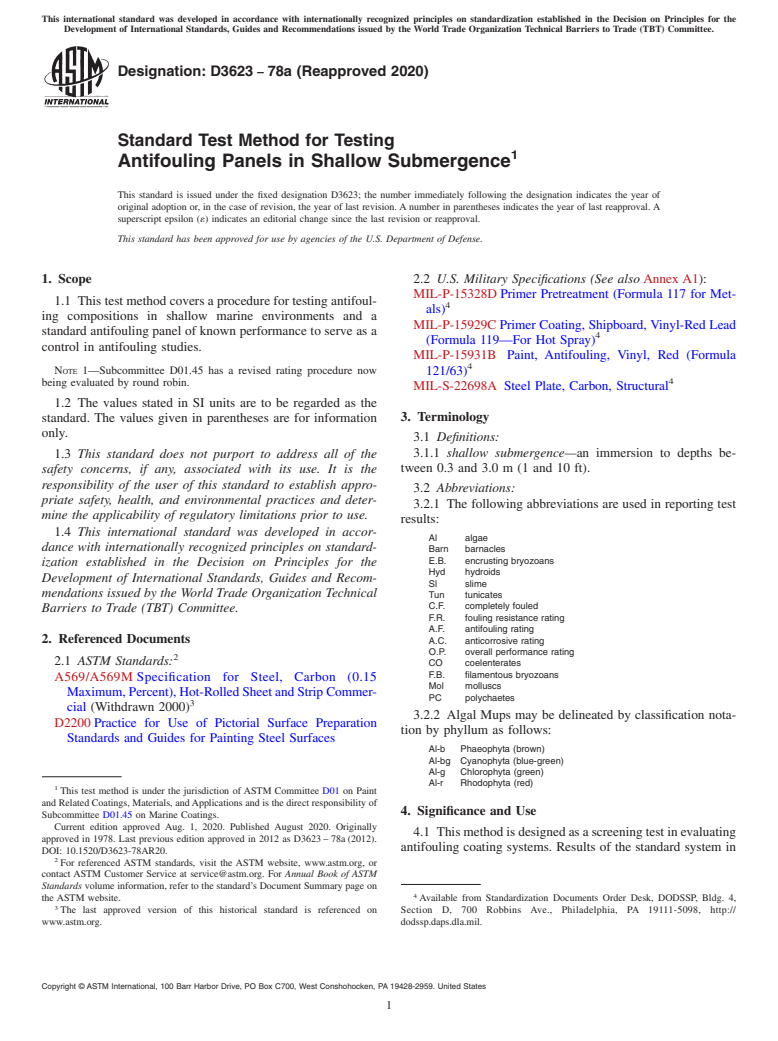
This international standard was developed in accordance with internationally recognized principles on standardization established in the Decision on Principles for the
Development of International Standards, Guides and Recommendations issued by the World Trade Organization Technical Barriers to Trade (TBT) Committee.
Designation: D3623 − 78a (Reapproved 2020)
Standard Test Method for Testing
1
Antifouling Panels in Shallow Submergence
This standard is issued under the fixed designation D3623; the number immediately following the designation indicates the year of
original adoption or, in the case of revision, the year of last revision.Anumber in parentheses indicates the year of last reapproval.A
superscript epsilon (´) indicates an editorial change since the last revision or reapproval.
This standard has been approved for use by agencies of the U.S. Department of Defense.
1. Scope 2.2 U.S. Military Specifications (See alsoAnnex A1):
MIL-P-15328DPrimer Pretreatment (Formula 117 for Met-
1.1 Thistestmethodcoversaprocedurefortestingantifoul-
4
als)
ing compositions in shallow marine environments and a
MIL-P-15929CPrimer Coating, Shipboard, Vinyl-Red Lead
standard antifouling panel of known performance to serve as a
4
(Formula 119—For Hot Spray)
control in antifouling studies.
MIL-P-15931B Paint, Antifouling, Vinyl, Red (Formula
4
NOTE 1—Subcommittee D01.45 has a revised rating procedure now
121/63)
4
being evaluated by round robin.
MIL-S-22698A Steel Plate, Carbon, Structural
1.2 The values stated in SI units are to be regarded as the
3. Terminology
standard. The values given in parentheses are for information
only.
3.1 Definitions:
3.1.1 shallow submergence—an immersion to depths be-
1.3 This standard does not purport to address all of the
tween 0.3 and 3.0 m (1 and 10 ft).
safety concerns, if any, associated with its use. It is the
responsibility of the user of this standard to establish appro-
3.2 Abbreviations:
priate safety, health, and environmental practices and deter-
3.2.1 The following abbreviations are used in reporting test
mine the applicability of regulatory limitations prior to use.
results:
1.4 This international standard was developed in accor-
Al algae
dance with internationally recognized principles on standard-
Barn barnacles
E.B. encrusting bryozoans
ization established in the Decision on Principles for the
Hyd hydroids
Development of International Standards, Guides and Recom-
Sl slime
mendations issued by the World Trade Organization Technical
Tun tunicates
C.F. completely fouled
Barriers to Trade (TBT) Committee.
F.R. fouling resistance rating
A.F. antifouling rating
2. Referenced Documents A.C. anticorrosive rating
O.P. overall performance rating
2
2.1 ASTM Standards:
CO coelenterates
F.B. filamentous bryozoans
A569/A569M Specification for Steel, Carbon (0.15
Mol molluscs
Maximum,Percent),Hot-RolledSheetandStripCommer-
PC polychaetes
3
cial (Withdrawn 2000)
3.2.2 Algal Mups may be delineated by classification nota-
D2200Practice for Use of Pictorial Surface Preparation
tion by phyllum as follows:
Standards and Guides for Painting Steel Surfaces
Al-b Phaeophyta (brown)
Al-bg Cyanophyta (blue-green)
Al-g Chlorophyta (green)
Al-r Rhodophyta (red)
1
This test method is under the jurisdiction of ASTM Committee D01 on Paint
and Related Coatings, Materials, andApplications and is the direct responsibility of
4. Significance and Use
Subcommittee D01.45 on Marine Coatings.
Current edition approved Aug. 1, 2020. Published August 2020. Originally
4.1 Thismethodisdesignedasascreeningtestinevaluating
approved in 1978. Last previous edition approved in 2012 as D3623–78a(2012).
antifouling coating systems. Results of the standard system in
DOI: 10.1520/D3623-78AR20.
2
For referenced ASTM standards, visit the ASTM website, www.astm.org, or
contact ASTM Customer Service at service@astm.org. For Annual Book of ASTM
Standards volume information, refer to the standard’s Document Summary page on
4
the ASTM website. Available from Standardization Documents Order Desk, DODSSP, Bldg. 4,
3
The last approved version of this historical standard is referenced on Section D, 700 Robbins Ave., Philadelphia, PA 19111-5098, http://
www.astm.org. dodssp.daps.dla.mil.
Copyright © ASTM International, 100 Barr Harbor Drive, PO Box C700, West Conshohocken, PA 19428-2959. United States
1
---------------------- Page: 1 ----------------------
D3623 − 78a (2020)
a specific marine environment are included to assist in inter- 6.2.3 Vinyl antifouling coating conforming to U.S. Military
preting results (see Annex A2). Specification MIL-P-15931B (Formula 121/63), B revision
only.
4.2 Antifouling systems providing positive comparisons
with the standard system should be considered acceptable for 6.3 Test Coating System—The test antifouling coating may
use in protecting underwater marine structures. be applied to the standard primer system, or to any other
suitable anticorrosive primer system.
4.3 The degree and type of fouling will vary d
...
Questions, Comments and Discussion
Ask us and Technical Secretary will try to provide an answer. You can facilitate discussion about the standard in here.