

ASTM D5489-18(2023)
(Guide)Standard Guide for Care Symbols for Care Instructions on Textile Products
General Information
- Abstract
SIGNIFICANCE AND USE
4.1 This guide provides symbols and a system for their use by which care instructions for textile products can be conveyed in a simple, space-saving, and easily understood pictorial format that is not language dependent. See also ADJD5489-E-PDF. Currently, the FTC Care Labeling Rule recognizes Guide D5489-96c.
4.2 Care symbols are an important means for identifying the appropriate care procedure for home laundering, commercial laundering, professional textile care, and coin-operated drycleaning, of textile products.
4.3 Care labeling using symbols can be used by the purchaser to select textiles on the basis of the care method required without knowledge of the language. The FTC Care Labeling Rule specifies Guide D5489-96c symbols. Additional changes in words and symbols have been added to this guide which are not covered by 16 CFR 423. In the United States, when care symbols only are to be included in a care label, the FTC requires that the Guide D5489-96c version of symbols must be used. However, the symbols, as included in this standard version (Guide D5489-18), may be used if symbols are used in addition to full care instructions written in English wording.
4.4 In countries in which a word-based care labeling system is required, the care symbol system may be used as a supplemental system.
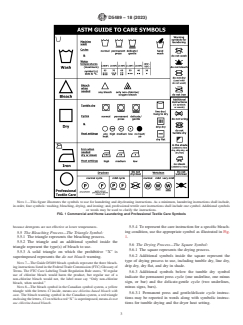
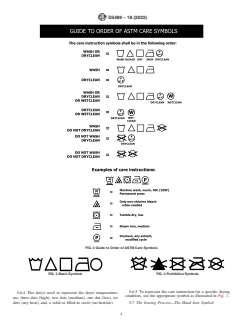
4.5 The word-based instructions for each symbol in this guide are harmonious with Terminology D123, and Terminology D3136, the United States Federal Trade Commission Care Labeling Rule, 16 CFR 423, and industry practice (see Figs. 1 and 2).
FIG. 1 Commercial and Home Laundering and Professional Textile Care Symbols
Note 1: This figure illustrates the symbols to use for laundering and drycleaning instructions. As a minimum, laundering instructions shall include, in order, four symbols: washing, bleaching, drying, and ironing; and, professional textile care instructions shall include one symbol. Additional symbols or words may be used to clarify the instructions.
...
SCOPE
1.1 This guide provides a uniform system of symbols for the disclosure of care instructions on textile products such as apparel, piece goods, and household and institutional articles, hereinafter referred to as “textile,” or “textile product.”
1.2 This guide provides a comprehensive system of symbols to represent care instructions reducing language-dependent care instructions.
1.3 The values stated in SI units are to be regarded as the standard. The values given in parentheses are for information only.
1.4 This standard does not purport to address all of the safety concerns, if any, associated with its use. It is the responsibility of the user of this standard to establish appropriate safety, health, and environmental practices and determine the applicability of regulatory limitations prior to use.
1.5 This international standard was developed in accordance with internationally recognized principles on standardization established in the Decision on Principles for the Development of International Standards, Guides and Recommendations issued by the World Trade Organization Technical Barriers to Trade (TBT) Committee.
- Status
- Published
- Publication Date
- 30-Nov-2023
- Technical Committee
- D13 - Textiles
- Drafting Committee
- D13.62 - Labeling
Overview
ASTM D5489-18(2023) – Standard Guide for Care Symbols for Care Instructions on Textile Products establishes a comprehensive system of care symbols designed for textile products such as apparel, household, and institutional textiles. Published by ASTM International, this standard provides a uniform and efficient method to convey care instructions in a pictorial format that transcends language barriers. These textile care symbols make it easier for manufacturers, retailers, and consumers to understand and comply with appropriate care processes, helping to maintain textile longevity and performance.
This guide is internationally recognized, aligns with the principles established by the World Trade Organization’s Technical Barriers to Trade Committee, and is referenced by regulations such as the U.S. Federal Trade Commission (FTC) Care Labeling Rule.
Key Topics
- Pictorial Care Symbols: The guide introduces five core care symbols-for washing, bleaching, drying, ironing, and professional textile care-including variations for specific processes like tumble dry or hand washing.
- Non-Language Dependent Communication: By using symbols instead of words, this system enables global use and makes care instructions accessible regardless of users’ language proficiency.
- Labeling Requirements: The standard specifies the order and minimum number of care symbols required on product care labels, ensuring clarity and consistency.
- Prohibitive Symbols: An “X” may be superimposed on care symbols to indicate that a particular process (e.g., “do not bleach”) could harm the textile.
- Supplemental Use: In countries where word-based labels are standard, care symbols can be used additionally for enhanced clarity.
- Regulatory Compliance: The FTC recognizes a specific version of these symbols for labels using symbols only, but the updated version of the standard may be used alongside English text instructions.
- Consistency with Industry Practice: Instructions and terminology align with other key standards and industry conventions, supporting seamless integration.
Applications
ASTM D5489-18(2023) is valuable for a wide range of stakeholders in the textile industry. Its primary applications include:
- Manufacturers: Ensures the correct use of care instructions for apparel, textile piece goods, and household items, improving consumer transparency and satisfaction.
- Retailers: Supports clear and uniform care information, reducing confusion and returns due to misuse.
- Consumers: Helps users select products appropriate for their needs and understand how to maintain textiles without requiring detailed language knowledge.
- Professional Cleaners: Provides clear guidelines for laundering, drycleaning, and professional wetcleaning, supporting industry best practices.
- Global Trade: Facilitates the international sale of textile products by providing a universally understood system, minimizing product returns and complaints due to misunderstood care requirements.
Related Standards
For best results when implementing or referencing ASTM D5489-18(2023), consider the following related standards:
- ASTM D123: Terminology Relating to Textiles
- ASTM D3136: Terminology Relating to Care Labeling for Apparel and Textile Products
- ASTM D3938: Guide for Determining or Confirming Care Instructions for Apparel and Other Textile Products
- FTC Care Labeling Rule (16 CFR 423): Specifies care labeling requirements for textiles in the United States
- AATCC Technical Manual: Contains relevant test methods and industry best practices
- CAN/CGSB-86.1-M91: Canadian standard for care labeling of textiles
Keywords: care instructions, textile care symbols, laundering, bleaching, drying, ironing, drycleaning, washing, permanent care label, ASTM textile standards, care labeling, international textile care.
Relations
- Effective Date
- 01-Dec-2023
- Referred By
ASTM F3392-20 - Standard Practice for Exoskeleton Wearing, Care, and Maintenance Instructions - Effective Date
- 01-Dec-2023
- Effective Date
- 01-Dec-2023
- Effective Date
- 01-Dec-2023
- Effective Date
- 01-Dec-2023
- Effective Date
- 01-Dec-2023
- Effective Date
- 01-Dec-2023
Frequently Asked Questions
ASTM D5489-18(2023) is a guide published by ASTM International. Its full title is "Standard Guide for Care Symbols for Care Instructions on Textile Products". This standard covers: SIGNIFICANCE AND USE 4.1 This guide provides symbols and a system for their use by which care instructions for textile products can be conveyed in a simple, space-saving, and easily understood pictorial format that is not language dependent. See also ADJD5489-E-PDF. Currently, the FTC Care Labeling Rule recognizes Guide D5489-96c. 4.2 Care symbols are an important means for identifying the appropriate care procedure for home laundering, commercial laundering, professional textile care, and coin-operated drycleaning, of textile products. 4.3 Care labeling using symbols can be used by the purchaser to select textiles on the basis of the care method required without knowledge of the language. The FTC Care Labeling Rule specifies Guide D5489-96c symbols. Additional changes in words and symbols have been added to this guide which are not covered by 16 CFR 423. In the United States, when care symbols only are to be included in a care label, the FTC requires that the Guide D5489-96c version of symbols must be used. However, the symbols, as included in this standard version (Guide D5489-18), may be used if symbols are used in addition to full care instructions written in English wording. 4.4 In countries in which a word-based care labeling system is required, the care symbol system may be used as a supplemental system. 4.5 The word-based instructions for each symbol in this guide are harmonious with Terminology D123, and Terminology D3136, the United States Federal Trade Commission Care Labeling Rule, 16 CFR 423, and industry practice (see Figs. 1 and 2). FIG. 1 Commercial and Home Laundering and Professional Textile Care Symbols Note 1: This figure illustrates the symbols to use for laundering and drycleaning instructions. As a minimum, laundering instructions shall include, in order, four symbols: washing, bleaching, drying, and ironing; and, professional textile care instructions shall include one symbol. Additional symbols or words may be used to clarify the instructions. ... SCOPE 1.1 This guide provides a uniform system of symbols for the disclosure of care instructions on textile products such as apparel, piece goods, and household and institutional articles, hereinafter referred to as “textile,” or “textile product.” 1.2 This guide provides a comprehensive system of symbols to represent care instructions reducing language-dependent care instructions. 1.3 The values stated in SI units are to be regarded as the standard. The values given in parentheses are for information only. 1.4 This standard does not purport to address all of the safety concerns, if any, associated with its use. It is the responsibility of the user of this standard to establish appropriate safety, health, and environmental practices and determine the applicability of regulatory limitations prior to use. 1.5 This international standard was developed in accordance with internationally recognized principles on standardization established in the Decision on Principles for the Development of International Standards, Guides and Recommendations issued by the World Trade Organization Technical Barriers to Trade (TBT) Committee.
SIGNIFICANCE AND USE 4.1 This guide provides symbols and a system for their use by which care instructions for textile products can be conveyed in a simple, space-saving, and easily understood pictorial format that is not language dependent. See also ADJD5489-E-PDF. Currently, the FTC Care Labeling Rule recognizes Guide D5489-96c. 4.2 Care symbols are an important means for identifying the appropriate care procedure for home laundering, commercial laundering, professional textile care, and coin-operated drycleaning, of textile products. 4.3 Care labeling using symbols can be used by the purchaser to select textiles on the basis of the care method required without knowledge of the language. The FTC Care Labeling Rule specifies Guide D5489-96c symbols. Additional changes in words and symbols have been added to this guide which are not covered by 16 CFR 423. In the United States, when care symbols only are to be included in a care label, the FTC requires that the Guide D5489-96c version of symbols must be used. However, the symbols, as included in this standard version (Guide D5489-18), may be used if symbols are used in addition to full care instructions written in English wording. 4.4 In countries in which a word-based care labeling system is required, the care symbol system may be used as a supplemental system. 4.5 The word-based instructions for each symbol in this guide are harmonious with Terminology D123, and Terminology D3136, the United States Federal Trade Commission Care Labeling Rule, 16 CFR 423, and industry practice (see Figs. 1 and 2). FIG. 1 Commercial and Home Laundering and Professional Textile Care Symbols Note 1: This figure illustrates the symbols to use for laundering and drycleaning instructions. As a minimum, laundering instructions shall include, in order, four symbols: washing, bleaching, drying, and ironing; and, professional textile care instructions shall include one symbol. Additional symbols or words may be used to clarify the instructions. ... SCOPE 1.1 This guide provides a uniform system of symbols for the disclosure of care instructions on textile products such as apparel, piece goods, and household and institutional articles, hereinafter referred to as “textile,” or “textile product.” 1.2 This guide provides a comprehensive system of symbols to represent care instructions reducing language-dependent care instructions. 1.3 The values stated in SI units are to be regarded as the standard. The values given in parentheses are for information only. 1.4 This standard does not purport to address all of the safety concerns, if any, associated with its use. It is the responsibility of the user of this standard to establish appropriate safety, health, and environmental practices and determine the applicability of regulatory limitations prior to use. 1.5 This international standard was developed in accordance with internationally recognized principles on standardization established in the Decision on Principles for the Development of International Standards, Guides and Recommendations issued by the World Trade Organization Technical Barriers to Trade (TBT) Committee.
ASTM D5489-18(2023) is classified under the following ICS (International Classification for Standards) categories: 61.020 - Clothes; 97.160 - Home textiles. Linen. The ICS classification helps identify the subject area and facilitates finding related standards.
ASTM D5489-18(2023) has the following relationships with other standards: It is inter standard links to ASTM D5489-18, ASTM F3392-20, ASTM F2061-17, ASTM D5253-04(2016), ASTM F3502-23a, ASTM D6322-15, ASTM D3938-18(2023). Understanding these relationships helps ensure you are using the most current and applicable version of the standard.
ASTM D5489-18(2023) is available in PDF format for immediate download after purchase. The document can be added to your cart and obtained through the secure checkout process. Digital delivery ensures instant access to the complete standard document.
Standards Content (Sample)
This international standard was developed in accordance with internationally recognized principles on standardization established in the Decision on Principles for the
Development of International Standards, Guides and Recommendations issued by the World Trade Organization Technical Barriers to Trade (TBT) Committee.
Designation: D5489 − 18 (Reapproved 2023)
Standard Guide for
Care Symbols for Care Instructions on Textile Products
This standard is issued under the fixed designation D5489; the number immediately following the designation indicates the year of
original adoption or, in the case of revision, the year of last revision. A number in parentheses indicates the year of last reapproval. A
superscript epsilon (´) indicates an editorial change since the last revision or reapproval.
1. Scope 2.2 ASTM Adjunct:
Care Symbol Chart
1.1 This guide provides a uniform system of symbols for the
2.3 AATCC Standard:
disclosure of care instructions on textile products such as
A Glossary of AATCC Standard Terminology, Current
apparel, piece goods, and household and institutional articles,
Edition
hereinafter referred to as “textile,” or “textile product.”
2.4 Other Standards:
1.2 This guide provides a comprehensive system of symbols
Federal Trade Commission Amendment to Trade Regulation
to represent care instructions reducing language-dependent
Rule Concerning Care Labeling of Textile Wearing
care instructions.
Apparel, and Certain Piece Goods, Federal Register, Vol
1.3 The values stated in SI units are to be regarded as the
48, No. 99, May 20, 1983 (cited as 16 CFR 423).
standard. The values given in parentheses are for information
The National Standard of Canada —Care Labelling of Tex-
only.
tiles (CAN/CGSB-86.1-M91)
1.4 This standard does not purport to address all of the
3. Terminology
safety concerns, if any, associated with its use. It is the
responsibility of the user of this standard to establish appro-
3.1 Definitions—For definitions of terms related to care
priate safety, health, and environmental practices and deter-
labeling, refer to Terminology D3136. For definitions of other
mine the applicability of regulatory limitations prior to use.
textile terms used in this guide, refer to Terminology D123.
1.5 This international standard was developed in accor-
3.1.1 care instructions, n—in textiles, a series of directions
dance with internationally recognized principles on standard-
that describe practices which should refurbish a product
ization established in the Decision on Principles for the
without adverse effects, and that warn against any part of the
Development of International Standards, Guides and Recom-
directions which one could reasonably be expected to use that
mendations issued by the World Trade Organization Technical
may harm the item. D3136
Barriers to Trade (TBT) Committee.
3.1.2 care label, n—in textiles, a label or other affixed
instruction set that reports how a product should be refur-
2. Referenced Documents
bished.
2.1 ASTM Standards: 3.1.2.1 Discussion—The Federal Trade Commission, in
D123 Terminology Relating to Textiles Rule 16 CFR 423, requires care instructions on most apparel
D3136 Terminology Relating to Care Labeling for Apparel, and certain other textile items. In relation to these products, the
Textile, Home Furnishing, and Leather Products (With- FTC definition states: “Care Label means a permanent label or
drawn 2023) tag, containing regular care information and instructions, that is
D3938 Guide for Determining or Confirming Care Instruc- attached or affixed in some manner that will not become
tions for Apparel and Other Textile Products separated from the product and will remain legible during the
useful life of the product.” D3136
This guide is under the jurisdiction of ASTM Committee D13 on Textiles and
is the direct responsibility of Subcommittee D13.62 on Labeling. Available from ASTM International Headquarters. Order Adjunct No.
Current edition approved Dec. 1, 2023. Published December 2023. Originally ADJD5489-E-PDF. Original adjunct produced in 1994.
approved in 1993. Last previous edition approved in 2018 as D5489 – 18. DOI: Annual AATCC Technical Manual, available from the American Association of
10.1520/D5489-18R23. Textile Chemists and Colorists (AATCC), P.O. Box 12215, Research Triangle Park,
For referenced ASTM standards, visit the ASTM website, www.astm.org, or NC 27709-2215, http://www.aatcc.org.
contact ASTM Customer Service at service@astm.org. For Annual Book of ASTM Available from U.S. Government Publishing Office, 732 N. Capitol Street, NW,
Standards volume information, refer to the standard’s Document Summary page on Washington, DC 20401, http://www.gpo.gov.
the ASTM website. Available from Canadian General Standards Board (CGSB), 11 Laurier St.,
The last approved version of this historical standard is referenced on Phase III, Place du Portage, Gatineau, Quebec K1A 0S5, Canada, http://www.tpsgc-
www.astm.org. pwgsc.gc.ca/ongc-cgsb.
Copyright © ASTM International, 100 Barr Harbor Drive, PO Box C700, West Conshohocken, PA 19428-2959. United States
D5489 − 18 (2023)
3.1.3 care symbol, n—a pictorial symbol that gives direc- the drying process, the iron represents the ironing or pressing
tions for refurbishing a consumer textile product. process, and the circle represents the professional textile care
process (Fig. 3).
4. Significance and Use
5.3 Prohibitive Symbols—The prohibitive “X” symbol may
4.1 This guide provides symbols and a system for their use
be used only when evidence can be provided that the care
by which care instructions for textile products can be conveyed
procedure on which it is superimposed would adversely change
in a simple, space-saving, and easily understood pictorial
the dimensions, hand, appearance, or performance of the
format that is not language dependent. See also ADJD5489-E-
textile. (Fig. 4).
PDF. Currently, the FTC Care Labeling Rule recognizes Guide
5.4 The Washing Process—The Washtub Symbol:
D5489-96c.
5.4.1 The washtub with a water wave represents the wash-
4.2 Care symbols are an important means for identifying the
ing process in a home laundering or commercial laundering
appropriate care procedure for home laundering, commercial
setting.
laundering, professional textile care, and coin-operated
5.4.1.1 The washtub without a water wave may be used to
drycleaning, of textile products.
present the washing process.
4.3 Care labeling using symbols can be used by the pur-
NOTE 2—The washtub without a water wave is used in the Canadian
chaser to select textiles on the basis of the care method required
care symbol system.
without knowledge of the language. The FTC Care Labeling
5.4.2 Additional symbols inside the washtub indicate the
Rule specifies Guide D5489-96c symbols. Additional changes
suggested water temperature and hand-washing process.
in words and symbols have been added to this guide which are
5.4.3 Additional symbols below the tub indicate the perma-
not covered by 16 CFR 423. In the United States, when care
nent press cycle (one underline, minus sign, or bar) and
symbols only are to be included in a care label, the FTC
delicate-gentle washing cycle (two underlines, minus signs, or
requires that the Guide D5489-96c version of symbols must be
bars).
used. However, the symbols, as included in this standard
5.4.3.1 Permanent dress and gentle/delicate cycle instruc-
version (Guide D5489-18), may be used if symbols are used in
tions may be reported in symbols or words on a label with the
addition to full care instructions written in English wording.
symbolic instructions for machine wash and the water tempera-
4.4 In countries in which a word-based care labeling system
ture.
is required, the care symbol system may be used as a
5.4.4 The numerical or the dot system or both illustrated in
supplemental system.
Fig. 1 may be used to represent the maximum water tempera-
ture for machine and hand washing.
4.5 The word-based instructions for each symbol in this
5.4.4.1 The six washing temperatures are 30 °C (80 °F),
guide are harmonious with Terminology D123, and Terminol-
40 °C (105 °F), 50 °C (120 °F), 60 °C (140 °F), 70 °C
ogy D3136, the United States Federal Trade Commission Care
(160 °F), and 95 °C (200 °F) and shall be in Celsius when
Labeling Rule, 16 CFR 423, and industry practice (see Figs. 1
using the numerical water temperature system.
and 2).
NOTE 3—The Fahrenheit temperatures, while not true conversions from
4.6 The care label symbol system is based on five basic care
Celsius to Fahrenheit, are within the range of tolerance and represent
symbols representing five operations: washing, bleaching,
common consumer usage.
drying, ironing, and professional textile care.
5.4.4.2 The symbols used to represent the maximum water
4.7 One color is used for all care symbols in this care
temperature in the dot system are: six dots [95 °C (200 °F)],
labeling system.
five dots [70 °C (160 °F)], four dots [60 °C (140 °F)], very hot,
NOTE 1—While this symbol system uses one color, it is harmonious three dots [50 °C (120 °F)], hot, two dots [40 °C (105 °F)],
with tri-color systems such as the Canadian system because the instruc-
warm, one dot [30 °C (85 °F)], cool ⁄cold.
tions are clear whether printed in one or three colors.
5.4.4.3 The water temperature placed in the hand washing
4.8 This guide does not specify the type of label material or
symbol may be 40 °C (105 °F) or 30 °C (85 °F).
fabric to use. However, appropriateness for consumer comfort
NOTE 4—In the Canadian care symbol system, a hand in a yellow
is recommended.
washtub means wash gently by hand in cool water (not exceeding 30 °C
(85 °F). In the ISO system, a hand in a washtub means hand wash only,
5. Procedure
do not machine wash, maximum temperature 40 °C (105 °F), handle with
care. A water temperature is not reported in either system.
5.1 Introduction—This section defines the basic symbols
and prohibitive symbols: the washing, bleaching, drying,
5.4.5 To represent the care instruction for a specific wash
ironing, and professional textile care processes; the required
condition, use the appropriate symbol as illustrated in Fig. 1.
number and order of symbols; supplementary care information;
NOTE 5—Consumers may obtain washing machine temperatures that
and appropriate instructions and labels.
are frequently below the suggested temperature. The actual water tem-
perature obtained when using the washing machine settings of hot, warm,
5.2 Basic Symbols:
and cold vary in North American by region, season, water heater settings,
5.2.1 There are five basic symbols: the washtub, triangle,
and regulations governing factory-set mixes. In general, North American
square, iron, and circle.
washing machines do not have internal heaters.
5.2.2 The washtub represents the washing process, the
NOTE 6—For consumer information the 30 °C wash water is repre-
triangle represents the bleaching process, the square represents sented on the symbol charts by the temperature range of 65 °F to 85 °F
D5489 − 18 (2023)
NOTE 1—This figure illustrates the symbols to use for laundering and drycleaning instructions. As a minimum, laundering instructions shall include,
in order, four symbols: washing, bleaching, drying, and ironing; and, professional textile care instructions shall include one symbol. Additional symbols
or words may be used to clarify the instructions.
FIG. 1 Commercial and Home Laundering and Professional Textile Care Symbols
because detergents are not effective at lower temperatures.
5.5.4 To represent the care instruction for a specific bleach-
ing condition, use the appropriate symbol as illustrated in Fig.
5.5 The Bleaching Process—The Triangle Symbol:
1.
5.5.1 The triangle represents the bleaching process.
5.5.2 The triangle and an additional symbol inside the
5.6 The Drying Process—The Square Symbol:
triangle represent the type(s)
...