

ASTM D5599-22
(Test Method)Standard Test Method for Determination of Oxygenates in Gasoline by Gas Chromatography and Oxygen Selective Flame Ionization Detection
General Information
- Abstract
SIGNIFICANCE AND USE
5.1 In gasoline blending, the determination of organic oxygenated compounds is important. Alcohols, ethers, and other oxygenates are added to gasoline to increase the octane number and to reduce tailpipe emissions of carbon monoxide. They must be added in the proper concentration and ratios to meet regulatory limitations and to avoid phase separation and problems with engine performance or efficiency.
5.2 This test method provides sufficient oxygen-to-hydro-carbon selectivity and sensitivity to allow determination of oxygenates in gasoline samples without interference from the bulk hydrocarbon matrix.
SCOPE
1.1 This test method covers a gas chromatographic procedure for the quantitative determination of organic oxygenated compounds in gasoline having a final boiling point not greater than 220 °C and oxygenates having a boiling point limit of 130 °C. It is applicable when oxygenates are present in the 0.1 % to 20 % by mass range.
1.2 This test method is intended to determine the mass concentration of each oxygenate compound present in a gasoline. This requires knowledge of the identity of each oxygenate being determined (for calibration purposes). However, the oxygen-selective detector used in this test method exhibits a response that is proportional to the mass of oxygen. It is, therefore, possible to determine the mass concentration of oxygen contributed by any oxygenate compound in the sample, whether or not it is identified. Total oxygen content in a gasoline may be determined from the summation of the accurately determined individual oxygenated compounds. The summed area of other, uncalibrated or unknown oxygenated compounds present, may be converted to a mass concentration of oxygen and summed with the oxygen concentration of the known oxygenated compounds.
1.3 The values stated in SI units are to be regarded as standard. No other units of measurement are included in this standard.
1.4 This standard does not purport to address all of the safety concerns, if any, associated with its use. It is the responsibility of the user of this standard to establish appropriate safety, health, and environmental practices and determine the applicability of regulatory limitations prior to use.
1.5 This international standard was developed in accordance with internationally recognized principles on standardization established in the Decision on Principles for the Development of International Standards, Guides and Recommendations issued by the World Trade Organization Technical Barriers to Trade (TBT) Committee.
- Status
- Published
- Publication Date
- 31-Mar-2022
- Technical Committee
- D02 - Petroleum Products, Liquid Fuels, and Lubricants
- Drafting Committee
- D02.04.0L - Gas Chromatography Methods
Buy Documents
ASTM D5599-22 - Standard Test Method for Determination of Oxygenates in Gasoline by Gas Chromatography and Oxygen Selective Flame Ionization Detection
REDLINE ASTM D5599-22 - Standard Test Method for Determination of Oxygenates in Gasoline by Gas Chromatography and Oxygen Selective Flame Ionization Detection
Overview
ASTM D5599-22 is the internationally recognized standard test method for the determination of oxygenates in gasoline by gas chromatography with oxygen-selective flame ionization detection (OFID). Developed by ASTM International, this method provides quantitative analysis of organic oxygenated compounds - such as alcohols and ethers - within gasoline samples. It ensures accurate measurement of these additives, which are critical for improving fuel octane ratings and reducing vehicle emissions.
This test method is essential in the petroleum and automotive industries, where compliance with regulatory limits on oxygenate concentrations is crucial for environmental protection and fuel performance.
Key Topics
Scope of the Method
- Applicable to gasoline samples with a final boiling point of up to 220°C and oxygenate compounds up to 130°C.
- Suitable for measuring oxygenate concentrations ranging between 0.1% and 20% by mass.
Significance and Use
- Enables precise determination of both identified and unknown oxygenates, ensuring compliance with legal and environmental standards.
- Allows blending optimization to avoid phase separation and engine performance issues.
Technical Approach
- Utilizes gas chromatography (GC) equipped with an oxygen-selective flame ionization detector.
- Selectively detects oxygenates without interference from hydrocarbons in the bulk gasoline matrix.
- Calibration with standards is required for accurate quantification.
Result Reporting
- Provides mass percent concentration of each oxygenate present.
- Capable of calculating total oxygen content in gasoline.
- Results are reported in SI units as per international measurement standards.
Quality Control
- Incorporates routine analysis of quality control check standards and independent reference standards.
- Recommends use of control charts to monitor measurement stability and identify outliers.
Applications
Gasoline Production and Blending
- Ensures the precise addition of oxygenates to meet regulatory and performance requirements.
- Optimizes fuel formulation for increased octane and improved combustion properties.
Environmental Compliance
- Assists refiners and regulatory bodies to verify that oxygenates are within mandated limits, helping reduce harmful tailpipe emissions, particularly carbon monoxide.
Laboratory Testing
- Used by petroleum laboratories for routine quality assurance, product certification, and troubleshooting of gasoline fuel blends.
Regulatory and Trade
- Supports international trade by providing a standardized approach for oxygenate content determination, facilitating compliance and consistent reporting across jurisdictions.
Related Standards
- ASTM D1298: Test Method for Density, Relative Density, or API Gravity of Crude Petroleum and Liquid Petroleum Products by Hydrometer Method.
- ASTM D4052: Test Method for Density, Relative Density, and API Gravity of Liquids by Digital Density Meter.
- ASTM D4175: Terminology Relating to Petroleum Products, Liquid Fuels, and Lubricants.
- ASTM D4307: Practice for Preparation of Liquid Blends for Use as Analytical Standards.
- ASTM D6299: Practice for Applying Statistical Quality Assurance and Control Charting Techniques to Analytical Measurement Systems.
- ASTM E355: Practice for Gas Chromatography Terms and Relationships.
- ASTM E594: Practice for Testing Flame Ionization Detectors Used in Gas or Supercritical Fluid Chromatography.
- ASTM E1064: Test Method for Water in Organic Liquids by Coulometric Karl Fischer Titration.
- ASTM E1510: Practice for Installing Fused Silica Open Tubular Capillary Columns in Gas Chromatographs.
Practical Value
By implementing ASTM D5599-22, laboratories and fuel producers gain a reliable, precise, and internationally accepted method for quantifying oxygenated compounds in gasoline. This supports fuel quality, upholds regulatory compliance, and contributes to cleaner automotive emissions through accurate formulation and monitoring of oxygenate additives such as methanol, ethanol, MTBE, ETBE, and TAME.
Keywords: ASTM D5599-22, oxygenates in gasoline, gas chromatography, oxygen selective detection, OFID, ethanol, methanol, MTBE, ETBE, TAME, quality control, fuel emissions, regulatory compliance, petroleum analysis, fuel blending.
Relations
- Effective Date
- 01-Jan-2024
- Refers
ASTM D4175-23a - Standard Terminology Relating to Petroleum Products, Liquid Fuels, and Lubricants - Effective Date
- 15-Dec-2023
- Effective Date
- 01-Dec-2023
- Refers
ASTM D4175-23e1 - Standard Terminology Relating to Petroleum Products, Liquid Fuels, and Lubricants - Effective Date
- 01-Jul-2023
- Effective Date
- 01-Sep-2019
- Effective Date
- 15-Dec-2017
- Effective Date
- 15-Nov-2017
- Effective Date
- 01-Jan-2017
- Effective Date
- 01-Oct-2015
- Effective Date
- 01-Dec-2013
- Effective Date
- 01-Oct-2013
- Effective Date
- 15-May-2012
- Effective Date
- 01-Apr-2012
- Effective Date
- 01-Nov-2011
- Effective Date
- 01-May-2010
Buy Documents
ASTM D5599-22 - Standard Test Method for Determination of Oxygenates in Gasoline by Gas Chromatography and Oxygen Selective Flame Ionization Detection
REDLINE ASTM D5599-22 - Standard Test Method for Determination of Oxygenates in Gasoline by Gas Chromatography and Oxygen Selective Flame Ionization Detection
Get Certified
Connect with accredited certification bodies for this standard

Element Materials Technology
Materials testing and product certification.

ABS Group Brazil
ABS Group certification services in Brazil.

ABS Quality Evaluations Inc.
American Bureau of Shipping quality certification.
Sponsored listings
Frequently Asked Questions
ASTM D5599-22 is a standard published by ASTM International. Its full title is "Standard Test Method for Determination of Oxygenates in Gasoline by Gas Chromatography and Oxygen Selective Flame Ionization Detection". This standard covers: SIGNIFICANCE AND USE 5.1 In gasoline blending, the determination of organic oxygenated compounds is important. Alcohols, ethers, and other oxygenates are added to gasoline to increase the octane number and to reduce tailpipe emissions of carbon monoxide. They must be added in the proper concentration and ratios to meet regulatory limitations and to avoid phase separation and problems with engine performance or efficiency. 5.2 This test method provides sufficient oxygen-to-hydro-carbon selectivity and sensitivity to allow determination of oxygenates in gasoline samples without interference from the bulk hydrocarbon matrix. SCOPE 1.1 This test method covers a gas chromatographic procedure for the quantitative determination of organic oxygenated compounds in gasoline having a final boiling point not greater than 220 °C and oxygenates having a boiling point limit of 130 °C. It is applicable when oxygenates are present in the 0.1 % to 20 % by mass range. 1.2 This test method is intended to determine the mass concentration of each oxygenate compound present in a gasoline. This requires knowledge of the identity of each oxygenate being determined (for calibration purposes). However, the oxygen-selective detector used in this test method exhibits a response that is proportional to the mass of oxygen. It is, therefore, possible to determine the mass concentration of oxygen contributed by any oxygenate compound in the sample, whether or not it is identified. Total oxygen content in a gasoline may be determined from the summation of the accurately determined individual oxygenated compounds. The summed area of other, uncalibrated or unknown oxygenated compounds present, may be converted to a mass concentration of oxygen and summed with the oxygen concentration of the known oxygenated compounds. 1.3 The values stated in SI units are to be regarded as standard. No other units of measurement are included in this standard. 1.4 This standard does not purport to address all of the safety concerns, if any, associated with its use. It is the responsibility of the user of this standard to establish appropriate safety, health, and environmental practices and determine the applicability of regulatory limitations prior to use. 1.5 This international standard was developed in accordance with internationally recognized principles on standardization established in the Decision on Principles for the Development of International Standards, Guides and Recommendations issued by the World Trade Organization Technical Barriers to Trade (TBT) Committee.
SIGNIFICANCE AND USE 5.1 In gasoline blending, the determination of organic oxygenated compounds is important. Alcohols, ethers, and other oxygenates are added to gasoline to increase the octane number and to reduce tailpipe emissions of carbon monoxide. They must be added in the proper concentration and ratios to meet regulatory limitations and to avoid phase separation and problems with engine performance or efficiency. 5.2 This test method provides sufficient oxygen-to-hydro-carbon selectivity and sensitivity to allow determination of oxygenates in gasoline samples without interference from the bulk hydrocarbon matrix. SCOPE 1.1 This test method covers a gas chromatographic procedure for the quantitative determination of organic oxygenated compounds in gasoline having a final boiling point not greater than 220 °C and oxygenates having a boiling point limit of 130 °C. It is applicable when oxygenates are present in the 0.1 % to 20 % by mass range. 1.2 This test method is intended to determine the mass concentration of each oxygenate compound present in a gasoline. This requires knowledge of the identity of each oxygenate being determined (for calibration purposes). However, the oxygen-selective detector used in this test method exhibits a response that is proportional to the mass of oxygen. It is, therefore, possible to determine the mass concentration of oxygen contributed by any oxygenate compound in the sample, whether or not it is identified. Total oxygen content in a gasoline may be determined from the summation of the accurately determined individual oxygenated compounds. The summed area of other, uncalibrated or unknown oxygenated compounds present, may be converted to a mass concentration of oxygen and summed with the oxygen concentration of the known oxygenated compounds. 1.3 The values stated in SI units are to be regarded as standard. No other units of measurement are included in this standard. 1.4 This standard does not purport to address all of the safety concerns, if any, associated with its use. It is the responsibility of the user of this standard to establish appropriate safety, health, and environmental practices and determine the applicability of regulatory limitations prior to use. 1.5 This international standard was developed in accordance with internationally recognized principles on standardization established in the Decision on Principles for the Development of International Standards, Guides and Recommendations issued by the World Trade Organization Technical Barriers to Trade (TBT) Committee.
ASTM D5599-22 is classified under the following ICS (International Classification for Standards) categories: 75.160.20 - Liquid fuels. The ICS classification helps identify the subject area and facilitates finding related standards.
ASTM D5599-22 has the following relationships with other standards: It is inter standard links to ASTM E1064-24, ASTM D4175-23a, ASTM D6299-23a, ASTM D4175-23e1, ASTM E594-96(2019), ASTM D6299-17b, ASTM D6299-17a, ASTM D6299-17, ASTM D4307-99(2015), ASTM D1744-13, ASTM D6299-13e1, ASTM D1298-12a, ASTM D1298-12, ASTM E594-96(2011), ASTM D4307-99(2010). Understanding these relationships helps ensure you are using the most current and applicable version of the standard.
ASTM D5599-22 is available in PDF format for immediate download after purchase. The document can be added to your cart and obtained through the secure checkout process. Digital delivery ensures instant access to the complete standard document.
Standards Content (Sample)
This international standard was developed in accordance with internationally recognized principles on standardization established in the Decision on Principles for the
Development of International Standards, Guides and Recommendations issued by the World Trade Organization Technical Barriers to Trade (TBT) Committee.
Designation: D5599 − 22
Standard Test Method for
Determination of Oxygenates in Gasoline by Gas
Chromatography and Oxygen Selective Flame Ionization
Detection
This standard is issued under the fixed designation D5599; the number immediately following the designation indicates the year of
original adoption or, in the case of revision, the year of last revision. A number in parentheses indicates the year of last reapproval. A
superscript epsilon (´) indicates an editorial change since the last revision or reapproval.
1. Scope* Development of International Standards, Guides and Recom-
mendations issued by the World Trade Organization Technical
1.1 This test method covers a gas chromatographic proce-
Barriers to Trade (TBT) Committee.
dure for the quantitative determination of organic oxygenated
compounds in gasoline having a final boiling point not greater
2. Referenced Documents
than 220 °C and oxygenates having a boiling point limit of
130 °C. It is applicable when oxygenates are present in the 2.1 ASTM Standards:
D1298 Test Method for Density, Relative Density, or API
0.1 % to 20 % by mass range.
Gravity of Crude Petroleum and Liquid Petroleum Prod-
1.2 This test method is intended to determine the mass
ucts by Hydrometer Method
concentration of each oxygenate compound present in a gaso-
D1744 Test Method for Determination of Water in Liquid
line.This requires knowledge of the identity of each oxygenate
Petroleum Products by Karl Fischer Reagent (Withdrawn
being determined (for calibration purposes). However, the
2016)
oxygen-selective detector used in this test method exhibits a
D4052 Test Method for Density, Relative Density, and API
response that is proportional to the mass of oxygen.Itis,
Gravity of Liquids by Digital Density Meter
therefore, possible to determine the mass concentration of
D4175 Terminology Relating to Petroleum Products, Liquid
oxygen contributed by any oxygenate compound in the sample,
Fuels, and Lubricants
whether or not it is identified. Total oxygen content in a
D4307 Practice for Preparation of Liquid Blends for Use as
gasoline may be determined from the summation of the
Analytical Standards
accurately determined individual oxygenated compounds. The
D6299 Practice for Applying Statistical Quality Assurance
summed area of other, uncalibrated or unknown oxygenated
and Control Charting Techniques to Evaluate Analytical
compounds present, may be converted to a mass concentration
Measurement System Performance
of oxygen and summed with the oxygen concentration of the
E355 Practice for Gas ChromatographyTerms and Relation-
known oxygenated compounds.
ships
1.3 The values stated in SI units are to be regarded as
E594 Practice for Testing Flame Ionization Detectors Used
standard. No other units of measurement are included in this
in Gas or Supercritical Fluid Chromatography
standard.
E1064 Test Method for Water in Organic Liquids by Coulo-
metric Karl Fischer Titration
1.4 This standard does not purport to address all of the
safety concerns, if any, associated with its use. It is the E1510 Practice for Installing Fused Silica Open Tubular
Capillary Columns in Gas Chromatographs
responsibility of the user of this standard to establish appro-
priate safety, health, and environmental practices and deter-
3. Terminology
mine the applicability of regulatory limitations prior to use.
1.5 This international standard was developed in accor-
3.1 Definitions:
dance with internationally recognized principles on standard-
3.1.1 This test method makes reference to common gas
ization established in the Decision on Principles for the
chromatographicprocedures,terms,andrelationships.Detailed
1 2
This test method is under the jurisdiction of ASTM Committee D02 on For referenced ASTM standards, visit the ASTM website, www.astm.org, or
Petroleum Products, Liquid Fuels, and Lubricants and is the direct responsibility of contact ASTM Customer Service at service@astm.org. For Annual Book of ASTM
Subcommittee D02.04.0L on Gas Chromatography Methods. Standards volume information, refer to the standard’s Document Summary page on
Current edition approved April 1, 2022. Published April 2022. Originally the ASTM website.
approved in 1994. Last previous edition approved in 2018 as D5599 – 18. DOI: The last approved version of this historical standard is referenced on
10.1520/D5599-22. www.astm.org.
*A Summary of Changes section appears at the end of this standard
Copyright © ASTM International, 100 Barr Harbor Drive, PO Box C700, West Conshohocken, PA 19428-2959. United States
D5599 − 22
definitions of these can be found in Practices E355 and E594 6.2 An excess layer of carbon is created in the Pt/Rh tube of
and Terminology D4175. the cracking reactor from the introduction of hydrocarbons
3.1.2 check standard, n—in QC testing, material having an from the sample or, if so designed, from a hydrocarbon (for
accepted reference value (ARV) used to determine the accu- example,pentaneorhexane)dopingsystem,orboth.Thislayer
racy of the measurement system. of carbon facilitates the cracking reaction and suppresses
3.1.2.1 Discussion—In the context of this test method, hydrocarbon response.
check standard refers to a spark ignition fuel.
6.3 The carbon monoxide formed in the cracking reactor is
3.1.3 oxygenate, n—an oxygen-containing organic
convertedtomethaneinthehydrogenatingreactoraccordingto
compound,whichmaybeusedasafuelorfuelsupplement,for
the following reaction:
example, various alcohols and ethers.
CO13H →CH 1H O (2)
2 4 2
4. Summary of Test Method
The CH is subsequently detected with an FID.
4.1 An internal standard of a noninterfering oxygenate, for
6.4 The methanizer consists either of a short porous layer
example, 1,2-dimethoxyethane (ethylene glycol dimethyl
opentubular(PLOT)glasscapillarytubeinternallycoatedwith
ether) is added in quantitative proportion to the gasoline
aluminum oxide with adsorbed nickel catalyst or stainless steel
sample. A representative aliquot of the sample and internal
tubing containing a nickel-based catalyst. It is installed within
standard is injected into a gas chromatograph equipped with a
or before the FID and is operated in the range from 350 °C to
capillary column operated to ensure separation of the oxygen-
450 °C, depending on the instrument’s manufacturer.
ates. Hydrocarbons and oxygenates are eluted from the
NOTE 2—Gasolines with high sulfur content may cause a loss in
column, but only oxygenates are detected with the oxygen-
detector sensitivity thereby limiting the number of samples that can be
selective flame ionization detector (OFID).Adiscussion of this
analyzed before the catalyst needs replacement.
detector is presented in Section 6.
7. Apparatus
4.2 Calibration mixtures are used for determining the reten-
7.1 Gas Chromatograph—Any gas chromatograph can be
tion times and relative mass response factors of the oxygenates
used having the following performance characteristics:
of interest. Suggested calibrant materials are listed in 8.2.
7.1.1 Column Temperature Programmer—The chromato-
4.3 The peak area of each oxygenate in the gasoline is
graph must be capable of reproducible linear temperature
measured relative to the peak area of the internal standard. A
programming over a range sufficient for separation of the
quadratic least-squares fit of the calibrated data of each
components of interest.
oxygenate is applied and the concentration of each oxygenate
7.1.2 Sample Introduction System—Any system capable of
calculated.
introducingarepresentative0.1 µLto1.0 µLliquidsampleinto
NOTE 1—While 1,2-dimethoxyethane has been found to be an appro-
the split inlet device of the gas chromatograph. Microlitre
priate internal standard, other oxygenates may be used provided they are
syringes, autosamplers, and liquid sampling valves have been
not present in the sample and do not interfere with any compound of
used successfully. The split injector should be capable of
interest.
accurate split control in the range from 10:1 to 500:1.
5. Significance and Use 7.1.3 Carrier and Detector Gas Control—Constant flow
control of carrier and detector gases is critical to optimum and
5.1 In gasoline blending, the determination of organic
consistent analytical performance. Control is best provided by
oxygenated compounds is important. Alcohols, ethers, and
the use of pressure regulators and fixed flow restrictors. The
other oxygenates are added to gasoline to increase the octane
gas flow rates are measured by any appropriate means. The
number and to reduce tailpipe emissions of carbon monoxide.
supply pressure of the gas delivered to the gas chromatograph
They must be added in the proper concentration and ratios to
must be at least 70 kPa (10 psig) greater than the regulated gas
meet regulatory limitations and to avoid phase separation and
at the instrument to compensate for the system back pressure.
problems with engine performance or efficiency.
In general, a supply pressure of 550 kPa (80 psig) will be
5.2 This test method provides sufficient oxygen-to-hydro-
satisfactory.
carbon selectivity and sensitivity to allow determination of
7.2 OFID Detector System, consisting of a cracking reactor,
oxygenates in gasoline samples without interference from the
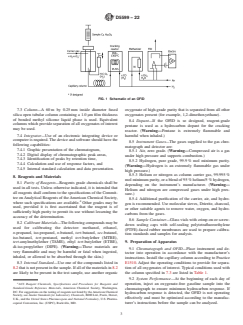
methanizer, and FID.Aschematic of a typical OFID system is
bulk hydrocarbon matrix.
shown in Fig. 1.
7.2.1 The detector must meet or exceed the typical specifi-
6. Theory of OFID Operation
cationsgiveninTable 1ofPracticeE594whileoperatinginthe
6.1 The detection system selective for organic oxygen
normal FID mode as specified by the manufacturer.
consists of a cracking reactor, hydrogenating reactor
7.2.2 In the OFID mode, the detector shall meet or exceed
(methanizer), and a flame ionization detector (FID). The
the following specifications: (a) equal to or greater than 10
cracking reactor, connected immediately after the gas chro-
linearity, (b) less than 100 ppm mass oxygen (1 ng O⁄s)
matographic capillary column, consists of a Pt/Rh capillary
sensitivity, (c) greater than 10 selectivity for oxygen com-
tube. Carbon monoxide (CO) is formed from compounds
pounds over hydrocarbons, (d) no interference from coeluting
containing oxygen according to the following reaction:
compounds when 0.1 µL to 1.0 µL sample is injected, (e)
C H O→zCO1~y/2!H 1~x 2 z!C (1)
x y z 2 equimolar response for oxygen.
D5599 − 22
FIG. 1 Schematic of an OFID
7.3 Column—A 60 m by 0.25 mm inside diameter fused oxygenate of high-grade purity that is separated from all other
silica open tubular column containing a 1.0 µm film thickness oxygenates present (for example, 1,2-dimethoxyethane).
of bonded methyl silicone liquid phase is used. Equivalent
8.4 Dopant—If the OFID is so designed, reagent-grade
columns which provide separation of all oxygenates of interest
pentane is used as a hydrocarbon dopant for the cracking
may be used.
reactor. (Warning—Pentane is extremely flammable and
7.4 Integrator—Use of an electronic integrating device or harmful when inhaled.)
computer is required. The device and software should have the
8.5 Instrument Gases—The gases supplied to the gas chro-
following capabilities:
matograph and detector are:
7.4.1 Graphic presentation of the chromatogram,
8.5.1 Air, zero grade. (Warning—Compressed air is a gas
7.4.2 Digital display of chromatographic peak areas,
under high pressure and supports combustion.)
7.4.3 Identification of peaks by retention time,
8.5.2 Hydrogen, pure grade, 99.9 % mol minimum purity.
7.4.4 Calculation and use of response factors, and
(Warning—Hydrogen is an extremely flammable gas under
7.4.5 Internal standard calculation and data presentation.
high pressure.)
8.5.3 Helium or nitrogen as column carrier gas, 99.995 %
8. Reagents and Materials
molminimumpurity,orablendof95 %helium/5 %hydrogen,
8.1 Purity of Reagents—Reagents grade chemicals shall be
depending on the instrument’s manufacturer. (Warning—
used in all tests. Unless otherwise indicated, it is intended that
Helium and nitrogen are compressed gases under high pres-
all reagents shall conform to the specifications of the Commit-
sure.)
tee onAnalytical Reagents of theAmerican Chemical Society,
8.5.4 Additional purification of the carrier, air, and hydro-
where such specifications are available. Other grades may be
gen is recommended. Use molecular sieves, Drierite, charcoal,
used, provided it is first ascertained that the reagent is of
or other suitable agents to remove water, oxygen, and hydro-
sufficiently high purity to permit its use without lessening the
carbons from the gases.
accuracy of the determination.
8.6 Sample Container—Glass vials with crimp-on or screw-
8.2 CalibrantMaterials—Thefollowingcompoundsmaybe
down sealing caps with self-sealing polytetrafluoroethylene
used for calibrating the detector: methanol, ethanol,
(PTFE)-faced rubber membranes are used to prepare calibra-
n-propanol, iso-propanol, n-butanol, tert-butanol, sec-butanol,
tion standards and samples for analysis.
iso-butanol, tert-pentanol, methyl tert-butylether (MTBE),
tert-amylmethylether (TAME), ethyl tert-butylether (ETBE), 9. Preparation of Apparatus
di-iso-propylether (DIPE). (Warning—These materials are
9.1 Chromatograph and OFID—Place instrument and de-
very flammable and may be harmful or fatal when ingested,
tector into operation in accordance with the manufacturer’s
inhaled, or allowed to be absorbed through the skin.)
instructions. Install the capillary column according to Practice
E1510. Adjust the operating conditions to provide for separa-
8.3 Internal Standard—Use one of the compounds listed in
8.2thatisnotpresentinthesample.Ifallofthematerialsin8.2 tion of all oxygenates of interest. Typical conditions used with
the column specified in 7.3 are listed in Table 1.
are likely to be present in the test sample, use another organic
9.2 System Performance—At the beginning of each day of
operation, inject an oxygenate-free gasoline sample into the
ACS Reagent Chemicals, Specifications and Procedures for Reagents and
Standard-Grade Reference Materials, American Chemical Society, Washington,
chromatograph to ensure minimum hydrocarbon response. If
DC. For suggestions on the testing of reagents not listed by theAmerican Chemical
hydrocarbon response is detected, the OFID is not operating
Society, see Analar Standards for Laboratory Chemicals, BDH Ltd., Poole, Dorset,
effectively and must be optimized according to the manufac-
U.K., and the United States Pharmacopeia and National Formulary, U.S. Pharma-
copeial Convention, Inc. (USPC), Rockville, MD. turer’s instructions before the sample can be analyzed.
D5599 − 22
TABLE 1 Typical Operating Conditions
Temperatures, °C
Injector 250
Column 50 °C (hold 10 min), ramp 8°/min to
250 °C
Detector Methanizer 350 °C – 450 °C
Reactor 850 °C – 1300 °C
Flows, mL/min
Column carrier gas 1
Detector gases Air: 300 mL/min
H : 30 mL/min
Auxiliary (for dopant, if available) H : 0.6 mL ⁄min
A
Sample Size 0.1 µL –1.0 µL
Split Ratio 100 – 1
A
Sample size and split ratio must be adjusted so that the oxygenates in the range
from 0.1 % mass to 20.0 % mass are eluted from the column and measured
linearly at the detector. Each laboratory must establish and monitor the conditions
that are needed to maintain linearity with their individual instruments. Nonlinearity
is most commonly observed when using an OFID with samples containing high
levels of individual oxygenates and can be compensated for by either decreasing
the sample size, increasing the split ratio, or diluting the sample with an
oxygenate-free gasoline. A sample size of 0.5 µL and a split ratio of 100:1 has been
used successfully in most cases.
10. Calibration and Standardization
10.1 Retention Time Identification—Determine the retention
NOTE 1—Operating conditions in accordance with Table 1.
time of each oxygenate component by injecting small amounts
FIG. 2 Chromatogram of an Oxygenates Blend
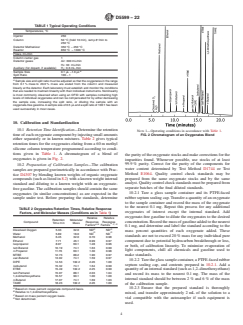
either separately or in known mixtures. Table 2 gives typical
retention times for the oxygenates eluting from a 60 m methyl
silicone column temperature programmed according to condi-
tions given in Table 1. A chromatogram of a blend of
the purity of the oxygenate stocks and make corrections for the
oxygenates is given in Fig. 2.
impurities found. Whenever possible, use stocks of at least
99.9 % purity. Correct for the purity of the components for
10.2 Preparation of Calibration Samples—The calibration
water content determined by Test Method D1744 or Test
samples are prepared gravimetrically in accordance with Prac-
Method E1064. Quality control check standards may be
tice D4307 by blending known weights of organic oxygenate
prepared from the same oxygenate stocks and by the same
compounds(suchaslistedin8.2)withaknownweightinternal
analyst.Qualitycontrolcheckstandardsmustbepreparedfrom
standard and diluting to a known weight with an oxygenate-
separate batches of the final diluted standards.
free gasoline. The calibration samples should contain the same
10.2.1 Tare a glass sample container and its PTFE-faced
oxygenates (in similar concentrations) as are expected in the
rubber septum sealing cap.Transfer a quantity of an oxygenate
sample under test. Before preparing the standards, determine
to the sample container and record the mass of the oxygenate
to the nearest 0.1 mg. Repeat this process for any additional
TABLE 2 Oxygenates Retention Times, Relative Response
oxygenates of interest except the internal standard. Add
Factors, and Molecular Masses (Conditions as in Table 1)
oxygenate-free gasoline to dilute the oxygenates to the desired
Relative Relative
Retention Molecular
Compound Response Response concentration.Recordthemassofgasolineaddedtothenearest
Time min Mass B,
A,B C, D
Factors Factors
0.1 mg, and determine and label the standard according to the
D D
Disso
...
This document is not an ASTM standard and is intended only to provide the user of an ASTM standard an indication of what changes have been made to the previous version. Because
it may not be technically possible to adequately depict all changes accurately, ASTM recommends that users consult prior editions as appropriate. In all cases only the current version
of the standard as published by ASTM is to be considered the official document.
Designation: D5599 − 18 D5599 − 22
Standard Test Method for
Determination of Oxygenates in Gasoline by Gas
Chromatography and Oxygen Selective Flame Ionization
Detection
This standard is issued under the fixed designation D5599; the number immediately following the designation indicates the year of
original adoption or, in the case of revision, the year of last revision. A number in parentheses indicates the year of last reapproval. A
superscript epsilon (´) indicates an editorial change since the last revision or reapproval.
1. Scope*
1.1 This test method covers a gas chromatographic procedure for the quantitative determination of organic oxygenated compounds
in gasoline having a final boiling point not greater than 220 °C and oxygenates having a boiling point limit of 130 °C. It is
applicable when oxygenates are present in the 0.1 % to 20 % by mass range.
1.2 This test method is intended to determine the mass concentration of each oxygenate compound present in a gasoline. This
requires knowledge of the identity of each oxygenate being determined (for calibration purposes). However, the oxygen-selective
detector used in this test method exhibits a response that is proportional to the mass of oxygen. It is, therefore, possible to determine
the mass concentration of oxygen contributed by any oxygenate compound in the sample, whether or not it is identified. Total
oxygen content in a gasoline may be determined from the summation of the accurately determined individual oxygenated
compounds. The summed area of other, uncalibrated or unknown oxygenated compounds present, may be converted to a mass
concentration of oxygen and summed with the oxygen concentration of the known oxygenated compounds.
1.3 The values stated in SI units are to be regarded as standard. No other units of measurement are included in this standard.
1.4 This standard does not purport to address all of the safety concerns, if any, associated with its use. It is the responsibility
of the user of this standard to establish appropriate safety, health, and environmental practices and determine the applicability of
regulatory limitations prior to use.
1.5 This international standard was developed in accordance with internationally recognized principles on standardization
established in the Decision on Principles for the Development of International Standards, Guides and Recommendations issued
by the World Trade Organization Technical Barriers to Trade (TBT) Committee.
2. Referenced Documents
2.1 ASTM Standards:
D1298 Test Method for Density, Relative Density, or API Gravity of Crude Petroleum and Liquid Petroleum Products by
Hydrometer Method
D1744 Test Method for Determination of Water in Liquid Petroleum Products by Karl Fischer Reagent (Withdrawn 2016)
D4052 Test Method for Density, Relative Density, and API Gravity of Liquids by Digital Density Meter
This test method is under the jurisdiction of ASTM Committee D02 on Petroleum Products, Liquid Fuels, and Lubricants and is the direct responsibility of Subcommittee
D02.04.0L on Gas Chromatography Methods.
Current edition approved June 1, 2018April 1, 2022. Published September 2018April 2022. Originally approved in 1994. Last previous edition approved in 20172018 as
D5599 – 175.D5599 – 18. DOI: 10.1520/D5599-18.10.1520/D5599-22.
For referenced ASTM standards, visit the ASTM website, www.astm.org, or contact ASTM Customer Service at service@astm.org. For Annual Book of ASTM Standards
volume information, refer to the standard’s Document Summary page on the ASTM website.
The last approved version of this historical standard is referenced on www.astm.org.
*A Summary of Changes section appears at the end of this standard
Copyright © ASTM International, 100 Barr Harbor Drive, PO Box C700, West Conshohocken, PA 19428-2959. United States
D5599 − 22
D4175 Terminology Relating to Petroleum Products, Liquid Fuels, and Lubricants
D4307 Practice for Preparation of Liquid Blends for Use as Analytical Standards
D6299 Practice for Applying Statistical Quality Assurance and Control Charting Techniques to Evaluate Analytical Measure-
ment System Performance
E355 Practice for Gas Chromatography Terms and Relationships
E594 Practice for Testing Flame Ionization Detectors Used in Gas or Supercritical Fluid Chromatography
E1064 Test Method for Water in Organic Liquids by Coulometric Karl Fischer Titration
E1510 Practice for Installing Fused Silica Open Tubular Capillary Columns in Gas Chromatographs
3. Terminology
3.1 Definitions:
3.1.1 This test method makes reference to common gas chromatographic procedures, terms, and relationships. Detailed definitions
of these can be found in Practices E355 and E594 and Terminology D4175.
3.1.2 independent reference standards, check standard, n—calibration samples ofin QC testing, the oxygenates which are
purchased or prepared from materials independent of the quality control check standards and used for intralaboratory accuracy.
material having an accepted reference value (ARV) used to determine the accuracy of the measurement system.
3.1.2.1 Discussion—
In the context of this test method, check standard refers to a spark ignition fuel.
3.1.3 oxygenate, n—an oxygen-containing compound, such as an alcohol or ether, organic compound, which may be used as a fuel
or fuel supplement.supplement, for example, various alcohols and ethers.
3.1.3 quality control check standards, n—calibration samples of the oxygenates for intralaboratory repeatability.
4. Summary of Test Method
4.1 An internal standard of a noninterfering oxygenate, for example, 1,2-dimethoxyethane (ethylene glycol dimethyl ether) is
added in quantitative proportion to the gasoline sample. A representative aliquot of the sample and internal standard is injected into
a gas chromatograph equipped with a capillary column operated to ensure separation of the oxygenates. Hydrocarbons and
oxygenates are eluted from the column, but only oxygenates are detected with the oxygen-selective flame ionization detector
(OFID). A discussion of this detector is presented in Section 6.
4.2 Calibration mixtures are used for determining the retention times and relative mass response factors of the oxygenates of
interest. Suggested calibrant materials are listed in 8.2.
4.3 The peak area of each oxygenate in the gasoline is measured relative to the peak area of the internal standard. A quadratic
least-squares fit of the calibrated data of each oxygenate is applied and the concentration of each oxygenate calculated.
NOTE 1—While 1,2-dimethoxyethane has been found to be an appropriate internal standard, other oxygenates may be used provided they are not present
in the sample and do not interfere with any compound of interest.
5. Significance and Use
5.1 In gasoline blending, the determination of organic oxygenated compounds is important. Alcohols, ethers, and other oxygenates
are added to gasoline to increase the octane number and to reduce tailpipe emissions of carbon monoxide. They must be added
in the proper concentration and ratios to meet regulatory limitations and to avoid phase separation and problems with engine
performance or efficiency.
5.2 This test method provides sufficient oxygen-to-hydro-carbon selectivity and sensitivity to allow determination of oxygenates
in gasoline samples without interference from the bulk hydrocarbon matrix.
6. Theory of OFID Operation
6.1 The detection system selective for organic oxygen consists of a cracking reactor, hydrogenating reactor (methanizer), and a
D5599 − 22
flame ionization detector (FID). The cracking reactor, connected immediately after the gas chromatographic capillary column,
consists of a Pt/Rh capillary tube. Carbon monoxide (CO) is formed from compounds containing oxygen according to the
following reaction:
C H O →zCO1~y/2!H 1~x2 z!C (1)
x y z 2
6.2 An excess layer of carbon is created in the Pt/Rh tube of the cracking reactor from the introduction of hydrocarbons from the
sample or, if so designed, from a hydrocarbon (for example, pentane or hexane) doping system, or both. This layer of carbon
facilitates the cracking reaction and suppresses hydrocarbon response.
6.3 The carbon monoxide formed in the cracking reactor is converted to methane in the hydrogenating reactor according to the
following reaction:
CO13H →CH 1H O (2)
2 4 2
The CH is subsequently detected with an FID.
6.4 The methanizer consists either of a short porous layer open tubular (PLOT) glass capillary tube internally coated with
aluminum oxide with adsorbed nickel catalyst or stainless steel tubing containing a nickel-based catalyst. It is installed within or
before the FID and is operated in the range from 350 °C to 450 °C, depending on the instrument’s manufacturer.
NOTE 2—Gasolines with high sulfur content may cause a loss in detector sensitivity thereby limiting the number of samples that can be analyzed before
the catalyst needs replacement.
7. Apparatus
7.1 Gas Chromatograph—Any gas chromatograph can be used having the following performance characteristics:
7.1.1 Column Temperature Programmer—The chromatograph must be capable of reproducible linear temperature programming
over a range sufficient for separation of the components of interest.
7.1.2 Sample Introduction System—Any system capable of introducing a representative 0.1 μL to 1.0 μL liquid sample into the
split inlet device of the gas chromatograph. Microlitre syringes, autosamplers, and liquid sampling valves have been used
successfully. The split injector should be capable of accurate split control in the range from 10:1 to 500:1.
7.1.3 Carrier and Detector Gas Control—Constant flow control of carrier and detector gases is critical to optimum and consistent
analytical performance. Control is best provided by the use of pressure regulators and fixed flow restrictors. The gas flow rates are
measured by any appropriate means. The supply pressure of the gas delivered to the gas chromatograph must be at least 70 kPa
(10 psig) greater than the regulated gas at the instrument to compensate for the system back pressure. In general, a supply pressure
of 550 kPa (80 psig) will be satisfactory.
7.2 OFID Detector System, consisting of a cracking reactor, methanizer, and FID. A schematic of a typical OFID system is shown
in Fig. 1.
7.2.1 The detector must meet or exceed the typical specifications given in Table 1 of Practice E594 while operating in the normal
FID mode as specified by the manufacturer.
7.2.2 In the OFID mode, the detector shall meet or exceed the following specifications: (a) equal to or greater than 10 linearity,
(b) less than 100 ppm mass oxygen (1 ng O ⁄s) sensitivity, (c) greater than 10 selectivity for oxygen compounds over
hydrocarbons, (d) no interference from coeluting compounds when 0.1 μL to 1.0 μL sample is injected, (e) equimolar response for
oxygen.
7.3 Column—A 60 m by 0.25 mm inside diameter fused silica open tubular column containing a 1.0 μm film thickness of bonded
methyl silicone liquid phase is used. Equivalent columns which provide separation of all oxygenates of interest may be used.
7.4 Integrator—Use of an electronic integrating device or computer is required. The device and software should have the
following capabilities:
D5599 − 22
FIG. 1 Schematic of an OFID
7.4.1 Graphic presentation of the chromatogram,
7.4.2 Digital display of chromatographic peak areas,
7.4.3 Identification of peaks by retention time,
7.4.4 Calculation and use of response factors, and
7.4.5 Internal standard calculation and data presentation.
8. Reagents and Materials
8.1 Purity of Reagents—Reagents grade chemicals shall be used in all tests. Unless otherwise indicated, it is intended that all
reagents shall conform to the specifications of the Committee on Analytical Reagents of the American Chemical Society, where
such specifications are available. Other grades may be used, provided it is first ascertained that the reagent is of sufficiently high
purity to permit its use without lessening the accuracy of the determination.
8.2 Calibrant Materials—The following compounds may be used for calibrating the detector: methanol, ethanol, n-propanol,
iso-propanol, n-butanol, tert-butanol, sec-butanol, iso-butanol, tert-pentanol, methyl tert-butylether (MTBE), tert-amylmethylether
(TAME), ethyl tert-butylether (ETBE), di-iso-propylether (DIPE). (Warning—These materials are very flammable and may be
harmful or fatal when ingested, inhaled, or allowed to be absorbed through the skin.)
8.3 Internal Standard—Use one of the compounds listed in 8.2 that is not present in the sample. If all of the materials in 8.2 are
likely to be present in the test sample, use another organic oxygenate of high-grade purity that is separated from all other
oxygenates present (for example, 1,2-dimethoxyethane).
8.4 Dopant—If the OFID is so designed, reagent-grade pentane is used as a hydrocarbon dopant for the cracking reactor.
(Warning—Pentane is extremely flammable and harmful when inhaled.)
8.5 Instrument Gases—The gases supplied to the gas chromatograph and detector are:
8.5.1 Air, zero grade. (Warning—Compressed air is a gas under high pressure and supports combustion.)
Reagent Chemicals, American Chemical Society Specifications,ACS Reagent Chemicals, Specifications and Procedures for Reagents and Standard-Grade Reference
Materials, American Chemical Society, Washington, DC. For suggestions on the testing of reagents not listed by the American Chemical Society, see Analar Standards for
Laboratory Chemicals, BDH Ltd., Poole, Dorset, U.K., and the United States Pharmacopeia and National Formulary, U.S. Pharmacopeial Convention, Inc. (USPC),
Rockville, MD.
D5599 − 22
8.5.2 Hydrogen, pure grade, 99.9 % mol minimum purity. (Warning—Hydrogen is an extremely flammable gas under high
pressure.)
8.5.3 Helium or nitrogen as column carrier gas, 99.995 % mol minimum purity, or a blend of 95 % helium/5 % hydrogen,
depending on the instrument’s manufacturer. (Warning—Helium and nitrogen are compressed gases under high pressure.)
8.5.4 Additional purification of the carrier, air, and hydrogen is recommended. Use molecular sieves, Drierite, charcoal, or other
suitable agents to remove water, oxygen, and hydrocarbons from the gases.
8.6 Sample Container—Glass vials with crimp-on or screw-down sealing caps with self-sealing polytetrafluoroethylene
(PTFE)-faced rubber membranes are used to prepare calibration standards and samples for analysis.
9. Preparation of Apparatus
9.1 Chromatograph and OFID—Place instrument and detector into operation in accordance with the manufacturer’s instructions.
Install the capillary column according to Practice E1510. Adjust the operating conditions to provide for separation of all oxygenates
of interest. Typical conditions used with the column specified in 7.3 are listed in Table 1.
9.2 System Performance—At the beginning of each day of operation, inject an oxygenate-free gasoline sample into the
chromatograph to ensure minimum hydrocarbon response. If hydrocarbon response is detected, the OFID is not operating
effectively and must be optimized according to the manufacturer’s instructions before the sample can be analyzed.
10. Calibration and Standardization
10.1 Retention Time Identification—Determine the retention time of each oxygenate component by injecting small amounts either
separately or in known mixtures. Table 2 gives typical retention times for the oxygenates eluting from a 60 m methyl silicone
column temperature programmed according to conditions given in Table 1. A chromatogram of a blend of oxygenates is given in
Fig. 2.
10.2 Preparation of Calibration Samples—The calibration samples are prepared gravimetrically in accordance with Practice
D4307 by blending known weights of organic oxygenate compounds (such as listed in 8.2) with a known weight internal standard
and diluting to a known weight with an oxygenate-free gasoline. The calibration samples should contain the same oxygenates (in
similar concentrations) as are expected in the sample under test. Before preparing the standards, determine the purity of the
oxygenate stocks and make corrections for the impurities found. Whenever possible, use stocks of at least 99.9 % purity. Correct
for the purity of the components for water content determined by Test Method D1744 or Test Method E1064. Quality control check
TABLE 1 Typical Operating Conditions
Temperatures, °C
Injector 250
Column 50 °C (hold 10 min), ramp 8°/min to
250 °C
Detector Methanizer 350 °C – 450 °C
Reactor 850 °C – 1300 °C
Flows, mL/min
Column carrier gas 1
Detector gases Air: 300 mL/min
H : 30 mL/min
Auxiliary (for dopant, if available) H : 0.6 mL ⁄min
A
Sample Size 0.1 μL –1.0 μL
Split Ratio 100 – 1
A
Sample size and split ratio must be adjusted so that the oxygenates in the range
from 0.1 % mass to 20.0 % mass are eluted from the column and measured
linearly at the detector. Each laboratory must establish and monitor the conditions
that are needed to maintain linearity with their individual instruments. Nonlinearity
is most commonly observed when using an OFID with samples containing high
levels of individual oxygenates and can be compensated for by either decreasing
the sample size, increasing the split ratio, or diluting the sample with an
oxygenate-free gasoline. A sample size of 0.5 μL and a split ratio of 100:1 has been
used successfully in most cases.
D5599 − 22
TABLE 2 Oxygenates Retention Times, Relative Response
Factors, and Molecular Masses (Conditions as in Table 1)
Relative Relative
Retention Molecular
Compound Response Response
Time min Mass B,
A,B C, D
Factors Factors
D D
Dissolved Oxygen 5.33 32.0 ND ND
D D
Water 5.89 18.0 ND ND
Methanol 6.45 32.0 0.70 0.98
Ethanol 7.71 46.1 0.99 0.97
Isopropanol 8.97 60.1 1.28 0.96
tert-Butanol 10.19 74.1 1.63 0.99
n-Propanol 11.76 60.1 1.30 0.98
MTBE 12.73 88.2 1.90 0.97
sec-Butanol 13.92 74.1 1.59 0.97
DIPE 14.53 102.2 2.26 1.00
Isobutanol 15.32 74.1 1.64 0.99
ETBE 15.49 102.2 2.25 0.99
tert-Pentanol 15.97 88.1 2.03 1.04
1,2-dimethoxyethane 16.57 90.1 1.00 1.00
n-Butanol 17.07 74.1 1.69 1.03
TAME 18.23 102.2 2.26 1.00
A
Based on mass percent oxygenate compound basis.
B
Relative to 1,2-dimethoxyethane.
C
Based on mass percent oxygen basis.
D
Not determined.
NOTE 1—Operating conditions in accordance with Table 1.
FIG. 2 Chromatogram of an Oxygenates Blend
standards may be prepared from the same oxygenate stocks and by the same analyst. Quality control check standards must be
prepared from separate batches of the final diluted standards.
10.2.1 Tare a glass sample container and its PTFE-faced rubber septum sealing cap. Transfer a quantity of an oxygenate to the
sample container and record the mass of the oxygenate to the nearest 0.1 mg. Repeat this process for any additional oxygenates
of interest except the internal standard. Add oxygenate-free gasoline to dilute the oxygenates to the desired concentration. Record
the mass of gasoline added to the nearest 0.1 mg, and determine and label the standard according to the mass percent quantities
of each oxygenate added. These standards are not to exceed 20 % mass for any individual pure component due to potential
hydrocarbon breakthrough or loss, or both, of calibration linearity. To minimize evaporation of light components, chill all
chemicals and gasoline used to make standards.
10.2.2 Tare the glass sample container, a PTFE-faced rubber septum sealing cap, and contents prepared in 10.2.1. Add a quantity
D5599 − 22
of an intern
...