

ASTM D5641/D5641M-16
(Practice)Standard Practice for Geomembrane Seam Evaluation by Vacuum Chamber
General Information
- Abstract
SIGNIFICANCE AND USE
5.1 This practice is a nondestructive evaluation intended to be used for quality control purposes during factory or field seaming of geomembranes.
5.2 This practice may also be used to evaluate geomembrane panels for holes that penetrate the entire thickness of material. Limitations on the test practice are that it may not be suitable for uneven or curved surfaces, thick seams, seams in corners, and thin extensible geomembranes.
SCOPE
1.1 This practice covers procedures to perform nondestructive quality control testing described in Practice D4437/D4437M and Practice D4545 for evaluating the continuity of all types of geomembrane seams using the bubble emission or vacuum chamber method.
1.2 The technique described in this practice is intended for use on geomembrane seams, patches, and defects.
1.3 The values stated in either SI units or inch-pound units are to be regarded separately as standard. The values stated in each system may not be exact equivalents; therefore, each system shall be used independently of the other. Combining values from the two systems may result in non-conformance with the standard.
1.4 This standard does not purport to address all of the safety concerns, if any, associated with its use. It is the responsibility of the user of this standard to establish appropriate safety and health practices and determine the applicability of regulatory limitations prior to use.
- Status
- Published
- Publication Date
- 30-Jun-2016
- Technical Committee
- D35 - Geosynthetics
- Drafting Committee
- D35.10 - Geomembranes

Overview
ASTM D5641/D5641M-16, Standard Practice for Geomembrane Seam Evaluation by Vacuum Chamber, establishes a procedure for conducting nondestructive quality control testing of geomembrane seams, patches, and possible defects. This standard, developed by ASTM International, applies a vacuum chamber method to detect continuity and identify holes or flaws in geomembrane installations. The practice is widely used in both factory and field environments to ensure the integrity and performance of geomembrane systems, which are essential in environmental containment, waste management, and civil engineering applications.
Key Topics
- Nondestructive Testing for Quality Control: This practice is designed specifically to assess the integrity of geomembrane seams without causing any damage, supporting both factory and field seaming operations.
- Detection of Flaws: The vacuum chamber method provides a reliable approach for identifying leaks, pinholes, and defects that penetrate the entire thickness of the geomembrane.
- Bubble Emission Technique: The procedure creates a pressure differential using a vacuum chamber and a foaming solution to visually identify defects by observing bubble formation.
- Application Limitations: While highly effective on flat, even surfaces, the method may not be suitable for seams in corners, thick seams, uneven or curved surfaces, and certain thin extensible geomembranes.
- Measurement Units: Test parameters and results should be recorded in either SI or inch-pound units, but not both, to adhere to consistent standards and avoid non-conformance.
- Reporting Requirements: Detailed documentation of material identification, seam information, test conditions, and results is required as part of the quality control record.
Applications
ASTM D5641/D5641M-16 is critical in a variety of industries and scenarios where geomembrane performance is vital to environmental and structural safety:
- Landfill Liners and Covers: Ensures the integrity of seams in geomembrane liners used to prevent leachate escape and environmental contamination.
- Water Containment Structures: Used for quality assurance in reservoirs, ponds, and canal linings to prevent water loss and maintain containment.
- Hazardous Waste and Industrial Impoundments: Verifies seam continuity in geomembranes designed to contain hazardous materials and industrial byproducts.
- Agricultural Applications: Supports the testing of lining systems in lagoons and tanks where geomembranes are used for liquid containment.
- Construction and Civil Engineering: Applied to temporary or permanent geomembrane installations for erosion control, soil stabilization, and barrier systems.
Related Standards
For comprehensive geomembrane testing and quality control, ASTM D5641/D5641M-16 is typically referenced alongside several other key standards:
- ASTM D4437/D4437M - Practice for Nondestructive Testing (NDT) for Determining the Integrity of Seams Used in Joining Flexible Polymeric Sheet Geomembranes.
- ASTM D4545 - Practice for Determining the Integrity of Factory Seams Used in Joining Manufactured Flexible Sheet Geomembranes (withdrawn).
- ASTM D4439 - Terminology for Geosynthetics.
- ASTM E515 - Practice for Leaks Using Bubble Emission Techniques.
- EPA/530/SW-91/051 - Inspection Techniques for the Fabrication of Geomembrane Field Seams.
Practical Value
Implementing the vacuum chamber test as outlined in ASTM D5641/D5641M-16 greatly enhances nondestructive testing procedures for geomembrane seams. It helps project managers, contractors, and quality assurance professionals maintain regulatory compliance, reduce the risk of environmental incidents, and extend the operational lifespan of geomembrane systems. This standard practice is an indispensable tool for those seeking dependable and repeatable verification of seam integrity in critical containment applications.
Keywords: ASTM D5641, geomembrane seam testing, vacuum chamber, nondestructive evaluation, bubble emission testing, geomembrane quality control, environmental containment, leak detection.
Relations
- Effective Date
- 01-Jul-2016
- Effective Date
- 01-Feb-2024
- Effective Date
- 01-Nov-2023
- Effective Date
- 15-Apr-2018
- Effective Date
- 01-Aug-2017
- Effective Date
- 01-Jul-2016
- Effective Date
- 01-Sep-2015
- Effective Date
- 01-Jul-2015
- Effective Date
- 01-Mar-2014
- Effective Date
- 01-Oct-2011
- Effective Date
- 01-Dec-2005
- Effective Date
- 01-Jun-2004
- Effective Date
- 10-Aug-2002
- Effective Date
- 10-Sep-2001
- Effective Date
- 10-Sep-2001
Get Certified
Connect with accredited certification bodies for this standard

Control Union Certifications
Global certification for agriculture and sustainability.

Hohenstein Institut
Textile testing and certification.

Bureau Veritas Bangladesh
Bureau Veritas certification services in Bangladesh.
Sponsored listings
Frequently Asked Questions
ASTM D5641/D5641M-16 is a standard published by ASTM International. Its full title is "Standard Practice for Geomembrane Seam Evaluation by Vacuum Chamber". This standard covers: SIGNIFICANCE AND USE 5.1 This practice is a nondestructive evaluation intended to be used for quality control purposes during factory or field seaming of geomembranes. 5.2 This practice may also be used to evaluate geomembrane panels for holes that penetrate the entire thickness of material. Limitations on the test practice are that it may not be suitable for uneven or curved surfaces, thick seams, seams in corners, and thin extensible geomembranes. SCOPE 1.1 This practice covers procedures to perform nondestructive quality control testing described in Practice D4437/D4437M and Practice D4545 for evaluating the continuity of all types of geomembrane seams using the bubble emission or vacuum chamber method. 1.2 The technique described in this practice is intended for use on geomembrane seams, patches, and defects. 1.3 The values stated in either SI units or inch-pound units are to be regarded separately as standard. The values stated in each system may not be exact equivalents; therefore, each system shall be used independently of the other. Combining values from the two systems may result in non-conformance with the standard. 1.4 This standard does not purport to address all of the safety concerns, if any, associated with its use. It is the responsibility of the user of this standard to establish appropriate safety and health practices and determine the applicability of regulatory limitations prior to use.
SIGNIFICANCE AND USE 5.1 This practice is a nondestructive evaluation intended to be used for quality control purposes during factory or field seaming of geomembranes. 5.2 This practice may also be used to evaluate geomembrane panels for holes that penetrate the entire thickness of material. Limitations on the test practice are that it may not be suitable for uneven or curved surfaces, thick seams, seams in corners, and thin extensible geomembranes. SCOPE 1.1 This practice covers procedures to perform nondestructive quality control testing described in Practice D4437/D4437M and Practice D4545 for evaluating the continuity of all types of geomembrane seams using the bubble emission or vacuum chamber method. 1.2 The technique described in this practice is intended for use on geomembrane seams, patches, and defects. 1.3 The values stated in either SI units or inch-pound units are to be regarded separately as standard. The values stated in each system may not be exact equivalents; therefore, each system shall be used independently of the other. Combining values from the two systems may result in non-conformance with the standard. 1.4 This standard does not purport to address all of the safety concerns, if any, associated with its use. It is the responsibility of the user of this standard to establish appropriate safety and health practices and determine the applicability of regulatory limitations prior to use.
ASTM D5641/D5641M-16 is classified under the following ICS (International Classification for Standards) categories: 59.080.70 - Geotextiles. The ICS classification helps identify the subject area and facilitates finding related standards.
ASTM D5641/D5641M-16 has the following relationships with other standards: It is inter standard links to ASTM D5641-94(2011), ASTM D4439-24, ASTM D4437/D4437M-16(2023), ASTM D4439-18, ASTM D4439-17, ASTM D4437/D4437M-16, ASTM D4439-15a, ASTM D4439-15, ASTM D4439-14, ASTM D4439-11, ASTM E515-05, ASTM D4439-04, ASTM D4439-02, ASTM D4439-00, ASTM D4439-01. Understanding these relationships helps ensure you are using the most current and applicable version of the standard.
ASTM D5641/D5641M-16 is available in PDF format for immediate download after purchase. The document can be added to your cart and obtained through the secure checkout process. Digital delivery ensures instant access to the complete standard document.
Standards Content (Sample)
This international standard was developed in accordance with internationally recognized principles on standardization established in the Decision on Principles for the
Development of International Standards, Guides and Recommendations issued by the World Trade Organization Technical Barriers to Trade (TBT) Committee.
Designation: D5641/D5641M − 16
Standard Practice for
Geomembrane Seam Evaluation by Vacuum Chamber
This standard is issued under the fixed designation D5641/D5641M; the number immediately following the designation indicates the
year of original adoption or, in the case of revision, the year of last revision. A number in parentheses indicates the year of last
reapproval. A superscript epsilon (´) indicates an editorial change since the last revision or reapproval.
1. Scope 2.2 E.P.A. Documents:
EPA/530/SW-91/051 Inspection Techniques for the Fabri-
1.1 This practice covers procedures to perform nondestruc-
cation of Geomembrane Field Seams
tive quality control testing described in Practice D4437/
D4437M and Practice D4545 for evaluating the continuity of
3. Terminology
all types of geomembrane seams using the bubble emission or
3.1 Definitions of Terms Specific to This Standard:
vacuum chamber method.
3.1.1 geomembrane, n—anessentiallyimpermeablegeosyn-
thetic composed of one or more synthetic sheets. (See Termi-
1.2 The technique described in this practice is intended for
nology D4439).
use on geomembrane seams, patches, and defects.
3.1.2 seam, n—the connection of two or more pieces of
1.3 The values stated in either SI units or inch-pound units
material by mechanical, chemical, or fusion methods to pro-
are to be regarded separately as standard. The values stated in
vide the integrity of a single piece of the material.
each system may not be exact equivalents; therefore, each
3.1.3 vacuum chamber, n—a device that allows a vacuum to
system shall be used independently of the other. Combining
be applied to a surface.
values from the two systems may result in non-conformance
3.1.3.1 Discussion—Ingeomembranes,typicalseamswould
with the standard.
include adhesive bonded, bodied chemical fusion welds;
1.4 This standard does not purport to address all of the
chemical fusion welds; dielectric; dual hot wedge; fillet extru-
safety concerns, if any, associated with its use. It is the
sion; flat extrusion; hot air; single hot wedge; and ultrasonic.
responsibility of the user of this standard to establish appro-
(See EPA/530/SW-91/051.)
priate safety and health practices and determine the applica-
NOTE 1—For definition of other terms used in this practice, refer to
bility of regulatory limitations prior to use.
Terminology D4439.
2. Referenced Documents 4. Summary of Practice
4.1 The basic principle of this practice consists of creating a
2.1 ASTM Standards:
pressuredifferentialacrossaseamandobservingforbubblesin
D4437/D4437M Practice for Nondestructive Testing (NDT)
a film of foaming solution over the low pressure side, within
for Determining the Integrity of Seams Used in Joining
the vacuum chamber. The vacuum chamber has a viewing port
Flexible Polymeric Sheet Geomembranes
that allows observation of the seam area being tested. The
D4439 Terminology for Geosynthetics
foaming solution is applied to the surface to be tested and the
D4545 Practice for Determining the Integrity of Factory
vacuum chamber is placed over the test area. As the chamber
Seams Used in Joining Manufactured Flexible Sheet
3 is held firmly in place, vacuum is applied.Air leakage through
Geomembranes (Withdrawn 2008)
flaws in the test area cause bubbles in the foaming solution that
E515 Practice for Leaks Using Bubble Emission Techniques
may be observed.
5. Significance and Use
This practice is under the jurisdiction of ASTM Committee D35 on Geosyn-
5.1 This practice is a nondestructive evaluation intended to
thetics and is the direct responsibility of Subcommittee D35.10 on Geomembranes.
be used for quality control purposes during factory or field
Current edition approved July 1, 2016. Published October 2016. Originally
approved in 1994. Last previous edition approved in 2011 as D5641 – 94 (2011). seaming of geomembranes.
DOI: 10.1520/D5641_D5641M-16.
2 5.2 This practice may also be used to evaluate geomem-
For referenced ASTM standards, visit the ASTM website, www.astm.org, or
contact ASTM Customer Service at service@astm.org. For Annual Book of ASTM brane panels for holes that penetrate the entire thickness of
Standards volume information, refer to the standard’s Document Summary page on
the ASTM website.
3 4
The last approved version of this historical standard is referenced on AvailablefromtheU.S.GovernmentPublishingOffice,732N.CapitolSt.,NW,
www.astm.org. Washington, DC 20401-0001, http://www.gpo.gov.
Copyright © ASTM International, 100 Barr Harbor Drive, PO Box C700, West Conshohocken, PA 19428-2959. United States
D5641/D5641M − 16
incorporation into this practice.
material. Limitations on the test practice are that it may not be
suitable for uneven or curved surfaces, thick seams, seams in
7. Procedure
corners, and thin extensible geomembranes.
7.1 Theareaoftheseamtobeevaluatedshouldbecleanand
6. Apparatus
free of soil or foreign objects that might prohibit a good seal
from being formed between the vacuum chamber and the
6.1 Vacuum Pump—The vacuum pump shall be fuel or
geomembrane.
electric powered and capable of sustaining the required
vacuum for the duration of the test.
7.2 Energize the vacuum pump.
6.2 Vacuum Gauge—The vacuum gauge shall be capable of
7.3 Wet an area immediately adjacent to and including the
registering, as a minimum, to 10 psi [70 kPa] in increments of
geomembrane seam or test area measuring approximately
⁄4 psi [5 kpa].
twice the width and length of the v
...
This document is not an ASTM standard and is intended only to provide the user of an ASTM standard an indication of what changes have been made to the previous version. Because
it may not be technically possible to adequately depict all changes accurately, ASTM recommends that users consult prior editions as appropriate. In all cases only the current version
of the standard as published by ASTM is to be considered the official document.
Designation: D5641 − 94 (Reapproved 2011) D5641/D5641M − 16
Standard Practice for
Geomembrane Seam Evaluation by Vacuum Chamber
This standard is issued under the fixed designation D5641;D5641/D5641M; the number immediately following the designation indicates
the year of original adoption or, in the case of revision, the year of last revision. A number in parentheses indicates the year of last
reapproval. A superscript epsilon (´) indicates an editorial change since the last revision or reapproval.
1. Scope
1.1 This practice covers procedures to perform nondestructive quality control testing described in Practice D4437D4437/
D4437M and Practice D4545 for evaluating the continuity of all types of geomembrane seams using the bubble emission or
vacuum chamber method.
1.2 The technique described in this practice is intended for use on geomembrane seams, patches, and defects.
1.3 The values stated in either SI units or inch-pound units are to be regarded separately as standard. The values given in
parentheses are for information only. stated in each system may not be exact equivalents; therefore, each system shall be used
independently of the other. Combining values from the two systems may result in non-conformance with the standard.
1.4 This standard does not purport to address all of the safety concerns, if any, associated with its use. It is the responsibility
of the user of this standard to establish appropriate safety and health practices and determine the applicability of regulatory
limitations prior to use.
2. Referenced Documents
2.1 ASTM Standards:
D4437D4437/D4437M Practice for Non-destructive Testing (NDT) for Determining the Integrity of Seams Used in Joining
Flexible Polymeric Sheet Geomembranes
D4439 Terminology for Geosynthetics
D4545 Practice for Determining the Integrity of Factory Seams Used in Joining Manufactured Flexible Sheet Geomembranes
(Withdrawn 2008)
E515 Practice for Leaks Using Bubble Emission Techniques
2.2 E.P.A. Documents:
EPA/530/SW-91/051 Inspection Techniques for the Fabrication of Geomembrane Field Seams
3. Terminology
3.1 Definitions of Terms Specific to This Standard:
3.1.1 geomembrane, n—an essentially impermeable geosynthetic composed of one or more synthetic sheets. (See Terminology
D4439).
3.1.2 seam, n—the connection of two or more pieces of material by mechanical, chemical, or fusion methods to provide the
integrity of a single piece of the material.
3.1.3 vacuum chamber, n—a device that allows a vacuum to be applied to a surface.
This practice is under the jurisdiction of ASTM Committee D35 on Geosynthetics and is the direct responsibility of Subcommittee D35.10 on Geomembranes.
Current edition approved June 1, 2011July 1, 2016. Published July 2011October 2016. Originally approved in 1994. Last previous edition approved in 20062011 as
D5641 – 94 (2011). (2006). DOI: 10.1520/D5641-94R11.10.1520/D5641_D5641M-16.
For referenced ASTM standards, visit the ASTM website, www.astm.org, or contact ASTM Customer Service at service@astm.org. For Annual Book of ASTM Standards
volume information, refer to the standard’s Document Summary page on the ASTM website.
The last approved version of this historical standard is referenced on www.astm.org.
Available from the Superintendent of Documents, U.S. Government Printing Office, Washington, DC 20402.Publishing Office, 732 N. Capitol St., NW, Washington, DC
20401-0001, http://www.gpo.gov.
3.1.3.1 Discussion—
In geomembranes, typical seams would include adhesive bonded, bodied chemical fusion welds; chemical fusion welds; dielectric;
dual hot wedge; fillet extrusion; flat extrusion; hot air; single hot wedge; and ultrasonic. (See EPA/530/SW-91/051.)
Copyright © ASTM International, 100 Barr Harbor Drive, PO Box C700, West Conshohocken, PA 19428-2959. United States
D5641/D5641M − 16
NOTE 1—For definition of other terms used in this practice, refer to Terminology D4439.
4. Summary of Practice
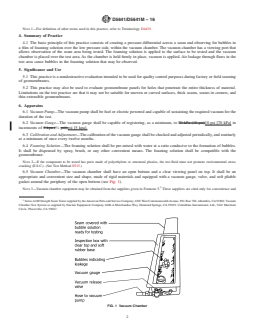
4.1 The basic principle of this practice consists of creating a pressure differential across a seam and observing for bubbles in
a film of foaming solution over the low pressure side, within the vacuum chamber. The vacuum chamber has a viewing port that
allows observation of the seam area being tested. The foaming solution is applied to the surface to be tested and the vacuum
chamber is placed over the test area. As the chamber is held firmly in place, vacuum is applied. Air leakage through flaws in the
test area cause bubbles in the foaming solution that may be observed.
5. Significance and Use
5.1 This practice is a nondestructive evaluation intended to be used for quality control purposes during factory or field seaming
of geomembranes.
5.2 This practice may also be used to evaluate geomembrane panels for holes that penetrate the entire thickness of material.
Limitations on the test practice are that it may not be suitable for uneven or curved surfaces, thick seams, seams in corners, and
thin extensible geomembranes.
6. Apparatus
6.1 Vacuum Pump—The vacuum pump shall be fuel or electric powered and capable of sustaining the required vacuum for the
duration of the test.
6.2 Vacuum Gauge—The vacuum gauge shall be capable of registering, as a minimum, to 70 kPa (10 psi)10 psi [70 kPa] in
increments of 5 kpa ( ⁄4 psi).psi [5 kpa].
6.3 Calibration and Adjustment—The calibration of the vacuum gauge shall be checked and adjusted periodically, and routinely
at a minimum of once every twelve months.
6.4 Foaming Solution—The foaming solution shall be pre-mixed with water at a ratio conducive to the formation of bubbles.
It shall
...