

ASTM D2525-22
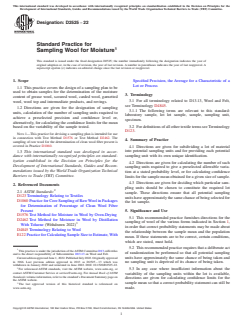
(Practice)Standard Practice for Sampling Wool for Moisture
General Information
- Abstract
SIGNIFICANCE AND USE
5.1 This recommended practice furnishes directions for the sampling of wool of the various forms indicated in Section 1, in order that correct probability statements may be made about the relationship between the sample mean and the population mean. If these statements are to be correct, certain conditions, which are stated, must hold.
5.2 This recommended practice requires that a deliberate act of randomization be performed so that all potential sampling units have approximately the same chance of being taken and no sampling unit is deprived of its chance of being taken.
5.3 In any case where insufficient information about the variability of the sampling units within the lot is available, directions are given for calculating confidence limits for the sample mean so that a correct probability statement can still be made.
SCOPE
1.1 This practice covers the design of a sampling plan to be used to obtain samples for the determination of the moisture content of grease wool, scoured wool, carded wool, garnetted wool, wool top and intermediate products, and rovings.
1.2 Directions are given for the designation of sampling units, calculation of the number of sampling units required to achieve a preselected precision and confidence level or, alternatively, for calculating the confidence limits for the mean based on the variability of the sample tested.
Note 1: This practice for devising a sampling plan is intended for use in connection with Test Method D1576 or Test Method D2462. The sampling of raw wool for the determination of clean wool fiber present is covered in Practice D1060.
1.3 This international standard was developed in accordance with internationally recognized principles on standardization established in the Decision on Principles for the Development of International Standards, Guides and Recommendations issued by the World Trade Organization Technical Barriers to Trade (TBT) Committee.
- Status
- Published
- Publication Date
- 31-May-2022
- Technical Committee
- D13 - Textiles
- Drafting Committee
- D13.13 - Wool and Felt
Overview
ASTM D2525-22: Standard Practice for Sampling Wool for Moisture provides a set of internationally recognized guidelines for obtaining representative samples of wool and related intermediate products to accurately determine their moisture content. This standard, developed by ASTM, is essential for ensuring the reliability of moisture measurement in grease wool, scoured wool, carded wool, garnetted wool, wool top, and rovings. It establishes procedures for randomization, calculation of sample size, and confidence limits, thereby supporting correct probability statements about the relationship between the sample mean and the population mean.
Key Topics
- Sampling Plan Design: Directions are provided for subdividing a lot of wool into potential sampling units and uniquely identifying each unit to ensure no exclusion from sampling.
- Randomization: The practice emphasizes deliberate random selection to give all units an equal chance of inclusion, minimizing bias and enhancing representativeness.
- Determining Sample Size: Methods are included for calculating the required number of sampling units to achieve specific precision and confidence levels, or alternatively, for calculating confidence limits based on sample variability.
- Statistical Homogeneity Testing: The standard outlines procedures to assess if lots are statistically homogeneous, recommending subdivision if significant variability is found.
- Adaptability to Wool Forms: Guidance is provided for tailored sample unit designation depending on whether the wool is in bulk, packaged, or processed into intermediate forms.
- Integration with Test Methods: It is intended for use alongside ASTM D1576 (oven-drying method) or D2462, and references D1060 for core sampling of raw wool.
Applications
- Textile Manufacturing and Processing: Quality control teams use this standard to ensure that moisture determinations in different wool forms meet industry specifications.
- Trade and Raw Material Assessment: Wool buyers, sellers, and laboratories utilize these procedures for reliable, consistent sampling when determining moisture–a critical parameter in pricing and processing.
- R&D and Product Development: Entities developing new wool products or processes rely on reproducible moisture data ensured by these sampling protocols.
- Certification and Compliance: Organizations use ASTM D2525-22 to demonstrate compliance with international guidelines, minimizing the risk of disputes in commercial transactions.
- Statistical Process Control: The statistical framework outlined enables ongoing process evaluation and the ability to make probability-based assessments of lot quality.
Related Standards
- ASTM D1576 - Test Method for Moisture in Wool by Oven-Drying
- ASTM D2462 - Test Method for Moisture in Wool by Distillation with Toluene (withdrawn 2022)
- ASTM D1060 - Practice for Core Sampling of Raw Wool in Packages for Determination of Percentage of Clean Wool Fiber Present
- ASTM D123 - Terminology Relating to Textiles
- ASTM D4845 - Terminology Relating to Wool
- ASTM E122 - Practice for Calculating Sample Size to Estimate, with Specified Precision, the Average for a Characteristic of a Lot or Process
Practical Value
Implementing ASTM D2525-22 in sampling procedures ensures unbiased, reproducible moisture determinations in wool, critical for maintaining product quality, meeting contractual obligations, and complying with international trade requirements. Its methodology is designed for adaptability, statistical rigor, and compatibility with industry-accepted test methods.
By utilizing this standard, stakeholders across the wool and textiles industries can achieve higher confidence in moisture content results, make informed decisions in quality control, and support transparent, fair trading practices. The emphasis on randomization, unit identification, and statistical assessment solidifies its role as an essential reference for any operation involved in wool sampling and testing.
Relations
- Effective Date
- 01-Jul-2018
- Effective Date
- 01-Jul-2018
- Effective Date
- 01-Mar-2017
- Effective Date
- 15-Sep-2015
- Effective Date
- 01-Sep-2015
- Effective Date
- 01-Apr-2015
- Effective Date
- 15-Jun-2013
- Effective Date
- 15-Jun-2013
- Effective Date
- 15-May-2013
- Effective Date
- 01-Feb-2012
- Effective Date
- 01-Feb-2012
- Effective Date
- 01-Aug-2011
- Effective Date
- 01-Jun-2010
- Effective Date
- 01-Jun-2010
- Effective Date
- 01-Jun-2010
Get Certified
Connect with accredited certification bodies for this standard

Control Union Certifications
Global certification for agriculture and sustainability.

Hohenstein Institut
Textile testing and certification.

Bureau Veritas Bangladesh
Bureau Veritas certification services in Bangladesh.
Sponsored listings
Frequently Asked Questions
ASTM D2525-22 is a standard published by ASTM International. Its full title is "Standard Practice for Sampling Wool for Moisture". This standard covers: SIGNIFICANCE AND USE 5.1 This recommended practice furnishes directions for the sampling of wool of the various forms indicated in Section 1, in order that correct probability statements may be made about the relationship between the sample mean and the population mean. If these statements are to be correct, certain conditions, which are stated, must hold. 5.2 This recommended practice requires that a deliberate act of randomization be performed so that all potential sampling units have approximately the same chance of being taken and no sampling unit is deprived of its chance of being taken. 5.3 In any case where insufficient information about the variability of the sampling units within the lot is available, directions are given for calculating confidence limits for the sample mean so that a correct probability statement can still be made. SCOPE 1.1 This practice covers the design of a sampling plan to be used to obtain samples for the determination of the moisture content of grease wool, scoured wool, carded wool, garnetted wool, wool top and intermediate products, and rovings. 1.2 Directions are given for the designation of sampling units, calculation of the number of sampling units required to achieve a preselected precision and confidence level or, alternatively, for calculating the confidence limits for the mean based on the variability of the sample tested. Note 1: This practice for devising a sampling plan is intended for use in connection with Test Method D1576 or Test Method D2462. The sampling of raw wool for the determination of clean wool fiber present is covered in Practice D1060. 1.3 This international standard was developed in accordance with internationally recognized principles on standardization established in the Decision on Principles for the Development of International Standards, Guides and Recommendations issued by the World Trade Organization Technical Barriers to Trade (TBT) Committee.
SIGNIFICANCE AND USE 5.1 This recommended practice furnishes directions for the sampling of wool of the various forms indicated in Section 1, in order that correct probability statements may be made about the relationship between the sample mean and the population mean. If these statements are to be correct, certain conditions, which are stated, must hold. 5.2 This recommended practice requires that a deliberate act of randomization be performed so that all potential sampling units have approximately the same chance of being taken and no sampling unit is deprived of its chance of being taken. 5.3 In any case where insufficient information about the variability of the sampling units within the lot is available, directions are given for calculating confidence limits for the sample mean so that a correct probability statement can still be made. SCOPE 1.1 This practice covers the design of a sampling plan to be used to obtain samples for the determination of the moisture content of grease wool, scoured wool, carded wool, garnetted wool, wool top and intermediate products, and rovings. 1.2 Directions are given for the designation of sampling units, calculation of the number of sampling units required to achieve a preselected precision and confidence level or, alternatively, for calculating the confidence limits for the mean based on the variability of the sample tested. Note 1: This practice for devising a sampling plan is intended for use in connection with Test Method D1576 or Test Method D2462. The sampling of raw wool for the determination of clean wool fiber present is covered in Practice D1060. 1.3 This international standard was developed in accordance with internationally recognized principles on standardization established in the Decision on Principles for the Development of International Standards, Guides and Recommendations issued by the World Trade Organization Technical Barriers to Trade (TBT) Committee.
ASTM D2525-22 is classified under the following ICS (International Classification for Standards) categories: 59.060.10 - Natural fibres. The ICS classification helps identify the subject area and facilitates finding related standards.
ASTM D2525-22 has the following relationships with other standards: It is inter standard links to ASTM D1060-10(2018), ASTM D4845-10(2018), ASTM D123-17, ASTM D123-15b, ASTM D123-15a, ASTM D123-15, ASTM D123-13a, ASTM D123-13ae1, ASTM D123-13, ASTM D123-12e1, ASTM D123-12, ASTM E122-09e1, ASTM D4845-10e1, ASTM D1060-10, ASTM D4845-10. Understanding these relationships helps ensure you are using the most current and applicable version of the standard.
ASTM D2525-22 is available in PDF format for immediate download after purchase. The document can be added to your cart and obtained through the secure checkout process. Digital delivery ensures instant access to the complete standard document.
Standards Content (Sample)
This international standard was developed in accordance with internationally recognized principles on standardization established in the Decision on Principles for the
Development of International Standards, Guides and Recommendations issued by the World Trade Organization Technical Barriers to Trade (TBT) Committee.
Designation: D2525 − 22
Standard Practice for
Sampling Wool for Moisture
This standard is issued under the fixed designation D2525; the number immediately following the designation indicates the year of
original adoption or, in the case of revision, the year of last revision.Anumber in parentheses indicates the year of last reapproval.A
superscript epsilon (´) indicates an editorial change since the last revision or reapproval.
1. Scope Specified Precision, the Average for a Characteristic of a
Lot or Process
1.1 This practice covers the design of a sampling plan to be
used to obtain samples for the determination of the moisture
3. Terminology
content of grease wool, scoured wool, carded wool, garnetted
3.1 For all terminology related to D13.13, Wool and Felt,
wool, wool top and intermediate products, and rovings.
see Terminology D4845.
1.2 Directions are given for the designation of sampling
3.1.1 The following terms are relevant to this standard:
units, calculation of the number of sampling units required to
laboratory sample, lot lot sample, sample, sampling unit,
achieve a preselected precision and confidence level or,
specimen.
alternatively,forcalculatingtheconfidencelimitsforthemean
3.2 FordefinitionsofallothertextiletermsseeTerminology
based on the variability of the sample tested.
D123.
NOTE 1—This practice for devising a sampling plan is intended for use
in connection with Test Method D1576 or Test Method D2462. The
4. Summary of Practice
sampling of raw wool for the determination of clean wool fiber present is
covered in Practice D1060.
4.1 Directions are given for subdividing a lot of material
into potential sampling units and for providing each potential
1.3 This international standard was developed in accor-
dance with internationally recognized principles on standard- sampling unit with its own unique identification.
ization established in the Decision on Principles for the
4.2 Directions are given for calculating the number of such
Development of International Standards, Guides and Recom-
sampling units required to give a preselected allowable varia-
mendations issued by the World Trade Organization Technical
tion at a stated probability level, or for calculating confidence
Barriers to Trade (TBT) Committee.
limitsforthesamplemeanobtainedforagivensizeofsample.
4.3 Directions are given for deciding which particular sam-
2. Referenced Documents
pling units should be chosen to constitute the required lot
2.1 ASTM Standards:
sample. These directions ensure that all potential sampling
D123Terminology Relating to Textiles
unitshaveapproximatelythesamechanceofbeingselectedfor
D1060PracticeforCoreSamplingofRawWoolinPackages
the lot sample.
for Determination of Percentage of Clean Wool Fiber
Present
5. Significance and Use
D1576Test Method for Moisture in Wool by Oven-Drying
5.1 This recommended practice furnishes directions for the
D2462Test Method for Moisture in Wool by Distillation
sampling of wool of the various forms indicated in Section 1,
With Toluene (Withdrawn 2022)
in order that correct probability statements may be made about
D4845Terminology Relating to Wool
the relationship between the sample mean and the population
E122PracticeforCalculatingSampleSizetoEstimate,With
mean. If these statements are to be correct, certain conditions,
which are stated, must hold.
5.2 Thisrecommendedpracticerequiresthatadeliberateact
This practice is under the jurisdiction of theASTM Committee D13 onTextiles
of randomization be performed so that all potential sampling
and is the direct responsibility of Subcommittee D13.13 on Wool and Felt.
units have approximately the same chance of being taken and
CurrenteditionapprovedJune1,2022.PublishedJuly2022.Originallyapproved
in 1966. Last previous edition approved in 2013 as D2525–13 which was
no sampling unit is deprived of its chance of being taken.
withdrawn in January 2022 and reinstated in June 2022. DOI: 10.1520/D2525-22.
5.3 In any case where insufficient information about the
For referenced ASTM standards, visit the ASTM website, www.astm.org, or
contact ASTM Customer Service at service@astm.org. For Annual Book of ASTM
variability of the sampling units within the lot is available,
Standards volume information, refer to the standard’s Document Summary page on
directions are given for calculating confidence limits for the
the ASTM website.
samplemeansothatacorrectprobabilitystatementcanstillbe
The last approved version of this historical standard is referenced on
www.astm.org. made.
Copyright ©ASTM International, 100 Barr Harbor Drive, PO Box C700, West Conshohocken, PA19428-2959. United States
D2525 − 22
6. Preliminary Conditions pling unit should be made to coincide with the size of the
specimen required by the method of measurement because the
6.1 If it is desired to calculate a sample size to achieve a
random variations observed in the test results are then directly
preselected precision at a preselected level of confidence,
applicable to the sampling units.
knowledge of the variation of the moisture content is neces-
sary.
7.1.3 When the material to be sampled exists in the form of
6.1.1 The test method to be used must be the same method
packages such as baled wool or packages within packages,
that was used to derive any prior information with respect to
such as balls of wool top in cases or bales, the sampling unit
the variability of the moisture content.
can be either an entire package or some portion of a package,
6.1.2 The sampling unit must be the fundamental unit in
depending upon the size of the specimen required.
termsofwhichthevarianceisexpressed.Inotherwords,ifthe
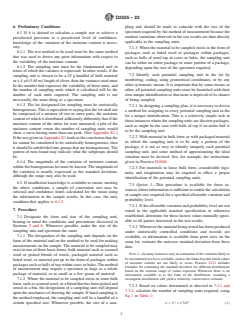
7.2 Identify each potential sampling unit in the lot by
sampling unit is chosen to be a 25 g handful of bulk material
numbering, coding, using geometrical coordinates, or by any
ora4yd(3.65m)lengthofsliver,thenthevarianceusedmust
other systematic means. It is important that by some means or
be the number that expresses the variability of these units, and
other, all potential sampling units must be furnished with their
the number of sampling units which is calculated will be the
number of such units required. The sampling unit is not ownuniqueidentificationsothatnoneisdeprivedofitschance
necessarily the same thing as a specimen.
of being sampled.
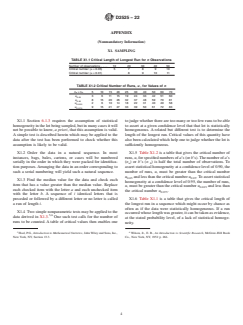
6.1.3 The lot designated for sampling must be statistically
7.2.1 In designing a sampling plan, it is necessary to devise
homogeneous.Thisisequivalenttosayingthatthelotshallnot
a method for assigning to every potential sampling unit in the
be composed of a mixture of two or more parts, the moisture
lot a unique identification. This is a relatively simple task in
contentofwhichisdistributedsufficientlydifferentlythatifthe
thoseinstanceswherethesamplingunitsarediscretepackages,
moisture content of the entire lot were measured, a plot of the
such as might be the case with balls of top if an entire ball is
moisture content versus the number of sampling units would
to be the sampling unit.
show a curve having more than one peak. (See Appendix X1.)
7.2.2 With material in bulk form or with packaged material
IfthetestgiveninAppendixX1leadstotheconclusionthatthe
in which the sampling unit is to be only a portion of the
lot cannot be considered to be statistically homogeneous, then
package, it is not as easy to identify uniquely each potential
itshouldbesubdividedintogroupsthatarehomogeneous.The
sampling unit, and some method of approximating the ideal
pattern of runs found may indicate what the subgroups should
situation must be devised. See, for example, the instructions
be.
given in Practice D1060.
6.1.4 The magnitude of the variation of moisture content
within the homogeneous lot must be known.The magnitude of
7.2.3 For materials in loose bulk form, considerable inge-
the variation is usually expressed as the standard deviation,
nuity and imagination may be required to effect a proper
although the range may also be used.
identification of the potential sampling units.
6.2 If insufficient knowledge is available to ensure meeting
7.3 Option 1—This procedure is available for those in-
the above conditions, a sample of convenient size may be
stanceswhereinformationissufficienttoenablethecalculation
selected and confidence limits calculated for the mean using
of sample size required for a specified allowable variation and
the information in the sample results. In this case, the only
probability level.
condition that applies is 6.1.3.
7.3.1 If the allowable variation and probability level are not
7. Procedure
stated in the applicable material specification or otherwise
established, determine for these factors values mutually agree-
7.1 Designate the form and size of the sampling unit,
able to all parties interested in the test results.
bearing in mind the conditions and precautions discussed in
Sections 5 and 6. Whenever possible, make the size of the
7.3.2 Wheneverthematerialbeingtestedhasbeenproduced
sampling unit and specimen the same.
under statistically controlled conditions and records are
7.1.1 The designation of the sampling unit depends on the
available, or information is available from prior tests on the
form of the material and on the method to be used for making
same lot, estimate the universe standard deviation from these
measurements on the sample. The material to be sampled may
data.
existinoneofthreebasicforms:bulkmaterialsuchasscoured
NOTE2—Inmanyinstancesonlyanestimationofthevariationlikelyto
wool or picked blends of wools, packaged material such as
beencounteredinalotisavailable,suchasthelimitsbeyondwhichvalues
baled wool, or material put up in the form of packages within
of moisture content are not likely to occur. Practice E122 includes
packagessuchasballsoftopwithincasesorbales.Themethod
formulas for estimating the standard deviation for different distributions
of measurement may require a specimen as large as a whole
based on the extreme range of values expected. Whenever there is no
package of material, or as small as a few grams of material.
information available as to the form of the distribution, assuming a
7.1.2 Where the material to be sampled exists in some bulk
rectangular distribution will yield a relatively conservative estimate.
form,suchasscouredwool,orablendthathasbeenpickedand
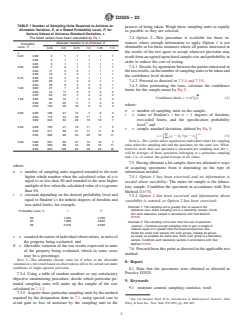
7.3.3 Based on values determined as directed in 7.3.1 and
stored in a bin, the designation of a sampling unit will depend
7.3.2, calculate the number of sampling units required, using
uponthemechanicsofdrawingthesample.Ifhandsamplingis
Eq 1 or Table 1:
the
...