

ASTM D3737-18(2023)e1
(Practice)Standard Practice for Establishing Allowable Properties for Structural Glued Laminated Timber (Glulam)
General Information
- Abstract
ABSTRACT
This practice details the standard procedures for establishing the allowable properties for structural glued laminated timber (glulam). Allowable properties include: stress indexes; stress modification factors associated with slop of grain; stresses for bending, tension and compression parallel to the grain; horizontal shear; compression perpendicular to the grain; radial tension and compression stresses in curved members; grade adjustment factors; modulus of elasticity; and modulus of rigidity. This practice is limited to the calculation of allowable properties subject to the given procedures for the selection and arrangement of grades of lumber of the species considered. It does not cover the requirements for production, inspection and certification, but in order to justify the allowable properties developed using procedures in this practice, manufacturers must conform to recognized manufacturing standards.
SCOPE
1.1 This practice covers the procedures for establishing allowable properties for structural glued laminated timber. Included are the allowable stresses for bending, tension and compression parallel to the grain, horizontal shear, compression perpendicular to the grain, and radial tension and compression in curved members. Also included are modulus of elasticity and modulus of rigidity.
1.2 This practice is limited to the calculation of allowable properties subject to the given procedures for the selection and arrangement of grades of lumber of the species considered.
1.3 Requirements for production, inspection and certification are not included, but in order to justify the allowable properties developed using procedures in this practice, manufacturers must conform to recognized manufacturing standards. Refer to ANSI A190.1 and CSA O122.
1.4 The values stated in inch-pound units are to be regarded as standard. The values given in SI units are mathematical conversions that are provided for information only and are not considered standard.
1.5 This standard does not purport to address all of the safety concerns, if any, associated with its use. It is the responsibility of the user of this standard to establish appropriate safety, health, and environmental practices and determine the applicability of regulatory limitations prior to use.
1.6 This international standard was developed in accordance with internationally recognized principles on standardization established in the Decision on Principles for the Development of International Standards, Guides and Recommendations issued by the World Trade Organization Technical Barriers to Trade (TBT) Committee.
- Status
- Published
- Publication Date
- 30-Sep-2023
- Technical Committee
- D07 - Wood
- Drafting Committee
- D07.02 - Lumber and Engineered Wood Products
Overview
ASTM D3737-18(2023)e1 is a standard practice established by ASTM International for determining the allowable properties of structural glued laminated timber (glulam). This standard outlines procedures for evaluating the key mechanical properties and stress indexes of glulam intended for use in structural applications. Allowable properties include stresses for bending, tension, and compression parallel to the grain, horizontal shear, compression perpendicular to the grain, radial tension and compression in curved members, as well as modulus of elasticity and modulus of rigidity. The practice addresses the calculation methods based on the selection and arrangement of lumber grades for designated wood species but does not cover manufacturing, inspection, or certification requirements.
Key Topics
- Allowable Stresses: Defines minimum allowable values for bending, tension, compression (both parallel and perpendicular to grain), and horizontal shear, ensuring glulam members meet performance and safety requirements.
- Stress Indexes and Modifiers: Provides criteria for stress modification factors influenced by wood characteristics such as knots, slope of grain, and specific gravity, adapting calculations for different grades and species of lumber.
- Modulus of Elasticity and Rigidity: Covers procedures to determine the elastic and rigidity properties of glulam, allowing for the design of timber structures with predictable deformation under load.
- Lamination Quality Requirements: Specifies grading, dimension, and material requirements for lumber used in glulam production, including visual and E-rated grading based on mechanical and visual inspection.
- Calculation Procedures: Detailed instructions for deriving design values using referenced tables, adjustment factors for grade, and mathematical relationships specific to timber configuration and use conditions.
- Species Considerations: Procedures are species-dependent and require adherence to recognized grading rules for different wood types considered in glulam production.
- Exclusions: While it guides property calculations, the standard points users to external manufacturing and certification standards (such as ANSI A190.1 and CSA O122) for conformity and quality assurance.
Applications
- Structural Engineering: Used by engineers to specify allowable design values for glulam beams, columns, and arches in buildings and bridges.
- Timber Products Manufacturing: Offers a framework for glulam manufacturers to validate product capabilities and select suitable lumber grades to ensure structural integrity.
- Building Codes Compliance: Enables building designers and inspectors to verify that glulam products meet required safety and reliability benchmarks as referenced in design codes.
- Product Development: Supports innovation in engineered wood products by providing standardized property determination methods applicable to evolving glulam profiles and timber species.
- Quality Assurance: Serves as part of the technical documentation required for product submittals, qualification testing, and industry certification.
Related Standards
- ANSI A190.1 - Structural Glued Laminated Timber: Provides comprehensive manufacturing, quality control, and product performance requirements.
- CSA O122 - Structural Glued Laminated Timber: Canadian standard for glulam production and evaluation.
- ASTM D143 - Test Methods for Small Clear Specimens of Timber: Basis for key physical property measurements.
- ASTM D198 - Static Tests of Lumber in Structural Sizes: Methods for evaluating large-dimension timber specimen performance.
- ASTM D245 - Practice for Establishing Structural Grades and Related Allowable Properties for Visually Graded Lumber.
- ASTM D6550 - Practice for Assigning Allowable Properties for Mechanically Graded Lumber.
- ANSI/AWC National Design Specification (NDS) for Wood Construction: Design specification referenced in North American building codes.
By following ASTM D3737-18(2023)e1, professionals in the timber and construction sectors ensure that structural glued laminated timber materials meet critical safety, performance, and regulatory criteria, enhancing reliability in engineered wood systems. This standard forms a foundational element in the responsible engineering and application of glulam in modern structures.
Relations
- Effective Date
- 01-Oct-2023
- Effective Date
- 01-Feb-2024
- Effective Date
- 01-Feb-2024
- Effective Date
- 15-Nov-2023
- Effective Date
- 15-May-2022
- Effective Date
- 01-Aug-2017
- Effective Date
- 01-Oct-2023
- Effective Date
- 01-Oct-2023
- Effective Date
- 01-Oct-2023
- Effective Date
- 01-Oct-2023
- Referred By
ASTM D7147-21 - Standard Specification for Testing and Establishing Allowable Loads of Joist Hangers - Effective Date
- 01-Oct-2023
- Effective Date
- 01-Oct-2023
- Effective Date
- 01-Oct-2023
Get Certified
Connect with accredited certification bodies for this standard

Gozdarski inštitut Slovenije
Slovenian Forestry Institute. Forest management certification support, timber testing.
Sponsored listings
Frequently Asked Questions
ASTM D3737-18(2023)e1 is a standard published by ASTM International. Its full title is "Standard Practice for Establishing Allowable Properties for Structural Glued Laminated Timber (Glulam)". This standard covers: ABSTRACT This practice details the standard procedures for establishing the allowable properties for structural glued laminated timber (glulam). Allowable properties include: stress indexes; stress modification factors associated with slop of grain; stresses for bending, tension and compression parallel to the grain; horizontal shear; compression perpendicular to the grain; radial tension and compression stresses in curved members; grade adjustment factors; modulus of elasticity; and modulus of rigidity. This practice is limited to the calculation of allowable properties subject to the given procedures for the selection and arrangement of grades of lumber of the species considered. It does not cover the requirements for production, inspection and certification, but in order to justify the allowable properties developed using procedures in this practice, manufacturers must conform to recognized manufacturing standards. SCOPE 1.1 This practice covers the procedures for establishing allowable properties for structural glued laminated timber. Included are the allowable stresses for bending, tension and compression parallel to the grain, horizontal shear, compression perpendicular to the grain, and radial tension and compression in curved members. Also included are modulus of elasticity and modulus of rigidity. 1.2 This practice is limited to the calculation of allowable properties subject to the given procedures for the selection and arrangement of grades of lumber of the species considered. 1.3 Requirements for production, inspection and certification are not included, but in order to justify the allowable properties developed using procedures in this practice, manufacturers must conform to recognized manufacturing standards. Refer to ANSI A190.1 and CSA O122. 1.4 The values stated in inch-pound units are to be regarded as standard. The values given in SI units are mathematical conversions that are provided for information only and are not considered standard. 1.5 This standard does not purport to address all of the safety concerns, if any, associated with its use. It is the responsibility of the user of this standard to establish appropriate safety, health, and environmental practices and determine the applicability of regulatory limitations prior to use. 1.6 This international standard was developed in accordance with internationally recognized principles on standardization established in the Decision on Principles for the Development of International Standards, Guides and Recommendations issued by the World Trade Organization Technical Barriers to Trade (TBT) Committee.
ABSTRACT This practice details the standard procedures for establishing the allowable properties for structural glued laminated timber (glulam). Allowable properties include: stress indexes; stress modification factors associated with slop of grain; stresses for bending, tension and compression parallel to the grain; horizontal shear; compression perpendicular to the grain; radial tension and compression stresses in curved members; grade adjustment factors; modulus of elasticity; and modulus of rigidity. This practice is limited to the calculation of allowable properties subject to the given procedures for the selection and arrangement of grades of lumber of the species considered. It does not cover the requirements for production, inspection and certification, but in order to justify the allowable properties developed using procedures in this practice, manufacturers must conform to recognized manufacturing standards. SCOPE 1.1 This practice covers the procedures for establishing allowable properties for structural glued laminated timber. Included are the allowable stresses for bending, tension and compression parallel to the grain, horizontal shear, compression perpendicular to the grain, and radial tension and compression in curved members. Also included are modulus of elasticity and modulus of rigidity. 1.2 This practice is limited to the calculation of allowable properties subject to the given procedures for the selection and arrangement of grades of lumber of the species considered. 1.3 Requirements for production, inspection and certification are not included, but in order to justify the allowable properties developed using procedures in this practice, manufacturers must conform to recognized manufacturing standards. Refer to ANSI A190.1 and CSA O122. 1.4 The values stated in inch-pound units are to be regarded as standard. The values given in SI units are mathematical conversions that are provided for information only and are not considered standard. 1.5 This standard does not purport to address all of the safety concerns, if any, associated with its use. It is the responsibility of the user of this standard to establish appropriate safety, health, and environmental practices and determine the applicability of regulatory limitations prior to use. 1.6 This international standard was developed in accordance with internationally recognized principles on standardization established in the Decision on Principles for the Development of International Standards, Guides and Recommendations issued by the World Trade Organization Technical Barriers to Trade (TBT) Committee.
ASTM D3737-18(2023)e1 is classified under the following ICS (International Classification for Standards) categories: 79.060.01 - Wood-based panels in general. The ICS classification helps identify the subject area and facilitates finding related standards.
ASTM D3737-18(2023)e1 has the following relationships with other standards: It is inter standard links to ASTM D3737-18e1, ASTM D2555-17a(2024), ASTM D2555-17a(2024)e1, ASTM D143-23, ASTM D143-22, ASTM D2555-17a, ASTM D6570-18a(2023)e1, ASTM D5457-23, ASTM D2915-17(2022), ASTM D7199-20, ASTM D7147-21, ASTM D198-22a, ASTM D7341-21. Understanding these relationships helps ensure you are using the most current and applicable version of the standard.
ASTM D3737-18(2023)e1 is available in PDF format for immediate download after purchase. The document can be added to your cart and obtained through the secure checkout process. Digital delivery ensures instant access to the complete standard document.
Standards Content (Sample)
This international standard was developed in accordance with internationally recognized principles on standardization established in the Decision on Principles for the
Development of International Standards, Guides and Recommendations issued by the World Trade Organization Technical Barriers to Trade (TBT) Committee.
´1
Designation: D3737 − 18 (Reapproved 2023)
Standard Practice for
Establishing Allowable Properties for Structural Glued
Laminated Timber (Glulam)
This standard is issued under the fixed designation D3737; the number immediately following the designation indicates the year of
original adoption or, in the case of revision, the year of last revision. A number in parentheses indicates the year of last reapproval. A
superscript epsilon (´) indicates an editorial change since the last revision or reapproval.
ε NOTE—Editorial changes were made throughout in October 2023.
1. Scope 2. Referenced Documents
2.1 ASTM Standards:
1.1 This practice covers the procedures for establishing
D9 Terminology Relating to Wood and Wood-Based Prod-
allowable properties for structural glued laminated timber.
ucts
Included are the allowable stresses for bending, tension and
D143 Test Methods for Small Clear Specimens of Timber
compression parallel to the grain, horizontal shear, compres-
D198 Test Methods of Static Tests of Lumber in Structural
sion perpendicular to the grain, and radial tension and com-
Sizes
pression in curved members. Also included are modulus of
D245 Practice for Establishing Structural Grades and Re-
elasticity and modulus of rigidity.
lated Allowable Properties for Visually Graded Lumber
1.2 This practice is limited to the calculation of allowable
D2395 Test Methods for Density and Specific Gravity (Rela-
properties subject to the given procedures for the selection and
tive Density) of Wood and Wood-Based Materials
arrangement of grades of lumber of the species considered.
D2555 Practice for Establishing Clear Wood Strength Values
D2915 Practice for Sampling and Data-Analysis for Struc-
1.3 Requirements for production, inspection and certifica-
tural Wood and Wood-Based Products
tion are not included, but in order to justify the allowable
D4761 Test Methods for Mechanical Properties of Lumber
properties developed using procedures in this practice, manu-
and Wood-Based Structural Materials
facturers must conform to recognized manufacturing standards.
D5456 Specification for Evaluation of Structural Composite
Refer to ANSI A190.1 and CSA O122.
Lumber Products
1.4 The values stated in inch-pound units are to be regarded
D6570 Practice for Assigning Allowable Properties for Me-
as standard. The values given in SI units are mathematical
chanically Graded Lumber
conversions that are provided for information only and are not
E105 Guide for Probability Sampling of Materials
considered standard.
2.2 Other Standards:
ANSI A190.1 Structural Glued Laminated Timber
1.5 This standard does not purport to address all of the
ANSI/AWC National Design Specification for Wood Con-
safety concerns, if any, associated with its use. It is the
struction
responsibility of the user of this standard to establish appro-
CSA O122 Structural Glued Laminated Timber
priate safety, health, and environmental practices and deter-
mine the applicability of regulatory limitations prior to use.
3. Terminology
1.6 This international standard was developed in accor-
3.1 Definitions:
dance with internationally recognized principles on standard-
3.1.1 alternative lumber—laminated veneer lumber (LVL),
ization established in the Decision on Principles for the
laminated strand lumber (LSL), oriented strand lumber (OSL),
Development of International Standards, Guides and Recom-
mendations issued by the World Trade Organization Technical
Barriers to Trade (TBT) Committee.
For referenced ASTM standards, visit the ASTM website, www.astm.org, or
contact ASTM Customer Service at service@astm.org. For Annual Book of ASTM
Standards volume information, refer to the standard’s Document Summary page on
the ASTM website.
1 3
This practice is under the jurisdiction of ASTM Committee D07 on Wood and Available from APA – The Engineered Wood Association, Tacoma, WA 98466,
is the direct responsibility of Subcommittee D07.02 on Lumber and Engineered http://www.apawood.org.
Wood Products. Available from American Wood Council (AWC), 222 Catoctin Circle, SE, Suite
Current edition approved Oct. 1, 2023. Published November 2023. Originally 201, Leesburg, VA 20175, http://www.awc.org.
ɛ1 5
approved in 1978. Last previous edition approved in 2018 as D3737 – 18 . DOI: Available from Canadian Standards Association (CSA), 5060 Spectrum Way,
10.1520/D3737-18R23E01. Mississauga, ON L4W 5N6, Canada, http://www.csa.ca.
Copyright © ASTM International, 100 Barr Harbor Drive, PO Box C700, West Conshohocken, PA 19428-2959. United States
´1
D3737 − 18 (2023)
or parallel strand lumber (PSL) meeting the requirements of knot, away from the edge of the lumber to the cross-sectional
Specification D5456; or solid-sawn lumber that is produced area of the lumber (see Fig. 1).
according to Practice D6570 and the grading rules of the
3.1.10 GDE—ratio of the cross-sectional area of the local
applicable grading or inspection agency.
grain deviation, which may or may not be associated with a
3.1.2 E-rated lumber—lumber graded for use in manufac- knot, at the edge of the lumber to the cross-sectional area of the
turing structural glued laminated timber by nondestructive lumber (see Fig. 1).
measurement of a modulus of elasticity (E) and by visual
3.1.11 GDS—projected sum of all GDE and GDC values
inspection in accordance with the grading rules of the appli-
within a one-foot length of lumber as defined in Fig. 1.
cable grading or inspection agency.
3.1.12 KC—ratio of the cross-sectional area of a knot
3.1.3 glulam—term used to denote structural glued lami-
located away from the edge of the lumber to the cross-sectional
nated timber, which is a product made from suitably selected
area of lumber. When a knot at the edge of the wide face and
and prepared pieces of wood bonded together with an adhesive
a knot located away from the edge are in the same cross-
either in a straight or curved form with the grain of all pieces
section, the combination of the two shall be used in determin-
essentially parallel to the longitudinal axis of the member.
ing KC (see Fig. 2).
3.1.4 horizontally laminated timber—member designed to
3.1.13 KE—ratio of cross-sectional area of a knot at the
resist bending loads applied perpendicularly to the wide faces
edge of wide face of lumber to the cross-sectional area of the
of the laminations (referred to as bending about the x-x axis).
lumber (see Fig. 2).
3.1.5 lamination—layer of lumber within the glued lami-
3.1.14 SR —required strength ratio of the tension lamina-
tl
nated timber.
tion at the outermost fiber.
3.1.6 modulus of elasticity (E)—for laminating, E is desig-
nated in two categories to distinguish mode of measurement
4. Materials Requirements
and application.
4.1 Requirements for Laminations:
3.1.6.1 Long-Span E (LSE)—modulus of elasticity calcu-
4.1.1 Laminations of glulam shall be of lumber with net
lated from deflection measured in a flat-wise static bending test
thickness of 2 in. (5 cm) or less.
of lumber with a center-point loading and a span-to-depth ratio
4.1.2 Lumber is permitted to be joined end to end with
ℓ
( ⁄d) of approximately 100 or the modulus of elasticity obtained
structural end joints to form long-length laminations. End
from Practice D2555 and multiplied by the appropriate factors
joints shall be qualified and quality controlled in accordance
from Tables 1-6.
with a recognized manufacturing standard.
4.1.3 Lumber is permitted to be placed or joined side to side
3.1.6.2 member E (E , E , E )—allowable modulus of
axial x y
to form wide laminations.
elasticity values of the structural glued laminated member as
4.1.4 Dimension lumber used to form laminations shall be
defined in this practice.
visually graded or E-rated according to established grading
3.1.7 vertically laminated timber—member designed to re-
rules.
sist bending loads applied parallel to the wide faces of the
4.1.5 Alternative lumber material is permitted by demon-
laminations (referred to as bending about the y-y axis).
strating equivalence to a dimension lumber grade in accor-
3.1.8 visually graded lumber—lumber graded by visual
dance with Annex A1.
inspection in accordance with the grading rules of the appli-
4.1.6 For the analysis of a glulam layup, all laminations in
cable grading or inspection agency.
a single cross-section shall be of equal thickness.
3.1.9 GDC—ratio of the cross-sectional area of the local
4.1.7 The analytical procedures of this standard practice are
grain deviation, which may or may not be associated with a
based on specific lamination characteristics.
4.1.7.1 Lumber properties including knot size and
frequency, physical properties such as specific gravity, and
TABLE 1 Adjustment Factors for Clear Wood Stresses
(Practice D2555) mechanical properties such as modulus of elasticity shall be
based on measurements of 2 by 6 lumber for definition of grade
Seasoning
Multipliers for Average
Factor for a
characteristics.
th
or 5 Percentile
12 %
Property
4.1.7.2 The effect of decay or compression failures upon
Average
strength cannot be readily determined, thus these defects shall
Moisture
Softwoods Hardwoods
Content
be prohibited from laminating grades insofar as existing
Bending 0.476 0.435 1.35
inspection and grading technology permit. Firm white speck or
1 1
( ⁄2.1) ( ⁄2.3)
light white pocket is permissible in grades of lumber that
permit knots to occupy up to one third or more of the
Compression 0.526 0.476 1.75
1 1
parallel to grain ( ⁄1.9) ( ⁄2.1)
cross-section provided their extent in combination with knots
does not exceed that of the largest edge knot permitted. The
Modulus of elas- 1.095 1.095 1.20
1 1
ticity ( ⁄0.913) ( ⁄0.913) exception is that firm white speck and light white pocket shall
be excluded from end joints in tension members and the outer
Horizontal shear 0.244 0.222 1.13
10 % of the total depth on the tension side of bending
1 1
( ⁄4.1) ( ⁄4.5)
members.
´1
D3737 − 18 (2023)
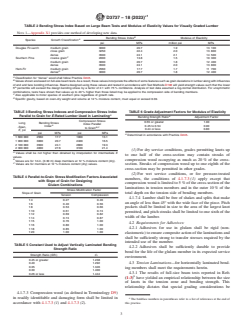
TABLE 2 Bending Stress Index Based on Large Beam Tests and Modulus of Elasticity Values for Visually Graded Lumber
NOTE 1—Appendix X1 provides one method of developing new data.
B
Bending Stress Index Modulus of Elasticity
A
Species Growth Classification
psi MPa million psi MPa
Douglas Fir-Larch medium grain 3000 20.7 1.9 13 100
close grain 3250 22.4 2.0 13 800
dense 3500 24.1 2.1 14 500
C
Southern Pine coarse grain 2000 13.8 1.5 10 300
medium grain 3000 20.7 1.8 12 400
dense 3500 24.1 2.0 13 800
Hem-Fir medium grain 2560 17.7 1.7 11 700
D
dense 3000 20.7 1.8 12 400
A
Classification for “dense” wood shall follow Practice D245.
B
Values shown are based on full-size beam tests. As a result, these values incorporate the effects of some features such as grain deviations in lumber along with influences
of end and face bonding influences. Beams designed using these values and tested in accordance with Test Methods D198 will yield strength values such that the lower
th
5 percentile will exceed the design bending stress by a factor of 2.1 with 75 % confidence. Analysis of test data assumed a log-normal distribution. For unsymmetric
combinations, tests have shown that values up to 40 % higher than those listed may be applied to the compression side of bending members.
C
Also applicable to minor species of southern pine regardless of growth rate.
D
Specific gravity, based on oven-dry weight and volume at 12 % moisture content, must equal or exceed 0.39.
TABLE 3 Bending Stress Indexes and Compression Stress Index TABLE 6 Grade Adjustment Factors for Modulus of Elasticity
A
Parallel to Grain for E-Rated Lumber Used in Laminating
A
Bending Strength Ratio Adjustment Factor
Compression Stress
0.55 or greater 1.00
Bending Stress
Long
Index Parallel
A
Index 0.45 to 0.54 0.90
-Span, B,C
to Grain
0.44 or less 0.80
E, psi
psi MPa psi MPa
A
Determined in accordance with Practice D245.
1 600 000 2560 17.7 1900 13.1
1 900 000 3000 20.7 2400 16.5
2 100 000 3500 24.1 2800 19.3
2 300 000 4000 27.6 3100 21.4
(1) For dry service conditions, grades permitting knots up
A
Values shall be not higher than obtained by interpolation for intermediate E
to one half of the cross-section may contain streaks of
values.
B
compression wood occupying as much as 20 % of the cross-
Values are for 12-in. (0.30 m) deep members at 12 % moisture content (dry).
C
Values are for members at 12 % moisture content (dry) values.
section. Streaks of compression wood up to one eighth of the
cross-section may be permitted in other grades.
(2) For wet service conditions, or for pressure-treated
TABLE 4 Parallel-to-Grain Stress Modification Factors Associated
members, the conditions of 4.1.7.3 (1) apply except that
with Slope of Grain for Designing
compression wood is limited to 5 % of the cross-section of the
Glulam Combinations
laminations in tension members and in the outer 10 % of the
Stress Modification Factor
Slope of Grain total depth on the tension side of bending members.
Tension Compression
4.1.7.4 Lumber shall be free of shakes and splits that make
1:4 0.27 0.46
an angle of less than 45° with the wide face of the piece. Pitch
1:6 0.40 0.56
1:8 0.53 0.66
pockets shall be limited in size to the area of the largest knot
1:10 0.61 0.74
permitted, and pitch streaks shall be limited to one sixth of the
1:12 0.69 0.82
width of the lumber.
1:14 0.74 0.87
1:15 0.76 1.00
4.2 Requirements for Adhesives:
1:16 0.80 1.00
4.2.1 Adhesives for use in glulam shall be rigid (non-
1:18 0.85 1.00
1:20 1.00 1.00
elastomeric) to ensure composite action of the laminations and
shall be sufficiently strong to transfer stresses required by the
intended use of the member.
TABLE 5 Constant Used to Adjust Vertically Laminated Bending
4.2.2 Adhesives shall be sufficiently durable to provide
Strength Ratio
bond for the life of the glulam member in its expected service
Strength Ratio (SR ) C
1 1
environment.
0.45 or greater 1.238
0.40 1.292 4.3 Tension Laminations—for horizontally laminated bend-
0.35 1.346
ing members shall meet the requirements herein.
0.30 1.400
4.3.1 The results of full-size beam tests reported in Refs
0.26 or less 1.444
(1-3) have yielded an empirical relationship between the size
of knots in the tension zone and bending strength. This
relationship dictates that special grading considerations be
4.1.7.3 Compression wood (as defined in Terminology D9)
in readily identifiable and damaging form shall be limited in
The boldface numbers in parentheses refer to a list of references at the end of
accordance with 4.1.7.3 (1) and 4.1.7.3 (2). this practice.
´1
D3737 − 18 (2023)
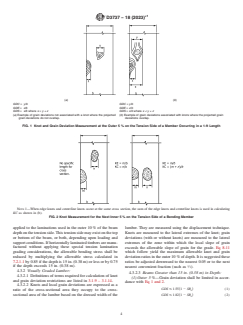
(a) (b)
GDC = y/b GDC = y/b
GDE = z/b GDE = z/b
GDS = x/b where x = y + z GDS = x/b where x < y + z
(a) Example of grain deviations not associated with a knot where the projected (b) Example of grain deviations associated with knots where the projected grain
grain deviations do not overlap. deviations overlap.
FIG. 1 Knot and Grain Deviation Measurement at the Outer 5 % on the Tension Side of a Member Occurring in a 1-ft Length
NOTE 1—When edge knots and centerline knots occur at the same cross section, the sum of the edge knots and centerline knots is used in calculating
KC as shown in (b).
FIG. 2 Knot Measurement for the Next Inner 5 % on the Tension Side of a Bending Member
applied to the laminations used in the outer 10 % of the beam lumber. They are measured using the displacement technique.
depth on the tension side. This tension side may exist on the top Knots are measured to the lateral extremes of the knot; grain
or bottom of the beam, or both, depending upon loading and deviations (with or without knots) are measured to the lateral
support conditions. If horizontally laminated timbers are manu-
extremes of the zone within which the local slope of grain
factured without applying these special tension lamination exceeds the allowable slope of grain for the grade. Eq 8-11
grading considerations, the allowable bending stress shall be
which follow yield the maximum allowable knot and grain
reduced by multiplying the allowable stress calculated in
deviation ratios in the outer 10 % of depth. It is suggested these
7.2.1.1 by 0.85 if the depth is 15 in. (0.38 m) or less or by 0.75
ratios be adjusted downward to the nearest 0.05 or to the next
if the depth exceeds 15 in. (0.38 m).
nearest convenient fraction (such as ⁄3).
4.3.2 Visually Graded Lumber:
4.3.2.3 Beams Greater than 15 in. (0.38 m) in Depth:
4.3.2.1 Definitions of terms required for calculation of knot
(1) Outer 5 %—Grain deviation shall be limited in accor-
and grain deviation restrictions are listed in 3.1.9 – 3.1.14.
dance with Eq 1 and 2.
4.3.2.2 Knots and local grain deviations are expressed as a
GDS # 1.55 1 2 SR (1)
~ !
tl
ratio of the cross-sectional area they occupy to the cross-
sectional area of the lumber based on the dressed width of the GDS # 1.82 1 2 SR (2)
~ !
tl
´1
D3737 − 18 (2023)
(a) Eq 1 shall be used when GDE, with or without GDC, 4.3.2.4 (1), with the exception of the knot and slope of grain
is used to determine GDS (Fig. 1). Eq 2 shall apply when GDE requirements as given in 4.3.3.3.
is not used to determine GDS. In addition, general slope of 4.3.3.2 Other Requirements:
grain shall not exceed 1:16 if the required strength ratio of the (1) Outer 5 %—Wide-ringed or lightweight pith associated
tension lamination is 0.60 or greater. If SR is less than 0.60, wood and compression wood are limited in the same manner as
tl
the general slope of grain shall not exceed 1:12. for visually graded lumber, except that there are no density
(2) Next Inner 5 %—Knots are restricted in accordance requirements. Material not meeting medium grain rate of
with Eq 3 and 4. growth, in combination with compression wood, shall be
limited to ⁄8 of the cross-section of the piece of lumber. In
KE 5 0.66 2 0.45 SR (3)
tl
addition, for wet conditions of use or pressure-treated
KC 5 1.20 2 0.93 SR (4)
tl
members, compression wood is limited to a maximum of 5 %
of the cross-section.
(a) General slope of grain shall be limited in accordance
4.3.3.3 The portions of the piece not subjected to mechani-
with the strength requirements of the individual laminations.
cal E measurements shall have visual criteria applied to ensure
4.3.2.4 Beams 12 in. (0.30 m) to 15 in. (0.38 m) in Depth:
piece quality. Edge knots up to the size permitted in the grade
(1) Outer 5 %—The requirements of 4.3.2.3 (1) apply
are acceptable. Other knots are limited to the visual require-
except that SR shall be multiplied by 0.90 in Eq 1 and 2. The
tl
ments of the bending stress index for which the E-rated lumber
value of 0.9 SR shall not be taken as less than 0.50.
tl
is qualified. For tension laminations, the slope of grain shall not
(2) Next Inner 5 %—General slope of grain shall be limited
exceed 1:12 and wide-ringed or pith-associated wood and
in accordance with the strength requirements of the individual
compression wood is limited as in 4.3.3.2. Medium grain
laminations.
growth requirements shall be met for Douglas Fir-Larch and
4.3.2.5 Beams of Four or More Laminations and Less than
Southern Pine.
12 in. (0.30 m) in Depth:
4.3.4 Tension laminations to meet the requirements identi-
(1) Outer 5 %—The requirements of 4.3.2.3 (1) apply
fied in 4.3.1 may be qualified by test as an alternative to the
except that SR shall be multiplied by 0.80 in Eq 1 and 2. The
t1
grading criteria of 4.3.2 and 4.3.3. The procedure given in
value of 0.80 SR shall not be taken as less than 0.50.
t1
Annex A1 shall be used.
(2) Next Inner 5 %—General slope of grain shall be limited
in accordance with the strength requirements of the individual
5. Allowable Properties for Glulam Members
laminations.
5.1 Allowable properties for individual laminations shall be
4.3.2.6 Density Requirements:
obtained by multiplying the stress index values from Section 6
(1) Outer 5 %—Density requirements shall apply to the
by the stress modification factors from Section 7 and modify-
full length of the piece of lumber. In order to ensure that
ing for specific conditions from Section 8. Allowable proper-
lumber is near-average or above specific gravity for the
ties for glulam members shall be calculated as described in 5.3
species, visually graded tension laminations shall have a
– 5.11.
minimum specific gravity of at least 94 % of the recognized
5.2 Allowable properties shall be rounded to the significant
species average from Practice D2555 based on dry weight and
digits as follows:
volume at 12 % moisture content. The minimum specific
gravity of the piece of lumber shall be the average specific Bending, tension parallel to grain, 0 to 1000 psi to nearest 25 psi
and compression parallel to grain (0.3 MPa)
gravity of the entire piece. Rate of growth and percentage of
1000 to 2000 psi to nearest 50 psi
latewood requirements for tension laminations shall apply to
(0.5 MPa)
2000 to 3000 psi to nearest 100 psi
the full length of lumber. Visual inspection alone is not an
(1 MPa)
acceptable method of determining specific gravity.
Horizontal shear Nearest 5 psi (0.05 MPa)
4.3.2.7 Other Requirements: Compression perpendicular to grain Nearest 5 psi (0.05 MPa)
and radial stresses in curved
(1) Outer 5 %—Wide-ringed or lightweight pith associated
members
wood has a pronounced effect on finger joint strength. The
Modulus of elasticity Nearest 100 000 psi (500 MPa)
amount of material not meeting rate of growth and density
5.3 The allowable bending stress for horizontally laminated
requirements, in combination with compression wood, shall be
timbers shall be calculated as shown by example in Annex A4.
limited to ⁄8 of the cross-section of the piece of lumber. In
5.4 The allowable bending stress of vertically laminated
addition, for wet service conditions or pressure-treated
timbers shall be determined by the following equation:
members, compression wood is limited to a maximum of 5 %
of the cross-section.
F
by i
F 5 Min E $ Min F (5)
H J ~ ! $ %
by avg by i
4.3.3 E-Rated Lumber:
E
i
4.3.3.1 Grading Requirements:
where:
(1) Outer 5 %—In addition to having the required modulus
F = allowable bending stress of the vertically laminated
by
of elasticity, E-rated lumber must meet the requirements for
timber,
visually graded lumber given in 4.3.2.2, 4.3.2.3 (1), and
´1
D3737 − 18 (2023)
shall be limited to straight beams of constant cross-section,
E = weighted average of the component lamination LSE
avg
which are not subject to impact or cyclic loads.
values,
th
F = allowable bending stress for the i lamination in the 5.8.2 Vertically Laminated Timbers—For vertically lami-
by i
combination which is obtained by multiplying the
nated timbers, the allowable stress in horizontal shear shall be
stress index value from 6.1.1 or 6.1.1.1 by the lower
the weighted average of the allowable stresses for the indi-
of the stress modification factors from 7.2.2.1 and vidual laminations, which are determined by multiplying the
7.2.2.2 and modifying for specific conditions from
shear stress index from 6.1.5 or 6.1.5.1 by the appropriate shear
Section 8. stress modification factor from 7.6.2 modified for specific
th
E = LSE for the i lamination.
conditions from Section 8. Because the test procedure refer-
i
enced in 6.1.5.1 utilizes prismatic beams subject to static,
5.5 Compression Parallel to Grain—The allowable stress
monotonic loading and produces significantly higher values
for compression parallel to grain shall be calculated as shown
than the procedure described in 6.1.5, shear stress values
by example in Annex A5.
determined using 6.1.5.1 shall be limited to straight beams of
5.6 Tension Parallel to Grain—The allowable stress for
constant cross-section, which are not subject to impact or
tension parallel to grain shall be the minimum allowable stress
cyclic loads.
of the individual laminations in the member, which is obtained
5.9 Compression Perpendicular to Grain—Allowable
by multiplying the tension stress index from 6.1.3 by the lower
stresses in compression perpendicular to grain for the glulam
of the stress modification factors from 7.4.2 and 7.4.3 and
member shall be determined based on the location of the
modifying for specific conditions from Section 8.
applied stress. The allowable stress for the lamination, as
5.7 Member E:
determined by multiplying the stress index from 6.1.6 by the
5.7.1 Axially Loaded Timbers—E shall be the weighted
axial
stress modification factor from 7.7.1 at the location of the
average of the individual lamination grade LSE values modi-
applied stress shall be the allowable stress for the glulam
fied for specific conditions from Section 8.
member.
5.7.2 Vertically Laminated Timbers—E shall be 95 % of the
y
5.10 The modulus of rigidity of glulam members can be
weighted average of the individual lamination grade LSE
considered to have a constant relationship to the modulus of
values modified for specific conditions from Section 8.
elasticity. For design purposes, the relationship G = E /K shall
5.7.3 Horizontally Laminated Timbers—E shall be 95 % of x
x
be used for members consisting of a single grade, where K = 16
the apparent modulus of elasticity as determined by a trans-
when specific data is not available. For members consisting of
formed section analysis using the LSE values for each grade in
multiple grades of lumber the modulus of rigidity shall be
the combination modified for specific conditions from Section
obtained by using the LSE of the lowest grade applied to the
8.
entire member.
5.8 Horizontal Shear:
5.11 Radial Stress in Curved Members:
5.8.1 Horizontally Laminated Timbers—For horizontally
5.11.1 Radial Tension—The allowable stress for radial ten-
laminated timbers, the allowable stress in horizontal shear shall
sion in curved members shall be equal to the allowable stress
be determined using the following equation:
for radial tension for the lamination with the lowest value.
F
vx,i
F 5 Min (6)
vx 5.11.2 Radial Compression—The allowable stress for radial
c
i
S D
1 2
S D
compression in curved members shall be equal to the allowable
c
stress for compression perpendicular to the grain for the
where:
lamination with the lowest value.
F = allowable shear stress for the horizontally laminated
vx
member,
6. Stress Index Values for Laminations
th
F = allowable shear stress for the i lamination, which is
vx,i
6.1 Visually Graded Lumber—Practice D2555 provides in-
determined by multiplying the shear stress index from
formation on clear wood strength properties and their expected
6.1.5 or 6.1.5.1 by the shear stress modification factor
variation for small clear, straight-grained specimens of green
from 7.6.1 modified for specific condition from Sec-
lumber. Based on these clear wood properties, stress index
tion 8,
values shall be calculated, unless otherwise permitted herein.
c = distance from the neutral axis of the horizontally
i
th
laminated timber to the innermost fiber of the i
6.1.1 Bending—The bending stress index shall be deter-
th
lamination, mined by calculating the 5 percentile of modulus of rupture in
c = distance from the neutral axis of the horizontally
accordance with Practice D2555, multiplying by the appropri-
laminated timber to the outermost fiber in the
ate factors in Table 1, and multiplying by 0.743 to adjust to a
member, and
12-in. (0.3 m) deep, uniformly loaded simple beam with a 21:1
i = 1 to n.
span-to-depth ratio.
Because the test procedure referenced in 6.1.5.1 utilizes 6.1.1.1 As an alternative to 6.1.1, testing and analysis of
prismatic beams subject to static, monotonic loading and large glulam beams of Douglas Fir-Larch, Southern Pine and
produces significantly higher values than the procedure de- Hem-Fir indicate that the stress indices given in Table 2 may be
scribed in 6.1.5, shear stress values determined using 6.1.5.1 used for Douglas Fir-Larch, grown within the states of
´1
D3737 − 18 (2023)
Wyoming, Montana, Washington, Idaho, Oregon, and Califor-
SG = average green specific gravity from Practice D2555
nia; for Southern Pine consisting of the four principal species:
or, for a species group, the standing timber volume
Longleaf, Slash, Shortleaf, and Loblolly; and for Hem-Fir
weighted average green specific gravity, adjusted as
consisting of Western Hemlock, California Red Fir, Grand Fir,
shown in 6.1.6.1, 6.1.6.2, or 6.1.6.3.
Noble Fir, Pacific Silver Fir, and White Fir.
6.1.6.1 For purposes of calculating stress index values in
6.1.2 Compression Parallel to the Grain—The compression
compression perpendicular to grain for visually graded
stress index parallel to grain shall be determined by calculating
material, the average green specific gravity of a species or
th
the 5 percentile strength in compression parallel to the grain
species group which have an average green specific gravity of
in accordance with Practice D2555 and multiplying by the
0.36 or above shall be reduced by the following amounts for
appropriate factors from Table 1.
various rates of growth and density to account for variation in
the specific gravity.
6.1.3 Tension Parallel to the Grain—The tension stress
index parallel to grain shall be five eighths of the bending stress Dense grain—0.03
Close grain—0.05
index obtained in 6.1.1 or 6.1.1.1.
Medium grain—0.06
6.1.4 Modulus of Elasticity—The stress index value for Coarse grain—0.09
modulus of elasticity shall be the average long-span modulus
6.1.6.2 When the average green specific gravity of a species
of elasticity as defined in 3.1.6.1.
or species group is 0.35 or less the reductions shall be as
6.1.4.1 As an alternative to 6.1.4, values from Table 2 based follows:
on testing of large samples of lumber of the species groups
Close grain—0.03
Medium grain—0.04
listed in 6.1.1.1 and multiplied by appropriate factors from
Table 6 are permitted to be used for LSE.
6.1.6.3 As an alternative to the method specified in 5.6.1 of
Practice D245, lumber is permitted to be qualified as dense by
6.1.5 Horizontal Shear—The horizontal shear stress index
th
weighing. The lumber specific gravity, adjusted to a green
shall be the lower 5 percentile of clear wood shear strength,
condition using Test Methods D2395, Appendix X1 conversion
determined in accordance with Practice D2915 using the data
formula, shall meet the reduced specific gravity as specified in
given in Practice D2555 and multiplying by the appropriate
6.1.6.1. The reduced value shall be used in Eq 2 to determine
factors from Table 1. The horizontal shear stress index for
the stress index value in compression perpendicular to grain.
coarse-grain Douglas Fir-Larch and Southern Pine shall be
6.1.7 Radial Tension—The stress index for radial tension
70 % of the value used for medium-grain materials.
shall be limited to one third of the value for horizontal shear as
6.1.5.1 As an alternative to 6.1.5, the horizontal shear stress
determined in accordance with 6.1.5, except for Douglas
index shall be permitted to be determined from flexural tests of
Fir-Larch, Hem-Fir, Douglas Fir South, Eastern Spruce, Cana-
full-size beams in accordance with the principles of Test
dian Spruce Pine, and mixed Softwood Species, which are
Methods D198 with specific loading details as shown in Annex
prescriptively limited to 15 psi (0.10 MPa) for other than wind
A7. Laminating lumber used in the critical core area of the test
or earthquake loads. For wind and earthquake loading of all
beams subjected to maximum shear stresses shall be selected
species groups, the allowable stress shall be one third of the
such that it is representative of the population of on-grade
allowable stress for horizontal shear determined in accordance
lumber used in normal production for the species and grade
with 6.1.5.
being evaluated. The required number of samples and the
th 6.2 E-Rated Lumber—This method is based on lumber that
lower 5 percentile tolerance limit of shear strength shall be
has been E-rated and visually graded in accordance with Annex
determined in accordance with Practice D2915 and the analysis
A1. E-rated lumber is designated by the modulus of elasticity
procedures given in Annex A7. The horizontal shear stress
(E) and the size of the edge characteristics permitted in the
th
index is determined by multiplying the lower 5 percentile
grade, for example, 1.6E- ⁄3, etc. Edge characteristics include
tolerance limit of shear strength by 0.476 (or ⁄2.1). Reassess-
knots, knot holes, burls, localized grain deviation or decay
ment of the horizontal shear stress index derived from this
(partially or wholly) at edges of wide faces.
section shall be conducted for beam configurations that are not
6.2.1 Bending—Bending stress index values for E-rated
included in the consideration of the testing described in this
lumber with various LSE values are given in Table 3.
section, or if there is a significant change in the lumber
6.2.2 Compression Parallel to Grain—Compression parallel
resource or in the lamination grading system or the manufac-
to grain stress index values for E-rated laminations shall be as
turing process.
given in Table 3.
6.1.6 Compression Perpendicular to the Grain—The stress
6.2.3 Tension Parallel to Grain—The tension stress index
index value for compression perpendicular to grain shall be
for E-rated Laminations shall be five eighths of the bending
determined as follows (4):
stress index obtained in 6.2.1.
F 5 ~2674 SG 2 551.3! ~1.9/1.67! (7) 6.2.4 Modulus of Elasticity—The stress index for modulus
C'
of elasticity for E-rated laminations shall be the LSE as defined
where:
in 3.1.6.1.
F = stress index value in compression perpendicular to
C'
6.2.4.1 LSE values shall be permitted to be determined by
grain; and
tests of lumber meeting the criteria of Annex A2.
´1
D3737 − 18 (2023)
6.2.5 Horizontal Shear—The stress index value for horizon- outer edge of each grade zone. All laminations in the same
tal shear for E-rated laminations shall be determined in the grade zone shall be permitted to use the same stress modifica-
same manner as for visually graded laminations in 6.1.5 or tion factor for knots. Transformed section analysis shall be
6.1.5.1. used to locate the neutral axis of the beam. The “half beam” on
each side of the neutral axis shall be considered independently
6.2.6 Compression Perpendicular to Grain—The stress in-
dex in compression perpendicular to grain for E-rated lamina- after locating the neutral axis. Knots affect strength less if
tions shall be determined as follows, using the LSE listed in located in laminations near the neutral axis than in outer
Table 3 and the growth rate classifications. laminations. Thus, the influence of knots depends both on their
(1) Dense—If the average LSE of the E-rated grade equals size and position and can be measured by their moment of
or exceeds that of the dense classification for the species, the inertia. Tests of glulam beams have provided an empirical
stress index for the dense visual grade of the species or species relationship between the ratio I /I and bending strength. I is
K G K
group per 6.1.6 shall be used. defined as the moment of inertia of all knots within 6 in.
(2) Medium Grain—If the average LSE of the E-rated (152 mm) of the critical cross-section and I is the gross
G
grade is less that the average LSE of the species or species moment of inertia. Knot properties shall be determined follow-
groups, but not more than 300 000 psi below the average, the ing the procedures given in Annex A3 and I /I ratios shall be
K G
calculated following procedures given in Annex A4. Additional
stress index determined for medium grain lumber per 6.1.6
shall be used. information is given in Refs (1) and (9). The stress modifica-
tion factor in bending shall be determined from the following
(3) Other—When the average LSE of the E-rated grade is
less than the average LSE of the species or species group minus relationship:
300 000 psi, the stress index value shall be determined by using 3
I I I
K K K
SMF 5 113 1 2 1 2 (8)
a specific gravity of 0.8 times the average specific gravity of S D S D S D
bx knots
I I 2I
G G G
the species in solving Eq 2. (The value obtained is approxi-
where:
mately the same as that used for coarse grain lumber.)
SMF = bending stress modification factor.
6.2.6.1 As an alternative to 6.2.6, the allowable stress for
bx knots
compression perpendicular to grain is permitted to be deter- (1) For visually graded laminations, the minimum value of
SMF shall not be less than the strength ratio in flatwise
mined in accordance with the applicable provisions of Refs
bx knots
(5-8). bending as determined by formula X1.2 of Practice D245.
(2) For E-rated laminations, the minimum value of SMF
6.2.7 Radial Tension—The stress index in radial tension
bx
knots shall not be less than the appropriate factor from Table 7.
shall be determined in the same manner as for visually graded
laminations in 6.1.7.
7.2.1.2 Slope of Grain—The bending stress modification
factor for slope of grain (SMF ) for each lamination shall
bx SOG
7. Stress Modification Factors (SMF) for Laminations
be as given in Table 4. Stress modification factors given for
tension shall apply to laminations in the tension side of bending
7.1 For some strength properties, knots, slope of grain, and
members while those given for compression shall apply to
other characteristics may affect the strength and therefore
laminations in the compression side.
reductions in the stress index values are required. This section
7.2.2 Vertically Laminated Timbers—The bending stress
discusses the stress modification factors applicable to lamina-
modification factor for laminations in vertically laminated
tions in structural glued laminated timber.
timbers shall be the lower of the two modification factors
7.1.1 Special tension lamination grades of lumber as de-
determined separately for knots and slope of grain as follows:
scribed in 4.3 are required to justify the bending stress
7.2.2.1 Knots—The bending stress modification factor for
modification factors determined in 7.2.1.1.
knots (SMF ) shall be determined from the following
7.1.2 Slope of grain stress modification factors shall not be by knots
empirical relationship (10):
applicable to E-rated laminations. However, slope of grain
restrictions in 4.3.2.3 (a) for tension laminations in the outer
5 % of bending members shall apply to E-rated laminations.
TABLE 7 Minimum Bending and Compression Parallel to Grain
7.2 Bending Stress Modification Factor—The bending
Stress Modification Factors for Members of E-Rated Lumber
stress modification factor for each lamination shall be the lower
Minimum Stress Modification Factor (SMF)
of the two modification factors determined separately on the
Horizontally Vertically Compression
E-Grade
basis of knots and on the basis of slope of grain.
Laminated Laminated Parallel
A
Designation
Bending Bending to Grain
7.2.1 Horizontally Laminated Timbers—The bending stress
⁄6 0.80 0.70 0.80
modification factor for laminations in horizontally laminated
⁄4 0.75 0.65 0.75
timbers (SMF ) shall be the lower of the two stress modifi- ⁄2 0.50 0.25 0.50
bx
A
cation factors determined separately for knots and slope of
The second part of the E-grade designation (for example, 2.0-1/6) indicates
fraction of cross-section that can be occupied by edge characteristics which
grain as follows:
include knots, knot holes, burls, distorted grain, or decay partially or wholly at
7.2.1.1 Knots—The bending stress modification factor for
edges of wide faces.
knots (SMF ) shall be determined for the lamination at the
bx knots
´1
D3737 − 18 (2023)
γ α 1/2
SMF 5 C SR N 1 2 1.645 Ω /N (9) 7.3.4 The stress modification factor in compression parallel
~ ! ~ ! ~ !
by knots 1 1 1
to grain for laminations in members of two or three laminations
where:
shall be the same as the strength ratio determined using
C = empirical constant from Table 5,
Practice D245 for a single piece of lumber of the applicable
SR = strength ratio from Practice D245 for an individual
grade.
piece of lumber loaded on edge,
7.4 Stress Modification Factor in Tension Parallel to the
γ = empirical constant equal to 0.81,
Grain:
α = 0.329 (1 − 1.049SR ),
N = number of laminations in the member of the same 7.4.1 The stress modification factor for tension parallel to
grade or higher up to 5 (for members with five or
grain (SMF ) for each lamination shall be the lower of the two
t
more laminations of the same grade or higher, N = 5), modification factors determined separately on the basis of
and knots and on the basis of slope of grain as follows:
Ω = coefficient of variation (COV) of bending strength for
1 7.4.2 Knots—The tension stress modification factor for
individual laminations. The applicable COV for indi-
knots (SMF ) shall be determined as follows:
t knots
vidual laminations of visually graded lumber shall be
SMF 5 1 2 Y (11)
t knots 2
0.36. The applicable COV for E-rated laminations
shall be 0.24, except for grades that permit the edge where:
characteristics to occupy up to one half of the cross-
SMF = tensile stress modification factor, and
t knots
section: in which case, the coefficient of variation
Y = maximum edge knot size permitted in the grade
shall be 0.36.
expressed in a decimal fraction of the dressed
width of the wide face of the piece of lumber
7.2.2.2 Slope of Grain—The bending stress modification
used for the lamination. Centerline knot size for
factor for slope of grain (SMF ) for each lamination shall
by SOG
visually graded laminations shall be limited to
be equal to the appropriate slope of grain stress modification
that resulting in an equivalent edgewise bending
factor for tension from Table 4.
strength ratio as determined by Practice D245.
7.3 Stress Modification Factors in Compression Parallel to
7.4.3 Slope of Grain—The tension stress modification factor
the Grain:
for each lamination shall be as given in Table 4.
7.3.1 The compression stress modification factor (SMF ) for
c
laminations in members with four or more laminations shall be
7.5 Modulus of Elasticity (E)—When LSE is determined by
the lower of the two modification factors determined separately
test methods other than those described in 3.1.6.1, then
from knots and slope of grain as follows:
modification factors described in section 4.3 of Practice D2915
7.3.2 Knots—A single compression stress modification fac-
shall be applied.
tor for knots (SMF ) shall be determined for the entire
c knots
7.6 Horizontal Shear:
cross-section. SMF shall be applied to each lamination in
c knots
7.6.1 Horizontally Laminated Timbers—The stress modifi-
the cross-section. Tests have shown that the axial compressive
cation factor for horizontal shear for laminations in horizon-
strength of short compression members is related to the ratio of
tally laminated timbers shall be calculated as the ratio of the
the area of knots in the cross-section to the gross cross
wane-free width to total surfaced width. Thus, when wane up
sectional area. Procedures for estimating values of this ratio for
to ⁄6 of the width is allowed along both edges, the stress
compression members are given in Annex A5. The stress
modification factor shall be ⁄3 .
modification factor for knots shall be determined from the
7.6.2 Vertically Laminated Timbers—For members consist-
following empirical relationship.
ing of four or more laminations, one out of four pieces is
A /A A /A
~ ! ~ !
K G K G
assumed to have a check or split that limits its modification
SMF 5 2 A /A 2 11 (10)
~ !
c knots K G
4 4
factor in shear to ⁄2 resulting in a modification factor of the
where: composite of ⁄8 . For two and three lamination beams, the
3 5
modification factor is ⁄4 and ⁄6 . For vertically laminated
SMF = compression stress modification factor for
c knots
timbers composed of 3, 5, 7, or 9 laminations with unbonded
knots, and
edge joints, an additional modification factor of 0.4 shall be
A /A = ratio of the area of knots in the cross-section to
K G
applied to each lamination. For all other vertically laminated
gross cross-sectional area as defined in Annex
timbers composed of laminations with unbonded edge joints,
A5.
an additional modification factor of 0.5 shall be applied to each
For members with grades of lumber placed
lamination.
unsymmetrically, an additional adjustment, given in Annex A5,
is necessary to compensate for additional bending stresses.
7.7 Compression Perpendicular to Grain and Rad
...