

ASTM D6390-23
(Test Method)Standard Test Method for Determination of Draindown Characteristics in Uncompacted Asphalt Mixtures
General Information
- Abstract
SIGNIFICANCE AND USE
5.1 This test method can be used to determine whether the amount of draindown measured for a given asphalt mixture is within specified acceptable levels. The test provides an evaluation of the draindown potential of an asphalt mixture during mixture design and/or during field production. This test is primarily used for mixtures with high coarse aggregate content such as porous asphalt (open-graded friction course) and stone matrix asphalt (SMA).
Note 1: The quality of the results produced by this standard are dependent on the competence of the personnel performing the procedure and the capability, calibration, and maintenance of the equipment used. Agencies that meet the criteria of Specification D3666 are generally considered capable of competent and objective testing, sampling, inspection, etc. Users of this standard are cautioned that compliance with Specification D3666 alone does not completely ensure reliable results. Reliable results depend on many factors; following the suggestions of Specification D3666 or some similar acceptable guideline provides a means of evaluating and controlling some of those factors.
SCOPE
1.1 This test method covers the determination of the amount of draindown in an uncompacted asphalt mixture sample when the sample is held at elevated temperatures comparable to those encountered during the production, storage, transport, and placement of the mixture. The test is particularly applicable to mixtures such as porous asphalt (open-graded friction course) and stone matrix asphalt (SMA).
1.2 The values stated in SI units are to be regarded as standard. No other units of measurement are included in this standard.
1.3 The text of this standard references notes and footnotes which provide explanatory material. These notes and footnotes (excluding those in tables and figures) shall not be considered as requirements of the standard.
1.4 This standard does not purport to address all of the safety concerns, if any, associated with its use. It is the responsibility of the user of this standard to establish appropriate safety, health, and environmental practices and determine the applicability of regulatory limitations prior to use.
1.5 This international standard was developed in accordance with internationally recognized principles on standardization established in the Decision on Principles for the Development of International Standards, Guides and Recommendations issued by the World Trade Organization Technical Barriers to Trade (TBT) Committee.
- Status
- Published
- Publication Date
- 30-Nov-2023
- Technical Committee
- D04 - Road and Paving Materials
- Drafting Committee
- D04.25 - Analysis of Asphalt Mixtures
Buy Documents


ASTM D6390-23 - Standard Test Method for Determination of Draindown Characteristics in Uncompacted Asphalt Mixtures
REDLINE ASTM D6390-23 - Standard Test Method for Determination of Draindown Characteristics in Uncompacted Asphalt Mixtures
Overview
ASTM D6390-23: Standard Test Method for Determination of Draindown Characteristics in Uncompacted Asphalt Mixtures establishes procedures for measuring the draindown of asphalt binder or fine aggregate from uncompacted asphalt mixtures. The draindown test evaluates an asphalt mixture’s tendency to lose binder when exposed to elevated temperatures similar to those encountered during production, storage, transport, and placement. This method is particularly relevant to mixtures with a high coarse aggregate content, such as porous asphalt (open-graded friction course) and stone matrix asphalt (SMA).
The standard ensures that asphalt mixtures maintain stability and consistency by quantifying how much material-binder, additives, or fine aggregates-separates from the mix, supporting quality control in both mixture design and field production phases.
Key Topics
- Draindown Evaluation: Measurement of the amount of material that drains from the asphalt mixture at elevated temperatures.
- Applicability: Especially suited to porous asphalt and stone matrix asphalt, which are prone to draindown due to their open aggregate structure.
- Testing Procedure:
- Prepare laboratory or plant-produced samples.
- Place samples in a wire basket atop a plate in a controlled-temperature oven for a specified duration.
- Weigh the drained material to determine percentage draindown.
- Significance: Protects against excessive binder loss, which can compromise pavement performance, leading to raveling, reduced durability, and lower skid resistance.
- Quality Assurance: Highlights the importance of equipment calibration, personnel competence, and adherence to related specifications for reliable results.
Applications
The ASTM D6390-23 test method is widely applied throughout the asphalt pavement industry, with key practical uses including:
- Mixture Design Validation: Ensures new asphalt mix designs limit draindown to acceptable levels, which is especially important for open-graded and SMA mixes that require higher binder content to achieve durability.
- Field Production Control: Monitors plant-produced mixes, verifying that draindown remains within specified limits during actual production runs, helping maintain pavement quality.
- Quality Assurance and Specification Compliance: Enables testing agencies and contractors to demonstrate compliance with project and regulatory specifications related to asphalt mixture stability.
- Optimization of Additives: Assesses the performance of fibers, polymers, and other stabilizing additives intended to minimize draindown and improve binder retention in asphalt mixtures.
Related Standards
Several ASTM standards are directly referenced or commonly used alongside ASTM D6390-23 in asphalt mixture testing and quality assurance:
- ASTM D3666 – Specification for minimum requirements for agencies testing and inspecting road and paving materials.
- ASTM D6926 – Practice for preparation of asphalt mixture specimens using the Marshall apparatus.
- ASTM E11 – Specification for woven wire test sieve cloth and test sieves, relevant for the wire basket and aggregate gradation.
- ASTM D4753 – Guide for evaluating, selecting, and specifying balances and standard masses for construction materials testing.
- ASTM D979/D979M – Practice for sampling asphalt mixtures.
By adhering to ASTM D6390-23 and these related standards, agencies, contractors, and laboratories can ensure that asphalt pavement mixtures are designed and produced to prevent excessive draindown, supporting long-term pavement performance and compliance with transportation infrastructure requirements.
Keywords: ASTM D6390, draindown, uncompacted asphalt mixtures, stone matrix asphalt, porous asphalt, open-graded mix, binder stability, asphalt mixture testing, quality control, pavement performance
Relations
- Effective Date
- 01-Dec-2023
- Effective Date
- 01-Feb-2024
- Effective Date
- 01-Feb-2024
- Effective Date
- 01-Jan-2024
- Effective Date
- 01-Nov-2022
- Effective Date
- 15-Jun-2015
- Effective Date
- 01-May-2015
- Effective Date
- 01-Dec-2023
- Effective Date
- 01-Dec-2023
Buy Documents
ASTM D6390-23 - Standard Test Method for Determination of Draindown Characteristics in Uncompacted Asphalt Mixtures
REDLINE ASTM D6390-23 - Standard Test Method for Determination of Draindown Characteristics in Uncompacted Asphalt Mixtures
Get Certified
Connect with accredited certification bodies for this standard

DIBt (Deutsches Institut für Bautechnik)
German Institute for Building Technology.
DIN CERTCO
DIN Group product certification.

Aboma Certification B.V.
Specialized in construction, metal, and transport sectors.
Sponsored listings
Frequently Asked Questions
ASTM D6390-23 is a standard published by ASTM International. Its full title is "Standard Test Method for Determination of Draindown Characteristics in Uncompacted Asphalt Mixtures". This standard covers: SIGNIFICANCE AND USE 5.1 This test method can be used to determine whether the amount of draindown measured for a given asphalt mixture is within specified acceptable levels. The test provides an evaluation of the draindown potential of an asphalt mixture during mixture design and/or during field production. This test is primarily used for mixtures with high coarse aggregate content such as porous asphalt (open-graded friction course) and stone matrix asphalt (SMA). Note 1: The quality of the results produced by this standard are dependent on the competence of the personnel performing the procedure and the capability, calibration, and maintenance of the equipment used. Agencies that meet the criteria of Specification D3666 are generally considered capable of competent and objective testing, sampling, inspection, etc. Users of this standard are cautioned that compliance with Specification D3666 alone does not completely ensure reliable results. Reliable results depend on many factors; following the suggestions of Specification D3666 or some similar acceptable guideline provides a means of evaluating and controlling some of those factors. SCOPE 1.1 This test method covers the determination of the amount of draindown in an uncompacted asphalt mixture sample when the sample is held at elevated temperatures comparable to those encountered during the production, storage, transport, and placement of the mixture. The test is particularly applicable to mixtures such as porous asphalt (open-graded friction course) and stone matrix asphalt (SMA). 1.2 The values stated in SI units are to be regarded as standard. No other units of measurement are included in this standard. 1.3 The text of this standard references notes and footnotes which provide explanatory material. These notes and footnotes (excluding those in tables and figures) shall not be considered as requirements of the standard. 1.4 This standard does not purport to address all of the safety concerns, if any, associated with its use. It is the responsibility of the user of this standard to establish appropriate safety, health, and environmental practices and determine the applicability of regulatory limitations prior to use. 1.5 This international standard was developed in accordance with internationally recognized principles on standardization established in the Decision on Principles for the Development of International Standards, Guides and Recommendations issued by the World Trade Organization Technical Barriers to Trade (TBT) Committee.
SIGNIFICANCE AND USE 5.1 This test method can be used to determine whether the amount of draindown measured for a given asphalt mixture is within specified acceptable levels. The test provides an evaluation of the draindown potential of an asphalt mixture during mixture design and/or during field production. This test is primarily used for mixtures with high coarse aggregate content such as porous asphalt (open-graded friction course) and stone matrix asphalt (SMA). Note 1: The quality of the results produced by this standard are dependent on the competence of the personnel performing the procedure and the capability, calibration, and maintenance of the equipment used. Agencies that meet the criteria of Specification D3666 are generally considered capable of competent and objective testing, sampling, inspection, etc. Users of this standard are cautioned that compliance with Specification D3666 alone does not completely ensure reliable results. Reliable results depend on many factors; following the suggestions of Specification D3666 or some similar acceptable guideline provides a means of evaluating and controlling some of those factors. SCOPE 1.1 This test method covers the determination of the amount of draindown in an uncompacted asphalt mixture sample when the sample is held at elevated temperatures comparable to those encountered during the production, storage, transport, and placement of the mixture. The test is particularly applicable to mixtures such as porous asphalt (open-graded friction course) and stone matrix asphalt (SMA). 1.2 The values stated in SI units are to be regarded as standard. No other units of measurement are included in this standard. 1.3 The text of this standard references notes and footnotes which provide explanatory material. These notes and footnotes (excluding those in tables and figures) shall not be considered as requirements of the standard. 1.4 This standard does not purport to address all of the safety concerns, if any, associated with its use. It is the responsibility of the user of this standard to establish appropriate safety, health, and environmental practices and determine the applicability of regulatory limitations prior to use. 1.5 This international standard was developed in accordance with internationally recognized principles on standardization established in the Decision on Principles for the Development of International Standards, Guides and Recommendations issued by the World Trade Organization Technical Barriers to Trade (TBT) Committee.
ASTM D6390-23 is classified under the following ICS (International Classification for Standards) categories: 91.100.50 - Binders. Sealing materials. The ICS classification helps identify the subject area and facilitates finding related standards.
ASTM D6390-23 has the following relationships with other standards: It is inter standard links to ASTM D6390-11(2017), ASTM C670-24a, ASTM D4753-24, ASTM C670-24, ASTM D979/D979M-22, ASTM C670-15, ASTM D4753-15, ASTM D7064/D7064M-21, ASTM D6932/D6932M-21. Understanding these relationships helps ensure you are using the most current and applicable version of the standard.
ASTM D6390-23 is available in PDF format for immediate download after purchase. The document can be added to your cart and obtained through the secure checkout process. Digital delivery ensures instant access to the complete standard document.
Standards Content (Sample)
This international standard was developed in accordance with internationally recognized principles on standardization established in the Decision on Principles for the
Development of International Standards, Guides and Recommendations issued by the World Trade Organization Technical Barriers to Trade (TBT) Committee.
Designation: D6390 − 23
Standard Test Method for
Determination of Draindown Characteristics in
Uncompacted Asphalt Mixtures
This standard is issued under the fixed designation D6390; the number immediately following the designation indicates the year of
original adoption or, in the case of revision, the year of last revision. A number in parentheses indicates the year of last reapproval. A
superscript epsilon (´) indicates an editorial change since the last revision or reapproval.
1. Scope D3666 Specification for Minimum Requirements for Agen-
cies Testing and Inspecting Road and Paving Materials
1.1 This test method covers the determination of the amount
D4753 Guide for Evaluating, Selecting, and Specifying Bal-
of draindown in an uncompacted asphalt mixture sample when
ances and Standard Masses for Use in Soil, Rock, and
the sample is held at elevated temperatures comparable to those
Construction Materials Testing
encountered during the production, storage, transport, and
D6926 Practice for Preparation of Asphalt Mixture Speci-
placement of the mixture. The test is particularly applicable to
mens Using Marshall Apparatus
mixtures such as porous asphalt (open-graded friction course)
E11 Specification for Woven Wire Test Sieve Cloth and Test
and stone matrix asphalt (SMA).
Sieves
1.2 The values stated in SI units are to be regarded as
standard. No other units of measurement are included in this
3. Terminology
standard.
3.1 Definitions:
1.3 The text of this standard references notes and footnotes
3.1.1 draindown—for the purpose of this test method, drain-
which provide explanatory material. These notes and footnotes
down is considered to be that portion of material which
(excluding those in tables and figures) shall not be considered
separates itself from the sample as a whole and is deposited
as requirements of the standard.
outside the wire basket during the test. The material which
drains may be composed of either asphalt binder or a combi-
1.4 This standard does not purport to address all of the
nation of asphalt binder, additives, or fine aggregate.
safety concerns, if any, associated with its use. It is the
responsibility of the user of this standard to establish appro-
4. Summary of Test Method
priate safety, health, and environmental practices and deter-
mine the applicability of regulatory limitations prior to use.
4.1 A sample of the asphalt mixture to be tested is prepared
1.5 This international standard was developed in accor-
in the laboratory or obtained from field production. The sample
dance with internationally recognized principles on standard-
is placed in a wire basket which is positioned on a plate or
ization established in the Decision on Principles for the
other suitable container of known mass. The sample, basket,
Development of International Standards, Guides and Recom-
and plate or container are placed in a forced-draft oven for 1 h
mendations issued by the World Trade Organization Technical
at a pre-selected temperature. At the end of 1 h, the basket
Barriers to Trade (TBT) Committee.
containing the sample is removed from the oven along with the
plate or container and the mass of the plate or container
2. Referenced Documents
containing the drained material, if any, is determined. The
2.1 ASTM Standards:
amount of draindown is then calculated.
C670 Practice for Preparing Precision and Bias Statements
5. Significance and Use
for Test Methods for Construction Materials
D979/D979M Practice for Sampling Asphalt Mixtures
5.1 This test method can be used to determine whether the
amount of draindown measured for a given asphalt mixture is
1 within specified acceptable levels. The test provides an evalu-
This test method is under the jurisdiction of ASTM Committee D04 on Road
and Paving Materials and is the direct responsibility of Subcommittee D04.25 on ation of the draindown potential of an asphalt mixture during
Analysis of Asphalt Mixtures.
mixture design and/or during field production. This test is
Current edition approved Dec. 1, 2023. Published December 2023. Originally
primarily used for mixtures with high coarse aggregate content
approved in 1999. Last previous edition approved in 2017 as D6390 – 11 (2017).
such as porous asphalt (open-graded friction course) and stone
DOI: 10.1520/D6390-23.
For referenced ASTM standards, visit the ASTM website, www.astm.org, or
matrix asphalt (SMA).
contact ASTM Customer Service at service@astm.org. For Annual Book of ASTM
Standards volume information, refer to the standard’s Document Summary page on NOTE 1—The quality of the results produced by this standard are
the ASTM website. dependent on the competence of the personnel performing the procedure
Copyright © ASTM International, 100 Barr Harbor Drive, PO Box C700, West Conshohocken, PA 19428-2959. United States
D6390 − 23
and the capability, calibration, and maintenance of the equipment used.
6.4 Miscellaneous Equipment—Any of the following, as
Agencies that meet the criteria of Specification D3666 are generally
needed: flat bottom metal pans for heating aggregates; scoops
considered capable of competent and objective testing, sampling,
for batching aggregates; containers for heating asphalt binders;
inspection, etc. Users of this standard are cautioned that compliance with
mixing spoons; trowels; spatulas; welder’s gloves for handling
Specification D3666 alone does not completely ensure reliable results.
hot equipment; laboratory timers; and mechanical mixers.
Reliable results depend on many factors; following the suggestions of
Specification D3666 or some similar acceptable guideline provides a
6.5 Balance—A balance readable to 0.1 g and conforming to
means of evaluating and controlling some of those factors.
the requirements of Guide D4753, GP2.
6. Apparatus
7. Sample Preparation
6.1 Forced-Draft Oven, capable of maintaining the tempera-
7.1 Laboratory-Prepared Samples:
ture in a range from 120 to 175 °C and the set temperature to
7.1.1 Number of Samples—For each mixture tested, the
within 62 °C.
draindown characteristics shall be determined at two different
6.2 Plates, or other suitable containers of appropriate size.
temperatures. The two temperatures shall be the anticipated
The plates or containers used shall be of appropriate durability
plant production temperature as well as 10 °C above (see Note
to withstand the oven temperatures. Cake pans or pie tins are
2). For each temperature, duplicate samples shall be tested.
examples of suitable types of containers.
Thus for one asphalt mixture, a minimum of four samples will
be tested.
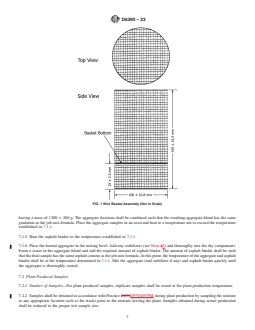
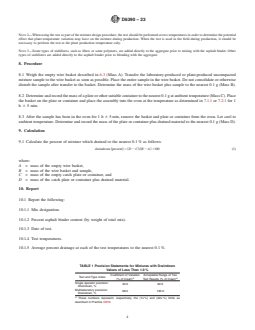
6.3 Standard Basket, meeting the dimensions shown in Fig.
7.1.2 Dry the aggregate to a constant mass and sieve it into
1. The basket shall be constructed using standard 6.3 mm sieve
appropriate size fractions as indicated in Practice D6926.
cloth as specified in Specification E11.
7.1.3 Determine the anticipated plant production tempera-
ture for the specific mix to be tested based on the
specifications, mix design, or recommendations of the binder
supplier.
7.1.4 Place
...
This document is not an ASTM standard and is intended only to provide the user of an ASTM standard an indication of what changes have been made to the previous version. Because
it may not be technically possible to adequately depict all changes accurately, ASTM recommends that users consult prior editions as appropriate. In all cases only the current version
of the standard as published by ASTM is to be considered the official document.
Designation: D6390 − 11 (Reapproved 2017) D6390 − 23
Standard Test Method for
Determination of Draindown Characteristics in
Uncompacted Asphalt Mixtures
This standard is issued under the fixed designation D6390; the number immediately following the designation indicates the year of
original adoption or, in the case of revision, the year of last revision. A number in parentheses indicates the year of last reapproval. A
superscript epsilon (´) indicates an editorial change since the last revision or reapproval.
1. Scope
1.1 This test method covers the determination of the amount of draindown in an uncompacted asphalt mixture sample when the
sample is held at elevated temperatures comparable to those encountered during the production, storage, transport, and placement
of the mixture. The test is particularly applicable to mixtures such as porous asphalt (open-graded friction course) and stone matrix
asphalt (SMA).
1.2 The values stated in SI units are to be regarded as standard. No other units of measurement are included in this standard.
1.3 The text of this standard references notes and footnotes which provide explanatory material. These notes and footnotes
(excluding those in tables and figures) shall not be considered as requirements of the standard.
1.4 This standard does not purport to address all of the safety concerns, if any, associated with its use. It is the responsibility
of the user of this standard to establish appropriate safety, health, and environmental practices and determine the applicability of
regulatory limitations prior to use.
1.5 This international standard was developed in accordance with internationally recognized principles on standardization
established in the Decision on Principles for the Development of International Standards, Guides and Recommendations issued
by the World Trade Organization Technical Barriers to Trade (TBT) Committee.
2. Referenced Documents
2.1 ASTM Standards:
C670 Practice for Preparing Precision and Bias Statements for Test Methods for Construction Materials
D979D979/D979M Practice for Sampling Asphalt Mixtures
D3666 Specification for Minimum Requirements for Agencies Testing and Inspecting Road and Paving Materials
D4753 Guide for Evaluating, Selecting, and Specifying Balances and Standard Masses for Use in Soil, Rock, and Construction
Materials Testing
D6926 Practice for Preparation of Asphalt Mixture Specimens Using Marshall Apparatus
E11 Specification for Woven Wire Test Sieve Cloth and Test Sieves
3. Terminology
3.1 Definitions:
This test method is under the jurisdiction of ASTM Committee D04 on Road and Paving Materials and is the direct responsibility of Subcommittee D04.25 on Analysis
of Asphalt Mixtures.
Current edition approved Oct. 1, 2017Dec. 1, 2023. Published October 2017December 2023. Originally approved in 1999. Last previous edition approved in 20112017
as D6390 – 11.D6390 – 11 (2017). DOI: 10.1520/D6390-11R17.10.1520/D6390-23.
For referenced ASTM standards, visit the ASTM website, www.astm.org, or contact ASTM Customer Service at service@astm.org. For Annual Book of ASTM Standards
volume information, refer to the standard’s Document Summary page on the ASTM website.
Copyright © ASTM International, 100 Barr Harbor Drive, PO Box C700, West Conshohocken, PA 19428-2959. United States
D6390 − 23
3.1.1 draindown—for the purpose of this test method, draindown is considered to be that portion of material which separates itself
from the sample as a whole and is deposited outside the wire basket during the test. The material which drains may be composed
of either asphalt binder or a combination of asphalt binder, additives, or fine aggregate.
4. Summary of Test Method
4.1 A sample of the asphalt mixture to be tested is prepared in the laboratory or obtained from field production. The sample is
placed in a wire basket which is positioned on a plate or other suitable container of known mass. The sample, basket, and plate
or container are placed in a forced draft forced-draft oven for 1 h at a pre-selected temperature. At the end of 1 h, the basket
containing the sample is removed from the oven along with the plate or container and the mass of the plate or container containing
the drained material, if any, is determined. The amount of draindown is then calculated.
5. Significance and Use
5.1 This test method can be used to determine whether the amount of draindown measured for a given asphalt mixture is within
specified acceptable levels. The test provides an evaluation of the draindown potential of an asphalt mixture during mixture design
and/or during field production. This test is primarily used for mixtures with high coarse aggregate content such as porous asphalt
(open-graded friction course) and stone matrix asphalt (SMA).
NOTE 1—The quality of the results produced by this standard are dependent on the competence of the personnel performing the procedure and the
capability, calibration, and maintenance of the equipment used. Agencies that meet the criteria of Specification D3666 are generally considered capable
of competent and objective testing, sampling, inspection, etc. Users of this standard are cautioned that compliance with Specification D3666 alone does
not completely ensure reliable results. Reliable results depend on many factors; following the suggestions of Specification D3666 or some similar
acceptable guideline provides a means of evaluating and controlling some of those factors.
6. Apparatus
6.1 Forced Draft Forced-Draft Oven, capable of maintaining the temperature in a range from 120 to 175 °C and the set
temperature to within 62 °C.
6.2 Plates, or other suitable containers of appropriate size. The plates or containers used shall be of appropriate durability to
withstand the oven temperatures. Cake pans or pie tins are examples of suitable types of containers.
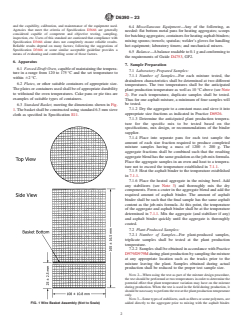
6.3 Standard Basket, meeting the dimensions shown in Fig. 1. The basket shall be constructed using standard 6.3-mm 6.3 mm
sieve cloth as specified in Specification E11.
6.4 Miscellaneous Equipment—Any of the following, as needed: flat bottom metal pans for heating aggregates; scoops for
batching aggregates; containers for heating asphalt binders; mixing spoons; trowels; spatulas; welder’s gloves for handling hot
equipment; laboratory timers; and mechanical mixers.
6.5 Balance—A balance readable to 0.1 g and conforming to the requirements of Guide D4753, GP2.
7. Sample Preparation
7.1 Laboratory-Prepared Samples:
7.1.1 Number of Samples—For each mixture tested, the draindown characteristics shall be determined at two different
temperatures. The two temperatures shall be the anticipated plant production temperature as well as 10 °C above (see Note 12).
For each temperature, duplicate samples shall be tested. Thus for one asphalt mixture, a minimum of four samples will be tested.
7.1.2 Dry the aggregate to a constant mass and sieve it into appropriate size fractions as indicated in Practice D6926.
7.1.3 Determine the anticipated plant production temperature for the specific mix to be tested based on the specifications, mix
design, or recommendati
...