

ASTM D2782-20
(Test Method)Standard Test Method for Measurement of Extreme-Pressure Properties of Lubricating Fluids (Timken Method)
General Information
- Abstract
SIGNIFICANCE AND USE
5.1 This test method is used widely for the determination of extreme pressure properties for specification purposes. Users are cautioned to carefully consider the precision and bias statements herein when establishing specification limits.
SCOPE
1.1 This test method covers the determination of the load-carrying capacity of lubricating fluids by means of the Timken Extreme Pressure Tester.
Note 1: This test method is suitable for testing fluids having a viscosity of less than about 5000 cSt (5000 mm2/s) at 40 °C. For testing fluids having a higher viscosity, refer to Note 5 in 9.1.
1.2 The values stated in SI units are to be regarded as standard. Because the equipment used in this test method is available only in inch-pound units, SI units are omitted when referring to the equipment and the test specimens.
1.3 This standard does not purport to address all of the safety concerns, if any, associated with its use. It is the responsibility of the user of this standard to establish appropriate safety, health, and environmental practices and determine the applicability of regulatory limitations prior to use. Specific warning statements are given in 7.1, 7.2, 8.1, 8.2, 9.4, and 9.9.
1.4 This international standard was developed in accordance with internationally recognized principles on standardization established in the Decision on Principles for the Development of International Standards, Guides and Recommendations issued by the World Trade Organization Technical Barriers to Trade (TBT) Committee.
- Status
- Published
- Publication Date
- 30-Sep-2020
- Technical Committee
- D02 - Petroleum Products, Liquid Fuels, and Lubricants
- Drafting Committee
- D02.L0.11 - Tribological Properties of Industrial Fluids and Lubricates
Buy Documents
ASTM D2782-20 - Standard Test Method for Measurement of Extreme-Pressure Properties of Lubricating Fluids (Timken Method)
REDLINE ASTM D2782-20 - Standard Test Method for Measurement of Extreme-Pressure Properties of Lubricating Fluids (Timken Method)
Overview
ASTM D2782-20, titled Standard Test Method for Measurement of Extreme-Pressure Properties of Lubricating Fluids (Timken Method), is a widely adopted international standard for assessing the extreme-pressure (EP) properties of lubricating fluids. Developed by ASTM International, this method helps determine the load-carrying capacity of lubricants, providing essential data for specification and quality control in industrial applications. The test employs the Timken Extreme Pressure Tester, in which the lubricant’s ability to prevent scoring and surface damage under high-stress conditions is measured. This information is vital for formulating and selecting lubricants for demanding mechanical systems.
Key Topics
- Extreme-Pressure Lubricant Properties: The standard evaluates how well a lubricating fluid can protect metal surfaces under heavy loads and extreme pressure conditions.
- Test Scope: Suitable for lubricants with viscosities below 5000 cSt at 40°C, the method uses a steel test cup and block to simulate high-stress contact.
- Critical Measurements:
- OK Value: The maximum load at which the lubricant prevents scoring or seizure.
- Score Value: The minimum load at which scoring or failure occurs.
- Precision and Bias: Users are advised to consider the precision and bias data provided in the standard when establishing specification limits for lubricants.
- Safety Considerations: Handling volatile reagents like acetone and Stoddard solvent requires standard laboratory safety protocols.
Applications
ASTM D2782-20’s Timken Method is used widely across industries involving rotating or sliding metal surfaces under significant load, including:
- Automotive: Evaluation of gear oils and other lubricating fluids critical to high-performance engines and transmissions.
- Manufacturing: Selection and quality assurance for industrial lubricants used in machinery, bearings, and gearboxes.
- Aerospace: Testing hydraulic fluids and specialty oils required for extreme operating conditions.
- Research and Development: Benchmarking EP performance for new lubricant formulations, including those with advanced additive packages.
- Petroleum and Lubricant Production: Compliance testing for product certification and competitive differentiation.
This test method provides a reliable, repeatable way to predict a lubricant’s capability to protect against wear, scoring, and seizure in vital equipment, reducing downtime and maintenance costs.
Related Standards
To ensure comprehensive evaluation of lubricants and greases, ASTM D2782-20 should be considered in conjunction with the following related standards:
- ASTM D2509: Test Method for Measurement of Load-Carrying Capacity of Lubricating Grease (Timken Method)
- ASTM D4175: Terminology Relating to Petroleum Products, Liquid Fuels, and Lubricants
- ASTM G40: Terminology Relating to Wear and Erosion
These supporting standards provide additional context for comparative analysis and facilitate a complete understanding of lubricant performance under varied operational and environmental conditions.
Practical Value
Adopting ASTM D2782-20 ensures lubricant manufacturers, quality control laboratories, and end-users can:
- Confidently specify and select lubricants that meet extreme-pressure requirements.
- Reduce equipment failure and maintenance costs by using fluids with proven load-carrying performance.
- Meet regulatory, contractual, or industry-specific performance benchmarks.
Keywords: ASTM D2782-20, Timken Method, Extreme Pressure, Lubricating Fluids, Load-Carrying Capacity, EP Additives, Scoring, Wear Protection, Industrial Lubricants, Lubricant Testing.
Relations
- Refers
ASTM D4175-23a - Standard Terminology Relating to Petroleum Products, Liquid Fuels, and Lubricants - Effective Date
- 15-Dec-2023
- Refers
ASTM D4175-23e1 - Standard Terminology Relating to Petroleum Products, Liquid Fuels, and Lubricants - Effective Date
- 01-Jul-2023
- Effective Date
- 01-Nov-2015
- Effective Date
- 01-Oct-2014
- Effective Date
- 01-Oct-2014
- Effective Date
- 01-Jun-2013
- Effective Date
- 01-May-2012
- Effective Date
- 01-Dec-2010
- Effective Date
- 01-Jul-2010
- Effective Date
- 01-Jan-2010
- Effective Date
- 15-Nov-2009
- Effective Date
- 01-May-2008
- Effective Date
- 01-May-2005
- Effective Date
- 01-Dec-2004
- Effective Date
- 10-May-2003
Buy Documents
ASTM D2782-20 - Standard Test Method for Measurement of Extreme-Pressure Properties of Lubricating Fluids (Timken Method)
REDLINE ASTM D2782-20 - Standard Test Method for Measurement of Extreme-Pressure Properties of Lubricating Fluids (Timken Method)
Get Certified
Connect with accredited certification bodies for this standard

Element Materials Technology
Materials testing and product certification.

ABS Group Brazil
ABS Group certification services in Brazil.

ABS Quality Evaluations Inc.
American Bureau of Shipping quality certification.
Sponsored listings
Frequently Asked Questions
ASTM D2782-20 is a standard published by ASTM International. Its full title is "Standard Test Method for Measurement of Extreme-Pressure Properties of Lubricating Fluids (Timken Method)". This standard covers: SIGNIFICANCE AND USE 5.1 This test method is used widely for the determination of extreme pressure properties for specification purposes. Users are cautioned to carefully consider the precision and bias statements herein when establishing specification limits. SCOPE 1.1 This test method covers the determination of the load-carrying capacity of lubricating fluids by means of the Timken Extreme Pressure Tester. Note 1: This test method is suitable for testing fluids having a viscosity of less than about 5000 cSt (5000 mm2/s) at 40 °C. For testing fluids having a higher viscosity, refer to Note 5 in 9.1. 1.2 The values stated in SI units are to be regarded as standard. Because the equipment used in this test method is available only in inch-pound units, SI units are omitted when referring to the equipment and the test specimens. 1.3 This standard does not purport to address all of the safety concerns, if any, associated with its use. It is the responsibility of the user of this standard to establish appropriate safety, health, and environmental practices and determine the applicability of regulatory limitations prior to use. Specific warning statements are given in 7.1, 7.2, 8.1, 8.2, 9.4, and 9.9. 1.4 This international standard was developed in accordance with internationally recognized principles on standardization established in the Decision on Principles for the Development of International Standards, Guides and Recommendations issued by the World Trade Organization Technical Barriers to Trade (TBT) Committee.
SIGNIFICANCE AND USE 5.1 This test method is used widely for the determination of extreme pressure properties for specification purposes. Users are cautioned to carefully consider the precision and bias statements herein when establishing specification limits. SCOPE 1.1 This test method covers the determination of the load-carrying capacity of lubricating fluids by means of the Timken Extreme Pressure Tester. Note 1: This test method is suitable for testing fluids having a viscosity of less than about 5000 cSt (5000 mm2/s) at 40 °C. For testing fluids having a higher viscosity, refer to Note 5 in 9.1. 1.2 The values stated in SI units are to be regarded as standard. Because the equipment used in this test method is available only in inch-pound units, SI units are omitted when referring to the equipment and the test specimens. 1.3 This standard does not purport to address all of the safety concerns, if any, associated with its use. It is the responsibility of the user of this standard to establish appropriate safety, health, and environmental practices and determine the applicability of regulatory limitations prior to use. Specific warning statements are given in 7.1, 7.2, 8.1, 8.2, 9.4, and 9.9. 1.4 This international standard was developed in accordance with internationally recognized principles on standardization established in the Decision on Principles for the Development of International Standards, Guides and Recommendations issued by the World Trade Organization Technical Barriers to Trade (TBT) Committee.
ASTM D2782-20 is classified under the following ICS (International Classification for Standards) categories: 75.080 - Petroleum products in general. The ICS classification helps identify the subject area and facilitates finding related standards.
ASTM D2782-20 has the following relationships with other standards: It is inter standard links to ASTM D4175-23a, ASTM D4175-23e1, ASTM G40-15, ASTM D2509-14e1, ASTM D2509-14, ASTM G40-13, ASTM G40-12, ASTM G40-10b, ASTM G40-10a, ASTM G40-10, ASTM G40-09, ASTM D2509-03(2008), ASTM G40-05, ASTM G40-04, ASTM D2509-03. Understanding these relationships helps ensure you are using the most current and applicable version of the standard.
ASTM D2782-20 is available in PDF format for immediate download after purchase. The document can be added to your cart and obtained through the secure checkout process. Digital delivery ensures instant access to the complete standard document.
Standards Content (Sample)
This international standard was developed in accordance with internationally recognized principles on standardization established in the Decision on Principles for the
Development of International Standards, Guides and Recommendations issued by the World Trade Organization Technical Barriers to Trade (TBT) Committee.
Designation: D2782 − 20
Standard Test Method for
Measurement of Extreme-Pressure Properties of Lubricating
Fluids (Timken Method)
This standard is issued under the fixed designation D2782; the number immediately following the designation indicates the year of
original adoption or, in the case of revision, the year of last revision.Anumber in parentheses indicates the year of last reapproval.A
superscript epsilon (´) indicates an editorial change since the last revision or reapproval.
1. Scope* G40Terminology Relating to Wear and Erosion
1.1 This test method covers the determination of the load-
3. Terminology
carrying capacity of lubricating fluids by means of theTimken
Extreme Pressure Tester.
3.1 Definitions:
3.1.1 extreme pressure (EP) additive, n—in a lubricant,a
NOTE 1—This test method is suitable for testing fluids having a
substance that minimizes damage to metal surfaces in contact
viscosity of less than about 5000cSt (5000mm /s) at 40°C. For testing
fluids having a higher viscosity, refer to Note 5 in 9.1.
under high-stress rubbing conditions. D4175
1.2 The values stated in SI units are to be regarded as
3.1.2 lubricant, n—any substance interposed between two
standard. Because the equipment used in this test method is
surfaces for the purpose of reducing friction or wear between
available only in inch-pound units, SI units are omitted when
them. G40
referring to the equipment and the test specimens.
3.1.3 scoring, n—in tribology, a severe form of wear char-
1.3 This standard does not purport to address all of the
acterized by the formation of extensive grooves and scratches
safety concerns, if any, associated with its use. It is the
in the direction of sliding. G40
responsibility of the user of this standard to establish appro-
3.1.4 wear, n—damage to a solid surface generally involv-
priate safety, health, and environmental practices and deter-
ingprogressivelossofmaterial,duetorelativemotionbetween
mine the applicability of regulatory limitations prior to use.
that surface and a contacting substance or substances. G40
Specific warning statements are given in 7.1, 7.2, 8.1, 8.2, 9.4,
and 9.9. 3.2 Definitions of Terms Specific to This Standard:
1.4 This international standard was developed in accor-
3.2.1 load-carrying capacity of a lubricant, n—as deter-
dance with internationally recognized principles on standard-
mined by this test method, the maximum load or pressure that
ization established in the Decision on Principles for the
can be sustained by the lubricant (when used in the given
Development of International Standards, Guides and Recom-
system under specific conditions) without failure of the sliding
mendations issued by the World Trade Organization Technical
contact surfaces as evidenced by scoring or seizure or asperity
Barriers to Trade (TBT) Committee.
welding.
3.2.2 OK value, n—as determined by this test method, the
2. Referenced Documents
maximummass(weight)addedtotheloadleverweightpan,at
2.1 ASTM Standards:
which no scoring or seizure occurs.
D2509Test Method for Measurement of Load-Carrying
3.2.3 score value, n—as determined by this test method, the
Capacity of Lubricating Grease (Timken Method)
minimum mass (weight) added to the load lever weight pan, at
D4175Terminology Relating to Petroleum Products, Liquid
which scoring or seizure occurs.
Fuels, and Lubricants
3.2.3.1 Discussion—Whenthelubricantfilmissubstantially
maintained, a smooth scar is obtained on the test block, but
1 when there is a breakdown of the lubricant film, scoring or
This test method is under the jurisdiction of ASTM Committee D02 on
Petroleum Products, Liquid Fuels, and Lubricants and is the direct responsibility of
surface failure of the test block takes place, as shown in Figs.
Subcommittee D02.L0.11 on Tribological Properties of Industrial Fluids and
1 and 2. In its simplest and most recognized form, scoring is
Lubricates.
characterizedbythefurrowedappearanceofawidescaronthe
Current edition approved Oct. 1, 2020. Published October 2020. Originally
test block and by excessive pick-up of metal on the surface of
approved in 1969. Last previous edition approved in 2017 as D2782–17. DOI:
10.1520/D2782-20.
the test cup. The form of surface failure more usually
For referenced ASTM standards, visit the ASTM website, www.astm.org, or
encountered, however, consists of a comparatively smooth
contact ASTM Customer Service at service@astm.org. For Annual Book of ASTM
scar, which shows local damage that usually extends beyond
Standards volume information, refer to the standard’s Document Summary page on
the ASTM website. the width of the scar. Scratches or striations that occur in an
*A Summary of Changes section appears at the end of this standard
Copyright © ASTM International, 100 Barr Harbor Drive, PO Box C700, West Conshohocken, PA 19428-2959. United States
D2782 − 20
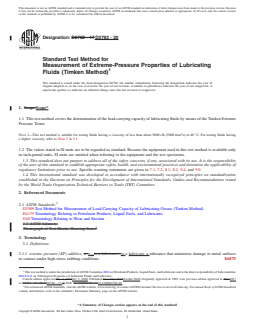
FIG. 1 Test Blocks Showing Various Types of Scar
6. Apparatus
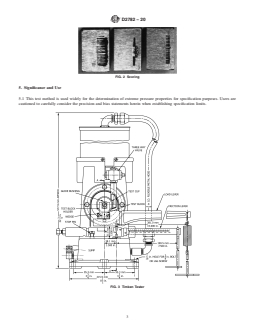
6.1 Timken Extreme Pressure Tester, described in detail in
Annex A1 and illustrated in Fig. 3.
6.2 Sample Feed Device, for supplying the test specimens
with fluid is described in Annex A1.
6.3 Loading Mechanism, for applying and removing the
load weights without shock at the uniform rate of
0.91kg⁄sto1.36kg⁄s (2lb⁄s to3lb⁄s). A detailed description
is given in Annex A1.
FIG. 2 Scoring
6.4 Microscope, low-power (50× to 60×) having sufficient
clearance under objective to accommodate the test block. It
should be fitted with a filar micrometer so that the scar width
maybemeasuredwithanaccuracyof 60.05mm(60.002in.).
otherwisesmoothscarandthatdonotextendbeyondthewidth
6.5 Timer, graduated in minutes and seconds.
of the scar are not considered as evidence of scoring.
3.2.4 seizure or asperity welding, n—localized fusion of
7. Reagents and Materials
metal between the rubbing surfaces of the test pieces. Seizure
7.1 Acetone, reagent grade. (Warning—Extremely flam-
is usually indicated by streaks appearing on the surface of the
mable. Harmful when inhaled. See A3.1.)
test cup, an increase in friction and wear, or unusual noise and
7.2 Stoddard Solvent or White Spirit, reagent grade.
vibration. Throughout this test method the term seizure is
(Warning—Flammable. See A3.2.)
understood to mean seizure or asperity welding.
3,4
7.3 Test Cup, of carburized steel, having a Rockwell
4. Summary of Test Method
Hardness“C”ScaleNumberof58to62,oraVickersHardness
Number of 653 to 756. The cups have a width of
4.1 The tester is operated with a steel test cup rotating
0.514in. 60.002in., a perimeter of 6.083in. 60.009in., a
against a steel test block. The rotating speed is
diameter of 1.938in.+0.001in.,−0.005in. and a maximum
123.71 m⁄min 6 0.77 m⁄min (405.88 ft⁄min 6 2.54 ft⁄min),
radialrun-outof0.0005in.Theaxialsurfaceroughnessshould
which is equivalent to a spindle speed of 800r⁄min 65r⁄min.
lie between 0.51µm and 0.76µm (20µin. and 30µin.) C.L.A.
Fluid samples are preheated to 37.8 °C 6 2.8 °C
3,5
(100°F 65°F) before starting the test. 7.4 Test Blocks, with test surfaces 0.485in. 60.002in.
wideand0.750in. 60.016in.long,ofcarburizedsteel,having
4.2 Two determinations are made: the minimum load (score
a Rockwell Hardness “C” Scale Number of 58 to 62, or a
value) that will rupture the lubricant film being tested between
Vickers Hardness Number of 653 to 756. Each block is
the rotating cup and the stationary block and cause scoring or
supplied with four ground faces and the surface roughness
seizure; and the maximum load (OK value) at which the
should lie between 0.51µm and 0.76µm (20µin. and 30µin.)
rotating cup will not rupture the lubricant film and cause
C.L.A.
scoring or seizure between the rotating cup and the stationary
block.
The sole source of supply of the apparatus known to the committee at this time
5. Significance and Use
is Falex Corp., 1020 Airpark Dr., Sugar Grove, IL 60554. If you are aware of
alternative suppliers, please provide this information to ASTM International
5.1 This test method is used widely for the determination of
Headquarters.Your comments will receive careful consideration at a meeting of the
extreme pressure properties for specification purposes. Users
responsible technical committee, which you may attend.
are cautioned to carefully consider the precision and bias
Available from Falex Corp., under Part No. F-25061.
statements herein when establishing specification limits. Available from Falex Corp., under Part No. F-25001.
D2782 − 20
FIG. 3 Timken Tester
8. Preparation of Apparatus blockholderandadjusttheleverssothatalltheknifeedgesare
inproperalignment.Exercisespecialcareinplacingthestirrup
8.1 Clean the apparatus with (1) Stoddard solvent or White
of the spring-weight platform assembly (selection of which
Spirit, and (2) acetone and blow dry. (Warning—Extremely
will depend on the loading device) in the groove of the
flammable. Harmful when inhaled. See A3.1.) (Warning—
load-leverarmtoavoidprematureshocktothetestblockwhen
Flammable. See A3.2.) Flush with approximately 1L(1qt) of
the load is applied. To ensure that the test block, test block
the fluid to be tested. Discard the flushing fluid. (Warning—
holder,andleverarmsareproperlyalignedandseated,coatthe
Sinceacetoneishighlyflammable,usetheminimumquantity.)
testblockandtestcupwiththelubricanttobetested,androtate
8.2 Select a new test cup and block, wash with Stoddard
the machine slowly for a few revolutions either by hand or by
solvent or White Spirit (Warning—Flammable. See A3.2.)
suitable control mechanism. When the parts are in alignment,
and dry with a clean soft cloth or paper. Immediately before
the fluid will be wiped off the cup over its entire width.
use rinse the test cup and block with acetone and blow them
NOTE 3—At this point it is recommended that a dial indicator used to
dry. Do not use solvents such as carbon tetrachloride or others
checktheradialrun-outofthecup in situnotexceed0.025mm(0.001in.)
that may inherently possess load-carrying properties which
total indicator movement.
may effect the results.
9. Procedure
NOTE 2—This cleaning may be done in an ultrasonic cleaner.
9.1 Fill the reservoir of the tester to within 76mm (3in.) of
8.3 Assemble the tester carefully (Fig. 4), placing the test
the top (approximately 3L or 3qt) with the fluid to be tested.
cup on the spindle and making certain that it is well seated,
Preheat the fluid to 37.8°C 6 2.8°C (100°F 6 5°F).
drawing it up firmly but avoiding possible distortion from
excessive tightening (Note 3). Place the test block in the test NOTE 4—The fluid may be heated by the use of an immersion heater
D2782 − 20
FIG. 3 Timken Tester (continued)
grease feeder also appears valid but may be difficult because of fluid
leakage.
9.2 Set the discharge valve at full open.Allow the lubricant
to flood the test cup and block. When the sump is about half
filledwiththefluid,startthemotorandrunfor30stobreak-in.
If the equipment used is equipped with acceleration control,
start the motor and increase the spindle speed gradually to
achieve 800r⁄min 6 5r⁄min after 15s. Run for a further 15s
to complete the break-in.
9.3 After a break-in period of 30s, start the timer and apply
at8.9N⁄sto13.3N⁄s(2lbf⁄sto3lbf⁄s),aloadthatislessthan
FIG. 4 Assembly of Tester Showing Test Pieces the expected score load. In the absence of a better estimate, a
starting load of 30lbf is recommended. The load-lever arm,
spring-weightplatformassemblyisnotconsideredapartofthe
located in the tester reservoir or by heating the fluid prior to filling the
applied load. In the event a lower starting load is used, it must
reservoir. If an immersion heater is used, localized overheating must be
be a multiple of 6. Then allow the machine to run at
avoided. This may be done by stirring or by circulating prior to the
assembly of the lever arm.
800r⁄min 65r⁄min for 10min 615s after load application
NOTE 5—Fluids having a viscosity above about 5000cSt (5000mm /s)
is initiated, unless a score is detected before that period.
at 40°C often cannot be tested at the prescribed fluid temperature of
37.8°C 6 2.8°C (100°F 6 5°F) because of inability of the pump to
9.4 If, after the load has been applied, scoring is evident by
recirculate the fluid at this temperature. However, results from limited
vibration or noise, stop the tester at once, turn off the flow of
cooperative tests, covered in Tables A1.1 and A1.2, indicate that the
lubricant, and remove the load. Since the excessive heat
starting fluid temperature could be increased to 65.6°C (150°F) to obtain
developed with deep scoring may alter the surface character-
adequate flow without affecting OK or score values. Testing of such
high-viscosity fluids at room temperature in the Test Method D2509 istics of the entire block, discard the test block. (Warning—
D2782 − 20
The machine and test pieces may be hot at this point and care where:
should be exercised in their handling.)
L = mechanical advantage of load-lever arm, 10,
G = load-lever constant (value is stamped on lever arm of
9.5 If no scoring is detected, allow the tester to run for
each tester),
10min 615s from the start of the application of the load.At
X = mass (weight) placed on the weight pan, lb,
theendofthe10min 615speriod,reversetheloadingdevice
X' = mass (weight) placed on the weight pan, kg,
and remove the load from the lever arm. Turn off the motor,
Y = length of test scar ( ⁄2in.),
allowthespindletocometorest,thenturnofftheflowoffluid.
Y' = length of test scar (12.7mm),
Remove the load lever and inspect the condition of the test
Z = average width of test scar, in., and
block surface at 1× magnification. Microscopical observations
Z' = average width of test scar, mm.
shall not be used to define when scoring has occurred. The
10.2 Forconvenience,contact(unit)pressuresinpoundsper
lubricant has failed at the imposed load if the wear scar
square inch are listed in Table X3.1.
indicates any scoring or welding.
11. Report
NOTE 6—A microscope may be used to examine the wear scar for
further information as required in 9.9.
11.1 Report the OK and score values in terms of the mass
(weights)placedontheweightpanhangingfromtheendofthe
9.6 If no score is observed, turn the test block to expose a
load-lever arm; do not include the mass (weight) of the pan
newsurfaceofcontactand,withanewtestcup,repeatthetest,
assembly. Report the values in multiples of 5lb above 30lb
asin9.5,at10lbfincrementsuntilaloadthatproducesascore
and in multiples of 3lb below 30lb.
is reached.At this point decrease the load by 5lbf for the final
determination.
12. Precision and Bias
NOTE 7—Before each test in 9.6 – 9.8 cool the fluid in the reservoir to
12.1 The precision and this test method as determined by
37.8°C 6 2.8°C (100°F 6 5°F), cool the shaft to less than 65.6°C
the statistical examination of interlaboratory test results is as
(150°F), install a new test cup, and turn the test block to expose a new
follows:
surfaceofcontact.Whenseizurehasoccurred,discardtheentiretestblock
since excessive heat, developed when scarring occurs, may alter the
12.1.1 Repeatability—The difference between successive
surface characteristics of the entire block.
results obtained by the same operator with the same apparatus
under constant operating conditions on identical test material
9.7 If a score is produced at the 30lbf load, reduce the load
would, in the long run, in the normal and correct operation of
by 6lbf decrements until no scoring is realized. At this point,
thetestmethodexceedthefollowingvaluesonlyinonecasein
increase the load by 3lbf for the final determination.
twenty.
9.8 When the wear scar evidence at any load stage makes
Repeatability=30% of the mean value
the definition of the onset of scoring questionable, repeat the
12.1.2 Reproducibility—The difference between two single
testatthesameload.Ifthesecondtestproducesascore,record
and independent results obtained by different operators work-
a score rating for this load. Similarly, if the second test
ing in different laboratories on identical test material would, in
producesnoscoring,recordanoscorerating.Ifthesecondtest
the long run, exceed the following values only in one case in
againyieldsaquestionableresult,simplywithholdjudgmentof
twenty.
theratingatthisloadstageandtestthefluidattheimmediately
Reproducibility=74% of the mean value
next higher load stage (see AnnexA2).Then assign a rating to
NOTE8—Precisiondatawereobtainedfromround-robintestsbyeleven
theloadstageinquestionthatisidenticaltotheratingobtained
laboratories on seven paraffinic base oil blends. Atable of raw data from
at the immediately next higher load stage employed.
the round robin is provided in Appendix X1 for information only.
NOTE 9—The precision values given in Section 12 are considered
9.9 AftertheOKvaluehasbeendetermined,removethetest
applicable for samples having, in the long run, an average Timken OK
block and wash with Stoddard solvent or White Spirit, rinse
load of 15lbf minimum.
with acetone (Warning—Extremely flammable. Harmful
NOTE 10—The following equipment, as listed in RR:D02-1223, was
when inhaled. See A3.1.) (Warning—Flammable. See A3.2.),
used to develop the precision statement and no statistically significant
and blow dry. By means of a filar micrometer microscope, differences were found between these pieces of equipment: (1) Falex
Timken EP Tester, 1020 Airpark Drive, Sugar Grove, IL 60555. (2) The
measure the width of the scars on those blocks which success-
Timken Company, Canton, OH. To date, no other equipment has demon-
fully carried this load. Make all measurements to 0.05mm
strated through ASTM interlaboratory testing the ability to meet the
(0.002in.).
precisionofthistest.ThisisnotanendorsementorcertificationbyASTM.
13. Keywords
10. Calculation
13.1 EP; extreme pressure; load carrying capacity; lubri-
10.1 When desired, the contact (unit) pressure that exists
cant; Timken
between the cup and block at the conclusion of the test can be
calculated. Calculate the contact pressure, C, as follows:
Supporting data have been filed atASTM International Headquarters and may
C, psi 5 @L X1G #/YZor @20 X1G #/Z (1)
~ ! ~ !
beobtainedbyrequestingResearchReportRR:D02-1223.ContactASTMCustomer
C, MPa 59.81@L~X'10.454G!#/Y'Z' (2) Service at service@astm.org.
D2782 − 20
ANNEXES
(Mandatory Information)
A1. TIMKEN EXTREME PRESSURE TESTER
A1.1 Timken Extreme Pressure Tester, consisting essen- magnet placed in the sump outlet is also suggested for this
tiallyofasteeltestcuprotatingagainstasteeltestblockloaded purpose. Flow rate of fluid onto the test cup and block is
from below. The test cup is attached to a horizontal spindle controlled by a three-way valve at the reservoir outlet.
mounted in two roller bearings and driven at 800r⁄min 6
A1.2 Loading Mechanism , consists of a power-operated
5r⁄minbya2hp(1.5W)synchronousmotor.Thetestblockis
loadingplatformsoarrangedthattheweightsareappliedtothe
mounted in a holder upon knife-edge bearings,
...
This document is not an ASTM standard and is intended only to provide the user of an ASTM standard an indication of what changes have been made to the previous version. Because
it may not be technically possible to adequately depict all changes accurately, ASTM recommends that users consult prior editions as appropriate. In all cases only the current version
of the standard as published by ASTM is to be considered the official document.
Designation: D2782 − 17 D2782 − 20
Standard Test Method for
Measurement of Extreme-Pressure Properties of Lubricating
Fluids (Timken Method)
This standard is issued under the fixed designation D2782; the number immediately following the designation indicates the year of
original adoption or, in the case of revision, the year of last revision. A number in parentheses indicates the year of last reapproval. A
superscript epsilon (´) indicates an editorial change since the last revision or reapproval.
1. Scope Scope*
1.1 This test method covers the determination of the load-carrying capacity of lubricating fluids by means of the Timken Extreme
Pressure Tester.
NOTE 1—This test method is suitable for testing fluids having a viscosity of less than about 5000 cSt (5000 mm /s) at 40 °C. For testing fluids having
a higher viscosity, refer to Note 5 in 9.1.
1.2 The values stated in SI units are to be regarded as standard. Because the equipment used in this test method is available only
in inch-pound units, SI units are omitted when referring to the equipment and the test specimens.
1.3 This standard does not purport to address all of the safety concerns, if any, associated with its use. It is the responsibility
of the user of this standard to establish appropriate safety, health, and environmental practices and determine the applicability of
regulatory limitations prior to use. Specific warning statements are given in 7.1, 7.2, 8.1, 8.2, 9.4, and 9.9.
1.4 This international standard was developed in accordance with internationally recognized principles on standardization
established in the Decision on Principles for the Development of International Standards, Guides and Recommendations issued
by the World Trade Organization Technical Barriers to Trade (TBT) Committee.
2. Referenced Documents
2.1 ASTM Standards:
D2509 Test Method for Measurement of Load-Carrying Capacity of Lubricating Grease (Timken Method)
D4175 Terminology Relating to Petroleum Products, Liquid Fuels, and Lubricants
G40 Terminology Relating to Wear and Erosion
2.2 ASTM Adjuncts:
Photograph of Test Blocks Showing Scars
3. Terminology
3.1 Definitions:
3.1.1 extreme pressure (EP) additive, n, n—in a lubricant—in a lubricant, a substance that minimizes damage to metal surfaces
in contact under high-stress rubbing conditions. D4175
This test method is under the jurisdiction of ASTM Committee D02 on Petroleum Products, Liquid Fuels, and Lubricants and is the direct responsibility of Subcommittee
D02.L0.11 on Tribological Properties of Industrial Fluids and Lubricates.
Current edition approved Dec. 1, 2017Oct. 1, 2020. Published December 2017October 2020. Originally approved in 1969. Last previous edition approved in 20142017
ε1
as D2782 – 02 (2014)D2782 – 17. . DOI: 10.1520/D2782-17.10.1520/D2782-20.
For referenced ASTM standards, visit the ASTM website, www.astm.org, or contact ASTM Customer Service at service@astm.org. For Annual Book of ASTM Standards
volume information, refer to the standard’s Document Summary page on the ASTM website.
*A Summary of Changes section appears at the end of this standard
Copyright © ASTM International, 100 Barr Harbor Drive, PO Box C700, West Conshohocken, PA 19428-2959. United States
D2782 − 20
3.1.2 lubricant, n—any substance interposed between two surfaces for the purpose of reducing friction or wear between them. G40
3.1.3 scoring, n, n—in tribology—in tribology, a severe form of wear characterized by the formation of extensive grooves and
scratches in the direction of sliding. G40
3.1.4 wear, n—damage to a solid surface generally involving progressive loss of material, due to relative motion between that
surface and a contacting substance or substances. G40
3.2 Definitions of Terms Specific to This Standard:
3.2.1 load-carrying capacity of a lubricant—lubricant, n—as determined by this test method, the maximum load or pressure that
can be sustained by the lubricant (when used in the given system under specific conditions) without failure of the sliding contact
surfaces as evidenced by scoring or seizure or asperity welding.
3.2.2 OK value, n—as determined by this test method, the maximum mass (weight) added to the load lever weight pan, at which
no scoring or seizure occurs.
3.2.3 score value, n—as determined by this test method, the minimum mass (weight) added to the load lever weight pan, at which
scoring or seizure occurs.
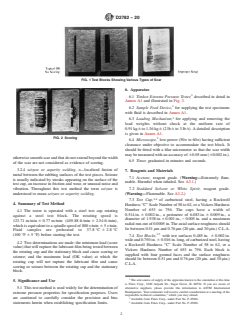
3.2.3.1 Discussion—
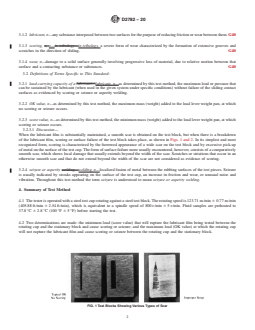
When the lubricant film is substantially maintained, a smooth scar is obtained on the test block, but when there is a breakdown
of the lubricant film, scoring or surface failure of the test block takes place, as shown in Figs. 1 and 2. In its simplest and most
recognized form, scoring is characterized by the furrowed appearance of a wide scar on the test block and by excessive pick-up
of metal on the surface of the test cup. The form of surface failure more usually encountered, however, consists of a comparatively
smooth scar, which shows local damage that usually extends beyond the width of the scar. Scratches or striations that occur in an
otherwise smooth scar and that do not extend beyond the width of the scar are not considered as evidence of scoring.
3.2.4 seizure or asperity welding—welding, n—localized fusion of metal between the rubbing surfaces of the test pieces. Seizure
is usually indicated by streaks appearing on the surface of the test cup, an increase in friction and wear, or unusual noise and
vibration. Throughout this test method the term seizure is understood to mean seizure or asperity welding.
4. Summary of Test Method
4.1 The tester is operated with a steel test cup rotating against a steel test block. The rotating speed is 123.71 m ⁄min 6 0.77 m ⁄min
(405.88 ft ⁄min 6 2.54 ft ⁄min), which is equivalent to a spindle speed of 800 r ⁄min 6 5 r ⁄min. Fluid samples are preheated to
37.8 °C 6 2.8 °C (100 °F 6 5 °F) before starting the test.
4.2 Two determinations are made: the minimum load (score value) that will rupture the lubricant film being tested between the
rotating cup and the stationary block and cause scoring or seizure; and the maximum load (OK value) at which the rotating cup
will not rupture the lubricant film and cause scoring or seizure between the rotating cup and the stationary block.
FIG. 1 Test Blocks Showing Various Types of Scar
D2782 − 20
FIG. 2 Scoring
5. Significance and Use
5.1 This test method is used widely for the determination of extreme pressure properties for specification purposes. Users are
cautioned to carefully consider the precision and bias statements herein when establishing specification limits.
FIG. 3 Timken Tester
D2782 − 20
6. Apparatus
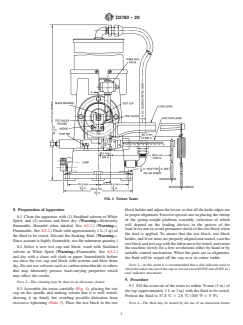
6.1 Timken Extreme Pressure Tester, described in detail in Annex A1 and illustrated in Fig. 3.
6.2 Sample Feed Device, for supplying the test specimens with fluid is described in Annex A1.
6.3 Loading Mechanism, for applying and removing the load weights without shock at the uniform rate of 0.91 kg ⁄s to 1.36 kg ⁄s
(2 lb ⁄s to 3 lb ⁄s). A detailed description is given in Annex A1.
6.4 Microscope, low-power (50× to 60×) having sufficient clearance under objective to accommodate the test block. It should be
fitted with a filar micrometer so that the scar width may be measured with an accuracy of 60.05 mm (60.002 in.).
6.5 Timer, graduated in minutes and seconds.
7. Reagents and Materials
7.1 Acetone, reagent grade. (Warning—Extremely flammable. Harmful when inhaled. See A3.1.)
FIG. 3 Timken Tester (continued)
The sole source of supply of the apparatus known to the committee at this time is Falex Corp., 1020 Airpark Dr., Sugar Grove, IL 60554. If you are aware of alternative
suppliers, please provide this information to ASTM International Headquarters. Your comments will receive careful consideration at a meeting of the responsible technical
committee, which you may attend.
D2782 − 20
7.2 Stoddard Solvent or White Spirit, reagent grade. (Warning—Flammable. See A3.2.)
3,4
7.3 Test Cup, of carburized steel, having a Rockwell Hardness “C” Scale Number of 58 to 62, or a Vickers Hardness Number
of 653 to 756. The cups have a width of 0.514 in. 6 0.002 in., a perimeter of 6.083 in. 6 0.009 in., a diameter of
1.938 in. + 0.001 in., − 0.005 in. and a maximum radial run-out of 0.0005 in. The axial surface roughness should lie between
0.51 μm and 0.76 μm (20 μin. and 30 μin.) C.L.A.
3,5
7.4 Test Blocks, with test surfaces 0.485 in. 6 0.002 in. wide and 0.750 in. 6 0.016 in. long, of carburized steel, having a
Rockwell Hardness “C” Scale Number of 58 to 62, or a Vickers Hardness Number of 653 to 756. Each block is supplied with four
ground faces and the surface roughness should lie between 0.51 μm and 0.76 μm (20 μin. and 30 μin.) C.L.A.
8. Preparation of Apparatus
8.1 Clean the apparatus with (1) Stoddard solvent or White Spirit, and (2) acetone and blow dry. (Warning—Extremely
flammable. Harmful when inhaled. See A3.1.) (Warning—Flammable. See A3.2.) Flush with approximately 1 L (1 qt) of the fluid
to be tested. Discard the flushing fluid. (Warning—Since acetone is highly flammable, use the minimum quantity.)
8.2 Select a new test cup and block, wash with Stoddard solvent or White Spirit (Warning—Flammable. See A3.2.) and dry with
a clean soft cloth or paper. Immediately before use rinse the test cup and block with acetone and blow them dry. Do not use solvents
such as carbon tetrachloride or others that may inherently possess load-carrying properties which may effect the results.
NOTE 2—This cleaning may be done in an ultrasonic cleaner.
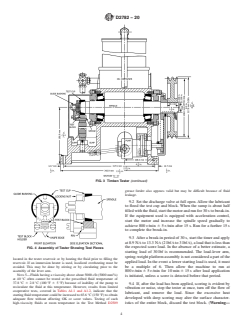
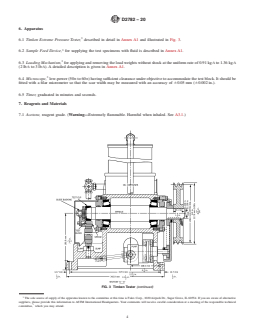
8.3 Assemble the tester carefully (Fig. 4), placing the test cup on the spindle and making certain that it is well seated, drawing
it up firmly but avoiding possible distortion from excessive tightening (Note 3). Place the test block in the test block holder and
adjust the levers so that all the knife edges are in proper alignment. Exercise special care in placing the stirrup of the spring-weight
platform assembly (selection of which will depend on the loading device) in the groove of the load-lever arm to avoid premature
shock to the test block when the load is applied. To ensure that the test block, test block holder, and lever arms are properly aligned
and seated, coat the test block and test cup with the lubricant to be tested, and rotate the machine slowly for a few revolutions either
by hand or by suitable control mechanism. When the parts are in alignment, the fluid will be wiped off the cup over its entire width.
NOTE 3—At this point it is recommended that a dial indicator used to check the radial run-out of the cup in situ not exceed 0.025 mm (0.001 in.) total
indicator movement.
9. Procedure
9.1 Fill the reservoir of the tester to within 76 mm (3 in.) of the top (approximately 3 L or 3 qt) with the fluid to be tested. Preheat
the fluid to 37.8 °C 6 2.8 °C (100 °F 6 5 °F).
FIG. 4 Assembly of Tester Showing Test Pieces
Available from Falex Corp., under Part No. F-25061.
Available from Falex Corp., under Part No. F-25001.
D2782 − 20
NOTE 4—The fluid may be heated by the use of an immersion heater located in the tester reservoir or by heating the fluid prior to filling the reservoir.
If an immersion heater is used, localized overheating must be avoided. This may be done by stirring or by circulating prior to the assembly of the lever
arm.
NOTE 5—Fluids having a viscosity above about 5000 cSt (5000 mm /s) at 40 °C often cannot be tested at the prescribed fluid temperature of 37.8 °C 6
2.8 °C (100 °F 6 5 °F) because of inability of the pump to recirculate the fluid at this temperature. However, results from limited cooperative tests,
covered in Tables A1.1 and A1.2, indicate that the starting fluid temperature could be increased to 65.6 °C (150 °F) to obtain adequate flow without
affecting OK or score values. Testing of such high-viscosity fluids at room temperature in the Test Method D2509 grease feeder also appears valid but
may be difficult because of fluid leakage.
9.2 Set the discharge valve at full open. Allow the lubricant to flood the test cup and block. When the sump is about half filled
with the fluid, start the motor and run for 30 s to break-in. If the equipment used is equipped with acceleration control, start the
motor and increase the spindle speed gradually to achieve 800 r ⁄min 6 5 r ⁄min after 15 s. Run for a further 15 s to complete the
break-in.
9.3 After a break-in period of 30 s, start the timer and apply at 8.9 N ⁄s to 13.3 N ⁄s (2 lbf ⁄s to 3 lbf ⁄s), a load that is less than the
expected score load. In the absence of a better estimate, a starting load of 30 lbf is recommended. The load-lever arm,
spring-weight platform assembly is not considered a part of the applied load. In the event a lower starting load is used, it must
be a multiple of 6. Then allow the machine to run at 800 r ⁄min 6 5 r ⁄min for 10 min 6 15 s after load application is initiated,
unless a score is detected before that period.
9.4 If, after the load has been applied, scoring is evident by vibration or noise, stop the tester at once, turn off the flow of lubricant,
and remove the load. Since the excessive heat developed with deep scoring may alter the surface characteristics of the entire block,
discard the test block. (Warning—The machine and test pieces may be hot at this point and care should be exercised in their
handling.)
9.5 If no scoring is detected, allow the tester to run for 10 min 6 15 s from the start of the application of the load. At the end of
the 10 min 6 15 s period, reverse the loading device and remove the load from the lever arm. Turn off the motor, allow the spindle
to come to rest, then turn off the flow of fluid. Remove the load lever and inspect the condition of the test block surface at 1×
magnification. Microscopical observations shall not be used to define when scoring has occurred. The lubricant has failed at the
imposed load if the wear scar indicates any scoring or welding.
NOTE 6—A microscope may be used to examine the wear scar for further information as required in 9.9.
9.6 If no score is observed, turn the test block to expose a new surface of contact and, with a new test cup, repeat the test, as in
9.5, at 10 lbf increments until a load that produces a score is reached. At this point decrease the load by 5 lbf for the final
determination.
NOTE 7—Before each test in 9.6 – 9.8 cool the fluid in the reservoir to 37.8 °C 6 2.8 °C (100 °F 6 5 °F), cool the shaft to less than 65.6 °C (150 °F),
install a new test cup, and turn the test block to expose a new surface of contact. When seizure has occurred, discard the entire test block since excessive
heat, developed when scarring occurs, may alter the surface characteristics of the entire block.
9.7 If a score is produced at the 30 lbf load, reduce the load by 6 lbf decrements until no scoring is realized. At this point, increase
the load by 3 lbf for the final determination.
9.8 When the wear scar evidence at any load stage makes the definition of the onset of scoring questionable, repeat the test at the
same load. If the second test produces a score, record a score rating for this load. Similarly, if the second test produces no scoring,
record a no score rating. If the second test again yields a questionable result, simply withhold judgment of the rating at this load
stage and test the fluid at the immediately next higher load stage (see Annex A2). Then assign a rating to the load stage in question
that is identical to the rating obtained at the immediately next higher load stage employed.
9.9 After the OK value has been determined, remove the test block and wash with Stoddard solvent or White Spirit, rinse with
acetone (Warning—Extremely flammable. Harmful when inhaled. See A3.1.) (Warning—Flammable. See A3.2.), and blow dry.
By means of a filar micrometer microscope, measure the width of the scars on those blocks which successfully carried this load.
Make all measurements to 0.05 mm (0.002 in.).
D2782 − 20
10. Calculation
10.1 When desired, the contact (unit) pressure that exists between the cup and block at the conclusion of the test can be calculated.
Calculate the contact pressure, C, as follows:
C, psi 5 L X1G /YZ or 20 X1G /Z (1)
@ ~ !# @ ~ !#
C, MPa 5 9.81@L~X'10.454G!#/Y'Z' (2)
where:
L = mechanical advantage of load-lever arm, 10,
G = load-lever constant (value is stamped on lever arm of each tester),
X = mass (weight) placed on the weight pan, lb,
X ' = mass (weight) placed on the weight pan, kg,
Y = length of test scar ( ⁄2 in.),
Y ' = length of test scar (12.7 mm),
Z = average width of test scar, in., and
Z ' = average width of test scar, mm.
10.2 For convenience, contact (unit) pressures in pounds per square inch are listed in Table X3.1.
11. Report
11.1 Report the OK and score values in terms of the mass (weights) placed on the weight pan hanging from the end of the
load-lever arm; do not include the mass (weight) of the pan assembly. Report the values in multiples of 5 lb above 30 lb and in
multiples of 3 lb below 30 lb.
12. Precision and Bias
12.1 The precision and this test method as determined by the statistical examination of interlaboratory test results is as follows:
12.1.1 Repeatability—The difference between successive results obtained by the same operator with the same apparatus under
constant operating conditions on identical test material would, in the long run, in the normal and correct operation of the test
method exceed the following values only in one case in twenty.
Repeatability = 30 % of the mean value
12.1.2 Reproducibility—The difference between two single and independent results obtained by different operators working in
different laboratories on identical test material would, in the long run, exceed the following values only in one case in twenty.
Reproducibility = 74 % of the mean value
NOTE 8—Precision data were obtained from round-robin tests by eleven laboratories on seven paraffinic base oil blends. A table of raw data from the
round robin is provided in Appendix X1 for information only.
NOTE 9—The precision values given in Section 12 are considered applicable for samples having, in the long run, an average Timken OK load of 15 lbf
minimum.
NOTE 10—The following equipment, as listed in RR:D02-1223, was used to develop the precision statement and no statistically significant differences
were found between these pieces of equipment: (1) Falex Timken EP Tester, 1020 Airpark Drive, Sugar Grove, IL 60555. (2) The Timken Company,
Canton, OH. To date, no other equipment has demonstrated through ASTM interlaboratory testing the ability to meet the precision of this test. This is
not an endorsement or certification by ASTM.
13. Keywords
13.1 EP; extreme pressure; load carrying capacity; lubricant; Timken
Supporting data have been filed at ASTM International Headquarters and may be obtained by requesting Research Report RR:D02-1223. Contact ASTM Customer
Service at service@astm.org.
D2782 − 20
ANNEXES
(Mandatory Information)
A1. TIMKEN EXTREME PRESSURE TESTER
A1.1 Timken Extreme Pressure Tester, consisting essentially of a steel test cup rotating against a steel test block loaded from
below. The test cup is attached to a horizontal spindle mounted in two roller bearings and driven at 800 r ⁄min 6 5 r ⁄min by a 2 hp
(1.5 W) synchronous motor. The test block is mounted in a holder upon knife-edge bearings, designed to promote correct alignment
and uniform pressure between the test cup and block. The machi
...