


ASTM F2563-16
(Practice)Standard Practice for Kit Assembly Instructions of Aircraft Intended Primarily for Recreation
Standard Practice for Kit Assembly Instructions of Aircraft Intended Primarily for Recreation
ABSTRACT
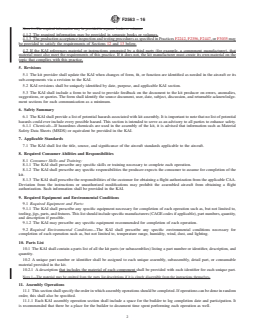
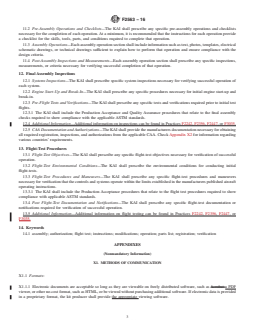
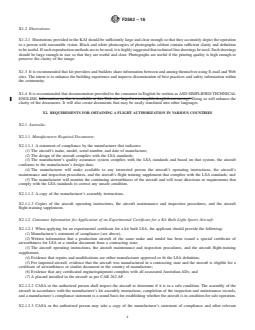
This practice covers the instructions a kit producer must provide to a consumer in order to assemble and safely flight-test a recreational aircraft to ensure compliance with applicable ASTM standards. The instructions prescribe the necessary mechanical skills or training, or both, required for successful completion of the kit, as well as necessary tooling, fixtures, inspections, measurements, and other pertinent items required for successful completion of the kit. The kit assembly instructions (KAI) shall include at least the following information: (1) Revisions; (2) Introduction and instructions for using the KAI; (3) Table of Contents; (4) Safety Summary; (5) Applicable standards and specifications; (6) Terminology; (7) Required consumer abilities and responsibilities; (8) Required equipment and environmental conditions; (9) Parts list; (10) Assembly operations; (11) Final assembly Inspections; (12) Flight-test procedures; and (13) Additional requirements.
SCOPE
1.1 This practice covers the instructions a kit producer must provide to a consumer in order to assemble and safely flight-test a recreational aircraft to ensure compliance with applicable ASTM standards.
1.2 The instructions prescribe the necessary mechanical skills or training, or both, required for successful completion of the kit, as well as necessary tooling, fixtures, inspections, measurements, and other pertinent items required for successful completion of the kit. Proof of compliance with these instructions may be vital for obtaining flight authorizations from the applicable CAA.
1.3 This standard does not purport to address all of the safety concerns, if any, associated with its use. It is the responsibility of the user of this standard to establish appropriate safety and health practices and determine the applicability of regulatory limitations prior to use.
General Information
- Status
- Published
- Publication Date
- 30-Sep-2016
- Technical Committee
- F37 - Light Sport Aircraft
- Drafting Committee
- F37.70 - Cross Cutting
Relations
- Effective Date
- 01-Oct-2016
- Effective Date
- 01-Nov-2018
- Effective Date
- 01-Nov-2018
- Effective Date
- 01-Jan-2018
- Effective Date
- 01-Jun-2013
- Effective Date
- 01-Jun-2013
- Effective Date
- 01-Dec-2010
- Effective Date
- 01-Jul-2009
- Effective Date
- 15-May-2008
- Effective Date
- 15-May-2008
- Effective Date
- 01-Dec-2007
- Effective Date
- 01-Nov-2005
- Effective Date
- 01-Apr-2005
- Effective Date
- 01-Mar-2005
- Effective Date
- 01-Jan-2005
Overview
ASTM F2563-16 is the standard practice developed by ASTM International for creating comprehensive kit assembly instructions (KAI) for recreational aircraft. Its aim is to ensure that kit producers provide clear, detailed, and safety-oriented documentation so consumers can successfully assemble and safely flight-test recreational aircraft in compliance with all applicable ASTM standards. This standard supports both the technical accuracy and the legal compliance required for achieving flight authorizations, helping kit builders meet civil aviation authority (CAA) requirements.
Key Topics
Content Requirements
The standard specifies the essential sections that must be included in kit assembly instructions:- Revisions tracking and document updates
- Clear introduction on how to use the instructions
- Table of contents for easy navigation
- Safety summary and hazard warnings
- Reference to applicable aircraft standards and specifications
- Terminology definitions and acronyms list
- Prescribed mechanical skills and training required for assembly
- Details on required tools, equipment, and environmental conditions
- Comprehensive parts list, including part numbers and descriptions
- Step-by-step assembly operations, including checklists, illustrations, and technical drawings
- Guidelines for pre-assembly, in-process, and post-assembly inspections
- Detailed final assembly inspections, system checks, and documentation for compliance
- Prescribed flight-test procedures and required environmental conditions
- Additional assembly and compliance requirements as needed
Revision and Feedback Management
The KAI must outline procedures for managing revisions and provide a feedback mechanism for users to report issues, suggest improvements, and verify document updates.Consumer Responsibilities
The instructions clarify the required builder skills, responsibilities during the assembly process, and steps necessary to obtain flight authorization. It addresses the impact of deviations and modifications on legal compliance.Safety and Compliance
Safety summaries highlight potential hazards such as chemicals or operational risks. References are made to Material Safety Data Sheets (MSDS) when hazardous materials are used.Format and Communication
The standard encourages the use of easily accessible electronic formats (e.g., PDF, HTML) and clear, high-quality illustrations. Simpler language, such as ASD Simplified Technical English, is recommended to enhance clarity and translation.
Applications
ASTM F2563-16 is applied by:
Kit Manufacturers:
Ensuring their products include all relevant technical information and safety instructions for end-users. It aids in consistent documentation and user support.Kit Builders/Consumers:
Assisting individuals or amateur builders in safely and correctly assembling recreational aircraft. Adhering to standardized instructions is crucial for successful build completion and obtaining necessary certification or flight authorization.Regulatory Authorities:
Evaluating compliance with applicable ASTM standards as part of the flight authorization, registration, and inspection process. Proof of following the KAI according to this standard is often required.Aviation Inspectors:
Using the comprehensive instructions to guide inspection, verification, and approval of kit-assembled aircraft prior to initial flights.
Related Standards
ASTM F2563-16 references and aligns with several other relevant ASTM standards that address production acceptance and testing for specific aircraft categories. Key related standards include:
- ASTM F2242: Specification for Production Acceptance Testing System for Powered Parachute Aircraft
- ASTM F2356: Specification for Production Acceptance Testing System for Lighter-Than-Air Light Sport Aircraft
- ASTM F2447: Practice for Production Acceptance Test Procedures for Weight-Shift-Control Aircraft
- ASTM F3035: Practice for Production Acceptance in the Manufacture of a Fixed Wing Light Sport Aircraft
These related standards ensure that the assembly and test procedures described in the KAI are consistent with industry best practices for various types of recreational and light sport aircraft.
Keywords: kit assembly instructions, recreational aircraft, ASTM F2563-16, light sport aircraft, flight test, assembly operations, compliance, parts list, safety standards, aviation kit builder, inspection procedures, flight authorization.
Buy Documents
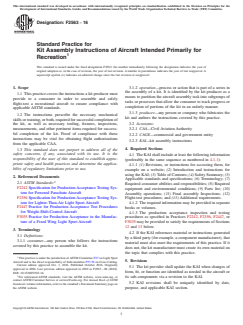

ASTM F2563-16 - Standard Practice for Kit Assembly Instructions of Aircraft Intended Primarily for Recreation
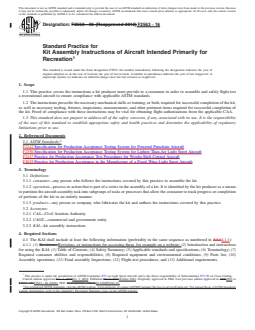
REDLINE ASTM F2563-16 - Standard Practice for Kit Assembly Instructions of Aircraft Intended Primarily for Recreation
Get Certified
Connect with accredited certification bodies for this standard

DEKRA North America
DEKRA certification services in North America.

Eagle Registrations Inc.
American certification body for aerospace and defense.

Element Materials Technology
Materials testing and product certification.
Sponsored listings
Frequently Asked Questions
ASTM F2563-16 is a standard published by ASTM International. Its full title is "Standard Practice for Kit Assembly Instructions of Aircraft Intended Primarily for Recreation". This standard covers: ABSTRACT This practice covers the instructions a kit producer must provide to a consumer in order to assemble and safely flight-test a recreational aircraft to ensure compliance with applicable ASTM standards. The instructions prescribe the necessary mechanical skills or training, or both, required for successful completion of the kit, as well as necessary tooling, fixtures, inspections, measurements, and other pertinent items required for successful completion of the kit. The kit assembly instructions (KAI) shall include at least the following information: (1) Revisions; (2) Introduction and instructions for using the KAI; (3) Table of Contents; (4) Safety Summary; (5) Applicable standards and specifications; (6) Terminology; (7) Required consumer abilities and responsibilities; (8) Required equipment and environmental conditions; (9) Parts list; (10) Assembly operations; (11) Final assembly Inspections; (12) Flight-test procedures; and (13) Additional requirements. SCOPE 1.1 This practice covers the instructions a kit producer must provide to a consumer in order to assemble and safely flight-test a recreational aircraft to ensure compliance with applicable ASTM standards. 1.2 The instructions prescribe the necessary mechanical skills or training, or both, required for successful completion of the kit, as well as necessary tooling, fixtures, inspections, measurements, and other pertinent items required for successful completion of the kit. Proof of compliance with these instructions may be vital for obtaining flight authorizations from the applicable CAA. 1.3 This standard does not purport to address all of the safety concerns, if any, associated with its use. It is the responsibility of the user of this standard to establish appropriate safety and health practices and determine the applicability of regulatory limitations prior to use.
ABSTRACT This practice covers the instructions a kit producer must provide to a consumer in order to assemble and safely flight-test a recreational aircraft to ensure compliance with applicable ASTM standards. The instructions prescribe the necessary mechanical skills or training, or both, required for successful completion of the kit, as well as necessary tooling, fixtures, inspections, measurements, and other pertinent items required for successful completion of the kit. The kit assembly instructions (KAI) shall include at least the following information: (1) Revisions; (2) Introduction and instructions for using the KAI; (3) Table of Contents; (4) Safety Summary; (5) Applicable standards and specifications; (6) Terminology; (7) Required consumer abilities and responsibilities; (8) Required equipment and environmental conditions; (9) Parts list; (10) Assembly operations; (11) Final assembly Inspections; (12) Flight-test procedures; and (13) Additional requirements. SCOPE 1.1 This practice covers the instructions a kit producer must provide to a consumer in order to assemble and safely flight-test a recreational aircraft to ensure compliance with applicable ASTM standards. 1.2 The instructions prescribe the necessary mechanical skills or training, or both, required for successful completion of the kit, as well as necessary tooling, fixtures, inspections, measurements, and other pertinent items required for successful completion of the kit. Proof of compliance with these instructions may be vital for obtaining flight authorizations from the applicable CAA. 1.3 This standard does not purport to address all of the safety concerns, if any, associated with its use. It is the responsibility of the user of this standard to establish appropriate safety and health practices and determine the applicability of regulatory limitations prior to use.
ASTM F2563-16 is classified under the following ICS (International Classification for Standards) categories: 49.035 - Components for aerospace construction. The ICS classification helps identify the subject area and facilitates finding related standards.
ASTM F2563-16 has the following relationships with other standards: It is inter standard links to ASTM F2563-06(2010), ASTM F2242-05(2018), ASTM F2356-05a(2018), ASTM F2447-05(2018), ASTM F2356-05a(2013), ASTM F2242-05(2013), ASTM F2356-05a(2010), ASTM F2447-05(2009), ASTM F2242-05(2008), ASTM F2356-05a(2008), ASTM F2447-05(2007), ASTM F2356-05a, ASTM F2356-05, ASTM F2242-05, ASTM F2447-05. Understanding these relationships helps ensure you are using the most current and applicable version of the standard.
ASTM F2563-16 is available in PDF format for immediate download after purchase. The document can be added to your cart and obtained through the secure checkout process. Digital delivery ensures instant access to the complete standard document.
Standards Content (Sample)
This international standard was developed in accordance with internationally recognized principles on standardization established in the Decision on Principles for the
Development of International Standards, Guides and Recommendations issued by the World Trade Organization Technical Barriers to Trade (TBT) Committee.
Designation: F2563 − 16
Standard Practice for
Kit Assembly Instructions of Aircraft Intended Primarily for
Recreation
This standard is issued under the fixed designation F2563; the number immediately following the designation indicates the year of
original adoption or, in the case of revision, the year of last revision. A number in parentheses indicates the year of last reapproval. A
superscript epsilon (´) indicates an editorial change since the last revision or reapproval.
1. Scope 3.1.2 operation—process or action that is part of a series in
the assembly of a kit. It is identified by the kit producer as a
1.1 This practice covers the instructions a kit producer must
means to partition the aircraft assembly task into subgroups of
provide to a consumer in order to assemble and safely
tasks or processes that allow the consumer to track progress or
flight-test a recreational aircraft to ensure compliance with
completion of portions of the kit in an orderly manner.
applicable ASTM standards.
3.1.3 producer—any person or company who fabricates the
1.2 The instructions prescribe the necessary mechanical
kit and authors the instructions covered by this practice.
skillsortraining,orboth,requiredforsuccessfulcompletionof
3.2 Acronyms:
the kit, as well as necessary tooling, fixtures, inspections,
3.2.1 CAA—Civil Aviation Authority
measurements, and other pertinent items required for success-
ful completion of the kit. Proof of compliance with these
3.2.2 CAGE—commercial and government entity
instructions may be vital for obtaining flight authorizations
3.2.3 KAI—kit assembly instructions
from the applicable CAA.
4. Required Sections
1.3 This standard does not purport to address all of the
safety concerns, if any, associated with its use. It is the
4.1 The KAI shall include at least the following information
responsibility of the user of this standard to establish appro-
(preferably in the same sequence as numbered in 4.1.1):
priate safety and health practices and determine the applica-
4.1.1 (1) Revisions, or instructions for accessing them, for
bility of regulatory limitations prior to use.
example on a website; (2) Introduction and instructions for
using the KAI; (3) Table of Contents; (4) Safety Summary; (5)
2. Referenced Documents
Applicable standards and specifications; (6) Terminology; (7)
2.1 ASTM Standards:
Required consumer abilities and responsibilities; (8) Required
F2242 Specification for ProductionAcceptance Testing Sys-
equipment and environmental conditions; (9) Parts list; (10)
tem for Powered Parachute Aircraft
Assembly operations; (11) Final assembly Inspections; (12)
F2356 Specification for ProductionAcceptance Testing Sys-
Flight-test procedures; and (13) Additional requirements.
tem for Lighter-Than-Air Light Sport Aircraft
4.1.2 The required information may be provided in separate
F2447 Practice for Production Acceptance Test Procedures
books or volumes.
for Weight-Shift-Control Aircraft
4.1.3 The production acceptance inspection and testing
F3035 Practice for Production Acceptance in the Manufac-
procedures as specified in Practices F2242, F2356, F2447,or
ture of a Fixed Wing Light Sport Aircraft
F3035 may be provided to satisfy the requirements of Sections
12 and 13 below.
3. Terminology
4.2 If the KAI references material or instructions generated
3.1 Definitions:
by a third party (for example, a component manufacturer), that
3.1.1 consumer—any person who follows the instructions
material must also meet the requirements of this practice. If it
covered by this practice to assemble the kit.
does not, the kit manufacturer must create its own material on
the topic that complies with this practice.
This practice is under the jurisdiction ofASTM Committee F37 on Light Sport
5. Revisions
Aircraft and is the direct responsibility of Subcommittee F37.70 on Cross Cutting.
Current edition approved Oct. 1, 2016. Published October 2016. Originally
5.1 The kit provider shall update the KAI when changes of
approved in 2006. Last previous edition approved in 2010 as F2563 – 06 (2010).
form, fit, or function are identified as needed in the aircraft or
DOI: 10.1520/F2563-16.
For referenced ASTM standards, visit the ASTM website, www.astm.org, or its sub-components via a revision to the KAI.
contact ASTM Customer Service at service@astm.org. For Annual Book of ASTM
5.2 KAI revisions shall be uniquely identified by date,
Standards volume information, refer to the standard’s Document Summary page on
the ASTM website. purpose, and applicable KAI section.
Copyright © ASTM International, 100 Barr Harbor Drive, PO Box C700, West Conshohocken, PA 19428-2959. United States
F2563 − 16
5.3 The KAI shall include a form to be used to provide 10.2.1 A description that includes the material of each
feedback on the document to the kit producer on errors, component shall be provided with each identifier for each
anomalies, suggestions, or queries. The form shall identify the unique part.
sourcedocument,user,date,subject,discussion,andreturnable
NOTE 1—The material may be omitted from the parts list descriptions
acknowledgement sections for each communication as a mini-
if it is clearly discernible from the instructions themselves.
mum.
11. Assembly Operations
6. Safety Summary
11.1 This section shall specify the order in which assembly
operations should be completed. If operations can be done in
6.1 The KAI shall provide a list of potential hazards
random order, this shall also be specified.
associated with kit assembly. It is important to note that no list
11.1.1 Each KAI assembly operation section shall include a
of potential hazards could ever include every possible hazard.
space for the builder to log completion date and participation.
This section is intended to serve as an advisory to all parties to
It is recommended that there be a place for the builder to
enhance safety.
document time spent performing each operation as well.
6.1.1 Chemicals—If hazardous chemicals are used in the
assembly of the kit, it is advised that information such as 11.2 Pre-Assembly Operations and Checklists—The KAI
MaterialSafetyDataSheets(MSDS)orequivalentbeprovided
shallprescribeanyspecificpre-assemblyoperationsandcheck-
in the KAI. lists necessary for the completion of each operation. At a
minimum, it is recommended that the instructions for each
7. Applicable Standards
operation provide a checklist for the skills, tools, parts, and
conditions required to complete that operation.
7.1 The KAI shall list the title, source, and significance of
the aircraft standards applicable to the aircraft.
11.3 Assembly Operations—Each assembly operation sec-
tion shall include information such as text, photos, templates,
8. Required Consumer Abilities and Responsibilities
electrical schematic drawings, or technical drawings sufficient
to explain how to perform that operation and ensure compli-
8.1 Consumer Skills and Training:
ance with the design criteria.
8.1.1 The KAI shall prescribe any specific skills or training
necessary to complete each operation.
11.4 Post-Assembly Inspections and Measurements—Each
8.1.2 The KAI shall prescribe any specific responsibilities
assembly operation section shall prescribe any specific
theproducerexpectstheconsumertoassumeforcompletionof
inspections, measurements, or criteria necessary for verifying
the kit.
successful completion of that operation.
8.1.3 The KAI shall prescribe the responsibilities of the
12. Final Assembly Inspections
customer for obtaining a flight authorization from the appli-
cable CAA. Deviation from the instructions or unauthorized
12.1 Systems Inspections—The KAI shall prescribe specific
modifications may prohibit the assembled aircraft from obtain-
systeminspectionsnecessaryforverifyingsuccessfuloperation
ing a flight authorization. Such information shall be provided
of each system.
in the KAI.
12.2 Engine Start-Up and Break-In—The KAI shall pre-
scribe any specific procedures necessary for initial engine
9. Required Equipment and Environmental Conditions
start-up and break-in.
9.1 Required Equipment and Parts:
12.3 Pre-Flight Tests and Verifications—The KAI shall
9.1.1 The KAI shall prescribe any specific equipment nec-
prescribe any specific tests and verifications required prior to
essaryforcompletionofeachoperationsuchas,butnotlimited
initial test flights.
to, tooling, jigs, parts,
...
This document is not an ASTM standard and is intended only to provide the user of an ASTM standard an indication of what changes have been made to the previous version. Because
it may not be technically possible to adequately depict all changes accurately, ASTM recommends that users consult prior editions as appropriate. In all cases only the current version
of the standard as published by ASTM is to be considered the official document.
Designation: F2563 − 06 (Reapproved 2010) F2563 − 16
Standard Practice for
Kit Assembly Instructions of Aircraft Intended Primarily for
Recreation
This standard is issued under the fixed designation F2563; the number immediately following the designation indicates the year of
original adoption or, in the case of revision, the year of last revision. A number in parentheses indicates the year of last reapproval. A
superscript epsilon (´) indicates an editorial change since the last revision or reapproval.
1. Scope
1.1 This practice covers the instructions a kit producer must provide to a consumer in order to assemble and safely flight-test
a recreational aircraft to ensure compliance with applicable ASTM standards.
1.2 The instructions prescribe the necessary mechanical skills or training, or both, required for successful completion of the kit,
as well as necessary tooling, fixtures, inspections, measurements, and other pertinent items required for successful completion of
the kit. Proof of compliance with these instructions may be vital for obtaining flight authorizations from the applicable CAA.
1.3 This standard does not purport to address all of the safety concerns, if any, associated with its use. It is the responsibility
of the user of this standard to establish appropriate safety and health practices and determine the applicability of regulatory
limitations prior to use.
2. Referenced Documents
2.1 ASTM Standards:
F2242 Specification for Production Acceptance Testing System for Powered Parachute Aircraft
F2356 Specification for Production Acceptance Testing System for Lighter-Than-Air Light Sport Aircraft
F2447 Practice for Production Acceptance Test Procedures for Weight-Shift-Control Aircraft
F3035 Practice for Production Acceptance in the Manufacture of a Fixed Wing Light Sport Aircraft
3. Terminology
3.1 Definitions:
3.1.1 consumer—any person who follows the instructions covered by this practice to assemble the kit.
3.1.2 operation—process or action that is part of a series in the assembly of a kit. It is identified by the kit producer as a means
to partition the aircraft assembly task into subgroups of tasks or processes that allow the consumer to track progress or completion
of portions of the kit in an orderly manner.
3.1.3 producer—any person or company who fabricates the kit and authors the instructions covered by this practice.
3.2 Acronyms:
3.2.1 CAA—Civil Aviation Authority
3.2.2 CAGE—commercial and government entity
3.2.3 KAI—kit assembly instructions
4. Required Sections
4.1 The KAI shall include at least the following information (preferably in the same sequence as numbered in 3.1.14.1.1):
4.1.1 (1) Revisions; Revisions, or instructions for accessing them, for example on a website; (2) Introduction and instructions
for using the KAI; (3) Table of Contents; (4) Safety Summary; (5) Applicable standards and specifications; (6) Terminology; (7)
Required consumer abilities and responsibilities; (8) Required equipment and environmental conditions; (9) Parts list; (10)
Assembly operations; (11) Final assembly Inspections; (12) Flight-test procedures; and (13) Additional requirements.
This practice is under the jurisdiction of ASTM Committee F37 on Light Sport Aircraft and is the direct responsibility of Subcommittee F37.70 on Cross Cutting.
Current edition approved Dec. 1, 2010Oct. 1, 2016. Published March 2011October 2016. Originally approved in 2006. Last previous edition approved in 20062010 as
F2563 – 06.F2563 – 06 (2010). DOI: 10.1520/F2563-06R10.10.1520/F2563-16.
For referenced ASTM standards, visit the ASTM website, www.astm.org, or contact ASTM Customer Service at service@astm.org. For Annual Book of ASTM Standards
volume information, refer to the standard’s Document Summary page on the ASTM website.
Copyright © ASTM International, 100 Barr Harbor Drive, PO Box C700, West Conshohocken, PA 19428-2959. United States
F2563 − 16
NOTE 1—The required information may be provided in separate books or volumes.
4.1.2 The required information may be provided in separate books or volumes.
4.1.3 The production acceptance inspection and testing procedures as specified in Practices F2242, F2356, F2447, or F3035 may
be provided to satisfy the requirements of Sections 12 and 13 below.
4.2 If the KAI references material or instructions generated by a third party (for example, a component manufacturer), that
material must also meet the requirements of this practice. If it does not, the kit manufacturer must create its own material on the
topic that complies with this practice.
5. Revisions
5.1 The kit provider shall update the KAI when changes of form, fit, or function are identified as needed in the aircraft or its
sub-components via a revision to the KAI.
5.2 KAI revisions shall be uniquely identified by date, purpose, and applicable KAI section.
5.3 The KAI shall include a form to be used to provide feedback on the document to the kit producer on errors, anomalies,
suggestions, or queries. The form shall identify the source document, user, date, subject, discussion, and returnable acknowledge-
ment sections for each communication as a minimum.
6. Safety Summary
6.1 The KAI shall provide a list of potential hazards associated with kit assembly. It is important to note that no list of potential
hazards could ever include every possible hazard. This section is intended to serve as an advisory to all parties to enhance safety.
6.1.1 Chemicals—If hazardous chemicals are used in the assembly of the kit, it is advised that information such as Material
Safety Data Sheets (MSDS) or equivalent be provided in the KAI.
7. Applicable Standards
7.1 The KAI shall list the title, source, and significance of the aircraft standards applicable to the aircraft.
8. Required Consumer Abilities and Responsibilities
8.1 Consumer Skills and Training:
8.1.1 The KAI shall prescribe any specific skills or training necessary to complete each operation.
8.1.2 The KAI shall prescribe any specific responsibilities the producer expects the consumer to assume for completion of the
kit.
8.1.3 The KAI shall prescribe the responsibilities of the customer for obtaining a flight authorization from the applicable CAA.
Deviation from the instructions or unauthorized modifications may prohibit the assembled aircraft from obtaining a flight
authorization. Such information shall be provided in the KAI.
9. Required Equipment and Environmental Conditions
9.1 Required Equipment and Parts:
9.1.1 The KAI shall prescribe any specific equipment necessary for completion of each operation such as, but not limited to,
tooling, jigs, parts, and fixtures. This list should include specific manufacturers (CAGE codes if applicable), part numbers, quantity,
and description if possible.
9.1.2 The KAI may prescribe any specific equipment recommended for completion of each operation.
9.2 Required Environmental Conditions—The KAI shall prescribe any specific environmental conditions necessary for
completion of each operation such as, but not limited to, temperature range, humidity, wind, dust, and lighting.
10. Parts List
10.1 The KAI shall contain a parts list of all the kit parts (or subassemblies) listing a part number or identifier, description, and
quantity.
10.2 A unique part number or identifier shall be assigned to each unique assembly, subassembly, detail part, or consumable
material provided in the kit.
10.2.1 A description that includes the material of each component shall be provided with each identifier for each unique part.
NOTE 1—The material may be omitted from the parts list descriptions if it is clearly discernible from the instructions themselves.
11. Assembly Operations
11.1 This section shall specify the order in which assembly operations should be completed. If operations can be done in random
order, this shall also be specified.
11.1.1 Each KAI assembly operation section shall include a space for the builder to log completion date and participation. It
is recommended that there be a place for the builder to document time spent performing each operation as well.
F2563 − 16
11.2 Pre-Assembly Operations and Checklists—The KAI shall prescribe any specific pre-assembly operations and checklists
necessary for the completion of each operation. At a minimum, it is recommended that the instructions for each operation provide
a checklist for the skills, tools, parts, and conditions required to complete that operation.
11.3 Ass
...
Questions, Comments and Discussion
Ask us and Technical Secretary will try to provide an answer. You can facilitate discussion about the standard in here.
Loading comments...