

ASTM D4812-19e1
(Test Method)Standard Test Method for Unnotched Cantilever Beam Impact Resistance of Plastics
General Information
- Abstract
SIGNIFICANCE AND USE
5.1 The pendulum-impact test indicates the energy to break standard test specimens of specified size under stipulated conditions of specimen mounting and pendulum velocity at impact.
5.2 The energy lost by the pendulum during the breakage of the specimen is the sum of the energies required to produce the following results:
5.2.1 To initiate fracture of the specimen,
5.2.2 To propagate the fracture across the specimen,
5.2.3 To throw the free end (or pieces) of the broken specimen (toss correction),
5.2.4 To bend the specimen,
5.2.5 To produce vibration in the pendulum arm,
5.2.6 To produce vibration or horizontal movement of the machine frame or base,
5.2.7 To overcome friction in the pendulum bearing and in the indicating mechanism, and to overcome windage (pendulum air drag),
5.2.8 To indent or deform plastically the specimen at the line of impact, and
5.2.9 To overcome the friction caused by the rubbing of the striking nose (or other part of the pendulum) over the face of the bent specimen.
5.3 For relatively brittle materials for which fracture propagation energy is small in comparison with the fracture initiation energy, the indicated impact energy absorbed is, for all practical purposes, the sum of items given in 5.2.1 and 5.2.3. The toss correction (5.2.3) may represent a very large fraction of the total energy absorbed when testing relatively dense and brittle materials.
5.4 For materials for which the fracture propagation energy (5.2.2) may be large compared to the fracture initiation energy (5.2.1), factors (5.2.2, 5.2.5, and 5.2.9) can become quite significant, even when the specimen is accurately machined and positioned and the machine is in good condition with adequate capacity (Note 3). Bending (5.2.4) and indentation losses (5.2.8) may be appreciable when testing soft materials.
Note 3: Although the frame and base of the machine should be sufficiently rigid and massive to handle the energies of tough specimens wit...
SCOPE
1.1 This test method covers the determination of the resistance of plastics to breakage by flexural shock, as indicated by the energy extracted from standardized pendulum-type hammers, mounted in standardized machines, in breaking standard specimens with one pendulum swing. The result of this test method is reported as energy absorbed per unit of specimen width.
Note 1: The pendulum-type test instruments have been standardized in that they must comply with certain requirements, including a fixed height of hammer fall that results in a substantially fixed velocity of the hammer at the moment of impact. Pendulums of different initial energies (produced by varying their effective weights) are recommended for use with specimens of different impact strengths. Moreover, manufacturers of the equipment are permitted to use different lengths and constructions of pendulums (with resulting possible differences in pendulum rigidities (see Section 5), and other differences in machine design).
1.2 The values stated in SI units are to be regarded as standard. The values given in parentheses are for information only.
1.3 This standard does not purport to address all of the safety concerns, if any, associated with its use. It is the responsibility of the user of this standard to establish appropriate safety, health, and environmental practices and determine the applicability of regulatory limitations prior to use.
Note 2: This standard and ISO 180, Method U address the same subject matter, but differ in technical content.
1.4 This international standard was developed in accordance with internationally recognized principles on standardization established in the Decision on Principles for the Development of International Standards, Guides and Recommendations issued by the World Trade Organization Technical Barriers to Trade (TBT) Committee.
- Status
- Published
- Publication Date
- 30-Sep-2019
- Technical Committee
- D20 - Plastics
- Drafting Committee
- D20.10 - Mechanical Properties
Overview
ASTM D4812-19e1 defines the Standard Test Method for Unnotched Cantilever Beam Impact Resistance of Plastics. Developed by ASTM International, this standard specifies a method for determining the resistance of plastics to breakage by flexural shock using a standardized pendulum-type impact test. The method precisely measures the energy absorbed by unnotched test specimens during a single pendulum swing, resulting in a value reported as energy absorbed per unit of specimen width.
This method is crucial for evaluating the mechanical properties of plastics, especially in applications where impact resistance is a key requirement. It supports quality control, material specification, and comparative material selection in research, manufacturing, and product development.
Key Topics
- Pendulum-Impact Test: Measures energy required to break standardized specimens under controlled conditions, providing insights into the plastic’s ability to withstand sudden forces.
- Energy Absorption Analysis: The test quantifies the sum of energies required for fracture initiation, fracture propagation, bending, vibration, overcoming friction, and deforming the specimen.
- Types of Break: The standard requires categorizing failures as complete breaks, partial breaks, or non-breaks, ensuring clear reporting and consistent comparison.
- Machine Requirements: Includes specifications for pendulum impact testers, such as standardized hammer fall height, pendulum energy levels, and machine rigidity.
- Specimen Preparation: Outlines precise specimen dimensions and preparation methods to ensure accurate and repeatable results.
- Data Reporting: Emphasizes comprehensive reporting, including details of specimen preparation, break classification, width/depth measurements, and calculated impact resistance.
Applications
ASTM D4812-19e1 is widely used in the plastics industry for:
- Quality Control: Ensuring plastic materials meet required impact resistance standards before use in end products.
- Material Specification: Assisting manufacturers and engineers in specifying plastics with appropriate impact resistance for intended applications.
- Research & Development: Comparing the performance of different plastic formulations or processing techniques under impact loading conditions.
- Product Design: Providing data to optimize plastics selection for parts expected to encounter sudden forces or shocks, such as automotive components, consumer electronics housings, and industrial equipment.
- Regulatory Compliance: Supporting evidence for meeting industry and governmental standards for impact resistance.
Related Standards
ASTM D4812-19e1 aligns and interacts with several related standards:
- ASTM D256: Test Methods for Determining the Izod Pendulum Impact Resistance of Plastics (notched specimens).
- ASTM D618: Practice for Conditioning Plastics for Testing.
- ASTM D883: Terminology Relating to Plastics.
- ASTM D5947: Methods for Measuring Physical Dimensions of Solid Plastics Specimens.
- ISO 180, Method U: International standard addressing similar subject matter for impact resistance (note differences in technical content).
Practical Value
Implementing ASTM D4812-19e1 ensures that manufacturers and users can:
- Compare and rate the impact resistance of diverse plastic materials accurately.
- Maintain high standards in product performance and reliability.
- Reduce risks associated with material failure due to inadequate impact strength.
- Optimize material selection for specific end-use environments.
- Meet customer and regulatory expectations for safety and durability.
By following ASTM D4812-19e1, organizations benefit from a trusted, reproducible framework for assessing the impact resistance of plastics, thereby supporting product innovation and consistent quality.
Keywords: ASTM D4812, impact resistance, plastics testing, pendulum-impact test, cantilever beam, unnotched specimens, quality control, material specification, plastic molding, mechanical properties.
Relations
- Effective Date
- 01-Feb-2024
- Effective Date
- 01-Nov-2023
- Effective Date
- 01-Apr-2022
- Effective Date
- 01-Jan-2020
- Effective Date
- 01-Aug-2019
- Effective Date
- 15-Apr-2019
- Effective Date
- 01-Feb-2019
- Effective Date
- 01-Dec-2018
- Effective Date
- 01-Nov-2018
- Refers
ASTM E2935-17 - Standard Practice for Conducting Equivalence Testing in Laboratory Applications - Effective Date
- 01-Oct-2017
- Effective Date
- 01-Oct-2017
- Effective Date
- 01-Oct-2017
- Effective Date
- 15-Aug-2017
- Refers
ASTM E2935-16 - Standard Practice for Conducting Equivalence Testing in Laboratory Applications - Effective Date
- 15-Nov-2016
- Refers
ASTM E2935-15 - Standard Practice for Conducting Equivalence Testing in Laboratory Applications - Effective Date
- 01-Oct-2015
Get Certified
Connect with accredited certification bodies for this standard

DIN CERTCO
DIN Group product certification.

Smithers Quality Assessments
US management systems and product certification.
Sponsored listings
Frequently Asked Questions
ASTM D4812-19e1 is a standard published by ASTM International. Its full title is "Standard Test Method for Unnotched Cantilever Beam Impact Resistance of Plastics". This standard covers: SIGNIFICANCE AND USE 5.1 The pendulum-impact test indicates the energy to break standard test specimens of specified size under stipulated conditions of specimen mounting and pendulum velocity at impact. 5.2 The energy lost by the pendulum during the breakage of the specimen is the sum of the energies required to produce the following results: 5.2.1 To initiate fracture of the specimen, 5.2.2 To propagate the fracture across the specimen, 5.2.3 To throw the free end (or pieces) of the broken specimen (toss correction), 5.2.4 To bend the specimen, 5.2.5 To produce vibration in the pendulum arm, 5.2.6 To produce vibration or horizontal movement of the machine frame or base, 5.2.7 To overcome friction in the pendulum bearing and in the indicating mechanism, and to overcome windage (pendulum air drag), 5.2.8 To indent or deform plastically the specimen at the line of impact, and 5.2.9 To overcome the friction caused by the rubbing of the striking nose (or other part of the pendulum) over the face of the bent specimen. 5.3 For relatively brittle materials for which fracture propagation energy is small in comparison with the fracture initiation energy, the indicated impact energy absorbed is, for all practical purposes, the sum of items given in 5.2.1 and 5.2.3. The toss correction (5.2.3) may represent a very large fraction of the total energy absorbed when testing relatively dense and brittle materials. 5.4 For materials for which the fracture propagation energy (5.2.2) may be large compared to the fracture initiation energy (5.2.1), factors (5.2.2, 5.2.5, and 5.2.9) can become quite significant, even when the specimen is accurately machined and positioned and the machine is in good condition with adequate capacity (Note 3). Bending (5.2.4) and indentation losses (5.2.8) may be appreciable when testing soft materials. Note 3: Although the frame and base of the machine should be sufficiently rigid and massive to handle the energies of tough specimens wit... SCOPE 1.1 This test method covers the determination of the resistance of plastics to breakage by flexural shock, as indicated by the energy extracted from standardized pendulum-type hammers, mounted in standardized machines, in breaking standard specimens with one pendulum swing. The result of this test method is reported as energy absorbed per unit of specimen width. Note 1: The pendulum-type test instruments have been standardized in that they must comply with certain requirements, including a fixed height of hammer fall that results in a substantially fixed velocity of the hammer at the moment of impact. Pendulums of different initial energies (produced by varying their effective weights) are recommended for use with specimens of different impact strengths. Moreover, manufacturers of the equipment are permitted to use different lengths and constructions of pendulums (with resulting possible differences in pendulum rigidities (see Section 5), and other differences in machine design). 1.2 The values stated in SI units are to be regarded as standard. The values given in parentheses are for information only. 1.3 This standard does not purport to address all of the safety concerns, if any, associated with its use. It is the responsibility of the user of this standard to establish appropriate safety, health, and environmental practices and determine the applicability of regulatory limitations prior to use. Note 2: This standard and ISO 180, Method U address the same subject matter, but differ in technical content. 1.4 This international standard was developed in accordance with internationally recognized principles on standardization established in the Decision on Principles for the Development of International Standards, Guides and Recommendations issued by the World Trade Organization Technical Barriers to Trade (TBT) Committee.
SIGNIFICANCE AND USE 5.1 The pendulum-impact test indicates the energy to break standard test specimens of specified size under stipulated conditions of specimen mounting and pendulum velocity at impact. 5.2 The energy lost by the pendulum during the breakage of the specimen is the sum of the energies required to produce the following results: 5.2.1 To initiate fracture of the specimen, 5.2.2 To propagate the fracture across the specimen, 5.2.3 To throw the free end (or pieces) of the broken specimen (toss correction), 5.2.4 To bend the specimen, 5.2.5 To produce vibration in the pendulum arm, 5.2.6 To produce vibration or horizontal movement of the machine frame or base, 5.2.7 To overcome friction in the pendulum bearing and in the indicating mechanism, and to overcome windage (pendulum air drag), 5.2.8 To indent or deform plastically the specimen at the line of impact, and 5.2.9 To overcome the friction caused by the rubbing of the striking nose (or other part of the pendulum) over the face of the bent specimen. 5.3 For relatively brittle materials for which fracture propagation energy is small in comparison with the fracture initiation energy, the indicated impact energy absorbed is, for all practical purposes, the sum of items given in 5.2.1 and 5.2.3. The toss correction (5.2.3) may represent a very large fraction of the total energy absorbed when testing relatively dense and brittle materials. 5.4 For materials for which the fracture propagation energy (5.2.2) may be large compared to the fracture initiation energy (5.2.1), factors (5.2.2, 5.2.5, and 5.2.9) can become quite significant, even when the specimen is accurately machined and positioned and the machine is in good condition with adequate capacity (Note 3). Bending (5.2.4) and indentation losses (5.2.8) may be appreciable when testing soft materials. Note 3: Although the frame and base of the machine should be sufficiently rigid and massive to handle the energies of tough specimens wit... SCOPE 1.1 This test method covers the determination of the resistance of plastics to breakage by flexural shock, as indicated by the energy extracted from standardized pendulum-type hammers, mounted in standardized machines, in breaking standard specimens with one pendulum swing. The result of this test method is reported as energy absorbed per unit of specimen width. Note 1: The pendulum-type test instruments have been standardized in that they must comply with certain requirements, including a fixed height of hammer fall that results in a substantially fixed velocity of the hammer at the moment of impact. Pendulums of different initial energies (produced by varying their effective weights) are recommended for use with specimens of different impact strengths. Moreover, manufacturers of the equipment are permitted to use different lengths and constructions of pendulums (with resulting possible differences in pendulum rigidities (see Section 5), and other differences in machine design). 1.2 The values stated in SI units are to be regarded as standard. The values given in parentheses are for information only. 1.3 This standard does not purport to address all of the safety concerns, if any, associated with its use. It is the responsibility of the user of this standard to establish appropriate safety, health, and environmental practices and determine the applicability of regulatory limitations prior to use. Note 2: This standard and ISO 180, Method U address the same subject matter, but differ in technical content. 1.4 This international standard was developed in accordance with internationally recognized principles on standardization established in the Decision on Principles for the Development of International Standards, Guides and Recommendations issued by the World Trade Organization Technical Barriers to Trade (TBT) Committee.
ASTM D4812-19e1 is classified under the following ICS (International Classification for Standards) categories: 83.140.99 - Other rubber and plastics products. The ICS classification helps identify the subject area and facilitates finding related standards.
ASTM D4812-19e1 has the following relationships with other standards: It is inter standard links to ASTM D883-24, ASTM D883-23, ASTM E456-13a(2022)e1, ASTM D883-20, ASTM D883-19c, ASTM D883-19a, ASTM D883-19, ASTM D883-18a, ASTM D883-18, ASTM E2935-17, ASTM E456-13A(2017)e3, ASTM E456-13A(2017)e1, ASTM D883-17, ASTM E2935-16, ASTM E2935-15. Understanding these relationships helps ensure you are using the most current and applicable version of the standard.
ASTM D4812-19e1 is available in PDF format for immediate download after purchase. The document can be added to your cart and obtained through the secure checkout process. Digital delivery ensures instant access to the complete standard document.
Standards Content (Sample)
This international standard was developed in accordance with internationally recognized principles on standardization established in the Decision on Principles for the
Development of International Standards, Guides and Recommendations issued by the World Trade Organization Technical Barriers to Trade (TBT) Committee.
´1
Designation: D4812 − 19
Standard Test Method for
Unnotched Cantilever Beam Impact Resistance of Plastics
This standard is issued under the fixed designation D4812; the number immediately following the designation indicates the year of
original adoption or, in the case of revision, the year of last revision.Anumber in parentheses indicates the year of last reapproval.A
superscript epsilon (´) indicates an editorial change since the last revision or reapproval.
ε NOTE—Editorial changes were made in April 2022.
1. Scope* 2. Referenced Documents
2.1 ASTM Standards:
1.1 This test method covers the determination of the resis-
D256Test Methods for Determining the Izod Pendulum
tance of plastics to breakage by flexural shock, as indicated by
Impact Resistance of Plastics
the energy extracted from standardized pendulum-type
D618Practice for Conditioning Plastics for Testing
hammers, mounted in standardized machines, in breaking
D883Terminology Relating to Plastics
standard specimens with one pendulum swing. The result of
D5947Test Methods for Physical Dimensions of Solid
this test method is reported as energy absorbed per unit of
Plastics Specimens
specimen width.
E456Terminology Relating to Quality and Statistics
NOTE 1—The pendulum-type test instruments have been standardized
E691Practice for Conducting an Interlaboratory Study to
in that they must comply with certain requirements, including a fixed
Determine the Precision of a Test Method
height of hammer fall that results in a substantially fixed velocity of the
E2935Practice for Evaluating Equivalence of Two Testing
hammer at the moment of impact. Pendulums of different initial energies
(produced by varying their effective weights) are recommended for use
Processes
with specimens of different impact strengths. Moreover, manufacturers of
the equipment are permitted to use different lengths and constructions of 3. Terminology
pendulums(withresultingpossibledifferencesinpendulumrigidities(see
3.1 Definitions—Definitions used in this test method are in
Section 5), and other differences in machine design).
accordance with Terminology D883. For terms relating to
1.2 The values stated in SI units are to be regarded as
precision and bias and associated issues, the terms used in this
standard. The values given in parentheses are for information
standard are defined in accordance with Terminology E456.
only.
4. Summary of Test Method
1.3 This standard does not purport to address all of the
4.1 This test method differs from others of similar character
safety concerns, if any, associated with its use. It is the
in that unnotched test specimens are used (see Test Methods
responsibility of the user of this standard to establish appro-
D256 for procedures using notched test specimens). The lack
priate safety, health, and environmental practices and deter-
of a notch makes this test method especially useful for
mine the applicability of regulatory limitations prior to use.
reinforced materials where a notch may mask the effects of
NOTE 2—This standard and ISO 180, Method U address the same
orientation. It may also be used with other filled or unrein-
subject matter, but differ in technical content.
forced materials where a stress-concentrating notch is not
1.4 This international standard was developed in accor-
desired. It is not valid for materials that twist when subjected
dance with internationally recognized principles on standard-
to this test.
ization established in the Decision on Principles for the
5. Significance and Use
Development of International Standards, Guides and Recom-
mendations issued by the World Trade Organization Technical
5.1 The pendulum-impact test indicates the energy to break
Barriers to Trade (TBT) Committee.
standard test specimens of specified size under stipulated
conditions of specimen mounting and pendulum velocity at
impact.
ThistestmethodisunderthejurisdictionofASTMCommitteeD20onPlastics
and is the direct responsibility of Subcommittee D20.10 on Mechanical Properties. For referenced ASTM standards, visit the ASTM website, www.astm.org, or
Current edition approved Oct. 1, 2019. Published October 2019. Originally contact ASTM Customer Service at service@astm.org. For Annual Book of ASTM
approved in 1988. Last previous edition approved in 2011 as D4812-11. DOI:
Standards volume information, refer to the standard’s Document Summary page on
10.1520/D4812-19E01.
the ASTM website.
*A Summary of Changes section appears at the end of this standard
Copyright © ASTM International, 100 Barr Harbor Drive, PO Box C700, West Conshohocken, PA 19428-2959. United States
´1
D4812 − 19
5.2 Theenergylostbythependulumduringthebreakageof 5.6.3.1 For tough materials the pendulum may not have the
thespecimenisthesumoftheenergiesrequiredtoproducethe energy necessary to completely break the extreme outermost
following results: fibers and toss the broken piece or pieces. Results obtained
5.2.1 To initiate fracture of the specimen, from “non-break” specimens shall be considered a departure
from standard and shall be reported as “NB” only and a
5.2.2 To propagate the fracture across the specimen,
numerical value shall not be reported. Impact values cannot be
5.2.3 To throw the free end (or pieces) of the broken
directly compared for any two materials that experience
specimen (toss correction),
different types of failure as defined by this code.
5.2.4 To bend the specimen,
5.6.4 Averages reported must likewise be derived from
5.2.5 To produce vibration in the pendulum arm,
specimens contained within a single failure category. This
5.2.6 To produce vibration or horizontal movement of the
letter code will be included with the reported impact identify-
machine frame or base,
ing the types of failure associated with the reported value. If
5.2.7 To overcome friction in the pendulum bearing and in
morethanonetypeoffailureisobservedforasamplematerial,
the indicating mechanism, and to overcome windage (pendu-
then the report will indicate the average impact value for each
lum air drag),
typeoffailure,followedbythepercentofthespecimensfailing
5.2.8 To indent or deform plastically the specimen at the
in that manner and identified by the letter code.
line of impact, and
5.2.9 To overcome the friction caused by the rubbing of the 5.7 The value of this impact test method lies mainly in the
striking nose (or other part of the pendulum) over the face of areas of quality control and materials specification. The fact
the bent specimen. that a material shows twice the energy absorption of another
under these conditions of test does not indicate that this same
5.3 For relatively brittle materials for which fracture propa-
relationship will exist under another set of test conditions. The
gationenergyissmallincomparisonwiththefractureinitiation
ranking of materials may even be changed under different
energy, the indicated impact energy absorbed is, for all
testing conditions.
practical purposes, the sum of items given in 5.2.1 and 5.2.3.
The toss correction (5.2.3) may represent a very large fraction 5.8 Before proceeding with this test method, reference
shouldbemadetothespecificationofthematerialbeingtested.
of the total energy absorbed when testing relatively dense and
brittle materials. Any test specimen preparation, conditioning, dimensions, or
testing parameters, or combination thereof, covered in the
5.4 For materials for which the fracture propagation energy
material specification shall take precedence over those men-
(5.2.2) may be large compared to the fracture initiation energy
tionedinthistestmethodexceptincaseswheretodosowould
(5.2.1), factors (5.2.2, 5.2.5, and 5.2.9) can become quite
conflict with the purpose for conducting testing. If there are no
significant, even when the specimen is accurately machined
material specifications, then the default conditions apply.
and positioned and the machine is in good condition with
adequate capacity (Note 3). Bending (5.2.4) and indentation
6. Apparatus
losses (5.2.8) may be appreciable when testing soft materials.
6.1 Impact Machine, consisting of a massive base on which
is mounted a vise for holding the specimen and to which is
NOTE 3—Although the frame and base of the machine should be
sufficiently rigid and massive to handle the energies of tough specimens
connected, through a rigid frame and antifriction bearings, one
without motion or excessive vibration, the pendulum arm cannot be made
of a number of pendulum-type hammers (or one basic hammer
very massive because the greater part of its mass must be concentrated
to which extra weights may be attached) having an initial
nearitscenterofpercussionatthestrikingnose.Locatingthestrikingnose
energy suitable for use with the particular specimen to be
precisely at the center of percussion reduces vibration of the pendulum
arm when used with brittle specimens. However, some losses due to tested, plus a pendulum holding and releasing mechanism and
pendulum-arm vibration, the amount varying with the design of the
a mechanism for indicating the breaking energy of the speci-
pendulum, will occur with tough specimens even when the striking nose
men.Ajig for positioning the specimen in the vise and graphs
is properly positioned.
or tables to aid in the calculation of the correction for friction
5.5 In a well-designed machine of sufficient rigidity and
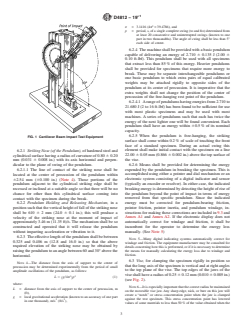
and windage should be included. See Fig. 1 for one type of
massthelossesduetotheitemsgivenin5.2.6and5.2.7should
machinethatmaybeused.Thetypeofmachinethatisdepicted
be very small. Vibrational losses (5.2.6) can be quite large
can also be used for the testing of notched specimens using
when specimens of tough materials are tested in machines of
Test Methods D256. Detailed requirements are given in 6.2 –
insufficient mass which are not securely fastened to a heavy
6.5. See Appendix X1 for general methods for checking and
base.
calibrating the machine.Additional instructions for adjusting a
particular machine should be supplied by the manufacturer.
5.6 Thistestmethodrequiresthatthetypeoffailureforeach
specimen be recorded as one of the three coded categories
6.2 Pendulum,consistingofasingleormultimemberedarm
defined as follows:
with a bearing on one end and a head, containing the striking
5.6.1 C (Complete Break)—Abreak in which the specimen
nose, on the other.Although a large proportion of the mass of
is separated into two or more pieces.
thependulumshouldbeconcentratedinthehead,thearmmust
5.6.2 P (Partial Break)—An incomplete break that has
be sufficiently rigid to maintain the proper clearances and
fractured at least 90% of the depth of the specimen. geometric relationships between the machine parts and the
5.6.3 NB (Non-Break)—An incomplete break where the specimen and to minimize vibrational losses which are always
fracture extends less than 90% of the depth of the specimen. included in the measured impact value.
´1
D4812 − 19
π = 3.1416 (4π =39.4786), and
p = period,s,ofasinglecompleteswing(toandfro)determinedfrom
at least 20 consecutive and uninterrupted swings (known to one
part in two thousandths). The angle of swing shall be less than 5°
each side of center.
6.2.4 The machine shall be provided with a basic pendulum
capable of delivering an energy of 2.710 6 0.135 J (2.00 6
0.10 ft-lbf). This pendulum shall be used with all specimens
that extract less than 85% of this energy. Heavier pendulums
shall be provided for specimens that require more energy to
break. These may be separate interchangeable pendulums or
one basic pendulum to which extra pairs of equal calibrated
weights may be attached rigidly to opposite sides of the
pendulum at its center of percussion. It is imperative that the
extra weights shall not change the position of the center of
percussion of the free-hanging rest point of the pendulum.
6.2.4.1 Arangeofpendulumshavingenergiesfrom2.710to
21.680 J (2 to 16 ft-lbf) has been found to be sufficient for use
with most plastic specimens and may be used with most
machines. A series of pendulums such that each has twice the
energy of the next lighter one will be found convenient. Each
pendulum shall have an energy within 60.5% of its nominal
capacity.
6.2.5 When the pendulum is free-hanging, the striking
FIG. 1 Cantilever Beam Impact Test Equipment
surface shall come within 0.2% of scale of touching the front
face of a standard specimen. During an actual swing this
element shall make initial contact with the specimen on a line
6.2.1 Striking Nose (of the Pendulum),ofhardenedsteeland
22.00 6 0.05 mm (0.866 6 0.002 in.) above the top surface of
cylindrical surface having a radius of curvature of 0.80 6 0.20
the vise.
mm (0.031 6 0.008 in.) with its axis horizontal and perpen-
dicular to the plane of swing of the pendulum. 6.2.6 Means shall be provided for determining the energy
expended by the pendulum in breaking the specimen. This is
6.2.1.1 The line of contact of the striking nose shall be
located at the center of percussion of the pendulum within accomplished using either a pointer and dial mechanism or an
electronic system consisting of a digital indicator and sensor
62.54 mm (60.100 in.) (Note 4). Those portions of the
(typically an encoder or resolver). In either case, the indicated
pendulum adjacent to the cylindrical striking edge shall be
breakingenergyisdeterminedbydetectingtheheightofriseof
recessed or inclined at a suitable angle so that there will be no
the pendulum beyond the point of impact in terms of energy
chance for other than this cylindrical surface coming into
removed from that specific pendulum. Since the indicated
contact with the specimen during the break.
energy must be corrected for pendulum-bearing friction,
6.2.2 Pendulum Holding and Releasing Mechanism, in a
pointer friction, pointer inertia, and pendulum windage, in-
positionsuchthattheverticalheightoffallofthestrikingnose
structions for making these corrections are included in 9.3 and
shall be 610 6 2 mm (24.0 6 0.1 in.); this will produce a
velocity of the striking nose at the moment of impact of Annex A1 and Annex A2. If the electronic display does not
automatically correct for windage and friction, it shall be
approximately 3.46 m (11.35 ft)/s. The mechanism shall be so
constructed and operated that it will release the pendulum incumbent for the operator to determine the energy loss
manually. (See Note 5)
without imparting acceleration or vibration to it.
6.2.3 Theeffectivelengthofthependulumshallbebetween
NOTE 5—Many digital indicating systems automatically correct for
0.325 and 0.406 m (12.8 and 16.0 in.) so that the above
windage and friction. The equipment manufacturer may be consulted for
required elevation of the striking nose may be obtained by
detailsconcerninghowthisisperformed,orifitisnecessarytodetermine
the means for manually calculating the energy loss due to windage and
raisingthependulumtoananglebetween60and30°abovethe
friction.
horizontal.
6.3 Vise, for clamping the specimen rigidly in position so
NOTE 4—The distance from the axis of support to the center of
thatthelongaxisofthespecimenisverticalandatrightangles
percussion may be determined experimentally from the period of small
to the top plane of the vise. The top edges of the jaws of the
amplitude oscillations of the pendulum, as follows:
viseshallhavearadiusof0.25 60.12mm(0.010 60.005in.)
2 2
L 5 ~g/4π !p (1)
(see Fig. 2).
where:
NOTE6—Itisespeciallyimportantthatthecorrectradiusbemaintained
L = distance from the axis of support to the center of percussion, m
on the moveable vise jaw. Any sharp edge, nick, or burr on this jaw will
(ft),
create a “notch” or stress concentration point when the jaw is clamped
g = local gravitational acceleration (known to an accuracy of one part
against the test specimen. This stress concentration point has lowered
2 2
in one thousand), m/s (ft/s ),
values of some materials to less than 50% of the value obtained when the
´1
D4812 − 19
FIG. 3 Sketch of Positioning Jig
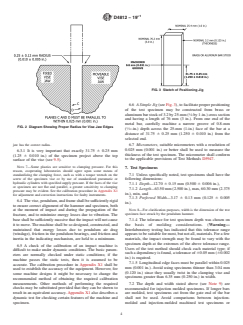
6.6 A Simple Jig(seeFig.3),tofacilitateproperpositioning
of the test specimen may be constructed from brass or
aluminumbarstockof3.2by25-mm( ⁄8by1-in.)crosssection
and having a length of 76 mm (3 in.). From one end of the
metal bar, carefully machine a narrow groove of 0.8-mm
FIG. 2 Diagram Showing Proper Radius for Vise Jaw Edges
( ⁄32-in.) depth across the 25-mm (1-in.) face of the bar at a
distance of 31.75 6 0.25 mm (1.250 6 0.010 in.) from the
selected end.
jaw has the correct radius.
6.7 Micrometers, suitable micrometers with a resolution of
0.025 mm (0.001 in.) or better shall be used to measure the
6.3.1 It is very important that exactly 31.75 6 0.25 mm
thickness of the test specimen. The micrometer shall conform
(1.25 6 0.010 in.) of the specimen project above the top
to the applicable provisions of Test Methods D5947.
surface of the vise (see 9.5).
NOTE 7—Some plastics are sensitive to clamping pressure. For this
7. Test Specimens
reason, cooperating laboratories should agree upon some means of
7.1 Unless specifically noted, test specimens shall have the
standardizing the clamping force, such as with a torque wrench on the
screw of the specimen vise or by use of standardized pneumatic or following dimensions:
hydraulic cylinders with specified supply pressure. If the faces of the vise
7.1.1 Depth—12.70 6 0.15 mm (0.500 6 0.006 in.),
or specimen are not flat and parallel, a greater sensitivity to clamping
7.1.2 Length—63.50mm(2.500in.),max,60.30mm(2.375
pressure may be evident. See the calibration procedure in Appendix X1
in.), min, and
for adjustment and correction instructions for faulty instruments.
7.1.3 Preferred Width—3.17 6 0.13 mm (0.125 6 0.005
6.4 Thevise,pendulum,andframeshallbesufficientlyrigid
in.).
to ensure correct alignment of the hammer and specimen, both
NOTE 8—For clarification purposes, width is the dimension of the test
at the moment of impact and during the propagation of the
specimen face struck by the pendulum hammer.
fracture, and to minimize energy losses due to vibration. The
baseshallbesufficientlymassivethattheimpactwillnotcause 7.1.4 The tolerance for test specimen depth was chosen on
it to move.The machine shall be so designed, constructed, and
the basis of molding considerations. (Warning—
maintained that energy losses due to pendulum air drag Interlaboratory testing has indicated that this tolerance range
(windage), friction in the pendulum bearings, and friction and appearstobesuitableformost,butnotall,materials.Forafew
inertia in the indicating mechanism, are held to a minimum. materials, the impact strength may be found to vary with the
specimen depth at the extremes of the above tolerance range.
6.5 A check of the calibration of an impact machine is
Users of the test method should check each material type; if
difficult to make under dynamic conditions. The basic param-
suchadependencyisfound,atoleranceof 60.05mm(60.002
eters are normally checked under static conditions; if the
in.) is required.
machine passes the static tests, then it is assumed to be
7.1.5 Longitudinal edge faces must be parallel within 0.025
accurate. The calibration procedure in Appendix X1 shall be
mm (0.001 in.). Avoid using specimens thinner than 3.04 mm
used to establish the accuracy of the equipment. However, for
(0.120 in.) since they usually twist in the clamping vise and
some machine designs it might be necessary to change the
specimens greater than 6.35 mm (0.250 in.) in width.
recommended method of obtaining the required calibration
measurements. Other methods of performing the required 7.2 The depth and width stated above (see Note 9) are
checks may be substituted provided that they can be shown to recommended for injection molded specimens. If longer bars
result in an equivalent accuracy. Appendix X1 also describes a are molded, test specimens cut from the gate end of the bar
dynamic test for checking certain features of the machine and shall not be used. Avoid comparisons between injection-
specimen. molded and injection-molded machined test specimens or
´1
D4812 − 19
NOTE 10—Ideally an impact test would be conducted at a constant test
molded-to-length and cut-to-length test specimens unless this
velocity. In a pendulum-type test the velocity decreases as the fracture
is a variation being studied.
progresses. For specimens that have an impact energy approaching the
NOTE 9—The type of mold and molding machine used and the flow capacity of the pendulum, there is insufficient energy to complete the
break and toss. By avoiding the higher 15% scale energy readings, the
behavior in the mold cavity will influence the results obtained. Cooper-
ating laboratories should agree on standard molds and upon a standard velocityofthependulumwillnotbereducedbelow1.33m/s(4.4ft/s).On
the other hand, the use of too heavy a pendulum would reduce the
molding procedure for the material under investigation.
sensitivity of the reading.
7.3 For sheet materials, the specimens shall be cut from the
9.3 If the machine is equipped with a mechanical pointer
sheet in both the lengthwise and crosswise directions, unless
and dial, perform the operations below before testing the
the sheets are known to be isotropic. The test specimen width
specimens. If the machine is equipped with a digital indicating
shall be the thickness of the sheet.
system, follow the manufacturer’s instructions to correct for
7.4 Test specimens prepared by other means are permitted.
windage and friction. If excessive friction is indicated, the
Results from two sets of data may not be comparable if
machine shall be adjusted before starting the test.
different means of test specimen preparation are used. A
9.3.1 With the indicating pointer in its normal starting
statement about test specimen preparation shall be part of the
position, but without a specimen in the vise, release the
report (see 10.1.2).
pendulum from its normal starting position and note the
7.5 Avoid the practice of cementing, bolting, clamping, or
position the pointer attains after the swing as one reading of
otherwise combining thinner specimens to form a composite
Factor A.
test specimen since test results may be seriously affected by
9.3.2 Without resetting the pointer or electronic indicator,
interface effects.
raise the pendulum and release it again. The pointer should
7.6 Each test specimen shall be free of twist, deformation,
move up the scale an additional amount. Repeat this procedure
nicks, scratches, pits, and sink marks. Any test specimen
untilaswingcausesnoadditionalmovementofthepointerand
showingobservableormeasurabledeparturefromoneormore
notethefinalreadingasonereadingofFactorB(seeNote11).
of these requirements shall be rejected.
9.3.3 Repeat the operations in 9.3.1 and 9.3.2 several times
and calculate and record the average A and B readings.
8. Conditioning
NOTE 11—Factor B is an indication of the energy lost by the pendulum
8.1 Specimen Conditioning:
tofrictioninthependulumbearingsandtowindage.ThedifferenceA−B
8.1.1 Condition the test specimens in accordance with
is an indication of the energy lost to friction and inertia in the indicating
Procedure A of Practice D618, unless otherwise specified by
mechanism. The actual corrections, however, will be smaller than these
contract or the relevant ASTM material specification. Condi-
factors, since in an actual test the energy absorbed by the specimen
tioning time is specified as a minimum. Temperature and preventsthependulumfrommakingafullswing.Therefore,theindicated
breakingenergyofthespecimenmustbeincludedinthecalculationofthe
humidity tolerances shall be in accordance with Section 7 of
machine correction before determining the breaking energy of the speci-
Practice D618 unless specified differently by contract or
men (see 9.7). The A and B values also provide an indication of the
material specification.
condition of the machine.
8.1.2 Condition materials known to be sensitive to moisture
9.3.4 If excess friction is indicated, the machine shall be
absorption in accordance with procedures appropriate for the
adjusted before starting a test.
material (for example, “dry as molded”) and state that in the
report.
9.4 Check the specimens for conformity with the require-
ments of Section 7. Measure the depth and width of each
8.2 Test Conditions—Conductthetestsatthesametempera-
specimen in the middle with a micrometer to the nearest 0.025
ture and humidity used for conditioning with tolerances in
mm(0.001in.)andrecord,alongwithitsidentifyingmarkings.
accordance with Section 7 of Practice D618, unless otherwise
specified by contract or material specification.
9.5 Position the specimen precisely and rigidly but not too
tightly clamped in the vise (see Note 7). The end of the test
9. Procedure
specimen can be matched against the groo
...