

ASTM E1338-09(2021)e1
(Guide)Standard Guide for Identification of Metals and Alloys in Computerized Material Property Databases
General Information
- Abstract
SIGNIFICANCE AND USE
4.1 This guide describes the types of information that are indispensable for uniquely identifying a metal or alloy in a computerized database. The purpose is to facilitate standardized storage and retrieval of the information with a computer, and allow meaningful comparison of data from different sources.
4.2 Many numbering systems for metals and alloys have been developed which are based on their chemical compositions. Separate systems have also evolved to describe the thermomechanical condition of metals and alloys in order to narrow their description. It is the separation into logical data elements from these complex, historically significant, and overlapping systems of identification that is the challenge in the identification of metals and alloys within computerized databases.
4.3 This guide is intended to provide a common starting point for designers and builders of materials property databases. This guide generally identifies the contents of the database in terms of data elements, but does not recommend any particular logical or physical database design. A database builder has considerable flexibility in designing a database schema, and it is intended that this guide support that flexibility.
4.4 It is recognized that material property databases will be designed for different levels of material information and for different purposes. For example, a database developed by an industry trade group might only identify typical properties generally representative of those for a particular metal or alloy, and not actual values measured on a specific sample. On the other hand, a business might desire to manage data on specific lots it procures, or even properties of a specific piece or sample from a lot. Consequently, some of the data elements identified in this guide might not be applicable in every database instance.
4.5 The extent of material identification implemented in a particular database depends on its specific purpose. A single organization may i...
SCOPE
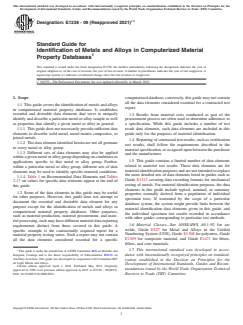
1.1 This guide covers the identification of metals and alloys in computerized material property databases. It establishes essential and desirable data elements that serve to uniquely identify and describe a particular metal or alloy sample as well as properties that identify a given metal or alloy in general.
1.1.1 This guide does not necessarily provide sufficient data elements to describe weld metal, metal matrix composites, or joined metals.
1.1.2 The data element identified herein are not all germane to every metal or alloy group.
1.1.3 Different sets of data elements may also be applied within a given metal or alloy group depending on conditions or applications specific to that metal or alloy group. Further, within a particular metal or alloy group, different sets of data elements may be used to identify specific material conditions.
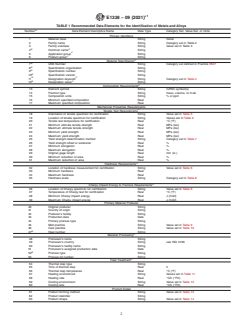
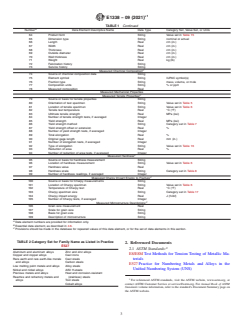
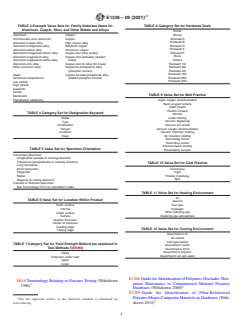
1.1.4 Table 1 on Recommended Data Elements and Tables 2-17 on values for specific data elements appear at the end of this guide.
1.2 Some of the data elements in this guide may be useful for other purposes. However, this guide does not attempt to document the essential and desirable data element for any purpose except for the identification of metals and alloys in computerized material property databases. Other purposes, such as material production, material procurement, and material processing, each may have different material data reporting requirements distinct from those covered in this guide. A specific example is the contractually required report for a material property testing series. Such a report may not contain all the data elements considered essential for a specific computerized database; conversely, this guide may not contain all the data elements considered essential for a contracted test report.
1.3 Results from material tests conducted as part of the procurement process are often used to determine adherence to a specification. While thi...
- Status
- Published
- Publication Date
- 31-Mar-2021
- Technical Committee
- B08 - Metallic and Inorganic Coatings
- Drafting Committee
- B08.01 - Ancillary Activities
Overview
ASTM E1338-09(2021)e1: Standard Guide for Identification of Metals and Alloys in Computerized Material Property Databases provides essential guidance for establishing and organizing data elements necessary for the unique identification and description of metals and alloys in digital material property systems. Developed by ASTM, this standard enables consistent, efficient, and meaningful storage, retrieval, and comparison of metals and alloys data across diverse computerized material databases.
The guide targets database designers, builders, and users who require a standardized approach for cataloging and retrieving detailed material property data. ASTM E1338-09(2021)e1 does not specify a particular logical or physical database format, allowing flexibility in database schema design while encouraging shared terminology, consistent data elements, and improved interoperability.
Key Topics
- Essential Data Elements: The standard outlines indispensable data elements for identifying metals and alloys, such as material class, family name, subdivision, common name, application group, and product group.
- Material Specifications: Includes fields for Unified Numbering System (UNS) numbers, specification organizations, specification numbers, versions, designation keywords, and designation values to ensure traceability and cross-reference.
- Chemical and Mechanical Properties: Recommends recording both specified and measured values for chemical composition (element symbol, composition units, min/max limits) and mechanical properties (tensile strength, hardness, elongation, impact energy, etc.).
- Producer and Processing Details: Captures data about the original producer, country of origin, facility, production date, primary process types, melt and cast practices, and heat numbers.
- Material Processing and Heat Treatment: Addresses documentation of secondary processing, including each processing step, processor details, dates, process types, lot numbers, heat treatment cycles, and pertinent parameters like temperature and environment.
- Product and Service Information: Calls for systematic recording of product forming methods, identifiers, shape, dimensions, weight, fabrication history, and service history.
- Measured Data and Microstructure: Facilitates the inclusion of both typical and sample-specific measured chemical and mechanical properties, as well as microstructure details such as grain size and description.
Applications
- Materials Databases: ASTM E1338-09(2021)e1 is fundamental in designing robust computerized material property databases for engineering, manufacturing, and research organizations. By following the guide, database developers ensure comprehensive and consistent identification of metals and alloys.
- Quality Assurance: Standardized data elements enable reliable comparison of materials from different producers and sources, supporting audit trails and traceability in quality management systems.
- Material Selection and Design: Engineers, designers, and procurement professionals rely on standardized identification to pull accurate data for material selection, design optimization, and regulatory compliance.
- Data Interchange: The standard promotes meaningful data exchange between organizations, laboratories, suppliers, and regulatory bodies by specifying consistent vocabularies and data types.
- Lifecycle Management: Companies managing assets with long service histories can use these guidelines for tracking fabrication, processing, usage, and maintenance records linked to specific metal lots or batches.
Related Standards
- ASTM E527: Practice for Numbering Metals and Alloys in the Unified Numbering System (UNS).
- ASTM E8/E8M: Test Methods for Tension Testing of Metallic Materials.
- ASTM E1313: Guide for Data Recording Formats for Mechanical Testing of Metals.
- ASTM E1308 & E1309: Guides for identification of polymers and fiber-reinforced composites in databases.
- ASTM E1471: Guide for Fibers, Fillers, and Core Materials in Computerized Material Property Databases.
- ANSI/AWS A9.1: Guide for Describing Arc Welds in Databases.
- ISO 3166: Codes for country names, useful for consistent location data.
Keywords: ASTM E1338, computerized material property databases, metal identification, alloy identification, standardized data elements, materials database design, UNS number, material specification, metals traceability, quality assurance, data exchange, material processing, heat treatment, materials lifecycle management.
Relations
- Effective Date
- 01-Jan-2024
- Effective Date
- 15-Jul-2016
- Effective Date
- 01-Feb-2015
- Effective Date
- 01-Apr-2014
- Effective Date
- 01-Jun-2013
- Effective Date
- 01-Dec-2011
- Effective Date
- 01-Aug-2011
- Effective Date
- 01-Nov-2008
- Effective Date
- 01-Oct-2005
- Effective Date
- 01-Mar-2004
- Effective Date
- 10-Apr-2003
- Effective Date
- 10-Mar-2000
- Effective Date
- 10-Oct-1998
- Effective Date
- 10-Mar-1997
Get Certified
Connect with accredited certification bodies for this standard

Element Materials Technology
Materials testing and product certification.

Inštitut za kovinske materiale in tehnologije
Institute of Metals and Technology. Materials testing, metallurgical analysis, NDT.
Sponsored listings
Frequently Asked Questions
ASTM E1338-09(2021)e1 is a guide published by ASTM International. Its full title is "Standard Guide for Identification of Metals and Alloys in Computerized Material Property Databases". This standard covers: SIGNIFICANCE AND USE 4.1 This guide describes the types of information that are indispensable for uniquely identifying a metal or alloy in a computerized database. The purpose is to facilitate standardized storage and retrieval of the information with a computer, and allow meaningful comparison of data from different sources. 4.2 Many numbering systems for metals and alloys have been developed which are based on their chemical compositions. Separate systems have also evolved to describe the thermomechanical condition of metals and alloys in order to narrow their description. It is the separation into logical data elements from these complex, historically significant, and overlapping systems of identification that is the challenge in the identification of metals and alloys within computerized databases. 4.3 This guide is intended to provide a common starting point for designers and builders of materials property databases. This guide generally identifies the contents of the database in terms of data elements, but does not recommend any particular logical or physical database design. A database builder has considerable flexibility in designing a database schema, and it is intended that this guide support that flexibility. 4.4 It is recognized that material property databases will be designed for different levels of material information and for different purposes. For example, a database developed by an industry trade group might only identify typical properties generally representative of those for a particular metal or alloy, and not actual values measured on a specific sample. On the other hand, a business might desire to manage data on specific lots it procures, or even properties of a specific piece or sample from a lot. Consequently, some of the data elements identified in this guide might not be applicable in every database instance. 4.5 The extent of material identification implemented in a particular database depends on its specific purpose. A single organization may i... SCOPE 1.1 This guide covers the identification of metals and alloys in computerized material property databases. It establishes essential and desirable data elements that serve to uniquely identify and describe a particular metal or alloy sample as well as properties that identify a given metal or alloy in general. 1.1.1 This guide does not necessarily provide sufficient data elements to describe weld metal, metal matrix composites, or joined metals. 1.1.2 The data element identified herein are not all germane to every metal or alloy group. 1.1.3 Different sets of data elements may also be applied within a given metal or alloy group depending on conditions or applications specific to that metal or alloy group. Further, within a particular metal or alloy group, different sets of data elements may be used to identify specific material conditions. 1.1.4 Table 1 on Recommended Data Elements and Tables 2-17 on values for specific data elements appear at the end of this guide. 1.2 Some of the data elements in this guide may be useful for other purposes. However, this guide does not attempt to document the essential and desirable data element for any purpose except for the identification of metals and alloys in computerized material property databases. Other purposes, such as material production, material procurement, and material processing, each may have different material data reporting requirements distinct from those covered in this guide. A specific example is the contractually required report for a material property testing series. Such a report may not contain all the data elements considered essential for a specific computerized database; conversely, this guide may not contain all the data elements considered essential for a contracted test report. 1.3 Results from material tests conducted as part of the procurement process are often used to determine adherence to a specification. While thi...
SIGNIFICANCE AND USE 4.1 This guide describes the types of information that are indispensable for uniquely identifying a metal or alloy in a computerized database. The purpose is to facilitate standardized storage and retrieval of the information with a computer, and allow meaningful comparison of data from different sources. 4.2 Many numbering systems for metals and alloys have been developed which are based on their chemical compositions. Separate systems have also evolved to describe the thermomechanical condition of metals and alloys in order to narrow their description. It is the separation into logical data elements from these complex, historically significant, and overlapping systems of identification that is the challenge in the identification of metals and alloys within computerized databases. 4.3 This guide is intended to provide a common starting point for designers and builders of materials property databases. This guide generally identifies the contents of the database in terms of data elements, but does not recommend any particular logical or physical database design. A database builder has considerable flexibility in designing a database schema, and it is intended that this guide support that flexibility. 4.4 It is recognized that material property databases will be designed for different levels of material information and for different purposes. For example, a database developed by an industry trade group might only identify typical properties generally representative of those for a particular metal or alloy, and not actual values measured on a specific sample. On the other hand, a business might desire to manage data on specific lots it procures, or even properties of a specific piece or sample from a lot. Consequently, some of the data elements identified in this guide might not be applicable in every database instance. 4.5 The extent of material identification implemented in a particular database depends on its specific purpose. A single organization may i... SCOPE 1.1 This guide covers the identification of metals and alloys in computerized material property databases. It establishes essential and desirable data elements that serve to uniquely identify and describe a particular metal or alloy sample as well as properties that identify a given metal or alloy in general. 1.1.1 This guide does not necessarily provide sufficient data elements to describe weld metal, metal matrix composites, or joined metals. 1.1.2 The data element identified herein are not all germane to every metal or alloy group. 1.1.3 Different sets of data elements may also be applied within a given metal or alloy group depending on conditions or applications specific to that metal or alloy group. Further, within a particular metal or alloy group, different sets of data elements may be used to identify specific material conditions. 1.1.4 Table 1 on Recommended Data Elements and Tables 2-17 on values for specific data elements appear at the end of this guide. 1.2 Some of the data elements in this guide may be useful for other purposes. However, this guide does not attempt to document the essential and desirable data element for any purpose except for the identification of metals and alloys in computerized material property databases. Other purposes, such as material production, material procurement, and material processing, each may have different material data reporting requirements distinct from those covered in this guide. A specific example is the contractually required report for a material property testing series. Such a report may not contain all the data elements considered essential for a specific computerized database; conversely, this guide may not contain all the data elements considered essential for a contracted test report. 1.3 Results from material tests conducted as part of the procurement process are often used to determine adherence to a specification. While thi...
ASTM E1338-09(2021)e1 is classified under the following ICS (International Classification for Standards) categories: 77.120.01 - Non-ferrous metals in general. The ICS classification helps identify the subject area and facilitates finding related standards.
ASTM E1338-09(2021)e1 has the following relationships with other standards: It is inter standard links to ASTM E8/E8M-24, ASTM E8/E8M-16, ASTM E8/E8M-15, ASTM E1471-92(2014), ASTM E8/E8M-13, ASTM E8/E8M-11, ASTM E1309-00(2011), ASTM E1471-92(2008), ASTM E1309-00(2005), ASTM E1471-92(2004), ASTM E527-83(2003), ASTM E1309-00, ASTM E1471-92(1998), ASTM E527-83(1997)e1. Understanding these relationships helps ensure you are using the most current and applicable version of the standard.
ASTM E1338-09(2021)e1 is available in PDF format for immediate download after purchase. The document can be added to your cart and obtained through the secure checkout process. Digital delivery ensures instant access to the complete standard document.
Standards Content (Sample)
This international standard was developed in accordance with internationally recognized principles on standardization established in the Decision on Principles for the
Development of International Standards, Guides and Recommendations issued by the World Trade Organization Technical Barriers to Trade (TBT) Committee.
´1
Designation:E1338 −09 (Reapproved 2021)
Standard Guide for
Identification of Metals and Alloys in Computerized Material
Property Databases
This standard is issued under the fixed designation E1338; the number immediately following the designation indicates the year of
original adoption or, in the case of revision, the year of last revision. A number in parentheses indicates the year of last reapproval. A
superscript epsilon (´) indicates an editorial change since the last revision or reapproval.
ε NOTE—The Referenced Documents list was updated editorially in March 2022.
1. Scope computerized database; conversely, this guide may not contain
all the data elements considered essential for a contracted test
1.1 This guide covers the identification of metals and alloys
report.
in computerized material property databases. It establishes
essential and desirable data elements that serve to uniquely
1.3 Results from material tests conducted as part of the
identify and describe a particular metal or alloy sample as well procurement process are often used to determine adherence to
as properties that identify a given metal or alloy in general. a specification. While this guide includes a number of test
1.1.1 This guide does not necessarily provide sufficient data result data elements, such data elements are included in this
elements to describe weld metal, metal matrix composites, or guide only for the purposes of material identification.
joined metals.
1.4 Reporting of contracted test results, such as certification
1.1.2 The data element identified herein are not all germane
test results, shall follow the requirements described in the
to every metal or alloy group.
materialspecification,orasagreeduponbetweenthepurchaser
1.1.3 Different sets of data elements may also be applied
and the manufacturer.
withinagivenmetaloralloygroupdependingonconditionsor
1.5 This guide contains a limited number of data elements
applications specific to that metal or alloy group. Further,
related to material test results. These data elements are for
within a particular metal or alloy group, different sets of data
material identification purposes and are not intended to replace
elements may be used to identify specific material conditions.
the more detailed sets of data elements listed in guides such as
1.1.4 Table 1 on Recommended Data Elements and Tables
Guide E1313 covering data recording formats for mechanical
2-17 on values for specific data elements appear at the end of
testing of metals. For material identification purposes, the data
this guide.
elements in this guide include typical, nominal, or summary
1.2 Some of the data elements in this guide may be useful
properties normally derived from a population of individual
for other purposes. However, this guide does not attempt to
specimen tests. If warranted by the scope of a particular
document the essential and desirable data element for any
database system, the system might provide links between the
purpose except for the identification of metals and alloys in
material identification data elements given in this guide, and
computerized material property databases. Other purposes,
the individual specimen test results recorded in accordance
such as material production, material procurement, and mate-
with other guides corresponding to particular test methods.
rialprocessing,eachmayhavedifferentmaterialdatareporting
1.6 Material Classes—See ANSI/AWS A9.1-92 for arc
requirements distinct from those covered in this guide. A
welds, Guide E527 for Metal and Alloys in the Unified
specific example is the contractually required report for a
Numbering System (UNS), Guide E1308 for polymers, Guide
material property testing series. Such a report may not contain
E1309 for composite material, and Guide E1471 for fibers,
all the data elements considered essential for a specific
fillers, and core materials.
1.7 This international standard was developed in accor-
This guide is under the jurisdiction ofASTM Committee B08 on Metallic and
dance with internationally recognized principles on standard-
Inorganic Coatings and is the direct responsibility of Subcommittee B08.01 on
AncillaryActivities. This guide was developed in cooperation with Committee B07
ization established in the Decision on Principles for the
on Light Metals and Alloys.
Development of International Standards, Guides and Recom-
Current edition approved April 1, 2021. Published May 2021. Originally
mendations issued by the World Trade Organization Technical
approved in 1990. Last previous edition approved in 2015 as E1338 – 09(2015).
DOI: 10.1520/E1338-09R21E01. Barriers to Trade (TBT) Committee.
Copyright © ASTM International, 100 Barr Harbor Drive, PO Box C700, West Conshohocken, PA 19428-2959. United States
´1
E1338−09 (2021)
TABLE 1 Recommended Data Elements for the Identification of Metals and Alloys
A
Number Data Element Descriptive Name Data Type Category Set, Value Set, or Units
Primary Identifiers
1 Material class String metal
2 Family name String Category set in Table 2
3 Family subclass String Value set in Table 3
B C
4 Common name String
C
5 Application group String
C
6 Product group String
C
Material Specification
B
7 UNS Number String Category set defined in Practice E527
B
8 Specification organization String
B
9 Specification number String
B
10 Specification version String
B C
11 Designation keyword String Category set in Table 4
B C
12 Designation value String
C
Composition Requirements
13 Element symbol String IUPAC symbol(s)
14 Fraction type String mass, volume, or mole
15 Composition units String % or ppm
16 Minimum specified composition Real
17 Maximum specified composition Real
Mechanical Properties Requirements
C
Tensile Test Requirements
18 Orientation of tensile specimen for certification String Value set in Table 5
19 Location of tensile specimen for certification String Values set in Table 6
20 Tensile test temperature for certification Real °C (°F)
21 Minimum ultimate tensile strength Real MPa (ksi)
22 Maximum ultimate tensile strength Real MPa (ksi)
23 Minimum yield strength Real MPa (ksi)
24 Maximum yield strength Real MPa (ksi)
25 Yield strength determination method String Category set in Table 7
26 Yield strength offset or extension Real %
27 Minimum elongation Real %
28 Maximum elongation Real %
29 Original gage length Real mm (in.)
30 Minimum reduction of area Real %
31 Maximum reduction of area Real %
C
Hardness Requirements
32 Location of hardness measurement for certification String Value set in Table 6
33 Minimum hardness Real
34 Maximum hardness Real
35 Hardness scale String Category set in Table 8
C
Charpy Impact Energy to Fracture Requirements
36 Location of Charpy specimen for certification String Value set in Table 6
37 Temperature of Charpy test for certification Real °C (°F)
38 Minimum Charpy impact energy Real J (ft-lbf)
39 Maximum Charpy impact energy Real J (ft-lbf)
Primary Material Producer
40 Original producer String
41 Country of origin String
42 Producer’s facility String
43 Production date Date
44 Primary process type String
45 Melt practice String Value set in Table 9
46 Cast practice String Value set in Table 10
B
47 Heat number String
C
Material Processing
48 Processor’s name String
49 Processor’s country String see ISO 3166
50 Processor’s facility name String
51 Processor’s assigned production date Date
B
52 Process type String
53 Process lot number String
C
Heat Treatment
54 Thermal step type String
55 Time of thermal step Real h
56 Thermal step temperature Real °C (°F)
57 Heating environment String Values set in Table 11
58 Heating rate Real °C/h (°F/h)
59 Cooling environment String Value set in Table 12
60 Cooling rate Real °C/h (°F/h)
Product Detail
61 Product forming method String Value set in Table 13
62 Product identifier String
63 Product shape String Value set in Table 14
´1
E1338−09 (2021)
TABLE1 Continued
A
Number Data Element Descriptive Name Data Type Category Set, Value Set, or Units
64 Product form String Value set in Table 15
65 Dimension type String nominal or actual
66 Length Real cm (in.)
67 Width Real cm (in.)
68 Thickness Real cm (in.)
69 Outside diameter Real cm (in.)
70 Wall thickness Real cm (in.)
71 Weight Real kg (lb)
72 Fabrication history String
73 Service history String
C
Measured Chemical Composition
74 Source of chemical composition data String
75 Element symbol String IUPAC symbol(s)
76 Fraction type String mass, volume, or mole
77 Composition units String % or ppm
78 Measured composition Real
Measured Mechanical Properties
C
Measured Tensile Properties
79 Source or basis for tensile properties String
80 Orientation of test specimen String Value set in Table 5
81 Location of tensile specimen String Value set in Table 6
82 Tensile test temperature Real °C (°F)
83 Ultimate tensile strength Real MPa (ksi)
84 Number of tensile strength tests, if averaged Integer
85 Yield strength Real MPa (ksi)
86 Yield strength method String Category set in Table 7
87 Yield strength offset or extension Real %
88 Number of yield strength tests, if averaged Integer
89 Total elongation Real %
90 Original gage length Real mm (in.)
91 Number of elongation tests, if averaged Integer
92 Type of elongation String Value set in Table 16
93 Reduction of area Real %
94 Number of reduction of area tests, if averaged Integer
C
Measured Hardness
95 Source or basis for hardness measurement String
96 Location of hardness measurement String Value set in Table 6
97 Hardness value Real
98 Hardness scale String Category set in Table 8
99 Number of hardness readings, if averaged Integer
C
Measured Charpy Impact Energy to Fracture
100 Source or basis for Charpy measurements String
101 Location of Charpy specimen String Value set in Table 6
102 Temperature of Charpy test Real °C (°F)
103 Charpy specimen size String Category set in Table 17
104 Charpy impact energy Real J (ft-lbf)
105 Number of Charpy tests, if averaged Integer
C
Measured Microstructure Descriptions
106 Grain size measurement Real
107 Scale for grain size String
108 Basis for grain size String
109 Description of microstructure String
A
Data element numbers are provided for information only.
B
Essential data element, as described in 4.6.
C
Provisions should be made in the database for repeated values of this data element, or for the set of data elements in this section.
TABLE 2 Category Set for Family Name as Listed in Practice
2. Referenced Documents
E527
2.1 ASTM Standards:
Aluminum and aluminum alloys Zinc and zinc alloys
E8/E8M Test Methods for Tension Testing of Metallic Ma-
Copper and copper alloys Cast irons
Rare earth and rare earth-like metals Cast steels
terials
and alloys Carbon steels
E527 Practice for Numbering Metals and Alloys in the
Low melting point metals and alloys Alloy steels
Unified Numbering System (UNS)
Nickel and nickel alloys AISI H-steels
Precious metals and alloys Heat and corrosion-resistant
Reactive and refractory metals and (stainless) steels
For referenced ASTM standards, visit the ASTM website, www.astm.org, or
alloys Tool steels
Cobalt alloys contact ASTM Customer Service at service@astm.org. For Annual Book of ASTM
Standards volume information, refer to the standard’s Document Summary page on
the ASTM website.
´1
E1338−09 (2021)
TABLE 3 Example Value Sets for Family Subclass Name for TABLE 8 Category Set for Hardness Scale
Aluminum, Copper, Steel, and Other Metals and Alloys
Brinell
Knoop
Aluminum: Copper:
Rockwell A
Commercially pure aluminum Copper
Rockwell B
Aluminum-copper alloy High copper alloy
Rockwell C
Aluminum-manganese alloy Beryllium copper
Rockwell E
Aluminum-silicon alloy Chromium copper
Rockwell F
Aluminum-manganese-silicon alloy Copper-zinc alloy (brass)
Shore
Aluminum-magnesium alloy Copper-zinc-lead-alloy (leaded
Vickers
Aluminum-magnesium-silicon alloy brass)
Rockwell 15t
Aluminum-zinc alloy Copper-zinc-tin alloy (tin brass)
Rockwell 30t
Other aluminum alloy Copper-tin-phosphorus alloy
Rockwell 45t
(phosphor bronze)
Steel: Copper-tin-lead-phosphorus alloy Rockwell 15N
Rockwell 30N
Chromium-molybdenum (leaded phosphor bronze)
Rockwell 45N
Low carbon
High carbon
Austenitic
Ferritic
TABLE 9 Value Set for Melt Practice
Martensitic
Precipitation hardening
Argon oxygen decarburization
Basic oxygen furnace
Open hearth
Electric furnace
TABLE 4 Category Set for Designation Keyword
Remelt
Ladle refining
Grade
Vacuum degassing
Type
Vacuum arc remelt
Composition
Vacuum oxygen decarburization
Temper
Vacuum induction melting
Condition
Air induction melting
Class
Electroslag remelt
Electroflux remelt
Electron beam melting
TABLE 5 Value Set for Specimen Orientation
Reverbatory furnace
Unnotched Specimen:
Longitudinal (parallel to working direction)
Transverse (perpendicular to working direction)
TABLE 10 Value Set for Cast Practice
Long transverse
Continuous
Short transverse
Ingot
Tangenital
Powder metallurgy
Radial
Spin
Diagonal (to rolling direction)
Cracked or Notched Specimen:
See Terminology E616 for orientation codes
TABLE 11 Value Set for Heating Environment
Air
TABLE 6 Value Set for Location Within Product
Vacuum
Inert gas
Outer surface
Internal Hydrogen
Other reducing gas
Inside surface
Oxidizing gas atmosphere
Surface
Quarter thickness
Center of thickness
Leading edge
TABLE 12 Value Set for Cooling Environment
Trailing edge
Quenched in oil
Air-cooled
Inert gas-cooled
TABLE 7 Category Set for Yield Strength Method (as explained in
Quenched in water
Test Methods E8/E8M)
Quenched in brine
Quenched in polymer
Offset
Quenched in air and water
Extension under load
Upper
Lower
E1308 Guide for Identification of Polymers (Excludes Ther-
E616 Terminology Relating to Fracture Testing (Withdrawn
moset Elastomers) in Computerized Material Property
1996)
Databases (Withdrawn 2000)
E1309 Guide for Identification of Fiber-Reinforced
Polymer-Matrix Composite Materials in Databases (With-
The last approved version of this historical standard is referenced on
www.astm.org. drawn 2015)
´1
E1338−09 (2021)
TABLE 13 Value Set for Forming Method
ANSI/AWS A9.1-92 Standard Guide for Describing Arc
Forging Welds in Computerized Material Property and Nonde-
Casting
structive Examination Databases
Extrusion
Hot rolling
3. Terminology
Cold rolling
Powder compaction
3.1 Computer-related technical terms in this guide are
Drawing/coining
defined in Terminology E1443.
Bending
4. Significance and Use
TABLE 14 Value Set for Product Shape
4.1 This guide describes the types of information that are
Flat indispensable for uniquely identifying a metal or alloy in a
Round
computerized database. The purpose is to facilitate standard-
Hexagonal
ized storage and retrieval of the information with a computer,
Square
Structural and allow meaningful comparison of data from different
Irregular
sources.
Profile
4.2 Many numbering systems for metals and alloys have
been developed which are based on their chemical composi-
TABLE 15 Value Set for Product Form
tions. Separate systems have also evolved to describe the
Bar Rod thermomechanical condition of metals and alloys in order to
Block Sheet
narrow their description. It is the separation into logical data
Pipe Shift
elements from these complex, historically significant, and
Plate Strip
Powder Tube overlapping systems of identification that is the challenge in
Ring Wire
the identification of metals and alloys within computerized
Extruded profile
databases.
4.3 This guide is intended to provide a common starting
TABLE 16 Value Set for Type of Elongation as Explained in Test
point for designers and builders of materials property data-
Methods E8/E8M
bases. This guide generally identifies the contents of the
After fracture
database in terms of data elements, but does not recommend
At fracture
any particular logical or physical database design. A database
builder has considerable flexibility in designing a database
schema, and it is intended that this guide support that flexibil-
TABLE 17 Category Set for Charpy Specimen Size
ity.
Full
One half 4.4 It is recognized that material property databases will be
One quarter
designed for different levels of material information and for
One eighth
different purposes. For example, a database developed by an
industry trade group might only identify typical properties
generally representative of those for a particular metal or alloy,
and not actual values measured on a specific sample. On the
other hand, a business might desire to manage data on specific
E1313 Guide for Recommended Formats for Data Records
lots it procures, or even properties of a specific piece or sample
Used in Computerization of Mechanical Test Data for
3 from a lot. Consequently, some of the data elements identified
Metals (Withdrawn 2000)
in this guide might not be applicable in every database
E1443 Terminology Relating to Building and Accessing
3 instance.
Material and Chemical Databases (Withdrawn 2000)
E1471 Guide for Identification of Fibers, Fillers, and Core 4.5 The extent of material identification implemented in a
Materials in Computerized Material Property Databases particular database depends on its specific purpose. A single
(Withdrawn 2015) organizationmayincludesubstantialdetailinitsdatabase.Less
IEEE/ASTM SI 10 American National Standard for Metric detail may be included in a common database used by several
Practice organizations because of commercial and other considerations.
Since metals and alloys are diverse and the technologies are
2.2 Other Standards:
always changing, recommendations should not be regarded as
ISO Standard: 3166 Codes for Representation of Names of
exclusive of additional data elements for material identifica-
Countries Quantities, Units and Symbols in Physical
tion. The recommended data elements should be expanded if
Chemistry—IUPAC
additional detailed information which serves to identify mate-
rials is to be recorded.
Available from International Organization for Standardization (ISO), 1, ch. de
la Voie-Creuse, Case postale 56, CH-1211, Geneva 20, Switzerland, http:// Available fromAmerican National Standards Institute (ANSI), 25 W. 43rd St.,
www.iso.ch. 4th Floor, New York, NY 10036, http://www.ansi.org.
´1
E1338−09 (2021)
4.6 A number of data elements are considered essential to which the numbers are expressed. Candidate values for both
any database and need to exist in the database. Data elements category and value sets are frequently given in separate tables
are considered essential if they are required for users to have in this guide. The database implementation should provide
sufficient information to interpret the data and be confident of some means of maintaining these lists of allowable values and
their ability to compare sets of data for materials from different presenting them to the database user. The distinction between
sources. Failure to complete an essential data element may categoryandvaluesetsidentifiedbelowprimarilyrelatestothe
render the record unusable in a database or in data exchange. degree of control over additions to these lists of values.
Essentialreferstothequalityorcompletenessofrecordeddata,
5.1.4.1 A category set is a closed set listing all possible (or
and does not necessarily have direct meaning relative to
acceptable) values the data element may take. Because this
database structure. In some cases, the identified data element
guide is intended to apply to databases with different scopes
might be accommodated within a particular database without
and purposes, values listed in sample tables in this guide are
explicitly including a field just for the essential data element.
generally not identified as category sets, but it may be
Additionally, a database schema may require additional data
appropriate to treat them as such in a particular database
fields to be not null to maintain data record integrity or to
application. The database application should control or restrict
implement a mandatory data relationship. These additional
the addition of a new value to a category set.
fields are beyond the scope of this guide. Finally, it is also
5.1.4.2 Avalue set is a representative set listing sample, but
noted that a data element identified as essential in this guide
notnecessarilyallacceptablevaluesthedataelementmaytake.
might not be relevant for a database created for a specific
In this case, the database applica
...