

ASTM E426-16(2021)
(Practice)Standard Practice for Electromagnetic (Eddy Current) Examination of Seamless and Welded Tubular Products, Titanium, Austenitic Stainless Steel and Similar Alloys
General Information
- Abstract
SIGNIFICANCE AND USE
5.1 Eddy current testing is a nondestructive method of locating discontinuities in a product. Changes in electromagnetic response caused by the presence of discontinuities are detected by the sensor, amplified and modified in order to actuate audio or visual indicating devices, or both, or a mechanical marker. Signals can be caused by outer surface, inner surface, or subsurface discontinuities. The eddy current examination is sensitive to many factors that occur as a result of processing (such as variations in conductivity, chemical composition, permeability, and geometry) as well as other factors not related to the tubing. Thus, all received indications are not necessarily indicative of defective tubing.
SCOPE
1.1 This practice2 covers procedures for eddy current examination of seamless and welded tubular products made of relatively low conductivity materials such as titanium, stainless steel, and similar alloys, such as nickel alloys. Austenitic chromium-nickel stainless steels, which are generally considered to be nonmagnetic, are specifically covered as distinguished from the martensitic and ferritic straight chromium stainless steels which are magnetic.
1.2 This practice is intended as a guide for eddy current examination of both seamless and welded tubular products using either an encircling coil or a probe-coil technique. Coils and probes are available that can be used inside the tubular product; however, their use is not specifically covered in this document. This type of examination is usually employed only to examine tubing which has been installed such as in a heat exchanger.
1.3 This practice covers the examination of tubular products ranging in diameter from 0.125 to 5 in. (3.2 to 127.0 mm) and wall thicknesses from 0.005 to 0.250 in. (0.127 to 6.4 mm).
1.4 For examination of aluminum alloy tubular products, see standard Practice E215.
1.5 Units—The values stated in inch-pound units are to be regarded as standard. The values given in parentheses are mathematical conversions to SI units that are provided for information only and are not considered standard.
1.6 This standard does not purport to address all of the safety concerns, if any, associated with its use. It is the responsibility of the user of this standard to establish appropriate safety, health, and environmental practices and determine the applicability of regulatory limitations prior to use.
1.7 This international standard was developed in accordance with internationally recognized principles on standardization established in the Decision on Principles for the Development of International Standards, Guides and Recommendations issued by the World Trade Organization Technical Barriers to Trade (TBT) Committee.
- Status
- Published
- Publication Date
- 31-May-2021
- Technical Committee
- E07 - Nondestructive Testing
- Drafting Committee
- E07.07 - Electromagnetic Method

Overview
ASTM E426-16(2021) is the globally recognized standard practice developed by ASTM International for conducting electromagnetic (eddy current) examinations on both seamless and welded tubular products composed of titanium, austenitic stainless steel, and similar low-conductivity alloys, including nickel alloys. This practice applies to nonmagnetic austenitic chromium-nickel stainless steels and establishes procedures for identifying material discontinuities-such as outer surface, inner surface, and subsurface flaws-in tubular products. With a focus on ensuring safety, product quality, and reliability, ASTM E426-16(2021) is essential for industries requiring high integrity in tubular components.
Key Topics
- Scope of Examination: Covers procedures for eddy current testing of tubular products ranging in diameter from 0.125 to 5 inches (3.2 to 127 mm) and wall thickness from 0.005 to 0.250 inches (0.127 to 6.4 mm).
- Applicable Materials: Titanium, austenitic stainless steel, and similar alloys characterized by relatively low electrical conductivity.
- Techniques Covered:
- Encircling Coil Technique: The tube passes through coils to enable full 360-degree examination for discontinuities.
- Probe-Coil Technique: A small probe examines a localized area; suitable for areas like welds or installed tubing.
- Discontinuity Detection: Detects changes in electromagnetic response related to flaws such as cracks, inclusions, or processing anomalies.
- Factors Affecting Sensitivity:
- Material properties (conductivity, composition, permeability, geometry)
- Processing effects, especially in welded or cold-worked zones
- Calibration and Reference Standards:
- Requires reference standards of the same alloy, size, and condition
- Utilizes artificial discontinuities (holes or notches) for standardization
Applications
The procedures and requirements of ASTM E426-16(2021) are widely adopted in sectors where the integrity of tubular products is critical:
- Power Generation: Inspection of heat exchanger and boiler tubes to prevent in-service failures.
- Aerospace and Aviation: Examination of lightweight, high-reliability tubing, where undetected material flaws could have severe consequences.
- Petrochemical Industry: Productivity assurance in pipelines and process tubing made from titanium or stainless steel.
- Manufacturing Quality Control: Routine non-destructive testing (NDT) during and after production to detect surface or subsurface defects in various alloy tubes.
- Weld Integrity Assessment: Focused examination of welded seams in tubular products, distinguishing between weld metal and base metal response.
Eddy current examination as per ASTM E426-16(2021) is valued for its ability to provide a nondestructive, fast, and repeatable method for quality assurance, making it integral to preventive maintenance and safety programs.
Related Standards
Several key standards are referenced or related to ASTM E426-16(2021) for eddy current and broader nondestructive testing (NDT):
- ASTM E215: Practice for Standardizing Equipment and Electromagnetic Examination of Seamless Aluminum-Alloy Tubes.
- ASTM E543: Specification for Agencies Performing Nondestructive Testing.
- ASTM E1316: Terminology for Nondestructive Examinations.
- ASNT SNT-TC-1A: Recommended Practice for Personnel Qualification and Certification in Nondestructive Testing.
- ANSI/ASNT CP-189: Standard for Qualification and Certification of NDT Personnel.
- ISO 9712: Certification and Qualification of NDT Personnel.
- NAS-410: Certification and Qualification of Nondestructive Testing Personnel in the aerospace sector.
Practical Value
Implementing ASTM E426-16(2021) assures manufacturers, suppliers, and end-users of a consistently high level of quality and safety in tubular products made from critical alloys. It standardizes the methodology for flaw detection, supports regulatory compliance, and reduces the risk of failure in service by identifying potential defects early in the production or service life of tubular products. This assurance is vital for industries where nondestructive eddy current testing directly impacts operational safety, reliability, and compliance with international trade and manufacturing standards.
Relations
- Effective Date
- 01-Feb-2024
- Effective Date
- 01-Dec-2019
- Effective Date
- 01-Mar-2019
- Effective Date
- 01-Jan-2018
- Effective Date
- 15-Jun-2017
- Effective Date
- 01-Feb-2017
- Effective Date
- 01-Aug-2016
- Effective Date
- 01-Feb-2016
- Effective Date
- 01-Dec-2015
- Effective Date
- 01-Sep-2015
- Effective Date
- 01-Jun-2014
- Effective Date
- 01-Jun-2014
- Effective Date
- 01-Dec-2013
- Effective Date
- 15-Jun-2013
- Effective Date
- 01-Jun-2013
Get Certified
Connect with accredited certification bodies for this standard

Institut za varilstvo d.o.o. (Welding Institute)
Slovenia's leading welding institute since 1952. ISO 3834, EN 1090, pressure equipment certification, NDT personnel, welder qualification. Only IIW Au
Sponsored listings
Frequently Asked Questions
ASTM E426-16(2021) is a standard published by ASTM International. Its full title is "Standard Practice for Electromagnetic (Eddy Current) Examination of Seamless and Welded Tubular Products, Titanium, Austenitic Stainless Steel and Similar Alloys". This standard covers: SIGNIFICANCE AND USE 5.1 Eddy current testing is a nondestructive method of locating discontinuities in a product. Changes in electromagnetic response caused by the presence of discontinuities are detected by the sensor, amplified and modified in order to actuate audio or visual indicating devices, or both, or a mechanical marker. Signals can be caused by outer surface, inner surface, or subsurface discontinuities. The eddy current examination is sensitive to many factors that occur as a result of processing (such as variations in conductivity, chemical composition, permeability, and geometry) as well as other factors not related to the tubing. Thus, all received indications are not necessarily indicative of defective tubing. SCOPE 1.1 This practice2 covers procedures for eddy current examination of seamless and welded tubular products made of relatively low conductivity materials such as titanium, stainless steel, and similar alloys, such as nickel alloys. Austenitic chromium-nickel stainless steels, which are generally considered to be nonmagnetic, are specifically covered as distinguished from the martensitic and ferritic straight chromium stainless steels which are magnetic. 1.2 This practice is intended as a guide for eddy current examination of both seamless and welded tubular products using either an encircling coil or a probe-coil technique. Coils and probes are available that can be used inside the tubular product; however, their use is not specifically covered in this document. This type of examination is usually employed only to examine tubing which has been installed such as in a heat exchanger. 1.3 This practice covers the examination of tubular products ranging in diameter from 0.125 to 5 in. (3.2 to 127.0 mm) and wall thicknesses from 0.005 to 0.250 in. (0.127 to 6.4 mm). 1.4 For examination of aluminum alloy tubular products, see standard Practice E215. 1.5 Units—The values stated in inch-pound units are to be regarded as standard. The values given in parentheses are mathematical conversions to SI units that are provided for information only and are not considered standard. 1.6 This standard does not purport to address all of the safety concerns, if any, associated with its use. It is the responsibility of the user of this standard to establish appropriate safety, health, and environmental practices and determine the applicability of regulatory limitations prior to use. 1.7 This international standard was developed in accordance with internationally recognized principles on standardization established in the Decision on Principles for the Development of International Standards, Guides and Recommendations issued by the World Trade Organization Technical Barriers to Trade (TBT) Committee.
SIGNIFICANCE AND USE 5.1 Eddy current testing is a nondestructive method of locating discontinuities in a product. Changes in electromagnetic response caused by the presence of discontinuities are detected by the sensor, amplified and modified in order to actuate audio or visual indicating devices, or both, or a mechanical marker. Signals can be caused by outer surface, inner surface, or subsurface discontinuities. The eddy current examination is sensitive to many factors that occur as a result of processing (such as variations in conductivity, chemical composition, permeability, and geometry) as well as other factors not related to the tubing. Thus, all received indications are not necessarily indicative of defective tubing. SCOPE 1.1 This practice2 covers procedures for eddy current examination of seamless and welded tubular products made of relatively low conductivity materials such as titanium, stainless steel, and similar alloys, such as nickel alloys. Austenitic chromium-nickel stainless steels, which are generally considered to be nonmagnetic, are specifically covered as distinguished from the martensitic and ferritic straight chromium stainless steels which are magnetic. 1.2 This practice is intended as a guide for eddy current examination of both seamless and welded tubular products using either an encircling coil or a probe-coil technique. Coils and probes are available that can be used inside the tubular product; however, their use is not specifically covered in this document. This type of examination is usually employed only to examine tubing which has been installed such as in a heat exchanger. 1.3 This practice covers the examination of tubular products ranging in diameter from 0.125 to 5 in. (3.2 to 127.0 mm) and wall thicknesses from 0.005 to 0.250 in. (0.127 to 6.4 mm). 1.4 For examination of aluminum alloy tubular products, see standard Practice E215. 1.5 Units—The values stated in inch-pound units are to be regarded as standard. The values given in parentheses are mathematical conversions to SI units that are provided for information only and are not considered standard. 1.6 This standard does not purport to address all of the safety concerns, if any, associated with its use. It is the responsibility of the user of this standard to establish appropriate safety, health, and environmental practices and determine the applicability of regulatory limitations prior to use. 1.7 This international standard was developed in accordance with internationally recognized principles on standardization established in the Decision on Principles for the Development of International Standards, Guides and Recommendations issued by the World Trade Organization Technical Barriers to Trade (TBT) Committee.
ASTM E426-16(2021) is classified under the following ICS (International Classification for Standards) categories: 23.040.10 - Iron and steel pipes. The ICS classification helps identify the subject area and facilitates finding related standards.
ASTM E426-16(2021) has the following relationships with other standards: It is inter standard links to ASTM E1316-24, ASTM E1316-19b, ASTM E1316-19, ASTM E1316-18, ASTM E1316-17a, ASTM E1316-17, ASTM E1316-16a, ASTM E1316-16, ASTM E1316-15a, ASTM E1316-15, ASTM E1316-14, ASTM E1316-14e1, ASTM E1316-13d, ASTM E1316-13c, ASTM E1316-13b. Understanding these relationships helps ensure you are using the most current and applicable version of the standard.
ASTM E426-16(2021) is available in PDF format for immediate download after purchase. The document can be added to your cart and obtained through the secure checkout process. Digital delivery ensures instant access to the complete standard document.
Standards Content (Sample)
This international standard was developed in accordance with internationally recognized principles on standardization established in the Decision on Principles for the
Development of International Standards, Guides and Recommendations issued by the World Trade Organization Technical Barriers to Trade (TBT) Committee.
Designation: E426 − 16 (Reapproved 2021)
Standard Practice for
Electromagnetic (Eddy Current) Examination of Seamless
and Welded Tubular Products, Titanium, Austenitic Stainless
Steel and Similar Alloys
This standard is issued under the fixed designation E426; the number immediately following the designation indicates the year of
original adoption or, in the case of revision, the year of last revision. A number in parentheses indicates the year of last reapproval. A
superscript epsilon (´) indicates an editorial change since the last revision or reapproval.
This standard has been approved for use by agencies of the U.S. Department of Defense.
1. Scope* priate safety, health, and environmental practices and deter-
mine the applicability of regulatory limitations prior to use.
1.1 This practice covers procedures for eddy current ex-
1.7 This international standard was developed in accor-
amination of seamless and welded tubular products made of
dance with internationally recognized principles on standard-
relativelylowconductivitymaterialssuchastitanium,stainless
ization established in the Decision on Principles for the
steel, and similar alloys, such as nickel alloys. Austenitic
Development of International Standards, Guides and Recom-
chromium-nickel stainless steels, which are generally consid-
mendations issued by the World Trade Organization Technical
ered to be nonmagnetic, are specifically covered as distin-
Barriers to Trade (TBT) Committee.
guished from the martensitic and ferritic straight chromium
stainless steels which are magnetic.
2. Referenced Documents
1.2 This practice is intended as a guide for eddy current 2.1 ASTM Standards:
examination of both seamless and welded tubular products E215 PracticeforStandardizingEquipmentandElectromag-
using either an encircling coil or a probe-coil technique. Coils netic Examination of Seamless Aluminum-Alloy Tube
and probes are available that can be used inside the tubular E543 Specification for Agencies Performing Nondestructive
product; however, their use is not specifically covered in this
Testing
document. This type of examination is usually employed only E1316 Terminology for Nondestructive Examinations
to examine tubing which has been installed such as in a heat 2.2 Other Documents:
exchanger. SNT-TC-1A Recommended Practice for Personnel Qualifi-
cation and Certification in Nondestructive Testing
1.3 This practice covers the examination of tubular products
ANSI/ASNT CP-189 ASNT Standard for Qualification and
ranging in diameter from 0.125 to 5 in. (3.2 to 127.0 mm) and
Certification of Nondestructive Testing Personnel
wall thicknesses from 0.005 to 0.250 in. (0.127 to 6.4 mm).
NAS-410 NAS Certification and Qualification of Nonde-
1.4 For examination of aluminum alloy tubular products,
structive Personnel (Quality Assurance Committee)
see standard Practice E215.
ISO 9712 Non-Destructive Testing—Certification and
Qualification of NDT Personnel
1.5 Units—The values stated in inch-pound units are to be
regarded as standard. The values given in parentheses are
3. Terminology
mathematical conversions to SI units that are provided for
3.1 Standardterminologyrelatingtoelectromagnetictesting
information only and are not considered standard.
may be found in Terminology E1316, Section C, Electromag-
1.6 This standard does not purport to address all of the
netic Testing.
safety concerns, if any, associated with its use. It is the
responsibility of the user of this standard to establish appro-
For referenced ASTM standards, visit the ASTM website, www.astm.org, or
contact ASTM Customer Service at service@astm.org. For Annual Book of ASTM
Standards volume information, refer to the standard’s Document Summary page on
the ASTM website.
1 4
This practice is under the jurisdiction of ASTM Committee E07 on Nonde- AvailablefromAmericanSocietyforNondestructiveTesting(ASNT),P.O.Box
structive Testing and is the direct responsibility of Subcommittee E07.07 on 28518, 1711 Arlingate Ln., Columbus, OH 43228-0518, http://www.asnt.org.
Electromagnetic Method. Available fromAerospace IndustriesAssociation ofAmerica, Inc. (AIA), 1000
Current edition approved June 1, 2021. Published June 2021. Originally WilsonBlvd.,Suite1700,Arlington,VA22209-3928,http://www.aia-aerospace.org.
approved in 1971. Last previous edition approved in 2016 as E426 – 16. DOI:
10.1520/E0426-16R21. Available from International Organization for Standardization (ISO), ISO
For ASME Boiler and Pressure Vessel Code applications see related Practice Central Secretariat, BIBC II, Chemin de Blandonnet 8, CP 401, 1214 Vernier,
SE-426 in Section II of that Code. Geneva, Switzerland, http://www.iso.org.
*A Summary of Changes section appears at the end of this standard
Copyright © ASTM International, 100 Barr Harbor Drive, PO Box C700, West Conshohocken, PA 19428-2959. United States
E426 − 16 (2021)
4. Summary of Practice products frequently only the weld is examined by scanning
along the weld zone. In the case where the tubular products are
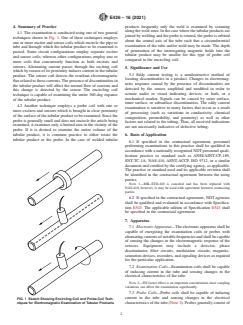
4.1 The examination is conducted using one of two general
joined by welding and the probe is rotated, the probe is orbited
techniques shown in Fig. 1. One of these techniques employs
about the central axis of the tube such that a circumferential
one or more exciter and sensor coils which encircle the pipe or
examination of the tube and/or weld may be made. The depth
tube and through which the tubular product to be examined is
of penetration of the interrogating magnetic fields into the
passed. Some circuit configurations employ separate exciter
tubular product may be smaller for this type of probe coil
and sensor coils; whereas other configurations employ one or
compared to the encircling coil.
more coils that concurrently function as both exciters and
sensors. Alternating current passes through the exciting coil
5. Significance and Use
which by reason of its proximity induces current in the tubular
5.1 Eddy current testing is a nondestructive method of
product. The sensor coil detects the resultant electromagnetic
locating discontinuities in a product. Changes in electromag-
flux related to these currents.The presence of discontinuities in
netic response caused by the presence of discontinuities are
the tubular product will affect the normal flow of currents and
detected by the sensor, amplified and modified in order to
this change is detected by the sensor. The encircling coil
actuate audio or visual indicating devices, or both, or a
technique is capable of examining the entire 360-deg expanse
mechanical marker. Signals can be caused by outer surface,
of the tubular product.
inner surface, or subsurface discontinuities. The eddy current
4.2 Another technique employs a probe coil with one or
examination is sensitive to many factors that occur as a result
more exciters and sensors which is brought in close proximity
of processing (such as variations in conductivity, chemical
of the surface of the tubular product to be examined. Since the
composition, permeability, and geometry) as well as other
probe is generally small and does not encircle the article being
factors not related to the tubing. Thus, all received indications
examined, it examines only a limited area in the vicinity of the
are not necessarily indicative of defective tubing.
probe. If it is desired to examine the entire volume of the
tubular product, it is common practice to either rotate the 6. Basis of Application
tubular product or the probe. In the case of welded tubular
6.1 If specified in the contractual agreement, personnel
performing examinations to this practice shall be qualified in
accordance with a nationally recognized NDT personnel quali-
fication practice or standard such as ANSI/ASNT-CP-189,
SNT-TC-1A, NAS-410, ASNT-ACCP, ISO 9712, or a similar
document and certified by the certifying agency, as applicable.
The practice or standard used and its applicable revision shall
be identified in the contractual agreement between the using
parties.
NOTE 1—MIL-STD-410 is canceled and has been replaced with
NAS-410, however, it may be used with agreement between contracting
parties.
6.2 If specified in the contractual agreement, NDT agencies
shall be qualified and evaluated in accordance with Specifica-
tion E543. The applicable edition of Specification E543 shall
be specified in the contractual agreement.
7. Apparatus
7.1 ElectronicApparatus—Theelectronicapparatusshallbe
capable of energizing the examination coils or probes with
alternatingcurrentsofsuitablefrequenciesandshallbecapable
of sensing the changes in the electromagnetic response of the
sensors. Equipment may include a detector, phase
discriminator, filter circuits, modulation circuits, magnetic-
saturation devices, recorders, and signaling devices as required
for the particular application.
7.2 Examination Coils—Examination coils shall be capable
of inducing current in the tube and sensing changes in the
electrical characteristics of the tube.
NOTE 2—Fill factor effect is an important consideration since coupling
variations can affect the examination significantly.
7.3 Probe Coils—Probe coils shall be capable of inducing
current in the tube and sensing changes in the electrical
FIG. 1 Sketch Showing Encircling-Coil and Probe-Coil Tech-
niques for Electromagnetic Examination of Tubular Products characteristics of the tube (Note 3). Probes generally consist of
E426 − 16 (2021)
an exciting coil and sensing coil or Hall element mounted in a as well as speed of examining which shall demonstrate the
common holder. A Hall element is a semiconductor that by system capability for detecting the discontinuities of interest.
reason of the Hall effect is capable of responding in a manner
8.2 Fabricate the applicable reference standard in accor-
directly proportional to magnetic-flux density. However, when
dance with the agreement between the purchaser and tubing
used with an exciting coil, it should be remembered that eddy
supplier.
current flow is influenced by the excitation frequency.
8.3 Adjust the apparatus to obtain an optimum signal-to-
NOTE 3—Lift-off effect is an important consideration since coupling
noise ratio wit
...