

ASTM E2096/E2096M-22
(Practice)Standard Practice for In Situ Examination of Ferromagnetic Heat-Exchanger Tubes Using Remote Field Testing
General Information
- Abstract
SIGNIFICANCE AND USE
5.1 The purpose of RFT is to evaluate the condition of the tubing. The evaluation results may be used to assess the likelihood of tube failure during service, a task which is not covered by this practice.
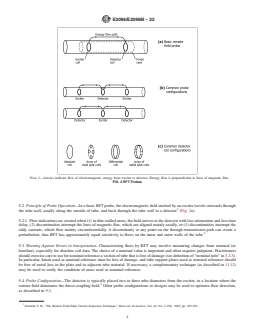
5.2 Principle of Probe Operation—In a basic RFT probe, the electromagnetic field emitted by an exciter travels outwards through the tube wall, axially along the outside of tube, and back through the tube wall to a detector3 (Fig. 2a).
FIG. 2 RFT Probes
Note 1: Arrows indicate flow of electromagnetic energy from exciter to detector. Energy flow is perpendicular to lines of magnetic flux.
5.2.1 Flaw indications are created when (1) in thin-walled areas, the field arrives at the detector with less attenuation and less time delay, (2) discontinuities interrupt the lines of magnetic flux, which are aligned mainly axially, or (3) discontinuities interrupt the eddy currents, which flow mainly circumferentially. A discontinuity at any point on the through-transmission path can create a perturbation; thus RFT has approximately equal sensitivity to flaws on the inner and outer walls of the tube.3
5.3 Warning Against Errors in Interpretation.Characterizing flaws by RFT may involve measuring changes from nominal (or baseline), especially for absolute coil data. The choice of a nominal value is important and often requires judgment. Practitioners should exercise care to use for nominal reference a section of tube that is free of damage (see definition of “nominal tube” in 3.2.3). In particular, bends used as nominal reference must be free of damage, and tube support plates used as nominal reference should be free of metal loss in the plate and in adjacent tube material. If necessary, a complementary technique (as described in 11.12) may be used to verify the condition of areas used as nominal reference.
5.4 Probe Configuration—The detector is typically placed two to three tube diameters from the exciter, in a location where the remote field dominates the direc...
SCOPE
1.1 This practice describes procedures to be followed during remote field examination of installed ferromagnetic heat-exchanger tubing for baseline and service-induced discontinuities.
1.2 This practice is intended for use on ferromagnetic tubes with outside diameters from 0.500 to 2.000 in. [12.70 to 50.80 mm], with wall thicknesses in the range from 0.028 to 0.134 in. [0.71 to 3.40 mm].
1.3 This practice does not establish tube acceptance criteria; the tube acceptance criteria must be specified by the using parties.
1.4 Units—The values stated in either SI units or inch-pound units are to be regarded separately as standard. The values stated in each system are not necessarily exact equivalents; therefore, to ensure conformance with the standard, each system shall be used independently of the other, and values from the two systems shall not be combined.
1.5 This standard does not purport to address all of the safety concerns, if any, associated with its use. It is the responsibility of the user of this standard to establish appropriate safety, health, and environmental practices and determine the applicability of regulatory limitations prior to use.
1.6 This international standard was developed in accordance with internationally recognized principles on standardization established in the Decision on Principles for the Development of International Standards, Guides and Recommendations issued by the World Trade Organization Technical Barriers to Trade (TBT) Committee.
- Status
- Published
- Publication Date
- 31-May-2022
- Technical Committee
- E07 - Nondestructive Testing
- Drafting Committee
- E07.07 - Electromagnetic Method
Buy Documents
ASTM E2096/E2096M-22 - Standard Practice for In Situ Examination of Ferromagnetic Heat-Exchanger Tubes Using Remote Field Testing
REDLINE ASTM E2096/E2096M-22 - Standard Practice for In Situ Examination of Ferromagnetic Heat-Exchanger Tubes Using Remote Field Testing
Overview
ASTM E2096/E2096M-22 is the internationally recognized standard practice for the in situ examination of installed ferromagnetic heat-exchanger tubes using remote field testing (RFT). Developed by ASTM International, this standard outlines comprehensive procedures for detecting baseline and service-induced discontinuities, supporting the effective maintenance and risk assessment of critical tubular components in heat exchangers.
Remote field testing is a non-destructive examination technique that uses electromagnetic methods to assess the integrity of tubes made from ferromagnetic materials. By identifying flaws or changes in wall thickness and other forms of degradation, RFT helps organizations maintain safety, efficiency, and regulatory compliance in pressure-boundary equipment.
Keywords: ASTM E2096, remote field testing, RFT, heat-exchanger tubes, ferromagnetic tube inspection, non-destructive examination, tube flaw detection.
Key Topics
Scope of Application
- Applicable to ferromagnetic tubes with outside diameters from 0.500 to 2.000 inches (12.70 to 50.80 mm) and wall thicknesses from 0.028 to 0.134 inches (0.71 to 3.40 mm)
- Procedures for both baseline and in-service inspections
Principle of Remote Field Testing
- Uses electromagnetic fields emitted by an exciter coil, traveling through and around the tube wall, detected by a sensor coil
- Equal sensitivity to flaws on the inner and outer tube surfaces
- Capable of detecting thin-walled areas, interruptions in magnetic flux, and eddy current disruptions
Interpretation and Reference Standards
- Importance of selecting an undamaged tube section as the nominal reference for accurate flaw characterization
- Systematic approach for instrument calibration using reference standards with known artificial flaws
- Recommendations for periodic system checks to ensure consistent sensitivity during examination
Factors Affecting Test Accuracy
- Material property variations (permeability, conductivity, residual stress, and magnetism)
- Presence of ferromagnetic or conductive objects near tubes (e.g., support plates, adjacent tubes, end plates)
- Tube geometry including bends, dents, and expansions
Procedural Guidance
- Cleaning tubes prior to inspection to remove debris
- Recommendations for probe and instrumentation configuration
- Data recording and reporting protocols to ensure traceability and accuracy
Applications
ASTM E2096/E2096M-22 offers significant value to industries reliant on heat exchanger performance and safety, especially:
- Power Generation: Regular inspection of boiler and condenser tubes to prevent unexpected failures and downtime.
- Petrochemical and Chemical Processing: Non-destructive testing for shell-and-tube heat exchangers to reduce process risk.
- HVAC Systems: Integrity assessment of chiller tubes and other heat transfer equipment to maintain operational efficiency.
- Industrial Manufacturing: Maintenance of process heaters and coolers relying on ferromagnetic tubular components.
In each context, using remote field testing in accordance with ASTM E2096 ensures early detection of flaws such as corrosion, wear, or manufacturing defects, thereby supporting predictive maintenance strategies and asset integrity management.
Related Standards
For comprehensive ferromagnetic heat-exchanger tube inspection and personnel qualification, consider these related standards:
- ASTM E543 - Specification for Agencies Performing Nondestructive Testing
- ASTM E1316 - Terminology for Nondestructive Examinations
- ASNT SNT-TC-1A - Recommended Practice for Personnel Qualification and Certification in Nondestructive Testing
- ANSI/ASNT CP-189 - Qualification and Certification of Nondestructive Testing Personnel
- ISO 9712 - Nondestructive Testing – Qualification and Certification of Personnel
These standards collectively provide a robust quality framework for the proper implementation of remote field testing and support the broader goals of safety and reliability in heat exchanger operation.
By adhering to ASTM E2096/E2096M-22 and accompanying standards, organizations enhance their inspection capabilities and contribute to the longevity and safety of essential industrial assets.
Relations
- Effective Date
- 01-Feb-2024
- Effective Date
- 01-Dec-2019
- Effective Date
- 01-Mar-2019
- Effective Date
- 01-Jan-2018
- Effective Date
- 15-Jun-2017
- Effective Date
- 01-Feb-2017
- Effective Date
- 01-Aug-2016
- Effective Date
- 01-Feb-2016
- Effective Date
- 01-Dec-2015
- Effective Date
- 01-Sep-2015
- Effective Date
- 01-Jun-2014
- Effective Date
- 01-Jun-2014
- Effective Date
- 01-Dec-2013
- Effective Date
- 15-Jun-2013
- Effective Date
- 01-Jun-2013
Buy Documents
ASTM E2096/E2096M-22 - Standard Practice for In Situ Examination of Ferromagnetic Heat-Exchanger Tubes Using Remote Field Testing
REDLINE ASTM E2096/E2096M-22 - Standard Practice for In Situ Examination of Ferromagnetic Heat-Exchanger Tubes Using Remote Field Testing
Get Certified
Connect with accredited certification bodies for this standard

Institut za varilstvo d.o.o. (Welding Institute)
Slovenia's leading welding institute since 1952. ISO 3834, EN 1090, pressure equipment certification, NDT personnel, welder qualification. Only IIW Au
Sponsored listings
Frequently Asked Questions
ASTM E2096/E2096M-22 is a standard published by ASTM International. Its full title is "Standard Practice for In Situ Examination of Ferromagnetic Heat-Exchanger Tubes Using Remote Field Testing". This standard covers: SIGNIFICANCE AND USE 5.1 The purpose of RFT is to evaluate the condition of the tubing. The evaluation results may be used to assess the likelihood of tube failure during service, a task which is not covered by this practice. 5.2 Principle of Probe Operation—In a basic RFT probe, the electromagnetic field emitted by an exciter travels outwards through the tube wall, axially along the outside of tube, and back through the tube wall to a detector3 (Fig. 2a). FIG. 2 RFT Probes Note 1: Arrows indicate flow of electromagnetic energy from exciter to detector. Energy flow is perpendicular to lines of magnetic flux. 5.2.1 Flaw indications are created when (1) in thin-walled areas, the field arrives at the detector with less attenuation and less time delay, (2) discontinuities interrupt the lines of magnetic flux, which are aligned mainly axially, or (3) discontinuities interrupt the eddy currents, which flow mainly circumferentially. A discontinuity at any point on the through-transmission path can create a perturbation; thus RFT has approximately equal sensitivity to flaws on the inner and outer walls of the tube.3 5.3 Warning Against Errors in Interpretation.Characterizing flaws by RFT may involve measuring changes from nominal (or baseline), especially for absolute coil data. The choice of a nominal value is important and often requires judgment. Practitioners should exercise care to use for nominal reference a section of tube that is free of damage (see definition of “nominal tube” in 3.2.3). In particular, bends used as nominal reference must be free of damage, and tube support plates used as nominal reference should be free of metal loss in the plate and in adjacent tube material. If necessary, a complementary technique (as described in 11.12) may be used to verify the condition of areas used as nominal reference. 5.4 Probe Configuration—The detector is typically placed two to three tube diameters from the exciter, in a location where the remote field dominates the direc... SCOPE 1.1 This practice describes procedures to be followed during remote field examination of installed ferromagnetic heat-exchanger tubing for baseline and service-induced discontinuities. 1.2 This practice is intended for use on ferromagnetic tubes with outside diameters from 0.500 to 2.000 in. [12.70 to 50.80 mm], with wall thicknesses in the range from 0.028 to 0.134 in. [0.71 to 3.40 mm]. 1.3 This practice does not establish tube acceptance criteria; the tube acceptance criteria must be specified by the using parties. 1.4 Units—The values stated in either SI units or inch-pound units are to be regarded separately as standard. The values stated in each system are not necessarily exact equivalents; therefore, to ensure conformance with the standard, each system shall be used independently of the other, and values from the two systems shall not be combined. 1.5 This standard does not purport to address all of the safety concerns, if any, associated with its use. It is the responsibility of the user of this standard to establish appropriate safety, health, and environmental practices and determine the applicability of regulatory limitations prior to use. 1.6 This international standard was developed in accordance with internationally recognized principles on standardization established in the Decision on Principles for the Development of International Standards, Guides and Recommendations issued by the World Trade Organization Technical Barriers to Trade (TBT) Committee.
SIGNIFICANCE AND USE 5.1 The purpose of RFT is to evaluate the condition of the tubing. The evaluation results may be used to assess the likelihood of tube failure during service, a task which is not covered by this practice. 5.2 Principle of Probe Operation—In a basic RFT probe, the electromagnetic field emitted by an exciter travels outwards through the tube wall, axially along the outside of tube, and back through the tube wall to a detector3 (Fig. 2a). FIG. 2 RFT Probes Note 1: Arrows indicate flow of electromagnetic energy from exciter to detector. Energy flow is perpendicular to lines of magnetic flux. 5.2.1 Flaw indications are created when (1) in thin-walled areas, the field arrives at the detector with less attenuation and less time delay, (2) discontinuities interrupt the lines of magnetic flux, which are aligned mainly axially, or (3) discontinuities interrupt the eddy currents, which flow mainly circumferentially. A discontinuity at any point on the through-transmission path can create a perturbation; thus RFT has approximately equal sensitivity to flaws on the inner and outer walls of the tube.3 5.3 Warning Against Errors in Interpretation.Characterizing flaws by RFT may involve measuring changes from nominal (or baseline), especially for absolute coil data. The choice of a nominal value is important and often requires judgment. Practitioners should exercise care to use for nominal reference a section of tube that is free of damage (see definition of “nominal tube” in 3.2.3). In particular, bends used as nominal reference must be free of damage, and tube support plates used as nominal reference should be free of metal loss in the plate and in adjacent tube material. If necessary, a complementary technique (as described in 11.12) may be used to verify the condition of areas used as nominal reference. 5.4 Probe Configuration—The detector is typically placed two to three tube diameters from the exciter, in a location where the remote field dominates the direc... SCOPE 1.1 This practice describes procedures to be followed during remote field examination of installed ferromagnetic heat-exchanger tubing for baseline and service-induced discontinuities. 1.2 This practice is intended for use on ferromagnetic tubes with outside diameters from 0.500 to 2.000 in. [12.70 to 50.80 mm], with wall thicknesses in the range from 0.028 to 0.134 in. [0.71 to 3.40 mm]. 1.3 This practice does not establish tube acceptance criteria; the tube acceptance criteria must be specified by the using parties. 1.4 Units—The values stated in either SI units or inch-pound units are to be regarded separately as standard. The values stated in each system are not necessarily exact equivalents; therefore, to ensure conformance with the standard, each system shall be used independently of the other, and values from the two systems shall not be combined. 1.5 This standard does not purport to address all of the safety concerns, if any, associated with its use. It is the responsibility of the user of this standard to establish appropriate safety, health, and environmental practices and determine the applicability of regulatory limitations prior to use. 1.6 This international standard was developed in accordance with internationally recognized principles on standardization established in the Decision on Principles for the Development of International Standards, Guides and Recommendations issued by the World Trade Organization Technical Barriers to Trade (TBT) Committee.
ASTM E2096/E2096M-22 is classified under the following ICS (International Classification for Standards) categories: 23.040.10 - Iron and steel pipes. The ICS classification helps identify the subject area and facilitates finding related standards.
ASTM E2096/E2096M-22 has the following relationships with other standards: It is inter standard links to ASTM E1316-24, ASTM E1316-19b, ASTM E1316-19, ASTM E1316-18, ASTM E1316-17a, ASTM E1316-17, ASTM E1316-16a, ASTM E1316-16, ASTM E1316-15a, ASTM E1316-15, ASTM E1316-14e1, ASTM E1316-14, ASTM E1316-13d, ASTM E1316-13c, ASTM E1316-13b. Understanding these relationships helps ensure you are using the most current and applicable version of the standard.
ASTM E2096/E2096M-22 is available in PDF format for immediate download after purchase. The document can be added to your cart and obtained through the secure checkout process. Digital delivery ensures instant access to the complete standard document.
Standards Content (Sample)
This international standard was developed in accordance with internationally recognized principles on standardization established in the Decision on Principles for the
Development of International Standards, Guides and Recommendations issued by the World Trade Organization Technical Barriers to Trade (TBT) Committee.
Designation: E2096/E2096M − 22
Standard Practice for
In Situ Examination of Ferromagnetic Heat-Exchanger Tubes
Using Remote Field Testing
ThisstandardisissuedunderthefixeddesignationE2096/E2096M;thenumberimmediatelyfollowingthedesignationindicatestheyear
of original adoption or, in the case of revision, the year of last revision. A number in parentheses indicates the year of last reapproval.
A superscript epsilon (´) indicates an editorial change since the last revision or reapproval.
1. Scope* 2. Referenced Documents
2.1 ASTM Standards:
1.1 Thispracticedescribesprocedurestobefollowedduring
E543 Specification for Agencies Performing Nondestructive
remote field examination of installed ferromagnetic heat-
Testing
exchanger tubing for baseline and service-induced discontinui-
E1316 Terminology for Nondestructive Examinations
ties.
1.2 This practice is intended for use on ferromagnetic tubes
3. Terminology
with outside diameters from 0.500 to 2.000 in. [12.70 to 50.80
3.1 General—Definitions of terms used in this practice can
mm],withwallthicknessesintherangefrom0.028to0.134in.
be found in Terminology E1316, Section A, “Common NDT
[0.71 to 3.40 mm].
Terms,” and Section C, “Electromagnetic Testing.”
1.3 This practice does not establish tube acceptance criteria;
3.2 Definitions:
the tube acceptance criteria must be specified by the using 3.2.1 detector, n—one or more coils or elements used to
parties.
sense or measure magnetic field; also known as a receiver.
3.2.2 exciter, n—a device that generates a time-varying
1.4 Units—The values stated in either SI units or inch-
electromagnetic field, usually a coil energized with alternating
pound units are to be regarded separately as standard. The
current (ac); also known as a transmitter.
values stated in each system are not necessarily exact equiva-
3.2.3 nominal tube, n—a tube or tube section meeting the
lents; therefore, to ensure conformance with the standard, each
tubing manufacturer’s specifications, with relevant properties
system shall be used independently of the other, and values
typical of a tube being examined, used for reference in
from the two systems shall not be combined.
interpretation and evaluation.
1.5 This standard does not purport to address all of the
3.2.4 remote field, n—as applied to nondestructive testing,
safety concerns, if any, associated with its use. It is the
the electromagnetic field which has been transmitted through
responsibility of the user of this standard to establish appro-
the test object and is observable beyond the direct coupling
priate safety, health, and environmental practices and deter-
field of the exciter.
mine the applicability of regulatory limitations prior to use.
3.2.5 remote field testing, n—a nondestructive test method
1.6 This international standard was developed in accor-
that measures changes in the remote field to detect and
dance with internationally recognized principles on standard-
characterize discontinuities.
ization established in the Decision on Principles for the
3.2.6 using parties, n—the supplier and purchaser.
Development of International Standards, Guides and Recom-
3.2.6.1 Discussion—The party carrying out the examination
mendations issued by the World Trade Organization Technical
is referred to as the “supplier,” and the party requesting the
Barriers to Trade (TBT) Committee.
examination is referred to as the “purchaser,” as required in
Form and Style for ASTM Standards, April 2004. In common
usage outside this practice, these parties are often referred to as
the “operator” and “customer,” respectively.
3.3 Definitions of Terms Specific to This Standard:
This practice is under the jurisdiction of ASTM Committee E07 on Nonde-
structive Testing and is the direct responsibility of Subcommittee E07.07 on
Electromagnetic Method. For referenced ASTM standards, visit the ASTM website, www.astm.org, or
Current edition approved June 1, 2022. Published June 2022. Originally contact ASTM Customer Service at service@astm.org. For Annual Book of ASTM
approved in 2000. Last previous edition approved in 2016 as E2096/E2096M – 16. Standards volume information, refer to the standard’s Document Summary page on
DOI: 10.1520/E2096_E2096M-22. the ASTM website.
*A Summary of Changes section appears at the end of this standard
Copyright © ASTM International, 100 Barr Harbor Drive, PO Box C700, West Conshohocken, PA 19428-2959. United States
E2096/E2096M − 22
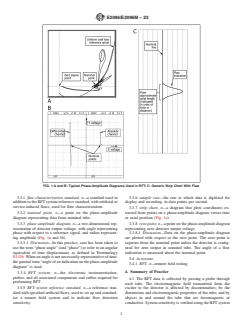
FIG. 1 A and B: Typical Phase-Amplitude Diagrams Used in RFT; C: Generic Strip Chart With Flaw
3.3.1 flaw characterization standard, n—a standard used in 3.3.6 sample rate—the rate at which data is digitized for
additiontotheRFTsystemreferencestandard,withartificialor display and recording, in data points per second.
service-induced flaws, used for flaw characterization.
3.3.7 strip chart, n—a diagram that plots coordinates ex-
3.3.2 nominal point, n—a point on the phase-amplitude tracted from points on a phase-amplitude diagram versus time
diagram representing data from nominal tube. or axial position (Fig. 1c).
3.3.3 phase-amplitude diagram, n—a two-dimensional rep- 3.3.8 zero point, n—a point on the phase-amplitude diagram
resentation of detector output voltage, with angle representing representing zero detector output voltage.
phase with respect to a reference signal, and radius represent- 3.3.8.1 Discussion—Data on the phase-amplitude diagram
ing amplitude (Fig. 1a and 1b). are plotted with respect to the zero point. The zero point is
3.3.3.1 Discussion—In this practice, care has been taken to separate from the nominal point unless the detector is config-
use the term “phase angle” (and “phase”) to refer to an angular ured for zero output in nominal tube. The angle of a flaw
equivalent of time displacement, as defined in Terminology indication is measured about the nominal point.
E1316.Whenanangleisnotnecessarilyrepresentativeoftime,
3.4 Acronyms:
thegeneralterm“angleofanindicationonthephase-amplitude
3.4.1 RFT, n—remote field testing
diagram” is used.
4. Summary of Practice
3.3.4 RFT system, n—the electronic instrumentation,
probes, and all associated components and cables required for
4.1 The RFT data is collected by passing a probe through
performing RFT.
each tube. The electromagnetic field transmitted from the
3.3.5 RFT system reference standard, n—a reference stan- exciter to the detector is affected by discontinuities; by the
dard with specified artificial flaws, used to set up and standard- dimensions and electromagnetic properties of the tube; and by
ize a remote field system and to indicate flaw detection objects in and around the tube that are ferromagnetic or
sensitivity. conductive.SystemsensitivityisverifiedusingtheRFTsystem
E2096/E2096M − 22
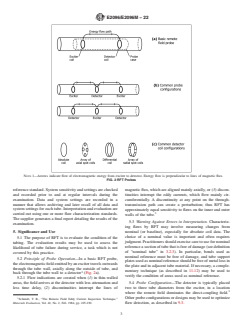
NOTE 1—Arrows indicate flow of electromagnetic energy from exciter to detector. Energy flow is perpendicular to lines of magnetic flux.
FIG. 2 RFT Probes
reference standard. System sensitivity and settings are checked magnetic flux, which are aligned mainly axially, or (3) discon-
and recorded prior to and at regular intervals during the
tinuities interrupt the eddy currents, which flow mainly cir-
examination. Data and system settings are recorded in a cumferentially. A discontinuity at any point on the through-
manner that allows archiving and later recall of all data and
transmission path can create a perturbation; thus RFT has
system settings for each tube. Interpretation and evaluation are
approximately equal sensitivity to flaws on the inner and outer
carried out using one or more flaw characterization standards.
walls of the tube.
The supplier generates a final report detailing the results of the
5.3 Warning Against Errors in Interpretation. Characteriz-
examination.
ing flaws by RFT may involve measuring changes from
5. Significance and Use nominal (or baseline), especially for absolute coil data. The
choice of a nominal value is important and often requires
5.1 The purpose of RFT is to evaluate the condition of the
judgment. Practitioners should exercise care to use for nominal
tubing. The evaluation results may be used to assess the
referenceasectionoftubethatisfreeofdamage(seedefinition
likelihood of tube failure during service, a task which is not
of “nominal tube” in 3.2.3). In particular, bends used as
covered by this practice.
nominal reference must be free of damage, and tube support
5.2 Principle of Probe Operation—In a basic RFT probe,
plates used as nominal reference should be free of metal loss in
theelectromagneticfieldemittedbyanexcitertravelsoutwards
the plate and in adjacent tube material. If necessary, a comple-
through the tube wall, axially along the outside of tube, and
mentary technique (as described in 11.12) may be used to
back through the tube wall to a detector (Fig. 2a).
verify the condition of areas used as nominal reference.
5.2.1 Flaw indications are created when (1) in thin-walled
areas, the field arrives at the detector with less attenuation and
5.4 Probe Configuration—The detector is typically placed
less time delay, (2) discontinuities interrupt the lines of
two to three tube diameters from the exciter, in a location
where the remote field dominates the direct-coupling field.
3 Other probe configurations or designs may be used to optimize
Schmidt, T. R., “The Remote Field Eddy Current Inspection Technique,”
Materials Evaluation, Vol. 42, No. 2, Feb. 1984, pp. 225-230. flaw detection, as described in 9.3.
E2096/E2096M − 22
5.5 Comparison with Conventional Eddy-Current Testing— 7.1.11 Complementary methods or techniques (including
Conventionaleddy-currenttestcoilsaretypicallyconfiguredto possible tube removal) that may be used to obtain additional
sense the field from the tube wall in the immediate vicinity of information.
the emitting element, whereas RFT probes are typically de-
7.1.12 Acceptance criteria to be used in evaluating flaw
signed to detect changes in the remote field.
indications.
7.1.13 Disposition of examination records and reference
6. Basis of Application
standards.
7.1.14 Format and outline contents of the examination
6.1 The following items are subject to contractual agree-
report.
ment between the parties using or referencing this practice.
6.2 Personnel Qualification—If specified in the contractual
8. Interferences
agreement, personnel performing examinations to this practice
8.1 This section describes items and conditions which may
shall be qualified in accordance with a nationally or interna-
compromise RFT.
tionally recognized NDT personnel qualification practice or
standard and certified by the employer or certifying agency, as
8.2 Material Properties:
applicable. The practice or standard used and its applicable
8.2.1 Variations in the material properties of ferromagnetic
revision shall be identified in the contractual agreement be-
tubes are a potential source of inaccuracy. Impurities,
tween the using parties.
segregation, manufacturing process, grain size, stress history,
present stress patterns, temperature history, present
6.3 Qualification of Nondestructive Testing Agencies—If
specified in the contractual agreement, NDT agencies shall be temperature, magnetic history, and other factors will affect the
electromagnetic response measured during RFT. The conduc-
qualified and evaluated as specified in Practice E543, with
reference to sections on electromagnetic testing. The appli- tivityandpermeabilityoftubeswiththesamegradeofmaterial
are often measurably different. It is common to find that some
cable edition of Practice E543 shall be specified in the
contractual agreement. of the tubes to be examined are newer tubes with different
material properties.
7. Job Scope and Requirements
8.2.2 Permeability variations may occur at locations where
there was uneven temperature or stress during tube
7.1 Thefollowingitemsmayrequireagreementbetweenthe
manufacture, near welds, at bends, where there were uneven
using parties and should be specified in the purchase document
heat transfer conditions during service, at areas where there is
or elsewhere:
cold working (such as that created by an integral finning
7.1.1 Location and type of tube component to be examined,
process), and in other locations. Indications from permeability
design specifications, degradation history, previous nonde-
variations may be mistaken for, or obscure flaw indications.
structive examination results, maintenance history, process
Effects may be less severe in tubes that were stress-relieved
conditions, and specific types of flaws that are required to be
during manufacture.
detected, if known.
8.2.3 Residual stress, with accompanying permeability
7.1.2 The maximum window of opportunity for work.
variations, may be present when discontinuities are machined
(Detection of small flaws may require a slower probe pull
intoareferencestandard,orduringtheintegralfinningprocess.
speed, which will affect productivity.)
8.2.4 RFT is affected by residual magnetism in the tubing,
7.1.3 Size, material grade and type, and configuration of
including residual magnetism created during a previous exami-
tubes to be examined.
nation using another magnetic method. Tubes with significant
7.1.4 A tube numbering or identification system.
residual magnetism should be demagnetized prior to RFT.
7.1.5 Extent of examination, for example: complete or
8.3 Ferromagnetic and Conductive Objects:
partial coverage, which tubes and to what length, whether
8.3.1 Objects near the tube that are ferromagnetic or con-
straight sections only, and the minimum radius of bends that
ductive may reduce the sensitivity and accuracy of flaw
can be examined.
characterization in their immediate vicinity. Such objects may
7.1.6 Means of access to tubes, and areas where access may
in some cases be mistaken for flaws. Knowledge of the
be restricted.
mechanical layout of the component to be examined is recom-
7.1.7 Type of RFT instrument and probe; and description of
mended. Examples of ferromagnetic or conductive objects
reference standards used, including such details as dimensions
include: tube support plates, baffle plates, end plates, tube
and material.
sheets, anti-vibration bars, neighboring tubes, impingement
7.1.8 Required operator qualifications and certification.
plates, loose parts, and attachments clamped or welded to a
7.1.9 Required tube cleanliness.
tube.
7.1.10 Environmental conditions, equipment, and prepara-
NOTE 2—Interference from ferromagnetic or conductive objects can be
tions that are the responsibility of the purchaser; common
of practical use when RFT is used to confirm the position of an object
sources of noise that may interfere with the examination.
installed on a tube or to detect where objects have become detached and
have fallen against a tube.
NOTE 1—Nearby welding activities may be a major source of interfer-
ence. 8.3.2 Neighboring Tubes:
E2096/E2096M − 22
8.3.2.1 In areas where there is non-constant tube spacing 9.2 Driving Mechanism—Amechanical means of traversing
(bowing) or where tubes cross close to each other, there are the probe through the tube at approximately constant speed
indications which may be mistaken for flaws. may be used.
8.3.2.2 Neighboring or adjacent tubes, in accordance with
9.3 Probes—The probes should be of the largest diameter
their number and position, create an offset in the phase. This
practical for the tubes being examined, leaving clearance for
phenomenon is known as the bundle effect and is a minor
debris, dents, changes in tube diameter, and other obstructions.
source of inaccuracy when absolute readings in nominal tube
The probes should be of an appropriate configuration and size
are required.
for the tube being examined and for the flaw type or types to
8.3.2.3 In cases where multiple RFT probes are used simul-
be detected. Probe centering is recommended.
taneously in the same heat exchanger, care should be taken to
9.3.1 Absolute Detectors—Absolute detectors (Fig. 2c) are
ensure adequate spacing between different probes.
commonly used to characterize and locate large-volume and
8.3.3 Conductiveormagneticdebrisinoronatubethatmay
gradual metal loss.
create false indications or obscure flaw indications should be
9.3.2 Differential Detectors—Differential detectors (Fig. 2c)
removed.
tend to maximize the response from small volume flaws and
8.4 Tube Geometry Effects:
abrupt changes along the tube length, and are also commonly
8.4.1 Due to geometrical effects (as well as to the effects of
used to locate and characterize large-volume and gradual metal
permeability variations described in 8.2.2), localized changes
loss.
in tube diameter such as dents, bulges, expansions, and bends
9.3.3 Array Detector—Array detectors use a configuration
create indications which may obscure or distort flaw indica-
of multiple sensing elements (Fig. 2c). Each element is
tions.
sensitive to a discrete section of the tube circumference. The
8.4.2 Reductions in the internal diameter may require a
elements may be oriented with their axes aligned axially or
smaller diameter probe that is able to pass through the
radially with respect to the tube.
restriction.Intheunrestrictedsections,flawsensitivityislikely
to be limited by the smaller probe fill factor. NOTE 3—The detector’s response represents an average of responses to
all flaws within its sensing area.
8.4.3 RFT End Effect—The field from the exciter is able to
propagate around the end of a tube when there is no shielding
9.3.4 Exciter and Detector Configurations—Probes may
from a tube sheet or vessel shell. A flaw indication may be
have multiple exciters and detectors in a variety of configura-
obscured or distorted if the flaw or any active probe element is
tions (see, for example, Fig. 2b). These configurations may
within approximately three tube diameters of the tube end.
reduce interference from support plates and other conductive
objects.
8.5 Instrumentation:
8.5.1 The operator should be aware of indicators of noise,
9.4 Data Displays:
saturation, or signal distortion particular to the instrument
9.4.1 The data display should include a phase-amplitude
being used. Special consideration should be given to the
diagram (Fig. 1a and 1b).
following concerns:
9.4.2 Strip Charts—Coordinates that may be displayed on
8.5.1.1 In a given tube, an RFT sy
...
This document is not an ASTM standard and is intended only to provide the user of an ASTM standard an indication of what changes have been made to the previous version. Because
it may not be technically possible to adequately depict all changes accurately, ASTM recommends that users consult prior editions as appropriate. In all cases only the current version
of the standard as published by ASTM is to be considered the official document.
Designation: E2096/E2096M − 16 E2096/E2096M − 22
Standard Practice for
In Situ Examination of Ferromagnetic Heat-Exchanger Tubes
Using Remote Field Testing
This standard is issued under the fixed designation E2096/E2096M; the number immediately following the designation indicates the year
of original adoption or, in the case of revision, the year of last revision. A number in parentheses indicates the year of last reapproval.
A superscript epsilon (´) indicates an editorial change since the last revision or reapproval.
1. Scope*
1.1 This practice describes procedures to be followed during remote field examination of installed ferromagnetic heat-exchanger
tubing for baseline and service-induced discontinuities.
1.2 This practice is intended for use on ferromagnetic tubes with outside diameters from 0.500 to 2.000 in. [12.70 to 50.80 mm],
with wall thicknesses in the range from 0.028 to 0.134 in. [0.71 to 3.40 mm].
1.3 This practice does not establish tube acceptance criteria; the tube acceptance criteria must be specified by the using parties.
1.4 Units—The values stated in either inch-poundSI units or SIinch-pound units are to be regarded separately as standard. The
values stated in each system mayare not benecessarily exact equivalents; therefore, to ensure conformance with the standard, each
system shall be used independently of the other. Combiningother, and values from the two systems may result in nonconformance
with the standard.shall not be combined.
1.5 This standard does not purport to address all of the safety concerns, if any, associated with its use. It is the responsibility
of the user of this practicestandard to establish appropriate safety safety, health, and healthenvironmental practices and determine
the applicability of regulatory limitations prior to use.
1.6 This international standard was developed in accordance with internationally recognized principles on standardization
established in the Decision on Principles for the Development of International Standards, Guides and Recommendations issued
by the World Trade Organization Technical Barriers to Trade (TBT) Committee.
2. Referenced Documents
2.1 ASTM Standards:
E543 Specification for Agencies Performing Nondestructive Testing
E1316 Terminology for Nondestructive Examinations
2.2 ASNT Documents:
SNT-TC-1A Recommended Practice for Personnel Qualification and Certification in Nondestructive Testing
ANSI/ASNT-CP-189 Standard for Qualification and Certification of Nondestructive Testing Personnel
2.3 Other Documents:
Can CGSB-48.9712-95 Qualification of Nondestructive Testing Personnel, Natural Resources Canada
ISO 9712 Nondestructive Testing—Qualification and Certification of Nondestructive Testing Personnel
This practice is under the jurisdiction of ASTM Committee E07 on Nondestructive Testing and is the direct responsibility of Subcommittee E07.07 on Electromagnetic
Method.
Current edition approved Feb. 1, 2016June 1, 2022. Published February 2016June 2022. Originally approved in 2000. Last previous edition approved in 20102016 as
E2096 - 10.E2096/E2096M – 16. DOI: 10.1520/E2096_E2096M-16.10.1520/E2096_E2096M-22.
For referenced ASTM standards, visit the ASTM website, www.astm.org, or contact ASTM Customer Service at service@astm.org. For Annual Book of ASTM Standards
volume information, refer to the standard’s Document Summary page on the ASTM website.
*A Summary of Changes section appears at the end of this standard
Copyright © ASTM International, 100 Barr Harbor Drive, PO Box C700, West Conshohocken, PA 19428-2959. United States
E2096/E2096M − 22
NAS-410 Certification and Qualification of Nondestructive Testing Personnel
3. Terminology
3.1 General—Definitions of terms used in this practice can be found in Terminology E1316, Section A, “Common NDT Terms,”
and Section C, “Electromagnetic Testing.”
3.2 Definitions:
3.2.1 detector, n—one or more coils or elements used to sense or measure magnetic field; also known as a receiver.
3.2.2 exciter, n—a device that generates a time-varying electromagnetic field, usually a coil energized with alternating current (ac);
also known as a transmitter.
3.2.3 nominal tube, n—a tube or tube section meeting the tubing manufacturer’s specifications, with relevant properties typical of
a tube being examined, used for reference in interpretation and evaluation.
3.2.4 remote field, n—as applied to nondestructive testing, the electromagnetic field which has been transmitted through the test
object and is observable beyond the direct coupling field of the exciter.
3.2.5 remote field testing, n—a nondestructive test method that measures changes in the remote field to detect and characterize
discontinuities.
3.2.6 using parties, n—the supplier and purchaser.
3.2.6.1 Discussion—
The party carrying out the examination is referred to as the “supplier,” and the party requesting the examination is referred to as
the “purchaser,” as required in Form and Style for ASTM Standards, April 2004. In common usage outside this practice, these
parties are often referred to as the “operator” and “customer,” respectively.
3.3 Definitions of Terms Specific to This Standard:
3.3.1 flaw characterization standard, n—a standard used in addition to the RFT system reference standard, with artificial or
service-induced flaws, used for flaw characterization.
3.3.2 nominal point, n—a point on the phase-amplitude diagram representing data from nominal tube.
3.3.3 phase-amplitude diagram, n—a two-dimensional representation of detector output voltage, with angle representing phase
with respect to a reference signal, and radius representing amplitude (Fig. 1a and 1b).
3.3.3.1 Discussion—
In this practice, care has been taken to use the term “phase angle” (and “phase”) to refer to an angular equivalent of time
displacement, as defined in Terminology E1316. When an angle is not necessarily representative of time, the general term “angle
of an indication on the phase-amplitude diagram” is used.
3.3.4 RFT system, n—the electronic instrumentation, probes, and all associated components and cables required for performing
RFT.
3.3.5 RFT system reference standard, n—a reference standard with specified artificial flaws, used to set up and standardize a
remote field system and to indicate flaw detection sensitivity.
3.3.6 sample rate—the rate at which data is digitized for display and recording, in data points per second.
3.3.7 strip chart, n—a diagram that plots coordinates extracted from points on a phase-amplitude diagram versus time or axial
position (Fig. 1c).
3.3.8 zero point, n—a point on the phase-amplitude diagram representing zero detector output voltage.
3.3.8.1 Discussion—
E2096/E2096M − 22
FIG. 1 A and B: Typical Phase-Amplitude Diagrams Used in RFT; C: Generic Strip Chart With Flaw
Data on the phase-amplitude diagram are plotted with respect to the zero point. The zero point is separate from the nominal point
unless the detector is configured for zero output in nominal tube. The angle of a flaw indication is measured about the nominal
point.
3.4 Acronyms:
3.4.1 RFT, n—remote field testing
4. Summary of Practice
4.1 The RFT data is collected by passing a probe through each tube. The electromagnetic field transmitted from the exciter to the
detector is affected by discontinuities; by the dimensions and electromagnetic properties of the tube; and by objects in and around
the tube that are ferromagnetic or conductive. System sensitivity is verified using the RFT system reference standard. System
sensitivity and settings are checked and recorded prior to and at regular intervals during the examination. Data and system settings
are recorded in a manner that allows archiving and later recall of all data and system settings for each tube. Interpretation and
evaluation are carried out using one or more flaw characterization standards. The supplier generates a final report detailing the
results of the examination.
5. Significance and Use
5.1 The purpose of RFT is to evaluate the condition of the tubing. The evaluation results may be used to assess the likelihood of
tube failure during service, a task which is not covered by this practice.
E2096/E2096M − 22
NOTE 1—Arrows indicate flow of electromagnetic energy from exciter to detector. Energy flow is perpendicular to lines of magnetic flux.
FIG. 2 RFT Probes
5.2 Principle of Probe Operation—In a basic RFT probe, the electromagnetic field emitted by an exciter travels outwards through
the tube wall, axially along the outside of tube, and back through the tube wall to a detector (Fig. 2a).
5.2.1 Flaw indications are created when (1) in thin-walled areas, the field arrives at the detector with less attenuation and less time
delay, (2) discontinuities interrupt the lines of magnetic flux, which are aligned mainly axially, or (3) discontinuities interrupt the
eddy currents, which flow mainly circumferentially. A discontinuity at any point on the through-transmission path can create a
perturbation; thus RFT has approximately equal sensitivity to flaws on the inner and outer walls of the tube.
5.3 Warning Against Errors in Interpretation. Characterizing flaws by RFT may involve measuring changes from nominal (or
baseline), especially for absolute coil data. The choice of a nominal value is important and often requires judgment. Practitioners
should exercise care to use for nominal reference a section of tube that is free of damage (see definition of “nominal tube” in 3.2.3).
In particular, bends used as nominal reference must be free of damage, and tube support plates used as nominal reference should
be free of metal loss in the plate and in adjacent tube material. If necessary, a complementary technique (as described in 11.12)
may be used to verify the condition of areas used as nominal reference.
5.4 Probe Configuration—The detector is typically placed two to three tube diameters from the exciter, in a location where the
remote field dominates the direct-coupling field. Other probe configurations or designs may be used to optimize flaw detection,
as described in 9.3.
Schmidt, T. R., “The Remote Field Eddy Current Inspection Technique,” Materials Evaluation, Vol. 42, No. 2, Feb. 1984, pp. 225-230.
E2096/E2096M − 22
5.5 Comparison with Conventional Eddy-Current Testing—Conventional eddy-current test coils are typically configured to sense
the field from the tube wall in the immediate vicinity of the emitting element, whereas RFT probes are typically designed to detect
changes in the remote field.
6. Basis of Application
6.1 The following items are subject to contractual agreement between the parties using or referencing this standard.practice.
6.2 Personnel Qualification—If specified in the contractual agreement, personnel performing examinations to this standardpractice
shall be qualified in accordance with a nationally or internationally recognized NDT personnel qualification practice or standard
such as ANSI/ASNT-CP-189, SNT-TC-1A, NAS-410, ISO 9712, or a similar document and certified by the employer or certifying
agency, as applicable. The practice or standard used and its applicable revision shall be identified in the contractual agreement
between the using parties.
6.3 Qualification of Nondestructive Testing Agencies—If specified in the contractual agreement, NDT agencies shall be qualified
and evaluated as specified in Practice E543, with reference to sections on electromagnetic testing. The applicable edition of
Practice E543 shall be specified in the contractual agreement.
7. Job Scope and Requirements
7.1 The following items may require agreement between the using parties and should be specified in the purchase document or
elsewhere:
7.1.1 Location and type of tube component to be examined, design specifications, degradation history, previous nondestructive
examination results, maintenance history, process conditions, and specific types of flaws that are required to be detected, if known.
7.1.2 The maximum window of opportunity for work. (Detection of small flaws may require a slower probe pull speed, which will
affect productivity.)
7.1.3 Size, material grade and type, and configuration of tubes to be examined.
7.1.4 A tube numbering or identification system.
7.1.5 Extent of examination, for example: complete or partial coverage, which tubes and to what length, whether straight sections
only, and the minimum radius of bends that can be examined.
7.1.6 Means of access to tubes, and areas where access may be restricted.
7.1.7 Type of RFT instrument and probe; and description of reference standards used, including such details as dimensions and
material.
7.1.8 Required operator qualifications and certification.
7.1.9 Required tube cleanliness.
7.1.10 Environmental conditions, equipment, and preparations that are the responsibility of the purchaser; common sources of
noise that may interfere with the examination.
NOTE 1—Nearby welding activities may be a major source of interference.
7.1.11 Complementary methods or techniques (including possible tube removal) that may be used to obtain additional information.
7.1.12 Acceptance criteria to be used in evaluating flaw indications.
7.1.13 Disposition of examination records and reference standards.
E2096/E2096M − 22
7.1.14 Format and outline contents of the examination report.
8. Interferences
8.1 This section describes items and conditions which may compromise RFT.
8.2 Material Properties:
8.2.1 Variations in the material properties of ferromagnetic tubes are a potential source of inaccuracy. Impurities, segregation,
manufacturing process, grain size, stress history, present stress patterns, temperature history, present temperature, magnetic history,
and other factors will affect the electromagnetic response measured during RFT. The conductivity and permeability of tubes with
the same grade of material are often measurably different. It is common to find that some of the tubes to be examined are newer
tubes with different material properties.
8.2.2 Permeability variations may occur at locations where there was uneven temperature or stress during tube manufacture, near
welds, at bends, where there were uneven heat transfer conditions during service, at areas where there is cold working (such as
that created by an integral finning process), and in other locations. Indications from permeability variations may be mistaken for,
or obscure flaw indications. Effects may be less severe in tubes that were stress-relieved during manufacture.
8.2.3 Residual stress, with accompanying permeability variations, may be present when discontinuities are machined into a
reference standard, or during the integral finning process.
8.2.4 RFT is affected by residual magnetism in the tubing, including residual magnetism created during a previous examination
using another magnetic method. Tubes with significant residual magnetism should be demagnetized prior to RFT.
8.3 Ferromagnetic and Conductive Objects:
8.3.1 Objects near the tube that are ferromagnetic or conductive may reduce the sensitivity and accuracy of flaw characterization
in their immediate vicinity. Such objects may in some cases be mistaken for flaws. Knowledge of the mechanical layout of the
component to be examined is recommended. Examples of ferromagnetic or conductive objects include: tube support plates, baffle
plates, end plates, tube sheets, anti-vibration bars, neighboring tubes, impingement plates, loose parts, and attachments clamped
or welded to a tube.
NOTE 2—Interference from ferromagnetic or conductive objects can be of practical use when RFT is used to confirm the position of an object installed
on a tube or to detect where objects have become detached and have fallen against a tube.
8.3.2 Neighboring Tubes:
8.3.2.1 In areas where there is non-constant tube spacing (bowing) or where tubes cross close to each other, there are indications
which may be mistaken for flaws.
8.3.2.2 Neighboring or adjacent tubes, in accordance with their number and position, create an offset in the phase. This
phenomenon is known as the bundle effect and is a minor source of inaccuracy when absolute readings in nominal tube are
required.
8.3.2.3 In cases where multiple RFT probes are used simultaneously in the same heat exchanger, care should be taken to ensure
adequate spacing between different probes.
8.3.3 Conductive or magnetic debris in or on a tube that may create false indications or obscure flaw indications should be
removed.
8.4 Tube Geometry Effects:
8.4.1 Due to geometrical effects (as well as to the effects of permeability variations described in 8.2.2), localized changes in tube
diameter such as dents, bulges, expansions, and bends create indications which may obscure or distort flaw indications.
E2096/E2096M − 22
8.4.2 Reductions in the internal diameter may require a smaller diameter probe that is able to pass through the restriction. In the
unrestricted sections, flaw sensitivity is likely to be limited by the smaller probe fill factor.
8.4.3 RFT End Effect—The field from the exciter is able to propagate around the end of a tube when there is no shielding from
a tube sheet or vessel shell. A flaw indication may be obscured or distorted if the flaw or any active probe element is within
approximately three tube diameters of the tube end.
8.5 Instrumentation:
8.5.1 The operator should be aware of indicators of noise, saturation, or signal distortion particular to the instrument being used.
Special consideration should be given to the following concerns:
8.5.1.1 In a given tube, an RFT system has a frequency where the flaw sensitivity is as high as practical without undue influence
from noise.
8.5.1.2 Saturation of electronic components is a potential problem in RFT because signal amplitude increases rapidly with
decreasing tube wall thickness. Data acquired under saturation conditions is not acceptable.
8.5.2 Instrument-induced Phase Offset—During the amplification and filtering processes, instruments may introduce a frequency-
dependent time delay which appears as a constant phase offset. The instrument phase offset may be a source of error when phase
values measured at different frequencies are compared.
9. RFT System
9.1 Instrumentation—The electronic instrumentation shall be capable of creating exciter signals of one or more frequencies
appropriate to the tube material. The apparatus shall be capable of phase and amplitude analysis of detector outputs at each
frequency, independent of other frequencies in use simultaneously. The instrument shall display data in real time. The instrument
shall be capable of recording data and system settings in a manner that allows archiving and later recall of all data and system
settings for each tube.
9.2 Driving Mechanism—A mechanical means of traversing the probe through the tube at approximately constant speed may be
used.
9.3 Probes—The probes should be of the largest diameter practical for the tubes being examined, leaving clearance for debris,
dents, changes in tube diameter, and other obstructions. The probes should be of an appropriate configuration and size for the tube
being examined and for the flaw type or types to be detected. Probe centering is recommended.
9.3.1 Absolute Detectors—Absolute detectors (Fig. 2c) are com
...