

ASTM D6558-22
(Test Method)Standard Test Method for Determination of TGA CO2 Reactivity of Baked Carbon Anodes and Cathode Blocks
General Information
- Abstract
SIGNIFICANCE AND USE
5.1 The CO2 reactivity rates are used to quantify the tendency of a carbon artifact to react with carbon dioxide. Carbon consumed by these unwanted side reactions is unavailable for the primary reactions of reducing alumina to the primary metal. CO2 dusting rates are used to quantify the tendency of the coke aggregate or binder coke of a carbon artifact to selectively react with these gases. Preferential attack of the binder coke or coke aggregate of a carbon artifact by these gases causes some carbon to fall off or dust, making the carbon unavailable for the primary reaction of reducing alumina and, more importantly, reducing the efficiency of the aluminum reduction cell.
5.2 Comparison of CO2 reactivity and dusting rates is useful in selecting raw materials for the manufacture of commercial anodes for specific smelting technologies in the aluminum reduction industry.
5.3 CO2 reactivity rates are used for evaluating effectiveness and beneficiation processes or for research purposes.
SCOPE
1.1 This test method covers the thermogravimetric (TGA) determination of CO2 reactivity and dusting of shaped carbon anodes and cathode blocks used in the aluminum reduction industry. The apparatus selection covers a significant variety of types with various thermal conditions, sample size capability, materials of construction, and procedures for determining the mass loss and subsequent rate of reaction. This test method standardizes the variables of sample shape, reaction temperature, gas velocity over the exposed surfaces, and reaction time such that results obtained on different apparatuses are correlatable.
1.2 The values stated in SI units are to be regarded as standard. No other units of measurement are included in this standard.
1.3 This standard does not purport to address all of the safety concerns, if any, associated with its use. It is the responsibility of the user of this standard to establish appropriate safety, health, and environmental practices and determine the applicability of regulatory limitations prior to use.
1.4 This international standard was developed in accordance with internationally recognized principles on standardization established in the Decision on Principles for the Development of International Standards, Guides and Recommendations issued by the World Trade Organization Technical Barriers to Trade (TBT) Committee.
- Status
- Published
- Publication Date
- 30-Apr-2022
- Technical Committee
- D02 - Petroleum Products, Liquid Fuels, and Lubricants
- Drafting Committee
- D02.05 - Properties of Fuels, Petroleum Coke and Carbon Material
Buy Documents
ASTM D6558-22 - Standard Test Method for Determination of TGA CO<inf>2</inf> Reactivity of Baked Carbon Anodes and Cathode Blocks
REDLINE ASTM D6558-22 - Standard Test Method for Determination of TGA CO<inf>2</inf> Reactivity of Baked Carbon Anodes and Cathode Blocks
Overview
ASTM D6558-22 is the internationally recognized standard test method for the determination of thermogravimetric analysis (TGA) CO₂ reactivity and dusting rates in baked carbon anodes and cathode blocks, which are primarily used in the aluminum reduction industry. This standard, developed by ASTM International, offers a consistent and reproducible procedure for quantifying how carbon artifacts react with carbon dioxide during aluminum smelting operations. By standardizing critical test variables-such as sample shape, reaction temperature, gas flow, and exposure time-this method enables reliable comparisons of performance across raw material lots and facilities.
Key Topics
- CO₂ Reactivity Measurement: Quantifies the rate at which shaped carbon samples react with carbon dioxide under controlled, isothermal conditions using TGA.
- Dusting Rate Determination: Assesses the tendency for carbon particles to detach (dust) from anodes and cathode blocks, reducing available carbon for aluminum reduction.
- Apparatus and Sample Preparation: Outlines specifications for the test equipment, including furnaces, reaction chambers, and sample holders, as well as sample coring, sizing, and cleaning.
- Calculation and Reporting: Provides standardized formulas to calculate initial, final, and total CO₂ reactivity rates and dusting rates per unit area and time.
- Precision and Reproducibility: Details statistical ranges for repeatability and reproducibility, ensuring laboratories can benchmark results according to industry-accepted accuracy.
Applications
- Material Selection for Aluminum Smelting: The CO₂ reactivity and dusting rates determined by this method are essential selection criteria for raw materials (such as petroleum coke, binder pitch, and other carbons) used in manufactured anodes and cathodes. Lower reactivity and dusting rates translate directly to improved efficiency and economic gains in electrolytic cells.
- Improvement of Manufacturing Processes: Results from this test method guide manufacturers in evaluating and refining beneficiation or treatment processes to enhance the performance of carbon blocks.
- Research and Development: Laboratories and research institutions use CO₂ reactivity data to study the mechanisms of carbon consumption and optimize new carbon materials or processing techniques for better resistance in high-temperature, reactive environments.
- Quality Assurance: Consistency in CO₂ reactivity and dusting rates enables plant operators to maintain stringent process control, reducing variability in aluminum production and extending the operational lifespan of reduction cells.
Related Standards
- ASTM D6353 - Guide for Sampling Plan and Core Sampling for Prebaked Anodes Used in Aluminum Production: Offers procedures for obtaining representative samples for TGA testing.
- ASTM D6354 - Guide for Sampling Plan and Core Sampling of Carbon Cathode Blocks Used in Aluminum Production: Complementary guidance for cathode block testing.
- ASTM E691 - Practice for Conducting an Interlaboratory Study to Determine the Precision of a Test Method: Used to validate precision and reproducibility benchmarks for the D6558 test.
Practical Value
By following ASTM D6558-22, aluminum producers and carbon product manufacturers can:
- Optimize anode and cathode performance for maximum metal yield and cell life.
- Reduce operational losses caused by excess carbon consumption and unwanted dust generation.
- Benchmark new materials and manufacturing processes to meet market and regulatory demands.
- Maintain quality compliance across operations and supply chains, supporting both internal audit and external certification processes.
This standard is essential for professionals involved in aluminum production, carbon material fabrication, quality control, and industrial research focused on enhancing cell efficiency and sustainability measures in metallurgical applications.
Relations
- Effective Date
- 01-May-2013
- Effective Date
- 15-Apr-2012
- Effective Date
- 01-Nov-2011
- Effective Date
- 01-May-2011
- Effective Date
- 15-Oct-2008
- Effective Date
- 01-Oct-2008
- Effective Date
- 01-Jul-2006
- Effective Date
- 01-Nov-2005
- Effective Date
- 01-Nov-2003
- Effective Date
- 01-Nov-2003
- Effective Date
- 10-May-1999
- Effective Date
- 10-Dec-1998
- Effective Date
- 10-Dec-1998
Buy Documents
ASTM D6558-22 - Standard Test Method for Determination of TGA CO<inf>2</inf> Reactivity of Baked Carbon Anodes and Cathode Blocks
REDLINE ASTM D6558-22 - Standard Test Method for Determination of TGA CO<inf>2</inf> Reactivity of Baked Carbon Anodes and Cathode Blocks
Get Certified
Connect with accredited certification bodies for this standard

Element Materials Technology
Materials testing and product certification.

Inštitut za kovinske materiale in tehnologije
Institute of Metals and Technology. Materials testing, metallurgical analysis, NDT.
Sponsored listings
Frequently Asked Questions
ASTM D6558-22 is a standard published by ASTM International. Its full title is "Standard Test Method for Determination of TGA CO<inf>2</inf> Reactivity of Baked Carbon Anodes and Cathode Blocks". This standard covers: SIGNIFICANCE AND USE 5.1 The CO2 reactivity rates are used to quantify the tendency of a carbon artifact to react with carbon dioxide. Carbon consumed by these unwanted side reactions is unavailable for the primary reactions of reducing alumina to the primary metal. CO2 dusting rates are used to quantify the tendency of the coke aggregate or binder coke of a carbon artifact to selectively react with these gases. Preferential attack of the binder coke or coke aggregate of a carbon artifact by these gases causes some carbon to fall off or dust, making the carbon unavailable for the primary reaction of reducing alumina and, more importantly, reducing the efficiency of the aluminum reduction cell. 5.2 Comparison of CO2 reactivity and dusting rates is useful in selecting raw materials for the manufacture of commercial anodes for specific smelting technologies in the aluminum reduction industry. 5.3 CO2 reactivity rates are used for evaluating effectiveness and beneficiation processes or for research purposes. SCOPE 1.1 This test method covers the thermogravimetric (TGA) determination of CO2 reactivity and dusting of shaped carbon anodes and cathode blocks used in the aluminum reduction industry. The apparatus selection covers a significant variety of types with various thermal conditions, sample size capability, materials of construction, and procedures for determining the mass loss and subsequent rate of reaction. This test method standardizes the variables of sample shape, reaction temperature, gas velocity over the exposed surfaces, and reaction time such that results obtained on different apparatuses are correlatable. 1.2 The values stated in SI units are to be regarded as standard. No other units of measurement are included in this standard. 1.3 This standard does not purport to address all of the safety concerns, if any, associated with its use. It is the responsibility of the user of this standard to establish appropriate safety, health, and environmental practices and determine the applicability of regulatory limitations prior to use. 1.4 This international standard was developed in accordance with internationally recognized principles on standardization established in the Decision on Principles for the Development of International Standards, Guides and Recommendations issued by the World Trade Organization Technical Barriers to Trade (TBT) Committee.
SIGNIFICANCE AND USE 5.1 The CO2 reactivity rates are used to quantify the tendency of a carbon artifact to react with carbon dioxide. Carbon consumed by these unwanted side reactions is unavailable for the primary reactions of reducing alumina to the primary metal. CO2 dusting rates are used to quantify the tendency of the coke aggregate or binder coke of a carbon artifact to selectively react with these gases. Preferential attack of the binder coke or coke aggregate of a carbon artifact by these gases causes some carbon to fall off or dust, making the carbon unavailable for the primary reaction of reducing alumina and, more importantly, reducing the efficiency of the aluminum reduction cell. 5.2 Comparison of CO2 reactivity and dusting rates is useful in selecting raw materials for the manufacture of commercial anodes for specific smelting technologies in the aluminum reduction industry. 5.3 CO2 reactivity rates are used for evaluating effectiveness and beneficiation processes or for research purposes. SCOPE 1.1 This test method covers the thermogravimetric (TGA) determination of CO2 reactivity and dusting of shaped carbon anodes and cathode blocks used in the aluminum reduction industry. The apparatus selection covers a significant variety of types with various thermal conditions, sample size capability, materials of construction, and procedures for determining the mass loss and subsequent rate of reaction. This test method standardizes the variables of sample shape, reaction temperature, gas velocity over the exposed surfaces, and reaction time such that results obtained on different apparatuses are correlatable. 1.2 The values stated in SI units are to be regarded as standard. No other units of measurement are included in this standard. 1.3 This standard does not purport to address all of the safety concerns, if any, associated with its use. It is the responsibility of the user of this standard to establish appropriate safety, health, and environmental practices and determine the applicability of regulatory limitations prior to use. 1.4 This international standard was developed in accordance with internationally recognized principles on standardization established in the Decision on Principles for the Development of International Standards, Guides and Recommendations issued by the World Trade Organization Technical Barriers to Trade (TBT) Committee.
ASTM D6558-22 is classified under the following ICS (International Classification for Standards) categories: 77.020 - Production of metals. The ICS classification helps identify the subject area and facilitates finding related standards.
ASTM D6558-22 has the following relationships with other standards: It is inter standard links to ASTM E691-13, ASTM D6354-12, ASTM E691-11, ASTM D6353-06(2011), ASTM D6354-98(2008), ASTM E691-08, ASTM D6353-06, ASTM E691-05, ASTM D6353-98(2003), ASTM D6354-98(2003), ASTM E691-99, ASTM D6354-98, ASTM D6353-98. Understanding these relationships helps ensure you are using the most current and applicable version of the standard.
ASTM D6558-22 is available in PDF format for immediate download after purchase. The document can be added to your cart and obtained through the secure checkout process. Digital delivery ensures instant access to the complete standard document.
Standards Content (Sample)
This international standard was developed in accordance with internationally recognized principles on standardization established in the Decision on Principles for the
Development of International Standards, Guides and Recommendations issued by the World Trade Organization Technical Barriers to Trade (TBT) Committee.
Designation: D6558 − 22
Standard Test Method for
Determination of TGA CO Reactivity of Baked Carbon
Anodes and Cathode Blocks
This standard is issued under the fixed designation D6558; the number immediately following the designation indicates the year of
original adoption or, in the case of revision, the year of last revision. A number in parentheses indicates the year of last reapproval. A
superscript epsilon (´) indicates an editorial change since the last revision or reapproval.
1. Scope* Carbon Cathode Blocks Used in Aluminum Production
E691 Practice for Conducting an Interlaboratory Study to
1.1 This test method covers the thermogravimetric (TGA)
Determine the Precision of a Test Method
determination of CO reactivity and dusting of shaped carbon
anodes and cathode blocks used in the aluminum reduction
3. Terminology
industry.The apparatus selection covers a significant variety of
3.1 Definitions of Terms Specific to This Standard:
types with various thermal conditions, sample size capability,
3.1.1 dusting, n—that quantity of carbon that falls off the
materials of construction, and procedures for determining the
carbonartifactwhileinthereactionchamberandiscollectedin
mass loss and subsequent rate of reaction. This test method
the container at the bottom of the reaction chamber plus the
standardizes the variables of sample shape, reaction
quantity of carbon that is collected from the carbon artifact
temperature, gas velocity over the exposed surfaces, and
after cooling.
reactiontimesuchthatresultsobtainedondifferentapparatuses
are correlatable. 3.1.2 final CO reactivity, n—the mass loss of the carbon
artifact during the final 30 min of exposure to CO in the
1.2 The values stated in SI units are to be regarded as
reaction chamber divided by the initial geometric (right cylin-
standard. No other units of measurement are included in this
drical) exposed surface area of the sample, expressed as
standard.
milligrams per centimetre squared per hour.
1.3 This standard does not purport to address all of the
3.1.3 initial CO reactivity, n—the mass loss of the carbon
safety concerns, if any, associated with its use. It is the
artifact during the first 30 min of exposure to CO in the
responsibility of the user of this standard to establish appro-
reaction chamber divided by the initial geometric (right cylin-
priate safety, health, and environmental practices and deter-
drical) exposed surface area of the sample, expressed as
mine the applicability of regulatory limitations prior to use.
milligrams per centimetre squared per hour.
1.4 This international standard was developed in accor-
3.1.4 total CO reactivity, n—the total mass loss of the
dance with internationally recognized principles on standard-
carbon artifact (including dusting) during the total time that the
ization established in the Decision on Principles for the
sample is exposed to CO (60 min to 420 min) in the reaction
Development of International Standards, Guides and Recom-
chamber divided by the initial geometric (right cylindrical)
mendations issued by the World Trade Organization Technical
exposed surface area of the sample, expressed as milligrams
Barriers to Trade (TBT) Committee.
per centimetre squared per hour.
2. Referenced Documents
4. Summary of Test Method
2.1 ASTM Standards:
4.1 Initial, final, and total CO reactivity and dusting are
D6353 Guide for Sampling Plan and Core Sampling for
determined by passing carbon dioxide gas at flow rates giving
Prebaked Anodes Used in Aluminum Production
a standard velocity of reactant gas around cylindrically shaped
D6354 Guide for Sampling Plan and Core Sampling of
carbon artifacts under isothermal conditions for a specified
length of time. The reactivity is determined by continuously
This test method is under the jurisdiction of ASTM Committee D02 on monitoring the sample mass loss. The dusting term can be
Petroleum Products, Liquid Fuels, and Lubricantsand is the direct responsibility of
determined by collecting and determining the mass of carbon
SubcommitteeD02.05onPropertiesofFuels,PetroleumCokeandCarbonMaterial.
particles that fall off the sample during reaction or collected
CurrenteditionapprovedMay1,2022.PublishedJuly2022.Originallyapproved
ɛ1
from the sample after the heat treatment.
in 2000. Last previous edition approved in 2015 as D6558 – 00a (2015) . DOI:
10.1520/D6558-22.
For referenced ASTM standards, visit the ASTM website, www.astm.org, or 5. Significance and Use
contact ASTM Customer Service at service@astm.org. For Annual Book of ASTM
5.1 The CO reactivity rates are used to quantify the
Standards volume information, refer to the standard’s Document Summary page on 2
the ASTM website. tendency of a carbon artifact to react with carbon dioxide.
*A Summary of Changes section appears at the end of this standard
Copyright © ASTM International, 100 Barr Harbor Drive, PO Box C700, West Conshohocken, PA 19428-2959. United States
D6558 − 22
Carbon consumed by these unwanted side reactions is unavail- patterns, gas temperature, exposed sample surface area, and so
able for the primary reactions of reducing alumina to the forth).Atypical apparatus that has been found to be suitable is
primary metal. CO dusting rates are used to quantify the illustrated in Fig. 1.
tendency of the coke aggregate or binder coke of a carbon 6.1.1 Furnace and Controller, capable of maintaining con-
artifact to selectively react with these gases. Preferential attack stanttemperature,within 62 °Cinthe100 mmregioncentered
of the binder coke or coke aggregate of a carbon artifact by on the specimen. The example apparatus of Fig. 1 employs a
these gases causes some carbon to fall off or dust, making the three zone heating element and associated controls to accom-
carbon unavailable for the primary reaction of reducing alu- plish this, but other methods such as tapered windings or long
mina and, more importantly, reducing the efficiency of the linear heaters are also suitable. The control thermocouple is a
aluminum reduction cell. groundedtypeandshallbelocatedwithinthereactionchamber
near the surface of the test sample to allow the furnace
5.2 ComparisonofCO reactivityanddustingratesisuseful
controller to adjust to exothermic reactions, which occur
in selecting raw materials for the manufacture of commercial
during air reactivity tests, if the furnace is also used for air
anodes for specific smelting technologies in the aluminum
reactivity testing.The control thermocouple shall be positioned
reduction industry.
4mm 6 1 mm from the side sample surface and centered
5.3 CO reactivity rates are used for evaluating effective-
vertically within 5 mm of the center. The furnace shall be large
ness and beneficiation processes or for research purposes.
enough to accept the reaction chamber.
6.1.1.1 Reaction Chamber, consisting of a vertical tube
6. Apparatus
constructed of a material capable of withstanding the tempera-
6.1 The apparatus to be used should be as simple as possible ture of the reaction (960 °C 6 2 °C) with sufficient inside
andbecommensuratewithwhatistobeachieved,theprincipal diameter(ID)toacceptthesampleandsampleholderwhilenot
criteria being that the reaction rate is to be determined under affecting the gas flow to and from the sample (100 mm 6
isothermal conditions and unaffected by physical and chemical 25 mm ID is recommended). The reaction chamber is to be
properties inherent to the apparatus (such as gas diffusion constructed with a dust collection cup at the bottom that is
FIG. 1 Typical CO Reactivity Apparatus
D6558 − 22
removableandcapableofcapturingallthedustthatfallsoffthe couple may be used to monitor reaction temperatures. Some
sample during the test. The most common materials of con- users find continuous temperature measurement of the internal
struction are quartz and Inconel. reaction chamber to be of value.
6.1.1.2 Sample Holders,capableofsupportingthesamplein 6.1.1.9 Calipers, or other suitable device, capable of mea-
the reaction chamber for the duration of the test and should be suring to within 0.01 mm for determining the sample diameter
capable of being reusable. The sample holder shall not change and height to calculate geometric surface area exposed to the
in mass during the test, affect the diffusion pattern of the gases test gases.
to or from the sample, limit the gas accessible surface area of 6.1.1.10 Optional Equipment, including, but not limited to,
the test sample, or interfere with the free fall of dust from the automatic control devices, multichannel line selector, and
sample. A typical sample holder is illustrated in Fig. 2. personal computer to automate data gathering, manipulation,
6.1.1.3 Gas Preheat Tube, extending into the first heat zone reporting, and storage.
of the reaction chamber to preheat the gases prior to entering
7. Reagents
the reaction chamber. The length and diameter of the tube can
vary as long as the gases exiting the tube are the same
7.1 Purity of Reagents—Reagent grade, conforming to the
temperatureasthereactionchamber.Theinletgasshallexitthe
specifications of the Committee on Analytical Reagents of the
preheat tube downward to prevent channeling of the gas
American Chemical Society.
through the reaction chamber and to prevent plugging of the
7.1.1 Nitrogen—99.95 %.
preheat tube with carbon dust.
7.1.2 Carbon Dioxide—99.95 %.
6.1.1.4 Balance, capable of measuring the mass of the
sample and sample holder (a maximum of approximately
8. Sampling
200 g) continuously throughout the duration of the test to the
8.1 Shape the carbon specimen by coring and cutting or
nearest 0.01 g.
machining to a right cylindrical geometry, with a length and
6.1.1.5 Gas Flow Meter, capable of monitoring the gas flow
diameter in the range 25 mm 6 1.0 mm to 50 mm 6 1.0 mm.
rate into the reaction chamber. All gas flow rates are to be
Most sample holders require a hole of about 3 mm diameter to
maintained at the rate determined for the part
...
This document is not an ASTM standard and is intended only to provide the user of an ASTM standard an indication of what changes have been made to the previous version. Because
it may not be technically possible to adequately depict all changes accurately, ASTM recommends that users consult prior editions as appropriate. In all cases only the current version
of the standard as published by ASTM is to be considered the official document.
´1
Designation: D6558 − 00a (Reapproved 2015) D6558 − 22
Standard Test Method for
Determination of TGA CO Reactivity of Baked Carbon
Anodes and Cathode Blocks
This standard is issued under the fixed designation D6558; the number immediately following the designation indicates the year of
original adoption or, in the case of revision, the year of last revision. A number in parentheses indicates the year of last reapproval. A
superscript epsilon (´) indicates an editorial change since the last revision or reapproval.
ε NOTE—SI unit formatting was corrected editorially in December 2015.
1. Scope Scope*
1.1 This test method covers the thermogravimetric (TGA) determination of CO reactivity and dusting of shaped carbon anodes
and cathode blocks used in the aluminum reduction industry. The apparatus selection covers a significant variety of types with
various thermal conditions, sample size capability, materials of construction, and procedures for determining the mass loss and
subsequent rate of reaction. This test method standardizes the variables of sample dimensions,shape, reaction temperature, gas
velocity over the exposed surfaces, and reaction time such that results obtained on different apparatuses are correlatable.
1.2 The values stated in SI units are to be regarded as standard. No other units of measurement are included in this standard.
1.3 This standard does not purport to address all of the safety concerns, if any, associated with its use. It is the responsibility
of the user of this standard to establish appropriate safety safety, health, and healthenvironmental practices and determine the
applicability of regulatory limitations prior to use.
1.4 This international standard was developed in accordance with internationally recognized principles on standardization
established in the Decision on Principles for the Development of International Standards, Guides and Recommendations issued
by the World Trade Organization Technical Barriers to Trade (TBT) Committee.
2. Referenced Documents
2.1 ASTM Standards:
D6353 Guide for Sampling Plan and Core Sampling for Prebaked Anodes Used in Aluminum Production
D6354 Guide for Sampling Plan and Core Sampling of Carbon Cathode Blocks Used in Aluminum Production
E691 Practice for Conducting an Interlaboratory Study to Determine the Precision of a Test Method
3. Terminology
3.1 Definitions of Terms Specific to This Standard:
3.1.1 dusting, n—that quantity of carbon that falls off the carbon artifact while in the reaction chamber and is collected in the
container at the bottom of the reaction chamber.chamber plus the quantity of carbon that is collected from the carbon artifact after
cooling.
This test method is under the jurisdiction of ASTM Committee D02 on Petroleum Products, Liquid Fuels, and Lubricantsand is the direct responsibility of Subcommittee
D02.05 on Properties of Fuels, Petroleum Coke and Carbon Material.
Current edition approved Oct. 1, 2015May 1, 2022. Published December 2015July 2022. Originally approved in 2000. Last previous edition approved in 20102015 as
ɛ1
D6558 – 00a (2010).(2015) . DOI: 10.1520/D6558-00AR15E01.10.1520/D6558-22.
For referenced ASTM standards, visit the ASTM website, www.astm.org, or contact ASTM Customer Service at service@astm.org. For Annual Book of ASTM Standards
volume information, refer to the standard’s Document Summary page on the ASTM website.
*A Summary of Changes section appears at the end of this standard
Copyright © ASTM International, 100 Barr Harbor Drive, PO Box C700, West Conshohocken, PA 19428-2959. United States
D6558 − 22
3.1.2 final CO reactivity,n—the mass loss of the carbon artifact during the final 30 min of exposure to CO in the reaction chamber
2 2
divided by the initial geometric (right cylindrical) exposed surface area of the sample, expressed as milligrams per centimetre
squared per hour.
3.1.3 initial CO reactivity,n—the mass loss of the carbon artifact during the first 30 min of exposure to CO in the reaction
2 2
chamber divided by the initial geometric (right cylindrical) exposed surface area of the sample, expressed as milligrams per
centimetre squared per hour.
3.1.4 total CO reactivity,n—the total mass loss of the carbon artifact (including dusting) during the total time that the sample is
exposed to CO (420 min) (60 min to 420 min) in the reaction chamber divided by the initial geometric (right cylindrical) exposed
surface area of the sample, expressed as milligrams per centimetre squared per hour.
4. Summary of Test Method
4.1 Initial, final, and total CO reactivity and dusting are determined by passing carbon dioxide gas at flow rates giving a standard
velocity of reactant gas around cylindrically shaped carbon artifacts under isothermal conditions for a specified length of time. The
reactivity is determined by continuously monitoring the sample mass loss. The dusting term is can be determined by collecting and
determining the mass of carbon particles that fall off the sample during reaction.reaction or collected from the sample after the heat
treatment.
5. Significance and Use
5.1 The CO reactivity rates are used to quantify the tendency of a carbon artifact to react with carbon dioxide. Carbon consumed
by these unwanted side reactions is unavailable for the primary reactions of reducing alumina to the primary metal. CO dusting
rates are used to quantify the tendency of the coke aggregate or binder coke of a carbon artifact to selectively react with these gases.
Preferential attack of the binder coke or coke aggregate of a carbon artifact by these gases causes some carbon to fall off or dust,
making the carbon unavailable for the primary reaction of reducing alumina and, more importantly, reducing the efficiency of the
aluminum reduction cell.
5.2 Comparison of CO reactivity and dusting rates is useful in selecting raw materials for the manufacture of commercial anodes
for specific smelting technologies in the aluminum reduction industry.
5.3 CO reactivity rates are used for evaluating effectiveness and beneficiation processes or for research purposes.
6. Apparatus
6.1 The apparatus to be used should be as simple as possible and be commensurate with what is to be achieved, the principal
criteria being that the reaction rate is to be determined under isothermal conditions and unaffected by physical and chemical
properties inherent to the apparatus (such as gas diffusion patterns, gas temperature, exposed sample surface area, and so forth).
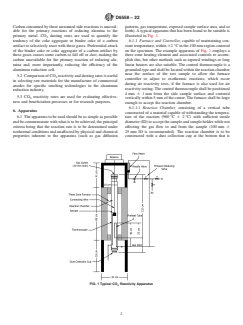
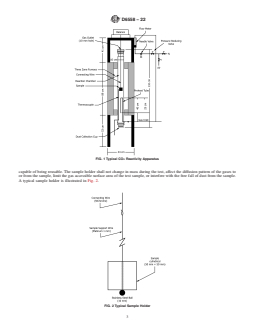
A typical apparatus that has been found to be suitable is illustrated in Fig. 1.
6.1.1 Furnace and Controller, capable of maintaining constant temperature, within 62 °C in the 100 mm region centered on the
specimen. The example apparatus of Fig. 1 employs a three zone heating element and associated controls to accomplish this, but
other methods such as tapered windings or long linear heaters are also suitable. The control thermocouple is a grounded type and
shall be located within the reaction chamber near the surface of the test sample to allow the furnace controller to adjust to
exothermic reactions, which occur during air reactivity tests, if the furnace is also used for air reactivity testing. The control
thermocouple shall be positioned 4 mm 6 1 mm from the side sample surface and centered vertically within 5 mm of the center.
The furnace shall be large enough to accept the reaction chamber.
6.1.1.1 Reaction Chamber, consisting of a vertical tube constructed of a material capable of withstanding the temperature of the
reaction (960 °C 6 2 °C) with sufficient inside diameter (ID) to accept the sample and sample holder while not affecting the gas
flow to and from the sample (100 mm 6 25 mm ID is recommended). The reaction chamber is to be constructed with a dust
collection cup at the bottom that is removable and capable of capturing all the dust that falls off the sample during the test. The
most common materials of construction are quartz and Inconel.
6.1.1.2 Sample Holders, capable of supporting the sample in the reaction chamber for the duration of the test and should be
D6558 − 22
FIG. 1 Typical CO Reactivity Apparatus
capable of being reusable. The sample holder shall not change in mass during the test, affect the diffusion pattern of the gases to
or from the sample, limit the gas accessible surface area of the test sample, or interfere with the free fall of dust from the sample.
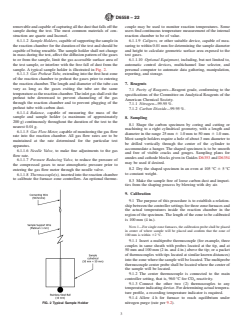
A typical sample holder is illustrated in Fig. 2.
FIG. 2 Typical Sample Holder
D6558 − 22
6.1.1.3 Gas Preheat Tube, extending into the first heat zone of the reaction chamber to preheat the gases prior to entering the
reaction chamber. The length and diameter of the tube can vary as long as the gases exiting the tube are the same temperature as
the reaction chamber. The inlet gas shall exit the preheat tube downward to prevent channeling of the gas through the reaction
chamber and to prevent plugging of the preheat tube with carbon dust.
6.1.1.4 Balance, capable of measuring the mass of the sample and sample holder (a maximum of approximately 200 g)
continuously throughout the duration of the test to the nearest 0.01 g.
6.1.1.5 Gas Flow Meter, capable of monitoring the gas flow rate into the reaction chamber. All gas flow rates are to be maintained
at the rate determined for the particular test apparatus.
6.1.1.6 Needle Valve, to make fine adjustments to the gas flow rate.
6.1.1.7 Pressure Reducing Valve, to reduce the pressure of the compressed gases to near atmospheric pressure prior to entering
the gas flow meter through the needle valve.
6.1.1.8 Thermocouple(s), inserted into the reaction chamber to calibrate the furnace zone controllers. An optional thermocouple
may be used to monitor reaction temperatures. Some users find continuous temperature measurement of the internal reaction
chamber to be of value.
6.1.1.9 Calipers, or other suitable device, capable of measuring to within 0.01 mm for determining the sample diameter and height
to calculate geometric surface area exposed to the test gases.
6.1.1.10 Optional Equipment, including, but not limited to, automatic control devices, multichannel line selector, and personal
computer to automate data gathering, manipulation, reporting, and storage.
7. Reagents
7.1 Purity of Reagents—Reagent grade, conforming to the specifications of the Committee on Analytical Reagents of the American
Chemical Society.
7.1.1 Nitrogen—99.95 %.
7.1.2 Carbon Dioxide—99.95 %.
8. Sampling
8.1 Shape the carbon specimen by coring and cutting or machining to a right cylindrical geometry, with a length of 50 mm 6
1.0 mm and diameter of and diameter in the range 25 mm 6 1.0 mm to 50 mm 6 1.0 mm. Most sample holders require a hole
of about 3 mm diameter to be drilled vertically through the center of the cylinder to accommodate a hanger. The shaped specimen
is to be smooth and free of visible cracks and gouges. Sampling plans for anodes and cathode blocks given in Guides D6353 and
D6354 may be used if desired.
8.2 Dry the shaped specimen in an oven at 105 °C 6 5 °C to constant weight.
8.3 Make the sample free of loose carbon dust and impurities from the shaping process by blowing with dry air.
9. Calibration
9.1 The purpose of this procedure is to establish a relationship between the controller settings for three zone furnaces and the
actual temperatures inside the reaction chamber in the region of the specimen. The length of the zone to be calibrated is 100 mm
(4 in.).
NOTE 1—For single zone furnaces, the calibration probe shall be placed in center of where sample will be placed and confirm that the zone of 100 mm
is within 62 °
...