

ASTM E1476-04(2022)
(Guide)Standard Guide for Metals Identification, Grade Verification, and Sorting
General Information
- Abstract
SIGNIFICANCE AND USE
4.1 A major concern of metals producers, warehouses, and users is to establish and maintain the identity of metals from melting to their final application. This involves the use of standard quality assurance practices and procedures throughout the various stages of manufacturing and processing, at warehouses and materials receiving, and during fabrication and final installation of the product. These practices typically involve standard chemical analyses and physical tests to meet product acceptance standards, which are slow. Several pieces from a production run are usually destroyed or rendered unusable through mechanical and chemical testing, and the results are used to assess the entire lot using statistical methods. Statistical quality assurance methods are usually effective; however, mixed grades, off-chemistry, and nonstandard physical properties remain the primary causes for claims in the metals industry. A more comprehensive verification of product properties is necessary. Nondestructive means are available to supplement conventional metals grade verification techniques, and to monitor chemical and physical properties at selected production stages, in order to assist in maintaining the identities of metals and their consistency in mechanical properties.
4.2 Nondestructive methods have the potential for monitoring grade during production on a continuous or statistical basis, for monitoring properties such as hardness and case depth, and for verifying the effectiveness of heat treatment, cold-working, and the like. They are quite often used in the field for solving problems involving off-grade and mixed-grade materials.
4.3 The nondestructive methods covered in this guide provide both direct and indirect responses to the sample being evaluated. Spectrometric analysis instruments respond to the presence and percents of alloying constituents. The electromagnetic (eddy current) and thermoelectric methods, on the other hand, are among those that respond to pr...
SCOPE
1.1 This guide is intended for tutorial purposes only. It describes the general requirements, methods, and procedures for the nondestructive identification and sorting of metals.
1.2 It provides guidelines for the selection and use of methods suited to the requirements of particular metals sorting or identification problems.
1.3 This standard does not purport to address all of the safety concerns, if any, associated with its use. It is the responsibility of the user of this standard to establish appropriate safety, health, and environmental practices and determine the applicability of regulatory limitations prior to use. For specific precautionary statements, see Section 10.
1.4 This international standard was developed in accordance with internationally recognized principles on standardization established in the Decision on Principles for the Development of International Standards, Guides and Recommendations issued by the World Trade Organization Technical Barriers to Trade (TBT) Committee.
- Status
- Published
- Publication Date
- 30-Nov-2022
- Technical Committee
- E07 - Nondestructive Testing
- Drafting Committee
- E07.10 - Specialized NDT Methods
Overview
ASTM E1476-04(2022), titled Standard Guide for Metals Identification, Grade Verification, and Sorting, is published by ASTM International. This standard provides comprehensive guidance for the nondestructive identification, sorting, and grade verification of metals. It addresses the growing needs of metals producers, warehouses, fabricators, and end-users to maintain the traceability and integrity of metal products throughout their lifecycle-from production and processing to storage, receiving, and final installation.
The importance of this standard stems from its ability to ensure metal products meet specified quality and composition requirements without overly destructive sampling and long turnaround times typical of conventional chemical and mechanical tests. Nondestructive testing (NDT) approaches, as described in ASTM E1476, supplement traditional techniques by offering faster, field-applicable, and often more cost-effective ways to prevent mixed grades and mitigate claims resulting from off-specification materials.
Key Topics
Nondestructive Identification Methods
The guide details several nondestructive methodologies, including:- X-ray fluorescence (XRF) spectrometry
- Optical emission spectrometry
- Electromagnetic (eddy current) sorting
- Electrical resistivity/conductivity testing
- Thermoelectric methods
- Chemical spot tests
- Triboelectric and spark testing
Qualitative and Quantitative Analysis
- Quantitative methods (such as XRF and optical emission spectrometry) provide direct analysis of alloying elements.
- Qualitative methods (such as eddy current, thermoelectric, and chemical spot testing) yield comparative information on the composition or mechanical properties.
Reference Standardization
- The selection and use of appropriate reference samples or coupon standards is crucial for instrument calibration, method accuracy, and consistent results.
- Reference standards must closely match the chemical, physical, and processing attributes of the materials under evaluation.
Quality Assurance in Metals Production
- The document emphasizes statistical and continuous quality assurance, combining NDT with traditional methods to provide ongoing verification and rapid feedback during manufacturing or receiving.
Acceptance Criteria and Sorting Automation
- Visual and digital display systems, threshold gates, and automated alarms support efficient decision-making for go/no-go sorting, minimizing the risk of off-grade shipments.
Applications
Adhering to ASTM E1476 is highly valuable in various sectors of the metals industry, including:
Metals Manufacturers
To maintain reliable identification and separation of multiple grades, ensure compliance with customer specifications, and minimize costly field failures or warranty claims.Warehousing and Distribution
For rapid verification of inventory materials during intake or prior to shipping, reducing the risk of mixed-grade stock.Fabrication and Installation
To confirm the correct metals are used in assemblies or structural applications, preventing mismatches that could compromise safety or performance.Field Inspection and Maintenance
Portable NDT instruments described in the standard, like handheld XRF analyzers, allow for on-site verification-critical in construction and infrastructure maintenance.Quality Control and Claim Resolution
Provides objective tools for dispute resolution when verifying the composition or grade of delivered metal products.
By leveraging nondestructive techniques defined in ASTM E1476, organizations can achieve faster turnaround, reduced scrap and loss, and improved product reliability.
Related Standards
Several ASTM standards complement or are referenced by ASTM E1476:
- ASTM E572 - Analysis of Stainless and Alloy Steels by Wavelength Dispersive X-Ray Fluorescence Spectrometry
- ASTM E703 - Practice for Electromagnetic (Eddy Current) Sorting of Nonferrous Metals
- ASTM E977 - Practice for Thermoelectric Sorting of Electrically Conductive Materials
- ASTM E305 - Practice for Establishing and Controlling Spark Atomic Emission Spectrochemical Analytical Curves
- ASTM E566 - Practice for Electromagnetic Sorting of Ferrous Metals
Adopting ASTM E1476 and related standards promotes best practices in metals identification, enhances traceability, and aligns with international standardization principles recognized by organizations such as the WTO Technical Barriers to Trade (TBT) Committee.
Keywords: metals identification, grade verification, nondestructive testing, metals sorting, ASTM E1476, X-ray fluorescence, optical emission spectrometry, eddy current testing, quality assurance, metal reference standards, field verification.
Relations
- Effective Date
- 01-Dec-2023
- Effective Date
- 01-Dec-2023
- Effective Date
- 01-Dec-2019
- Effective Date
- 01-Jul-2016
- Effective Date
- 01-Jul-2016
- Effective Date
- 01-Jun-2014
- Effective Date
- 01-Jun-2014
- Effective Date
- 01-Jun-2014
- Effective Date
- 01-Dec-2012
- Refers
ASTM F355-10a - Standard Test Method for Impact Attenuation of Playing Surface Systems and Materials - Effective Date
- 01-Jul-2010
- Effective Date
- 01-Jun-2010
- Refers
ASTM F355-10 - Standard Test Method for Impact Attenuation of Playing Surface Systems and Materials - Effective Date
- 15-Apr-2010
- Refers
ASTM F355-09 - Standard Test Method for Impact Attenuation of Playing Surface Systems and Materials - Effective Date
- 15-Nov-2009
- Effective Date
- 01-Jun-2009
- Refers
ASTM E703-09 - Standard Practice for Electromagnetic (Eddy-Current) Sorting of Nonferrous Metals - Effective Date
- 01-Jun-2009
Get Certified
Connect with accredited certification bodies for this standard

Element Materials Technology
Materials testing and product certification.

Inštitut za kovinske materiale in tehnologije
Institute of Metals and Technology. Materials testing, metallurgical analysis, NDT.
Sponsored listings
Frequently Asked Questions
ASTM E1476-04(2022) is a guide published by ASTM International. Its full title is "Standard Guide for Metals Identification, Grade Verification, and Sorting". This standard covers: SIGNIFICANCE AND USE 4.1 A major concern of metals producers, warehouses, and users is to establish and maintain the identity of metals from melting to their final application. This involves the use of standard quality assurance practices and procedures throughout the various stages of manufacturing and processing, at warehouses and materials receiving, and during fabrication and final installation of the product. These practices typically involve standard chemical analyses and physical tests to meet product acceptance standards, which are slow. Several pieces from a production run are usually destroyed or rendered unusable through mechanical and chemical testing, and the results are used to assess the entire lot using statistical methods. Statistical quality assurance methods are usually effective; however, mixed grades, off-chemistry, and nonstandard physical properties remain the primary causes for claims in the metals industry. A more comprehensive verification of product properties is necessary. Nondestructive means are available to supplement conventional metals grade verification techniques, and to monitor chemical and physical properties at selected production stages, in order to assist in maintaining the identities of metals and their consistency in mechanical properties. 4.2 Nondestructive methods have the potential for monitoring grade during production on a continuous or statistical basis, for monitoring properties such as hardness and case depth, and for verifying the effectiveness of heat treatment, cold-working, and the like. They are quite often used in the field for solving problems involving off-grade and mixed-grade materials. 4.3 The nondestructive methods covered in this guide provide both direct and indirect responses to the sample being evaluated. Spectrometric analysis instruments respond to the presence and percents of alloying constituents. The electromagnetic (eddy current) and thermoelectric methods, on the other hand, are among those that respond to pr... SCOPE 1.1 This guide is intended for tutorial purposes only. It describes the general requirements, methods, and procedures for the nondestructive identification and sorting of metals. 1.2 It provides guidelines for the selection and use of methods suited to the requirements of particular metals sorting or identification problems. 1.3 This standard does not purport to address all of the safety concerns, if any, associated with its use. It is the responsibility of the user of this standard to establish appropriate safety, health, and environmental practices and determine the applicability of regulatory limitations prior to use. For specific precautionary statements, see Section 10. 1.4 This international standard was developed in accordance with internationally recognized principles on standardization established in the Decision on Principles for the Development of International Standards, Guides and Recommendations issued by the World Trade Organization Technical Barriers to Trade (TBT) Committee.
SIGNIFICANCE AND USE 4.1 A major concern of metals producers, warehouses, and users is to establish and maintain the identity of metals from melting to their final application. This involves the use of standard quality assurance practices and procedures throughout the various stages of manufacturing and processing, at warehouses and materials receiving, and during fabrication and final installation of the product. These practices typically involve standard chemical analyses and physical tests to meet product acceptance standards, which are slow. Several pieces from a production run are usually destroyed or rendered unusable through mechanical and chemical testing, and the results are used to assess the entire lot using statistical methods. Statistical quality assurance methods are usually effective; however, mixed grades, off-chemistry, and nonstandard physical properties remain the primary causes for claims in the metals industry. A more comprehensive verification of product properties is necessary. Nondestructive means are available to supplement conventional metals grade verification techniques, and to monitor chemical and physical properties at selected production stages, in order to assist in maintaining the identities of metals and their consistency in mechanical properties. 4.2 Nondestructive methods have the potential for monitoring grade during production on a continuous or statistical basis, for monitoring properties such as hardness and case depth, and for verifying the effectiveness of heat treatment, cold-working, and the like. They are quite often used in the field for solving problems involving off-grade and mixed-grade materials. 4.3 The nondestructive methods covered in this guide provide both direct and indirect responses to the sample being evaluated. Spectrometric analysis instruments respond to the presence and percents of alloying constituents. The electromagnetic (eddy current) and thermoelectric methods, on the other hand, are among those that respond to pr... SCOPE 1.1 This guide is intended for tutorial purposes only. It describes the general requirements, methods, and procedures for the nondestructive identification and sorting of metals. 1.2 It provides guidelines for the selection and use of methods suited to the requirements of particular metals sorting or identification problems. 1.3 This standard does not purport to address all of the safety concerns, if any, associated with its use. It is the responsibility of the user of this standard to establish appropriate safety, health, and environmental practices and determine the applicability of regulatory limitations prior to use. For specific precautionary statements, see Section 10. 1.4 This international standard was developed in accordance with internationally recognized principles on standardization established in the Decision on Principles for the Development of International Standards, Guides and Recommendations issued by the World Trade Organization Technical Barriers to Trade (TBT) Committee.
ASTM E1476-04(2022) is classified under the following ICS (International Classification for Standards) categories: 77.020 - Production of metals. The ICS classification helps identify the subject area and facilitates finding related standards.
ASTM E1476-04(2022) has the following relationships with other standards: It is inter standard links to ASTM E977-05(2023), ASTM F355-23, ASTM E977-05(2019), ASTM F355-16e1, ASTM F355-16, ASTM E703-14, ASTM E566-14, ASTM E977-05(2014), ASTM E572-12, ASTM F355-10a, ASTM E977-05(2010), ASTM F355-10, ASTM F355-09, ASTM E566-09, ASTM E703-09. Understanding these relationships helps ensure you are using the most current and applicable version of the standard.
ASTM E1476-04(2022) is available in PDF format for immediate download after purchase. The document can be added to your cart and obtained through the secure checkout process. Digital delivery ensures instant access to the complete standard document.
Standards Content (Sample)
This international standard was developed in accordance with internationally recognized principles on standardization established in the Decision on Principles for the
Development of International Standards, Guides and Recommendations issued by the World Trade Organization Technical Barriers to Trade (TBT) Committee.
Designation:E1476 −04 (Reapproved 2022)
Standard Guide for
Metals Identification, Grade Verification, and Sorting
This standard is issued under the fixed designation E1476; the number immediately following the designation indicates the year of
original adoption or, in the case of revision, the year of last revision.Anumber in parentheses indicates the year of last reapproval.A
superscript epsilon (´) indicates an editorial change since the last revision or reapproval.
1. Scope E572TestMethodforAnalysisofStainlessandAlloySteels
byWavelengthDispersiveX-RayFluorescenceSpectrom-
1.1 This guide is intended for tutorial purposes only. It
etry
describes the general requirements, methods, and procedures
E703PracticeforElectromagnetic(EddyCurrent)Sortingof
for the nondestructive identification and sorting of metals.
Nonferrous Metals
1.2 It provides guidelines for the selection and use of
E977Practice for Thermoelectric Sorting of Electrically
methods suited to the requirements of particular metals sorting
Conductive Materials
or identification problems.
F355TestMethodforImpactAttenuationofPlayingSurface
1.3 This standard does not purport to address all of the
Systems, Other Protective Sport Systems, and Materials
safety concerns, if any, associated with its use. It is the
Used for Athletics, Recreation and Play
responsibility of the user of this standard to establish appro-
F1156Terminology Relating to Product Counterfeit Protec-
priate safety, health, and environmental practices and deter-
tion Systems (Withdrawn 2001)
mine the applicability of regulatory limitations prior to use.
For specific precautionary statements, see Section 10.
3. Terminology
1.4 This international standard was developed in accor-
3.1 Definitions—Terms used in this guide are defined in the
dance with internationally recognized principles on standard-
standards cited in Section 2 and in current technical literature
ization established in the Decision on Principles for the
or dictionaries; however, because a number of terms that are
Development of International Standards, Guides and Recom-
used generally in nondestructive testing have meanings or
mendations issued by the World Trade Organization Technical
carry implications unique to metal sorting, they appear with
Barriers to Trade (TBT) Committee.
explanation in Appendix X1.
2. Referenced Documents
4. Significance and Use
2.1 ASTM Standards:
E158Practice for Fundamental Calculations to Convert
4.1 A major concern of metals producers, warehouses, and
Intensities into Concentrations in Optical Emission Spec-
users is to establish and maintain the identity of metals from
trochemical Analysis (Withdrawn 2004)
melting to their final application. This involves the use of
E305 Practice for Establishing and Controlling Spark
standardqualityassurancepracticesandproceduresthroughout
Atomic Emission Spectrochemical Analytical Curves
the various stages of manufacturing and processing, at ware-
E322Test Method for Analysis of Low-Alloy Steels and
housesandmaterialsreceiving,andduringfabricationandfinal
CastIronsbyWavelengthDispersiveX-RayFluorescence
installation of the product. These practices typically involve
Spectrometry (Withdrawn 2021)
standard chemical analyses and physical tests to meet product
E566Practice for Electromagnetic (Eddy Current/Magnetic
acceptance standards, which are slow. Several pieces from a
Induction) Sorting of Ferrous Metals
production run are usually destroyed or rendered unusable
through mechanical and chemical testing, and the results are
usedtoassesstheentirelotusingstatisticalmethods.Statistical
This guide is under the jurisdiction ofASTM Committee E07 on Nondestruc-
quality assurance methods are usually effective; however,
tiveTesting and is the direct responsibility of Subcommittee E07.10 on Specialized
NDT Methods. mixed grades, off-chemistry, and nonstandard physical proper-
Current edition approved Dec. 1, 2022. Published December 2022. Originally
ties remain the primary causes for claims in the metals
approved in 1992. Last previous edition approved in 2014 as E1476–04(2014).
industry. A more comprehensive verification of product prop-
DOI: 10.1520/E1476-04R22.
erties is necessary. Nondestructive means are available to
For referenced ASTM standards, visit the ASTM website, www.astm.org, or
contact ASTM Customer Service at service@astm.org. For Annual Book of ASTM
supplement conventional metals grade verification techniques,
Standards volume information, refer to the standard’s Document Summary page on
and to monitor chemical and physical properties at selected
the ASTM website.
production stages, in order to assist in maintaining the identi-
The last approved version of this historical standard is referenced on
www.astm.org. ties of metals and their consistency in mechanical properties.
Copyright © ASTM International, 100 Barr Harbor Drive, PO Box C700, West Conshohocken, PA 19428-2959. United States
E1476−04 (2022)
4.2 Nondestructive methods have the potential for monitor- 5.2 Nondestructive methods may be used in conjunction
inggradeduringproductiononacontinuousorstatisticalbasis, with the accepted standard product quality tests to provide
formonitoringpropertiessuchashardnessandcasedepth,and continuous verification that current production lies within the
forverifyingtheeffectivenessofheattreatment,cold-working, agreed upon acceptance limits specified. In-line electromag-
and the like. They are quite often used in the field for solving
netic examinations may be used to indicate the consistency of
problems involving off-grade and mixed-grade materials. production. Any deviation from the norms set for the accep-
tance band will result in automatic alarms, kick-out, or other
4.3 The nondestructive methods covered in this guide pro-
means of alerting production personnel of a problem. Thus
vide both direct and indirect responses to the sample being
alerted,themillcandeterminethecauseforthealarmandtake
evaluated. Spectrometric analysis instruments respond to the
corrective action. Portable optical emission spectrometry units
presence and percents of alloying constituents. The electro-
may be used to determine the concentrations of critical
magnetic (eddy current) and thermoelectric methods, on the
elements without having to resort to slow physical and chemi-
other hand, are among those that respond to properties in the
cal analyses. A quality assurance program combining conven-
sample that are affected by chemistry and processing, and they
tional measurements with suitable nondestructive methods can
yield indirect information on composition and mechanical
provide effective and timely information on product composi-
properties. In this guide, the spectrometric methods are classi-
tion and physical properties. This will result in improved
fied as quantitative, whereas the methods that yield indirect
quality and yield; savings in time, labor, and material; and
readings are termed qualitative.
reduced field failures and claims. This guide provides specific
4.4 This guide describes a variety of qualitative and quan-
information regarding nondestructive metals identification,
titativemethods.Itsummarizestheoperatingprinciplesofeach
gradeverification,andsortingmethodstoassistinselectingthe
method, provides guidance on where and how each may be
optimum approach to solving specific needs.
applied, gives (when applicable) the precision and bias that
5.3 Spectrometricmethodsarecapableofdirectlyindicating
may be expected, and assists the investigator in selecting the
the presence and percent of many of the elements that
best candidates for specific grade verification or sorting prob-
characterize a metal grade. The spectrometric and thermoelec-
lems.
tric techniques examine only the outermost surfaces of the
4.5 For the purposes of this guide, the term “nondestruc-
sampleormaterial.Asaresult,forgradeverificationpurposes,
tive”includestechniquesthatmayrequiretheremovalofsmall
it may be necessary to grind sufficiently deep to ensure access
amountsofmetalduringtheexamination,withoutaffectingthe
tothebasemetalforaccuratereadings.However,grindingmay
serviceability of the product.
affect the thermoelectric response. The spectrometric methods
require physical contact and often some surface preparation.
4.6 The nondestructive methods covered in this guide pro-
The electromagnetic method, however, does not require con-
vide quantitative and qualitative information on metals prop-
tact and very often is suited for on-line, automatic operation.
erties; they are listed as follows:
The thermoelectric method, although requiring contact, re-
4.6.1 Quantitative:
sponds to many of the same parameters that influence the
4.6.1.1 X-ray fluorescence spectrometry, and
electromagnetic responses. Both respond to chemical
4.6.1.2 Optical emission spectrometry.
composition,processing,andtreatmentsthataffectthephysical
4.6.2 Qualitative:
and mechanical properties of the product. Nondestructive
4.6.2.1 Electromagnetic (eddy current),
methodsforindicatingthemechanicalpropertiesofametalare
4.6.2.2 Conductivity/resistivity,
beyond the scope of this guide.
4.6.2.3 Thermoelectric,
5.4 Each method has particular advantages and disadvan-
4.6.2.4 Chemical spot tests,
tages. The selection of suitable candidates for a specific grade
4.6.2.5 Triboelectric, and
verification or sorting application requires an understanding of
4.6.2.6 Spark testing (special case).
the technical operating features of each method.These include
the precision and bias necessary for the application and
5. Background
practical considerations such as product configuration, surface
5.1 The standard quality assurance procedures for verifying
condition, product and ambient temperatures, environmental
the composition and physical properties of a metal at a
constraints, etc.
producing facility are through chemical analysis and mechani-
cal testing. These required tests result in the sacrifice of a
6. General Procedures
certain amount of production for the preparation of samples,
6.1 Standardization/Calibration:
are costly and time-consuming, and may not provide timely
information regarding changes in product quality. In a market 6.1.1 Of primary concern in any materials identification or
in which a single failure can result in heavy litigation and sorting program is delineation of the pertinent product charac-
damage costs, the manufacturer requires assurance that his teristics (such as chemical composition, processing,
production will meet the customer’s acceptance standards. configuration, and physical properties) and the assignment of
Nondestructivegradeverificationprovidesonemeansofmoni- acceptance limits to each. Often prescribed by materials
toring production to ensure that the product will meet accep- specifications, they also may result from quality assurance
tance requirements. proceduresorbyagreementbetweentheproducerandtheuser.
E1476−04 (2022)
6.1.2 Of equal importance is the selection of reference electromagnetic method. Composition, size, processing, sur-
standards. Quantitative methods employ coupon standards that face condition, finish, straightness, and temperature must be
are representative of the metals or alloy compositions to be nominally the same as that represented by the standard
verified, and the analytical instrumentation is standardized samples. To a lesser degree, this is also true for the thermo-
against them. The indirect methods, particularly those that electricmethod.Fortheothermethods,size,configuration,and
respond to physical properties as well as composition, require mechanical processing usually do not affect composition read-
reference standards that will represent the material specified in ings to any significant degree.
composition, mechanical and physical properties, and
6.2.2 The means for performing the examination must be
processing, as well as cover the means and extremes of the
controlled. If some surface metal removal is necessary (as it is
acceptance band. Coupon reference standards or product ref-
forspectrometricexaminations),theamountofremoval,means
erence standards, or both, may be selected as required.
of removal, and removal location on the piece must be
6.1.2.1 Coupon Reference Standards—These are small, eas-
specified and monitored closely. For electromagnetic
ily handled metal panels made to specified chemical composi-
examinations, the piece should be positioned in the same
tions. They are available commercially in sets, singly, or to
manner relative to the coil as is the product standard sample.
specification. They are useful for instrument standardization,
Failuretocontrolvariablescanresultinthemisidentificationof
determining separability among metals, and field use with
samples.
portable equipment.They are not intended to reflect the effects
6.3 Display and Accept/Reject Criteria:
of processing or heat treatment on the acceptability of a
6.3.1 Most systems employ some form of visual display or
product.
readout to indicate the response to piece variables. Meter
6.1.2.2 Product Reference Standards—Thesemustrepresent
readings, oscilloscope patterns, digital signals, and colored
the product specified in composition and mechanical and
spots (from a reagent in chemical spot testing) are typical
physical properties. Ideally, three or more product reference
examples. On instruments with digital or cathode ray tube
standards covering the mean, plus two or more covering the
displays,itiscommonpracticetoshowthepositionandextent
extremes, should be obtained, suitably catalogued, and marked
of adjustable gates for the setting of automatic alarm circuits.
for proper identification.
6.3.2 Automaticalarmgatesmaybepositionedandadjusted
6.1.3 Standardization or calibration procedures, or both, for
tobetriggeredbythepresenceorabsenceofasignalofagiven
each method must be followed as specified by the instrument
amplitude and location. Both of these are adjustable. They are
manufacturer. Coupon reference standards are used to stan-
designed for use in automatic or operator-assisted systems to
dardize and set up quantitative (spectrometric) or qualitative
indicate when a product falls outside the acceptance limits, as
(thermoelectric and chemical spot test, etc.) verifications, as
well as to indicate whether it falls on the high or the low side.
wellasformetalssortingchecksonelectromagnetic,electrical
Similarly, instruments may be equipped with a computer buss
conductivity, and similar instruments. Rod, bar, wire, and
interface for electronic data processing.
tubularproductreferencestandardsareusedalmostexclusively
6.3.3 As described in the standardization and setup
for the qualitative methods, such as the electromagnetic,
procedure, acceptance and rejection criteria should be estab-
electrical conductivity, triboelectric, and spark tests. These are
lished on the basis of specified product parameters.These may
fabricated from the product being manufactured, from samples
beasimplego/no-goselectionoramorecomplexclassification
with compositions and physical properties verified through
based on special requirements. The decision as to how refined
analytical examinations.
a sorting is possible is based on a number of product and
6.1.4 The known product reference standards used for the
measurement variables that are peculiar to the product, exami-
qualitative methods must be representative of the chemistry,
nation method(s), and service requirements. Such decisions
processing, surface, and other physical and mechanical param-
should be handled on an individual basis.
eters that might affect readings. Product standard parameters
must be verifiable.
7. Survey of Nondestructive Metals Sorting/Grade
6.1.5 Coupon reference standards are useful for initial
Verification Methods
instrument adjustments, but final adjustments should be made
on standard samples verified as representative of good produc-
7.1 X-ray Fluorescence Spectrometry Method (Fig. 1):
tion pieces.
7.1.1 Summary of Method—X-rayfluorescence(XRF)spec-
6.1.6 Productstandardsampleswilldisclosepotentialerrors
trometry is a comparative analytical method that employs
that might result from surface alloy depletion, heavy oxide
low-energy(1toapproximately30keV)X-raysorgammarays
layers,orhardnessvariationsresultingfromprocessinganoma-
to excite characteristic X-rays in the subject material. These
lies. Such known variables must be used to determine final
X-raysemanatefromtheindividualelementsinthesubjectand
acceptance limits for any examination, and they will aid
may be analyzed by either of the following means: qualitative
materially in both selecting a method and optimizing the
(recognition of the elements by unique X-ray patterns) or
examination conditions.
quantitative (identification of characteristic X-rays and mea-
6.2 Test Piece Requirements:
surement of their intensities). Sensitive and sophisticated
6.2.1 The relationship between the standard product laboratory XRF systems have been in use for many years.
samples and pieces being evaluated must be understood More recently, the advent of improved detectors and
clearly. This is of particular importance when using the microelectronics,coupledwithadvancedcomputertechnology,
E1476−04 (2022)
7.1.4 Calibration—Calibration information may be part of
the instrumentation program supplied by the manufacturer for
each unit, and may be verified by using standard test blocks of
known composition.
7.1.5 Speed—Qualitativesortingmaybeaccomplishedinas
few as 5 s per sample (exclusive of handling and surface
preparation time). Quantitative readings may require from 10
to 200 s. Some sources report that readings may be made in 1
s.
7.1.6 Accuracy—Statementsofprecisionandbiasvaryfrom
manufacturer to manufacturer and from element to element.
Users of the XRF method should refer to the instrument
referencemanualsandtoMethodE322andTestMethodE572.
7.1.7 Advantages:
7.1.7.1 May be used in quantitative or qualitative mode;
FIG. 1 X-Ray Fluorescence Spectrometry
7.1.7.2 Provides reasonably accurate alloy identification;
7.1.7.3 Portable and easy to use;
7.1.7.4 Direct reading; and
have resulted in portable XRF systems capable of yielding
7.1.7.5 Digital numeric readout/printout available.
accurate readings on the shop floor and in the field.
7.1.8 Disadvantages:
7.1.2 Displays—X-ray fluorescence analyzers are typically
7.1.8.1 Careful sample surface preparation often necessary;
programmed to respond to a specific set of alloys selected as
7.1.8.2 Elements with atomic numbers of 22 or below (for
representative of the composition of the materials examined.
example, aluminum, carbon, silicon, sulfur, and phosphorus)
The displays are numeric and show the percent concentration
show poor responses on portable/transportable units;
of each designated element. Hard-copy printouts of these
7.1.8.3 Potential radiation safety hazard; and
readings are available. From 1 to 18 elements may be
7.1.8.4 Alloying constituents with similar characteristic
displayed, depending on the equipment design and manufac-
wavelengths may produce uncertain or false results.
turer.Eighttotenelementsareconsideredsufficientforprecise
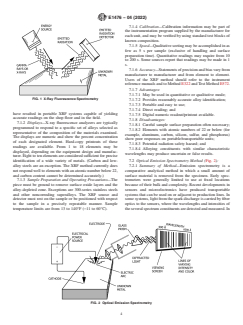
7.2 Optical Emission Spectrometry Method (Fig. 2):
identification of a wide variety of metals. (Carbon and low-
alloy steels are an exception. The XRF method currently does 7.2.1 Summary of Method—Emission spectrometry is a
notrespondwelltoelementswithanatomicnumberbelow22, comparative analytical method in which a small amount of
and carbon content cannot be determined accurately.) surface material is removed from the specimen. Early spec-
7.1.3 Sample Preparation and Operating Precautions—The trometers were generally limited to use at fixed locations
piece must be ground to remove surface oxide layers and the because of their bulk and complexity. Recent developments in
alloy-depleted zone. Exceptions are 300-series stainless steels sensors and microelectronics have produced transportable
and other noncorroding superalloys. The XRF source and systems that can be used on or adjacent to production lines. In
detector must rest on the sample or be positioned with respect somesystems,lightfromthesparkdischargeiscarriedbyfiber
to the sample in a precisely repeatable manner. Sample optics to the sensors, where the wavelengths and intensities of
temperature limits are from 13 to 140°F (−11 to 60°C). theseveralspectrumconstituentsaredetectedandmeasured.In
FIG. 2 Optical Emission Spectrometry
E1476−04 (2022)
other systems, the fine particles dislodged by the spark dis- 7.2.8.4 Unproven when separation is based on carbon,
chargearecarriedbycapillarytubetoachamberinwhichthey sulfur, or phosphorus.
areburnedundercontrolledconditionsandthespectrumofthe
7.3 Electromagnetic Method:
flame is analyzed. Photomultipliers are used with diffraction
7.3.1 Summary of Method—The electromagnetic (Eddy
gratings to measure the intensities of preselected analytical
Current) method is a primary means for high-speed, non-
lines in the spectrum. The numerical results are displayed in
contact, and automatic sorting of ferrous and nonferrous
digitalformonreadoutsorprintedoutinhardcopy,orboth.In
metals.Thechemicalcomposition,metallurgicalstructure,and
the semiquantitative mode, the information may be displayed
mechanical properties of metals affect the electromagnetic
on a cathode-ray tube (CRT), and red and green lights at the
properties of metals to varying degrees, making this method
remote sensor indicate whether the piece lies within the grade
versatileandusefulformetalscharacterization.Acoilisplaced
acceptance limits.
in proximity to the piece, and when an alternating current is
7.2.2 Displays—Percent concentrations of preselected ele-
passed through the coil, an alternating electromagnetic field is
ments are presented in digital form on a CRT, LCD, or similar
induced in the metal under examination. The coil may be a
display, and they may be printed out on hard copy.
probe placed on or near the surface of the piece, or it may be
7.2.3 Sample Preparation and Environment
a solenoid that encircles the piece (around a rod, bar, or pipe).
Considerations—The sample must be free of water, oil, and
The alternating field induced into the piece produces reaction
dirt. Heavy oxide and alloy-depleted layers must be removed
currents and fields that are unique to the electromagnetic
by grinding. The grinding must remove paint, coatings, and
characteristics of the product. Electromagnetic signal
rust to present an area for placing the spark-discharge gun that
amplitude, phase relationships, and harmonic content combine
has no cracks or porosity. Sample temperature limits are 13 to
to characterize the piece. These are sensed by the coil and
140°F (−11 to 60°C).
associated instrumentation and analyzed to indicate significant
7.2.4 Standardization—Certified reference standards should
changes in structure, mass, chemistry, and mechanical
be run two or three times and the readings averaged. The
properties, as compared to a product reference standard. For
concentration-ratio or intensity-ratio methods described in
purposes of grade verification and sorting, the total signal is
Practice E158, and the calibration procedure described in
compared to that from the standard and analyzed. For specific
Practice E305, should be followed.
cases, in which a particular variable in the metal is of interest
7.2.5 Speed—Analysis time ranges from 10 s to 1 min,
(for example, hardness), perhaps only one of the electromag-
exclusive of sample preparation time. This time may be
netic signal variables may yield useful results.
reduced somewhat with faster data acquisition. (The spark
7.3.2 Displays—The electromagnetic method is indirect in
generator must be held in position for 18 s, limiting the
that its effectiveness relies on the correlation of changes in the
maximum speed for samples with good surfaces.)
properties of metals being examined with measurable electro-
7.2.6 Accuracy—Statements of precision and bias vary
magnetic responses. These responses are vector quantities
among manufacturers and from element to element. Users of
containing frequency, amplitude, and phase information, and
the emission spectrometry method should refer to the instru-
they are often displayed on a CRT, on which the signals from
ment reference manuals. Repeatability is very good on stan-
specific grades result in groupings that are unique in phase
dard reference samples. Results on actual pieces may vary
(angle) and amplitude with respect to other metals. Such
because of poor homogeneity, inadequate surface preparation,
groupings on a CRT may be interpreted by an operator who
moisture, and other factors affecting measurement.
rejects all pieces falling out of the acceptance limits set for a
7.2.7 Advantages:
given product. Electronic threshold (box) gates may be gener-
ated and adjusted to encompass the acceptance limits, so that
7.2.7.1 May be operated in a qualitative, comparative, or
quantitative mode; any signal falling outside of these limits will cause automatic
rejection of the sample. Similarly, the signal from the piece
7.2.7.2 Provides reasonably accurate chemical analysis in
may be analyzed in a comparator arrangement, in which the
less than 1 min, exclusive of sample preparation and handling
voltage from the standard sample is compared in phase and
time;
amplitude with a standard voltage that is representative of the
7.2.7.3 Spectrometermaybemobileandoperatedatornear
grade of the product specified. The reference standard voltage
a production line or in the field;
represents the grade, heat treatment, hardness, or other signifi-
7.2.7.4 Direct reading; and
cant parameter of the product, and acceptance limits are
7.2.7.5 Hard-copy records available.
adjusted accordingly. The differences between the reference
7.2.8 Disadvantages:
standard and the piece voltages produce an error signal an
7.2.8.1 Careful surface preparation necessary;
exact match resulting in a zero reading. Limits bracketing zero
7.2.8.2 Operatorfatiguemayaffecttechniquesandaccuracy
may be established to include acceptable variations in product
of readings;
parameters, exclude out-of-tolerance material, and thus permit
7.2.8.3 Alloysandtraceelementswithwavelengthscloseto automatic three-way sorting for acceptable, off-grade low, and
those of the unknown elements may produce erroneous off-grade high product. Guidance for the selection of samples,
determinations, although corrections may be made by analyz- standardization,andestablishingacceptancelimitsaregivenin
ing standard samples of the same grade or similar composi- Practice E566 for sorting of nonferrous metals and in Practice
tions; and E703 for sorting of ferrous metals. Electromagnetic signal
E1476−04 (2022)
amplitude, harmonic content, and phase shifts combine to 7.3.7.1 Not quantitative, that is, requires supporting quanti-
characterize the piece and relate to material structure, size, tative measurements to establish operating parameters;
chemistry, and mechanical properties. For most grade verifi-
7.3.7.2 Sensitivity to a wide range of variables can confuse
cation problems, the total signal or the fundamental frequency
the results, and dissimilar materials may exhibit similar elec-
signal is analyzed. For specific cases, perhaps only one or two
tromagnetic characteristics, requiring supplemental examina-
componentsofthetotalsignalareselectedasresponsivetothe
tion using other methods;
variable (for example, hardness) of interest.
7.3.7.3 Coil and part temperatures can cause drift; and
7.3.7.4 Where sorting is to be conducted on the basis of
NOTE 1—The electromagnetic method has the potential for on-line
composition alone, the response to heat treatment, mechanical
grade verification or process monitoring of metals at elevated processing
temperatures. Water-cooled encircling coils suitable for use on wire, rod,
working, and other processing variables can result in the
bar, and tubular products are available for use at a temperature of 2000°F
misidentification of metals with the same composition.
(1100°C) and are used with suitable instrumentation for these purposes.
7.4 Electrical Resistivity Method:
7.3.3 Standardization—Certification of a sorting system re-
7.4.1 Summary of Method—Electrical resistivity is a prop-
lies on standardization based on standard reference samples of
ertyofmetalsthatisaffectedby,amongotherfactors,chemical
the product that are representative of the size, nominal chemi-
composition and grain structure, and it can be considered as a
cal composition, and processing specified for the product.Two
means for sorting electrically conductive materials. The resis-
or three samples each, of product representing the means and
tivity method utilizes a probe with four in-line, equally spaced
extremes of the acceptance range, should be used, and system
pins (electrodes) placed in contact with a metal. A constant
adjustments should be made accordingly. Practices E566 and
current is passed through the material from the outer two
E703liststepsfortheselectionofreferencesamples,settingof
electrodes, and a potential drop is measured across the inner
acceptance limits and standardization procedures, and precau-
two electrodes. The potential drop is usually converted to
tions and interferences that should be observed. New
resistivity and displayed on a conventional meter or digital
microprocessor-based instrumentation provides a different ap-
readout.Thereadoutmayrefertotheabsoluteresistivityofthe
proach to standardization. Data for a large number of test
material, or it may be a relative resistivity value. This mea-
specimensmaybestored,permittinganaccurateassessmentof
surement requires direct, uniform contact with the material
the normal distribution of product variables and a highly
surface using the four-point probe. The examination is con-
accurate standardization of grade verification results.
ducted by placing the probe on the object whose electrical
7.3.4 Speed—The electromagnetic method is capable of
resistivity is to be determined, applying the current, and
high-speed operation. Speed is dependent on the geometry of
reading the meter.
the part, excitation frequency, time necessary to make a grade
7.4.2 Displays—The display reads out either resistivity or
determination, and product handling considerations. The rela-
conductivity on an analog or digital display.
tionship of the coil to the part must be such that the electro-
7.4.3 Sample Preparation and Environmental
magneticsignalsobtainedfrompiecetopieceareconsistent,so
Considerations—Epoxies,paints,andothernonconductivesur-
that the signal is not affected by part geometry or position.
face coatings, as well as surface oxides, dirt, oil, and greas
...