

ASTM E2620-15(2020)
(Classification)Standard Classification for Program and Project Estimate Summaries
General Information
- Abstract
SIGNIFICANCE AND USE
4.1 Program and project estimates are a necessary part of planning and implementing any program of work.
4.2 These estimates are used by persons involved in the planning and management of programs and projects. They are an essential part of establishing initial budgets and provide a framework for continuing updates permitting cost control through the life of a program and its various projects.
4.3 Users include owners, developers, facilities programmers, financial managers, company controllers, executives, program managers, project managers, and specialist cost planners including life cycle cost analysts.
4.4 They are also of use in risk management, and also provide a consistent list of major activity phases for use in program and project time schedules.
SCOPE
1.1 This classification establishes a classification of cost summaries for use when estimating program and project costs.
1.2 This classification can be applied to construction programs and projects that include one or more construction work projects.
1.3 This classification is not based on permanent physical elements of construction (as defined and classified in Classification E1557 for example); rather, the classification items are cost components common to most program and project estimates.
1.4 This standard does not purport to address all of the safety concerns, if any, associated with its use. It is the responsibility of the user of this standard to establish appropriate safety, health, and environmental practices and determine the applicability of regulatory limitations prior to use.
1.5 This international standard was developed in accordance with internationally recognized principles on standardization established in the Decision on Principles for the Development of International Standards, Guides and Recommendations issued by the World Trade Organization Technical Barriers to Trade (TBT) Committee.
- Status
- Published
- Publication Date
- 31-Mar-2020
- Technical Committee
- E06 - Performance of Buildings
- Drafting Committee
- E06.81 - Building Economics
Overview
ASTM E2620-15(2020), Standard Classification for Program and Project Estimate Summaries, is an international standard developed by ASTM to establish a structured classification for summarizing cost estimates related to programs and projects. The core purpose of this standard is to provide a consistent framework for generating, presenting, and updating estimates throughout the life cycle of construction programs and projects. This classification supports budget development, cost control, risk management, and project scheduling by organizing costs into clearly defined layers and components.
The standard is highly relevant to a range of professionals, including owners, developers, program and project managers, cost planners, financial managers, company executives, and life cycle cost analysts. By promoting a consistent approach to estimate summaries, ASTM E2620-15(2020) supports better decision-making, enhances transparency, and enables effective communication among stakeholders.
Key Topics
Cost Classification Layers: The standard introduces a multi-layered approach to cost summaries:
- Program Layer: Encompasses overall program activities, such as planning, implementation, operation, and disposal.
- Project Layer: Focuses on activities and costs required to complete a specific project to meet program objectives.
- Construction Layer: Details the costs directly associated with the physical construction entity.
Hierarchy and Structure:
- Costs are organized hierarchically (major group elements, group elements, and elements) without being tied to specific physical components, allowing applicability across various project types.
- The approach supports easy distinction between areas of responsibility and helps ensure costs are categorized consistently.
Significance and Use:
- Essential for initial budget establishment, continuous update, and cost control.
- Provides clear phases and activities that inform project schedules and risk management processes.
Terminology and Consistency:
- References established ASTM standards for unified terminology (e.g., E631, E833, E1557).
- Ensures communication uses shared definitions for common construction and cost terms.
Applications
The practical applications of ASTM E2620-15(2020) span across several domains in the construction industry:
- Budgeting and Cost Control: Enables the development of comprehensive program and project budgets and provides a framework for ongoing monitoring and updating of costs through different project phases.
- Project and Program Management: Serves as a tool for managing projects from identification and planning through to execution, operation, and final closure, facilitating clear assignment of responsibilities at each layer.
- Risk Management: Helps identify and allocate contingency and reserve sums for unplanned events and risks.
- Reporting and Communication: Standardizes reporting formats for estimate summaries, improving clarity and consistency in documentation delivered to stakeholders.
- Procurement and Contract Arrangements: Supports various contractual strategies, including design-bid-build, design-build, and construction management approaches, by classifying costs across all procurement paths consistently.
Professionals using this standard can deliver projects with greater financial transparency, supporting efficient cost management, informed decision-making, and enhanced client confidence.
Related Standards
For comprehensive use and alignment with industry best practices, consider these related ASTM standards:
- ASTM E1557: Classification for Building Elements and Related Sitework-UNIFORMAT II
- ASTM E2514: Practice for Presentation Format of Elemental Cost Estimates, Summaries, and Analyses
- ASTM E631: Terminology of Building Constructions
- ASTM E833: Terminology of Building Economics
- ASTM E2083: Classification for Building Construction Field Requirements, and Office Overhead & Profit
- ASTM E2168: Classification for Allowance, Contingency, and Reserve Sums in Building Construction Estimating
By integrating ASTM E2620-15(2020) with these standards, construction professionals can ensure a robust, standardized approach to cost estimation and program management, compliant with internationally recognized principles.
Keywords: program cost summary, project estimate summary, construction cost classification, budget control, cost management, project management estimating, ASTM standards, risk management in construction, program lifecycle costs.
Relations
- Effective Date
- 01-Apr-2020
- Effective Date
- 01-Apr-2020
- Effective Date
- 01-May-2016
- Effective Date
- 01-Oct-2015
- Effective Date
- 01-Mar-2015
- Effective Date
- 01-Nov-2014
- Effective Date
- 01-Nov-2013
- Effective Date
- 15-Oct-2013
- Effective Date
- 01-Oct-2013
- Effective Date
- 01-May-2012
- Effective Date
- 01-May-2010
- Effective Date
- 01-May-2010
- Effective Date
- 01-Nov-2009
- Refers
ASTM E1557-09 - Standard Classification for Building Elements and Related Sitework-UNIFORMAT II - Effective Date
- 01-Jun-2009
- Effective Date
- 01-May-2009
Get Certified
Connect with accredited certification bodies for this standard

DIBt (Deutsches Institut für Bautechnik)
German Institute for Building Technology.
DIN CERTCO
DIN Group product certification.

Aboma Certification B.V.
Specialized in construction, metal, and transport sectors.
Sponsored listings
Frequently Asked Questions
ASTM E2620-15(2020) is a standard published by ASTM International. Its full title is "Standard Classification for Program and Project Estimate Summaries". This standard covers: SIGNIFICANCE AND USE 4.1 Program and project estimates are a necessary part of planning and implementing any program of work. 4.2 These estimates are used by persons involved in the planning and management of programs and projects. They are an essential part of establishing initial budgets and provide a framework for continuing updates permitting cost control through the life of a program and its various projects. 4.3 Users include owners, developers, facilities programmers, financial managers, company controllers, executives, program managers, project managers, and specialist cost planners including life cycle cost analysts. 4.4 They are also of use in risk management, and also provide a consistent list of major activity phases for use in program and project time schedules. SCOPE 1.1 This classification establishes a classification of cost summaries for use when estimating program and project costs. 1.2 This classification can be applied to construction programs and projects that include one or more construction work projects. 1.3 This classification is not based on permanent physical elements of construction (as defined and classified in Classification E1557 for example); rather, the classification items are cost components common to most program and project estimates. 1.4 This standard does not purport to address all of the safety concerns, if any, associated with its use. It is the responsibility of the user of this standard to establish appropriate safety, health, and environmental practices and determine the applicability of regulatory limitations prior to use. 1.5 This international standard was developed in accordance with internationally recognized principles on standardization established in the Decision on Principles for the Development of International Standards, Guides and Recommendations issued by the World Trade Organization Technical Barriers to Trade (TBT) Committee.
SIGNIFICANCE AND USE 4.1 Program and project estimates are a necessary part of planning and implementing any program of work. 4.2 These estimates are used by persons involved in the planning and management of programs and projects. They are an essential part of establishing initial budgets and provide a framework for continuing updates permitting cost control through the life of a program and its various projects. 4.3 Users include owners, developers, facilities programmers, financial managers, company controllers, executives, program managers, project managers, and specialist cost planners including life cycle cost analysts. 4.4 They are also of use in risk management, and also provide a consistent list of major activity phases for use in program and project time schedules. SCOPE 1.1 This classification establishes a classification of cost summaries for use when estimating program and project costs. 1.2 This classification can be applied to construction programs and projects that include one or more construction work projects. 1.3 This classification is not based on permanent physical elements of construction (as defined and classified in Classification E1557 for example); rather, the classification items are cost components common to most program and project estimates. 1.4 This standard does not purport to address all of the safety concerns, if any, associated with its use. It is the responsibility of the user of this standard to establish appropriate safety, health, and environmental practices and determine the applicability of regulatory limitations prior to use. 1.5 This international standard was developed in accordance with internationally recognized principles on standardization established in the Decision on Principles for the Development of International Standards, Guides and Recommendations issued by the World Trade Organization Technical Barriers to Trade (TBT) Committee.
ASTM E2620-15(2020) is classified under the following ICS (International Classification for Standards) categories: 91.010.20 - Contractual aspects. The ICS classification helps identify the subject area and facilitates finding related standards.
ASTM E2620-15(2020) has the following relationships with other standards: It is inter standard links to ASTM E2620-15, ASTM E1557-09(2020)e1, ASTM E2083-05(2016), ASTM E1557-09(2015), ASTM E631-15, ASTM E631-14, ASTM E833-13b, ASTM E833-13a, ASTM E833-13, ASTM E833-12, ASTM E2083-05(2010), ASTM E2168-10, ASTM E833-09a, ASTM E1557-09, ASTM E833-09. Understanding these relationships helps ensure you are using the most current and applicable version of the standard.
ASTM E2620-15(2020) is available in PDF format for immediate download after purchase. The document can be added to your cart and obtained through the secure checkout process. Digital delivery ensures instant access to the complete standard document.
Standards Content (Sample)
This international standard was developed in accordance with internationally recognized principles on standardization established in the Decision on Principles for the
Development of International Standards, Guides and Recommendations issued by the World Trade Organization Technical Barriers to Trade (TBT) Committee.
Designation:E2620 −15 (Reapproved 2020)
Standard Classification for
Program and Project Estimate Summaries
This standard is issued under the fixed designation E2620; the number immediately following the designation indicates the year of
original adoption or, in the case of revision, the year of last revision. A number in parentheses indicates the year of last reapproval. A
superscript epsilon (´) indicates an editorial change since the last revision or reapproval.
1. Scope E2514 Practice for Presentation Format of Elemental Cost
Estimates, Summaries, and Analyses
1.1 This classification establishes a classification of cost
2.2 Other Standard:
summaries for use when estimating program and project costs.
MasterFormat
1.2 This classification can be applied to construction pro-
grams and projects that include one or more construction work
3. Terminology
projects.
3.1 Definitions: For other definitions of general terms re-
1.3 This classification is not based on permanent physical
latedtobuildingconstructionusedinthisclassification,referto
elements of construction (as defined and classified in Classifi-
Terminology E631; and for general terms related to building
cation E1557 for example); rather, the classification items are
economics, refer to Terminology E833.
cost components common to most program and project esti-
3.1.1 element, n—in construction planning, design,
mates.
specification, estimating, and cost analysis, a significant com-
1.4 This standard does not purport to address all of the ponent part of the whole that performs a specific function, or
functions, regardless of design, specification, or construction
safety concerns, if any, associated with its use. It is the
responsibility of the user of this standard to establish appro- method.
3.1.1.1 Discussion—While through analysis, or by direct
priate safety, health, and environmental practices and deter-
mine the applicability of regulatory limitations prior to use. application, construction estimates categorized into elements
(functional elements) with allocated costs, may be summarized
1.5 This international standard was developed in accor-
dance with internationally recognized principles on standard- in an elemental cost summary or elemental cost analysis;
elements (functional elements) also provide a framework for
ization established in the Decision on Principles for the
Development of International Standards, Guides and Recom- consistent preliminary project description, outline, and perfor-
mance specification, through all stages of planning, design,
mendations issued by the World Trade Organization Technical
Barriers to Trade (TBT) Committee. construction, and maintenance.
3.1.2 elemental cost analysis, n—in construction planning,
2. Referenced Documents
design,specification,estimating,andcostanalysis,atabulation
2.1 ASTM Standards:
of cost categorized by major group element, group element,
E631 Terminology of Building Constructions
or element, or any combination thereof, to which a parameter
E833 Terminology of Building Economics
quantity, or parameter quantities, has, or have, been applied to
E1557 Classification for Building Elements and Related
derive benchmark figures (rates, ratios, percentages, and so
Sitework—UNIFORMAT II
forth).
E2083 Classification for Building Construction Field
3.1.2.1 Discussion—Elemental cost analyses are valuable
Requirements, and Office Overhead & Profit
tools in planning, estimating, and controlling construction cost
E2168 Classification for Allowance, Contingency, and Re-
through all stages of planning and design. The benchmark
serve Sums in Building Construction Estimating
figures are primarily derived from underlying estimate detail
but can, in some circumstances, be used directly to approxi-
mate estimates for other projects.
This classification is under the jurisdiction of ASTM Committee E06 on
3.1.3 elemental cost summary, n—in construction planning,
Performance of Buildings and is the direct responsibility of Subcommittee E06.81
on Building Economics. design,specification,estimating,andcostanalysis,atabulation
Current edition approved April 1, 2020. Published April 2020. Originally
of cost categorized by major group element, group element,
approved in 2008. Last previous edition approved in 2015 as E2620–15. DOI:
or element.
10.1520/E2620-15R20.
For referenced ASTM standards, visit the ASTM website, www.astm.org, or
contact ASTM Customer Service at service@astm.org. For Annual Book of ASTM
Standards volume information, refer to the standard’s Document Summary page on Available from the Construction Specifications Institute (CSI), 110 South
the ASTM website. Union Street, Suite 100, Alexandria VA 22314, http://www.csinet.org.
Copyright © ASTM International, 100 Barr Harbor Drive, PO Box C700, West Conshohocken, PA 19428-2959. United States
E2620−15 (2020)
3.1.4 group element, n—in construction planning, design, framework for continuing updates permitting cost control
specification, estimating, and cost analysis, a significant com- through the life of a program and its various projects.
ponent part of the whole that includes relevant elements
4.3 Users include owners, developers, facilities
which, as a group, perform specific function, or functions,
programmers, financial managers, company controllers,
regardless of design, specification or construction method.
executives, program managers, project managers, and special-
3.1.5 major group element, n—in construction planning,
ist cost planners including life cycle cost analysts.
design, specification, estimating, and cost analysis, a very
4.4 They are also of use in risk management, and also
significant component part of the whole that includes relevant
provide a consistent list of major activity phases for use in
group elements which, as a group, perform major specific
program and project time schedules.
function, or functions, regardless of design, specification or
construction method. 5. Basis of Classification
3.1.6 parameter quantity, n—in construction planning, 5.1 Classification Criteria—The selected classification of
design, specification, estimating, and cost analysis, a measure
terms is based on the following criteria. The terms shall:
of the amount (quantity) of work included within a major
5.1.1 Be readily distinguishable one from the other,
group element, group element,or element, or any combina-
5.1.2 Follow generic management hierarchical lines,
tion thereof, which, using standardized metrics, ensures con-
5.1.3 Allow a distinction between primary realms of
sistent elemental cost analysis preparation and comparison.
responsibility, and
5.1.4 Be appropriate to many forms of construction.
3.1.7 UNIFORMAT II UII, n—a hierarchical breakdown
structure of construction work ordered by elements.
5.2 Primary Classification—Based on the concept of layers
3.1.7.1 Discussion—Primarily designed for cost manage-
that overlay and incorporate subordinate layers to build an
ment (planning, control, and analysis) during the planning,
overall estimated cost picture appropriate for those charged
budgeting, and design phases of construction, its hierarchical
with responsibility for the successful delivery of that layer of
elemental breakdown structure is also used for qualitative–text
the whole. A program may include all the phases envisaged in
rich–reports (preliminary project description, condition
the program’s Whole Life Cycle and will typically include
assessment, asset description), and other quantitative–text and
morethanoneproject.Theseprojectsmaytakeplaceatseveral
numerical–purposes (value engineering, risk analysis, prelimi-
stages in several phases in a program’s life cycle and may be
nary time schedule, building information modeling).
concurrent or sequential, or both, in their delivery. A project
will include at least one constructed entity but may include
3.2 Definitions of Terms Specific to This Standard: Defini-
more, constructed concurrently or sequentially, or both.
tions for the terms program, project, and construction are
5.2.1 Program Layer—This layer “wraps” around (over-
legion. For the purposes of this classification, the following
lays) and includes the project layer(s) necessary to complete
variations in the terms are used.
the whole program. It details and summarizes cash expendi-
3.2.1 construction, n—a discrete undertaking, requiring
tures from initial identification of need or opportunity through
concerted effort, that has a specified end product and is
operation and maintenance to final closure and disposal.
accomplished using finite resources.
5.2.2 Project Layer—This layer “wraps” around and in-
3.2.2 construction layer, n—contains those activities and
cludes the construction layer(s). It details and summarizes
associated costs required to manage and deliver a constructed
those cash expenditures appropriate and necessary to deliver-
entity.
ing the constructed entity from inception to completion.
3.2.3 program,n—aspecificcollection,orgroup,ofprojects
5.2.3 Construction Layer—This layer details the specific
that is directed toward a common goal that may also serve as
construction deliverable, be it a building, installation, or other
the basis for defining and planning those projects.
constructed entity.
3.2.4 program layer, n—contains those activities and asso-
6. Description of Program, Project, and Construction
ciated costs required to manage and deliver a collection, or
Layers
group, of projects.
6.1 The “Layer” Concept:
3.2.5 project, n—adiscreteundertaking,requiringconcerted
6.1.1 Programs and projects are typically structured in a
effort, that has defined objectives, a defined life within specific
hierarchical scheme wherein each layer of management has
start and end points, that is usually accomplished by using
specific functions or actions, in addition to control and over-
finite, or limited, resources.
sight responsibilities for those actions taken by subordinate
3.2.6 project layer, n—contains those activities and associ-
layers. The metaphor is that each superior layer “overlays” a
ated costs required to manage and deliver a project.
subordinate layer. Removing each “layer” will uncover a more
specific layer beneath. This classification outlines these layers
4. Significance and Use
from the “top-down” although from an estimating point of
4.1 Program and project estimates are a necessary part of
viewitmayoftenbethelower(subordinate)layerthat“drives”
planning and implementing any program of work.
the content and magnitude of the next layer up. Some organi-
4.2 These estimates are used by persons involved in the zations may well wish to view this hierarchy in a “bottom-up”
planning and management of programs and projects. They are manner which may be done without changing the layer
an essential part of establishing initial budgets and provide a concept. Appendix X1 uses this “bottom-up” approach.
E2620−15 (2020)
6.1.2 Therewillbeseverallevelsofdetailwithineachlayer. objective, a specific beginning, and a defined end. A project
For example, Classification E1557 uses the term level to may include more than one constructed entity, and these may
describe its hierarchy of increasing detail supporting each
be constructed sequentially, concurrently, or in a combination
Major Group Element, Group Element, Element, and Sub- of these two modes. Projects involving construction typically
Element. To avoid confusion, and allow for clarity in
include two major phases of activity:
discussion,thisclassificationquitespecificallyavoidsusingthe
6.1.7.1 Design Phase, and
term level when distinguishing between the three identified
6.1.7.2 Construction Phase.
layers.
6.1.8 Construction refers to the physical erection of each
6.1.3 The three layers represent three readily identifiable
constructedentity,beitabuilding,abridge,oroneofthemany
layers of responsibility that are applicable when managing a
different construction forms extant in the built environment.
construction program or construction project.
6.1.4 Each layer might also be likened to a “container”
7. Program Layer
wherein specific functions and actions are contained and
controlled. Some of the functions and actions may become
7.1 The program layer, in its entirety, is an all-
more specific management applications in each succeeding
encompassing, over-arching layer that typically includes all
(lower) layer, although others will not. They will be specific to
phases of the Program.
their layer and may also contain several levels of detail.
7.2 For the purposes of this classification, a program esti-
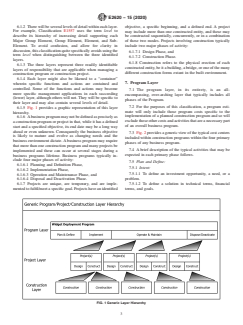
6.1.5 Fig. 1 provides a graphic representation of this layer
mate will only include those program costs specific to the
hierarchy.
implementation of a planned construction program and so will
6.1.6 Abusinessprogrammaynotbedefinedaspreciselyas
excludethoseothercostsandactivitiesthatareanecessarypart
a construction program or project in that, while it has a defined
of an overall business program.
start and a specified objective, its end date may be a long way
ahead or even unknown. Consequently the business objective
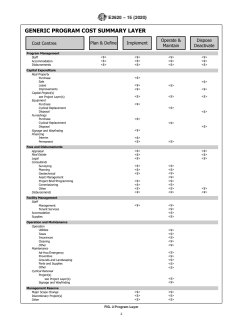
7.3 Fig. 2 provides a generic view of the typical cost centers
is likely to mature and evolve as changing needs and the
included within construction programs within the four primary
business environment dictate.Abusiness program may require
phases of any business program.
that more than one construction program and many projects be
7.4 A brief description of the typical activities that may be
implemented and these can occur at several stages during a
expected in each primary phase follows.
business programs lifetime. Business programs typically in-
clude four major phases of activity:
7.5 Plan and Define:
6.1.6.1 Planning and Definition Phase,
7.5.1 Intent:
6.1.6.2 Implementation Phase,
7.5.1.1 To define an investment opportunity, a need, or a
6.1.6.3 Operation and Maintenance Phase, and
problem.
6.1.6.4 Disposal and Deactivation Phase.
6.1.7 Projects are unique, are temporary, and are imple- 7.5.1.2 To define a solution in technical terms, financial
mentedtofulfil/meetaspecificgoal.Projectshaveanidentified terms, and goals.
FIG. 1Generic Layer Hierarchy
E2620−15 (2020)
FIG. 2Program Layer
E2620−15 (2020)
7.5.1.3 Asuccessful corporate entity will always be search- (b) Furnishings:
ing for improvement, either in product delivery or product Installation:
availability, as a means to maximizing profit (often by cost Moving/Transportation.
reduction), or the identification of new investment opportuni- Storage.
ties. This ongoing activity entails some cost and research. 7.6.3 Participants:
7.5.2 Activities: 7.6.3.1 Project Management Team.
7.6.3.2 Program Manager.
7.5.2.1 Identify Opportunity.
7.5.2.2 Define Objective. 7.6.3.3 Consultants.
7.5.2.3 Analyze and Decide. 7.6.3.4 Contractors.
7.6.3.5 Suppliers.
7.5.2.4 Seek Approvals.
7.5.3 Participants: 7.6.4 Documents:
7.6.4.1 Specifications, Working Drawings, and Contract
7.5.3.1 Program Manager.
Documents.
7.5.3.2 Property Managers.
7.6.4.2 Commissioning and Maintenance Manuals.
7.5.3.3 Real Estate Analysts.
7.6.4.3 As-Built drawings and specifications.
7.5.3.4 Investment and Financial Specialists/Analysts.
7.6.5 Key Product and Critical Decisions:
7.5.3.5 Technical Specialists/Analysts.
7.6.5.1 Constructed facility(ies) that meet the approved
7.5.4 Key Product:
criteria of cost, quality, and time.
7.5.4.1 Program Description.
7.6.5.2 Acceptance of Design.
7.5.5 Critical Decisions:
7.6.5.3 Acceptance of Building.
7.5.5.1 A firm decision to proceed with a new program.
7.6.5.4 Compliance with Brief and Constraints.
7.5.5.2 Appointment of Program Manager(s) and support
team(s).
7.7 Operate and Maintain:
7.5.5.3 Constraints—financial, time, and quality.
7.7.1 Purpose:
7.7.1.1 To operate the facility(ies) for the life of the pro-
7.6 Implement:
gram.
7.6.1 Purpose:
7.7.1.2 To maintain the facility(ies) for efficient operation
7.6.1.1 To design and construct the identified needs in
and in accordance with all applicable codes and regulations.
accordance with the Program Description and within the
7.7.1.3 To operate and maintain the constructed entity(ies),
bounds of the identified constraints.
included within the program, to ensure safe and efficient
7.6.1.2 To design and construct the required facilities in
utilization.
accordance with the approved program decision. To put the
7.7.2 Activities:
requirement into action.
7.7.2.1 Operation.
7.6.2 Activities:
7.7.2.2 Ad-Hoc Maintenance.
7.6.2.1 Locate Finance, both Int
...