

ASTM F2836-18
(Practice)Standard Practice for Gasket Constants for Bolted Joint Design
General Information
- Abstract
SIGNIFICANCE AND USE
5.1 This practice determines the room temperature gasket constants Gb and a for initial seating and Gs for operating conditions as related to the tightness behavior of pressurized bolted flanged connections. These constants are used in determining the design bolt load for gasketed bolted joints.
5.2 This practice is suitable for all the types of gaskets and facings as are considered by the ASME Division 1 Code. This includes ASME B16.5 raised facings, nubbin-type facings, O-ring grooves, and a wide variety of gaskets including spiral wound, flat sheet, solid metal, jacketed, and other types of gaskets common to process and power industry pressurized equipment.
5.3 These constants are intended for direct use in determining ASME Code design calculations for bolted flanged joints. An appendix of the ASME Boiler and Pressure Vessel Code, Section VIII, Division 1 will refer to the gasket constants Gb, a, and Gs produced by this practice. The user and bolted joint designer are cautioned that gasket constants Gb, a, and Gs and any gasket design stresses calculated from these may not be conservative for design stresses below S1 or beyond S13 as indicated in Table 3.
5.4 When required, this practice evaluates both the mechanical and leakage resistance of gaskets to excessive compression to determine their maximum assembly stress, Sc.
5.5 This test procedure is a gasket tightness characterization test and is not considered as a gasket manufacturing quality control test.
SCOPE
1.1 This practice determines room temperature gasket tightness design constants for pressurized bolted flanged connections such as those designed in accordance with the ASME Boiler and Pressure Vessel Code.
1.2 This practice applies mainly to all types of circular gasket products and facings typically used in process or power plant pressure vessels, heat exchangers, and piping including solid metal, jacketed, spiral wound, and sheet-type gaskets. As an optional extension of this practice, the maximum assembly stress for those gaskets may also be determined by this procedure.
1.3 Units—The values stated in SI units are to be regarded as the standard, but other units may be included.
1.4 This standard does not purport to address all of the safety concerns, if any, associated with its use. It is the responsibility of the user of this standard to establish appropriate safety, health, and environmental practices and determine the applicability of regulatory limitations prior to use.
1.5 This international standard was developed in accordance with internationally recognized principles on standardization established in the Decision on Principles for the Development of International Standards, Guides and Recommendations issued by the World Trade Organization Technical Barriers to Trade (TBT) Committee.
- Status
- Published
- Publication Date
- 31-Jul-2018
- Technical Committee
- F03 - Gaskets
- Drafting Committee
- F03.20 - Mechanical Test Methods
Overview
ASTM F2836-18, "Standard Practice for Gasket Constants for Bolted Joint Design," provides a comprehensive method for determining the room temperature gasket constants needed in the design and analysis of bolted flange connections using gaskets. Developed by ASTM International, this standard establishes a unified approach for calculating key gasket constants Gb, a, and Gs, which correlate to the performance and tightness of gasketed joints under pressurized conditions. These constants are essential for engineers and designers when specifying, verifying, and optimizing gaskets used in conjunction with bolted flanges based on the requirements of the ASME Boiler and Pressure Vessel Code and related industry standards.
Key Topics
- Gasket Constant Determination: The standard outlines procedures to obtain gasket constants (Gb and a for initial seating, Gs for operational conditions) by testing under controlled conditions, including application of stress and measurement of tightness and leakage.
- Applicability to Gasket Types: ASTM F2836-18 covers a broad spectrum of gasket materials and designs, such as spiral wound, metal, sheet, jacketed, O-ring, and PTFE gaskets, along with various flange facings (e.g., ASME B16.5 raised face, grooved, and flat).
- Test Methodology: Emphasis is placed on room temperature testing, employing helium as the test media, and using precise instrumentation to evaluate gasket performance in both initial assembly (seating) and during operation under load cycles.
- Design Integration: The constants derived are intended for direct integration into ASME Code design calculations, helping ensure that flanged joint assemblies achieve required leak tightness and structural reliability.
- Limitations and Safety: The standard highlights that resulting constants and calculated joint design stresses may not always be conservative outside specified load ranges, and it is the user's responsibility to verify suitability and address safety and regulatory considerations.
Applications
ASTM F2836-18 is widely used across industries where bolted flanged connections are exposed to internal pressure and require reliable gasketing performance. Key application areas include:
- Process and Power Industries: Chemical plants, refineries, and power stations use this standard to ensure the integrity of pressure vessel, pipeline, and heat exchanger joints.
- Gasket Selection and Qualification: Manufacturers and engineers use the standard to characterize and compare gasket materials, facilitating informed selection based on measured gasket constants.
- Flanged Joint Design: The standard supports precise calculation of required bolt load and gasket stress, improving joint reliability, reducing leakage risk, and ensuring compliance with ASME-required tightness criteria.
- Quality Assurance and Specification: Although not a manufacturing quality control test, results provide valuable data for qualifying gasket types for specified service conditions.
- Maintenance and Troubleshooting: Understanding gasket performance through standardized constants assists in root cause analysis of leakage and enhances maintenance planning for bolted flange systems.
Related Standards
Designers and engineers referencing ASTM F2836-18 should also be aware of related standards that complement gasket and flanged joint design:
- ASME B16.5: Pipe Flanges and Flanged Fittings
- ASME B16.20: Metallic Gaskets for Pipe Flanges
- ASME B16.21: Nonmetallic Flat Gaskets for Pipe Flanges
- ASME Boiler and Pressure Vessel Code, Section VIII, Division 1: Governs the design of pressure vessels and includes direct reference to gasket constants determined by this ASTM practice.
- Welding Research Council Bulletins: Such as WRC 491 and WRC 495, for detailed test fixturing and additional guidance on gasket testing.
By using ASTM F2836-18, industrial facilities, equipment manufacturers, and consulting engineers ensure their bolted flange connections with gaskets meet the highest standards for leak tightness and compliance with international codes and regulations. This standard thus plays a foundational role in the ongoing improvement of pressure boundary reliability and safety in a wide range of engineering applications.
Get Certified
Connect with accredited certification bodies for this standard

Institut za varilstvo d.o.o. (Welding Institute)
Slovenia's leading welding institute since 1952. ISO 3834, EN 1090, pressure equipment certification, NDT personnel, welder qualification. Only IIW Au
Sponsored listings
Frequently Asked Questions
ASTM F2836-18 is a standard published by ASTM International. Its full title is "Standard Practice for Gasket Constants for Bolted Joint Design". This standard covers: SIGNIFICANCE AND USE 5.1 This practice determines the room temperature gasket constants Gb and a for initial seating and Gs for operating conditions as related to the tightness behavior of pressurized bolted flanged connections. These constants are used in determining the design bolt load for gasketed bolted joints. 5.2 This practice is suitable for all the types of gaskets and facings as are considered by the ASME Division 1 Code. This includes ASME B16.5 raised facings, nubbin-type facings, O-ring grooves, and a wide variety of gaskets including spiral wound, flat sheet, solid metal, jacketed, and other types of gaskets common to process and power industry pressurized equipment. 5.3 These constants are intended for direct use in determining ASME Code design calculations for bolted flanged joints. An appendix of the ASME Boiler and Pressure Vessel Code, Section VIII, Division 1 will refer to the gasket constants Gb, a, and Gs produced by this practice. The user and bolted joint designer are cautioned that gasket constants Gb, a, and Gs and any gasket design stresses calculated from these may not be conservative for design stresses below S1 or beyond S13 as indicated in Table 3. 5.4 When required, this practice evaluates both the mechanical and leakage resistance of gaskets to excessive compression to determine their maximum assembly stress, Sc. 5.5 This test procedure is a gasket tightness characterization test and is not considered as a gasket manufacturing quality control test. SCOPE 1.1 This practice determines room temperature gasket tightness design constants for pressurized bolted flanged connections such as those designed in accordance with the ASME Boiler and Pressure Vessel Code. 1.2 This practice applies mainly to all types of circular gasket products and facings typically used in process or power plant pressure vessels, heat exchangers, and piping including solid metal, jacketed, spiral wound, and sheet-type gaskets. As an optional extension of this practice, the maximum assembly stress for those gaskets may also be determined by this procedure. 1.3 Units—The values stated in SI units are to be regarded as the standard, but other units may be included. 1.4 This standard does not purport to address all of the safety concerns, if any, associated with its use. It is the responsibility of the user of this standard to establish appropriate safety, health, and environmental practices and determine the applicability of regulatory limitations prior to use. 1.5 This international standard was developed in accordance with internationally recognized principles on standardization established in the Decision on Principles for the Development of International Standards, Guides and Recommendations issued by the World Trade Organization Technical Barriers to Trade (TBT) Committee.
SIGNIFICANCE AND USE 5.1 This practice determines the room temperature gasket constants Gb and a for initial seating and Gs for operating conditions as related to the tightness behavior of pressurized bolted flanged connections. These constants are used in determining the design bolt load for gasketed bolted joints. 5.2 This practice is suitable for all the types of gaskets and facings as are considered by the ASME Division 1 Code. This includes ASME B16.5 raised facings, nubbin-type facings, O-ring grooves, and a wide variety of gaskets including spiral wound, flat sheet, solid metal, jacketed, and other types of gaskets common to process and power industry pressurized equipment. 5.3 These constants are intended for direct use in determining ASME Code design calculations for bolted flanged joints. An appendix of the ASME Boiler and Pressure Vessel Code, Section VIII, Division 1 will refer to the gasket constants Gb, a, and Gs produced by this practice. The user and bolted joint designer are cautioned that gasket constants Gb, a, and Gs and any gasket design stresses calculated from these may not be conservative for design stresses below S1 or beyond S13 as indicated in Table 3. 5.4 When required, this practice evaluates both the mechanical and leakage resistance of gaskets to excessive compression to determine their maximum assembly stress, Sc. 5.5 This test procedure is a gasket tightness characterization test and is not considered as a gasket manufacturing quality control test. SCOPE 1.1 This practice determines room temperature gasket tightness design constants for pressurized bolted flanged connections such as those designed in accordance with the ASME Boiler and Pressure Vessel Code. 1.2 This practice applies mainly to all types of circular gasket products and facings typically used in process or power plant pressure vessels, heat exchangers, and piping including solid metal, jacketed, spiral wound, and sheet-type gaskets. As an optional extension of this practice, the maximum assembly stress for those gaskets may also be determined by this procedure. 1.3 Units—The values stated in SI units are to be regarded as the standard, but other units may be included. 1.4 This standard does not purport to address all of the safety concerns, if any, associated with its use. It is the responsibility of the user of this standard to establish appropriate safety, health, and environmental practices and determine the applicability of regulatory limitations prior to use. 1.5 This international standard was developed in accordance with internationally recognized principles on standardization established in the Decision on Principles for the Development of International Standards, Guides and Recommendations issued by the World Trade Organization Technical Barriers to Trade (TBT) Committee.
ASTM F2836-18 is classified under the following ICS (International Classification for Standards) categories: 23.040.80 - Seals for pipe and hose assemblies. The ICS classification helps identify the subject area and facilitates finding related standards.
ASTM F2836-18 is available in PDF format for immediate download after purchase. The document can be added to your cart and obtained through the secure checkout process. Digital delivery ensures instant access to the complete standard document.
Standards Content (Sample)
This international standard was developed in accordance with internationally recognized principles on standardization established in the Decision on Principles for the
Development of International Standards, Guides and Recommendations issued by the World Trade Organization Technical Barriers to Trade (TBT) Committee.
Designation: F2836 − 18
Standard Practice for
Gasket Constants for Bolted Joint Design
This standard is issued under the fixed designation F2836; the number immediately following the designation indicates the year of
original adoption or, in the case of revision, the year of last revision.Anumber in parentheses indicates the year of last reapproval.A
superscript epsilon (´) indicates an editorial change since the last revision or reapproval.
1. Scope 3. Terminology
1.1 This practice determines room temperature gasket tight- 3.1 Definitions of Terms Specific to This Standard:
ness design constants for pressurized bolted flanged connec- 3.1.1 ASME Class 150, n—refers to the dimensions and
tions such as those designed in accordance with the ASME pressure rating of Class 150 of standard flanges in ASME
Boiler and Pressure Vessel Code. Standard B16.5.
3.1.2 flange rotation, n—rotation of the flange face surfaces
1.2 This practice applies mainly to all types of circular
so that the gasket outside diameter (OD) is compressed more
gasket products and facings typically used in process or power
than the gasket inside diameter (ID) when the bolts are
plant pressure vessels, heat exchangers, and piping including
tightened to compress the gasket.
solid metal, jacketed, spiral wound, and sheet-type gaskets.As
an optional extension of this practice, the maximum assembly
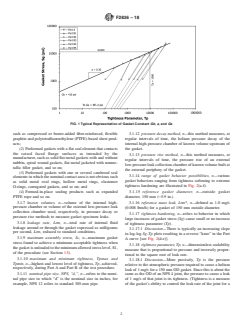
3.1.3 gasket constants, n—if a log-log plot of gasket stress
stress for those gaskets may also be determined by this
versus tightness (Sg-Tp graph) is made and an analysis of the
procedure.
dataisperformedinaccordwiththispractice,then(seeFig.1):
(1)The value, Gb, is the stress intercept (at Tp =1)
1.3 Units—The values stated in SI units are to be regarded
associated with a regression of the Part A tightness data.
as the standard, but other units may be included.
(2)Thevalue, a,istheslopeassociatedwiththePartAdata
1.4 This standard does not purport to address all of the
and combined values of Gb and a describe the seating or
safety concerns, if any, associated with its use. It is the
loading characteristic of a gasket and give an indication of the
responsibility of the user of this standard to establish appro-
gasket capacity to develop tightness upon initial seating.
priate safety, health, and environmental practices and deter-
(3)The value, Gs, is the stress intercept (at Tp =1)
mine the applicability of regulatory limitations prior to use.
associatedwithPartBtightnessdataandvaluesof Gsrepresent
1.5 This international standard was developed in accor-
the gasket potential to maintain tightness after pressurization
dance with internationally recognized principles on standard-
and during operation and indicate the gasket’s sensitivity to
ization established in the Decision on Principles for the
unloading excursions or susceptibility to crushing.
Development of International Standards, Guides and Recom-
(4)The combined effect of constants Gb and a is best
mendations issued by the World Trade Organization Technical
a
represented by the value of S = Gb × Tp calculated for
Tp
Barriers to Trade (TBT) Committee.
typical values of Tp such as 100, 1000, or 10 000 where S
Tp
tells us what the minimum gasket stress shall be to maintain a
2. Referenced Documents
specified level of minimum tightness.
2.1 ASME Standards:
(5)The value, Gs, is an independent constant that repre-
ASME B16.5Steel Pipe Flanges and Flanged Fittings
sents operation and it characterizes the gasket tightness sensi-
ASME B16.20Metallic Gaskets for Pipe Flanges—Ring-
tivity to operating bolt load reductions that occur during
Joint, Spiral-Wound, and Jacketed
pressurization or gasket creep or thermal disturbances.
ASME B16.21Nonmetallic Flat Gaskets for Pipe Flanges
3.1.4 gasket contact area, Ag, n—initial (nominal) area of
ASME Boiler and Pressure Vessel CodeSection VIII Divi-
the gasket that is considered to be loaded by the flange
sion 1, Appendix 2
surfaces.
3.1.5 gasket stress, Sg, n—gasket stress is the ratio of the
ThispracticeisunderthejurisdictionofASTMCommitteeF03onGasketsand
applied load by the fixture over the gasket contact area, Ag.
is the direct responsibility of Subcommittee F03.20 on Mechanical Test Methods.
Current edition approved Aug. 1, 2018. Published November 2018. DOI:
3.1.6 gasket types, n—for this practice, it is convenient to
10.1520/F2836-18.
differentiate gasket styles as:
Available from American Society of Mechanical Engineers (ASME), ASME
(1)Sheetgasketmaterialstypicallyfrom0.5to5mmthick
International Headquarters, Two Park Ave., New York, NY 10016-5990, http://
www.asme.org. commonly in use and in which circular gasket samples are cut,
Copyright © ASTM International, 100 Barr Harbor Drive, PO Box C700, West Conshohocken, PA 19428-2959. United States
F2836 − 18
FIG. 1 Typical Representation of Gasket Constant Gb, a, and Gs
such as compressed or beater-added fiber-reinforced, flexible 3.1.12 pressure decay method, n—this method measures, at
graphite and polytetrafluoroethylene (PTFE)-based sheet prod- regular intervals of time, the helium pressure decay of the
ucts; internal high-pressure chamber of known volume upstream of
(2)Preformed gaskets with a flat seal element that contacts the gasket.
the raised faced flange surfaces as intended by the
3.1.13 pressure rise method, n—this method measures, at
manufacturer, such as solid flat metal gaskets with and without
regular intervals of time, the pressure rise of an external
nubbin, spiral wound gaskets, flat metal jacketed with nonme-
low-pressureleakcollectionchamberofknownvolumebuiltat
tallic filler gasket, and so on;
the external periphery of the gasket.
(3)Preformed gaskets with one or several cambered seal
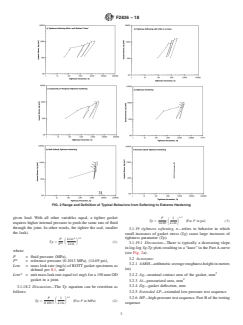
3.1.14 range of gasket behavior possibilities, n—various
elementsinwhichthenominalcontactareaisnotobvioussuch
gasket behaviors ranging from tightness softening to extreme
as solid metal oval rings, hollow metal rings, elastomer
tightness hardening are illustrated in Fig. 2(a-f).
O-rings, corrugated gaskets, and so on; and
(4)Formed-in-place sealing products such as expanded
3.1.15 reference gasket diameter, n—outside gasket
PTFE rope and so on. diameter, 150 mm (~5.9 in.).
3.1.7 known volumes, n—volume of the internal high-
3.1.16 reference mass leak, Lrm*, n—defined as 1.0 mg/s
pressure chamber or volume of the external low-pressure leak
(0.008 lbm/h) for a gasket of 150 mm outside diameter.
collection chamber used, respectively, in pressure decay or
3.1.17 tightness hardening, n—refers to behavior in which
pressure rise methods to measure gasket specimen leaks.
large increases of gasket stress (Sg) cause small or no increase
3.1.8 leakage rate, Lrm, n—total rate of internal fluid
of tightness parameter (Tp).
leakage around or through the gasket expressed as milligrams
3.1.17.1 Discussion—There is typically an increasing slope
per second, Lrm, reduced to standard conditions.
in log-log Sg-Tp plots resulting in a reverse “knee” in the Part
3.1.9 maximum assembly stress, Sc, n—maximum gasket
A curve [see Fig. 2(d-e)].
stress found to achieve a minimum acceptable tightness when
3.1.18 tightness parameter, Tp, n—dimensionlesssealability
thegasketisunloadedtotheminimumallowedstresslevel,S1,
measure that is proportional to pressure and inversely propor-
of the procedure (see Section 13).
tional to the square root of leak rate.
3.1.10 maximum and minimum tightness, Tpmax and
3.1.18.1 Discussion—More precisely, Tp is the pressure
Tpmin, n—highest and lowest level of tightness, Tp, achieved,
relative to the atmospheric pressure required to cause a helium
respectively, during Part A and Part B of the test procedure.
leakof1mg/sfora150mmODgasket.Sincethisisaboutthe
3.1.11 nominal pipe size, NPS, “d,”, n—refers to the nomi- same as the OD of an NPS 4 joint, the pressure to cause a leak
nal pipe size in which “d” is the nominal size in inches, for of 1 mg/s of that joint is its tightness. (Tightness is a measure
example, NPS 12 refers to standard 305-mm pipe. of the gasket’s ability to control the leak rate of the joint for a
F2836 − 18
FIG. 2 Range and Definition of Typical Behaviors from Softening to Extreme Hardening
0.5
given load. With all other variables equal, a tighter gasket P 1
Tp 5 ~For P inpsi! (3)
S D
requires higher internal pressure to push the same rate of fluid 14.69 Lrm
through the joint. In other words, the tighter the seal, smaller
3.1.19 tightness softening, n—refers to behavior in which
the leak).
small increases of gasket stress (Sg) cause large increases of
0.5
tightness parameter (Tp).
P Lrm*
Tp 5 (1)
S D
3.1.19.1 Discussion—There is typically a decreasing slope
P* Lrm
in log-log Sg-Tp plots resulting in a “knee” in the PartAcurve
where:
(see Fig. 2a).
P = fluid pressure (MPa),
3.2 Acronyms:
P* = reference pressure (0.1013 MPa), (14.69 psi),
3.2.1 AARH—arithmeticaverageroughnessheightinmeters
Lrm = mass leak rate (mg/s) of ROTTgasket specimens as
(m)
defined per 8.1, and
3.2.2 Ag—nominal contact area of the gasket, mm
Lrm* = unitmassleakrateequalto1mg/sfora150mmOD
gasket in a joint.
3.2.3 Ai—pressurized area, mm
3.2.4 Dg—gasket deflection, mm
3.1.18.2 Discussion—The Tp equation can be rewritten as
follows:
3.2.5 Extended LP—extended low-pressure test sequence
0.5
P 1
3.2.6 HP—high-pressuretestsequence.PartBofthetesting
Tp 5 ~For P inMPa! (2)
S D
0.1013 Lrm sequence
F2836 − 18
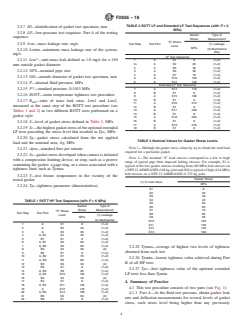
TABLE 2 ROTT LP and Extended LP Test Sequences (with P =2
3.2.7 ID—identification of gasket test specimen, mm
MPa)
3.2.8 LP—low-pressure test sequence. Part A of the testing
Gasket Type of
sequence
Stress Measurement
“S” Stress
3.2.9 Lrm—mass leakage rate, mg/s Test Step Test Part (1) Leakage
Level
MPa
(2) Mechanical
3.2.10 Lrmin—minimum mass leakage rate of the system,
Only
mg/s
LP Test Sequence
3.2.11 Lrm*—unit mass leak defined as 1.0 mg/s for a 150 1 A S1 8 (1+2)
1a A S2 20 (1+2)
mm outside gasket diameter
2 A S3 30 (1+2)
3.2.12 NPS—nominal pipe size 3 A S5 50 (1+2)
4 A S7 70 (1+2)
3.2.13 OD—outside diameter of gasket test specimen, mm
5 A S10 105 (1+2)
6 A S12 140 (1+2)
3.2.14 P—internal fluid pressure, MPa
Extended LP Test Sequence
7 A S14 170 (1+2)
3.2.15 P*—standard pressure, 0.1013 MPa
8 B S1 8 (1+2)
3.2.16 ROTT—room temperature tightness test procedure
9 A S15 190 (1+2)
10 B S1 8 (1+2)
3.2.17 R —ratio of mass leak rates, Lrm1 and Lrm2,
LM
11 A S16 210 (1+2)
measured at the same step of the ROTT test procedure (see
12 B S1 8 (1+2)
13 A S17 230 (1+2)
Tables 1 and 2) in two different ROTT tests performed on a
14 B S1 8 (1+2)
gasket style
15 A S18 250 (1+2)
16 B S1 8 (1+2)
3.2.18 S—level of gasket stress defined in Table 3, MPa
17 A S19 270 (1+2)
3.2.19 Sc—thehighestgasketstressoftheoptionalextended
18 B S1 8 (1+2)
LP tests preceding the stress level that resulted in Tpc, MPa
3.2.20 Sg—gasket stress calculated from the net applied
TABLE 3 Nominal Values for Gasket Stress Levels
load and the nominal area, Ag, MPa
NOTE1—Multiplythegasketstressvaluesby Agtoobtainthetotalload
3.2.21 slpm—standard litre per minute
required for a particular gasket.
3.2.22 Ss—gasket stress developed when contact is initiated
NOTE 2—The nominal “S” load stresses correspond to a low to high
with a compression limiting device, or stop, such as a groove
range of typical pipe fitter imposed bolting stresses. For example, S1 is
containing the gasket, a gage ring, or a stress associated with a
typical of the low gasket stresses resulting from (69 MPa) bolt stresses on
tightness limit such as Tpmax
aNPS12ASME/ANSIcl68kgjointandS10istypicalofhigh(414MPa)
bolt stresses on a NPS 12 ASME/ANSI cl 272 kg joint.
3.2.23 T—test fixture temperature in the vicinity of the
Gasket Stress
tested gasket
(1) S Load Value
MPa
3.2.24 Tp—tightness parameter (dimensionless)
S1 8
S2 20
S3 30
S4 40
TABLE 1 ROTT HP Test Sequence (with P = 6 MPa)
S5 50
Gasket Type of
S6 60
Stress Measurement
S7 70
“S” Stress
Test Step Test Part
S8 80
Level (1) Leakage
MPa
S9 90
(2) Mechanical
S10 105
1 A S1 8 (1+2) S11 120
2 A S2 20 (1+2)
S12 140
3 A S3 30 (1+2) S13 160
4 A, B1 S4 40 (1+2)
5 B1 S1 8 (1+2)
6 A, B1 S5 50 (1+2)
7 A, B2 S6 60 (1+2)
3.2.25 Tpmax—average of highest two levels of tightness
8B2 S2 20 (2)
obtained from each test
9 B2 S1 8 (1+2)
10 A, B2 S7 70 (1+2)
3.2.26 Tpmin—lowest tightness value achieved during Part
11 A, B3 S8 80 (1+2)
B of all HP tests
12 B3 S3 30 (2)
13 B3 S1 8 (1+2)
3.2.27 Tpc—first tightness value of the optional extended
14 A, B3 S9 90 (1+2)
LP tests less than Tpmin
15 A, B4 S10 105 (1+2)
16 B4 S4 40 (2)
17 B4 S1 8 (1+2)
4. Summary of Practice
18 A, B4 S11 120 (1+2)
19 A S12 140 (1+2) 4.1 This test procedure consists of two parts (see Fig. 1):
20 A, B5 S13 160 (1+2)
4.1.1 Part A—At the fluid test pressure, obtain gasket leak
21 B5 S5 50 (2)
rate and deflection measurements for several levels of gasket
22 B5 S1 8 (1+2)
stress, each stress level being higher than any previously
F2836 − 18
applied stress. Part A may be interrupted to perform Part B 6.3.2 LP Test Sequence—ThistestincludessomePartAdata
sequences (see 4.1.2). Part A provides information on initial points only (see 4.1.1) and is performed under a 2 MPa helium
loading known as gasket seating and yields the constants Gb pressure. See Table 2.
and a (see 3.1.3). 6.3.3 Extended LP Test Sequence—When needed, the deter-
mination of the maximum assembly stress, Sc, requires an
4.1.2 Part B—Obtain gasket leak rate and deflection mea-
extension of stress levels of the LPtest sequence of 6.3.2. See
surements under fluid pressure for five unload-reload stress
Table 2.
cycles. Part B is performed by interrupting Part A at five
specific stress levels as shown in Fig. 1. Part B provides
6.4 Test Pressure Regulation—The LP test pressure of 2
information on the operating gasket performance including its
MPa shall be regulated to within 620 kPa. The HP test
sensitivity to load reductions after initial loading. Part B yields
pressure of 6 MPa shall be regulated to within 660 kPa.
the constant Gs (see 3.1.3(5)).
6.5 Test Temperature—Test temperature shall be within 18
to 30°C (64.4 to 86°F) and shall not vary more than 0.550°C/h
5. Significance and Use
(1°F) during a test.
5.1 This practice determines the room temperature gasket
constants Gb and a for initial seating and Gs for operating 7. Apparatus
conditions as related to the tightness behavior of pressurized
7.1 Load Fixture Requirements:
bolted flanged connections. These constants are used in deter- 3
7.1.1 Requirements for Acceptable Fixtures:
mining the design bolt load for gasketed bolted joints.
7.1.1.1 NPS 4,ASME/ANSI Class 1500, or 900 weld neck
flange pairs loaded by hydraulic bolt tensioners.
5.2 This practice is suitable for all the types of gaskets and
facings as are considered by theASME Division 1 Code. This 7.1.1.2 Apair of rigid platens loaded hydraulically within a
larger fixture that is suitable for the hydraulic pressure or
includes ASME B16.5 raised facings, nubbin-type facings,
O-ring grooves, and a wide variety of gaskets including spiral loadedexternallybyaservohydraulictestmachineofadequate
capacity.
wound, flat sheet, solid metal, jacketed, and other types of
gaskets common to process and power industry pressurized 7.1.1.3 The minimum load capacity of the fixture shall be
equipment. 1.56 MN to perform tests on any gasket defined in 8.1. A 1.8
MN fixture is necessary to perform the optional maximum
5.3 These constants are intended for direct use in determin-
assembly stress load sequence on sheet gaskets as defined in
ing ASME Code design calculations for bolted flanged joints.
8.1.1. A capacity of 2.6 MN is necessary to perform the
An appendix of the ASME Boiler and Pressure Vessel Code,
optional maximum assembly stress load sequence on NPS 4
Section VIII, Division 1 will refer to the gasket constants Gb,
size gaskets (8.1.2).
a, and Gs produced by this practice. The user and bolted joint
7.1.1.4 The fixture shall be rigid enough to limit flange or
designer are cautioned that gasket constants Gb, a, and Gs and
platen rotation to 0.01°/100 kN. Class 900 NPS 4 flanges in
any gasket design stresses calculated from these may not be
accord with ASME B16.5 are considered sufficiently rigid for
conservative for design stresses below S1 or beyond S13 as
all types of gaskets as defined in 3.1.6.
indicated in Table 3.
7.1.2 Flanges or Load Platens:
5.4 When required, this practice evaluates both the me-
7.1.2.1 Flanges or load platens shall be steel having an
chanical and leakage resistance of gaskets to excessive com-
elastic modulus between 180 to 210 GPa.
pression to determine their maximum assembly stress, Sc.
7.1.2.2 Load platens shall be machined with a raised face in
accord with NPS 4, ASME Class 1500, or 900 weld neck
5.5 Thistestprocedureisagaskettightnesscharacterization
flanges. The ID of the raised face shall be that of the standard
test and is not considered as a gasket manufacturing quality
flange and its height shall be 6.3 mm (0.25 in.).
control test.
7.1.2.3 The surface finish of each flange or platen shall be
machined with a phonographic-type spiral cut to result in a
6. Test Parameters
roughness value fixed at 6.3 6 1.25 mm (a 1.5 mm radius tool
6.1 Test Media—The test media is helium of high-purity
shall be used). The roughness shall be measured along three
type (99.995 %).
radial lines in the gasket contact region separated by 120°.
Report the average value in mm.
6.2 Test Loads—Test loads correspond to the standard “S”
7.1.3 Gasket Stress Control:
gasket stress levels defined in Table 3 and shall be applied in
7.1.3.1 The gasket stress shall be controlled within the
the sequence described in Tables 1 and 2.Any deviation from
highest of 60.4MPaor1%ofthetargeted gasket stress.
the prescribed sequence is not acceptable.At each stress level,
7.1.3.2 Load reaction caused by an internal pressure acting
gasket stress shall be maintained as per 7.1.3.
over the pressurized area (Ai) contained by the gasket shall be
6.3 Test Sequences—The determination of gasket constants
compensated by additional load so that the intended gasket
Gb, a, and Gs and optional maximum assembly stress, Sc,
stress remains constant as the internal pressure is varied.
requires the use of HP and LP test sequences.
6.3.1 HP Test Sequence—This sequence is a combination of
PartsAand B data points (see 4.1) and is performed under a 6
See Welding Research Council Bulletin #491 for details of fixtures that have
MPa helium pressure. See Table 1. been used previously.
F2836 − 18
Arrangements whereby this compensation is assisted by elimi- bubblefreebyaleakbubbletest.Whenamassspectrometeris
nating a part of the pressure reaction by substantially reducing used, leakage shall not exceed the equipment manufacturer’s
the pressurized area (Ai) are acceptable. criteria for leak testing.
7.1.3.3 If the fixture depends on O-rings or other seals that
react to the applied load, the load reaction of the O-ring
8. Specimens
assembly shall be compensated so that the targeted gasket
8.1 Test Specimen Sampling, Dimensions, and Gasket Area
stress is achieved within the tolerance of 7.1.3.1.
Definition—It is recommended, but not required, that speci-
7.2 Instrumentation:
mensbetakenfromthesamebatchofmanufacturedgasketsor
7.2.1 Pressurization System—The pressure regulation sys-
cut from the same sheet as a means to ensure the greatest
tem shall provide a minimum He flow of 6 mg/s at the target
consistency of results.Although only four samples are needed,
pressure.
six samples minimum and preferably twelve shall be reserved
7.2.2 Internal Pressure Measurement Transducer—A pres-
in case repeat tests are required per Section 10. To the extent
sure transducer rated 0 to 6.9 MPa maximum can be used.
that the same batch sampling does not reflect marketplace
Transducer resolution is to be 0.35 KPa with an accuracy of
variations, it is acceptable, if specified, to require sampling of
60.5 % full scale. This transducer is also used for leak
specimens from different batches.
measurements performed with the pressure decay method (see
8.1.1 Sheet Materials—Gasket test specimens of sheet ma-
7.2.3).
terial shall be precut to 123.8 + 0.5 mm ID (4.87 6 0.020 in.)
7.2.3 Leakage Measurement Equipment—Typically,forgas-
and 149.2 6 0.5 mm (5.87 6 0.20 in.) OD. If other sizes are
ketingproducts,theleakratesvaryingfrom10-8to6mg/smay
used,thedimensionsshallbeincludedinthereportanditshall
need to be measured. The leakage measurement method may
be understood that results may be different. Edges shall be
vary depending on the expected leakage level to be measured
clean and free of burns. These gaskets have a nominal area of
for a tested gasket specimen. For this selection, the following
2 2
Ag = 5450 mm (8.45 in. ).
equipment is recommended:
8.1.2 Preformed Gasket with a Flat Seal Element (Such as
7.2.3.1 Mass flowmeter—Range 0 to 6 mg/s with a resolu-
Spiral Wound)—GasketspecimensshallbesizedNPS4having
tion of 0.01 mg/s and an accuracy of 1 % full scale.
an OD no larger than is suitable for the fixture. The nominal
7.2.3.2 Pressure transducer for the pressure decay
contactarea, Ag,shallbebasedontheinitialcontactareaofthe
method—Same as in 7.2.2.
seal element with the flange or platen-raised faces.
7.2.3.3 Pressure transducer for the pressure rise method—
8.1.3 Preformed Gasket with One or Several Cambered Seal
Sealed or absolute pressure gage rated 101.4 to 140 KPa with
Elements—(This type includes elastomeric or hollow metal
a resolution of 0.0069 KPa and an accuracy of 60.25 % full
ring seal elements situated in a groove or within or between
scale.
-8
metal gage rings.) Gasket specimens shall be sized NPS 4
7.2.3.4 Helium mass spectrometer—Typicalrangefrom10
-1
having an OD no larger than is suitable for the fixture. The
to 10 mg/s of helium.
nominal contact area, Ag, shall be based on the average
7.2.4 Gasket Deflection Measurement—Gasket deflection
circumference of the seal elements multiplied by its initial
(Dg) shall be measured throughout the test at a minimum of
width.The initial width is the width contacting or projected on
two diametrical locations. Deflection measuring devices shall
to the flange or platen-raised face surfaces.
have a resolution of 0.001 mm or less with a minimum
accuracy of 1 % over a minimum range of 6.35 mm.
8.1.4 Formed-in-Place Products (Such as PTFE Rope)—
7.2.5 Fixture Temperature Measurement—A temperature
Circular gasket specimens shall be formed in place on the
probe shall be located in the fixture in the vicinity of the tested
flange or platen-raised face on the basis of the size of an NPS
gasket. The probe resolution shall be 0.01°C with an accuracy
4 preformed gasket. The nominal contact area, Ag, shall be
of 6 1°C, respectively. based on the average circumference of the seal elements times
7.2.6 Test Parameter Control and Recording—The follow-
its full projected initial width on the flange or platen-raised
ing parameters are recorded or regulated or both during a test: faces.
7.2.6.1 Gasket compressive load (or stress)—Recorded and
8.1.5 Flat Solid Metal Gaskets and Jacketed Gaskets for
regulated.
Heat Exchanger Service—Flat solid metal gaskets whether
7.2.6.2 Gasket deflection (change of thickness)—Recorded.
profiled or not, and whether fitted with soft envelope or not
7.2.6.3 Gasket fluid pressure—Recorded and regulated.
(such as Kammprofile), and metal jacketed gaskets, whether
7.2.
...