

ASTM F913-02(2021)
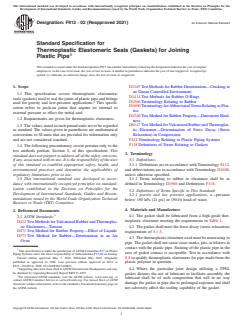
(Specification)Standard Specification for Thermoplastic Elastomeric Seals (Gaskets) for Joining Plastic Pipe
General Information
- Abstract
ABSTRACT
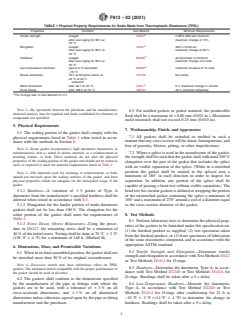
This specification covers thermoplastic elastomeric seals (gaskets) used to seal the push-on joints of plastic pipe and fittings used for gravity and low-pressure applications. The gasket shall be fabricated from a high-grade thermoplastic elastomer meeting the following physical property requirements: tensile strength, elongation, hardness, low-temperature hardness, ozone resistance, accelerated aging, water immersion, and force decay or stress relaxation. All gaskets shall be extruded or molded in such a manner that any cross section will be dense, homogeneous, and free of porosity, blisters, pitting, or other imperfections.
SCOPE
1.1 This specification covers thermoplastic elastomeric seals (gaskets) used to seal the joints of plastic pipe and fittings used for gravity and low-pressure applications.2 This specification refers to push-on joints that require no internal or external pressure to effect the initial seal.
1.2 Requirements are given for thermoplastic elastomers.
1.3 The values stated in inch-pound units are to be regarded as standard. The values given in parentheses are mathematical conversions to SI units that are provided for information only and are not considered standard.
1.4 The following precautionary caveat pertains only to the test methods portion, Section 8, of this specification: This standard does not purport to address all of the safety concerns, if any, associated with its use. It is the responsibility of the user of this standard to establish appropriate safety, health, and environmental practices and determine the applicability of regulatory limitations prior to use.
1.5 This international standard was developed in accordance with internationally recognized principles on standardization established in the Decision on Principles for the Development of International Standards, Guides and Recommendations issued by the World Trade Organization Technical Barriers to Trade (TBT) Committee.
- Status
- Published
- Publication Date
- 30-Apr-2021
- Technical Committee
- F17 - Plastic Piping Systems
- Drafting Committee
- F17.20 - Joining


Overview
ASTM F913-02(2021) - Standard Specification for Thermoplastic Elastomeric Seals (Gaskets) for Joining Plastic Pipe establishes requirements for gaskets made from thermoplastic elastomers (TPEs) used in sealing the push-on joints of plastic pipe and fittings. This specification targets gravity and low-pressure water applications, where joints are typically assembled without internal or external pressure to create an initial seal.
The standard defines the physical, chemical, and performance properties that thermoplastic elastomeric gaskets must meet to ensure reliable sealing, durability, and compatibility with plastic piping systems. It also outlines methods for inspection, acceptance, and storage of these gaskets, helping manufacturers and users maintain quality control and long-term system performance.
Key Topics
Material Requirements
Gaskets must be fabricated from high-grade thermoplastic elastomers that meet strict criteria for:- Tensile strength and elongation (both unaged and after aging)
- Hardness, including performance at low temperatures
- Ozone and water resistance
- Dimensional tolerances and consistency
Physical Property Testing
Performance is verified through laboratory tests, including:- Tensile testing (ASTM D412, D1414)
- Hardness measurement (ASTM D2240)
- Water immersion and volume change (ASTM D471)
- Ozone resistance (ASTM D1149)
- Aging, stress relaxation, and force decay (ASTM D573, D6147)
Manufacture and Quality
All gaskets must be extruded or molded to ensure a dense, homogeneous structure, free from porosity or defects. Splices, if used, require additional verification for strength and integrity.Design and Performance
Gaskets must:- Not cause surface damage (e.g., crazing, pitting) to the plastic pipe after prolonged contact
- Perform reliably in conditions up to specific temperature and pressure thresholds typical of gravity and low-pressure systems
Certification and Marking
Manufacturers are required to certify compliance and provide traceability through clear marking of gaskets with relevant codes and size information.
Applications
ASTM F913-02(2021) is widely used in the water supply, wastewater, and drainage industries for applications involving gravity-fed or low-pressure plastic piping systems. Key use cases include:
- Municipal water mains and distribution lines
- Wastewater and stormwater drainage systems
- Irrigation pipelines
- Industrial and process piping with low-pressure requirements
Push-on joint gaskets covered by this standard are essential for ensuring leak-tight connections, ease of assembly, and long-term reliability in plastic piping installations. The standard provides assurance for specifiers, engineers, and installers that the selected gaskets will perform under typical environmental stresses encountered in the field.
Related Standards
Several ASTM standards underpin and complement ASTM F913-02(2021):
- ASTM D412 - Test Methods for Vulcanized Rubber and Thermoplastic Elastomers-Tension
- ASTM D471 - Test Method for Rubber Property-Effect of Liquids
- ASTM D573 - Test Method for Rubber-Deterioration in an Air Oven (aging)
- ASTM D1149 - Test Methods for Rubber Deterioration-Cracking in an Ozone Controlled Environment
- ASTM D2240 - Test Method for Rubber Property-Durometer Hardness
- ASTM D1414 - Test Methods for Rubber O-Rings (applicable for gasket testing)
- ASTM D6147 - Test Method for Force Decay (Stress Relaxation) in Compression
- ASTM F412 - Terminology Relating to Plastic Piping Systems
- ASTM F118 - Definitions of Terms Relating to Gaskets
Compliance with ASTM F913-02(2021) ensures that thermoplastic elastomeric gaskets deliver consistent, verified performance in critical piping infrastructure, supporting both safety and long-term functionality.
Relations
- Effective Date
- 01-Apr-2020
- Effective Date
- 01-Jan-2019
- Refers
ASTM D1600-18 - Standard Terminology for Abbreviated Terms Relating to Plastics (Withdrawn 2024) - Effective Date
- 01-Jan-2018
- Effective Date
- 01-Aug-2017
- Effective Date
- 01-Feb-2017
- Effective Date
- 15-Nov-2016
- Effective Date
- 01-Aug-2016
- Effective Date
- 01-Jun-2015
- Effective Date
- 01-Feb-2014
- Effective Date
- 15-Apr-2013
- Effective Date
- 15-Feb-2013
- Effective Date
- 01-Apr-2012
- Effective Date
- 01-May-2009
- Effective Date
- 01-Mar-2008
- Effective Date
- 15-Dec-2007
Get Certified
Connect with accredited certification bodies for this standard

Institut za varilstvo d.o.o. (Welding Institute)
Slovenia's leading welding institute since 1952. ISO 3834, EN 1090, pressure equipment certification, NDT personnel, welder qualification. Only IIW Au
Sponsored listings
Frequently Asked Questions
ASTM F913-02(2021) is a technical specification published by ASTM International. Its full title is "Standard Specification for Thermoplastic Elastomeric Seals (Gaskets) for Joining<brk/> Plastic Pipe". This standard covers: ABSTRACT This specification covers thermoplastic elastomeric seals (gaskets) used to seal the push-on joints of plastic pipe and fittings used for gravity and low-pressure applications. The gasket shall be fabricated from a high-grade thermoplastic elastomer meeting the following physical property requirements: tensile strength, elongation, hardness, low-temperature hardness, ozone resistance, accelerated aging, water immersion, and force decay or stress relaxation. All gaskets shall be extruded or molded in such a manner that any cross section will be dense, homogeneous, and free of porosity, blisters, pitting, or other imperfections. SCOPE 1.1 This specification covers thermoplastic elastomeric seals (gaskets) used to seal the joints of plastic pipe and fittings used for gravity and low-pressure applications.2 This specification refers to push-on joints that require no internal or external pressure to effect the initial seal. 1.2 Requirements are given for thermoplastic elastomers. 1.3 The values stated in inch-pound units are to be regarded as standard. The values given in parentheses are mathematical conversions to SI units that are provided for information only and are not considered standard. 1.4 The following precautionary caveat pertains only to the test methods portion, Section 8, of this specification: This standard does not purport to address all of the safety concerns, if any, associated with its use. It is the responsibility of the user of this standard to establish appropriate safety, health, and environmental practices and determine the applicability of regulatory limitations prior to use. 1.5 This international standard was developed in accordance with internationally recognized principles on standardization established in the Decision on Principles for the Development of International Standards, Guides and Recommendations issued by the World Trade Organization Technical Barriers to Trade (TBT) Committee.
ABSTRACT This specification covers thermoplastic elastomeric seals (gaskets) used to seal the push-on joints of plastic pipe and fittings used for gravity and low-pressure applications. The gasket shall be fabricated from a high-grade thermoplastic elastomer meeting the following physical property requirements: tensile strength, elongation, hardness, low-temperature hardness, ozone resistance, accelerated aging, water immersion, and force decay or stress relaxation. All gaskets shall be extruded or molded in such a manner that any cross section will be dense, homogeneous, and free of porosity, blisters, pitting, or other imperfections. SCOPE 1.1 This specification covers thermoplastic elastomeric seals (gaskets) used to seal the joints of plastic pipe and fittings used for gravity and low-pressure applications.2 This specification refers to push-on joints that require no internal or external pressure to effect the initial seal. 1.2 Requirements are given for thermoplastic elastomers. 1.3 The values stated in inch-pound units are to be regarded as standard. The values given in parentheses are mathematical conversions to SI units that are provided for information only and are not considered standard. 1.4 The following precautionary caveat pertains only to the test methods portion, Section 8, of this specification: This standard does not purport to address all of the safety concerns, if any, associated with its use. It is the responsibility of the user of this standard to establish appropriate safety, health, and environmental practices and determine the applicability of regulatory limitations prior to use. 1.5 This international standard was developed in accordance with internationally recognized principles on standardization established in the Decision on Principles for the Development of International Standards, Guides and Recommendations issued by the World Trade Organization Technical Barriers to Trade (TBT) Committee.
ASTM F913-02(2021) is classified under the following ICS (International Classification for Standards) categories: 23.040.80 - Seals for pipe and hose assemblies. The ICS classification helps identify the subject area and facilitates finding related standards.
ASTM F913-02(2021) has the following relationships with other standards: It is inter standard links to ASTM F412-20, ASTM F412-19, ASTM D1600-18, ASTM F412-17a, ASTM F412-17, ASTM F412-16a, ASTM F412-16, ASTM F412-15, ASTM D1600-14, ASTM D1600-13, ASTM F412-13, ASTM F412-12, ASTM F412-09, ASTM D1600-08, ASTM F412-07. Understanding these relationships helps ensure you are using the most current and applicable version of the standard.
ASTM F913-02(2021) is available in PDF format for immediate download after purchase. The document can be added to your cart and obtained through the secure checkout process. Digital delivery ensures instant access to the complete standard document.
Standards Content (Sample)
This international standard was developed in accordance with internationally recognized principles on standardization established in the Decision on Principles for the
Development of International Standards, Guides and Recommendations issued by the World Trade Organization Technical Barriers to Trade (TBT) Committee.
Designation:F913 −02 (Reapproved 2021) An American National Standard
Standard Specification for
Thermoplastic Elastomeric Seals (Gaskets) for Joining
Plastic Pipe
ThisstandardisissuedunderthefixeddesignationF913;thenumberimmediatelyfollowingthedesignationindicatestheyearoforiginal
adoptionor,inthecaseofrevision,theyearoflastrevision.Anumberinparenthesesindicatestheyearoflastreapproval.Asuperscript
epsilon (´) indicates an editorial change since the last revision or reapproval.
1. Scope D1149TestMethodsforRubberDeterioration—Crackingin
an Ozone Controlled Environment
1.1 This specification covers thermoplastic elastomeric
D1414Test Methods for Rubber O-Rings
seals(gaskets)usedtosealthejointsofplasticpipeandfittings
2 D1566Terminology Relating to Rubber
used for gravity and low-pressure applications. This specifi-
D1600TerminologyforAbbreviatedTermsRelatingtoPlas-
cation refers to push-on joints that require no internal or
tics
external pressure to effect the initial seal.
D2240TestMethodforRubberProperty—DurometerHard-
1.2 Requirements are given for thermoplastic elastomers.
ness
1.3 Thevaluesstatedininch-poundunitsaretoberegarded D6147TestMethodforVulcanizedRubberandThermoplas-
tic Elastomer—Determination of Force Decay (Stress
as standard. The values given in parentheses are mathematical
conversions to SI units that are provided for information only Relaxation) in Compression
F412Terminology Relating to Plastic Piping Systems
and are not considered standard.
F118Definitions of Terms Relating to Gaskets
1.4 The following precautionary caveat pertains only to the
test methods portion, Section 8, of this specification: This
3. Terminology
standard does not purport to address all of the safety concerns,
if any, associated with its use. It is the responsibility of the user 3.1 Definitions:
of this standard to establish appropriate safety, health, and 3.1.1 Definitions are in accordance withTerminology F412,
environmental practices and determine the applicability of and abbreviations are in accordance with Terminology D1600,
regulatory limitations prior to use. unless otherwise specified.
1.5 This international standard was developed in accor- 3.1.2 Terms relating to rubber or elastomer shall be as
dance with internationally recognized principles on standard- defined in Terminology D1566 and Definitions F118.
ization established in the Decision on Principles for the
3.2 Definitions of Terms Specific to This Standard:
Development of International Standards, Guides and Recom-
3.2.1 gravity and low pressure applications, n—pressure
mendations issued by the World Trade Organization Technical
below 150 kPa (21 psi) or (50-ft) head of water.
Barriers to Trade (TBT) Committee.
4. Materials and Manufacture
2. Referenced Documents
4.1 The gasket shall be fabricated from a high-grade ther-
2.1 ASTM Standards:
moplastic elastomer meeting the requirements in Table 1.
D412TestMethodsforVulcanizedRubberandThermoplas-
tic Elastomers—Tension
4.2 Thegasketshallmeettheforcedecay(stressrelaxation)
D471Test Method for Rubber Property—Effect of Liquids
requirements of 5.1.3.
D573Test Method for Rubber—Deterioration in an Air
4.3 Thethermoplasticelastomerusedmustbenoncrazingto
Oven
pipe.Thegasketshallnotcausecrazemarks,pits,orblistersin
contact with the plastic pipe. Staining of the plastic pipe in the
This specification is under the jurisdiction ofASTM Committee F17 on Plastic
area of gasket contact is acceptable. Test in accordance with
Piping Systems and is the direct responsibility of Subcommittee F17.20 on Joining.
8.8 to qualify thermoplastic elastomers for pipe made from the
Current edition approved May 1, 2021. Published May 2021. Originally
published as approved in 1986. Last previous edition approved in 2014 as
plastic polymer in question.
F913–02(2014). DOI: 10.1520/F0913-02R21.
4.4 Where the particular joint design utilizing a TPEL
Supporting data have been filed atASTM International Headquarters and may
be obtained by requesting Research Report RR:F17-1035.
gasket dictates the use of lubricant to facilitate assembly, the
For referenced ASTM standards, visit the ASTM website, www.astm.org, or
lubricant shall be of such composition that will in no way
contact ASTM Customer Service at service@astm.org. For Annual Book of ASTM
damagethegasketorpipeduetoprolongedexposureandshall
Standards volume information, refer to the standard’s Document Summary page on
the ASTM website. not adversely affect the sealing capability of the gasket.
Copyright © ASTM International, 100 Barr Harbor Drive, PO Box C700, West Conshohocken, PA 19428-2959. United States
F913−02 (2021)
TABLE 1 Physical Property Requirements for Seals Made from Thermoplastic Elastomers (TPEL)
Properties Condition Test Method Minimum Requirements
A
Tensile strength unaged D412 2 MPa (300 psi) minimum
after oven aging for 96 h at maximum change of 15%
70 °C
A
Elongation unaged D412 350 % minimum
after oven aging for 96 h at maximum change of 20 %
70 °C
A
Hardness unaged D2240 40 durometer A minimum
after oven aging for 96 h at maximum change of 8 units
70 °C
A
Low temperature hardness type A or D durometer D2240 maximum increase of 15 units
−10 °C
Ozone resistance 70 h at 50 pphm ozone at D1149 No cracks
40 °C at 20 %
extension
A
Water immersion after 48 h at 70 °C D471 5 % maximum change in volume
Force Decay after 168 h at 70 °C D6147 40 % minimum remaining
A
For O-rings refer to Test Method D1414
NOTE 1—By agreement between the purchaser and the manufacturer,
6.3 For molded gaskets or gasket material, the permissible
chemical analysis may be required and limits established for elements or
flash shall be a maximum of +0.80mm (0.032 in.). Maximum
compounds not specified.
mold mismatch shall not exceed 0.25 mm (0.010 in).
5. Physical Requirements
7. Workmanship, Finish, and Appearance
5.1 The sealing portion of the gasket shall comply with the
7.1 All gaskets shall be extruded or molded in such a
physical requirements listed in Table 1 when tested in accor-
mannerthatanycrosssectionwillbedense,homogeneous,and
dance with the methods in Section 8.
free of porosity, blisters, pitting, or other imperfections.
NOTE 2—Some gasket incorporated a high durometer elastomeric or
7.2 Where a splice is used in the manufacture of the gasket,
nonelastomeric, that is, metal or plastic material, as a reinforcement or
retaining feature, or both. These materials do not alter the physical thestrengthshallbesuchthatthegasketshallwithstand100%
properties of the sealing portion of the gasket and should not be tested as
elongation over the part of the gasket that includes the splice
such, or expected to meet the material requirements listed in Table 1.
with no visible separation of the splice. (While in a stretched
position the gasket shall be rotated
...