

ASTM D6928-17
(Test Method)Standard Test Method for Resistance of Coarse Aggregate to Degradation by Abrasion in the Micro-Deval Apparatus
General Information
- Abstract
SIGNIFICANCE AND USE
5.1 The Micro-Deval abrasion test is a test of coarse aggregate to determine abrasion loss in the presence of water and an abrasive charge. Many aggregates are more susceptible to abrasion when wet than dry, and the use of water in this test incorporates this reduction in resistance to degradation in contrast to some other tests, which are conducted on dry aggregate. The test results are helpful in evaluating the toughness/abrasion resistance of coarse aggregate subject to abrasion when adequate information is not available from service records.
5.2 The Micro-Deval abrasion test is useful for detecting changes in properties of aggregate produced from an aggregate source as part of a quality control or quality assurance process.
SCOPE
1.1 This test method covers a procedure for testing coarse aggregate for resistance to abrasion using the Micro-Deval apparatus.
1.2 The values stated in SI units are to be regarded as standard. No other units of measurement are included in this standard.
1.3 The text of this method references notes and footnotes which provide explanatory material. These notes and footnotes (excluding those in tables and figures) shall not be considered as requirements of the test method.
1.4 This procedure may involve hazardous materials, operations, and equipment. This standard does not purport to address all of the safety concerns, if any, associated with its use. It is the responsibility of the user of this standard to establish appropriate safety and health practices and determine the applicability of regulatory limitations prior to use.
1.5 This international standard was developed in accordance with internationally recognized principles on standardization established in the Decision on Principles for the Development of International Standards, Guides and Recommendations issued by the World Trade Organization Technical Barriers to Trade (TBT) Committee.
- Status
- Published
- Publication Date
- 31-Mar-2017
- Technical Committee
- D04 - Road and Paving Materials
- Drafting Committee
- D04.51 - Aggregate Tests
Buy Documents
ASTM D6928-17 - Standard Test Method for Resistance of Coarse Aggregate to Degradation by Abrasion in the Micro-Deval Apparatus
REDLINE ASTM D6928-17 - Standard Test Method for Resistance of Coarse Aggregate to Degradation by Abrasion in the Micro-Deval Apparatus
Overview
ASTM D6928-17 is the Standard Test Method for Resistance of Coarse Aggregate to Degradation by Abrasion in the Micro-Deval Apparatus, developed by ASTM International. This method provides an established procedure to evaluate the abrasion resistance and durability of coarse aggregates-from various sources-when exposed to mechanical wear in a wet environment. Unlike certain dry abrasion tests, the Micro-Deval method simulates real-world conditions where aggregates frequently encounter moisture, offering practical insight into performance in applications like roadways, concrete, and asphalt.
This standard is essential for aggregate producers, construction project managers, quality control laboratories, and engineers who require reliable methods for assessing the long-term performance of materials used in infrastructure and construction.
Key Topics
- Abrasion Resistance Assessment: The test measures the loss of mass of coarse aggregate samples subjected to abrasion and grinding with steel balls in the presence of water.
- Significance of Wet Abrasion Testing: Many aggregates exhibit reduced abrasion resistance when wet. The Micro-Deval test reflects the additional degradation risk that occurs under real, often moist, service conditions.
- Quality Control and Assurance: The method serves as a key tool for detecting changes in aggregate quality at the source. It aids in ongoing quality control and quality assurance throughout production and prior to material acceptance for specific projects.
- Testing Procedure Highlights: The process involves soaking aggregate samples, rotating them with steel balls in a sealed container, and measuring the proportion of material lost after processing.
- Safety Considerations: The procedure requires awareness of potential hazards, as it involves heavy equipment, abrasive materials, and oven drying at high temperatures.
Applications
The ASTM D6928-17 Micro-Deval test is applicable to a variety of civil engineering and construction scenarios:
- Aggregates for Pavement and Road Construction: The test is widely used to evaluate aggregates destined for road bases, sub-bases, and surface courses where resistance to degradation is critical for lifespan and safety.
- Structural Concrete Production: In structural concrete, aggregate durability greatly influences long-term strength and serviceability. The test supports the selection of robust materials, especially when service records are unavailable.
- Asphalt Concrete Mixtures: It is an effective method for screening aggregate for asphalt layers, where materials are exposed to significant wear and environmental moisture.
- Source Qualification: Producers and purchasers use the test to certify aggregate sources, confirm compliance with specifications, and ensure consistency between batches.
- Quality Monitoring Over Time: Regular testing reveals shifts in material properties from a single source, helping identify issues early and supporting regulatory or customer requirements.
Related Standards
Several other ASTM standards intersect with or complement ASTM D6928-17 in the material testing and construction quality domain:
- ASTM C136 - Test Method for Sieve Analysis of Fine and Coarse Aggregates: Specifies grading used in preparing aggregate samples for the Micro-Deval test.
- ASTM E11 - Specification for Woven Wire Test Sieve Cloth and Test Sieves: Relates to the sieves necessary for sample processing and analysis.
- ASTM C670 - Practice for Preparing Precision and Bias Statements for Test Methods for Construction Materials: Provides the basis for evaluating the precision and repeatability of the Micro-Deval test.
- Other Related Methods: For certain applications, alternative or supplementary abrasion and durability tests such as the Los Angeles Abrasion (ASTM C131/C535) may also be referenced.
Summary
By providing a reliable, water-involved abrasion test for coarse aggregates, ASTM D6928-17 helps engineers and material suppliers ensure that construction materials meet durability standards essential for highways, pavements, and concrete structures. The Micro-Deval method supports effective quality control, source evaluation, and specification compliance in aggregate selection and use.
Relations
- Effective Date
- 01-Apr-2017
- Effective Date
- 01-Feb-2024
- Effective Date
- 01-Jan-2024
- Effective Date
- 01-Oct-2013
- Effective Date
- 01-Jul-2013
- Effective Date
- 01-Oct-2010
- Effective Date
- 01-May-2009
- Effective Date
- 15-Feb-2006
- Effective Date
- 01-Feb-2005
- Effective Date
- 01-Aug-2004
- Effective Date
- 01-May-2004
- Effective Date
- 10-Jan-2003
- Effective Date
- 10-Jun-2001
- Effective Date
- 10-Jun-2001
- Effective Date
- 10-May-2001
Buy Documents
ASTM D6928-17 - Standard Test Method for Resistance of Coarse Aggregate to Degradation by Abrasion in the Micro-Deval Apparatus
REDLINE ASTM D6928-17 - Standard Test Method for Resistance of Coarse Aggregate to Degradation by Abrasion in the Micro-Deval Apparatus
Get Certified
Connect with accredited certification bodies for this standard

DIBt (Deutsches Institut für Bautechnik)
German Institute for Building Technology.
DIN CERTCO
DIN Group product certification.

Aboma Certification B.V.
Specialized in construction, metal, and transport sectors.
Sponsored listings
Frequently Asked Questions
ASTM D6928-17 is a standard published by ASTM International. Its full title is "Standard Test Method for Resistance of Coarse Aggregate to Degradation by Abrasion in the Micro-Deval Apparatus". This standard covers: SIGNIFICANCE AND USE 5.1 The Micro-Deval abrasion test is a test of coarse aggregate to determine abrasion loss in the presence of water and an abrasive charge. Many aggregates are more susceptible to abrasion when wet than dry, and the use of water in this test incorporates this reduction in resistance to degradation in contrast to some other tests, which are conducted on dry aggregate. The test results are helpful in evaluating the toughness/abrasion resistance of coarse aggregate subject to abrasion when adequate information is not available from service records. 5.2 The Micro-Deval abrasion test is useful for detecting changes in properties of aggregate produced from an aggregate source as part of a quality control or quality assurance process. SCOPE 1.1 This test method covers a procedure for testing coarse aggregate for resistance to abrasion using the Micro-Deval apparatus. 1.2 The values stated in SI units are to be regarded as standard. No other units of measurement are included in this standard. 1.3 The text of this method references notes and footnotes which provide explanatory material. These notes and footnotes (excluding those in tables and figures) shall not be considered as requirements of the test method. 1.4 This procedure may involve hazardous materials, operations, and equipment. This standard does not purport to address all of the safety concerns, if any, associated with its use. It is the responsibility of the user of this standard to establish appropriate safety and health practices and determine the applicability of regulatory limitations prior to use. 1.5 This international standard was developed in accordance with internationally recognized principles on standardization established in the Decision on Principles for the Development of International Standards, Guides and Recommendations issued by the World Trade Organization Technical Barriers to Trade (TBT) Committee.
SIGNIFICANCE AND USE 5.1 The Micro-Deval abrasion test is a test of coarse aggregate to determine abrasion loss in the presence of water and an abrasive charge. Many aggregates are more susceptible to abrasion when wet than dry, and the use of water in this test incorporates this reduction in resistance to degradation in contrast to some other tests, which are conducted on dry aggregate. The test results are helpful in evaluating the toughness/abrasion resistance of coarse aggregate subject to abrasion when adequate information is not available from service records. 5.2 The Micro-Deval abrasion test is useful for detecting changes in properties of aggregate produced from an aggregate source as part of a quality control or quality assurance process. SCOPE 1.1 This test method covers a procedure for testing coarse aggregate for resistance to abrasion using the Micro-Deval apparatus. 1.2 The values stated in SI units are to be regarded as standard. No other units of measurement are included in this standard. 1.3 The text of this method references notes and footnotes which provide explanatory material. These notes and footnotes (excluding those in tables and figures) shall not be considered as requirements of the test method. 1.4 This procedure may involve hazardous materials, operations, and equipment. This standard does not purport to address all of the safety concerns, if any, associated with its use. It is the responsibility of the user of this standard to establish appropriate safety and health practices and determine the applicability of regulatory limitations prior to use. 1.5 This international standard was developed in accordance with internationally recognized principles on standardization established in the Decision on Principles for the Development of International Standards, Guides and Recommendations issued by the World Trade Organization Technical Barriers to Trade (TBT) Committee.
ASTM D6928-17 is classified under the following ICS (International Classification for Standards) categories: 91.100.15 - Mineral materials and products. The ICS classification helps identify the subject area and facilitates finding related standards.
ASTM D6928-17 has the following relationships with other standards: It is inter standard links to ASTM D6928-10, ASTM C670-24a, ASTM C670-24, ASTM E11-13, ASTM C670-13, ASTM C670-10, ASTM E11-09e1, ASTM C136-06, ASTM C136-05, ASTM C136-04, ASTM E11-04, ASTM C670-03, ASTM C136-96a, ASTM C136-01, ASTM E11-01. Understanding these relationships helps ensure you are using the most current and applicable version of the standard.
ASTM D6928-17 is available in PDF format for immediate download after purchase. The document can be added to your cart and obtained through the secure checkout process. Digital delivery ensures instant access to the complete standard document.
Standards Content (Sample)
This international standard was developed in accordance with internationally recognized principles on standardization established in the Decision on Principles for the
Development of International Standards, Guides and Recommendations issued by the World Trade Organization Technical Barriers to Trade (TBT) Committee.
Designation: D6928 − 17
Standard Test Method for
Resistance of Coarse Aggregate to Degradation by Abrasion
in the Micro-Deval Apparatus
This standard is issued under the fixed designation D6928; the number immediately following the designation indicates the year of
original adoption or, in the case of revision, the year of last revision. A number in parentheses indicates the year of last reapproval. A
superscript epsilon (´) indicates an editorial change since the last revision or reapproval.
1. Scope 3. Terminology
1.1 This test method covers a procedure for testing coarse 3.1 Definitions:
aggregate for resistance to abrasion using the Micro-Deval 3.1.1 constant mass, n—the condition of a test sample dried
apparatus. at a temperature of 110 6 5 °C such that it will not lose more
than 0.1 % moisture after2hof drying.
1.2 The values stated in SI units are to be regarded as
3.1.1.1 Discussion—Such a condition of dryness can be
standard. No other units of measurement are included in this
verified by determining the mass of the sample before and after
standard.
successive 2-h drying periods. In lieu of such a determination,
1.3 The text of this method references notes and footnotes
samples may be considered to have reached constant mass
which provide explanatory material. These notes and footnotes
when they have been dried at a temperature of 110 6 5 °C for
(excluding those in tables and figures) shall not be considered
an equal or longer period than that previously found adequate
as requirements of the test method.
for producing the desired constant mass condition under equal
1.4 This procedure may involve hazardous materials,
or heavier loading conditions of the oven.
operations, and equipment. This standard does not purport to
4. Summary of Test Method
address all of the safety concerns, if any, associated with its
use. It is the responsibility of the user of this standard to
4.1 TheMicro-Devaltestisameasureofabrasionresistance
establish appropriate safety and health practices and deter-
and durability of mineral aggregates resulting from a combi-
mine the applicability of regulatory limitations prior to use.
nation of actions including abrasion and grinding with steel
1.5 This international standard was developed in accor-
balls in the presence of water.Asample with standard grading
dance with internationally recognized principles on standard-
is initially soaked in water for not less than 1 h. The sample is
ization established in the Decision on Principles for the
then placed in a jar mill with 2.0 L of water and an abrasive
Development of International Standards, Guides and Recom-
charge consisting of 5000 g of 9.5-mm diameter steel balls.
mendations issued by the World Trade Organization Technical
The jar, aggregate, water, and charge are revolved at 100 rpm
Barriers to Trade (TBT) Committee.
forupto2h,dependingontheparticlesize.Thesampleisthen
washed and oven dried. The loss is the amount of material
2. Referenced Documents
passing the 1.18-mm sieve expressed as a percent by mass of
2.1 ASTM Standards:
the original sample.
C136 Test Method for Sieve Analysis of Fine and Coarse
5. Significance and Use
Aggregates
C670 Practice for Preparing Precision and Bias Statements
5.1 The Micro-Deval abrasion test is a test of coarse
for Test Methods for Construction Materials
aggregate to determine abrasion loss in the presence of water
E11 Specification for Woven Wire Test Sieve Cloth and Test
and an abrasive charge. Many aggregates are more susceptible
Sieves
to abrasion when wet than dry, and the use of water in this test
incorporates this reduction in resistance to degradation in
contrast to some other tests, which are conducted on dry
This test method is under the jurisdiction of ASTM Committee D04 on Road
aggregate. The test results are helpful in evaluating the
and Paving Materials and is the direct responsibility of Subcommittee D04.51 on
Aggregate Tests.
toughness/abrasion resistance of coarse aggregate subject to
Current edition approved April 1, 2017. Published April 2017. Originally
abrasion when adequate information is not available from
approved in 2003. Last previous edition approved in 2010 as D6928 – 10. DOI:
service records.
10.1520/D6928-17.
For referenced ASTM standards, visit the ASTM website, www.astm.org, or
5.2 The Micro-Deval abrasion test is useful for detecting
contact ASTM Customer Service at service@astm.org. For Annual Book of ASTM
changes in properties of aggregate produced from an aggregate
Standards volume information, refer to the standard’s Document Summary page on
the ASTM website. source as part of a quality control or quality assurance process.
Copyright © ASTM International, 100 Barr Harbor Drive, PO Box C700, West Conshohocken, PA 19428-2959. United States
D6928 − 17
6. Apparatus 9. Test Procedure
6.1 Micro-Deval Abrasion Machine, a jar rolling mill ca- 9.1 Prepare a representative 1500 6 5-g test sample. Weigh
pable of running at 100 6 5 rpm (Fig. 1). the sample and record the mass, A, to the nearest 1.0 g.
9.2 Immerse the test sample in 2.0 6 0.05 L of tap water at
NOTE 1—Micro-Deval abrasion machine fitted with a counter may be
used if the test is conducted on the basis of number of revolutions (see
a temperature of 20 6 5 °C for a minimum of 1 h either in the
9.3.2).
Micro-Deval container or some other suitable container.
6.2 Containers, stainless steel Micro-Deval abrasion jars
9.3 Place the test sample in the Micro-Deval abrasion
having an apporiximate 5-L capacity, a locking cover and
container with 5000 6 5 g steel balls and the water used in 9.2
gasket capable of sealing the jar and making it watertight.
to immerse the sample. Install the cover and place the
External diameter of the abrasion jar shall be 194 mm to
Micro-Deval container on the machine.
202 mm and the internal height shall be 170 mm to 177 mm.
9.3.1 Run the machine at 100 6 5 rpm for 2 h 6 1 min for
The inside and outside surfaces of the jars shall be smooth and
the grading shown in 8.2. For the grading shown in 8.3, run the
have no significant ridges or indentations (Fig. 1).
machinefor105 61min.Forthegradingshownin8.4,runthe
6.3 Abrasive Charge—Magnetic stainless steel balls are
machine for 95 6 1 min.
required. These shall have a diameter of 9.5 6 0.5 mm. Each
9.3.2 If a revolution counter is available, run the machine
jar requires a charge of 5000 6 5 g of balls.
for 12 000 6 100 revolutions for the grading shown in 8.2. For
the grading shown in 8.3, run the machine for 10 500 6 100
6.4 Sieves, with square openings, and of the following sizes
revolutions. For the grading shown in 8.4, run the machine for
conforming to Specification E11 specifications: 19.0 mm,
9500 6 100 revolutions.
16.0 mm, 12.5 mm, 9.5 mm, 6.7 mm, 6.3 mm, 4.75 mm, and
1.18 mm.
9.4 Carefully pour the test sample and the steel balls over a
4.75-mm sieve superimposed on a 1.18-mm sieve.Take care to
6.5 Oven, capable of maintaining a temperature of 110 6
remove the entire test sample from the stainless steel jar. Wash
5 °C.
and manipulate the retained material on the sieve with water
6.6 Balance, or scale accurate to 1.0 g.
using a hand-held water hose and the hand until the washings
are clear and material smaller than 1.18 mm passes that sieve.
7. Supplies
Discard material smaller than 1.18 mm. Remove the stainless
steel balls as described in 9.5.
7.1 ReferenceAggregate—Anadequatesupplyofaggregate,
established by the laboratory to use for verification of the
9.5 Remove the steel balls using one of the following
consistency of the test method (see 11.1).
options:
9.5.1 Option 1, Wet Method for Removing Steel Balls from
8. Test Sample
Sample—Remove the stainless steel balls from the sample
immediately after washing using a magnet or other suitable
8.1 The test sample shall be washed and oven dried at 110
means, being careful not to lose any material. Combine the
6 5 °C to constant mass, separated into individual size
fractions in accordance with Test Method C136, and recom- material retained on the 4.75-mm and 1.18-mm sieves. Oven-
dry the test sample to a constant mass at 110 6 5 ºC.
bined to meet the grading as shown in 8.2, 8.3,or 8.4.In
sections 8.3 and 8.4, the 6.7-mm sieve can be used in place of 9.5.2 Option 2, Dry Method for Removing Steel Balls from
the 6.3-mm sieve when specified. Sample—Combine the material retained on the 4.75-mm and
1.18-mm sieves and steel balls, being careful not to lose any
8.2 Aggregate for the test sample shall consist o
...
This document is not an ASTM standard and is intended only to provide the user of an ASTM standard an indication of what changes have been made to the previous version. Because
it may not be technically possible to adequately depict all changes accurately, ASTM recommends that users consult prior editions as appropriate. In all cases only the current version
of the standard as published by ASTM is to be considered the official document.
Designation: D6928 − 10 D6928 − 17
Standard Test Method for
Resistance of Coarse Aggregate to Degradation by Abrasion
in the Micro-Deval Apparatus
This standard is issued under the fixed designation D6928; the number immediately following the designation indicates the year of
original adoption or, in the case of revision, the year of last revision. A number in parentheses indicates the year of last reapproval. A
superscript epsilon (´) indicates an editorial change since the last revision or reapproval.
1. Scope
1.1 This test method covers a procedure for testing coarse aggregate for resistance to abrasion using the Micro-Deval apparatus.
1.2 The values stated in SI units are to be regarded as standard. No other units of measurement are included in this standard.
1.3 The text of this method references notes and footnotes which provide explanatory material. These notes and footnotes
(excluding those in tables and figures) shall not be considered as requirements of the test method.
1.4 This procedure may involve hazardous materials, operations, and equipment. This standard does not purport to address all
of the safety concerns, if any, associated with its use. It is the responsibility of the user of this standard to establish appropriate
safety and health practices and determine the applicability of regulatory limitations prior to use.
1.5 This international standard was developed in accordance with internationally recognized principles on standardization
established in the Decision on Principles for the Development of International Standards, Guides and Recommendations issued
by the World Trade Organization Technical Barriers to Trade (TBT) Committee.
2. Referenced Documents
2.1 ASTM Standards:
C136 Test Method for Sieve Analysis of Fine and Coarse Aggregates
C670 Practice for Preparing Precision and Bias Statements for Test Methods for Construction Materials
E11 Specification for Woven Wire Test Sieve Cloth and Test Sieves
3. Terminology
3.1 Definitions:
3.1.1 constant mass, n—the condition of a test sample dried at a temperature of 110 6 5°C5 °C such that it will not lose more
than 0.1 % moisture after 2 h of drying.
This test method is under the jurisdiction of ASTM Committee D04 on Road and Paving Materials and is the direct responsibility of Subcommittee D04.51 on Aggregate
Tests.
Current edition approved June 1, 2010April 1, 2017. Published June 2010April 2017. Originally approved in 2003. Last previous edition approved in 20082010 as D6928 –
ε1
0810. . DOI: 10.1520/D6928-10.10.1520/D6928-17.
For referenced ASTM standards, visit the ASTM website, www.astm.org, or contact ASTM Customer Service at service@astm.org. For Annual Book of ASTM Standards
volume information, refer to the standard’s Document Summary page on the ASTM website.
3.1.1.1 Discussion—
Such a condition of dryness can be verified by determining the mass of the sample before and after successive 2-h drying periods.
In lieu of such a determination, samples may be considered to have reached constant mass when they have been dried at a
temperature of 110 6 5°C5 °C for an equal or longer period than that previously found adequate for producing the desired constant
mass condition under equal or heavier loading conditions of the oven.
4. Summary of Test Method
4.1 The Micro-Deval Testtest is a measure of abrasion resistance and durability of mineral aggregates resulting from a
combination of actions including abrasion and grinding with steel balls in the presence of water. A sample with standard grading
is initially soaked in water for not less than one hour.1 h. The sample is then placed in a jar mill with 2.0 L of water and an abrasive
charge consisting of 5000 g of 9.5-mm diameter steel balls. The jar, aggregate, water, and charge are revolved at 100 rpm for up
Copyright © ASTM International, 100 Barr Harbor Drive, PO Box C700, West Conshohocken, PA 19428-2959. United States
D6928 − 17
to 2 h, depending on the particle size. The sample is then washed and oven dried. The loss is the amount of material passing the
1.18-mm sieve expressed as a percent by mass of the original sample.
5. Significance and Use
5.1 The Micro-Deval abrasion test is a test of coarse aggregate to determine abrasion loss in the presence of water and an
abrasive charge. Many aggregates are more susceptible to abrasion when wet than dry, and the use of water in this test incorporates
this reduction in resistance to degradation in contrast to some other tests, which are conducted on dry aggregate. The test results
are helpful in evaluating the toughness/abrasion resistance of coarse aggregate subject to abrasion when adequate information is
not available from service records.
5.2 The Micro-Deval abrasion test is useful for detecting changes in properties of aggregate produced from an aggregate source
as part of a quality control or quality assurance process.
6. Apparatus
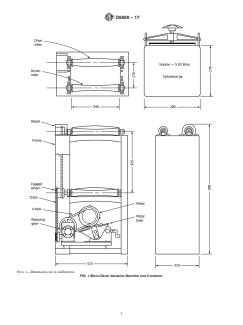
6.1 Micro-Deval Abrasion Machine, a jar rolling mill capable of running at 100 6 5 rpm (Fig. 1).
NOTE 1—Micro-Deval abrasion machine fitted with a counter may be used if the test is conducted on the basis of number of revolutions (Section(see
9.3.2).
6.2 Containers, stainless steel Micro-Deval abrasion jars having an apporiximate 5-L capacity, a locking cover and gasket
capable of sealing the jar and making it water-tight.watertight. External diameter of the abrasion jar shall be 194-mm194 mm to
202-mm202 mm and the internal height shall be 170-mm170 mm to 177-mm.177 mm. The inside and outside surfaces of the jars
shall be smooth and have no significant ridges or indentations (Fig. 1).
6.3 Abrasive Charge—Magnetic stainless steel balls are required. These shall have a diameter of 9.5 6 0.5 mm. Each jar
requires a charge of 5000 6 5 g of balls.
6.4 Sieves, with square openings, and of the following sizes conforming to Specification E11 specifications: 19.0 mm, 16.0 mm,
16.0 mm, 12.5 mm, 9.5 mm, 6.7 mm, 6.3 mm, 4.75 mm, and 1.18 mm.
6.5 Oven, capable of maintaining a temperature of 110 6 5°C.5 °C.
6.6 Balance, or scale accurate to 1.0 g.
7. Supplies
7.1 Laboratory Reference Aggregate—A supply of standard “Brechin Quarry No. 2” coarse aggregate available from the Soils
and Aggregates Section, Materials Engineering Materials Office, Ministry of Transportation, 1201 Wilson Avenue, Downsview,
Ontario, Canada M3M1J8. Fax: 1-416-235-4101.
7.1 CalibrationReference Aggregate—An adequate supply of aggregate, established by the Laboratorylaboratory to use for
calibrationverification of the consistency of the test method (see 11.1).
8. Test Sample
8.1 The test sample shall be washed and oven-dried oven dried at 110 6 5°C5 °C to constant mass, separated into individual
size fractions in accordance with Test Method C136, and recombined to meet the grading as shown in 8.2, 8.3, or 8.4. In sections
8.3 and 8.4, the 6.7-mm sieve can be used in place of the 6.3-mm sieve when specified.
8.2 Aggregate for the test sample shall consist of material passing the 19.0-mm sieve, retained on the 9.5-mm sieve. An
oven-dried sample of 1500 6 5 g shall be prepared as follows:
Passing Retained Mass
19.0-mm 16.0-mm 375 g
16.0-mm 12.5-mm 375 g
12.5-mm 9.5-mm 750 g
8.3 In a case where the maximum nominal size of the coarse aggregate is 12.5 mm, a sample of 1500 6 5 g shall be prepared
as follows:
Passing Retained Mass
12.5-mm 9.5-mm 750 g
9.5-mm 6.3-mm 375 g
6.3-mm 4.75-mm 375 g
8.4 In a case where the maximum nominal size of the coarse aggregate is 9.5 mm or less, a sample 1500 6 5 g shall be prepared
as follows:
Passing Retained Mass
9.5-mm 6.3-mm 750 g
6.3-mm 4.75-mm 750 g
D6928 − 17
NOTE 1—Dimensions are in millimeters.
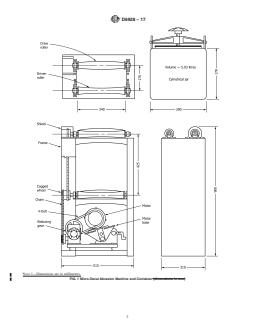
FIG. 1 Micro-Deval Abrasion Machine and Container (dimensions in mm)
D6928 − 17
9. Test Procedure
9.1 Prepare a representative 1500 6 5 g 5-g test sample. Weigh the sample and record the Mass,mass, A, to the nearest 1.0 g.
9.2 Immerse the test sample in 2.0 6 0.05 L of tap water at a temperature of 20 6 5°C5 °C for a minimum of 1 h either in the
Micro-Deval container or some other suitable container.
9.3 Place the test sample in the Micro-Deval abrasion container with 5000 6 5 g steel balls and the water used in 9.2 to immerse
the sample. Install the cover and place the Micro-Deval container on the machine.
9.3.1 Run the machine at 100 6 5 rpm for 2 h 6 1 min for the grading shown in 8.2. For the grading shown in 8.3, run the
machine for 105 6 1 min. For the grading shown in 8.4, run the machine for 95 6 1 min.
9.3.2 If a revolution counter is available;available, run the machine for 12 000 6 100 revolutions for the grading shown in 8.2;
for. For the grading shown in 8.3, run the machine for 10 500 6 100 revolutions;revolutions. For the grading shown in 8.4, run
the machine for 9500 6 100 revolutions.
9.4 Carefully pour the test sample and the steel balls over a 4.75–mm4.75-mm sieve superimposed on a 1.18–mm1.18-mm
sieve. Take care to remove the entire test sample from the stainless steel jar. Wash and manipulate the retained material on the sieve
with water using a hand held hand-held water hose and the hand until the washings are clear and material smaller than 1.18 mm
passes that sieve. Discard material smaller than 1.18mm. 1.18 mm. Remove the stainless steel balls as described in 9.5.
9.5 Remove the steel bal
...