


ASTM A108-24
(Specification)Standard Specification for Steel Bar, Carbon and Alloy, Cold-Finished
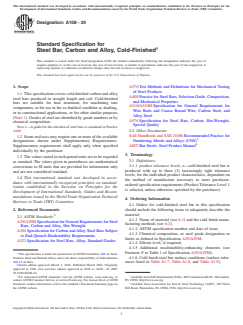
Standard Specification for Steel Bar, Carbon and Alloy, Cold-Finished
ABSTRACT
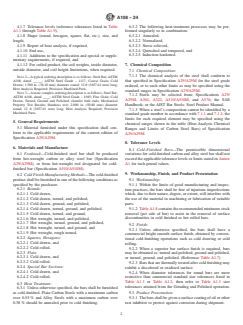
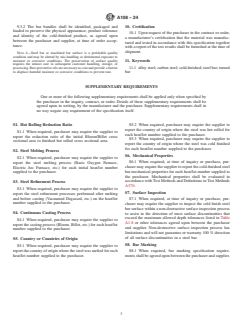
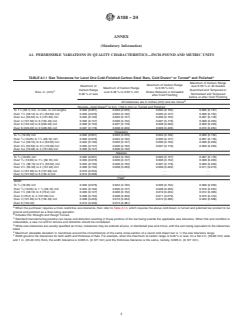
This specification covers cold-finished carbon and alloy steel bars for heat treatment, machining into components, or for as-finished condition as shafting or in constructional applications. The steel materials shall be cold drawn, turned, ground, polished, hot wrought, cold rolled, and heat treated. The steel specimens shall undergo chemical analysis.
SCOPE
1.1 This specification covers cold-finished carbon and alloy steel bars produced in straight length and coil. Cold-finished bars are suitable for heat treatment, for machining into components, or for use in the as-finished condition as shafting, or in constructional applications, or for other similar purposes (Note 1). Grades of steel are identified by grade numbers or by chemical composition.
Note 1: A guide for the selection of steel bars is contained in Practice A400.
1.2 Some end uses may require one or more of the available designations shown under Supplementary Requirements. Supplementary requirements shall apply only when specified individually by the purchaser.
1.3 The values stated in inch-pound units are to be regarded as standard. The values given in parentheses are mathematical conversions to SI units that are provided for information only and are not considered standard.
1.4 This international standard was developed in accordance with internationally recognized principles on standardization established in the Decision on Principles for the Development of International Standards, Guides and Recommendations issued by the World Trade Organization Technical Barriers to Trade (TBT) Committee.
General Information
- Status
- Published
- Publication Date
- 29-Feb-2024
- Technical Committee
- A01 - Steel, Stainless Steel and Related Alloys
- Drafting Committee
- A01.15 - Bars
Relations
- Effective Date
- 01-Mar-2024
- Effective Date
- 01-Mar-2024
- Effective Date
- 15-Sep-2023
- Effective Date
- 01-Mar-2024
- Effective Date
- 01-Mar-2024
- Effective Date
- 01-Mar-2024
- Referred By
ASTM F1511-18(2023) - Standard Specification for Mechanical Seals for Shipboard Pump Applications - Effective Date
- 01-Mar-2024
- Effective Date
- 01-Mar-2024
- Effective Date
- 01-Mar-2024
- Effective Date
- 01-Mar-2024
- Effective Date
- 01-Mar-2024
- Effective Date
- 01-Mar-2024
- Effective Date
- 01-Mar-2024
- Effective Date
- 01-Mar-2024
- Effective Date
- 01-Mar-2024
Overview
ASTM A108-24 is the internationally recognized standard specification for cold-finished carbon and alloy steel bars. Developed by ASTM International, this standard outlines requirements for producing cold-finished steel bars used in applications such as heat treatment, machining into components, shafting, and constructional projects. ASTM A108-24 covers straight length and coil products and specifies manufacturing methods, product tolerances, chemical composition, and surface quality to ensure consistent material properties and performance.
Key Topics
- Product Scope: Covers cold-finished carbon and alloy steel bars, which may be supplied in round, square, hexagon, flat, or special shapes.
- Manufacturing Methods: Includes cold drawing, turning, grinding, polishing, hot rolling, and cold rolling. The bars may also be supplied in various finished conditions, such as annealed or quenched and tempered.
- Chemical Composition: Steel grades are identified by grade numbers or chemical ranges, as specified in related standards (ASTM A29/A29M, SAE Handbook, etc.).
- Product Tolerances: Specifies dimensional tolerances and straightness requirements for different product shapes, sizes, and finish levels to ensure performance consistency.
- Surface Quality: Defines acceptable finishes, surface roughness, and allowable surface discontinuities. Includes recommendations for stock removal to address surface imperfections.
- Certification and Inspection: Requires manufacturers to provide certificates of compliance and include test results upon request. Includes options for supplementary requirements such as detailed origin tracking or enhanced mechanical property reporting.
Applications
ASTM A108 cold-finished steel bars are designed for diverse industrial uses where high dimensional accuracy, improved surface finish, and reliable mechanical properties are essential. Main areas of application include:
- Automotive Industry: Shafts, gears, and machined engine components.
- Machinery Manufacturing: Spindles, pins, and precision-machined parts requiring tight tolerances.
- Constructional Applications: Structural components and fasteners where uniform properties and surface quality are critical.
- General Engineering: Applications requiring steel bar conditioning for subsequent heat treatment, stress relief, or induction hardening.
The standard covers both carbon and alloy grades, ensuring material suitability for a wide range of operating environments and engineering demands.
Related Standards
ASTM A108-24 is closely connected to several other ASTM and industry standards that govern steel bars, wire rods, and related products:
- ASTM A29/A29M - General Requirements for Steel Bars, Carbon and Alloy, Hot-Wrought
- ASTM A322 - Steel Bars, Alloy, Standard Grades
- ASTM A370 - Mechanical Testing of Steel Products
- ASTM A510/A510M - Wire Rods and Coarse Round Wire, Carbon Steel, and Alloy Steel
- ASTM A576 - Steel Bars, Carbon, Hot-Wrought, Special Quality
- ASTM A304 - Carbon and Alloy Steel Bars Subject to End-Quench Hardenability Requirements
- SAE J1086 - Numbering Metals and Alloys (UNS designation system)
- ASTM A400 - Practice for Steel Bars, Selection Guide, Composition, and Mechanical Properties
Practical Value
By adopting ASTM A108-24, manufacturers, fabricators, and end-users ensure standardized steel bar quality for performance-critical applications. This standard promotes precision, reduces material waste, and supports global engineering interoperability, making it essential for suppliers and purchasers in steel bar sourcing, machining, and downstream manufacturing operations. Using ASTM A108-24 helps organizations meet industry requirements and comply with international trade practices, guaranteeing the consistency and quality of cold-finished carbon and alloy steel bars.
Buy Documents
ASTM A108-24 - Standard Specification for Steel Bar, Carbon and Alloy, Cold-Finished
REDLINE ASTM A108-24 - Standard Specification for Steel Bar, Carbon and Alloy, Cold-Finished
Get Certified
Connect with accredited certification bodies for this standard

Element Materials Technology
Materials testing and product certification.

Inštitut za kovinske materiale in tehnologije
Institute of Metals and Technology. Materials testing, metallurgical analysis, NDT.
Sponsored listings
Frequently Asked Questions
ASTM A108-24 is a technical specification published by ASTM International. Its full title is "Standard Specification for Steel Bar, Carbon and Alloy, Cold-Finished". This standard covers: ABSTRACT This specification covers cold-finished carbon and alloy steel bars for heat treatment, machining into components, or for as-finished condition as shafting or in constructional applications. The steel materials shall be cold drawn, turned, ground, polished, hot wrought, cold rolled, and heat treated. The steel specimens shall undergo chemical analysis. SCOPE 1.1 This specification covers cold-finished carbon and alloy steel bars produced in straight length and coil. Cold-finished bars are suitable for heat treatment, for machining into components, or for use in the as-finished condition as shafting, or in constructional applications, or for other similar purposes (Note 1). Grades of steel are identified by grade numbers or by chemical composition. Note 1: A guide for the selection of steel bars is contained in Practice A400. 1.2 Some end uses may require one or more of the available designations shown under Supplementary Requirements. Supplementary requirements shall apply only when specified individually by the purchaser. 1.3 The values stated in inch-pound units are to be regarded as standard. The values given in parentheses are mathematical conversions to SI units that are provided for information only and are not considered standard. 1.4 This international standard was developed in accordance with internationally recognized principles on standardization established in the Decision on Principles for the Development of International Standards, Guides and Recommendations issued by the World Trade Organization Technical Barriers to Trade (TBT) Committee.
ABSTRACT This specification covers cold-finished carbon and alloy steel bars for heat treatment, machining into components, or for as-finished condition as shafting or in constructional applications. The steel materials shall be cold drawn, turned, ground, polished, hot wrought, cold rolled, and heat treated. The steel specimens shall undergo chemical analysis. SCOPE 1.1 This specification covers cold-finished carbon and alloy steel bars produced in straight length and coil. Cold-finished bars are suitable for heat treatment, for machining into components, or for use in the as-finished condition as shafting, or in constructional applications, or for other similar purposes (Note 1). Grades of steel are identified by grade numbers or by chemical composition. Note 1: A guide for the selection of steel bars is contained in Practice A400. 1.2 Some end uses may require one or more of the available designations shown under Supplementary Requirements. Supplementary requirements shall apply only when specified individually by the purchaser. 1.3 The values stated in inch-pound units are to be regarded as standard. The values given in parentheses are mathematical conversions to SI units that are provided for information only and are not considered standard. 1.4 This international standard was developed in accordance with internationally recognized principles on standardization established in the Decision on Principles for the Development of International Standards, Guides and Recommendations issued by the World Trade Organization Technical Barriers to Trade (TBT) Committee.
ASTM A108-24 is classified under the following ICS (International Classification for Standards) categories: 77.140.60 - Steel bars and rods. The ICS classification helps identify the subject area and facilitates finding related standards.
ASTM A108-24 has the following relationships with other standards: It is inter standard links to ASTM A108-18, ASTM A370-24, ASTM A370-23, ASTM F721-18(2022), ASTM F2080-23, ASTM D807-18, ASTM F1511-18(2023), ASTM F1387-23, ASTM D7548-22, ASTM A400-23, ASTM A29/A29M-23, ASTM D3603-20, ASTM D665-23, ASTM A311/A311M-04(2020), ASTM F670-02(2022). Understanding these relationships helps ensure you are using the most current and applicable version of the standard.
ASTM A108-24 is available in PDF format for immediate download after purchase. The document can be added to your cart and obtained through the secure checkout process. Digital delivery ensures instant access to the complete standard document.
Standards Content (Sample)
This international standard was developed in accordance with internationally recognized principles on standardization established in the Decision on Principles for the
Development of International Standards, Guides and Recommendations issued by the World Trade Organization Technical Barriers to Trade (TBT) Committee.
Designation: A108 − 24
Standard Specification for
Steel Bar, Carbon and Alloy, Cold-Finished
This standard is issued under the fixed designation A108; the number immediately following the designation indicates the year of
original adoption or, in the case of revision, the year of last revision. A number in parentheses indicates the year of last reapproval. A
superscript epsilon (´) indicates an editorial change since the last revision or reapproval.
This standard has been approved for use by agencies of the U.S. Department of Defense.
1. Scope A370 Test Methods and Definitions for Mechanical Testing
of Steel Products
1.1 This specification covers cold-finished carbon and alloy
A400 Practice for Steel Bars, Selection Guide, Composition,
steel bars produced in straight length and coil. Cold-finished
and Mechanical Properties
bars are suitable for heat treatment, for machining into
A510/A510M Specification for General Requirements for
components, or for use in the as-finished condition as shafting,
Wire Rods and Coarse Round Wire, Carbon Steel, and
or in constructional applications, or for other similar purposes
Alloy Steel
(Note 1). Grades of steel are identified by grade numbers or by
A576 Specification for Steel Bars, Carbon, Hot-Wrought,
chemical composition.
Special Quality
NOTE 1—A guide for the selection of steel bars is contained in Practice
A400.
2.2 Other Documents:
SAE Handbook and SAE J1086 Recommended Practice for
1.2 Some end uses may require one or more of the available
Numbering Metals and Alloys (UNS)
designations shown under Supplementary Requirements.
AIST Bar Steels: Steel Product Manual
Supplementary requirements shall apply only when specified
individually by the purchaser.
3. Terminology
1.3 The values stated in inch-pound units are to be regarded
3.1 Definitions:
as standard. The values given in parentheses are mathematical
3.1.1 product tolerance levels, n—cold-finished steel bar is
conversions to SI units that are provided for information only
produced with up to three (3) increasingly tight tolerance
and are not considered standard.
levels, for the individual product characteristics, dependent on
1.4 This international standard was developed in accor-
the method of manufacture necessary to meet purchaser-
dance with internationally recognized principles on standard-
ordered specification requirements (Product Tolerance Level 1
ization established in the Decision on Principles for the
is selected, unless otherwise specified by the purchaser).
Development of International Standards, Guides and Recom-
mendations issued by the World Trade Organization Technical
4. Ordering Information
Barriers to Trade (TBT) Committee.
4.1 Orders for cold-finished steel bar to this specification
should include the following items to adequately describe the
2. Referenced Documents
material:
2.1 ASTM Standards:
4.1.1 Name of material (see 6.1) and the cold finish manu-
A29/A29M Specification for General Requirements for Steel
facturing methods (see 6.2),
Bars, Carbon and Alloy, Hot-Wrought
4.1.2 ASTM specification number and date of issue,
A304 Specification for Carbon and Alloy Steel Bars Subject
4.1.3 Chemical composition, or steel grade designation or
to End-Quench Hardenability Requirements
limits as defined in Specification A29/A29M,
A322 Specification for Steel Bars, Alloy, Standard Grades
4.1.4 Silicon level, if required,
4.1.5 Additional machinability-enhancing elements (see
Footnote F to Table 1 of Specification A29/A29M),
This specification is under the jurisdiction of ASTM Committee A01 on Steel,
Stainless Steel and Related Alloys and is the direct responsibility of Subcommittee 4.1.6 Cold finish steel bar surface conditions (surface toler-
A01.15 on Bars.
ances listed in Table A1.7, Table A1.8, and Table A1.9),
Current edition approved March 1, 2024. Published March 2024. Originally
approved in 1926. Last previous edition approved in 2018 as A108 – 18. DOI:
10.1520/A0108-24.
2 3
For referenced ASTM standards, visit the ASTM website, www.astm.org, or Available from SAE International (SAE), 400 Commonwealth Dr., Warrendale,
contact ASTM Customer Service at service@astm.org. For Annual Book of ASTM PA 15096, http://www.sae.org.
Standards volume information, refer to the standard’s Document Summary page on Available from Association for Iron & Steel Technology (AIST), 180 Thorn
the ASTM website. Hill Road, Warrendale, PA 15086–7528, http://www.aist.org
Copyright © ASTM International, 100 Barr Harbor Drive, PO Box C700, West Conshohocken, PA 19428-2959. United States
A108 − 24
4.1.7 Tolerance levels (reference tolerances listed in Table 6.3.2 The following heat-treatment processes may be per-
A1.1 through Table A1.9), formed singularly or in combination:
4.1.8 Shape (round, hexagon, square, flat, etc.), size, and 6.3.2.1 Annealed,
length, 6.3.2.2 Normalized,
6.3.2.3 Stress relieved,
4.1.9 Report of heat analysis, if required,
4.1.10 End use, 6.3.2.4 Quenched and tempered, and
6.3.2.5 Induction hardened.
4.1.11 Additions to the specification and special or supple-
mentary requirements, if required, and
4.1.12 For coiled product, the coil weights, inside diameter, 7. Chemical Composition
outside diameter, and coil height limitations, when required.
7.1 Chemical Composition:
7.1.1 The chemical analysis of the steel shall conform to
NOTE 2—A typical ordering description is as follows: Steel Bar; ASTM
A108, dated _____; ASTM Steel Grade – 1117; Coarse Grain; Cold that specified in Specification A29/A29M for the steel grade
Drawn; 1.500 in. (38.10 mm) diameter round; 12 ft (3657.61 mm) long;
ordered, or to such other limits as may be specified using the
Heat Analysis Required; Precision Machined Parts.
standard ranges in Specification A29/A29M.
NOTE 3—A more complex ordering description is as follows: Steel Bar;
7.1.2 Steels may be selected from: Specifications A29/
ASTM A108, dated ____; ASTM Steel Grade – 1045; Fine Grain; Cold
A29M, A304, A322, A510/A510M, and A576; the SAE
Drawn, Turned, Ground and Polished; chamfer both ends; Mechanical
Property Test Results; Hardness test; 2.000 in. (50.80 mm) diameter Handbook; or the AIST Bar Steels: Steel Product Manual.
round; 12 ft (3657.61 mm) long; Heat Analysis Required; Precision
7.1.3 When a steel’s composition cannot be identified by a
Machined Parts.
standard grade number in accordance with 7.1.1 and 7.1.2, the
limits for each required element may be specified using the
5. General Requirements
chemical ranges shown in the table (Heat Analysis Chemical
5.1 Material furnished under this specification shall con-
Ranges and Limits of Carbon Steel Bars) of Specification
form to the applicable requirements of the current edition of
A29/A29M.
Specification A29/A29M.
8. Tolerance Levels
6. Materials and Manufacture
8.1 Cold-Finished Bars—The permissible dimensional
6.1 Feedstock—Cold-finished steel bar shall be produced variations for cold-finished carbon and alloy steel bar shall not
from hot-wrought carbon or alloy steel bar (Specification
exceed the applicable tolerance levels or limits stated in Annex
A29/A29M), or from hot-wrought rod designated for cold- A1 for inch-pound values.
finished bar (Specification A510/A510M).
9. Workmanship, Finish, and Product Presentation
6.2 Cold Finish Manufacturing Methods—The cold-finished
product shall be furnished in one of the following conditions as
9.1 Workmanship:
specified by the purchaser.
9.1.1 Within the limits of good manufacturing and inspec-
6.2.1 Rounds: tion practices, the bars shall be free of injurious imperfections
6.2.1.1 Cold drawn,
which, due to their nature, degree, or extent, will interfere with
6.2.1.2 Cold drawn, turned, and polished, the use of the material in machining or fabrication of suitable
6.2.1.3 Cold drawn, ground, and polished, parts.
6.2.1.4 Cold drawn, turned, ground, and polished, 9.1.2 Table A1.8 contains the recommended minimum stock
6.2.1.5 Cold drawn, turned, and ground, removal (per side of bar) to assist in the removal of surface
discontinuities in cold finished or hot rolled bars.
6.2.1.6 Hot wrought, turned, and polished,
6.2.1.7 Hot wrought, turned, ground, and polished,
9.2 Finish:
6.2.1.8 Hot wrought, turned, and ground, and
9.2.1 Unless otherwise specified, the bars shall have a
6.2.1.9 Hot wrought, rough turned.
commercial bright smooth surface finish, obtained by conven-
6.2.2 Squares, Hexagons:
tional cold-finishing operations such as cold drawing or cold
6.2.2.1 Cold drawn, and
rolling.
6.2.2.2 Cold rolled.
9.2.2 When a superior bar surface finish is required, bars
6.2.3 Flats:
may be obtained as: turned and polished, ground and polished,
6.2.3.1 Cold drawn, and
or turned, ground, and polished. (Reference Table A1.7)
6.2.3.2 Cold rolled.
9.2.3 Bars that are thermally treated after cold finishing may
6.2.4 Special Bar Sections:
exhibit a discolored or oxidized surface.
6.2.4.1 Cold drawn, and
9.2.4 When diameter tolerances for round bars are more
6.2.4.2 Cold rolled.
restrictive than commercial standard size tolerances listed in
Table A1.1 or Table A1.2, then refer to Table A1.3 size
6.3 Heat Treatment:
tolerances attained from the Grinding and Polished operation.
6.3.1 Unless otherwise specified, the bars shall be furnished
as cold-finished. Plain Carbon Steels with a maximum carbon 9.3 Product Presentation:
over 0.55 % and Alloy Steels with a maximum carbon over 9.3.1 The bars shall be given a surface coating of oil or other
0.38 % should be annealed prior to cold finishing. rust inhibitor to protect against corrosion during shipment.
A108 − 24
9.3.2 The bar bundles shall be identified, packaged and 10. Certification
loaded to preserve the physical appearance, product tolerance
10.1 Upon request of the purchaser in the contract or order,
and identity of the cold-finished product, as agreed upon
a manufacturer’s certification that the material was manufac-
between the purchaser and supplier, at time of order accep-
tured and tested in accordance with this specification together
tance.
with a report of the test results shall be furnished at the time of
shipment.
NOTE 4—Steel bar or machined bar surface is a perishable quality
condition and may be altered by mis-handling or detrimental exposure to
moisture or corrosive conditions. The preservation of surface quality
11. Keywords
requires the utmost care in subsequent customer handling, storage, or
11.1 alloy steel; carbon steel; cold-finished; steel bar; turned
processing. Rust preventive oils are necessary to coat and provide a barrier
to displace harmful moisture or corrosive conditions to prevent rust. bar
SUPPLEMENTARY REQUIREMENTS
One or more of the following supplementary requirements shall be applied only when specified by
the purchaser in the inquiry, contract, or order. Details of these supplementary requirements shall be
agreed upon in writing, by the manufacturer and the purchaser. Supplementary requirements shall in
no way negate any requirement of the specification itself.
S1. Hot Rolling Reduction Ratio S5.2 When required, purchaser may require the supplier to
report the country of origin where the steel was hot rolled for
S1.1 When required, purchaser may require the supplier to
each heat/lot number supplied to the purchaser.
report the reduction ratio of the initial Bloom/Billet cross
S5.3 When required, purchaser may require the supplier to
sectional area to finished hot rolled cross sectional area.
report the country of origin where the steel was cold finished
for each heat/lot number supplied to the purchaser.
S2. Steel Melting Process
S6. Mechanical Properties
S2.1 When required, purchaser may require the supplier to
S6.1 When required, at time of inquiry or purchase, pur-
report the steel melting process (Basic Oxygen Furnace,
chaser may require the supplier to report the cold-finished steel
Electric Arc Furnace, etc.) for each initial heat/lot number
bar mechanical properties for each heat/lot number supplied to
supplied to the purchaser.
the purchaser. Mechanical properties shall be evaluated in
accordance with Test Methods and Definitions in Test Methods
S3. Steel Refinement Process
A370.
S3.1 When required, purchaser may require the supplier to
S7. Surface Inspection
report the steel refinement processes performed after melting
and before casting (Vacuumed Degassed, etc.) on the heat/lot
S7.1 When required, at time of inquiry or purchase, pur-
number supplied to the purchaser.
chaser may require the supplier to inspect the cold finish steel
bar surface within a non-destructive surface inspection process
S4. Continuous Casting Process
to assist in the detection of most surface discontinuities that
exceed the maximum allowed depth tolerances listed in Table
S4.1 When required, purchaser may require the supplier to
A1.8 or other tolerances agreed upon between the purchaser
report the casting process (Bloom, Billet, etc.) for each heat/lot
and supplier. Non-destructive surface inspection process has
number supplied to the purchaser.
limitations and will not guarantee or warranty 100 % detection
of all surface discontinuities in a steel bar.
S5. Country or Countries of Origin
S8. Bar Marking
S5.1 When required, purchaser may require the supplier to
report the country of origin where the steel was melted for each S8.1 When required, bar marking specification require-
heat/lot number supplied to the purchaser. ments shall be agreed upon between the purchaser and supplier.
A108 − 24
ANNEX
(Mandatory Information)
A1. PERMISSIBLE VARIATIONS IN QUALITY CHARACTERISTICS—INCH-POUND AND METRIC UNITS
A B A
TABLE A1.1 Size Tolerances for Level One Cold-Finished Carbon Steel Bars, Cold Drawn or Turned and Polished
Maximum of Carbon Range
Maximum of Carbon Range
Maximum of over 0.55 % or All Grades
Maximum of Carbon Range to 0.55 % incl,
Carbon Range Quenched and Tempered or
C
over 0.28 % to 0.55 % incl Stress Relieved or Annealed
Size, in. (mm)
0.28 % or less Normalized and Tempered
after Cold Finishing
before or after Cold Finishing
D
All tolerances are in inches (mm) and are minus
E
Rounds—Cold Drawn to 6 in. (152.4 mm) or Turned and Polished
To 1 ⁄2 (38.1) incl, in coils, or cut lengths 0.002 (0.051) 0.003 (0.076) 0.004 (0.102) 0.005 (0.127)
1 1
Over 1 ⁄2 (38.10) to 2 ⁄2 (63.50) incl 0.003 (0.076) 0.004 (0.102) 0.005 (0.127) 0.006 (0.152)
Over 2 ⁄2 (63.50) to 4 (101.60) incl 0.004 (0.102) 0.005 (0.127) 0.006 (0.152) 0.007 (0.178)
Over 4 (101.60) to 6 (152.40) incl 0.005 (0.127) 0.006 (0.152) 0.007 (0.178) 0.008 (0.203)
Over 6 (152.40) to 8 (203.20) incl 0.006 (0.152) 0.007 (0.178) 0.008 (0.203) 0.009 (0.229)
Over 8 (203.20) to 9 (228.60) incl 0.007 (0.178) 0.008 (0.203) 0.009 (0.229) 0.010 (0.254)
Hexagons
To ⁄4 (19.05) incl 0.002 (0.051) 0.003 (0.076) 0.004 (0.102) 0.006 (0.152)
3 1
Over ⁄4 (19.05) to 1 ⁄2 (38.10) incl 0.003 (0.076) 0.
...
This document is not an ASTM standard and is intended only to provide the user of an ASTM standard an indication of what changes have been made to the previous version. Because
it may not be technically possible to adequately depict all changes accurately, ASTM recommends that users consult prior editions as appropriate. In all cases only the current version
of the standard as published by ASTM is to be considered the official document.
Designation: A108 − 18 A108 − 24
Standard Specification for
Steel Bar, Carbon and Alloy, Cold-Finished
This standard is issued under the fixed designation A108; the number immediately following the designation indicates the year of
original adoption or, in the case of revision, the year of last revision. A number in parentheses indicates the year of last reapproval. A
superscript epsilon (´) indicates an editorial change since the last revision or reapproval.
This standard has been approved for use by agencies of the U.S. Department of Defense.
1. Scope*Scope
1.1 This specification covers cold-finished carbon and alloy steel bars produced in straight length and coil. Cold-finished bars are
suitable for heat treatment, for machining into components, or for use in the as-finished condition as shafting, or in constructional
applications, or for other similar purposes (Note 1). Grades of steel are identified by grade numbers or by chemical composition.
NOTE 1—A guide for the selection of steel bars is contained in Practice A400.
1.2 Some end uses may require one or more of the available designations shown under Supplementary Requirements.
Supplementary requirements shall apply only when specified individually by the purchaser.
1.3 The values stated in inch-pound units are to be regarded as standard. The values given in parentheses are mathematical
conversions to SI units that are provided for information only and are not considered standard.
1.4 This international standard was developed in accordance with internationally recognized principles on standardization
established in the Decision on Principles for the Development of International Standards, Guides and Recommendations issued
by the World Trade Organization Technical Barriers to Trade (TBT) Committee.
2. Referenced Documents
2.1 ASTM Standards:
A29/A29M Specification for General Requirements for Steel Bars, Carbon and Alloy, Hot-Wrought
A304 Specification for Carbon and Alloy Steel Bars Subject to End-Quench Hardenability Requirements
A322 Specification for Steel Bars, Alloy, Standard Grades
A370 Test Methods and Definitions for Mechanical Testing of Steel Products
A400 Practice for Steel Bars, Selection Guide, Composition, and Mechanical Properties
A510/A510M Specification for General Requirements for Wire Rods and Coarse Round Wire, Carbon Steel, and Alloy Steel
A576 Specification for Steel Bars, Carbon, Hot-Wrought, Special Quality
2.2 Other Documents:
SAE Handbook and SAE J1086 Recommended Practice for Numbering Metals and Alloys (UNS)
AIST Bar Steels: Steel Product Manual
This specification is under the jurisdiction of ASTM Committee A01 on Steel, Stainless Steel and Related Alloys and is the direct responsibility of Subcommittee A01.15
on Bars.
Current edition approved Nov. 1, 2018March 1, 2024. Published November 2018March 2024. Originally approved in 1926. Last previous edition approved in 20132018
as A108A108 – 18.–13. DOI: 10.1520/A0108–18.10.1520/A0108-24.
For referenced ASTM standards, visit the ASTM website, www.astm.org, or contact ASTM Customer Service at service@astm.org. For Annual Book of ASTM Standards
volume information, refer to the standard’s Document Summary page on the ASTM website.
Available from SAE International (SAE), 400 Commonwealth Dr., Warrendale, PA 15096, http://www.sae.org.
Available from Association for Iron & Steel Technology (AIST), 180 Thorn Hill Road, Warrendale, PA 15086–7528, http://www.aist.org
*A Summary of Changes section appears at the end of this standard
Copyright © ASTM International, 100 Barr Harbor Drive, PO Box C700, West Conshohocken, PA 19428-2959. United States
A108 − 24
3. Terminology
3.1 Definitions:
3.1.1 product tolerance levels—levels, n—cold-finished steel bar is produced with up to three (3) increasingly tight tolerance
levels, for the individual product characteristics, dependent on the method of manufacture necessary to meet purchaser-ordered
specification requirements.requirements (Product Tolerance Level 1 is selected, unless otherwise specified by the purchaser.)pur-
chaser).
4. Ordering Information
4.1 Orders for cold-finished steel bar to this specification should include the following items to adequately describe the material:
4.1.1 Name of material,material (see 6.1) and the cold finish manufacturing methods (see 6.2),
4.1.2 ASTM specification number and date of issue,
4.1.3 Chemical composition, or steel grade designation or limits as defined in Specification A29/A29M,
4.1.4 Silicon level, if required,
4.1.5 Additional machinability-enhancing elements (see Footnote F to Table 1 of Specification A29/A29M),
4.1.6 Surface Condition (Surface Cold finish steel bar surface conditions (surface tolerances listed in Table A1.7, Table A1.8, and
Table A1.9),
4.1.7 Tolerance Levels (Referencelevels (reference tolerances listed in Table A1.1 through Table A1.9),
4.1.8 Shape (round, hexagon, square, flat, etc.), size, and length,
4.1.9 Report of heat analysis, if required,
4.1.10 End use,
4.1.11 Additions to the specification and special or supplementary requirements, if required, and
4.1.12 For coiled product, the coil weights, inside diameter, outside diameter, and coil height limitations, when required.
NOTE 2—A typical ordering description is as follows: Steel Bar; ASTM A108, dated _____; ASTM Steel Grade -– 1117; Coarse Grain; Cold Drawn; 1.500
in. (38.10 mm) diameter round; 12 ft 12 ft (3657.61 mm) long; Heat Analysis Required; Precision Machined Parts.
NOTE 3—A more complex ordering description is as follows: Steel Bar; ASTM A108, dated ____; ASTM Steel Grade -– 1045; Fine Grain; Cold Drawn,
Turned, Ground and Polished; chamfer both ends; Mechanical Property Test Results; Hardness test; 2.000 in. (50.80 mm) diameter round; 12 ft (3657.61
mm) long; Heat Analysis Required; Precision Machined Parts.
5. General Requirements
5.1 Material furnished under this specification shall conform to the applicable requirements of the current edition of Specification
A29/A29M.
6. Materials and Manufacture
6.1 Feedstock—Cold-finished steel bar shall be produced from hot-wrought carbon or alloy steel bar (Specification A29/A29M),
or from hot-wrought rod designated for cold-finished bar (Specification A510/A510M).
6.2 Condition—Cold Finish Manufacturing Methods—The cold-finished product shall be furnished in one of the following
conditions as specified by the purchaser.
6.2.1 Rounds:
A108 − 24
6.2.1.1 Cold drawn,
6.2.1.2 Cold drawn, turned, and polished,
6.2.1.3 Cold drawn, ground, and polished,
6.2.1.4 Cold drawn, turned, ground, and polished,
6.2.1.5 Cold drawn, turned, and ground,
6.2.1.6 Hot wrought, turned, and polished,
6.2.1.7 Hot wrought, turned, ground, and polished,
6.2.1.8 Hot wrought, turned, and ground, and
6.2.1.9 Hot wrought, rough turned.
6.2.2 Squares, Hexagons:
6.2.2.1 Cold drawn, and
6.2.2.2 Cold rolled.
6.2.3 Flats:
6.2.3.1 Cold drawn, and
6.2.3.2 Cold rolled.
6.2.4 Special Bar Sections:
6.2.4.1 Cold drawn, and
6.2.4.2 Cold rolled.
6.3 Heat Treatment:
6.3.1 Unless otherwise specified, the bars shall be furnished as cold-finished. Plain Carbon Steels with a maximum carbon over
0.55 % and Alloy Steels with a maximum carbon over 0.38 % shallshould be annealed prior to cold finishing.
6.3.2 The following heat-treatment processes may be performed singularly or in combination:
6.3.2.1 Annealed,
6.3.2.2 Normalized,
6.3.2.3 Stress relieved,
6.3.2.4 Quenched and tempered, and
6.3.2.5 Induction hardened.
7. Chemical Composition
7.1 Chemical Composition:
A108 − 24
7.1.1 The chemical analysis of the steel shall conform to that specified in Specification A29/A29M for the steel grade ordered,
or to such other limits as may be specified using the standard ranges in Specification A29/A29M.
7.1.2 Steels may be selected from: Specifications A29/A29M, A304, A322, A510/A510M, and A576; the SAE Handbook; or the
AIST Bar Steels: Steel Product Manual.
7.1.3 When a steel’s composition cannot be identified by a standard grade number in accordance with 7.1.1 and 7.1.2, the limits
for each required element may be specified using the chemical ranges shown in the table (Heat Analysis Chemical Ranges and
Limits of Carbon Steel Bars) of Specification A29/A29M.
8. Tolerance Levels
8.1 Cold-Finished Bars—The permissible dimensional variations for cold-finished carbon and alloy steel bar shall not exceed the
applicable tolerance levels or limits stated in Annex A1 for inch-pound values.
9. Workmanship, Finish, and Product Presentation
9.1 Workmanship:
9.1.1 Within the limits of good manufacturing and inspection practices, the bars shall be free of injurious imperfections which,
due to their nature, degree, or extent, will interfere with the use of the material in machining or fabrication of suitable parts.
9.1.2 Table A1.8 contains the recommended minimum stock removal (per side of bar) to assist in the removal of surface
discontinuities in cold finished or hot rolled bars.
9.2 Finish:
9.2.1 Unless otherwise specified, the bars shall have a commercial bright smooth surface finish, obtained by conventional
cold-finishing operations such as cold drawing or cold rolling.
9.2.2 When a superior bar surface finish is required, bars may be obtained as: turned and polished, ground and polished, or turned,
ground, and polished. (Reference Table A1.7)
9.2.3 Bars that are thermally treated after cold finishing may exhibit a discolored or oxidized surface.
9.2.4 When diameter tolerances for round bars are more restrictive than commercial standard size tolerances listed in Table A1.1
or Table A1.2, then refer to Table A1.3 size tolerances attained from the Grinding and Polished operation.
9.3 Product Presentation:
9.3.1 The bars shall be given a surface coating of oil or other rust inhibitor to protect against corrosion during shipment.
9.3.2 The bar bundles shall be identified, packaged and loaded to preserve the physical appearance, product tolerance and identity
of the cold-finished product, as agreed upon between the purchaser and supplier, at time of order acceptance.
NOTE 4—Steel bar or machined bar surface is a perishable quality condition and may be altered by mis-handling or detrimental exposure to moisture or
corrosive conditions. The preservation of surface quality requires the utmost care in subsequent customer handling, storage, or processing. Rust preventive
oils are necessary to coat and provide a barrier to displace harmful moisture or corrosive conditions to prevent rust.
10. Certification
10.1 Upon request of the purchaser in the contract or order, a manufacturer’s certification that the material was manufactured and
tested in accordance with this specification together with a report of the test results shall be furnished at the time of shipment.
11. Keywords
11.1 alloy steel; carbon steel; cold-finished; steel bar; turned bar
A108 − 24
SUPPLEMENTARY REQUIREMENTS
One or more of the following supplementary requirements shall be applied only when specified by
the purchaser in the inquiry, contract, or order. Details of these supplementary requirements shall be
agreed upon in writing, by the manufacturer and the purchaser. Supplementary requirements shall in
no way negate any requirement of the specification itself.
S1. Hot Rolling Reduction Ratio
S1.1 When required, purchaser may require the supplier to report the reduction ratio of the initial Bloom/Billet cross sectional
area to finished hot rolled cross sectional area.
S2. Steel Melting Process
S2.1 When required, purchaser may require the supplier to report the steel melting process (Basic Oxygen Furnace, Electric Arc
Furnace, etc.) for each initial heat/lot number supplied to the purchaser.
S3. Steel Refinement Process
S3.1 When required, purchaser may require the supplier to report the steel refinement processes performed after melting and
before casting (Vacuumed Degassed, etc.) on the heat/lot number supplied to the purchaser.
S4. Continuous Casting Process
S4.1 When required, purchaser may require the supplier to report the casting process (Bloom, Billet, etc.) for each heat/lot
number supplied to the purchaser.
S5. Country or Countries of Origin
S5.1 When required, purchaser may require the supplier to report the country of origin where the steel was melted for each
heat/lot number supplied to the purchaser.
S5.2 When required, purchaser may require the supplier to report the country of origin where the steel was hot rolled for each
heat/lot number supplied to the purchaser.
S5.3 When required, purchaser may require the supplier to report the country of origin where the steel was cold finished for
each heat/lot number supplied to the purchaser.
S6. Mechanical Properties
S6.1 When required, at time of inquiry or purchase, purchaser may require the supplier to report the cold-finished steel bar
mechanical properties for each heat/lot number supplied to the purchaser. Mechanical properties shall be evaluated in accordance
with Test Methods and Definitions in Test Methods A370.
A108 − 24
S7. Surface Inspection
S7.1 When required, at time of inquiry or purchase, purchaser may require the supplier to inspect the cold finish steel bar surface
within a non-destructive surface inspection process to assist in the detection of most surface discontinuities that exceed the
maximum allowed depth tolerances listed in Table A1.8 or other tolerances agreed upon between the purchaser and supplier.
Non-destructive surface inspection process has limitations and will not guarantee or warranty 100 % detection of all surface
discontinuities in a steel bar.
S8. Bar Marking
S8.1 When required, bar marking specification requirements shall be agreed upon between the purchaser and supplier.
A108 − 24
ANNEX
(Mandatory Information)
A1. PERMISSIBLE VARIATIONS IN QUALITY CHARACTERISTICS—INCH-POUND AND METRIC UNITS
A B A
TABLE A1.1 Size Tolerances for Level One Cold-Finished Carbon Steel Bars, Cold Drawn or Turned and Polished
Maximum of Carbon Range
Maximum of Carbon Range
Maximum of over 0.55 % or All Grades
Maximum of Carbon Range to 0.55 % incl,
Carbon Range Quenched and Tempered or
BC
over 0.28 % to 0.55 % incl Stress Relieved or Annealed
Size, in. (mm)
0.28 % or less Normalized and Tempered
after Cold Finishing
before or after Cold Finishing
CD
All tolerances are in inches (mm) and are minus
D
Rounds—Cold Drawn to 6 in. (152.4 mm) or Turned and Polished
E
Rounds—Cold Drawn to 6 in. (152.4 mm) or Turned and Polished
To 1 ⁄2 (38.1) incl, in coils, or cut lengths 0.002 (0.051) 0.003 (0.076) 0.004 (0.102) 0.005 (0.127)
1 1
Over 1 ⁄2 (38.10) to 2 ⁄2 (63.50) incl 0.003 (0.076) 0.004 (0.102) 0.005 (0.127) 0.006 (0.152)
Over 2 ⁄2 (63.50) to 4 (101.60) incl 0.004 (0.102) 0.005 (0.127) 0.006 (0.152) 0.007 (0.178)
Over 4 (101.60) to 6 (152.40) incl 0.005 (0.127) 0.006 (0.152) 0.007 (0.178) 0.008 (0.203)
Over 6 (152.40) to 8 (203.20) incl 0.006 (0.152) 0.007 (0.178) 0.008 (0.203) 0.009 (0.229)
Over 8 (203.20) to 9 (228.60) incl 0.007 (0.178) 0.008 (0.203) 0.009 (0.229) 0.010 (0.254)
Hexagons
To ⁄4 (19.05) incl 0.002 (0.051) 0.003 (0.076) 0.004 (0.102) 0.006 (0.152)
3 1
Over ⁄4 (19.05) to 1 ⁄2 (38.10) incl 0.003 (0.076) 0.004 (0.102) 0.0
...
Questions, Comments and Discussion
Ask us and Technical Secretary will try to provide an answer. You can facilitate discussion about the standard in here.
Loading comments...