

ASTM D2132-23
(Test Method)Standard Test Method for Dust-and-Fog Tracking and Erosion Resistance of Electrical Insulating Materials
General Information
- Abstract
SIGNIFICANCE AND USE
6.1 Method—It is possible that electrical insulation in service will fail as a result of tracking, erosion, or a combination of both, if exposed to high relative humidity and contamination environments. This is particularly true of organic insulations in outdoor applications where the surface of the insulation becomes contaminated by deposits of moisture and dirt, for example, coal dust or salt spray. This test method is an accelerated test that simulates extremely severe outdoor contamination. It is believed that the most severe conditions likely to be encountered in outdoor service in the United States will be relatively mild compared to the conditions specified in this test method.
6.2 Test Results—Materials can be classified by this test method as tracking-resistant, tracking-affected, or tracking-susceptible. The exact test values for these categories as they apply to specific uses will be specified in the appropriate material specifications, but guideline figures are suggested in Note 4. Tracking-resistant materials, unless erosion failure occurs first, have the potential to last many hundreds of hours (Note 5). Erosion, though it is possible that it will progress laterally, generally results in a failure perpendicular to the specimen surface. Therefore, compare only specimens of the same nominal thickness for resistance to tracking-induced erosion. Estimate the extent of erosion from measurements of the depth of penetration of the erosion. Place materials that are not tracking-susceptible in three broad categories—erosion-resistant, erosion-affected, and erosion-susceptible. When the standard thickness specimen is tested, the following times to failure typify the categories (Note 6):
Erosion-susceptible
5 h to 50 h
Erosion-affected
50 h to 200 h
Erosion-resistant
over 200 h
Note 4: Tracking-susceptible materials usually fail within 5 h. Tracking-affected materials usually fail before about 100 h.
Note 5: This information is derive...
SCOPE
1.1 This test method is intended to differentiate solid electrical insulating materials with respect to their resistance to the action of electric arcs produced by conduction through surface films of a specified contaminant containing moisture. Test Methods D2302, D2303, D3638, and D5288 are also useful to evaluate materials.
1.2 Units—The values stated in SI units are the standard. The inch-pound units in parentheses are for information only. The values stated in each system are not necessarily exact equivalents; therefore, to ensure conformance with the standard, each system shall be used independently of the other, and values from the two systems shall not be combined.
1.3 This standard does not purport to address all of the safety concerns, if any, associated with its use. It is the responsibility of the user of this standard to establish appropriate safety, health, and environmental practices and determine the applicability of regulatory limitations prior to use.
Note 1: There is no equivalent ISO standard.
1.4 This international standard was developed in accordance with internationally recognized principles on standardization established in the Decision on Principles for the Development of International Standards, Guides and Recommendations issued by the World Trade Organization Technical Barriers to Trade (TBT) Committee.
- Status
- Published
- Publication Date
- 31-Jul-2023
- Technical Committee
- D09 - Electrical and Electronic Insulating Materials
- Drafting Committee
- D09.07 - Electrical Insulating Materials
Buy Documents
ASTM D2132-23 - Standard Test Method for Dust-and-Fog Tracking and Erosion Resistance of Electrical Insulating Materials
REDLINE ASTM D2132-23 - Standard Test Method for Dust-and-Fog Tracking and Erosion Resistance of Electrical Insulating Materials
Overview
ASTM D2132-23: Standard Test Method for Dust-and-Fog Tracking and Erosion Resistance of Electrical Insulating Materials is an internationally recognized standard from ASTM International. This test method evaluates the capability of solid electrical insulating materials to resist tracking and erosion when subjected to electric arcs in the presence of dust, moisture, and contaminants. Tracking and erosion are critical failure mechanisms for insulations exposed to severe outdoor environments, such as those with high humidity and airborne pollutants like coal dust or salt spray.
The method offers an accelerated laboratory procedure that simulates these harsh service conditions, supporting manufacturers, designers, and users in assessing the performance of insulation materials intended for use in challenging environments.
Key Topics
- Tracking Resistance: The ability of insulation materials to withstand the formation of conductive paths (tracks) due to electric discharges along their surfaces in contaminated environments.
- Erosion Resistance: Assessment of how materials resist the loss of surface material (erosion) due to heat from arcing, even if tracking does not occur.
- Testing Procedure: The method involves applying synthetic dust to the specimen, generating fog to mimic high humidity, and impressing a high-voltage alternating current to simulate electrical stress.
- Material Classification: Based on test results, materials are categorized according to their resistance:
- Tracking-resistant
- Tracking-affected
- Tracking-susceptible
- Erosion-resistant
- Erosion-affected
- Erosion-susceptible
Applications
ASTM D2132-23 provides practical value in various electrical and electronic industries, including:
- Outdoor Electrical Equipment: Assists in selecting suitable insulating materials for use in overhead lines, switchgear, transformers, and other apparatus exposed to harsh outdoor environments.
- Product and Material Qualification: Enables material suppliers and manufacturers to certify that their insulating components meet reliability and durability expectations under severe contamination and humidity conditions.
- Quality Assurance & Failure Analysis: Offers guidance for quality control departments to assess the performance of insulation batches, and supports root-cause analysis when insulation failure occurs in service.
- Research & Development: Supports R&D efforts aimed at improving the tracking and erosion resistance of polymers, composites, and other insulating materials.
- Specification Compliance: Used to qualify materials for compliance with procurement specifications in power generation, transmission, and distribution applications.
Related Standards
This method is part of a comprehensive set of ASTM standards that address the performance of electrical insulating materials:
- ASTM D2303: Test Methods for Liquid-Contaminant, Inclined-Plane Tracking and Erosion of Insulating Materials
- ASTM D3638: Test Method for Comparative Tracking Index of Electrical Insulating Materials
- ASTM D5288: Test Method for Determining Tracking Index of Electrical Insulating Materials Using Various Electrode Materials
- ASTM D709: Specification for Laminated Thermosetting Materials
- ASTM D1711: Terminology Relating to Electrical Insulation
There is currently no equivalent ISO standard for the test method described by ASTM D2132-23, making it a key reference for organizations operating in regions where ASTM standards are applicable.
Keywords: ASTM D2132-23, electrical insulation, tracking resistance, erosion resistance, insulating materials, dust and fog test, high voltage, contamination, quality assurance, electrical equipment testing.
Relations
- Effective Date
- 01-Mar-2024
- Effective Date
- 01-Mar-2016
- Effective Date
- 01-Nov-2015
- Effective Date
- 01-Nov-2014
- Effective Date
- 01-May-2014
- Effective Date
- 01-Nov-2013
- Effective Date
- 01-Nov-2013
- Effective Date
- 01-Aug-2011
- Effective Date
- 15-Jan-2010
- Effective Date
- 01-May-2008
- Effective Date
- 01-Jun-2007
- Effective Date
- 01-May-2007
- Effective Date
- 01-Mar-2004
- Effective Date
- 01-Mar-2004
- Effective Date
- 10-Mar-2002
Buy Documents
ASTM D2132-23 - Standard Test Method for Dust-and-Fog Tracking and Erosion Resistance of Electrical Insulating Materials
REDLINE ASTM D2132-23 - Standard Test Method for Dust-and-Fog Tracking and Erosion Resistance of Electrical Insulating Materials
Get Certified
Connect with accredited certification bodies for this standard

IMQ S.p.A. (Certification)
Italian electrical product certification.

SLG Prüf- und Zertifizierungs GmbH
German testing and certification body.

UL Solutions
Global safety science company with testing, inspection and certification.
Sponsored listings
Frequently Asked Questions
ASTM D2132-23 is a standard published by ASTM International. Its full title is "Standard Test Method for Dust-and-Fog Tracking and Erosion Resistance of Electrical Insulating Materials". This standard covers: SIGNIFICANCE AND USE 6.1 Method—It is possible that electrical insulation in service will fail as a result of tracking, erosion, or a combination of both, if exposed to high relative humidity and contamination environments. This is particularly true of organic insulations in outdoor applications where the surface of the insulation becomes contaminated by deposits of moisture and dirt, for example, coal dust or salt spray. This test method is an accelerated test that simulates extremely severe outdoor contamination. It is believed that the most severe conditions likely to be encountered in outdoor service in the United States will be relatively mild compared to the conditions specified in this test method. 6.2 Test Results—Materials can be classified by this test method as tracking-resistant, tracking-affected, or tracking-susceptible. The exact test values for these categories as they apply to specific uses will be specified in the appropriate material specifications, but guideline figures are suggested in Note 4. Tracking-resistant materials, unless erosion failure occurs first, have the potential to last many hundreds of hours (Note 5). Erosion, though it is possible that it will progress laterally, generally results in a failure perpendicular to the specimen surface. Therefore, compare only specimens of the same nominal thickness for resistance to tracking-induced erosion. Estimate the extent of erosion from measurements of the depth of penetration of the erosion. Place materials that are not tracking-susceptible in three broad categories—erosion-resistant, erosion-affected, and erosion-susceptible. When the standard thickness specimen is tested, the following times to failure typify the categories (Note 6): Erosion-susceptible 5 h to 50 h Erosion-affected 50 h to 200 h Erosion-resistant over 200 h Note 4: Tracking-susceptible materials usually fail within 5 h. Tracking-affected materials usually fail before about 100 h. Note 5: This information is derive... SCOPE 1.1 This test method is intended to differentiate solid electrical insulating materials with respect to their resistance to the action of electric arcs produced by conduction through surface films of a specified contaminant containing moisture. Test Methods D2302, D2303, D3638, and D5288 are also useful to evaluate materials. 1.2 Units—The values stated in SI units are the standard. The inch-pound units in parentheses are for information only. The values stated in each system are not necessarily exact equivalents; therefore, to ensure conformance with the standard, each system shall be used independently of the other, and values from the two systems shall not be combined. 1.3 This standard does not purport to address all of the safety concerns, if any, associated with its use. It is the responsibility of the user of this standard to establish appropriate safety, health, and environmental practices and determine the applicability of regulatory limitations prior to use. Note 1: There is no equivalent ISO standard. 1.4 This international standard was developed in accordance with internationally recognized principles on standardization established in the Decision on Principles for the Development of International Standards, Guides and Recommendations issued by the World Trade Organization Technical Barriers to Trade (TBT) Committee.
SIGNIFICANCE AND USE 6.1 Method—It is possible that electrical insulation in service will fail as a result of tracking, erosion, or a combination of both, if exposed to high relative humidity and contamination environments. This is particularly true of organic insulations in outdoor applications where the surface of the insulation becomes contaminated by deposits of moisture and dirt, for example, coal dust or salt spray. This test method is an accelerated test that simulates extremely severe outdoor contamination. It is believed that the most severe conditions likely to be encountered in outdoor service in the United States will be relatively mild compared to the conditions specified in this test method. 6.2 Test Results—Materials can be classified by this test method as tracking-resistant, tracking-affected, or tracking-susceptible. The exact test values for these categories as they apply to specific uses will be specified in the appropriate material specifications, but guideline figures are suggested in Note 4. Tracking-resistant materials, unless erosion failure occurs first, have the potential to last many hundreds of hours (Note 5). Erosion, though it is possible that it will progress laterally, generally results in a failure perpendicular to the specimen surface. Therefore, compare only specimens of the same nominal thickness for resistance to tracking-induced erosion. Estimate the extent of erosion from measurements of the depth of penetration of the erosion. Place materials that are not tracking-susceptible in three broad categories—erosion-resistant, erosion-affected, and erosion-susceptible. When the standard thickness specimen is tested, the following times to failure typify the categories (Note 6): Erosion-susceptible 5 h to 50 h Erosion-affected 50 h to 200 h Erosion-resistant over 200 h Note 4: Tracking-susceptible materials usually fail within 5 h. Tracking-affected materials usually fail before about 100 h. Note 5: This information is derive... SCOPE 1.1 This test method is intended to differentiate solid electrical insulating materials with respect to their resistance to the action of electric arcs produced by conduction through surface films of a specified contaminant containing moisture. Test Methods D2302, D2303, D3638, and D5288 are also useful to evaluate materials. 1.2 Units—The values stated in SI units are the standard. The inch-pound units in parentheses are for information only. The values stated in each system are not necessarily exact equivalents; therefore, to ensure conformance with the standard, each system shall be used independently of the other, and values from the two systems shall not be combined. 1.3 This standard does not purport to address all of the safety concerns, if any, associated with its use. It is the responsibility of the user of this standard to establish appropriate safety, health, and environmental practices and determine the applicability of regulatory limitations prior to use. Note 1: There is no equivalent ISO standard. 1.4 This international standard was developed in accordance with internationally recognized principles on standardization established in the Decision on Principles for the Development of International Standards, Guides and Recommendations issued by the World Trade Organization Technical Barriers to Trade (TBT) Committee.
ASTM D2132-23 is classified under the following ICS (International Classification for Standards) categories: 29.035.01 - Insulating materials in general. The ICS classification helps identify the subject area and facilitates finding related standards.
ASTM D2132-23 has the following relationships with other standards: It is inter standard links to ASTM D1711-24, ASTM D709-16, ASTM D1711-15, ASTM D1711-14a, ASTM D1711-14, ASTM D1711-13, ASTM D709-13, ASTM D1711-11a, ASTM D5288-10, ASTM D1711-08, ASTM D3638-07, ASTM D709-01(2007), ASTM D2303-97(2004), ASTM D5288-97(2004), ASTM D1711-02. Understanding these relationships helps ensure you are using the most current and applicable version of the standard.
ASTM D2132-23 is available in PDF format for immediate download after purchase. The document can be added to your cart and obtained through the secure checkout process. Digital delivery ensures instant access to the complete standard document.
Standards Content (Sample)
This international standard was developed in accordance with internationally recognized principles on standardization established in the Decision on Principles for the
Development of International Standards, Guides and Recommendations issued by the World Trade Organization Technical Barriers to Trade (TBT) Committee.
Designation: D2132 − 23
Standard Test Method for
Dust-and-Fog Tracking and Erosion Resistance of Electrical
Insulating Materials
This standard is issued under the fixed designation D2132; the number immediately following the designation indicates the year of
original adoption or, in the case of revision, the year of last revision. A number in parentheses indicates the year of last reapproval. A
superscript epsilon (´) indicates an editorial change since the last revision or reapproval.
1. Scope* tance of Electrical Insulating Materials with Controlled
Water-to-Metal Discharges (Withdrawn 1982)
1.1 This test method is intended to differentiate solid elec-
D2303 Test Methods for Liquid-Contaminant, Inclined-
trical insulating materials with respect to their resistance to the
Plane Tracking and Erosion of Insulating Materials
action of electric arcs produced by conduction through surface
D3638 Test Method for Comparative Tracking Index of
films of a specified contaminant containing moisture. Test
Electrical Insulating Materials
Methods D2302, D2303, D3638, and D5288 are also useful to
D5288 Test Method for Determining Tracking Index of
evaluate materials.
Electrical Insulating Materials Using Various Electrode
1.2 Units—The values stated in SI units are the standard.
Materials (Excluding Platinum)
The inch-pound units in parentheses are for information only.
The values stated in each system are not necessarily exact 3. Terminology
equivalents; therefore, to ensure conformance with the
3.1 Definitions:
standard, each system shall be used independently of the other,
3.1.1 For definitions pertinent to this test method see Ter-
and values from the two systems shall not be combined.
minology D1711.
1.3 This standard does not purport to address all of the
4. High Voltage Hazard
safety concerns, if any, associated with its use. It is the
responsibility of the user of this standard to establish appro-
4.1 Warning—Lethal voltages are a potential hazard during
priate safety, health, and environmental practices and deter-
the performance of this test. It is essential that the test
mine the applicability of regulatory limitations prior to use.
apparatus, and all associated equipment electrically connected
to it, be properly designed and installed for safe operation.
NOTE 1—There is no equivalent ISO standard.
4.2 Solidly ground all electrically conductive parts which it
1.4 This international standard was developed in accor-
is possible for a person to contact during the test.
dance with internationally recognized principles on standard-
ization established in the Decision on Principles for the
4.3 Provide means for use at the completion of any test to
Development of International Standards, Guides and Recom-
ground any parts which were at high voltage during the test or
mendations issued by the World Trade Organization Technical
have the potential for acquiring an induced charge during the
Barriers to Trade (TBT) Committee.
test or retaining a charge even after disconnection of the
voltage source.
2. Referenced Documents
4.4 Thoroughly instruct all operators as to the correct
2.1 ASTM Standards:
procedures for performing tests safely.
D709 Specification for Laminated Thermosetting Materials
4.5 When making high voltage tests, particularly in com-
D1711 Terminology Relating to Electrical Insulation
pressed gas or in oil, it is possible for the energy released at
D2302 Method of Test for Differential Wet Tracking Resis-
breakdown to be sufficient to result in fire, explosion, or
rupture of the test chamber. Design test equipment, test
chambers, and test specimens so as to minimize the possibility
This test method is under the jurisdiction of ASTM Committee D09 on
of such occurrences and to eliminate the possibility of personal
Electrical and Electronic Insulating Materials and is the direct responsibility of
Subcommittee D09.07 on Electrical Insulating Materials.
injury.
Current edition approved Aug. 1, 2023. Published September 2023. Originally
NOTE 2—If the potential for fire exists, have fire suppression equipment
approved in 1962. Last previous edition approved in 2019 as D2132 – 19. DOI:
10.1520/D2132-23. available.
For referenced ASTM standards, visit the ASTM website, www.astm.org, or
contact ASTM Customer Service at service@astm.org. For Annual Book of ASTM
Standards volume information, refer to the standard’s Document Summary page on The last approved version of this historical standard is referenced on
the ASTM website. www.astm.org.
*A Summary of Changes section appears at the end of this standard
Copyright © ASTM International, 100 Barr Harbor Drive, PO Box C700, West Conshohocken, PA 19428-2959. United States
D2132 − 23
5. Summary of Test Method
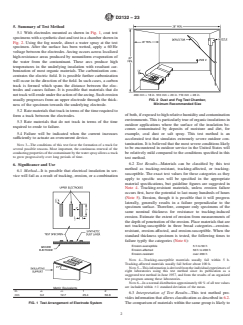
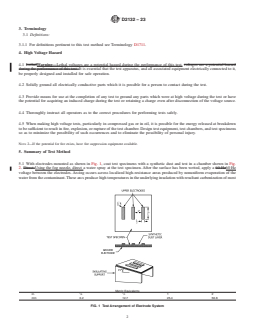
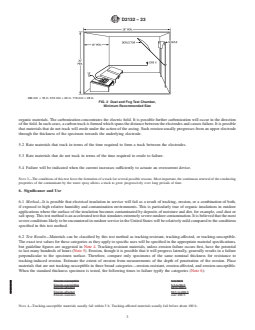
5.1 With electrodes mounted as shown in Fig. 1, coat test
specimens with a synthetic dust and test in a chamber shown in
Fig. 2. Using the fog nozzle, direct a water spray at the test
specimen. After the surface has been wetted, apply a 60 Hz
voltage between the electrodes. Arcing occurs across localized
high-resistance areas produced by nonuniform evaporation of
the water from the contaminant. These arcs produce high
temperatures in the underlying insulation with resultant car-
bonization of most organic materials. The carbonization con-
centrates the electric field. It is possible further carbonization
will occur in the direction of the field. In such cases, a carbon
track is formed which spans the distance between the elec-
trodes and causes failure. It is possible that materials that do
not track will erode under the action of the arcing. Such erosion 460 mm = 18 in. 510 mm = 20 in. 710 mm = 28 in.
usually progresses from an upper electrode through the thick- FIG. 2 Dust and Fog Test Chamber,
Minimum Recommended Size
ness of the specimen towards the underlying electrode.
5.2 Rate materials that track in terms of the time required to
of both, if exposed to high relative humidity and contamination
form a track between the electrodes.
environments. This is particularly true of organic insulations in
5.3 Rate materials that do not track in terms of the time
outdoor applications where the surface of the insulation be-
required to erode to failure.
comes contaminated by deposits of moisture and dirt, for
5.4 Failure will be indicated when the current increases
example, coal dust or salt spray. This test method is an
sufficiently to actuate an overcurrent device.
accelerated test that simulates extremely severe outdoor con-
tamination. It is believed that the most severe conditions likely
NOTE 3—The conditions of this test favor the formation of a track for
to be encountered in outdoor service in the United States will
several possible reasons. Most important, the continuous renewal of the
conducting properties of the contaminant by the water spray allows a track
be relatively mild compared to the conditions specified in this
to grow progressively over long periods of time.
test method.
6.2 Test Results—Materials can be classified by this test
6. Significance and Use
method as tracking-resistant, tracking-affected, or tracking-
6.1 Method—It is possible that electrical insulation in ser-
susceptible. The exact test values for these categories as they
vice will fail as a result of tracking, erosion, or a combination
apply to specific uses will be specified in the appropriate
material specifications, but guideline figures are suggested in
Note 4. Tracking-resistant materials, unless erosion failure
occurs first, have the potential to last many hundreds of hours
(Note 5). Erosion, though it is possible that it will progress
laterally, generally results in a failure perpendicular to the
specimen surface. Therefore, compare only specimens of the
same nominal thickness for resistance to tracking-induced
erosion. Estimate the extent of erosion from measurements of
the depth of penetration of the erosion. Place materials that are
not tracking-susceptible in three broad categories—erosion-
resistant, erosion-affected, and erosion-susceptible. When the
standard thickness specimen is tested, the following times to
failure typify the categories (Note 6):
Erosion-susceptible 5 h to 50 h
Erosion-affected 50 h to 200 h
Erosion-resistant over 200 h
NOTE 4—Tracking-susceptible materials usually fail within 5 h.
Tracking-affected materials usually fail before about 100 h.
NOTE 5—This information is derived from the individual experiences of
eight laboratories using this test method since its publication as a
suggested test method in June 1957, and from the results of an organized
test program among these laboratories.
NOTE 6—In a normal distribution approximately 68 % of all test values
are included within 61 standard deviation of the mean.
Metric Equivalents
1 1
in. ⁄8 ⁄2 1 2
6.3 Interpretation of Test Results—This test method pro-
mm 3.2 12.7 25.4 50.8
vides information that allows classification as described in 6.2.
FIG. 1 Test Arrangement of Electrode System The comparison of materials within the same group is likely to
D2132 − 23
be ambiguous unless three or more replicate specimens are 7.4 Control Transformer—Use a variable-ratio
tested. When the test method is used for specification purposes, autotransformer, T , to adjust the voltage as required.
do not establish simple minimum values without consideration
7.5 Voltmeter—Use a voltmeter, V, in the primary side to
of the large variance to be expected in test results. It is
determine the specimen test voltage. Alternatively, use a
recommended that quality levels and specification minima be
high-impedance voltmeter for connection in the secondary, in
determined by statistical techniques.
which case take precautions to prevent electric shock to an
operator. If a voltmeter is used in the primary, calibrate it
7. Apparatus
against secondary voltage with a secondary load of 10 mA.
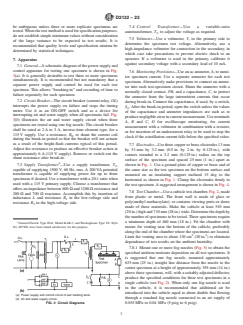
7.1 General—A schematic diagram of the power supply and
control apparatus for testing one specimen is shown in Fig.
7.6 Monitoring Provisions—Use an ac ammeter, A, to moni-
3(a). It is generally desirable to test three or more specimens
tor specimen current. Use a separate ammeter for each test
simultaneously. It is recommended but not mandatory that a
specimen. Alternatively make provisions to connect an amme-
separate power supply and control be used for each test
ter into each test-specimen circuit. Shunt the ammeter with a
specimen. This allows “breaking-in” and recording of time to
normally closed contact, PB, and a capacitance, C, to protect
failure separately for each specimen.
the ammeter from the large intermittent currents that occur
7.2 Circuit Breaker—The circuit breaker (current relay, OL)
during break-in. Connect the capacitance, if used, by a switch,
interrupts the power supply on failure and stops the timing
S . After the break-in period, open the switch unless the values
A
meter. Use it as an ON-OFF switch and as a device for
of the capacitance and ammeter impedances are such as to
interrupting air and water supply when all specimens fail. Fig.
produce negligible error in current measurement. Use terminals
3(b) illustrates the air and water supply circuit when three
A, B and C, D for oscilloscope monitoring, for current
specimens are tested using one fog nozzle. The circuit breaker
measurement with a voltmeter in combination with a resistor,
shall be rated at 2 A to 3 A, inverse-time element type, for a
or for insertion of an undercurrent relay to be used to stop the
115 V supply. Use a resistance, R , to shunt the current coil
clock if the scintillation current falls below the specified value.
during the break-in period so that the breaker will not actuate
as a result of the bright-flash currents typical of this period.
7.7 Electrodes—Use three copper or brass electrodes 13 mm
Adjust the resistance to produce an effective breaker action at
by 51 mm by 3.2 mm (0.5 in. by 2 in. by 0.125 in.), with
approximately 6 A (115 V supply). Remove or switch out the
corners rounded to a 3.2 mm (0.125 in.) radius on the top
shunt resistance after break-in.
surface of t
...
This document is not an ASTM standard and is intended only to provide the user of an ASTM standard an indication of what changes have been made to the previous version. Because
it may not be technically possible to adequately depict all changes accurately, ASTM recommends that users consult prior editions as appropriate. In all cases only the current version
of the standard as published by ASTM is to be considered the official document.
Designation: D2132 − 19 D2132 − 23
Standard Test Method for
Dust-and-Fog Tracking and Erosion Resistance of Electrical
Insulating Materials
This standard is issued under the fixed designation D2132; the number immediately following the designation indicates the year of
original adoption or, in the case of revision, the year of last revision. A number in parentheses indicates the year of last reapproval. A
superscript epsilon (´) indicates an editorial change since the last revision or reapproval.
1. Scope*
1.1 This test method is intended to differentiate solid electrical insulating materials with respect to their resistance to the action
of electric arcs produced by conduction through surface films of a specified contaminant containing moisture. Test Methods D2302,
D2303and, D2303D3638, and D5288 are also useful to evaluate materials.
1.2 Units—The values stated in SI units are the standard. The inch-pound units in parentheses are for information only. The values
stated in each system are not necessarily exact equivalents; therefore, to ensure conformance with the standard, each system shall
be used independently of the other, and values from the two systems shall not be combined.
1.3 This standard does not purport to address all of the safety concerns, if any, associated with its use. It is the responsibility
of the user of this standard to establish appropriate safety, health, and environmental practices and determine the applicability of
regulatory limitations prior to use.
NOTE 1—There is no equivalent ISO standard.
1.4 This international standard was developed in accordance with internationally recognized principles on standardization
established in the Decision on Principles for the Development of International Standards, Guides and Recommendations issued
by the World Trade Organization Technical Barriers to Trade (TBT) Committee.
2. Referenced Documents
2.1 ASTM Standards:
D709 Specification for Laminated Thermosetting Materials
D1711 Terminology Relating to Electrical Insulation
D2302 Method of Test for Differential Wet Tracking Resistance of Electrical Insulating Materials with Controlled Water-to-
Metal Discharges (Withdrawn 1982)
D2303 Test Methods for Liquid-Contaminant, Inclined-Plane Tracking and Erosion of Insulating Materials
D3638 Test Method for Comparative Tracking Index of Electrical Insulating Materials
D5288 Test Method for Determining Tracking Index of Electrical Insulating Materials Using Various Electrode Materials
(Excluding Platinum)
This test method is under the jurisdiction of ASTM Committee D09 on Electrical and Electronic Insulating Materials and is the direct responsibility of Subcommittee
D09.07 on Electrical Insulating Materials.
Current edition approved Aug. 1, 2019Aug. 1, 2023. Published August 2019September 2023. Originally approved in 1962. Last previous edition approved in 20182019
as D2132 – 12 (2018).D2132 – 19. DOI: 10.1520/D2132-19.10.1520/D2132-23.
For referenced ASTM standards, visit the ASTM website, www.astm.org, or contact ASTM Customer Service at service@astm.org. For Annual Book of ASTM Standards
volume information, refer to the standard’s Document Summary page on the ASTM website.
The last approved version of this historical standard is referenced on www.astm.org.
*A Summary of Changes section appears at the end of this standard
Copyright © ASTM International, 100 Barr Harbor Drive, PO Box C700, West Conshohocken, PA 19428-2959. United States
D2132 − 23
3. Terminology
3.1 Definitions:
3.1.1 For definitions pertinent to this test method see Terminology D1711.
4. High Voltage Hazard
4.1 LethalWarning—Lethal voltages are a potential hazard during the performance of this test. voltages are a potential hazard
during the performance of this test. It is essential that the test apparatus, and all associated equipment electrically connected to it,
be properly designed and installed for safe operation.
4.2 Solidly ground all electrically conductive parts which it is possible for a person to contact during the test.
4.3 Provide means for use at the completion of any test to ground any parts which were at high voltage during the test or have
the potential for acquiring an induced charge during the test or retaining a charge even after disconnection of the voltage source.
4.4 Thoroughly instruct all operators as to the correct procedures for performing tests safely.
4.5 When making high voltage tests, particularly in compressed gas or in oil, it is possible for the energy released at breakdown
to be sufficient to result in fire, explosion, or rupture of the test chamber. Design test equipment, test chambers, and test specimens
so as to minimize the possibility of such occurrences and to eliminate the possibility of personal injury.
NOTE 2—If the potential for fire exists, have fire suppression equipment available.
5. Summary of Test Method
5.1 With electrodes mounted as shown in Fig. 1, coat test specimens with a synthetic dust and test in a chamber shown in Fig.
2. Direct Using the fog nozzle, direct a water spray at the test specimen. After the surface has been wetted, apply a 60-Hz60 Hz
voltage between the electrodes. Arcing occurs across localized high-resistance areas produced by nonuniform evaporation of the
water from the contaminant. These arcs produce high temperatures in the underlying insulation with resultant carbonization of most
Metric Equivalents
1 1
in. ⁄8 ⁄2 1 2
mm 3.2 12.7 25.4 50.8
FIG. 1 Test Arrangement of Electrode System
D2132 − 23
460 mm = 18 in. 510 mm = 20 in. 710 mm = 28 in.
FIG. 2 Dust and Fog Test Chamber,
Minimum Recommended Size
organic materials. The carbonization concentrates the electric field. It is possible further carbonization will occur in the direction
of the field. In such cases, a carbon track is formed which spans the distance between the electrodes and causes failure. It is possible
that materials that do not track will erode under the action of the arcing. Such erosion usually progresses from an upper electrode
through the thickness of the specimen towards the underlying electrode.
5.2 Rate materials that track in terms of the time required to form a track between the electrodes.
5.3 Rate materials that do not track in terms of the time required to erode to failure.
5.4 Failure will be indicated when the current increases sufficiently to actuate an overcurrent device.
NOTE 3—The conditions of this test favor the formation of a track for several possible reasons. Most important, the continuous renewal of the conducting
properties of the contaminant by the water spray allows a track to grow progressively over long periods of time.
6. Significance and Use
6.1 Method—It is possible that electrical insulation in service will fail as a result of tracking, erosion, or a combination of both,
if exposed to high relative humidity and contamination environments. This is particularly true of organic insulations in outdoor
applications where the surface of the insulation becomes contaminated by deposits of moisture and dirt, for example, coal dust or
salt spray. This test method is an accelerated test that simulates extremely severe outdoor contamination. It is believed that the most
severe conditions likely to be encountered in outdoor service in the United States will be relatively mild compared to the conditions
specified in this test method.
6.2 Test Results—Materials can be classified by this test method as tracking-resistant, tracking-affected, or tracking-susceptible.
The exact test values for these categories as they apply to specific uses will be specified in the appropriate material specifications,
but guideline figures are suggested in Note 4. Tracking-resistant materials, unless erosion failure occurs first, have the potential
to last many hundreds of hours (Note 5). Erosion, though it is possible that it will progress laterally, generally results in a failure
perpendicular to the specimen surface. Therefore, compare only specimens of the same nominal thickness for resistance to
tracking-induced erosion. Estimate the extent of erosion from measurements of the depth of penetration of the erosion. Place
materials that are not tracking-susceptible in three broad categories—erosion-resistant, erosion-affected, and erosion-susceptible.
When the standard thickness specimen is tested, the following times to failure typify the categories (Note 6):
Erosion-susceptible 5 to 50 h
Erosion-susceptible 5 h to 50 h
Erosion-affected 50 to 200 h
Erosion-affected 50 h to 200 h
Erosion-resistant over 200 h
NOTE 4—Tracking-susceptible materials usually fail within 5 h. Tracking-affected materials usually fail before about 100 h.
D2132 − 23
NOTE 5—This information is derived from the individual experiences of eight laboratories using this test method since its publication as a suggested test
method in June 1957, and from the results of an organized test program among these laboratories.
NOTE 6—In a normal distribution approximately 68 % of all test values are included within 61 standard deviation of the mean.
6.3 Interpretation of Test Results—This test method provides information that allows classification as described in 6.2. The
comparison of materials within the same group is likely to be ambiguous unless three or more replicate specimens are tested. When
the test method is used for specification purposes, do not establish simple minimum values without consideration of the large
variance to be expected in test results. It is recommended that quality levels and specification minima be determined by statistical
techniques.
7. Apparatus
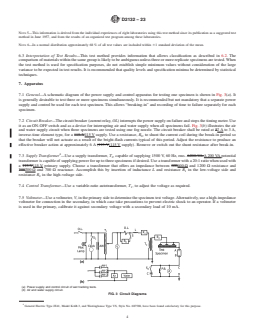
7.1 General—A schematic diagram of the power supply and control apparatus for testing one specimen is shown in Fig. 3(a). It
is generally desirable to test three or more specimens simultaneously. It is recommended but not mandatory that a separate power
supply and control be used for each test specimen. This allows “breaking-in” and recording of time to failure separately for each
specimen.
7.2 Circuit Breaker—The circuit breaker (current relay, OL) interrupts the power supply on failure and stops the timing meter. Use
it as an ON-OFF switch and as a device for interrupting air and water supply when all specimens fail. Fig. 3(b) illustrates the air
and water supply circuit when three specimens are tested using one fog nozzle. The circuit breaker shall be rated at 22 A to 3 A,
inverse-time element type, for a 115-V115 V supply. Use a resistance, R , to shunt the current coil during the break-in period so
that the breaker will not actuate as a result of the bright-flash currents typical of this period. Adjust the resistance to produce an
effective breaker action at approximately 6 A (115-V(115 V supply). Remove or switch out the shunt resistance after break-in.
7.3 Supply Transformer —Use a supply transformer, T , capable of supplying 1500 V, 60 Hz, rms. A200-VA A 200 VA potential
transformer is capable of supplying power for up to three specimens if desired. Use a transformer with a 20:1 ratio when used with
a 115-V115 V primary supply. Choose a transformer that offers an impedance between 600600 Ω and 1200 Ω resistance and
200200 Ω and 700 Ω reactance. Accomplish this by insertion of inductance L and resistance R in the low-voltage side and
resistance R in the high-voltage side.
7.4 Control Transformer—Use a variable-ratio autotransformer, T , to adjust the voltage as required.
7.5 Voltmeter—Use a voltmeter, V, in the primary side to determine the specimen test voltage. Alternatively, use a high-impedance
voltmeter for connection in the secondary, in which case take precautions to prevent electric shock to an operator. If a voltmeter
is used in the primary, calibrate it against secondary voltage with a secondary load of 10 mA.
(a) Power supply and control circuit of wet tracking tests.
(b) Air and water supply circuit.
FIG. 3 Circuit Diagrams
General Electric Type JE41, Model KAR-3, and Westinghouse Type VS, Style No. 687588, have been found satisfactory for this purpose.
D2132 − 23
FIG. 4 Clamping Arrangement for Test-Specimen Electrodes
7.6 Monitoring Provisions—Use an ac ammeter, A, to monitor specimen current. Use a separate ammeter for each test specimen.
Alternatively make provisions to connect an ammeter i
...