

ASTM D6721-01(2015)
(Test Method)Standard Test Method for Determination of Chlorine in Coal by Oxidative Hydrolysis Microcoulometry
General Information
- Abstract
SIGNIFICANCE AND USE
4.1 This test method permits measurements of the chlorine content of coals.
SCOPE
1.1 This test method covers the determination of total chlorine in coal.
1.2 The values stated in SI units are to be regarded as standard. No other units of measurement are included in this standard.
1.3 This standard does not purport to address all of the safety concerns, if any, associated with its use. It is the responsibility of the user of this standard to establish appropriate safety and health practices and determine the applicability of regulatory limitations prior to use.
- Status
- Published
- Publication Date
- 31-Dec-2014
- Technical Committee
- D05 - Coal and Coke
- Drafting Committee
- D05.29 - Major Elements in Ash and Trace Elements of Coal
Overview
ASTM D6721-01(2015) is the international standard test method published by ASTM International for the determination of total chlorine in coal using oxidative hydrolysis microcoulometry. This standard provides laboratories and industry professionals with a reliable procedure to measure chlorine content in coal, supporting quality control, regulatory compliance, and research applications. The methodology utilizes SI units exclusively and applies a rigorous microcoulometric detection system following sample combustion.
This standard plays a vital role in coal testing, enabling accurate assessment of chlorine levels to help control emissions, improve boiler operation, and manage environmental and corrosion risks.
Key Topics
Chlorine Determination in Coal:
The test method specifies how to measure total chlorine in various types of coal, which is essential for understanding potential impacts on both equipment and environment.Oxidative Hydrolysis Microcoulometry:
Combustion of a coal sample in a humidified oxygen atmosphere at high temperature oxidizes halogens. Chlorine is converted to hydrochloric acid and quantitatively measured coulometrically.Sample Preparation and Analysis:
Samples are prepared according to referenced ASTM methods, and precise analytical steps are outlined to ensure accuracy and repeatability.Quality Control:
Procedures for blank determination, recovery factor calculation, and repeatability and reproducibility assessments are included to guarantee analytical quality and method validation.Interferences & Limitations:
The method notes potential interferences from other halides (e.g., bromides, iodides) and specifies that fluorides are not detected.
Applications
Environmental Compliance:
Measurement of chlorine in coal is crucial for power plants and industries to adhere to environmental regulations, particularly regarding emissions and waste management.Boiler and Equipment Maintenance:
Chlorine levels in coal influence corrosion rates of metals in boilers and related equipment. Accurate determination helps in preventing costly maintenance and equipment failure.Coal Quality Assessment:
Coal suppliers and purchasers use chlorine content as a quality parameter, impacting blending decisions and end-use suitability.Research and Development:
Laboratories and research teams apply this test method to study coal characteristics, investigate combustion behavior, and develop cleaner coal technologies.
Related Standards
- ASTM D2013 – Practice for Preparing Coal Samples for Analysis
- ASTM D3173 – Test Method for Moisture in the Analysis Sample of Coal and Coke
- ASTM D3180 – Practice for Calculating Coal and Coke Analyses from As-Determined to Different Bases
- ASTM D5142 – Test Methods for Proximate Analysis of Coal and Coke by Instrumental Procedures
- ISO 5725-6:1994 – Accuracy (trueness and precision) of measurement methods and results
- ASTM E691 – Practice for Conducting an Interlaboratory Study to Determine the Precision of a Test Method
Practical Value
Implementing ASTM D6721-01(2015) enables coal testing laboratories, power generators, and environmental professionals to obtain standardized, repeatable, and reproducible results for chlorine content in coal. Using oxidative hydrolysis microcoulometry ensures high sensitivity and specificity, supporting critical decisions in quality assurance, compliance, and asset protection. By following this internationally recognized method, organizations ensure reliable reporting and facilitate regulatory approval and market acceptance for coal products. Proper adherence to the standard also aids in troubleshooting operational issues related to chlorine in fuel sources.
Relations
- Effective Date
- 01-Jan-2015
- Effective Date
- 01-Dec-2023
- Effective Date
- 01-Jan-2015
- Effective Date
- 01-May-2013
- Effective Date
- 01-Apr-2012
- Effective Date
- 01-Nov-2011
- Effective Date
- 01-Apr-2011
- Effective Date
- 01-Oct-2008
- Effective Date
- 01-Oct-2008
- Refers
ASTM D3173-03(2008) - Standard Test Method for Moisture in the Analysis Sample of Coal and Coke - Effective Date
- 01-Feb-2008
- Effective Date
- 15-Jul-2007
- Effective Date
- 01-Jun-2007
- Effective Date
- 15-Nov-2006
- Effective Date
- 15-Sep-2006
- Effective Date
- 01-May-2006
Get Certified
Connect with accredited certification bodies for this standard

Bureau Veritas Chile
Bureau Veritas certification services in Chile.
Bureau Veritas Peru
Bureau Veritas certification services in Peru.
BVQI Peru
Bureau Veritas certification in Peru.
Sponsored listings
Frequently Asked Questions
ASTM D6721-01(2015) is a standard published by ASTM International. Its full title is "Standard Test Method for Determination of Chlorine in Coal by Oxidative Hydrolysis Microcoulometry". This standard covers: SIGNIFICANCE AND USE 4.1 This test method permits measurements of the chlorine content of coals. SCOPE 1.1 This test method covers the determination of total chlorine in coal. 1.2 The values stated in SI units are to be regarded as standard. No other units of measurement are included in this standard. 1.3 This standard does not purport to address all of the safety concerns, if any, associated with its use. It is the responsibility of the user of this standard to establish appropriate safety and health practices and determine the applicability of regulatory limitations prior to use.
SIGNIFICANCE AND USE 4.1 This test method permits measurements of the chlorine content of coals. SCOPE 1.1 This test method covers the determination of total chlorine in coal. 1.2 The values stated in SI units are to be regarded as standard. No other units of measurement are included in this standard. 1.3 This standard does not purport to address all of the safety concerns, if any, associated with its use. It is the responsibility of the user of this standard to establish appropriate safety and health practices and determine the applicability of regulatory limitations prior to use.
ASTM D6721-01(2015) is classified under the following ICS (International Classification for Standards) categories: 73.040 - Coals. The ICS classification helps identify the subject area and facilitates finding related standards.
ASTM D6721-01(2015) has the following relationships with other standards: It is inter standard links to ASTM D6721-01(2006), ASTM D3180-15(2023), ASTM D3180-15, ASTM E691-13, ASTM D3180-12, ASTM E691-11, ASTM D3173-11, ASTM E691-08, ASTM E29-08, ASTM D3173-03(2008), ASTM D3180-07, ASTM D2013-07, ASTM E29-06b, ASTM E29-06a, ASTM E29-06. Understanding these relationships helps ensure you are using the most current and applicable version of the standard.
ASTM D6721-01(2015) is available in PDF format for immediate download after purchase. The document can be added to your cart and obtained through the secure checkout process. Digital delivery ensures instant access to the complete standard document.
Standards Content (Sample)
This international standard was developed in accordance with internationally recognized principles on standardization established in the Decision on Principles for the
Development of International Standards, Guides and Recommendations issued by the World Trade Organization Technical Barriers to Trade (TBT) Committee.
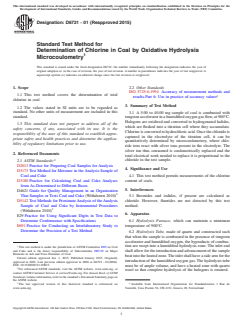
Designation: D6721 − 01 (Reapproved 2015)
Standard Test Method for
Determination of Chlorine in Coal by Oxidative Hydrolysis
Microcoulometry
This standard is issued under the fixed designation D6721; the number immediately following the designation indicates the year of
original adoption or, in the case of revision, the year of last revision. A number in parentheses indicates the year of last reapproval. A
superscript epsilon (´) indicates an editorial change since the last revision or reapproval.
1. Scope 2.2 Other Standards
ISO 5725-6:1994 Accuracy of measurement methods and
1.1 This test method covers the determination of total
results-Part 6: Use in practice of accuracy values
chlorine in coal.
3. Summary of Test Method
1.2 The values stated in SI units are to be regarded as
standard. No other units of measurement are included in this
3.1 A 5.00 to 40.00 mg sample of coal is combusted with
standard. tungstenacceleratorinahumidifiedoxygengasflow,at900°C.
Halogens are oxidized and converted to hydrogenated halides,
1.3 This standard does not purport to address all of the
which are flushed into a titration cell where they accumulate.
safety concerns, if any, associated with its use. It is the
Chlorineisconvertedtohydrochloricacid.Oncethechlorideis
responsibility of the user of this standard to establish appro-
captured in the electrolyte of the titration cell, it can be
priate safety and health practices and determine the applica-
quantitatively determined by microcoulometery, where chlo-
bility of regulatory limitations prior to use.
ride ions react with silver ions present in the electrolyte. The
silver ion thus consumed is coulometrically replaced and the
2. Referenced Documents
total electrical work needed to replace it is proportional to the
chloride in the test sample.
2.1 ASTM Standards:
D2013 Practice for Preparing Coal Samples for Analysis
4. Significance and Use
D3173 Test Method for Moisture in the Analysis Sample of
4.1 This test method permits measurements of the chlorine
Coal and Coke
content of coals.
D3180 Practice for Calculating Coal and Coke Analyses
from As-Determined to Different Bases
5. Interferences
D4621 Guide for Quality Management in an Organization
That Samples or Tests Coal and Coke (Withdrawn 2010) 5.1 Bromides and iodides, if present are calculated as
D5142 Test Methods for ProximateAnalysis of theAnalysis chloride. However, fluorides are not detected by this test
method.
Sample of Coal and Coke by Instrumental Procedures
(Withdrawn 2010)
6. Apparatus
E29 Practice for Using Significant Digits in Test Data to
Determine Conformance with Specifications 6.1 Hydrolysis Furnace, which can maintain a minimum
E691 Practice for Conducting an Interlaboratory Study to temperature of 900°C.
Determine the Precision of a Test Method
6.2 Hydrolysis Tube, made of quartz and constructed such
that when the sample is combusted in the presence of tungsten
accelerator and humidified oxygen, the byproducts of combus-
This test method is under the jurisdiction of ASTM Committee D05 on Coal tion are swept into a humidified hydrolysis zone. The inlet end
and Coke and is the direct responsibility of Subcommittee D05.29 on Major
shall allow for the introduction and advancement of the sample
Elements in Ash and Trace Elements of Coal.
boatintotheheatedzone.Theinletshallhaveasidearmforthe
Current edition approved Jan. 1, 2015. Published January 2015. Originally
introduction of the humidified oxygen gas.The hydrolysis tube
approved in 2001. Last previous edition approved in 2006 as D6721 – 01(2006).
DOI: 10.1520/D6721-01R15. must be of ample volume, and have a heated zone with quartz
For referenced ASTM standards, visit the ASTM website, www.astm.org, or
wool so that complete hydrolysis of the halogens is ensured.
contact ASTM Customer Service at service@astm.org. For Annual Book of ASTM
Standards volume information, refer to the standard’s Document Summary page on
the ASTM website.
3 4
The last approved version of this historical standard is referenced on Available from International Organization for Standardization 1 Rue de
www.astm.org. Varembé, Case Postale 56, CH-1211, Geneva 20, Switzerland
Copyright © ASTM International, 100 Barr Harbor Drive, PO Box C700, West Conshohocken, PA 19428-2959. United States
D6721 − 01 (2015)
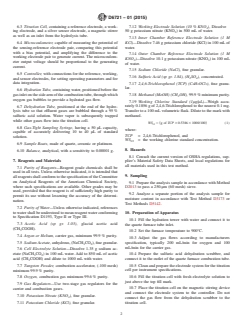
6.3 Titration Cell, containing a reference electrode, a work- 7.12 Working Electrode Solution (10% KNO ), Dissolve
ing electrode, and a silver sensor electrode, a magnetic stirrer 50 g potassium nitrate (KNO ) in 500 mL of water.
as well as an inlet from the hydrolysis tube.
7.13 Inner Chamber Reference Electrode Solution (1 M
KCl)—Dissolve 7.46 g potassium chloride (KCl) in 100 mL of
6.4 Microcoulometer, capable of measuring the potential of
the sensing-reference electrode pair, comparing this potential water.
with a bias potential, and amplifying the difference to the
7.14 Outer Chamber Reference Electrode Solution (1 M
working electrode pair to generate current. The microcoulom-
KNO )—Dissolve 10.1 g potassium nitrate (KNO ) in 100 mL
3 3
eter output voltage should be proportional to the generating
of water.
current.
7.15 Sodium Chloride (NaCl), fine granular.
6.5 Controller, with connections for the reference, working,
7.16 Sulfuric Acid (sp gr. 1.84), (H SO ), concentrated.
2 4
and sensor electrodes, for setting operating parameters and for
data integration.
7.17 2,4,6-Trichlorophenol (TCP) (C H OCl ), fine granu-
6 3 3
lar.
6.6 Hydration Tube, containing water, positioned before the
gasinletonthesidearmofthecombustiontube,throughwhich 7.18 Methanol (MeOH) (CH OH), 99.9 % minimum purity.
oxygen gas bubbles to provide a hydrated gas flow.
7.19 Working Chlorine Standard (1µg/µL)—Weigh accu-
6.7 Dehydration Tube, positioned at the end of the hydro- rately 0.1856 g of 2,4,6-Trichlorophenol to the nearest 0.1 mg.
Transfer to a 100 mLvolumetric flask. Dilute to the mark with
lysis tube so that effluent gases are bubbled through a 95 %
sulfuric acid solution. Water vapor is subsequently trapped methanol.
while other gases flow into the titration cell.
WS 5 gofTCP 30.5386 31000/100 (1)
~ !
CI
6.8 Gas-Tight Sampling Syringe, having a 50 µL capacity,
where:
capable of accurately delivering 10 to 40 µL of standard
TCP = 2,4,6-Trichlorophenol, and
solution.
WS = the working chlorine standard concentration.
CI
6.9 Sample Boats, made of quartz, ceramic or platinum.
8. Hazards
6.10 Balance, analytical, with a sensitivity to 0.00001 g.
8.1 Consult the current version of OSHA regulations, sup-
7. Reagents and Materials
plier’s Material Safety Data Sheets, and local regulations for
all materials used in this test method.
7.1 Purity of Reagents—Reagent grade chemicals shall be
used in all tests. Unless otherwise indicated, it is intended that
9. Sampling
allreagentsshallconformtothespecificationoftheCommittee
on Analytical Reagents of the American Chemical Society,
9.1 Prepare the analysis sample in accordance with Method
where such specifications are available. Other grades may be
D2013 to pass a 250-µm (60 mesh) sieve.
used, provided that the reagent is of sufficiently high purity to
9.2 Analyze a separate portion of the analysis sample for
permit its use without lessening the accuracy of the determi-
moisture content in accordance with Test Method D3173 or
nation.
Test Methods D5142.
7.2 Purity of Water—Unless otherwise indicated, references
towatershallbeunderstoodtomeanreagentwaterconforming
10. Preparation of Apparatus
to Specification D1193, Type II or Type III.
10.1 Fill the hydration tower with water and connect it to
7.3 Acetic Acid (sp gr. 1.05), glacial acetic acid
the quartz furnace tube inlet.
(CH COOH).
10.2 Set the furnace temperature to 900°C.
7.4 Argon or Helium, carrier gas, minimum 99.9 % purity.
10.3 Adjust the gas flows according to manufacturers
7.5 SodiumAcetate, anhydrous, (NaCH CO ), fine granular.
specification, typically 200 mL/min for oxygen and 100
3 2
mL/min for the carrier gas.
7.6 Cell Electrolyte Solution—Dissolve 1.35 g sodium ac-
etate (NaCH CO ) in 100 mL water. Add to 850 mL of acetic 10.4 Prepare the sulfuric acid dehydration scrubber, and
3 2
acid (CH COOH) and dilute to 1000 mL with water. connect it to the outlet of the quartz furnace combustion tube.
7.7 Tungsten Powder, combustion accelerator, (-100 mesh) 10.5 Clean and prepare the electrode system for the titration
cell per instrument specifications.
minimum 99.9 % purity.
10.6 Fill the titration cell with fresh electrolyte solution to
7.8 Oxygen, combustion gas minimum 99.6 % purity.
just above the top fill mark.
7.9 Gas Regulators—Use two-stage gas regulators for the
10.7 Place the titration cell on the magnetic stirring device
carrier and combustion gases.
and connect the electrode system to the controller. Do not
7.10 Potassium Nitrate (KNO ), fine granular.
connect the gas flow from the dehydration scrubber to the
7.11 Potassium Chloride (KCl), fine granular. titration cell.
D6721 − 01 (2015)
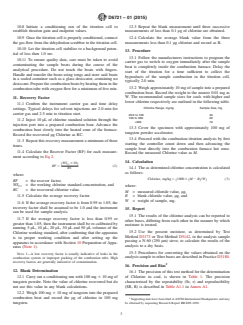
10.8 Initiate a conditioning run of the titration cell to 12.3 Repeat the blank measurement until three successive
establish titration gain and endpoint values. measurements of less than 0.1 µg of chlorine are obtained.
10.9 Once the titration cell is properly conditioned, connect 12.4 Calculate the average blank value f
...