

ASTM F3444/F3444M-20
(Practice)Standard Practice for Training Exoskeleton Users
General Information
- Abstract
SIGNIFICANCE AND USE
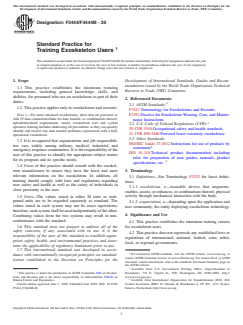
4.1 This practice establishes the minimum training criteria for exoskeleton users.
4.2 This practice does not supersede any established laws or regulations of international, national, federal, state, tribal, local, or regional governments.
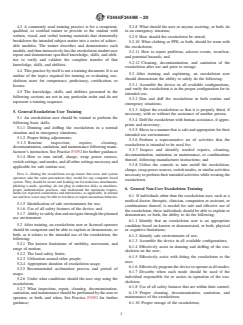
4.3 A commonly used training practice is for a competent, qualified, or certified trainer to provide to the student with written, visual, and verbal training materials that elementally breakdown the intended subject matter into a series of achievable modules. The trainer describes and demonstrates each module, and then interactively has the exoskeleton student user repeat and demonstrate specified knowledge, skills, and abilities to verify and validate the complete transfer of that knowledge, skills, and abilities.
4.4 This practice by itself is not a training document. It is an outline of the topics required for training or evaluating exoskeleton users for competence, proficiency, certification, or license.
4.5 The knowledge, skills, and abilities presented in the following sections are not in any particular order and do not represent a training sequence.
SCOPE
1.1 This practice establishes the minimum training requirements, including general knowledge, skills, and abilities, for personnel who use an exoskeleton as part of their duties.
1.2 This practice applies only to exoskeletons and exosuits.
Note 1: For more advanced exoskeletons, those that are powered, or with IT data connections/links for data transfer, or combinations thereof, upload/download requirements, ensure exoskeleton user and system operators training includes addressing all precautions so they can quickly identify and resolve any data transfer problems experienced with a fully operational exoskeleton.
1.3 It is recognized that organizations and job responsibilities vary widely among military, medical, industrial, and emergency response communities. It is the responsibility of the user of this practice to identify the appropriate subject matter for its program and its specific needs.
1.4 Users of this practice should consult with the exoskeleton manufacturer to ensure they have the latest and most relevant information on the exoskeleton. In addition, all training should comply with laws and regulations regarding user safety and health as well as the safety of individuals in close proximity to the user.
1.5 Units—The values stated in either SI units or inch-pound units are to be regarded separately as standard. The values stated in each system may not be exact equivalents; therefore, each system shall be used independently of the other. Combining values from the two systems may result in non-conformance with the standard.
1.6 This standard does not purport to address all of the safety concerns, if any, associated with its use. It is the responsibility of the user of this standard to establish appropriate safety, health, and environmental practices and determine the applicability of regulatory limitations prior to use.
1.7 This international standard was developed in accordance with internationally recognized principles on standardization established in the Decision on Principles for the Development of International Standards, Guides and Recommendations issued by the World Trade Organization Technical Barriers to Trade (TBT) Committee.
- Status
- Published
- Publication Date
- 31-May-2020
- Technical Committee
- F48 - Exoskeletons and Exosuits
- Drafting Committee
- F48.02 - Human Factors and Ergonomics


Overview
ASTM F3444/F3444M-20: Standard Practice for Training Exoskeleton Users establishes the minimum requirements for training individuals who utilize exoskeletons and exosuits as part of their professional duties. Developed by ASTM International’s Committee F48 on Exoskeletons and Exosuits, this standard serves as a foundational framework for ensuring that exoskeleton users are equipped with the essential knowledge, skills, and abilities to operate these wearable robotic devices safely and effectively. The practice applies to a range of application settings, including industrial, medical, military, and emergency response environments.
Key Topics
This standard provides a structured outline of essential training topics for exoskeleton users and those assisting or supervising them. Important aspects include:
- Donning and doffing procedures for both routine and emergency situations
- Proper fit adjustments for the individual user
- Routine inspection, cleaning, and sanitation, following manufacturer instructions
- Safe operation: Turning on/off, changing power sources, and using safety features
- Awareness of safe environments for exoskeleton use
- User safety and health compliance, including appropriate use of personal protective equipment (PPE)
- Troubleshooting: Recognizing and reporting faults, hazards, or required maintenance
- Demonstration of competence through hands-on validation of knowledge, skills, and abilities
- Special considerations for advanced exoskeletons involving powered features or data connections
- Training and competency for assistants, companions, or supervisors supporting the user
- Guidance on storage, cleaning, and regular maintenance
Applications
The practices outlined in ASTM F3444/F3444M-20 are applicable to a wide range of industries and scenarios:
- Industrial and Manufacturing: Ensuring workers are properly trained to use exoskeletons for material handling, ergonomic support, and injury prevention.
- Healthcare and Rehabilitation: Training patients or clinicians using exoskeletons for mobility assistance and therapy.
- Military: Preparing personnel to safely operate exoskeletons in challenging operational environments.
- Emergency Response: Training first responders who may use exoskeletons for load carriage or rescue applications.
Organizations can customize the training content to align with their specific use cases and exoskeleton devices, ensuring compliance with all relevant laws, safety standards, and manufacturer instructions.
Related Standards
Several standards are closely related to ASTM F3444/F3444M-20 and may be referenced for comprehensive exoskeleton training and use:
- ASTM F3323: Terminology for Exoskeletons and Exosuits
- ASTM F3392: Practice for Exoskeleton Wearing, Care, and Maintenance Instructions
- 29 CFR 1910: U.S. Occupational Safety and Health Standards
- 21 CFR 890.3480: Powered Lower Extremity Exoskeleton regulations
- ISO/IEC Guide 37:2012: Instructions for use of products by consumers
- ISO 01.110: Technical product documentation, including preparation of user guides and manuals
Practical Value
By following ASTM F3444/F3444M-20, organizations can:
- Standardize exoskeleton user training across multiple environments
- Enhance user safety, competence, and confidence when operating exoskeletons
- Meet regulatory, organizational, and manufacturer requirements
- Support consistent training documentation and evaluation of exoskeleton proficiency
This standard is essential for any entity deploying exoskeleton technology, providing a reliable structure for training programs that protect both users and those around them.
Relations
- Effective Date
- 01-Oct-2019
- Effective Date
- 01-Apr-2019
- Effective Date
- 01-Sep-2018
- Effective Date
- 01-Jun-2020
- Effective Date
- 01-Jun-2020
- Effective Date
- 01-Jun-2020
- Effective Date
- 01-Jun-2020
- Referred By
ASTM F3523-21 - Standard Test Method for Exoskeleton Use: Confined Space: Horizontal Movement - Effective Date
- 01-Jun-2020
- Effective Date
- 01-Jun-2020
Get Certified
Connect with accredited certification bodies for this standard

BSI Group
BSI (British Standards Institution) is the business standards company that helps organizations make excellence a habit.

TÜV Rheinland
TÜV Rheinland is a leading international provider of technical services.

TÜV SÜD
TÜV SÜD is a trusted partner of choice for safety, security and sustainability solutions.
Sponsored listings
Frequently Asked Questions
ASTM F3444/F3444M-20 is a standard published by ASTM International. Its full title is "Standard Practice for Training Exoskeleton Users". This standard covers: SIGNIFICANCE AND USE 4.1 This practice establishes the minimum training criteria for exoskeleton users. 4.2 This practice does not supersede any established laws or regulations of international, national, federal, state, tribal, local, or regional governments. 4.3 A commonly used training practice is for a competent, qualified, or certified trainer to provide to the student with written, visual, and verbal training materials that elementally breakdown the intended subject matter into a series of achievable modules. The trainer describes and demonstrates each module, and then interactively has the exoskeleton student user repeat and demonstrate specified knowledge, skills, and abilities to verify and validate the complete transfer of that knowledge, skills, and abilities. 4.4 This practice by itself is not a training document. It is an outline of the topics required for training or evaluating exoskeleton users for competence, proficiency, certification, or license. 4.5 The knowledge, skills, and abilities presented in the following sections are not in any particular order and do not represent a training sequence. SCOPE 1.1 This practice establishes the minimum training requirements, including general knowledge, skills, and abilities, for personnel who use an exoskeleton as part of their duties. 1.2 This practice applies only to exoskeletons and exosuits. Note 1: For more advanced exoskeletons, those that are powered, or with IT data connections/links for data transfer, or combinations thereof, upload/download requirements, ensure exoskeleton user and system operators training includes addressing all precautions so they can quickly identify and resolve any data transfer problems experienced with a fully operational exoskeleton. 1.3 It is recognized that organizations and job responsibilities vary widely among military, medical, industrial, and emergency response communities. It is the responsibility of the user of this practice to identify the appropriate subject matter for its program and its specific needs. 1.4 Users of this practice should consult with the exoskeleton manufacturer to ensure they have the latest and most relevant information on the exoskeleton. In addition, all training should comply with laws and regulations regarding user safety and health as well as the safety of individuals in close proximity to the user. 1.5 Units—The values stated in either SI units or inch-pound units are to be regarded separately as standard. The values stated in each system may not be exact equivalents; therefore, each system shall be used independently of the other. Combining values from the two systems may result in non-conformance with the standard. 1.6 This standard does not purport to address all of the safety concerns, if any, associated with its use. It is the responsibility of the user of this standard to establish appropriate safety, health, and environmental practices and determine the applicability of regulatory limitations prior to use. 1.7 This international standard was developed in accordance with internationally recognized principles on standardization established in the Decision on Principles for the Development of International Standards, Guides and Recommendations issued by the World Trade Organization Technical Barriers to Trade (TBT) Committee.
SIGNIFICANCE AND USE 4.1 This practice establishes the minimum training criteria for exoskeleton users. 4.2 This practice does not supersede any established laws or regulations of international, national, federal, state, tribal, local, or regional governments. 4.3 A commonly used training practice is for a competent, qualified, or certified trainer to provide to the student with written, visual, and verbal training materials that elementally breakdown the intended subject matter into a series of achievable modules. The trainer describes and demonstrates each module, and then interactively has the exoskeleton student user repeat and demonstrate specified knowledge, skills, and abilities to verify and validate the complete transfer of that knowledge, skills, and abilities. 4.4 This practice by itself is not a training document. It is an outline of the topics required for training or evaluating exoskeleton users for competence, proficiency, certification, or license. 4.5 The knowledge, skills, and abilities presented in the following sections are not in any particular order and do not represent a training sequence. SCOPE 1.1 This practice establishes the minimum training requirements, including general knowledge, skills, and abilities, for personnel who use an exoskeleton as part of their duties. 1.2 This practice applies only to exoskeletons and exosuits. Note 1: For more advanced exoskeletons, those that are powered, or with IT data connections/links for data transfer, or combinations thereof, upload/download requirements, ensure exoskeleton user and system operators training includes addressing all precautions so they can quickly identify and resolve any data transfer problems experienced with a fully operational exoskeleton. 1.3 It is recognized that organizations and job responsibilities vary widely among military, medical, industrial, and emergency response communities. It is the responsibility of the user of this practice to identify the appropriate subject matter for its program and its specific needs. 1.4 Users of this practice should consult with the exoskeleton manufacturer to ensure they have the latest and most relevant information on the exoskeleton. In addition, all training should comply with laws and regulations regarding user safety and health as well as the safety of individuals in close proximity to the user. 1.5 Units—The values stated in either SI units or inch-pound units are to be regarded separately as standard. The values stated in each system may not be exact equivalents; therefore, each system shall be used independently of the other. Combining values from the two systems may result in non-conformance with the standard. 1.6 This standard does not purport to address all of the safety concerns, if any, associated with its use. It is the responsibility of the user of this standard to establish appropriate safety, health, and environmental practices and determine the applicability of regulatory limitations prior to use. 1.7 This international standard was developed in accordance with internationally recognized principles on standardization established in the Decision on Principles for the Development of International Standards, Guides and Recommendations issued by the World Trade Organization Technical Barriers to Trade (TBT) Committee.
ASTM F3444/F3444M-20 is classified under the following ICS (International Classification for Standards) categories: 11.180.01 - Aids for disabled and handicapped persons in general; 25.040.30 - Industrial robots. Manipulators. The ICS classification helps identify the subject area and facilitates finding related standards.
ASTM F3444/F3444M-20 has the following relationships with other standards: It is inter standard links to ASTM F3323-19a, ASTM F3323-19, ASTM F3323-18, ASTM F3527-21, ASTM F3584-22, ASTM F3581-22, ASTM F3582-22, ASTM F3523-21, ASTM F3583-22. Understanding these relationships helps ensure you are using the most current and applicable version of the standard.
ASTM F3444/F3444M-20 is available in PDF format for immediate download after purchase. The document can be added to your cart and obtained through the secure checkout process. Digital delivery ensures instant access to the complete standard document.
Standards Content (Sample)
This international standard was developed in accordance with internationally recognized principles on standardization established in the Decision on Principles for the
Development of International Standards, Guides and Recommendations issued by the World Trade Organization Technical Barriers to Trade (TBT) Committee.
Designation: F3444/F3444M − 20
Standard Practice for
Training Exoskeleton Users
ThisstandardisissuedunderthefixeddesignationF3444/F3444M;thenumberimmediatelyfollowingthedesignationindicatestheyear
of original adoption or, in the case of revision, the year of last revision. A number in parentheses indicates the year of last reapproval.
A superscript epsilon (´) indicates an editorial change since the last revision or reapproval.
1. Scope Development of International Standards, Guides and Recom-
mendations issued by the World Trade Organization Technical
1.1 This practice establishes the minimum training
Barriers to Trade (TBT) Committee.
requirements, including general knowledge, skills, and
abilities, for personnel who use an exoskeleton as part of their
2. Referenced Documents
duties.
2.1 ASTM Standards:
1.2 This practice applies only to exoskeletons and exosuits.
F3323 Terminology for Exoskeletons and Exosuits
F3392 Practice for Exoskeleton Wearing, Care, and Mainte-
NOTE 1—For more advanced exoskeletons, those that are powered, or
with IT data connections/links for data transfer, or combinations thereof,
nance Instructions
upload/download requirements, ensure exoskeleton user and system
2.2 U.S. Code of Federal Regulations (CFR):
operators training includes addressing all precautions so they can quickly
29 CFR 1910 Occupational safety and health standards
identify and resolve any data transfer problems experienced with a fully
21 CFR 890.3480 Powered lower extremity exoskeleton
operational exoskeleton.
2.3 Other Standards:
1.3 It is recognized that organizations and job responsibili-
ISO/IEC Guide 37:2012 Instructions for use of products by
ties vary widely among military, medical, industrial, and
consumers
emergency response communities. It is the responsibility of the
ISO 01.110 Technical product documentation including
user of this practice to identify the appropriate subject matter
rules for preparation of user guides, manuals, product
for its program and its specific needs.
specifications, etc.
1.4 Users of this practice should consult with the exoskel-
3. Terminology
eton manufacturer to ensure they have the latest and most
relevant information on the exoskeleton. In addition, all
3.1 Definitions—See Terminology F3323 for latest defini-
training should comply with laws and regulations regarding
tions:
user safety and health as well as the safety of individuals in
3.1.1 exoskeleton, n—wearable device that augments,
close proximity to the user.
enables, assists, or enhances, or combinations thereof, physical
activity through mechanical interaction with the body.
1.5 Units—The values stated in either SI units or inch-
pound units are to be regarded separately as standard. The
3.1.2 organization, n—depending upon the application and
values stated in each system may not be exact equivalents;
user community, the entity deploying exoskeleton technology.
therefore,eachsystemshallbeusedindependentlyoftheother.
4. Significance and Use
Combining values from the two systems may result in non-
conformance with the standard.
4.1 This practice establishes the minimum training criteria
1.6 This standard does not purport to address all of the for exoskeleton users.
safety concerns, if any, associated with its use. It is the
4.2 This practice does not supersede any established laws or
responsibility of the user of this standard to establish appro-
regulations of international, national, federal, state, tribal,
priate safety, health, and environmental practices and deter-
local, or regional governments.
mine the applicability of regulatory limitations prior to use.
1.7 This international standard was developed in accor-
For referenced ASTM standards, visit the ASTM website, www.astm.org, or
dance with internationally recognized principles on standard-
contact ASTM Customer Service at service@astm.org. For Annual Book of ASTM
ization established in the Decision on Principles for the
Standards volume information, refer to the standard’s Document Summary page on
the ASTM website.
Available from U.S. Government Printing Office, Superintendent of
This practice is under the jurisdiction of ASTM Committee F48 on Exoskel- Documents, 732 N. Capitol St., NW, Washington, DC 20401-0001, http://
etons and Exosuits and is the direct responsibility of Subcommittee F48.02 on www.access.gpo.gov.
Human Factors and Ergonomics. Available from International Organization for Standardization (ISO), ISO
Current edition approved June 1, 2020. Published June 2020. DOI: 10.1520/ Central Secretariat, BIBC II, Chemin de Blandonnet 8, CP 401, 1214 Vernier,
F3444_F3444M-20. Geneva, Switzerland, http://www.iso.org.
Copyright © ASTM International, 100 Barr Harbor Drive, PO Box C700, West Conshohocken, PA 19428-2959. United States
F3444/F3444M − 20
4.3 A commonly used training practice is for a competent, 5.2.8 What should the user or anyone assisting, or both, do
qualified, or certified trainer to provide to the student with in an emergency situation;
written, visual, and verbal training materials that elementally
5.2.9 How should the exoskeleton be stored;
breakdown the intended subject matter into a series of achiev-
5.2.10 What clothing or PPE, or both, should be worn with
able modules. The trainer describes and demonstrates each
the exoskeleton;
module, and then interactively has the exoskeleton student user
5.2.11 How to report problems, adverse events, wear/tear,
repeat and demonstrate specified knowledge, skills, and abili-
and potential hazards; and
ties to verify and validate the complete transfer of that
5.2.12 Cleaning, decontamination, and sanitation of the
knowledge, skills, and abilities.
exoskeleton after use and prior to storage.
4.4 This practice by itself is not a training document. It is an
5.3 After training and explaining, an exoskeleton user
outline of the topics required for training or evaluating exo-
should demonstrate the ability to safely do the following:
skeleton users for competence, proficiency, certification, or
5.3.1 Assemble the device in all available configurations,
license.
and verify the exoskeleton is in the proper confi
...