


ASTM D1500-24
(Test Method)Standard Test Method for ASTM Color of Petroleum Products (ASTM Color Scale)
Standard Test Method for ASTM Color of Petroleum Products (ASTM Color Scale)
SIGNIFICANCE AND USE
4.1 Determination of the color of petroleum products is used mainly for manufacturing control purposes and is an important quality characteristic, since color is readily observed by the user of the product. In some cases, the color may serve as an indication of the degree of refinement of the material. When the color range of a particular product is known, a variation outside the established range may indicate possible contamination with another product. However, color is not always a reliable guide to product quality and should not be used indiscriminately in product specifications.
SCOPE
1.1 This test method covers the visual determination of the color of a wide variety of petroleum products, such as lubricating oils, heating oils, diesel fuel oils, and petroleum waxes.
Note 1: Test Method D156 is applicable to refined products that have an ASTM color lighter than 0.5.
Note 2: The color of some dyed products may extend outside color range defined by the glass reference standards employed in the testing procedure. Furthermore, samples used to determine the precision and bias did not include dyed products.
Note 3: It is up to the user to determine the suitability of this test method for their dyed products.
1.2 This test method reports results specific to the test method and recorded as “ASTM Color.”
1.3 This standard does not purport to address all of the safety concerns, if any, associated with its use. It is the responsibility of the user of this standard to establish appropriate safety, health, and environmental practices and determine the applicability of regulatory limitations prior to use.
1.4 This international standard was developed in accordance with internationally recognized principles on standardization established in the Decision on Principles for the Development of International Standards, Guides and Recommendations issued by the World Trade Organization Technical Barriers to Trade (TBT) Committee.
General Information
- Status
- Published
- Publication Date
- 29-Feb-2024
- Technical Committee
- D02 - Petroleum Products, Liquid Fuels, and Lubricants
- Drafting Committee
- D02.05 - Properties of Fuels, Petroleum Coke and Carbon Material
Relations
- Replaces
ASTM D1500-12(2017) - Standard Test Method for ASTM Color of Petroleum Products (ASTM Color Scale) - Effective Date
- 01-Mar-2024
- Effective Date
- 01-Mar-2024
- Effective Date
- 01-Mar-2024
- Effective Date
- 01-Mar-2024
- Referred By
ASTM D3394-16(2022) - Standard Test Methods for Sampling and Testing Electrical Insulating Board - Effective Date
- 01-Mar-2024
- Effective Date
- 01-Mar-2024
- Effective Date
- 01-Mar-2024
- Effective Date
- 01-Mar-2024
- Effective Date
- 01-Mar-2024
- Effective Date
- 01-Mar-2024
- Effective Date
- 01-Mar-2024
- Effective Date
- 01-Mar-2024
- Effective Date
- 01-Mar-2024
- Effective Date
- 01-Mar-2024
- Effective Date
- 01-Mar-2024
Overview
ASTM D1500-24, titled “Standard Test Method for ASTM Color of Petroleum Products (ASTM Color Scale),” establishes a standardized method for visually determining the color of various petroleum products using the ASTM Color Scale. This color assessment is a key quality indicator, primarily used for manufacturing control, verification of refinement levels, and identification of potential contamination in products such as lubricating oils, heating oils, diesel fuel oils, and petroleum waxes. The method utilizes a colorimeter and a set of calibrated glass standards to ensure reliable and repeatable color grading under controlled conditions.
Key Topics
- ASTM Color Scale: The test method utilizes a visual comparison of the petroleum product sample against glass color standards ranging from 0.5 to 8.0.
- Scope of Use: Applicable to a wide array of petroleum products, including lubricating oils, heating and diesel fuel oils, and waxes. Results are recorded as “ASTM Color.”
- Testing Procedure: The product sample, prepared as necessary, is visually compared with ASTM glass reference standards using a colorimeter under standardized lighting. If the color does not match exactly, the higher value is reported.
- Precision and Repeatability: The method documents specific repeatability and reproducibility metrics, promoting data consistency between labs.
- Manufacturing and Quality Control: Visual color assessment is significant for in-process control and can be an alert to off-spec or contaminated product, although it is not an absolute measure of quality.
- Safety Considerations: The standard notes the need to follow appropriate safety, health, and environmental practices when conducting tests.
Applications
- Quality Control in Refineries: Quick, visual detection of color changes helps maintain consistent product quality and can signal processing anomalies or contamination.
- Lubricant and Fuel Analysis: Color determination is commonly used to check the consistency of lubricating oils and diesel fuels, which can reflect the level of refinement or the presence of contaminants.
- Inspection of Petroleum Waxes: Color measurement offers an immediate indication of potential blending or processing issues in waxes and related products.
- Compliance and Specification: The "ASTM Color" value provided by this method is often cited in product specifications and regulatory documents.
This standard is recognized and used by the petroleum industry, testing laboratories, and regulatory agencies worldwide as part of product assessment, quality assurance, and compliance verification.
Related Standards
- ASTM D156: Test Method for Saybolt Color of Petroleum Products, often used for lighter color ranges (ASTM Color < 0.5).
- ASTM D938: Test Method for Congealing Point of Petroleum Waxes, referenced for proper sample preparation.
- ASTM D2500: Test Method for Cloud Point of Petroleum Products and Liquid Fuels, also used for sample heating guidance.
- ASTM D4057: Practice for Manual Sampling of Petroleum and Petroleum Products, ensures representative sampling for accurate color testing.
Practical Value
Adopting ASTM D1500-24 assures users that the color of petroleum products is measured consistently across the industry, facilitating clear communication and comparison of quality characteristics. It supports decision-making for product release, contamination detection, and process optimization in the refining and blending of fuels, lubricants, and waxes. This standardized color assessment enhances operational efficiency, regulatory compliance, and trust in product quality throughout the petroleum supply chain.
Keywords: ASTM Color, petroleum product color, color scale, lubricant color, diesel oil color, petroleum wax quality, refining quality control, ASTM D1500, colorimeter testing, product contamination detection
Buy Documents
ASTM D1500-24 - Standard Test Method for ASTM Color of Petroleum Products (ASTM Color Scale)
REDLINE ASTM D1500-24 - Standard Test Method for ASTM Color of Petroleum Products (ASTM Color Scale)
Get Certified
Connect with accredited certification bodies for this standard

ABS Quality Evaluations Inc.
American Bureau of Shipping quality certification.

Element Materials Technology
Materials testing and product certification.

ABS Group Brazil
ABS Group certification services in Brazil.
Sponsored listings
Frequently Asked Questions
ASTM D1500-24 is a standard published by ASTM International. Its full title is "Standard Test Method for ASTM Color of Petroleum Products (ASTM Color Scale)". This standard covers: SIGNIFICANCE AND USE 4.1 Determination of the color of petroleum products is used mainly for manufacturing control purposes and is an important quality characteristic, since color is readily observed by the user of the product. In some cases, the color may serve as an indication of the degree of refinement of the material. When the color range of a particular product is known, a variation outside the established range may indicate possible contamination with another product. However, color is not always a reliable guide to product quality and should not be used indiscriminately in product specifications. SCOPE 1.1 This test method covers the visual determination of the color of a wide variety of petroleum products, such as lubricating oils, heating oils, diesel fuel oils, and petroleum waxes. Note 1: Test Method D156 is applicable to refined products that have an ASTM color lighter than 0.5. Note 2: The color of some dyed products may extend outside color range defined by the glass reference standards employed in the testing procedure. Furthermore, samples used to determine the precision and bias did not include dyed products. Note 3: It is up to the user to determine the suitability of this test method for their dyed products. 1.2 This test method reports results specific to the test method and recorded as “ASTM Color.” 1.3 This standard does not purport to address all of the safety concerns, if any, associated with its use. It is the responsibility of the user of this standard to establish appropriate safety, health, and environmental practices and determine the applicability of regulatory limitations prior to use. 1.4 This international standard was developed in accordance with internationally recognized principles on standardization established in the Decision on Principles for the Development of International Standards, Guides and Recommendations issued by the World Trade Organization Technical Barriers to Trade (TBT) Committee.
SIGNIFICANCE AND USE 4.1 Determination of the color of petroleum products is used mainly for manufacturing control purposes and is an important quality characteristic, since color is readily observed by the user of the product. In some cases, the color may serve as an indication of the degree of refinement of the material. When the color range of a particular product is known, a variation outside the established range may indicate possible contamination with another product. However, color is not always a reliable guide to product quality and should not be used indiscriminately in product specifications. SCOPE 1.1 This test method covers the visual determination of the color of a wide variety of petroleum products, such as lubricating oils, heating oils, diesel fuel oils, and petroleum waxes. Note 1: Test Method D156 is applicable to refined products that have an ASTM color lighter than 0.5. Note 2: The color of some dyed products may extend outside color range defined by the glass reference standards employed in the testing procedure. Furthermore, samples used to determine the precision and bias did not include dyed products. Note 3: It is up to the user to determine the suitability of this test method for their dyed products. 1.2 This test method reports results specific to the test method and recorded as “ASTM Color.” 1.3 This standard does not purport to address all of the safety concerns, if any, associated with its use. It is the responsibility of the user of this standard to establish appropriate safety, health, and environmental practices and determine the applicability of regulatory limitations prior to use. 1.4 This international standard was developed in accordance with internationally recognized principles on standardization established in the Decision on Principles for the Development of International Standards, Guides and Recommendations issued by the World Trade Organization Technical Barriers to Trade (TBT) Committee.
ASTM D1500-24 is classified under the following ICS (International Classification for Standards) categories: 17.180.20 - Colours and measurement of light; 75.080 - Petroleum products in general. The ICS classification helps identify the subject area and facilitates finding related standards.
ASTM D1500-24 has the following relationships with other standards: It is inter standard links to ASTM D1500-12(2017), ASTM D4378-24, ASTM D2129-17, ASTM D8323-20, ASTM D3394-16(2022), ASTM D1364-22, ASTM D6074-15(2022), ASTM D8180-23, ASTM D5222-23, ASTM D6871-17, ASTM D117-22, ASTM D7665-22, ASTM D156-23, ASTM D3455-11(2019), ASTM D7826-23b. Understanding these relationships helps ensure you are using the most current and applicable version of the standard.
ASTM D1500-24 is available in PDF format for immediate download after purchase. The document can be added to your cart and obtained through the secure checkout process. Digital delivery ensures instant access to the complete standard document.
Standards Content (Sample)
This international standard was developed in accordance with internationally recognized principles on standardization established in the Decision on Principles for the
Development of International Standards, Guides and Recommendations issued by the World Trade Organization Technical Barriers to Trade (TBT) Committee.
Designation: D1500 − 24
Designation: 196/97 (2014)
Standard Test Method for
1,2
ASTM Color of Petroleum Products (ASTM Color Scale)
This standard is issued under the fixed designation D1500; the number immediately following the designation indicates the year of
original adoption or, in the case of revision, the year of last revision. A number in parentheses indicates the year of last reapproval. A
superscript epsilon (´) indicates an editorial change since the last revision or reapproval.
This standard has been approved for use by agencies of the U.S. Department of Defense.
1. Scope* 2. Referenced Documents
2.1 ASTM Standards:
1.1 This test method covers the visual determination of the
D156 Test Method for Saybolt Color of Petroleum Products
color of a wide variety of petroleum products, such as
(Saybolt Chromometer Method)
lubricating oils, heating oils, diesel fuel oils, and petroleum
D938 Test Method for Congealing Point of Petroleum
waxes.
Waxes, Including Petrolatum
NOTE 1—Test Method D156 is applicable to refined products that have D2500 Test Method for Cloud Point of Petroleum Products
an ASTM color lighter than 0.5.
and Liquid Fuels
NOTE 2—The color of some dyed products may extend outside color
D4057 Practice for Manual Sampling of Petroleum and
range defined by the glass reference standards employed in the testing
Petroleum Products
procedure. Furthermore, samples used to determine the precision and bias
did not include dyed products. 3. Summary of Test Method
NOTE 3—It is up to the user to determine the suitability of this test
3.1 Using a standard light source, a liquid sample is placed
method for their dyed products.
in the test container and compared with colored glass disks
1.2 This test method reports results specific to the test ranging in value from 0.5 to 8.0. When an exact match is not
found and the sample color falls between two standard colors,
method and recorded as “ASTM Color.”
the higher of the two colors is reported.
1.3 This standard does not purport to address all of the
safety concerns, if any, associated with its use. It is the
4. Significance and Use
responsibility of the user of this standard to establish appro-
4.1 Determination of the color of petroleum products is used
priate safety, health, and environmental practices and deter-
mainly for manufacturing control purposes and is an important
mine the applicability of regulatory limitations prior to use.
quality characteristic, since color is readily observed by the
1.4 This international standard was developed in accor- user of the product. In some cases, the color may serve as an
dance with internationally recognized principles on standard- indication of the degree of refinement of the material. When the
color range of a particular product is known, a variation outside
ization established in the Decision on Principles for the
the established range may indicate possible contamination with
Development of International Standards, Guides and Recom-
another product. However, color is not always a reliable guide
mendations issued by the World Trade Organization Technical
to product quality and should not be used indiscriminately in
Barriers to Trade (TBT) Committee.
product specifications.
5. Apparatus
This test method is under the jurisdiction of ASTM International Committee
5.1 Colorimeter, consisting of light source, glass color
D02 on Petroleum Products, Liquid Fuels, and Lubricants and is the direct
standards, sample container housing with cover, and viewing
responsibility of ASTM Subcommittee D02.05 on Properties of Fuels, Petroleum
Coke and Carbon Material. The technically equivalent standard as referenced is
piece as listed in Annex A1.
under the jurisdiction of the Energy Institute Subcommittee SC-B-10.
5.2 Sample Container—For referee work, use the glass
Current edition approved March 1, 2024. Published March 2024. Originally
approved in 1957. Last previous edition approved in 2017 as D1500 – 12 (2017).
sample jar as shown in Fig. 1. For routine tests, it is permissible
DOI: 10.1520/D1500-24.
his test method has been developed through the cooperative effort between
ASTM and the Energy Institute, London. ASTM and IP standards were approved by For referenced ASTM standards, visit the ASTM website, www.astm.org, or
ASTM and EI technical committees as being technically equivalent but that does not contact ASTM Customer Service at service@astm.org. For Annual Book of ASTM
imply both standards are identical. This test method was adopted as a joint ASTM-IP Standards volume information, refer to the standard’s Document Summary page on
standard in 1966. the ASTM website.
*A Summary of Changes section appears at the end of this standard
Copyright © ASTM International, 100 Barr Harbor Drive, PO Box C700, West Conshohocken, PA 19428-2959. United States
D1500 − 24
either stop the test and report “D8 ASTM Color” (see 10.2) or
continue the test and mix 15 volumes of sample into 85 vol-
umes of solvent kerosene or alternative material (see 7.1) and
observe the color of the mixture.
8.2 Petroleum Waxes, Including Petrolatum—Heat the
sample just sufficiently enough to make it fluid and clear to
perform the color measurement at that temperature without
heating the wax excessively, because oxidation can occur,
along with consequent discoloration of the test specimen. A
sample heated to a temperature of 11 °C to 17 °C (20 °F to
30 °F) above its congealing point, as determined in accordance
with Test Method D938, has been found suitable to test
samples using this test method. When the sample is darker than
8 color, one may either stop the test and report “D8 ASTM
Color” (see 10.2) or continue the test and mix 15 volumes of
melted sample with 85 volumes of solvent kerosene or alter-
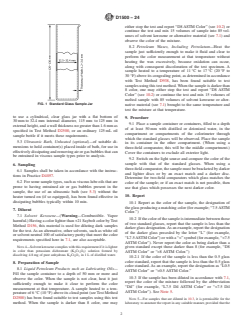
FIG. 1 Standard Glass Sample Jar
native material (see 7.1) brought to the same temperature and
test the mixture at that temperature.
to use a cylindrical, clear glass jar with a flat bottom of
9. Procedure
30 mm to 32.4 mm internal diameter, 115 mm to 125 mm in
9.1 Place a sample container or containers, filled to a depth
external height, and a wall thickness no greater than 1.6 mm as
of at least 50 mm with distilled or deionized water, in the
specified in Test Method D2500, or an ordinary 125 mL oil
compartment or compartments of the colorimeter through
sample bottle if it meets these requirements.
which the standard glasses will be observed. Place the sample
5.3 Ultrasonic Bath, Unheated (optional)—of suitable di-
in its container in the other compartment. (When using a
mensions to hold container(s) placed inside of bath, for use in
three-field comparator, this will be the middle compartment.)
effectively dissipating and removing air or gas bubbles that can
Cover the containers to exclude all exterior light.
be entrained in viscous sample types prior to analysis.
9.2 Switch on the light source and compare the color of the
sample with that of the standard glasses. When using a
6. Sampling
three-field comparator, the sample must be bracketed by darker
6.1 Samples shall be taken in accordance with the instruc-
and lighter discs or by an exact match and a darker disc.
tions in Practice D4057.
Determine for two-field comparators which glass matches the
6.2 For some sample types, such as viscous lube oils that are
color of the sample; or if an exact match is not possible, then
prone to having entrained air or gas bubbles present in the
use that glass which possesses the next darker color.
sample, the use of an ultrasonic bath (see 5.3) without the
10. Report
heater turned on (if so equipped), has been found effective in
dissipating bubbles typically within 10 min.
10.1 Report as the color of the sample, the designation of
the glass producing a matching color (for example; “7.5 ASTM
7. Diluent
Color.”)
7.1 Solvent Kerosene—(Warning—Combustible. Vapor
10.2 If the color of the sample is intermediate between those
harmful.) Having a color lighter than +21 Saybolt color by Test
of two standard glasses, report that the sample is less than the
Method D156, this material is used for diluting dark samples
darker glass designation. As an example, report the designation
for the test. As an alternative, other solvents, such as white oil
of the darker glass preceded by the letter “L” (for example,
or solvent neutral 100 of satisfactory purity that meet the color
“L7.5 ASTM Color”) or with a “<” symbol (for example, “<7.5
requirements specified here in 7.1, are also acceptable.
ASTM Color”). Never report the color as being darker than a
NOTE 4—Solvent kerosene complies with this requirement if it is lighter
given standard except those darker than 8 (for example, “D8
in color than potassium dichromate (K Cr O ) solution formed by
2 2 7 ASTM Color” or “>8 ASTM Color.”)
dissolving 4.8 mg of pure anhydrous K Cr O in 1 L of distilled water.
2 2 7
10.2.1 If the color of the sample is less than the 0.5 glass
color standard, report that the sample is less than the 0.5 glass
8. Preparation of Sample
color standard. As an example, report the designation as “L0.5
8.1 Liquid Petroleum Products such as Lubricating Oils—
ASTM Color” or “<0.5 ASTM Color.”
Fill the sample container to a depth of 50 mm or more and
10.3 If the sample has been diluted in accordance with 7.1,
observe the color. When the sample is not clear, heat it just
report the color of the mixture followed by the abbreviation
sufficiently enough to make it clear to perform the color
“Dil” (for example, “L7.5 Dil ASTM Color” or “<7.5 Dil
measurement at that temperature. A sample heated to a tem-
ASTM Color”). See Note 5.
perature of 6 °C (10 °F) above its cloud point (see Test Method
D2500) has been found suitable to test samples using this test
NOTE 5—For samples that are diluted in 10.3, it is permissible for the
method. When the sample is darker than 8 color, one may laboratory to annotate the report in any suitable manner, provided that the
D1500 − 24
information clearly conveys to the data recipient that the sample analyzed
operation of the test method, exceed the following value only
was diluted.
in one case in twenty: 0.5 color units.
4 11.1.2 Reproducibility—The difference between two single
11. Precision and Bias
and independent test results obtained by different operators
11.1 Precision—The precision of this test method as ob-
working in different laboratories on identical test material
tained by statistical examination of interlaboratory test results
would, in the long run, in the normal and correct operation of
is as follows:
the test method exceed the following value only in one case in
11.1.1 Repeatability—The difference between successive
twenty: 1 color unit.
test results obtained by the same operator with the same
11.2 Bias—The proce
...
This document is not an ASTM standard and is intended only to provide the user of an ASTM standard an indication of what changes have been made to the previous version. Because
it may not be technically possible to adequately depict all changes accurately, ASTM recommends that users consult prior editions as appropriate. In all cases only the current version
of the standard as published by ASTM is to be considered the official document.
Designation: D1500 − 12 (Reapproved 2017) D1500 − 24
Designation: 196/97 (2014)
Standard Test Method for
1,2
ASTM Color of Petroleum Products (ASTM Color Scale)
This standard is issued under the fixed designation D1500; the number immediately following the designation indicates the year of
original adoption or, in the case of revision, the year of last revision. A number in parentheses indicates the year of last reapproval. A
superscript epsilon (´) indicates an editorial change since the last revision or reapproval.
This standard has been approved for use by agencies of the U.S. Department of Defense.
1. Scope Scope*
1.1 This test method covers the visual determination of the color of a wide variety of petroleum products, such as lubricating oils,
heating oils, diesel fuel oils, and petroleum waxes.
NOTE 1—Test Method D156 is applicable to refined products that have an ASTM color lighter than 0.5.
NOTE 2—The color of some dyed products may extend outside color range defined by the glass reference standards employed in the testing procedure.
Furthermore, samples used to determine the precision and bias did not include dyed products.
NOTE 3—It is up to the user to determine the suitability of this test method for their dyed products.
1.2 This test method reports results specific to the test method and recorded as “ASTM Color.”
1.3 This standard does not purport to address all of the safety concerns, if any, associated with its use. It is the responsibility
of the user of this standard to establish appropriate safety, health, and environmental practices and determine the applicability of
regulatory limitations prior to use.
1.4 This international standard was developed in accordance with internationally recognized principles on standardization
established in the Decision on Principles for the Development of International Standards, Guides and Recommendations issued
by the World Trade Organization Technical Barriers to Trade (TBT) Committee.
2. Referenced Documents
2.1 ASTM Standards:
D156 Test Method for Saybolt Color of Petroleum Products (Saybolt Chromometer Method)
D938 Test Method for Congealing Point of Petroleum Waxes, Including Petrolatum
D2500 Test Method for Cloud Point of Petroleum Products and Liquid Fuels
This test method is under the jurisdiction of ASTM International Committee D02 on Petroleum Products, Liquid Fuels, and Lubricants and is the direct responsibility
of ASTM Subcommittee D02.05 on Properties of Fuels, Petroleum Coke and Carbon Material. The technically equivalent standard as referenced is under the jurisdiction of
the Energy Institute Subcommittee SC-B-10.
Current edition approved Oct. 1, 2017March 1, 2024. Published November 2017March 2024. Originally approved in 1957. Last previous edition approved in 20122017
as D1500 – 12.D1500 – 12 (2017). DOI: 10.1520/D1500-12R17.10.1520/D1500-24.
This is also a standard of Energy Institute issued under the fixed designation IP 196. The final number indicates the year of last revision. This test method was adopted
as a joint ASTM-IP standard in 1966. In the IP, this test method is under the jurisdiction of the Standardization Committee.
his test method has been developed through the cooperative effort between ASTM and the Energy Institute, London. ASTM and IP standards were approved by ASTM
and EI technical committees as being technically equivalent but that does not imply both standards are identical. This test method was adopted as a joint ASTM-IP standard
in 1966.
For referenced ASTM standards, visit the ASTM website, www.astm.org, or contact ASTM Customer Service at service@astm.org. For Annual Book of ASTM Standards
volume information, refer to the standard’s Document Summary page on the ASTM website.
*A Summary of Changes section appears at the end of this standard
Copyright © ASTM International, 100 Barr Harbor Drive, PO Box C700, West Conshohocken, PA 19428-2959. United States
D1500 − 24
D4057 Practice for Manual Sampling of Petroleum and Petroleum Products
3. Summary of Test Method
3.1 Using a standard light source, a liquid sample is placed in the test container and compared with colored glass disks ranging
in value from 0.5 to 8.0. When an exact match is not found and the sample color falls between two standard colors, the higher of
the two colors is reported.
4. Significance and Use
4.1 Determination of the color of petroleum products is used mainly for manufacturing control purposes and is an important
quality characteristic, since color is readily observed by the user of the product. In some cases, the color may serve as an indication
of the degree of refinement of the material. When the color range of a particular product is known, a variation outside the
established range may indicate possible contamination with another product. However, color is not always a reliable guide to
product quality and should not be used indiscriminately in product specifications.
5. Apparatus
5.1 Colorimeter, consisting of light source, glass color standards, sample container housing with cover, and viewing piece as listed
in Annex A1.
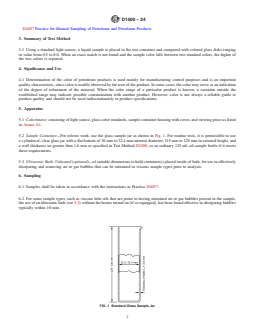
5.2 Sample Container—For referee work, use the glass sample jar as shown in Fig. 1. For routine tests, it is permissible to use
a cylindrical, clear glass jar with a flat bottom of 30 mm to 32.4 mm internal diameter, 115 mm to 125 mm in external height, and
a wall thickness no greater than 1.6 mm as specified in Test Method D2500, or an ordinary 125 mL oil sample bottle if it meets
these requirements.
5.3 Ultrasonic Bath, Unheated (optional)—of suitable dimensions to hold container(s) placed inside of bath, for use in effectively
dissipating and removing air or gas bubbles that can be entrained in viscous sample types prior to analysis.
6. Sampling
6.1 Samples shall be taken in accordance with the instructions in Practice D4057.
6.2 For some sample types, such as viscous lube oils that are prone to having entrained air or gas bubbles present in the sample,
the use of an ultrasonic bath (see 5.3) without the heater turned on (if so equipped), has been found effective in dissipating bubbles
typically within 10 min.
FIG. 1 Standard Glass Sample Jar
D1500 − 24
7. Diluent
7.1 Solvent Kerosene—(Warning—Combustible. Vapor harmful.) Having a color lighter than +21 Saybolt color by Test Method
D156, this material is used for diluting dark samples for the test. As an alternative, other solvents, such as white oil or solvent
neutral 100 of satisfactory purity that meet the color requirements specified here in 7.1, are also acceptable.
NOTE 4—Solvent kerosene complies with this requirement if it is lighter in color than potassium dichromate (K Cr O ) solution formed by dissolving
2 2 7
4.8 mg of pure anhydrous K Cr O in 1 L of distilled water.
2 2 7
8. Preparation of Sample
8.1 Liquid Petroleum Products such as Lubricating Oils—Fill the sample container to a depth of 50 mm or more and observe the
color. When the sample is not clear, heat it just sufficiently enough to make it clear to perform the color measurement at that
temperature. A sample heated to a temperature of 6 °C (10 °F) above its cloud point (see Test Method D2500) has been found
suitable to test samples using this test method. When the sample is darker than 8 color, one may either stop the test and report “D8
ASTM Color” (see 10.2) or continue the test and mix 15 volumes of sample into 85 volumes of solvent kerosene or alternative
material (see 7.1) and observe the color of the mixture.
8.2 Petroleum Waxes, Including Petrolatum—Heat the sample just sufficiently enough to make it fluid and clear to perform the
color measurement at that temperature without heating the wax excessively, because oxidation can occur, along with consequent
discoloration of the test specimen. A sample heated to a temperature of 11 °C to 17 °C (20 °F to 30 °F) above its congealing point,
as determined in accordance with Test Method D938, has been found suitable to test samples using this test method. When the
sample is darker than 8 color, one may either stop the test and report “D8 ASTM Color” (see 10.2) or continue the test and mix
15 volumes of melted sample with 85 volumes of solvent kerosene or alternative material (see 7.1) brought to the same temperature
and test the mixture at that temperature.
9. Procedure
9.1 Place a sample container or containers, filled to a depth of at least 50 mm with distilled or deionized water, in the compartment
or compartments of the colorimeter through which the standard glasses will be observed. Place the sample in its container in the
other compartment. (When using a three-field comparator, this will be the middle compartment.) Cover the containers to exclude
all exterior light.
9.2 Switch on the light source and compare the color of the sample with that of the standard glasses. When using a three-field
comparator, the sample must be bracketed by darker and lighter discs or by an exact match and a darker disc. Determine for
two-field comparators which glass matches the color of the sample; or if an exact match is not possible, then use that glass which
possesses the next darker color.
10. Report
10.1 Report as the color of the sample, the designation of the glass producing a matching color (for example; “7.5 ASTM Color.”)
10.2 If the color of the sample is intermediate between those of two standard glasses, report that the sample is less than the darker
glass designation. As an example, report the designation of the darker glass preceded by the letter “L” (for example, “L7.5 ASTM
Color”) or with a “<” symbol (for example, “<7.5 ASTM Color”). Never report the color as being darker than a given standard
except those darker than 8 (for example, “D8 ASTM Color” or “>8 ASTM Color.”)
10.2.1 If the color of the sample is less than the 0.5 glass color standard, report that the sample is less than the 0.5 glass color
standard. As an example, report the designation as “L0.5 ASTM Color” or “<0.5 ASTM Color.”
10.3 If the sample has been diluted in accordance with 7.1, report the color of the mixture followed by the abbreviation “Dil” (for
example, “L7.5 Dil ASTM Color” or “<7.5 Dil ASTM Color”). See Note 35.
NOTE 5—For samples that are diluted in 10.3, it is permissible for the laboratory to annotate the report in any suitable manner, provided that the
information clearly conveys to the data recipient that the sample analyzed was diluted.
D1500 − 24
11. Precision and Bias
11.1 Precision—The precision of this test method as obtained by statistical examination of interlaboratory test results is as follows:
11.1.1 Repeatability—The difference between successive test results obtained by the same operator with the same apparatus under
constant operating conditions on identical test material would, in the long run, in the normal and correct operation of the test
method, exceed the following value only in
...
Questions, Comments and Discussion
Ask us and Technical Secretary will try to provide an answer. You can facilitate discussion about the standard in here.
Loading comments...