

ASTM D6241-22a
(Test Method)Standard Test Method for Measuring Static Puncture Strength of Geotextiles and Geosynthetic-Related Products Using a 50 mm Probe
General Information
- Abstract
SIGNIFICANCE AND USE
5.1 Puncture using a 50 mm probe is applicable to determine the index strength resistance and deformation of a particular geotextile or geotextile-related products.
5.2 This test method is considered satisfactory for acceptance testing of commercial shipments of geotextiles.
5.3 In case of a dispute arising from differences in reported test results when using this test method for acceptance testing of commercial shipments, the purchaser and the supplier should conduct comparative tests to determine if there is a statistical bias between their laboratories. Competent statistical assistance is recommended for the investigation of bias. As a minimum, the two parties should take a group of test specimens that are as homogeneous as possible and that are from a lot of the type in question. The test specimens then should be randomly assigned in equal numbers to each laboratory for testing. The average results from the two laboratories should be compared using Student's t-test for unpaired data and an acceptable probability level chosen by the two parties before the testing is begun. If a bias is found, either its cause must be found and corrected, or the purchaser and the supplier must agree to interpret future test results in light of the known bias.
5.4 This test method is not applicable to materials that are manufactured in sizes that are too small to be placed into the test apparatus in accordance with the procedures in this test method. Furthermore, it is not appropriate to separate plies of a geosynthetic or geocomposite for use in this test method.
SCOPE
1.1 This test method is an index test used to measure the force required to puncture a geotextile and geotextile-related products with a 50 mm diameter cylindrical probe. The dimensions of the probe provide a multidirectional force on the geotextile.
Note 1: This test is also commonly known as CBR Puncture Test.
1.2 The values stated in SI units are to be regarded as the standard. The values given in parentheses are for information only.
1.3 This standard does not purport to address all of the safety concerns, if any, associated with its use. It is the responsibility of the user of this standard to establish appropriate safety, health, and environmental practices and determine the applicability of regulatory limitations prior to use.
1.4 This international standard was developed in accordance with internationally recognized principles on standardization established in the Decision on Principles for the Development of International Standards, Guides and Recommendations issued by the World Trade Organization Technical Barriers to Trade (TBT) Committee.
- Status
- Published
- Publication Date
- 30-Nov-2022
- Technical Committee
- D35 - Geosynthetics
- Drafting Committee
- D35.01 - Mechanical Properties
Buy Documents
ASTM D6241-22a - Standard Test Method for Measuring Static Puncture Strength of Geotextiles and Geosynthetic-Related Products Using a 50 mm Probe
REDLINE ASTM D6241-22a - Standard Test Method for Measuring Static Puncture Strength of Geotextiles and Geosynthetic-Related Products Using a 50 mm Probe
Overview
ASTM D6241-22a is the internationally recognized standard test method for measuring the static puncture strength of geotextiles and geosynthetic-related products using a 50 mm probe. Commonly referenced as the CBR Puncture Test, this method determines the force required to puncture geotextile materials, thus providing critical data on the index strength resistance and deformation behavior of these products under multidirectional force. This test is indispensable for quality control, design validation, and the acceptance of geotextiles for commercial shipments.
Key Topics
- Purpose of the Test: The test measures the puncture resistance and deformation characteristics of geotextile and related products using a 50 mm cylindrical steel probe, simulating actual stresses experienced in the field.
- Test Applicability: It is suitable for a wide range of geotextile and geosynthetic-related materials, as long as the material can be accommodated by the test apparatus. It is not suitable for materials too small for the setup or for separated plies of geosynthetic composites.
- Acceptance Testing: The method is commonly used for acceptance testing of commercial shipments, supporting both manufacturers and purchasers in verifying product conformity.
- Comparative Lab Testing: In the event of inconsistent test outcomes between laboratories, comparative testing with standardized statistical methodology (such as Student’s t-test) is recommended to resolve disputes and assess any bias.
- Sample Preparation: Test specimens are carefully sampled and conditioned to ensure representative results and to simulate practical field conditions.
- Test Method: A specimen is clamped between circular plates and tested on a tensile or compression machine where a 50 mm steel probe punctures the material. The peak force and displacement at rupture are recorded as the puncture strength indices.
- Reporting: Test reports should detail the method, number and conditioning of specimens, sampling method, test results, average values, and any deviations from standard procedures.
- Precision and Limitations: The method ensures a defined level of precision and repeatability, but is not designed for all material types or construction sizes.
Applications
- Civil Engineering: Used for design, specification, and verification of geotextiles in infrastructure applications such as roadways, embankments, and drainage systems.
- Construction Quality Control: Ensures geotextile materials in commercial shipments meet required puncture strength standards, preventing material failure in the field.
- Product Development: Assists manufacturers in evaluating new materials and improving puncture performance through research and development.
- Dispute Resolution: Provides a reliable, standardized approach to resolve quality control or specification compliance issues between purchasers and suppliers.
- Regulatory Compliance: Used by regulatory authorities to ensure geosynthetic materials comply with specified mechanical requirements for safety and durability.
Related Standards
- ASTM D76/D76M: Specification for tensile testing machines for textiles
- ASTM D123: Terminology relating to textiles
- ASTM D1776/D1776M: Practice for conditioning and testing textiles
- ASTM D1883: Test method for California Bearing Ratio (CBR) of compacted soils, related to the mold used in D6241
- ASTM D4354: Practice for sampling geosynthetics and rolled erosion control products for testing
- ASTM D4439: Terminology for geosynthetics
- ASTM E691: Practice for interlaboratory studies to determine test method precision
Keywords: ASTM D6241, geotextiles, static puncture strength, CBR Puncture Test, geosynthetics, acceptance testing, index strength, puncture resistance, quality control, civil engineering standards, materials testing
Relations
- Effective Date
- 01-Feb-2024
- Effective Date
- 01-May-2020
- Effective Date
- 01-Feb-2020
- Effective Date
- 15-Apr-2018
- Effective Date
- 01-Aug-2017
- Effective Date
- 01-Mar-2017
- Effective Date
- 01-Jan-2016
- Effective Date
- 15-Sep-2015
- Effective Date
- 01-Sep-2015
- Effective Date
- 01-Sep-2015
- Effective Date
- 01-Jul-2015
- Effective Date
- 01-Apr-2015
- Effective Date
- 01-Feb-2015
- Effective Date
- 01-Dec-2014
- Effective Date
- 01-Mar-2014
Buy Documents
ASTM D6241-22a - Standard Test Method for Measuring Static Puncture Strength of Geotextiles and Geosynthetic-Related Products Using a 50 mm Probe
REDLINE ASTM D6241-22a - Standard Test Method for Measuring Static Puncture Strength of Geotextiles and Geosynthetic-Related Products Using a 50 mm Probe
Get Certified
Connect with accredited certification bodies for this standard

Control Union Certifications
Global certification for agriculture and sustainability.

Hohenstein Institut
Textile testing and certification.

Bureau Veritas Bangladesh
Bureau Veritas certification services in Bangladesh.
Sponsored listings
Frequently Asked Questions
ASTM D6241-22a is a standard published by ASTM International. Its full title is "Standard Test Method for Measuring Static Puncture Strength of Geotextiles and Geosynthetic-Related Products Using a 50 mm Probe". This standard covers: SIGNIFICANCE AND USE 5.1 Puncture using a 50 mm probe is applicable to determine the index strength resistance and deformation of a particular geotextile or geotextile-related products. 5.2 This test method is considered satisfactory for acceptance testing of commercial shipments of geotextiles. 5.3 In case of a dispute arising from differences in reported test results when using this test method for acceptance testing of commercial shipments, the purchaser and the supplier should conduct comparative tests to determine if there is a statistical bias between their laboratories. Competent statistical assistance is recommended for the investigation of bias. As a minimum, the two parties should take a group of test specimens that are as homogeneous as possible and that are from a lot of the type in question. The test specimens then should be randomly assigned in equal numbers to each laboratory for testing. The average results from the two laboratories should be compared using Student's t-test for unpaired data and an acceptable probability level chosen by the two parties before the testing is begun. If a bias is found, either its cause must be found and corrected, or the purchaser and the supplier must agree to interpret future test results in light of the known bias. 5.4 This test method is not applicable to materials that are manufactured in sizes that are too small to be placed into the test apparatus in accordance with the procedures in this test method. Furthermore, it is not appropriate to separate plies of a geosynthetic or geocomposite for use in this test method. SCOPE 1.1 This test method is an index test used to measure the force required to puncture a geotextile and geotextile-related products with a 50 mm diameter cylindrical probe. The dimensions of the probe provide a multidirectional force on the geotextile. Note 1: This test is also commonly known as CBR Puncture Test. 1.2 The values stated in SI units are to be regarded as the standard. The values given in parentheses are for information only. 1.3 This standard does not purport to address all of the safety concerns, if any, associated with its use. It is the responsibility of the user of this standard to establish appropriate safety, health, and environmental practices and determine the applicability of regulatory limitations prior to use. 1.4 This international standard was developed in accordance with internationally recognized principles on standardization established in the Decision on Principles for the Development of International Standards, Guides and Recommendations issued by the World Trade Organization Technical Barriers to Trade (TBT) Committee.
SIGNIFICANCE AND USE 5.1 Puncture using a 50 mm probe is applicable to determine the index strength resistance and deformation of a particular geotextile or geotextile-related products. 5.2 This test method is considered satisfactory for acceptance testing of commercial shipments of geotextiles. 5.3 In case of a dispute arising from differences in reported test results when using this test method for acceptance testing of commercial shipments, the purchaser and the supplier should conduct comparative tests to determine if there is a statistical bias between their laboratories. Competent statistical assistance is recommended for the investigation of bias. As a minimum, the two parties should take a group of test specimens that are as homogeneous as possible and that are from a lot of the type in question. The test specimens then should be randomly assigned in equal numbers to each laboratory for testing. The average results from the two laboratories should be compared using Student's t-test for unpaired data and an acceptable probability level chosen by the two parties before the testing is begun. If a bias is found, either its cause must be found and corrected, or the purchaser and the supplier must agree to interpret future test results in light of the known bias. 5.4 This test method is not applicable to materials that are manufactured in sizes that are too small to be placed into the test apparatus in accordance with the procedures in this test method. Furthermore, it is not appropriate to separate plies of a geosynthetic or geocomposite for use in this test method. SCOPE 1.1 This test method is an index test used to measure the force required to puncture a geotextile and geotextile-related products with a 50 mm diameter cylindrical probe. The dimensions of the probe provide a multidirectional force on the geotextile. Note 1: This test is also commonly known as CBR Puncture Test. 1.2 The values stated in SI units are to be regarded as the standard. The values given in parentheses are for information only. 1.3 This standard does not purport to address all of the safety concerns, if any, associated with its use. It is the responsibility of the user of this standard to establish appropriate safety, health, and environmental practices and determine the applicability of regulatory limitations prior to use. 1.4 This international standard was developed in accordance with internationally recognized principles on standardization established in the Decision on Principles for the Development of International Standards, Guides and Recommendations issued by the World Trade Organization Technical Barriers to Trade (TBT) Committee.
ASTM D6241-22a is classified under the following ICS (International Classification for Standards) categories: 59.080.70 - Geotextiles. The ICS classification helps identify the subject area and facilitates finding related standards.
ASTM D6241-22a has the following relationships with other standards: It is inter standard links to ASTM D4439-24, ASTM D4354-12(2020), ASTM D1776/D1776M-20, ASTM D4439-18, ASTM D4439-17, ASTM D123-17, ASTM D1776/D1776M-16, ASTM D123-15b, ASTM D123-15a, ASTM D4439-15a, ASTM D4439-15, ASTM D123-15, ASTM D1776/D1776M-15, ASTM D1883-14, ASTM D4439-14. Understanding these relationships helps ensure you are using the most current and applicable version of the standard.
ASTM D6241-22a is available in PDF format for immediate download after purchase. The document can be added to your cart and obtained through the secure checkout process. Digital delivery ensures instant access to the complete standard document.
Standards Content (Sample)
This international standard was developed in accordance with internationally recognized principles on standardization established in the Decision on Principles for the
Development of International Standards, Guides and Recommendations issued by the World Trade Organization Technical Barriers to Trade (TBT) Committee.
Designation: D6241 − 22a
Standard Test Method for
Measuring Static Puncture Strength of Geotextiles and
Geosynthetic-Related Products Using a 50 mm Probe
This standard is issued under the fixed designation D6241; the number immediately following the designation indicates the year of
original adoption or, in the case of revision, the year of last revision. A number in parentheses indicates the year of last reapproval. A
superscript epsilon (´) indicates an editorial change since the last revision or reapproval.
1. Scope D4354 Practice for Sampling of Geosynthetics and Rolled
Erosion Control Products (RECPs) for Testing
1.1 This test method is an index test used to measure the
D4439 Terminology for Geosynthetics
force required to puncture a geotextile and geotextile-related
E691 Practice for Conducting an Interlaboratory Study to
products with a 50 mm diameter cylindrical probe. The
Determine the Precision of a Test Method
dimensions of the probe provide a multidirectional force on the
geotextile.
NOTE 2—Test Method D1883 describes a mold (CBR mold) that can be
used for this test method.
NOTE 1—This test is also commonly known as CBR Puncture Test.
1.2 The values stated in SI units are to be regarded as the
3. Terminology
standard. The values given in parentheses are for information
3.1 Definitions—For definitions of other textile terms used
only.
in this test method, refer to Terminology D123. For definitions
1.3 This standard does not purport to address all of the
of other terms relating to geosynthetics used in this test
safety concerns, if any, associated with its use. It is the
method, refer to Terminology D4439.
responsibility of the user of this standard to establish appro-
priate safety, health, and environmental practices and deter-
4. Summary of Test Method
mine the applicability of regulatory limitations prior to use.
4.1 A test specimen is clamped without tension between
1.4 This international standard was developed in accor-
circular plates and secured in a tensile or compression testing
dance with internationally recognized principles on standard-
machine, or both. A force is exerted against the center of the
ization established in the Decision on Principles for the
unsupported portion of the test specimen by a cylindrical steel
Development of International Standards, Guides and Recom-
probe attached to the load indicator until rupture occurs. The
mendations issued by the World Trade Organization Technical
maximum force is the value of puncture strength.
Barriers to Trade (TBT) Committee.
5. Significance and Use
2. Referenced Documents
5.1 Puncture using a 50 mm probe is applicable to deter-
2.1 ASTM Standards:
mine the index strength resistance and deformation of a
D76/D76M Specification for Tensile Testing Machines for
particular geotextile or geotextile-related products.
Textiles
D123 Terminology Relating to Textiles 5.2 This test method is considered satisfactory for accep-
tance testing of commercial shipments of geotextiles.
D1776/D1776M Practice for Conditioning and Testing Tex-
tiles
5.3 In case of a dispute arising from differences in reported
D1883 Test Method for California Bearing Ratio (CBR) of
test results when using this test method for acceptance testing
Laboratory-Compacted Soils
of commercial shipments, the purchaser and the supplier
should conduct comparative tests to determine if there is a
statistical bias between their laboratories. Competent statistical
This test method is under the jurisdiction of ASTM Committee D35 on
assistance is recommended for the investigation of bias. As a
Geosynthetics and is the direct responsibility of Subcommittee D35.01 on Mechani-
minimum, the two parties should take a group of test speci-
cal Properties.
mens that are as homogeneous as possible and that are from a
Current edition approved Dec. 1, 2022. Published December 2022. Originally
lot of the type in question. The test specimens then should be
approved in 1998. Last previous edition approved in 2022 as D6241 – 22. DOI:
10.1520/D6241-22A.
randomly assigned in equal numbers to each laboratory for
For referenced ASTM standards, visit the ASTM website, www.astm.org, or
testing.Theaverageresultsfromthetwolaboratoriesshouldbe
contact ASTM Customer Service at service@astm.org. For Annual Book of ASTM
compared using Student’s t-test for unpaired data and an
Standards volume information, refer to the standard’s Document Summary page on
the ASTM website. acceptable probability level chosen by the two parties before
Copyright © ASTM International, 100 Barr Harbor Drive, PO Box C700, West Conshohocken, PA 19428-2959. United States
D6241 − 22a
the testing is begun. If a bias is found, either its cause must be diameter is suggested to be 250 mm (9.8 in.). The diameter of
found and corrected, or the purchaser and the supplier must the holes used for securing the ring clamp assemblage is
agree to interpret future test results in light of the known bias. suggested to be 11 mm ( ⁄16 in.) and equally spaced at a
diameterof220mm(8.7in.).Theclampingsurfacesofthering
5.4 This test method is not applicable to materials that are
plates shall be machined to limit slippage to less than 5 mm;
manufactured in sizes that are too small to be placed into the
see Note 3. It is suggested that 9.5 mm ( ⁄8 in.) bolts be welded
test apparatus in accordance with the procedures in this test
to the bottom plate so that the top plate can be placed over the
method. Furthermore, it is not appropriate to separate plies of
bolts and nuts and easily tightened.Aguide block may be used
a geosynthetic or geocomposite for use in this test method.
to help seat the material being clamped. Other clamps that
eliminate slippage are acceptable. See Figs. 2-4.
6. Apparatus
6.1 Testing Machine—Types of tensile machines covered in
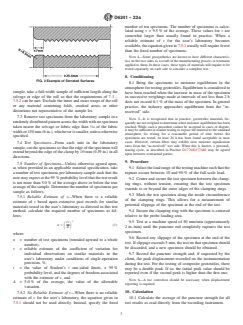
NOTE 3—Common methods of machining the grip surfaces of the
clamping plates include: spiral or concentric serrations, knurling, grooves
thistestmethodareconstant-rate-of-extensionorconstant-rate-
with rubber O-rings, or bonding sandpaper to the opposing surfaces.
of-traverse, with autographic recorder conforming to the re-
quirement of Specification D76/D76M.
7. Sampling and Selection of Specimens
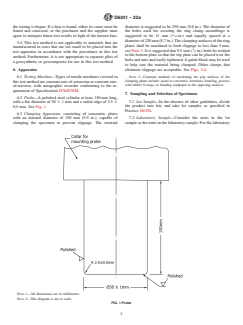
6.2 Probe—A polished steel cylinder at least 150 mm long,
7.1 Lot Sample—In the absence of other guidelines, divide
with a flat diameter of 50 6 1 mm and a radial edge of 2.5 6
the product into lots and take lot samples as specified in
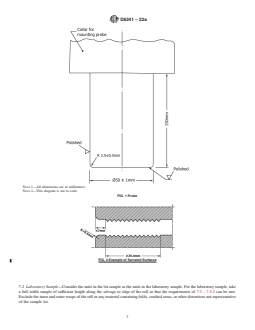
0.5 mm. See Fig. 1.
Practice D4354.
6.3 Clamping Apparatus, consisting of concentric plates
with an internal diameter of 150 mm (5.9 in.), capable of 7.2 Laboratory Sample—Consider the units in the lot
clamping the specimen to prevent slippage. The external sample as the units in the laboratory sample. For the laboratory
NOTE 1—All dimensions are in millimetres.
NOTE 2—This diagram is not to scale.
FIG. 1 Probe
D6241 − 22a
number of ten specimens. The number of specimens is calcu-
lated using v = 9.5 % of the average. These values for v are
somewhat larger than usually found in practice. When a
reliable estimate of v for the user’s laboratory becomes
available, the equation given in 7.5.1 usually will require fewer
than the fixed number of specimens.
NOTE 4—Some geosynthetics are known to have different characteris-
tics on the two sides as a result of the manufacturing process or treatment
applied to them. In these cases, these types of materials will require to be
tested separately on each side to consider a complete test.
8. Conditioning
FIG. 2 Example of Serrated Surfaces
8.1 Bring the specimens to moisture equilibrium in the
atmospherefortestinggeotextiles.Equilibriumisconsideredto
sample, take a full-width sample of sufficient length along the
have been reached when the increase in mas
...
This document is not an ASTM standard and is intended only to provide the user of an ASTM standard an indication of what changes have been made to the previous version. Because
it may not be technically possible to adequately depict all changes accurately, ASTM recommends that users consult prior editions as appropriate. In all cases only the current version
of the standard as published by ASTM is to be considered the official document.
Designation: D6241 − 22 D6241 − 22a
Standard Test Method for
Measuring Static Puncture Index Strength of Geotextiles
and Geotextile-RelatedGeosynthetic-Related Products Using
a 50 mm Probe
This standard is issued under the fixed designation D6241; the number immediately following the designation indicates the year of
original adoption or, in the case of revision, the year of last revision. A number in parentheses indicates the year of last reapproval. A
superscript epsilon (´) indicates an editorial change since the last revision or reapproval.
1. Scope
1.1 This test method is an index test used to measure the force required to puncture a geotextile and geotextile-related products
with a 50 mm diameter probe rod.cylindrical probe. The dimensions of the probe provide a multidirectional force on the geotextile.
NOTE 1—This test is also commonly known as CBR Puncture Test.
1.2 The values stated in SI units are to be regarded as the standard. The values given in parentheses are for information only.
1.3 This standard does not purport to address all of the safety concerns, if any, associated with its use. It is the responsibility
of the user of this standard to establish appropriate safety, health, and environmental practices and determine the applicability of
regulatory limitations prior to use.
1.4 This international standard was developed in accordance with internationally recognized principles on standardization
established in the Decision on Principles for the Development of International Standards, Guides and Recommendations issued
by the World Trade Organization Technical Barriers to Trade (TBT) Committee.
2. Referenced Documents
2.1 ASTM Standards:
D76/D76M Specification for Tensile Testing Machines for Textiles
D123 Terminology Relating to Textiles
D1776/D1776M Practice for Conditioning and Testing Textiles
D1883 Test Method for California Bearing Ratio (CBR) of Laboratory-Compacted Soils
D4354 Practice for Sampling of Geosynthetics and Rolled Erosion Control Products (RECPs) for Testing
D4439 Terminology for Geosynthetics
E691 Practice for Conducting an Interlaboratory Study to Determine the Precision of a Test Method
NOTE 2—Test Method D1883 describes a mold (CBR mold) that can be used for this test method.
This test method is under the jurisdiction of ASTM Committee D35 on Geosynthetics and is the direct responsibility of Subcommittee D35.01 on Mechanical Properties.
Current edition approved July 1, 2022Dec. 1, 2022. Published July 2022December 2022. Originally approved in 1998. Last previous edition approved in 20142022 as
D6241 – 14.D6241 – 22. DOI: 10.1520/D6241-22.10.1520/D6241-22A.
For referenced ASTM standards, visit the ASTM website, www.astm.org, or contact ASTM Customer Service at service@astm.org. For Annual Book of ASTM Standards
volume information, refer to the standard’s Document Summary page on the ASTM website.
Copyright © ASTM International, 100 Barr Harbor Drive, PO Box C700, West Conshohocken, PA 19428-2959. United States
D6241 − 22a
3. Terminology
3.1 Definitions—For definitions of other textile terms used in this test method, refer to Terminology D123. For definitions of other
terms relating to geosynthetics used in this test method, refer to Terminology D4439.
4. Summary of Test Method
4.1 A test specimen is clamped without tension between circular plates and secured in a tensile or compression testing machine,
or both. A force is exerted against the center of the unsupported portion of the test specimen by a circularcylindrical steel probe
attached to the load indicator until rupture occurs. The maximum force is the value of puncture strength.
5. Significance and Use
5.1 Puncture using a 50 mm flat circular probe is applicable to determine the index strength resistance and deformation of a
particular geotextile or geotextile-related products.
5.2 This test method is considered satisfactory for acceptance testing of commercial shipments of geotextiles.
5.3 In case of a dispute arising from differences in reported test results when using this test method for acceptance testing of
commercial shipments, the purchaser and the supplier should conduct comparative tests to determine if there is a statistical bias
between their laboratories. Competent statistical assistance is recommended for the investigation of bias. As a minimum, the two
parties should take a group of test specimens that are as homogeneous as possible and that are from a lot of the type in question.
The test specimens then should be randomly assigned in equal numbers to each laboratory for testing. The average results from
the two laboratories should be compared using Student’s t-test for unpaired data and an acceptable probability level chosen by the
two parties before the testing is begun. If a bias is found, either its cause must be found and corrected, or the purchaser and the
supplier must agree to interpret future test results in light of the known bias.
5.4 This test method is not applicable to materials that are manufactured in sizes that are too small to be placed into the test
apparatus in accordance with the procedures in this test method. Furthermore, it is not appropriate to separate plies of a
geosynthetic or geocomposite for use in this test method.
6. Apparatus
6.1 Testing Machine—Types of tensile machines covered in this specification are constant-rate-of-extension, constant-rate-of-
traverse, and constant-rate-of-loading types, test method are constant-rate-of-extension or constant-rate-of-traverse, with
autographic recorder conforming to the requirement of Specification D76/D76M.
6.2 Probe—A circular, 150 mm long polished steel loading platen polished steel cylinder at least 150 mm long, with a flat diameter
of 50 6 1 mm and a radial edge of 2.5 6 0.5 mm. See Fig. 1.
6.3 Clamping Apparatus, consisting of concentric plates with an internal diameter of 150 mm (5.9 in.), capable of clamping the
test specimen without slippage (limit slippage of test specimen to 5 mm).specimen to prevent slippage. The external diameter is
suggested to be 250 mm (9.8 in.). The diameter of the holes used for securing the ring clamp assemblage is suggested to be 11
mm (7/16( ⁄16 in.) in.) and equally spaced at a diameter of 220 mm (8.7 in.). The clamping surfaces of these plates can consist
of serrated plates, grooves with rubber O-rings, or coarsethe ring plates shall be machined to limit slippage to less than 5 mm; see
Note 3sandpaper bonded onto opposing surfaces. . It is suggested that 9.5 mm (3/8( ⁄8 in.) in.) bolts be welded to the bottom plate
so that the top plate can be placed over the bolts and nuts and easily tightened. A guide block may be used to help seat the material
being clamped. Other clamps that eliminate slippage are acceptable. See Figs. 2 and 2-34.
NOTE 3—Common methods of machining the grip surfaces of the clamping plates include: spiral or concentric serrations, knurling, grooves with rubber
O-rings, or bonding sandpaper to the opposing surfaces.
7. Sampling and Selection of Specimens
7.1 Lot Sample—In the absence of other guidelines, divide the product into lots and take lot samples as specified in Practice
D4354.
D6241 − 22a
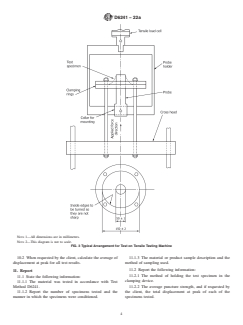
NOTE 1—All dimensions are in millimetres.
NOTE 2—This diagram is not to scale.
FIG. 1 Probe
FIG. 2 Example of Serrated Surfaces
7.2 Laboratory Sample—Consider the units in the lot sample as the units in the laboratory sample. For the laboratory sample, take
a full-width sample of sufficient length along the selvage or edge of the roll so that the requirements of 7.3 – 7.5.2 can be met.
Exclude the inner and outer wraps of the roll or any material containing folds, crushed areas, or other distortions not representative
of the sample lot.
D6241 − 22a
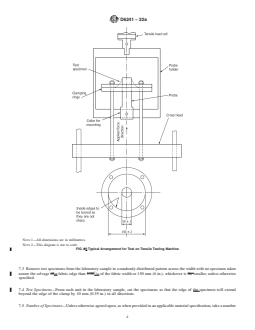
NOTE 1—All dimensions are in millimetres.
NOTE 2—This diagram is not to scale.
FIG. 23 Typical Arrangement for Test on Tensile Testing Machine
7.3 Remove test specimens from the laboratory sample in a randomly distributed pattern across the width with no specimen taken
nearer the selvage ofor fabric edge than 1/20 ⁄20 of the fabric width or 150 mm (6 in.), whichever is the smalle
...