

ASTM E1226-19
(Test Method)Standard Test Method for Explosibility of Dust Clouds
General Information
- Abstract
SIGNIFICANCE AND USE
5.1 This test method provides a procedure for performing laboratory tests to evaluate deflagration parameters of dusts.
5.2 The data developed by this test method may be used for the purpose of sizing deflagration vents in conjunction with the nomographs and equations published in NFPA 68, ISO 6184/1, or VDI 3673.
5.3 The values obtained by this testing technique are specific to the sample tested and the method used and are not to be considered intrinsic material constants.
5.4 For dusts with low KSt values, discrepancies have been observed between tests in 20-L and 1-m3 chambers. A strong ignitor may overdrive a 20-L chamber, as discussed in Test Method E1515 and Refs (1-4).8 Conversely, more recent testing has shown that some metal dusts can be prone to underdriving in the 20-L chamber, exhibiting significantly lower KSt values than in a 1-m3 chamber (5). Ref (6) provides supporting calculations showing that a test vessel of at least 1-m3 of volume is necessary to obtain the maximum explosibility index for a burning dust cloud having an abnormally high flame temperature. In these two overdriving and underdriving scenarios described above, it is therefore recommended to perform tests in 1-m3 or larger calibrated test vessels in order to measure dusts explosibility parameters accurately.
Note 5: Ref (2) concluded that dusts with KSt values below 45 bar m/s when measured in a 20-L chamber with a 10 000-J ignitor, may not be explosible when tested in a 1-m3 chamber with a 10 000-J ignitor. Ref (2) and unpublished testing has also shown that in some cases the KSt values measured in the 20-L chamber can be lower than those measured in the 1-m3 chamber. Refs (1) and (3) found that for some dusts, it was necessary to use lower ignition energy in the 20-L chamber in order to match MEC or MIC test data in a 1-m3 chamber. If a dust has measurable (nonzero) Pmax and KSt values with a 5000 or 10 000-J ignitor when tested in a 20-L chamber but no measurable Pmax and ...
SCOPE
1.1 Purpose. The purpose of this test method is to provide standard test methods for characterizing the “explosibility” of dust clouds in two ways, first by determining if a dust is “explosible,” meaning a cloud of dust dispersed in air is capable of propagating a deflagration, which could cause a flash fire or explosion; or, if explosible, determining the degree of “explosibility,” meaning the potential explosion hazard of a dust cloud as characterized by the dust explosibility parameters, maximum explosion pressure, Pmax; maximum rate of pressure rise, (dP/dt)max; and explosibility index, KSt.
1.2 Limitations. Results obtained by the application of the methods of this standard pertain only to certain combustion characteristics of dispersed dust clouds. No inference should be drawn from such results relating to the combustion characteristics of dusts in other forms or conditions (for example, ignition temperature or spark ignition energy of dust clouds, ignition properties of dust layers on hot surfaces, ignition of bulk dust in heated environments, etc.)
1.3 Use. It is intended that results obtained by application of this test be used as elements of a dust hazard analysis (DHA) that takes into account other pertinent risk factors; and in the specification of explosion prevention systems (see, for example NFPA 68, NFPA 69, and NFPA 652) when used in conjunction with approved or recognized design methods by those skilled in the art.
Note 1: Historically, the evaluation of the deflagration parameters of maximum pressure and maximum rate of pressure rise has been performed using a 1.2-L Hartmann Apparatus. Test Method E789, which describes this method, has been withdrawn. The use of data obtained from the test method in the design of explosion protection systems is not recommended.
1.4 The values stated in SI units are to be regarded as standard. No other units of measurement are included in this standard.
1....
- Status
- Published
- Publication Date
- 14-Dec-2019
- Technical Committee
- E27 - Hazard Potential of Chemicals
- Drafting Committee
- E27.05 - Explosibility and Ignitability of Dust Clouds
Overview
ASTM E1226-19: Standard Test Method for Explosibility of Dust Clouds provides a laboratory procedure to determine whether a dispersed dust cloud is capable of propagating a deflagration (i.e., is “explosible”), and to quantify the degree of explosibility. Key data from this standard - maximum explosion pressure (Pmax), maximum rate of pressure rise ((dP/dt)max), and explosibility index (KSt) - are critical for assessing potential explosion hazards in industries where combustible dusts are present. This method supports compliance with dust hazard analysis (DHA) requirements and underpins explosion protection system design as outlined in national and international safety standards.
Key Topics
- Explosibility Testing: The method establishes whether a dust, when suspended in air, can sustain a deflagration and quantifies its potential by determining key deflagration parameters.
- Critical Parameters:
- Pmax: Maximum explosion pressure produced during a dust deflagration.
- (dP/dt)max: Maximum rate of pressure rise during the explosion event.
- KSt: Normalized deflagration index, representing the relative explosiveness of the dust.
- Test Apparatus: The standard specifies use of calibrated closed vessels (commonly 20-L or 1-m³ chambers) for consistent testing; chamber size can significantly affect results, particularly for dusts with low KSt values or unique combustion properties.
- Significance of Data: Test results are specific to the dust sample and conditions used, and should not be considered as absolute, material-intrinsic properties.
- Screening and Go/No-Go Criteria: Includes a methodology to distinguish between explosible and non-explosible dust samples.
- Calibration & Standardization: Detailed guidance for ensuring testing reliability and comparability across laboratories.
Applications
ASTM E1226-19 is widely applicable for industries involved in processing, handling, or manufacturing activities where combustible dust is generated, deposited, or handled. It is used to:
- Inform Dust Hazard Analysis (DHA): Results are essential components in facility-wide explosion risk assessments as mandated by standards such as NFPA 652.
- Explosion Protection System Design: KSt and Pmax values are used to appropriately size deflagration vents, specify explosion prevention systems, and select mitigation measures according to standards like NFPA 68 and NFPA 69, as well as international equivalents.
- Regulatory Compliance: Many safety and environmental regulations require proper material classification (explosible vs. non-explosible) and the correct use of explosion control technologies.
- Process Safety Management: Testing supports management of change processes when handling new or altered materials by providing objective explosibility data.
- Material Handling & Storage Assessment: Results help in designing safer storage, transfer, and processing systems for combustible dust.
Related Standards
ASTM E1226-19 testing is often referenced with or supplemented by:
- NFPA 68: Standard on Explosion Protection by Deflagration Venting
- NFPA 69: Standard on Explosion Prevention Systems
- NFPA 652: Fundamentals of Combustible Dust
- ISO 6184/1: Explosion protection systems - Determination of explosion indices of combustible dusts in air
- VDI 3673: Pressure release of dust explosions
- ASTM E1515: Minimum Explosible Concentration of Combustible Dusts
- ASTM E1445: Terminology Relating to Hazard Potential of Chemicals
Practical Value
- Enhanced Workplace Safety: Understanding and mitigating combustible dust explosion risks.
- Facility Compliance: Fulfills due diligence for OSHA and other authorities.
- Design Optimization: Supports safer, more efficient engineering decisions for dust collection, ventilation, and explosion venting systems.
- Risk Communication: Provides clear, quantifiable data to communicate hazards within multidisciplinary safety teams.
Professionals involved in process safety, industrial hygiene, EH&S, and risk management rely on ASTM E1226-19 to ensure safe operations where explosive dust hazards are present. Accurate explosibility characterization reduces the risk of catastrophic incidents, drives compliance, and supports ongoing safety and productivity improvements.
Relations
- Effective Date
- 15-Dec-2019
- Effective Date
- 15-Nov-2023
- Refers
ASTM D3175-20 - Standard Test Method for Volatile Matter in the Analysis Sample of Coal and Coke - Effective Date
- 01-Feb-2020
- Refers
ASTM D3175-18 - Standard Test Method for Volatile Matter in the Analysis Sample of Coal and Coke - Effective Date
- 01-Dec-2018
- Refers
ASTM D3175-17 - Standard Test Method for Volatile Matter in the Analysis Sample of Coal and Coke - Effective Date
- 01-Feb-2017
- Effective Date
- 01-Apr-2011
- Refers
ASTM D3175-11 - Standard Test Method for Volatile Matter in the Analysis Sample of Coal and Coke - Effective Date
- 01-Apr-2011
- Effective Date
- 15-May-2008
- Refers
ASTM D3173-03(2008) - Standard Test Method for Moisture in the Analysis Sample of Coal and Coke - Effective Date
- 01-Feb-2008
- Refers
ASTM E1515-07 - Standard Test Method for Minimum Explosible Concentration of Combustible Dusts - Effective Date
- 01-Oct-2007
- Refers
ASTM D3175-07 - Standard Test Method for Volatile Matter in the Analysis Sample of Coal and Coke - Effective Date
- 01-Mar-2007
- Effective Date
- 10-Jul-2003
- Refers
ASTM E1515-03 - Standard Test Method for Minimum Explosible Concentration of Combustible Dusts - Effective Date
- 10-Jul-2003
- Effective Date
- 10-Apr-2003
- Effective Date
- 10-Oct-2002
Get Certified
Connect with accredited certification bodies for this standard

BSMI (Bureau of Standards, Metrology and Inspection)
Taiwan's standards and inspection authority.
CIS Institut d.o.o.
Personal Protective Equipment (PPE) certification body. Notified Body NB-2890 for EU Regulation 2016/425 PPE.

Kiwa BDA Testing
Building and construction product certification.
Sponsored listings
Frequently Asked Questions
ASTM E1226-19 is a standard published by ASTM International. Its full title is "Standard Test Method for Explosibility of Dust Clouds". This standard covers: SIGNIFICANCE AND USE 5.1 This test method provides a procedure for performing laboratory tests to evaluate deflagration parameters of dusts. 5.2 The data developed by this test method may be used for the purpose of sizing deflagration vents in conjunction with the nomographs and equations published in NFPA 68, ISO 6184/1, or VDI 3673. 5.3 The values obtained by this testing technique are specific to the sample tested and the method used and are not to be considered intrinsic material constants. 5.4 For dusts with low KSt values, discrepancies have been observed between tests in 20-L and 1-m3 chambers. A strong ignitor may overdrive a 20-L chamber, as discussed in Test Method E1515 and Refs (1-4).8 Conversely, more recent testing has shown that some metal dusts can be prone to underdriving in the 20-L chamber, exhibiting significantly lower KSt values than in a 1-m3 chamber (5). Ref (6) provides supporting calculations showing that a test vessel of at least 1-m3 of volume is necessary to obtain the maximum explosibility index for a burning dust cloud having an abnormally high flame temperature. In these two overdriving and underdriving scenarios described above, it is therefore recommended to perform tests in 1-m3 or larger calibrated test vessels in order to measure dusts explosibility parameters accurately. Note 5: Ref (2) concluded that dusts with KSt values below 45 bar m/s when measured in a 20-L chamber with a 10 000-J ignitor, may not be explosible when tested in a 1-m3 chamber with a 10 000-J ignitor. Ref (2) and unpublished testing has also shown that in some cases the KSt values measured in the 20-L chamber can be lower than those measured in the 1-m3 chamber. Refs (1) and (3) found that for some dusts, it was necessary to use lower ignition energy in the 20-L chamber in order to match MEC or MIC test data in a 1-m3 chamber. If a dust has measurable (nonzero) Pmax and KSt values with a 5000 or 10 000-J ignitor when tested in a 20-L chamber but no measurable Pmax and ... SCOPE 1.1 Purpose. The purpose of this test method is to provide standard test methods for characterizing the “explosibility” of dust clouds in two ways, first by determining if a dust is “explosible,” meaning a cloud of dust dispersed in air is capable of propagating a deflagration, which could cause a flash fire or explosion; or, if explosible, determining the degree of “explosibility,” meaning the potential explosion hazard of a dust cloud as characterized by the dust explosibility parameters, maximum explosion pressure, Pmax; maximum rate of pressure rise, (dP/dt)max; and explosibility index, KSt. 1.2 Limitations. Results obtained by the application of the methods of this standard pertain only to certain combustion characteristics of dispersed dust clouds. No inference should be drawn from such results relating to the combustion characteristics of dusts in other forms or conditions (for example, ignition temperature or spark ignition energy of dust clouds, ignition properties of dust layers on hot surfaces, ignition of bulk dust in heated environments, etc.) 1.3 Use. It is intended that results obtained by application of this test be used as elements of a dust hazard analysis (DHA) that takes into account other pertinent risk factors; and in the specification of explosion prevention systems (see, for example NFPA 68, NFPA 69, and NFPA 652) when used in conjunction with approved or recognized design methods by those skilled in the art. Note 1: Historically, the evaluation of the deflagration parameters of maximum pressure and maximum rate of pressure rise has been performed using a 1.2-L Hartmann Apparatus. Test Method E789, which describes this method, has been withdrawn. The use of data obtained from the test method in the design of explosion protection systems is not recommended. 1.4 The values stated in SI units are to be regarded as standard. No other units of measurement are included in this standard. 1....
SIGNIFICANCE AND USE 5.1 This test method provides a procedure for performing laboratory tests to evaluate deflagration parameters of dusts. 5.2 The data developed by this test method may be used for the purpose of sizing deflagration vents in conjunction with the nomographs and equations published in NFPA 68, ISO 6184/1, or VDI 3673. 5.3 The values obtained by this testing technique are specific to the sample tested and the method used and are not to be considered intrinsic material constants. 5.4 For dusts with low KSt values, discrepancies have been observed between tests in 20-L and 1-m3 chambers. A strong ignitor may overdrive a 20-L chamber, as discussed in Test Method E1515 and Refs (1-4).8 Conversely, more recent testing has shown that some metal dusts can be prone to underdriving in the 20-L chamber, exhibiting significantly lower KSt values than in a 1-m3 chamber (5). Ref (6) provides supporting calculations showing that a test vessel of at least 1-m3 of volume is necessary to obtain the maximum explosibility index for a burning dust cloud having an abnormally high flame temperature. In these two overdriving and underdriving scenarios described above, it is therefore recommended to perform tests in 1-m3 or larger calibrated test vessels in order to measure dusts explosibility parameters accurately. Note 5: Ref (2) concluded that dusts with KSt values below 45 bar m/s when measured in a 20-L chamber with a 10 000-J ignitor, may not be explosible when tested in a 1-m3 chamber with a 10 000-J ignitor. Ref (2) and unpublished testing has also shown that in some cases the KSt values measured in the 20-L chamber can be lower than those measured in the 1-m3 chamber. Refs (1) and (3) found that for some dusts, it was necessary to use lower ignition energy in the 20-L chamber in order to match MEC or MIC test data in a 1-m3 chamber. If a dust has measurable (nonzero) Pmax and KSt values with a 5000 or 10 000-J ignitor when tested in a 20-L chamber but no measurable Pmax and ... SCOPE 1.1 Purpose. The purpose of this test method is to provide standard test methods for characterizing the “explosibility” of dust clouds in two ways, first by determining if a dust is “explosible,” meaning a cloud of dust dispersed in air is capable of propagating a deflagration, which could cause a flash fire or explosion; or, if explosible, determining the degree of “explosibility,” meaning the potential explosion hazard of a dust cloud as characterized by the dust explosibility parameters, maximum explosion pressure, Pmax; maximum rate of pressure rise, (dP/dt)max; and explosibility index, KSt. 1.2 Limitations. Results obtained by the application of the methods of this standard pertain only to certain combustion characteristics of dispersed dust clouds. No inference should be drawn from such results relating to the combustion characteristics of dusts in other forms or conditions (for example, ignition temperature or spark ignition energy of dust clouds, ignition properties of dust layers on hot surfaces, ignition of bulk dust in heated environments, etc.) 1.3 Use. It is intended that results obtained by application of this test be used as elements of a dust hazard analysis (DHA) that takes into account other pertinent risk factors; and in the specification of explosion prevention systems (see, for example NFPA 68, NFPA 69, and NFPA 652) when used in conjunction with approved or recognized design methods by those skilled in the art. Note 1: Historically, the evaluation of the deflagration parameters of maximum pressure and maximum rate of pressure rise has been performed using a 1.2-L Hartmann Apparatus. Test Method E789, which describes this method, has been withdrawn. The use of data obtained from the test method in the design of explosion protection systems is not recommended. 1.4 The values stated in SI units are to be regarded as standard. No other units of measurement are included in this standard. 1....
ASTM E1226-19 is classified under the following ICS (International Classification for Standards) categories: 13.230 - Explosion protection; 17.100 - Measurement of force, weight and pressure. The ICS classification helps identify the subject area and facilitates finding related standards.
ASTM E1226-19 has the following relationships with other standards: It is inter standard links to ASTM E1226-12a, ASTM E1445-08(2023), ASTM D3175-20, ASTM D3175-18, ASTM D3175-17, ASTM D3173-11, ASTM D3175-11, ASTM E1445-08, ASTM D3173-03(2008), ASTM E1515-07, ASTM D3175-07, ASTM E1445-03, ASTM E1515-03, ASTM D3173-03, ASTM D3173-02. Understanding these relationships helps ensure you are using the most current and applicable version of the standard.
ASTM E1226-19 is available in PDF format for immediate download after purchase. The document can be added to your cart and obtained through the secure checkout process. Digital delivery ensures instant access to the complete standard document.
Standards Content (Sample)
This international standard was developed in accordance with internationally recognized principles on standardization established in the Decision on Principles for the
Development of International Standards, Guides and Recommendations issued by the World Trade Organization Technical Barriers to Trade (TBT) Committee.
Designation:E1226 −19
Standard Test Method for
Explosibility of Dust Clouds
This standard is issued under the fixed designation E1226; the number immediately following the designation indicates the year of
original adoption or, in the case of revision, the year of last revision.Anumber in parentheses indicates the year of last reapproval.A
superscript epsilon (´) indicates an editorial change since the last revision or reapproval.
INTRODUCTION
Particulate solids of combustible materials present a significant risk of dust explosion if suspended
in air and subjected to an ignition source. The methods of this standard can be used to determine if
a dispersed dust cloud is “explosible” and, if so, to what degree it is explosible, that is, its
“explosibility.” Knowledge that a dust may be explosible if dispersed as a dust cloud is important in
the conduct of a process hazard safety review. Contained herein is an explosibility or go/no-go
screening test procedure for the purpose of determining whether a dust sample is explosible.
If a dust is explosible, the explosibility parameters, maximum explosion pressure, P ; maximum
max
rate of pressure rise, (dP/dt) ; and explosibility index, K , are useful in the design of explosion
max St
prevention and control measures as described in national (NFPA) and international (ISO, CEN and
others) explosion protection standards.
1. Scope NFPA68, NFPA69, and NFPA652) when used in conjunction
with approved or recognized design methods by those skilled
1.1 Purpose. The purpose of this test method is to provide
in the art.
standard test methods for characterizing the “explosibility” of
NOTE 1—Historically, the evaluation of the deflagration parameters of
dust clouds in two ways, first by determining if a dust is
maximumpressureandmaximumrateofpressurerisehasbeenperformed
“explosible,” meaning a cloud of dust dispersed in air is
using a 1.2-L Hartmann Apparatus. Test Method E789, which describes
capable of propagating a deflagration, which could cause a this method, has been withdrawn. The use of data obtained from the test
methodinthedesignofexplosionprotectionsystemsisnotrecommended.
flashfireorexplosion;or,ifexplosible,determiningthedegree
of “explosibility,” meaning the potential explosion hazard of a
1.4 The values stated in SI units are to be regarded as
dust cloud as characterized by the dust explosibility
standard. No other units of measurement are included in this
parameters,maximumexplosionpressure,P ;maximumrate
standard.
max
of pressure rise, (dP/dt) ; and explosibility index, K .
max St
1.5 This standard does not purport to address all of the
1.2 Limitations. Results obtained by the application of the safety concerns, if any, associated with its use. It is the
methods of this standard pertain only to certain combustion
responsibility of the user of this standard to establish appro-
characteristicsofdisperseddustclouds.Noinferenceshouldbe priate safety, health, and environmental practices and deter-
drawn from such results relating to the combustion character-
mine the applicability of regulatory limitations prior to use.
istics of dusts in other forms or conditions (for example, 1.6 This international standard was developed in accor-
ignition temperature or spark ignition energy of dust clouds,
dance with internationally recognized principles on standard-
ignition properties of dust layers on hot surfaces, ignition of ization established in the Decision on Principles for the
bulk dust in heated environments, etc.) Development of International Standards, Guides and Recom-
mendations issued by the World Trade Organization Technical
1.3 Use.Itisintendedthatresultsobtainedbyapplicationof
Barriers to Trade (TBT) Committee.
this test be used as elements of a dust hazard analysis (DHA)
that takes into account other pertinent risk factors; and in the
2. Referenced Documents
specificationofexplosionpreventionsystems(see,forexample
2.1 ASTM Standards:
D3173Test Method for Moisture in theAnalysis Sample of
Coal and Coke
This test method is under the jurisdiction ofASTM Committee E27 on Hazard
Potential of Chemicals and is the direct responsibility of Subcommittee E27.05 on
Explosibility and Ignitability of Dust Clouds. For referenced ASTM standards, visit the ASTM website, www.astm.org, or
Current edition approved Dec. 15, 2019. Published January 2020. Originally contact ASTM Customer Service at service@astm.org. For Annual Book of ASTM
approved in 1988. Last previous edition approved in 2012 as E1226–12a. DOI: Standards volume information, refer to the standard’s Document Summary page on
10.1520/E1226-19. the ASTM website.
Copyright © ASTM International, 100 Barr Harbor Drive, PO Box C700, West Conshohocken, PA 19428-2959. United States
E1226−19
D3175Test Method for Volatile Matter in the Analysis
Sample of Coal and Coke
E789Test Method for Dust Explosions in a 1.2-Litre Closed
Cylindrical Vessel (Withdrawn 2007)
E1445Terminology Relating to Hazard Potential of Chemi-
cals
E1515Test Method for Minimum Explosible Concentration
of Combustible Dusts
2.2 NFPA Publication:
NFPA68Standard on Explosion Protection By Deflagration
Venting
NFPA 69Standard on Explosion Prevention Systems
NFPA 652Standard on the Fundamentals of Combustible
Dust
2.3 VDI Standard:
VDI-3673Pressure Release of Dust Explosions
2.4 ISO Standard:
ISO 6184/1Explosion Protection Systems, Part 1, Determi-
nation of Explosion Indices of Combustible Dusts in Air
2.5 ASME Code:
ASME Boiler and Pressure Vessel Code, Section VIII
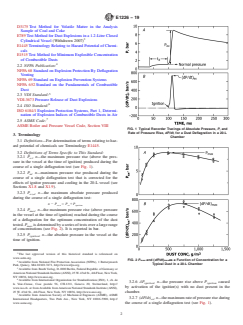
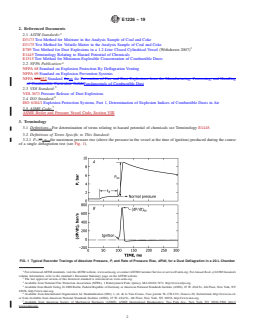
FIG. 1 Typical Recorder Tracings of Absolute Pressure, P, and
Rate of Pressure Rise, dP/dt, for a Dust Deflagration in a 20-L
3. Terminology
Chamber
3.1 Definitions—For determination of terms relating to haz-
ard potential of chemicals see Terminology E1445.
3.2 Definitions of Terms Specific to This Standard:
3.2.1 P ,n—the maximum pressure rise (above the pres-
ex
sure in the vessel at the time of ignition) produced during the
course of a single deflagration test (see Fig. 1).
3.2.2 P ,n—maximum pressure rise produced during the
m
course of a single deflagration test that is corrected for the
effects of ignitor pressure and cooling in the 20-L vessel (see
Sections X1.8 and X1.9).
3.2.3 P ,n—the maximum absolute pressure produced
ex,a
during the course of a single deflagration test:
n 2 P 5 P 1P
ex,a ex ignition
3.2.4 P ,n—the maximum pressure rise (above pressure
max
in the vessel at the time of ignition) reached during the course
of a deflagration for the optimum concentration of the dust
tested. P isdeterminedbyaseriesoftestsoveralargerange
max
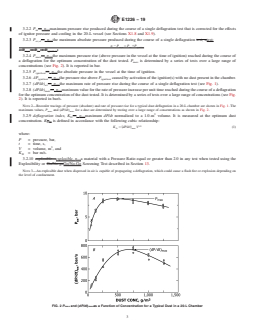
of concentrations (see Fig. 2). It is reported in bar.
3.2.5 P ,n—the absolute pressure in the vessel at the
ignition
time of ignition.
The last approved version of this historical standard is referenced on
www.astm.org.
FIG. 2 P and (dP/dt) as a Function of Concentration for a
max max
Available from National Fire Protection Association (NFPA), 1 Batterymarch
Typical Dust in a 20-L Chamber
Park, Quincy, MA 02169-7471, http://www.nfpa.org.
Available from Beuth Verlag, D-1000 Berlin, Federal Republic of Germany or
AmericanNationalStandardsInstitute(ANSI),25W.43rdSt.,4thFloor,NewYork,
NY 10036, http://www.ansi.org.
Available from International Organization for Standardization (ISO), 1, ch. de
3.2.6 ∆P ,n—the pressure rise above P caused
ignition ignition
la Voie-Creuse, Case postale 56, CH-1211, Geneva 20, Switzerland, http://
by activation of the ignitior(s) with no dust present in the
www.iso.ch. or fromAvailable fromAmerican National Standards Institute (ANSI),
25 W. 43rd St., 4th Floor, New York, NY 10036, http://www.ansi.org.
chamber.
Available from American Society of Mechanical Engineers (ASME), ASME
3.2.7 (dP/dt) ,n—themaximumrateofpressureriseduring
International Headquarters, Two Park Ave., New York, NY 10016-5990, http:// ex
www.asme.org. the course of a single deflagration test (see Fig. 1).
E1226−19
3.2.8 (dP/dt) ,n—maximumvaluefortherateofpressure 5.3 The values obtained by this testing technique are spe-
max
increase per unit time reached during the course of a deflagra- cifictothesampletestedandthemethodusedandarenottobe
tion for the optimum concentration of the dust tested. It is considered intrinsic material constants.
determined by a series of tests over a large range of concen-
5.4 For dusts with low K values, discrepancies have been
St
trations (see Fig. 2). It is reported in bar/s. 3
observed between tests in 20-L and 1-m chambers. A strong
ignitor may overdrive a 20-L chamber, as discussed in Test
NOTE 2—Recorder tracings of pressure (absolute) and rate of pressure
rise for a typical dust deflagration in a 20-Lchamber are shown in Fig. 1. Method E1515 and Refs (1-4). Conversely, more recent
The maximum values, P and (dP/dt) for a dust are determined by
max max testing has shown that some metal dusts can be prone to
testing over a large range of concentrations as shown in Fig. 2.
underdriving in the 20-L chamber, exhibiting significantly
3.2.9 deflagration index, K ,n—maximum dP/dt normal-
lower K values than in a 1-m chamber (5). Ref (6) provides
St
St
ized to a 1.0-m volume. It is measured at the optimum dust
supporting calculations showing that a test vessel of at least
concentration. K is defined in accordance with the following
1-m of volume is necessary to obtain the maximum explosi-
St
cubic relationship:
bilityindexforaburningdustcloudhavinganabnormallyhigh
1/3
flame temperature. In these two overdriving and underdriving
K 5 dP/dt V (1)
~ !
St
max
scenarios described above, it is therefore recommended to
where:
perform tests in 1-m or larger calibrated test vessels in order
P = pressure, bar,
to measure dusts explosibility parameters accurately.
t = time, s,
NOTE5—Ref (2)concludedthatdustswith K valuesbelow45barm/s
St
V = volume, m , and when measured in a 20-L chamber with a 10 000-J ignitor, may not be
explosible when tested in a 1-m chamber with a 10 000-J ignitor. Ref (2)
K = bar m/s.
St
and unpublished testing has also shown that in some cases the K values
St
3.2.10 explosible, n—a material with a Pressure Ratio equal
measured in the 20-L chamber can be lower than those measured in the
or greater than 2.0 in any test when tested using the Explosi- 1-m chamber.Refs (1)and (3)foundthatforsomedusts,itwasnecessary
to use lower ignition energy in the 20-L chamber in order to match MEC
bility or Go/No-Go Screening Test described in Section 13.
or MIC test data in a 1-m chamber. If a dust has measurable (nonzero)
P and K values with a 5000 or 10000-J ignitor when tested in a 20-L
NOTE 3—An explosible dust when dispersed in air is capable of
max St
propagating a deflagration, which could cause a flash fire or explosion chamber but no measurable P and K values with tests conducted
max St
using an ignition source less than or equal to 2500 J, it may be helpful to
depending on the level of confinement.
testthematerialinalargerchambersuchasa1-m chamberusingatleast
3.2.11 ignition delay time, t,n—experimental parameter
d
a 10 000-J ignition source to further characterize the material’s explosi-
defined as the time interval between the initiation of the dust
bility in dust cloud form.
dispersionprocedure(thetimeatwhichthedispersionairstarts
6. Interferences
to enter the chamber) in an experimental apparatus and the
activationoftheignitionsource(seeFig.1).Theignitiondelay
6.1 In certain industrial situations where extreme levels of
time characterizes the turbulence level prevailing at ignition
turbulence may be encountered, such as the rapid introduction
under the defined test conditions.
of expanding gases resulting from combustion in connected
piping or operations where hybrid mixtures (combustible dusts
3.2.12 pressure ratio (PR), n—
and combustible gases or vapors) are encountered, the use of
PR 5 P 2 ∆P ⁄P
~ !
ex,a ignitor ignition
thedeflagrationindicesbasedonthistestmethodforthesizing
NOTE4—WhentestingintheSiwek20-Lvessel(seeAppendixX1),PR
of deflagration vents may not be possible.
may be calculated using the corrected explosion pressure:
n 2 PR 5 ~P 1 P !⁄P
7. Apparatus
m ignitition ignition
7.1 The equipment consists of a closed steel combustion
4. Summary of Test Method
chamber with an internal volume of at least 20 L, spherical or
4.1 Adust cloud is formed in a closed combustion chamber
cylindrical (with a length to diameter ratio of approximately
by an introduction of the material with air. 1:1) in shape.
4.2 Ignitionofthisdust-airmixtureisthenattemptedaftera 7.2 The apparatus must be capable of dispersing a fairly
uniform dust cloud of the material.
specified delay time by an ignition source located at the center
of the chamber.
7.3 The pressure transducer and recording equipment must
have a combined response rate greater than the maximum
4.3 The pressure time curve is recorded on a suitable piece
measured rates of pressure rise.
of equipment.
7.4 An example of a chamber and specific procedures that
5. Significance and Use
have been found suitable are shown in Appendix X1. This
chamber has been calibrated as described in Section 10.
5.1 This test method provides a procedure for performing
laboratory tests to evaluate deflagration parameters of dusts.
7.5 Examples of other test chambers that have not yet been
calibrated are listed in Appendix X2.
5.2 The data developed by this test method may be used for
thepurposeofsizingdeflagrationventsinconjunctionwiththe
nomographsandequationspublishedinNFPA68,ISO6184/1,
The boldface numbers in parentheses refer to a list of references at the end of
or VDI 3673. this standard.
E1226−19
state, it should be recognized that the test results may not represent the
8. Safety Precautions
most severe dust deflagration possible.Any process change resulting in a
8.1 Prior to handling a dust material, the toxicity of the
higher fraction of fines than normal or drier product than normal may
sample and its combustion products must be considered. This
increase the explosion severity.
information is generally obtained from the manufacturer or
9.3 To achieve this particle fineness (≥95% minus 200
supplier. Appropriate safety precautions must be taken if the
mesh), the sample may be ground or pulverized or it may be
material has toxic or irritating characteristics. Tests using this
sieved.
apparatus should be conducted in a ventilated hood or other
area having adequate ventilation. NOTE 7—The operator should consider the thermal stability of the dust
during any grinding or pulverizing. In sieving the material, the operator
8.2 Before initiating a test, a physical check of all gaskets
must verify that there is no selective separation of components in a dust
and fittings should be made to prevent leakage.
that is not a pure substance.
8.3 All enclosures containing electrical equipment should
9.4 The moisture content of the test sample should not
be connected to a common ground. Shielded cables should be
exceed 5% in order to avoid test results of a given dust being
used.
noticeably influenced.
8.4 Ifchemicalignitorsareusedasanignitionsource,safety
NOTE 8—For most materials, dry samples will produce maximum P
max
in handling and use is a primary consideration. Ignition by
and K values.Forsomewaterreactivematerials,suchasreactivemetals,
St
electrostatic discharge must be considered a possibility. When
maximum values may occur when some moisture is present.
handling these ignitors, eye protection must be worn at all
NOTE 9—There is no single method for determining the moisture
times. A grounded, conductive tabletop is recommended for content or for drying a sample. ASTM lists many methods for moisture
determination in the Annual Book of ASTM Standards. Sample drying is
preparation. Federal, state, and local regulations for the
equally complex due to the presence of volatiles, lack of or varying
procurement, use, and storage of chemical ignitors must be
porosity (see Test Methods D3173 and D3175), weight change due to
followed.
oxidation, and sensitivity of the sample to heat. Therefore, each must be
dried in a manner that will not modify or destroy the integrity of the
8.5 All testing should initially be conducted with small
sample. Hygroscopic materials must be desiccated.
quantities of sample to prevent overpressurization due to high
energy material.
9.5 Retention and storage of dust samples can lead to aging
which may affect explosibility results. Changes that may occur
8.6 In assembling the electrical circuitry for this apparatus,
are,butnotlimitedto:dryingorabsorptionofmoisture,lossof
standardwiringandgroundingproceduresmustbefollowed.If
solvent or volatiles, surface oxidation, slow chemical/
a high-voltage spark circuit is used, it presents an electric
biological reactions or other decomposition mechanism. Ap-
shock hazard and adequate interlocking and shielding must be
propriate measures should be taken to avoid aging of the
employed to prevent contact.
samplepriortotesting,sothesampleremainsrepresentativeof
8.7 The operator should work from a protected location in
the material present in the industrial process to be protected.
case of vessel or electrical failure.
Dusts that are susceptible to aging effects after being sampled
8.8 The vessel should be designed and fabricated in accor- shall be preserved in a suitable atmosphere and stored under
dance with the ASME Boiler and Pressure Vessel Code, suitable temperature conditions until tested. Argon blanketing
Section VIII. A maximum allowable working pressure should be considered for dusts that are unusually reactive with
(MAWP) of at least 15 bar is recommended. moisture and oxygen, or both. Argon may be otherwise
preferable to nitrogen as a blanketing gas, owing both to its
9. Sampling, Test Specimens, Test Units, and Storage
larger density and to the slower rate at which oxygen will
diffuse into opened or leaking sample containers.
9.1 Itisnotpracticaltospecifyasinglemethodofsampling
dust for test purposes because the character of the material and
10. Calibration and Standardization
its available form affect selection of the sampling procedure.
Generally accepted sampling procedures should be used as
10.1 Theobjectiveofthistestmethodistodevelopdatathat
described in MNL 32.
canbecorrelatedtothosefromthe1-m chamber(describedin
9.2 Tests may be run on an as-received sample. However,
ISO6184⁄1andVDI3673)inordertousethenomogramsand
due to the possible accumulation of fines at some location in a
equations (see 5.2).
processingsystem,itisrecommendedthatthetestsamplebeat
10.2 Because a number of factors (concentration, unifor-
least 95% minus 200 mesh (75 µm).
mityofdispersion,turbulenceofignition,sampleage,etc.)can
NOTE6—Itmaybedesirableinsomecasestoconductdustdeflagration
affectthetestresults,thetestvesseltobeusedforroutinework
testsonmaterialsassampledfromaprocessbecauseprocessduststreams
must be standardized using dust samples whose K and P
St max
or deposits may contain a wide range of particle sizes or have a
parameters are known in the 1-m chamber. Samples used for
well-defined specific moisture content, materials consisting of a mixture
standardization should provide a wide range of K values. A
of chemicals may be selectively separated on sieves and certain fibrous
St
materials which may not pass through a relatively coarse screen may
minimum of five different dust samples are required over each
produce dust deflagrations. When a material is tested in the as-received
of the following three K ranges: 1–200, 201–300, and >300
St
bar m/s. The P value for each dust must agree to within
max
610% with the 1-m value and the K value must agree to
MNL 32 —ASTM Manual on Test Sieving Methods is available fromASTM St
Headquarters, 100 Barr Harbor Drive, W. Conshohocken, PA 19428. within 620%.
E1226−19
10.3 In cases where the test apparatus will not be used to 11.5 Place ignition source in the center of the apparatus.
determine deflagration indices of dusts within certain dust
11.6 Seal chamber, all valves must be closed.
classes, it is permissible to reduce the number of standardiza-
11.7 Partially evacuate chamber so that after addition of
tion dusts tested in these ranges.
dispersing air, the desired normal pressure in the chamber of 1
10.4 The calibration and standardization procedure for a
bar absolute will be reached prior to initiation of the deflagra-
chamber will normally involve varying the dispersion proce-
tion test.
dure (especially the dispersion and delay time) so that the
11.8 Actuate the timing circuit to conduct the test.
measureddataarecomparabletothosefromthe1-m chamber.
Once the specific dispersion procedures (that produce data
NOTE 12—The dust sample is automatically dispersed through a
comparable to those from the 1-m chamber) have been
dispersion system in the chamber. The deflagration is then initiated when
a defined ignition delay time has elapsed. This effective ignition delay
determined, they are fixed for future testing.
time, t , is the length of time between the first pressure rise due to dust
d
10.5 Average measured values from three calibrated 20-L
dispersion and the moment normal pressure has been reached in the
chambers for lycopodium dust (the reticulate form, Lycopo-
chamber and ignition is activated (see Fig. 1). The length of this time
defines the degree of turbulence and in many cases the concentration of
dium clavatum, a natural plant spore having a narrow size
the dust dispersed in the chamber at the moment of ignition.
distribution with a mean diameter of ~28-µm) are:
11.9 The pressure time curve is recorded on a suitable piece
P = 7.0 bar
max
(dP/dt) = 555 bar/s
of equipment, such as a storage oscilloscope, high-speed chart
max
K = 151 bar m/s
St
recorder, or electronic data acquisition system. The explosion
Data were obtained from two calibrated 20-L chambers for
data, P and(dP/dt) ,canbeobtainedinaccordancewithFig.
ex ex
Pittsburghseambituminouscoaldust(~80%minus200mesh,
1.
~50% minus 325 mesh, 36% volatility).
11.10 After the test, open a valve to vent pressure from the
P = 7.0 bar
max
chamber. Open the chamber, remove residue and thoroughly
(dP/dt) = 430 bar/s
max
clean the chamber and dispersion system.
K = 117 bar m/ s
St
10.6 Dust deflagration data in the 1-m chamber at Basel,
11.11 It is recommended that an initial concentration of 250
Switzerland are:
g/m be tested (see 9.2). This concentration may be systemati-
Lycopodium: callyincreasedbyanequivalentof250g/m (forexample,500,
P = 6.9 bar
max
750,1000g/m etc.)untilcurvesareobtainedforboth(dP/dt)
ex
K = 157 bar m/s
St
and P that clearly indicate an optimum value has been
ex
reached (see Fig. 2). Two additional test series are run at the
Pittsburgh seam bituminous coal:
P = 7.0 bar
max
concentrations where the maximums were found and at least
K = 95 bar m/s
St
one concentration on each side of the maximums.
Dust deflagration data for other dusts measured in the 1-m
NOTE13—The(dP/dt)maxandP valuesarenormallyobtainedinthe
chamber are listed in Refs (7, 8). max
500to1250-g/m range.Inmanycasesthe P and(dP/dt) valuesare
max max
10.7 Inadditiontotheinitialcalibrationandstandardization
not found at the same concentrations. For materials containing high
procedure, at least one suitable dust should be retested quar- atomic weight elements (for example, metals) or inert components the
optimum values may occur at larger concentrations and it is acceptable to
terly to verify that the dispersion, turbulence, and ignition
use concentrations increments larger than 250 g/m (for example 2000,
characteristics of the system have not changed.
2500, 3000 g/m etc.)
11. Procedure
11.12 If it is indicated that the optimum concentration for
(dP/dt)max or P is less than 250 g/m , the tested concen-
11.1 Thesegeneralproceduresareapplicableforallsuitable
max
t
...
This document is not an ASTM standard and is intended only to provide the user of an ASTM standard an indication of what changes have been made to the previous version. Because
it may not be technically possible to adequately depict all changes accurately, ASTM recommends that users consult prior editions as appropriate. In all cases only the current version
of the standard as published by ASTM is to be considered the official document.
Designation: E1226 − 12a E1226 − 19
Standard Test Method for
Explosibility of Dust Clouds
This standard is issued under the fixed designation E1226; the number immediately following the designation indicates the year of
original adoption or, in the case of revision, the year of last revision. A number in parentheses indicates the year of last reapproval. A
superscript epsilon (´) indicates an editorial change since the last revision or reapproval.
INTRODUCTION
Particulate solids of combustible materials present a significant risk of dust explosion if suspended
in air and subjected to an ignition source. The methods of this standard can be used to determine if
a dispersed dust cloud is “explosible” and, if so, to what degree it is explosible, that is, its
“explosibility.” Knowledge that a dust may be explosible if dispersed as a dust cloud is important in
the conduct of a process hazard safety review. Contained herein is an explosibility or go/no-go
screening test procedure for the purpose of determining whether a dust sample is explosible.
If a dust is explosible, the explosibility parameters, maximum explosion pressure, P ; maximum
max
rate of pressure rise, (dP/dt)(dP/dt) ; and explosibility index, K , are useful in the design of
max St
explosion prevention and control measures as described in national (NFPA) and international (ISO,
CEN and others) explosion protection standards.
1. Scope
1.1 Purpose. The purpose of this test method is to provide standard test methods for characterizing the “explosibility” of dust
clouds in two ways, first by determining if a dust is “explosible,” meaning a cloud of dust dispersed in air is capable of propagating
a deflagration, which could cause a flash fire or explosion; or, if explosible, determining the degree of “explosibility,” meaning the
potential explosion hazard of a dust cloud as characterized by the dust explosibility parameters, maximum explosion pressure,
P ; maximum rate of pressure rise, (dP/dt)(dP/dt) ; and explosibility index, K .
max max St
1.2 Limitations. Results obtained by the application of the methods of this standard pertain only to certain combustion
characteristics of dispersed dust clouds. No inference should be drawn from such results relating to the combustion characteristics
of dusts in other forms or conditions (for example, ignition temperature or spark ignition energy of dust clouds, ignition properties
of dust layers on hot surfaces, ignition of bulk dust in heated environments, etc.)
1.3 Use. It is intended that results obtained by application of this test be used as elements of an explosion risk assessment a dust
hazard analysis (DHA) that takes into account other pertinent risk factors; and in the specification of explosion prevention systems
(see, for example NFPA 68, NFPA 69, and NFPA 654)652) when used in conjunction with approved or recognized design methods
by those skilled in the art.
NOTE 1—Historically, the evaluation of the deflagration parameters of maximum pressure and maximum rate of pressure rise has been performed using
a 1.2-L Hartmann Apparatus. Test Method E789, which describes this method, has been withdrawn. The use of data obtained from the test method in
the design of explosion protection systems is not recommended.
1.4 The values stated in SI units are to be regarded as standard. No other units of measurement are included in this standard.
1.5 This standard does not purport to address all of the safety concerns, if any, associated with its use. It is the responsibility
of the user of this standard to establish appropriate safety, health, and environmental practices and determine the applicability of
regulatory limitations prior to use.
1.6 This international standard was developed in accordance with internationally recognized principles on standardization
established in the Decision on Principles for the Development of International Standards, Guides and Recommendations issued
by the World Trade Organization Technical Barriers to Trade (TBT) Committee.
This test method is under the jurisdiction of ASTM Committee E27 on Hazard Potential of Chemicals and is the direct responsibility of Subcommittee E27.05 on
Explosibility and Ignitability of Dust Clouds.
Current edition approved Dec. 1, 2012Dec. 15, 2019. Published January 2013January 2020. Originally approved in 1988. Last previous edition approved in 2012 as
E1226 – 12.E1226 – 12a. DOI: 10.1520/E1226-12A.10.1520/E1226-19.
Copyright © ASTM International, 100 Barr Harbor Drive, PO Box C700, West Conshohocken, PA 19428-2959. United States
E1226 − 19
2. Referenced Documents
2.1 ASTM Standards:
D3173 Test Method for Moisture in the Analysis Sample of Coal and Coke
D3175 Test Method for Volatile Matter in the Analysis Sample of Coal and Coke
E789 Test Method for Dust Explosions in a 1.2-Litre Closed Cylindrical Vessel (Withdrawn 2007)
E1445 Terminology Relating to Hazard Potential of Chemicals
E1515 Test Method for Minimum Explosible Concentration of Combustible Dusts
2.2 NFPA Publication:
NFPA 68 Standard on Explosion Protection By Deflagration Venting
NFPA 69 Standard on Explosion Prevention Systems
NFPA 654652 Standard foron the Prevention of Fire and Dust Explosions from the Manufacturing, Processing, and Handling
of Combustible Particulate SolidsFundamentals of Combustible Dust
2.3 VDI Standard:
VDI-3673 Pressure Release of Dust Explosions
2.4 ISO Standard:
ISO 6184/1 Explosion Protection Systems, Part 1, Determination of Explosion Indices of Combustible Dusts in Air
2.5 ASME Code:
ASME Boiler and Pressure Vessel Code, Section VIII
3. Terminology
3.1 Definitions—For determination of terms relating to hazard potential of chemicals see Terminology E1445.
3.2 Definitions of Terms Specific to This Standard:
3.2.1 P —, n—the maximum pressure rise (above the pressure in the vessel at the time of ignition) produced during the course
ex
of a single deflagration test (see Fig. 1).
FIG. 1 Typical Recorder Tracings of Absolute Pressure, P, and Rate of Pressure Rise, dP/dt, for a Dust Deflagration in a 20-L Chamber
For referenced ASTM standards, visit the ASTM website, www.astm.org, or contact ASTM Customer Service at service@astm.org. For Annual Book of ASTM Standards
volume information, refer to the standard’s Document Summary page on the ASTM website.
The last approved version of this historical standard is referenced on www.astm.org.
Available from National Fire Protection Association (NFPA), 1 Batterymarch Park, Quincy, MA 02169-7471, http://www.nfpa.org.
Available from Beuth Verlag, D-1000 Berlin, Federal Republic of Germany or American National Standards Institute (ANSI), 25 W. 43rd St., 4th Floor, New York, NY
10036, http://www.ansi.org.
Available from International Organization for Standardization (ISO), 1, ch. de la Voie-Creuse, Case postale 56, CH-1211, Geneva 20, Switzerland, http://www.iso.ch.
or from Available from American National Standards Institute (ANSI), 25 W. 43rd St., 4th Floor, New York, NY 10036, http://www.ansi.org.
Available from American Society of Mechanical Engineers (ASME), ASME International Headquarters, Two Park Ave., New York, NY 10016-5990, http://
www.asme.org.
E1226 − 19
3.2.2 P —, n—maximum pressure rise produced during the course of a single deflagration test that is corrected for the effects
m
of ignitor pressure and cooling in the 20-L vessel (see Sections X1.8 and X1.9).
3.2.3 P —, n—the maximum absolute pressure produced during the course of a single deflagration test, ntest:
ex,a
n 2 P 5 P 1P
ex,a ex ignition
– P = P + P .
ex,a ex ignition
3.2.4 P —, n—the maximum pressure rise (above pressure in the vessel at the time of ignition) reached during the course of
max
a deflagration for the optimum concentration of the dust tested. P is determined by a series of tests over a large range of
max
concentrations (see Fig. 2). It is reported in bar.
3.2.5 P —, n—the absolute pressure in the vessel at the time of ignition.
ignition
3.2.6 ΔP —, n—the pressure rise above P caused by activation of the ignitior(s) with no dust present in the chamber.
ignition ignition
3.2.7 (dP/dt) —, n—the maximum rate of pressure rise during the course of a single deflagration test (see Fig. 1).
ex
3.2.8 (dP/dt) —, n—maximum value for the rate of pressure increase per unit time reached during the course of a deflagration
max
for the optimum concentration of the dust tested. It is determined by a series of tests over a large range of concentrations (see Fig.
2). It is reported in bar/s.
NOTE 2—Recorder tracings of pressure (absolute) and rate of pressure rise for a typical dust deflagration in a 20-L chamber are shown in Fig. 1. The
maximum values, P and (dP/dt) for a dust are determined by testing over a large range of concentrations as shown in Fig. 2.
max max
3.2.9 deflagration index, K —, n—maximum dP/dt normalized to a 1.0-m volume. It is measured at the optimum dust
St
concentration. K is defined in accordance with the following cubic relationship:
StSt
1/3
K 5 dP/dt V (1)
~ !
St max
where:
P = pressure, bar,
t = time, s,
V = volume, m , and
K = bar m/s.
St
3.2.10 explosible—explosible, n—a material with a Pressure Ratio equal or greater than 2.0 in any test when tested using the
Explosibility or Go/No-goGo/No-Go Screening Test described in Section 13.
NOTE 3—An explosible dust when dispersed in air is capable of propagating a deflagration, which could cause a flash fire or explosion depending on
the level of confinement.
FIG. 2 P and (dP/dt) as a Function of Concentration for a Typical Dust in a 20-L Chamber
max max
E1226 − 19
3.2.11 ignition delay time, t —, n—experimental parameter defined as the time interval between the initiation of the dust
d
dispersion procedure (the time at which the dispersion air starts to enter the chamber) in an experimental apparatus and the
activation of the ignition source (see Fig. 1). The ignition delay time characterizes the turbulence level prevailing at ignition under
the defined test conditions.
3.2.12 pressure ratio (PR), n—PR
PR 5 ~P 2 ΔP !⁄P
ex,a ignitor ignition
= (P −ΔP )/P .
ex,a ignitor ignition
NOTE 4—When testing in the Siwek 20-L vessel (see Appendix X1)), PR may be calculated using the corrected explosion pressure, npressure:
n 2 PR 5 ~P 1 P !⁄P
m ignitition ignition
– PR = (P + P )/P .
m ignition ignition
4. Summary of Test Method
4.1 A dust cloud is formed in a closed combustion chamber by an introduction of the material with air.
4.2 Ignition of this dust-air mixture is then attempted after a specified delay time by an ignition source located at the center of
the chamber.
4.3 The pressure time curve is recorded on a suitable piece of equipment.
5. Significance and Use
5.1 This test method provides a procedure for performing laboratory tests to evaluate deflagration parameters of dusts.
5.2 The data developed by this test method may be used for the purpose of sizing deflagration vents in conjunction with the
nomographs and equations published in NFPA 68, ISO 6184/1, or VDI 3673.
5.3 The values obtained by this testing technique are specific to the sample tested and the method used and are not to be
considered intrinsic material constants.
5.4 For dusts with low K -values, values, discrepancies have been observed between tests in 20-L and 1-m chambers. A
St St
strong ignitor may overdrive a 20-L chamber, as discussed in Test Method E1515 and Refs (1-34). Conversely, more recent testing
has shown that some metal dusts can be prone to underdriving in the 20-L chamber, exhibiting significantly lower K values than
St
3 3
in a 1-m chamber (5). Ref (6) provides supporting calculations showing that a test vessel of at least 1-m of volume is necessary
to obtain the maximum explosibility index for a burning dust cloud having an abnormally high flame temperature. In these two
overdriving and underdriving scenarios described above, it is therefore recommended to perform tests in 1-m or larger calibrated
test vessels in order to measure dusts explosibility parameters accurately.
NOTE 5—Ref (2) concluded that dusts with K -values values below 45 bar m/s when measured in a 20-L chamber with a 10 000-J ignitor, may not
St
be explosible when tested in a 1-m chamber with a 10 000-J ignitor. Ref (2) and unpublished testing has also shown that in some cases the K -values
St
values measured in the 20-L chamber can be lower than those measured in the 1-m chamber. Refs (1) and (3) found that for some dusts, it was necessary
to use lower ignition energy in the 20-L chamber in order to match MEC or MIC test data in a 1-m chamber. If a dust has measurable (nonzero) P -
max
and K -values values with a 5000 or 10 000-J ignitor when tested in a 20-L chamber but no measurable P - and K -values values with tests conducted
St max St
using an ignition source less than or equal to 2500 J, it may be helpful to test the material in a larger chamber such as a 1-m chamber using at least
a 10 000-J ignition source to further characterize the material’s explosibility in dust cloud form.
6. Interferences
6.1 In certain industrial situations where extreme levels of turbulence may be encountered, such as the rapid introduction of
expanding gases resulting from combustion in connected piping or operations where hybrid mixtures (combustible dusts and
combustible gases or vapors) are encountered, the use of the deflagration indices based on this test method for the sizing of
deflagration vents may not be possible.
7. Apparatus
7.1 The equipment consists of a closed steel combustion chamber with an internal volume of at least 20 L, spherical or
cylindrical (with a length to diameter ratio of approximately 1:1) in shape.
7.2 The apparatus must be capable of dispersing a fairly uniform dust cloud of the material.
7.3 The pressure transducer and recording equipment must have a combined response rate greater than the maximum measured
rates of pressure rise.
7.4 An example of a chamber and specific procedures that have been found suitable are shown in Appendix X1. This chamber
has been calibrated as described in Section 10.
7.5 Examples of other test chambers that have not yet been calibrated are listed in Appendix X2.
The boldface numbers in parentheses refer to a list of references at the end of this standard.
E1226 − 19
8. Safety Precautions
8.1 Prior to handling a dust material, the toxicity of the sample and its combustion products must be considered. This
information is generally obtained from the manufacturer or supplier. Appropriate safety precautions must be taken if the material
has toxic or irritating characteristics. Tests using this apparatus should be conducted in a ventilated hood or other area having
adequate ventilation.
8.2 Before initiating a test, a physical check of all gaskets and fittings should be made to prevent leakage.
8.3 All enclosures containing electrical equipment should be connected to a common ground. Shielded cables should be used.
8.4 If chemical ignitors are used as an ignition source, safety in handling and use is a primary consideration. Ignition by
electrostatic discharge must be considered a possibility. When handling these ignitors, eye protection must be worn at all times.
A grounded, conductive tabletop is recommended for preparation. Federal, state, and local regulations for the procurement, use,
and storage of chemical ignitors must be followed.
8.5 All testing should initially be conducted with small quantities of sample to prevent overpressurization due to high energy
material.
8.6 In assembling the electrical circuitry for this apparatus, standard wiring and grounding procedures must be followed. If a
high-voltage spark circuit is used, it presents an electric shock hazard and adequate interlocking and shielding must be employed
to prevent contact.
8.7 The operator should work from a protected location in case of vessel or electrical failure.
8.8 The vessel should be designed and fabricated in accordance with the ASME Boiler and Pressure Vessel Code, Section VIII.
A maximum allowable working pressure (MAWP) of at least 15 bar is recommended.
9. Sampling, Test Specimens, and Test Units Test Units, and Storage
9.1 It is not practical to specify a single method of sampling dust for test purposes because the character of the material and
its available form affect selection of the sampling procedure. Generally accepted sampling procedures should be used as described
in MNL 32.
9.2 Tests may be run on an as-received sample. However, due to the possible accumulation of fines at some location in a
processing system, it is recommended that the test sample be at least 95 % minus 200 mesh (75 μm).
NOTE 6—It may be desirable in some cases to conduct dust deflagration tests on materials as sampled from a process because process dust streams
or deposits may contain a wide range of particle sizes or have a well-defined specific moisture content, materials consisting of a mixture of chemicals
may be selectively separated on sieves and certain fibrous materials which may not pass through a relatively coarse screen may produce dust deflagrations.
When a material is tested in the as-received state, it should be recognized that the test results may not represent the most severe dust deflagration possible.
Any process change resulting in a higher fraction of fines than normal or drier product than normal may increase the explosion severity.
9.3 To achieve this particle fineness (≥95 % minus 200 mesh), the sample may be ground or pulverized or it may be sieved.
NOTE 7—The operator should consider the thermal stability of the dust during any grinding or pulverizing. In sieving the material, the operator must
verify that there is no selective separation of components in a dust that is not a pure substance.
9.4 The moisture content of the test sample should not exceed 5 % in order to avoid test results of a given dust being noticeably
influenced.
NOTE 8—For most materials, dry samples will produce maximum P and K values. For some water reactive materials, such as reactive metals,
max St
maximum values may occur when some moisture is present.
NOTE 9—There is no single method for determining the moisture content or for drying a sample. ASTM lists many methods for moisture determination
in the Annual Book of ASTM Standards. Sample drying is equally complex due to the presence of volatiles, lack of or varying porosity (see Test Methods
D3173 and D3175), weight change due to oxidation, and sensitivity of the sample to heat. Therefore, each must be dried in a manner that will not modify
or destroy the integrity of the sample. Hygroscopic materials must be desiccated.
9.5 Retention and storage of dust samples can lead to aging which may affect explosibility results. Changes that may occur are,
but not limited to: drying or absorption of moisture, loss of solvent or volatiles, surface oxidation, slow chemical/biological
reactions or other decomposition mechanism. Appropriate measures should be taken to avoid aging of the sample prior to testing,
so the sample remains representative of the material present in the industrial process to be protected. Dusts that are susceptible to
aging effects after being sampled shall be preserved in a suitable atmosphere and stored under suitable temperature conditions until
tested. Argon blanketing should be considered for dusts that are unusually reactive with moisture and oxygen, or both. Argon may
be otherwise preferable to nitrogen as a blanketing gas, owing both to its larger density and to the slower rate at which oxygen
will diffuse into opened or leaking sample containers.
MNL 32 — ASTM Manual on Test Sieving Methods is available from ASTM Headquarters, 100 Barr Harbor Drive, W. Conshohocken, PA 19428.
E1226 − 19
10. Calibration and Standardization
10.1 The objective of this test method is to develop data that can be correlated to those from the 1-m chamber (described in
ISO 6184 ⁄1 and VDI 3673) in order to use the nomograms and equations (see 5.2).
10.2 Because a number of factors (concentration, uniformity of dispersion, turbulence of ignition, sample age, etc.) can affect
the test results, the test vessel to be used for routine work must be standardized using dust samples whose K and P parameters
St max
are known in the 1-m chamber. Samples used for standardization should provide a wide range of K values. A minimum of five
St
different dust samples are required over each of the following three K ranges: 1–200, 201–300, and >300 bar m/s. The P value
St max
for each dust must agree to within 610 % with the 1-m value and the K value must agree to within 620 %.
St
10.3 In cases where the test apparatus will not be used to determine deflagration indices of dusts within certain dust classes,
it is permissible to reduce the number of standardization dusts tested in these ranges.
10.4 The calibration and standardization procedure for a chamber will normally involve varying the dispersion procedure
(especially the dispersion and delay time) so that the measured data are comparable to those from the 1-m chamber. Once the
specific dispersion procedures (that produce data comparable to those from the 1-m chamber) have been determined, they are fixed
for future testing.
10.5 Average measured values from three calibrated 20-L chambers for lycopodium dust (the reticulate form, Lycopodium
clavatum, a natural plant spore having a narrow size distribution with a mean diameter of ~28-μm) are:
P = 7.0 bar
max
(dP/dt) = 555 bar/s
max
K = 151 bar m/s
St
P = 7.0 bar
max
(dP/dt) = 555 bar/s
max
K = 151 bar m/s
St
Data were obtained from two calibrated 20-L chambers for Pittsburgh seam bituminous coal dust (~80 % minus 200 mesh,
~50 % minus 325 mesh, 36 % volatility).
P = 7.0 bar
max
(dP/dt) = 430 bar/s
max
K = 117 bar m/ s
St
P = 7.0 bar
max
(dP/dt) = 430 bar/s
max
K = 117 bar m/ s
St
10.6 Dust deflagration data in the 1-m chamber at Basel, Switzerland are:
P = 6.9 bar
max
lycopodium:
K = 157 bar m/s
St
Pittsburgh seam bituminous coal:
P = 7.0 bar
max
K = 95 bar m/s
St
Lycopodium:
P = 6.9 bar
max
K = 157 bar m/s
St
Pittsburgh seam bituminous coal:
P = 7.0 bar
max
K = 95 bar m/s
St
Dust deflagration data for other dusts measured in the 1-m chamber are listed in Refs (47, 58).
10.7 In addition to the initial calibration and standardization procedure, at least one suitable dust should be retested quarterly
to verify that the dispersion, turbulence, and ignition characteristics of the system have not changed.
11. Procedure
11.1 These general procedures are applicable for all suitable chambers. The detailed procedures specific to each chamber are
listed in the corresponding appendix.
11.2 Inspect equipment to be sure it is thoroughly cleaned and in good operational condition.
NOTE 10—A high frequency of operation (20 to 40 explosions per day) can increase the operating temperature in some chambers to approximately 40
to 50°C. It has been determined that a reduction of up to 15 % in P will result if the operating temperature in the chamber rises to this range.
max
11.3 Ensure that the oxygen content of the dispersion air is 20.9 6 0.5 %. Higher or lower oxygen content will affect the P
max
and K values.
StSt
NOTE 11—The oxygen content of some synthetic air cylinders may range from 19 to 26 %.
E1226 − 19
11.4 Place a weighed amount of dust in the storage chamber or main chamber according to detailed instructions in the
appendixes.
11.5 Place ignition source in the center of the apparatus.
11.6 Seal chamber, all valves must be closed.
11.7 Partially evacuate chamber so that after addition of dispersing air, the desired normal pressure in the chamber of 1 bar
absolute will be reached prior to initiation of the deflagration test.
11.8 Actuate the timing circuit to conduct the test.
NOTE 12—The dust sample is automatically dispersed through a dispersion system in the chamber. The deflagration is then initiated when a defined
ignition delay time has elapsed. This effective ignition delay time, t , is the length of time between the first pressure rise due to dust dispersion and the
d
moment normal pressure has been reached in the chamber and ignition is activated (see Fig. 1). The length of this time defines the degree of turbulence
and in many cases the concentration of the dust dispersed in the chamber at the moment of ignition.
11.9 The pressure time curve is recorded on a suitable piece of equipment, such as a storage oscilloscope, high-speed chart
recorder, or electronic data acquisition system. The explosion data, P and (dP/dt) , can be obtained in accordance with Fig. 1.
ex ex
11.10 After the test, open a valve to vent pressure from the chamber. Open the chamber, remove residue and thoroughly clean
the chamber and dispersion system.
11.11 It is recommended that an initial concentration of 250 g/m be tested (see 9.2). This concentration may be systematically
3 3
increased by an equivalent of 250 g/m (for example, 500, 750, 1000 g/m etc.) until cu
...