

ASTM D3585-24
(Specification)Standard Specification for ASTM Reference Fluid for Coolant Tests
General Information
- Abstract
ABSTRACT
This specification covers a reference ethylene glycol-base test fluid to be used in providing base line data for ASTM coolant test procedures. The reference test fluid concentrate shall be prepared to conform to the requirements as to chemical composition prescribed. The materials used to prepare the reference test fluid shall meet the requirements specified. The formulated reference test fluid concentrate shall conform to the requirements for laboratory test performance prescribed.
SIGNIFICANCE AND USE
5.1 The data obtained for the reference test fluid are intended to be used by laboratory personnel to determine their capability to perform tests properly. If a particular determination does not fall within the prescribed limits, it has to be assumed that an error occurred in the application of the test procedure.
5.2 The coolant composition given in this specification is not intended to be a commercial product.
SCOPE
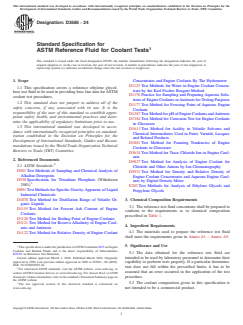
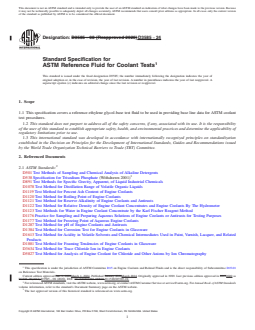
1.1 This specification covers a reference ethylene glycol-base test fluid to be used in providing base line data for ASTM coolant test procedures.
1.2 This standard does not purport to address all of the safety concerns, if any, associated with its use. It is the responsibility of the user of this standard to establish appropriate safety, health, and environmental practices and determine the applicability of regulatory limitations prior to use.
1.3 This international standard was developed in accordance with internationally recognized principles on standardization established in the Decision on Principles for the Development of International Standards, Guides and Recommendations issued by the World Trade Organization Technical Barriers to Trade (TBT) Committee.
- Status
- Published
- Publication Date
- 29-Feb-2024
- Technical Committee
- D15 - Engine Coolants and Related Fluids
- Drafting Committee
- D15.01 - Reference Test Materials
Buy Documents
ASTM D3585-24 - Standard Specification for ASTM Reference Fluid for Coolant Tests
REDLINE ASTM D3585-24 - Standard Specification for ASTM Reference Fluid for Coolant Tests
Overview
ASTM D3585-24: Standard Specification for ASTM Reference Fluid for Coolant Tests provides requirements for the preparation and use of a reference ethylene glycol-based test fluid in laboratory testing of engine coolants. Developed by ASTM International, this specification is intended to ensure standardized, repeatable baseline conditions for various ASTM coolant test procedures, supporting reliable comparison and laboratory proficiency.
The reference fluid defined in ASTM D3585-24 is not intended as a commercial coolant product, but rather as a controlled test material for laboratory use. This ensures that test results are not affected by variations in test fluid composition, enabling labs worldwide to assess and validate their coolant testing methods with confidence.
Key Topics
- Reference Test Fluid Composition: Specifies strict requirements for chemical composition, including ethylene glycol, diethylene glycol, sodium tetraborate, trisodium phosphate, sodium mercaptobenzothiazole, and other additives.
- Quality and Purity of Ingredients: Prescribes detailed quality standards for constituent chemicals and solutions, ensuring consistent and reliable reference fluid.
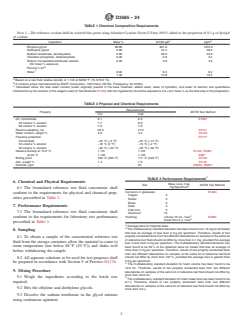
- Physical and Chemical Properties: Lists target values for properties such as pH, reserve alkalinity, water content, freezing and boiling points, relative density, ash content, and allowable chlorides.
- Lab Testing and Performance: Includes requirements for corrosion inhibition, foam tendencies, and mass loss in metals, confirming the fluid’s suitability for use as a test reference in various ASTM standard test methods.
- Packaging and Storage Practices: Advises on storing the reference fluid in opaque containers and minimizing exposure to light or moisture to preserve test validity.
Applications
The ASTM D3585-24 reference fluid is essential in several practical contexts:
- Coolant Performance Testing: Laboratories use this standard reference fluid to establish baseline data for evaluating the performance of commercial and experimental engine coolants.
- Method Validation and Proficiency Testing: Laboratories assess their capability by comparing test results with known standards, diagnosing procedural errors when results fall outside specified limits.
- Interlaboratory Comparisons: Facilitates consistent results across laboratories worldwide by standardizing the baseline reference material.
- Training and Quality Control: Provides a controlled material for training new laboratory professionals and for routine checks of test accuracy and consistency.
- Regulatory and Compliance Verification: Supports adherence to international and national regulatory requirements for automotive and industrial coolant testing.
The reference test fluid specified by this standard is not for commercial use as an engine coolant but is essential for lab-based diagnostic and evaluation activities.
Related Standards
ASTM D3585-24 is closely associated with several other ASTM standards essential for coolant and analytical testing, including:
- ASTM D891: Test Methods for Specific Gravity of Liquid Industrial Chemicals
- ASTM D1119: Test Method for Percent Ash Content of Engine Coolants
- ASTM D1120: Test Method for Boiling Point of Engine Coolants
- ASTM D1121: Test Method for Reserve Alkalinity of Engine Coolants
- ASTM D1122/D5931: Methods for Determining Relative Density
- ASTM D1177: Test Method for Freezing Point of Aqueous Engine Coolants
- ASTM D1287: Test Method for pH of Engine Coolants
- ASTM D1384: Corrosion Test for Engine Coolants
- ASTM D1881: Test Method for Foaming Tendencies of Engine Coolants
- ASTM D3634 and D5827: Analysis of Anions in Engine Coolants
Consulting these standards together with ASTM D3585-24 ensures comprehensive understanding and effective implementation of coolant test fluid specifications and laboratory quality assurance protocols.
Keywords: ASTM D3585-24, reference fluid, coolant test, ethylene glycol, engine coolant, laboratory standard, chemical composition, performance requirements, test methodology, coolant testing, laboratory proficiency
Relations
- Effective Date
- 01-Mar-2024
- Effective Date
- 01-Mar-2024
- Referred By
ASTM D1881-17 - Standard Test Method for Foaming Tendencies of Engine Coolants in Glassware - Effective Date
- 01-Mar-2024
- Effective Date
- 01-Mar-2024
- Effective Date
- 01-Mar-2024
Buy Documents
ASTM D3585-24 - Standard Specification for ASTM Reference Fluid for Coolant Tests
REDLINE ASTM D3585-24 - Standard Specification for ASTM Reference Fluid for Coolant Tests
Get Certified
Connect with accredited certification bodies for this standard

ECOCERT
Organic and sustainability certification.

Eurofins Food Testing Global
Global leader in food, environment, and pharmaceutical product testing.

Intertek Bangladesh
Intertek certification and testing services in Bangladesh.
Sponsored listings
Frequently Asked Questions
ASTM D3585-24 is a technical specification published by ASTM International. Its full title is "Standard Specification for ASTM Reference Fluid for Coolant Tests". This standard covers: ABSTRACT This specification covers a reference ethylene glycol-base test fluid to be used in providing base line data for ASTM coolant test procedures. The reference test fluid concentrate shall be prepared to conform to the requirements as to chemical composition prescribed. The materials used to prepare the reference test fluid shall meet the requirements specified. The formulated reference test fluid concentrate shall conform to the requirements for laboratory test performance prescribed. SIGNIFICANCE AND USE 5.1 The data obtained for the reference test fluid are intended to be used by laboratory personnel to determine their capability to perform tests properly. If a particular determination does not fall within the prescribed limits, it has to be assumed that an error occurred in the application of the test procedure. 5.2 The coolant composition given in this specification is not intended to be a commercial product. SCOPE 1.1 This specification covers a reference ethylene glycol-base test fluid to be used in providing base line data for ASTM coolant test procedures. 1.2 This standard does not purport to address all of the safety concerns, if any, associated with its use. It is the responsibility of the user of this standard to establish appropriate safety, health, and environmental practices and determine the applicability of regulatory limitations prior to use. 1.3 This international standard was developed in accordance with internationally recognized principles on standardization established in the Decision on Principles for the Development of International Standards, Guides and Recommendations issued by the World Trade Organization Technical Barriers to Trade (TBT) Committee.
ABSTRACT This specification covers a reference ethylene glycol-base test fluid to be used in providing base line data for ASTM coolant test procedures. The reference test fluid concentrate shall be prepared to conform to the requirements as to chemical composition prescribed. The materials used to prepare the reference test fluid shall meet the requirements specified. The formulated reference test fluid concentrate shall conform to the requirements for laboratory test performance prescribed. SIGNIFICANCE AND USE 5.1 The data obtained for the reference test fluid are intended to be used by laboratory personnel to determine their capability to perform tests properly. If a particular determination does not fall within the prescribed limits, it has to be assumed that an error occurred in the application of the test procedure. 5.2 The coolant composition given in this specification is not intended to be a commercial product. SCOPE 1.1 This specification covers a reference ethylene glycol-base test fluid to be used in providing base line data for ASTM coolant test procedures. 1.2 This standard does not purport to address all of the safety concerns, if any, associated with its use. It is the responsibility of the user of this standard to establish appropriate safety, health, and environmental practices and determine the applicability of regulatory limitations prior to use. 1.3 This international standard was developed in accordance with internationally recognized principles on standardization established in the Decision on Principles for the Development of International Standards, Guides and Recommendations issued by the World Trade Organization Technical Barriers to Trade (TBT) Committee.
ASTM D3585-24 is classified under the following ICS (International Classification for Standards) categories: 71.100.45 - Refrigerants and antifreezes. The ICS classification helps identify the subject area and facilitates finding related standards.
ASTM D3585-24 has the following relationships with other standards: It is inter standard links to ASTM D3585-08(2020), ASTM D5828-97(2023), ASTM D1881-17, ASTM D6208-07(2020), ASTM D4725-15(2023). Understanding these relationships helps ensure you are using the most current and applicable version of the standard.
ASTM D3585-24 is available in PDF format for immediate download after purchase. The document can be added to your cart and obtained through the secure checkout process. Digital delivery ensures instant access to the complete standard document.
Standards Content (Sample)
This international standard was developed in accordance with internationally recognized principles on standardization established in the Decision on Principles for the
Development of International Standards, Guides and Recommendations issued by the World Trade Organization Technical Barriers to Trade (TBT) Committee.
Designation: D3585 − 24
Standard Specification for
ASTM Reference Fluid for Coolant Tests
This standard is issued under the fixed designation D3585; the number immediately following the designation indicates the year of
original adoption or, in the case of revision, the year of last revision. A number in parentheses indicates the year of last reapproval. A
superscript epsilon (´) indicates an editorial change since the last revision or reapproval.
1. Scope Concentrates and Engine Coolants By The Hydrometer
D1123 Test Methods for Water in Engine Coolant Concen-
1.1 This specification covers a reference ethylene glycol-
trate by the Karl Fischer Reagent Method
base test fluid to be used in providing base line data for ASTM
D1176 Practice for Sampling and Preparing Aqueous Solu-
coolant test procedures.
tions of Engine Coolants or Antirusts for Testing Purposes
1.2 This standard does not purport to address all of the
D1177 Test Method for Freezing Point of Aqueous Engine
safety concerns, if any, associated with its use. It is the
Coolants
responsibility of the user of this standard to establish appro-
D1287 Test Method for pH of Engine Coolants and Antirusts
priate safety, health, and environmental practices and deter-
D1384 Test Method for Corrosion Test for Engine Coolants
mine the applicability of regulatory limitations prior to use.
in Glassware
1.3 This international standard was developed in accor-
D1613 Test Method for Acidity in Volatile Solvents and
dance with internationally recognized principles on standard-
Chemical Intermediates Used in Paint, Varnish, Lacquer,
ization established in the Decision on Principles for the
and Related Products
Development of International Standards, Guides and Recom-
D1881 Test Method for Foaming Tendencies of Engine
mendations issued by the World Trade Organization Technical
Coolants in Glassware
Barriers to Trade (TBT) Committee.
D3634 Test Method for Trace Chloride Ion in Engine Cool-
ants
2. Referenced Documents
D5827 Test Method for Analysis of Engine Coolant for
2.1 ASTM Standards:
Chloride and Other Anions by Ion Chromatography
D501 Test Methods of Sampling and Chemical Analysis of
D5931 Test Method for Density and Relative Density of
Alkaline Detergents
Engine Coolant Concentrates and Aqueous Engine Cool-
D538 Specification for Trisodium Phosphate (Withdrawn
ants by Digital Density Meter
2001)
E202 Test Methods for Analysis of Ethylene Glycols and
D891 Test Methods for Specific Gravity, Apparent, of Liquid
Propylene Glycols
Industrial Chemicals
D1078 Test Method for Distillation Range of Volatile Or-
3. Chemical Composition Requirements
ganic Liquids
3.1 The reference test fluid concentrate shall be prepared to
D1119 Test Method for Percent Ash Content of Engine
conform to the requirements as to chemical composition
Coolants
prescribed in Table 1.
D1120 Test Method for Boiling Point of Engine Coolants
D1121 Test Method for Reserve Alkalinity of Engine Cool-
4. Ingredient Requirements
ants and Antirusts
4.1 The materials used to prepare the reference test fluid
D1122 Test Method for Relative Density of Engine Coolant
shall meet the requirements given in Annex A1 – Annex A5.
5. Significance and Use
This specification is under the jurisdiction of ASTM Committee D15 on Engine
Coolants and Related Fluids and is the direct responsibility of Subcommittee
5.1 The data obtained for the reference test fluid are
D15.01 on Reference Test Materials.
intended to be used by laboratory personnel to determine their
Current edition approved March 1, 2024. Published March 2024. Originally
approved in 1989. Last previous edition approved in 2020 as D3585 – 08 (2020).
capability to perform tests properly. If a particular determina-
DOI: 10.1520/D3585-24.
tion does not fall within the prescribed limits, it has to be
For referenced ASTM standards, visit the ASTM website, www.astm.org, or
assumed that an error occurred in the application of the test
contact ASTM Customer Service at service@astm.org. For Annual Book of ASTM
Standards volume information, refer to the standard’s Document Summary page on procedure.
the ASTM website.
5.2 The coolant composition given in this specification is
The last approved version of this historical standard is referenced on
www.astm.org. not intended to be a commercial product.
Copyright © ASTM International, 100 Barr Harbor Drive, PO Box C700, West Conshohocken, PA 19428-2959. United States
D3585 − 24
TABLE 1 Chemical Composition Requirements
NOTE 1—The reference coolant shall be colored blue-green using Alizarine Cyanine Green G Extra 100 % added in the proportion of 0.3 g of dye/gal
of coolant.
A 3
Ingredient Mass % lb/100 gal kg/m
Ethylene glycol 89.86 847.9 1016.0
Diethylene glycol 5.00 47.2 56.5
Sodium tetraborate, pentahydrate 3.06 28.9 34.6
Trisodium phosphate, dodecahydrate 0.30 2.8 3.4
Sodium mercaptobenzothiazole solution 0.40 3.8 4.5
(50 mass % aqueous)
B
Pluronic L-61
C
Water 0.02 0.2 0.2
1.36 12.8 15.4
A
Based on a test fluid relative density of 1.133 at 60/60 °F (15.5/15.5 °C).
B
A nonionic polyol manufactured by BASF Corporation, 100 Cherry Hill Rd., Parsippany, NJ 07054.
C
Calculated value; the total water content (water originally present in the base materials, added water, water of hydration, and water of reaction and quantitative
interference by the reaction of the reagent used (in Test Methods D1123) with the ingredients) should be adjusted to 4.0 ± 0.2 mass % as the final step in the preparation.
TABLE 2 Physical and Chemical Requirements
Requirements
Property ASTM Test Method
min max
pH, concentrate 6.1 6.3 D1287
33 volume % solution 7.7 8.0
50 volume % solution 7.5 7.8
Reserve alkalinity, mL 26.5 27.5 D1121
Water content, weight % 3.8 4.2 D1123
Freezing protection: D1177
Concentrate −23 °C (−9 °F) −25 °C (−13 °F)
33 volume % solution −18 °C (0 °F) −19 °C (−2 °F)
50 volume % solution −36 °C (−33 °F) −38 °C (−36 °F)
Relative Density at 15.6 °C 1.131 1.134 D1122, D5931
at 20 °C 1.129 1.132 D891
Boiling point 166 °C (330 °F) 171 °C (340 °F) D1120
Ash, weight % 1.4 1.6 D1119
Chloride, ppm − 25 D3634, D5827
A
TABLE 3 Performance Requirements
6. Chemical and Physical Requirements
Mass Loss, max,
Test ASTM Test Method
B
mg/Specimen
6.1 The formulated reference test fluid concentrate shall
Corrosion in glassware D1384
conform to the requirements for physical and chemical prop-
Copper 5
erties prescribed in Table 2.
Solder 5
Brass 5
7. Performance Requirements
Steel 5
Cast iron 5
7.1 The formulated reference test fluid concentrate shall
Aluminum 15
C
Foaming volume 75 mL, max D1881
conform to the requirements for laboratory test performance
D
break time 5 s, max
prescribed in Table 3.
A
Average data for triplicate tests.
B
The multilaboratory standard deviation has been found to be 1.8 mg for all metals
8. Sampling
that lose an average of less than 3 mg per specimen. Therefore, results of two
properly conducted tests from two different laboratories on samples of the same lot
8.1 To obtain a sample of the concentrated reference test
of reference test fluid should not differ by more than 4.1 mg, provided the average
fluid from the storage container, allow the material to come to
loss is less than 3 mg per specimen. The multilaboratory standard deviation has
room temperature (not below 68 °F (20 °C)) and shake well
been found to be 59 % of the obtained value on metals that lose an average of
more than 3 mg per specimen. Therefore, results of two properly conducted tests
before withdrawing the sample.
from two different laboratories on samples of the same lot of reference test flui
...
This document is not an ASTM standard and is intended only to provide the user of an ASTM standard an indication of what changes have been made to the previous version. Because
it may not be technically possible to adequately depict all changes accurately, ASTM recommends that users consult prior editions as appropriate. In all cases only the current version
of the standard as published by ASTM is to be considered the official document.
Designation: D3585 − 08 (Reapproved 2020) D3585 − 24
Standard Specification for
ASTM Reference Fluid for Coolant Tests
This standard is issued under the fixed designation D3585; the number immediately following the designation indicates the year of
original adoption or, in the case of revision, the year of last revision. A number in parentheses indicates the year of last reapproval. A
superscript epsilon (´) indicates an editorial change since the last revision or reapproval.
1. Scope
1.1 This specification covers a reference ethylene glycol-base test fluid to be used in providing base line data for ASTM coolant
test procedures.
1.2 This standard does not purport to address all of the safety concerns, if any, associated with its use. It is the responsibility
of the user of this standard to establish appropriate safety, health, and environmental practices and determine the applicability of
regulatory limitations prior to use.
1.3 This international standard was developed in accordance with internationally recognized principles on standardization
established in the Decision on Principles for the Development of International Standards, Guides and Recommendations issued
by the World Trade Organization Technical Barriers to Trade (TBT) Committee.
2. Referenced Documents
2.1 ASTM Standards:
D501 Test Methods of Sampling and Chemical Analysis of Alkaline Detergents
D538 Specification for Trisodium Phosphate (Withdrawn 2001)
D891 Test Methods for Specific Gravity, Apparent, of Liquid Industrial Chemicals
D1078 Test Method for Distillation Range of Volatile Organic Liquids
D1119 Test Method for Percent Ash Content of Engine Coolants
D1120 Test Method for Boiling Point of Engine Coolants
D1121 Test Method for Reserve Alkalinity of Engine Coolants and Antirusts
D1122 Test Method for Relative Density of Engine Coolant Concentrates and Engine Coolants By The Hydrometer
D1123 Test Methods for Water in Engine Coolant Concentrate by the Karl Fischer Reagent Method
D1176 Practice for Sampling and Preparing Aqueous Solutions of Engine Coolants or Antirusts for Testing Purposes
D1177 Test Method for Freezing Point of Aqueous Engine Coolants
D1287 Test Method for pH of Engine Coolants and Antirusts
D1384 Test Method for Corrosion Test for Engine Coolants in Glassware
D1613 Test Method for Acidity in Volatile Solvents and Chemical Intermediates Used in Paint, Varnish, Lacquer, and Related
Products
D1881 Test Method for Foaming Tendencies of Engine Coolants in Glassware
D3634 Test Method for Trace Chloride Ion in Engine Coolants
D5827 Test Method for Analysis of Engine Coolant for Chloride and Other Anions by Ion Chromatography
This specification is under the jurisdiction of ASTM Committee D15 on Engine Coolants and Related Fluids and is the direct responsibility of Subcommittee D15.01
on Reference Test Materials.
Current edition approved Jan. 1, 2020March 1, 2024. Published January 2020March 2024. Originally approved in 1989. Last previous edition approved in 20132020 as
D3585–08(2013).D3585 – 08 (2020). DOI: 10.1520/D3585–08R20.10.1520/D3585-24.
For referenced ASTM standards, visit the ASTM website, www.astm.org, or contact ASTM Customer Service at service@astm.org. For Annual Book of ASTM Standards
volume information, refer to the standard’s Document Summary page on the ASTM website.
The last approved version of this historical standard is referenced on www.astm.org.
Copyright © ASTM International, 100 Barr Harbor Drive, PO Box C700, West Conshohocken, PA 19428-2959. United States
D3585 − 24
D5931 Test Method for Density and Relative Density of Engine Coolant Concentrates and Aqueous Engine Coolants by Digital
Density Meter
E202 Test Methods for Analysis of Ethylene Glycols and Propylene Glycols
3. Chemical Composition Requirements
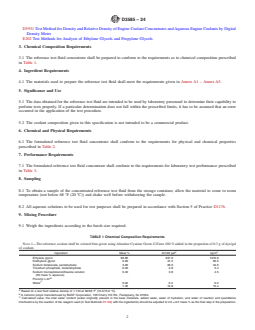
3.1 The reference test fluid concentrate shall be prepared to conform to the requirements as to chemical composition prescribed
in Table 1.
4. Ingredient Requirements
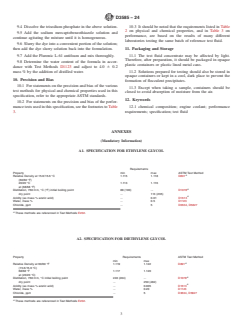
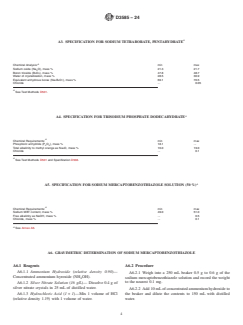
4.1 The materials used to prepare the reference test fluid shall meet the requirements given in Annex A1 – Annex A5.
5. Significance and Use
5.1 The data obtained for the reference test fluid are intended to be used by laboratory personnel to determine their capability to
perform tests properly. If a particular determination does not fall within the prescribed limits, it has to be assumed that an error
occurred in the application of the test procedure.
5.2 The coolant composition given in this specification is not intended to be a commercial product.
6. Chemical and Physical Requirements
6.1 The formulated reference test fluid concentrate shall conform to the requirements for physical and chemical properties
prescribed in Table 2.
7. Performance Requirements
7.1 The formulated reference test fluid concentrate shall conform to the requirements for laboratory test performance prescribed
in Table 3.
8. Sampling
8.1 To obtain a sample of the concentrated reference test fluid from the storage container, allow the material to come to room
temperature (not below 68 °F (20 °C)) and shake well before withdrawing the sample.
8.2 All aqueous solutions to be used for test purposes shall be prepared in accordance with Section 5 of Practice D1176.
9. Mixing Procedure
9.1 Weigh the ingredients according to the batch size required.
TABLE 1 Chemical Composition Requirements
NOTE 1—The reference coolant shall be colored blue-green using Alizarine Cyanine Green G Extra 100 % added in the proportion of 0.3 g of dye/gal
of coolant.
A 3
Ingredient Mass % lb/100 gal kg/m
Ethylene glycol 89.86 847.9 1016.0
Diethylene glycol 5.00 47.2 56.5
Sodium tetraborate, pentahydrate 3.06 28.9 34.6
Trisodium phosphate, dodecahydrate 0.30 2.8 3.4
Sodium mercaptobenzothiazole solution 0.40 3.8 4.5
(50 mass % aqueous)
B
Pluronic L-61
C
Water 0.02 0.2 0.2
1.36 12.8 15.4
A
Based on a test fluid relative density of 1.133 at 60/60 °F (15.5/15.5 °C).
B
A nonionic polyol manufactured by BASF Corporation, 100 Cherry Hill Rd., Parsippany, NJ 07054.
C
Calculated value; the total water content (water originally present in the base materials, added water, water of hydration, and water of reaction and quantitative
interference by the reaction of the reagent used (in Test Methods D1123) with the ingredients) should be adjusted to 4.0 ± 0.2 mass % as the final step in the preparation.
D3585 − 24
TABLE 2 Physical and Chemical Requirements
Requirements
Property ASTM Test Method
min max
pH, concentrate 6.1 6.3 D1287
33 volume % solution 7.7 8.0
50 volume % solution 7.5 7.8
Reserve alkalinity, mL 26.5 27.5 D1121
Water content, weight % 3.8 4.2 D1123
Freezing protection: D1177
Concentrate −23 °C (−9 °F) −25 °C (−13 °F)
33 volume % solution −18 °C (0 °F) −19 °C (−2 °F)
50 volume % solution −36 °C (−33 °F) −38 °C (−36 °F)
Relative Density at 15.6 °C 1.131 1.134 D1122, D5931
at 20 °C 1.129 1.132 D891
Boiling point, °C (°F) 330 (166) 340 (171) D1120
Boiling point 166 °C (330 °F) 171 °C (340 °F) D1120
Ash, weight % 1.4 1.6 D1119
Chloride, ppm − 25 D3634, D5827
A
TABLE 3 Performance Requirements
Mass Loss, max,
Test ASTM Test Method
B
mg/Specimen
Corrosion in glassware D1384
Copper 5
Solder 5
Brass 5
Steel 5
Cast iron 5
Aluminum 15
C
Foaming volume 75 mL, max D1881
D
break time 5 s, max
A
Average data for triplicate tests.
B
The multilaboratory standard deviation has been found to be 1.8 mg for all metals
that lose an average of less than 3 mg per specimen. Therefore, results of two
properly conducted tests from two different laboratories on samples of the same lot
of reference test fluid should not differ by more than 4.1 mg, provided the avera
...