


ASTM D2225-20
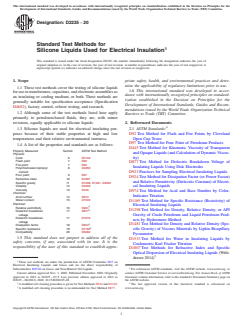
(Test Method)Standard Test Methods for Silicone Liquids Used for Electrical Insulation
Standard Test Methods for Silicone Liquids Used for Electrical Insulation
SIGNIFICANCE AND USE
4.1 Tests covered in this standard may be used for quality control and design considerations.
4.2 Included in each test method is a brief statement describing its significance.
SCOPE
1.1 These test methods cover the testing of silicone liquids for use in transformers, capacitors, and electronic assemblies as an insulating or cooling medium, or both. These methods are generally suitable for specification acceptance (Specification D4652), factory control, referee testing, and research.
1.2 Although some of the test methods listed here apply primarily to petroleum-based fluids, they are, with minor revisions, equally applicable to silicone liquids.
1.3 Silicone liquids are used for electrical insulating purposes because of their stable properties at high and low temperatures and their relative environmental inertness.
1.4 A list of the properties and standards are as follows:
Property Measured
Section
ASTM Test Method
Physical:
Color
6
D2129
Flash point
7
D92
Fire point
7
D92
Polychlorinated biphenyl
content
8
D4059
Pour point
9
D97
Refractive index
10
D1807
Specific gravity
11
D1298, D1481, D4052
Volatility
12
D4559
Viscosity
13
D445
Chemical:
Acid number
14
D974
Water content
15
D1533
Electrical:
Relative permittivity
16
D9242
Dielectric breakdown
voltage
17
D8773
Dielectric breakdown
voltage
17
D1816
Dissipation factor
18
D9242
Specific resistance
19
D11692
Compatibility
20
D5282
1.5 This standard does not purport to address all of the safety concerns, if any, associated with its use. It is the responsibility of the user of this standard to establish appropriate safety, health, and environmental practices and determine the applicability of regulatory limitations prior to use.
1.6 This international standard was developed in accordance with internationally recognized principles on standardization established in the Decision on Principles for the Development of International Standards, Guides and Recommendations issued by the World Trade Organization Technical Barriers to Trade (TBT) Committee.
General Information
- Status
- Published
- Publication Date
- 31-Oct-2020
- Technical Committee
- D27 - Electrical Insulating Liquids and Gases
- Drafting Committee
- D27.02 - Gases and Non-Mineral Oil Liquids
Relations
- Effective Date
- 01-Apr-2024
- Effective Date
- 01-Dec-2023
- Effective Date
- 01-Dec-2023
- Effective Date
- 01-Nov-2023
- Effective Date
- 01-Oct-2019
- Effective Date
- 01-Oct-2019
- Effective Date
- 01-Apr-2019
- Effective Date
- 01-Dec-2018
- Effective Date
- 01-Jun-2017
- Effective Date
- 01-Mar-2017
- Effective Date
- 01-Feb-2017
- Effective Date
- 01-Jan-2017
- Effective Date
- 15-Dec-2016
- Effective Date
- 01-Oct-2015
- Effective Date
- 01-Dec-2014
Overview
ASTM D2225-20 is the internationally recognized standard for test methods related to silicone liquids used for electrical insulation. Published by ASTM International, this standard details comprehensive procedures to assess the critical physical, chemical, and electrical properties of silicone insulating liquids used in transformers, capacitors, and electronic assemblies. Silicone liquids are valued in electrical applications for their thermal stability, dielectric strength, and chemical inertness across a broad temperature range. This standard is essential for quality control, specification acceptance, production consistency, research, and referee testing of silicone-based insulating fluids.
Key Topics
- Physical Properties:
- Color, flash and fire point, polychlorinated biphenyl (PCB) content, pour point, refractive index, specific gravity, volatility, and viscosity.
- Chemical Properties:
- Neutralization (acid) number and water content.
- Electrical Properties:
- Relative permittivity (dielectric constant), dielectric breakdown voltage, dissipation (power) factor, and specific resistance (resistivity).
- Compatibility Testing:
- Evaluation of silicone liquids with construction materials used in electrical equipment to ensure operational safety and longevity.
- Significance and Use:
- Each test method includes a statement of significance, guiding practical application in quality assurance and design.
Referenced ASTM Test Methods:
- Examples include D445 for viscosity, D877 and D1816 for dielectric breakdown voltage, D924 for dissipation factor and relative permittivity, D1533 for water content, and D5282 for compatibility.
Applications
Silicone liquids tested by ASTM D2225-20 play an integral role in:
- Transformers: Acting as both an electrical insulator and cooling medium, silicone fluids ensure thermal stability and reliable dielectric performance, even under high-stress conditions or fluctuating temperatures.
- Capacitors: Maintaining insulation and preventing electrical breakdown, especially in high-voltage or temperature-sensitive environments.
- Electronic Assemblies: Providing both coolant and electrical insulation, essential for sensitive or compact electronic components.
- Quality Control & Specification Acceptance: Ensuring that batches of silicone liquid meet industry specifications and remain free from contamination, thereby preventing operational failures.
- Research and Development: Facilitating the comparison of silicone liquids with petroleum-based fluids (which these methods also support with minor modification) and innovation in insulation materials.
- Environmental and Regulatory Compliance: Verifying low PCB content and environmental inertness for safe use and disposal, in accordance with local and international guidelines.
Related Standards
Users and manufacturers frequently consult these related ASTM standards for context and compliance:
- ASTM D4652 - Specification for Silicone Liquid Used for Electrical Insulation
- ASTM D445 - Test Method for Kinematic Viscosity of Transparent and Opaque Liquids
- ASTM D877 and D1816 - Test Methods for Dielectric Breakdown Voltage of Insulating Liquids
- ASTM D924 - Test Method for Dissipation and Permittivity
- ASTM D1533 - Test Method for Water in Insulating Liquids
- ASTM D5282 - Compatibility Test Methods for Silicone Fluid Used in Electrical Insulation
Practical Value
Adhering to ASTM D2225-20 ensures that silicone insulating liquids meet stringent safety, reliability, and performance specifications. This is crucial for equipment longevity, accident prevention, and regulatory adherence in electrical industries. Implementing these test methods helps manufacturers, utilities, and researchers maintain high-quality standards for insulating fluids, reduce risk of electrical failure, and enable robust product development for high-performance electrical systems.
Buy Documents

ASTM D2225-20 - Standard Test Methods for Silicone Liquids Used for Electrical Insulation
REDLINE ASTM D2225-20 - Standard Test Methods for Silicone Liquids Used for Electrical Insulation
Get Certified
Connect with accredited certification bodies for this standard

Intertek Testing Services NA Inc.
Intertek certification services in North America.

UL Solutions
Global safety science company with testing, inspection and certification.

ANCE
Mexican certification and testing association.
Sponsored listings
Frequently Asked Questions
ASTM D2225-20 is a standard published by ASTM International. Its full title is "Standard Test Methods for Silicone Liquids Used for Electrical Insulation". This standard covers: SIGNIFICANCE AND USE 4.1 Tests covered in this standard may be used for quality control and design considerations. 4.2 Included in each test method is a brief statement describing its significance. SCOPE 1.1 These test methods cover the testing of silicone liquids for use in transformers, capacitors, and electronic assemblies as an insulating or cooling medium, or both. These methods are generally suitable for specification acceptance (Specification D4652), factory control, referee testing, and research. 1.2 Although some of the test methods listed here apply primarily to petroleum-based fluids, they are, with minor revisions, equally applicable to silicone liquids. 1.3 Silicone liquids are used for electrical insulating purposes because of their stable properties at high and low temperatures and their relative environmental inertness. 1.4 A list of the properties and standards are as follows: Property Measured Section ASTM Test Method Physical: Color 6 D2129 Flash point 7 D92 Fire point 7 D92 Polychlorinated biphenyl content 8 D4059 Pour point 9 D97 Refractive index 10 D1807 Specific gravity 11 D1298, D1481, D4052 Volatility 12 D4559 Viscosity 13 D445 Chemical: Acid number 14 D974 Water content 15 D1533 Electrical: Relative permittivity 16 D9242 Dielectric breakdown voltage 17 D8773 Dielectric breakdown voltage 17 D1816 Dissipation factor 18 D9242 Specific resistance 19 D11692 Compatibility 20 D5282 1.5 This standard does not purport to address all of the safety concerns, if any, associated with its use. It is the responsibility of the user of this standard to establish appropriate safety, health, and environmental practices and determine the applicability of regulatory limitations prior to use. 1.6 This international standard was developed in accordance with internationally recognized principles on standardization established in the Decision on Principles for the Development of International Standards, Guides and Recommendations issued by the World Trade Organization Technical Barriers to Trade (TBT) Committee.
SIGNIFICANCE AND USE 4.1 Tests covered in this standard may be used for quality control and design considerations. 4.2 Included in each test method is a brief statement describing its significance. SCOPE 1.1 These test methods cover the testing of silicone liquids for use in transformers, capacitors, and electronic assemblies as an insulating or cooling medium, or both. These methods are generally suitable for specification acceptance (Specification D4652), factory control, referee testing, and research. 1.2 Although some of the test methods listed here apply primarily to petroleum-based fluids, they are, with minor revisions, equally applicable to silicone liquids. 1.3 Silicone liquids are used for electrical insulating purposes because of their stable properties at high and low temperatures and their relative environmental inertness. 1.4 A list of the properties and standards are as follows: Property Measured Section ASTM Test Method Physical: Color 6 D2129 Flash point 7 D92 Fire point 7 D92 Polychlorinated biphenyl content 8 D4059 Pour point 9 D97 Refractive index 10 D1807 Specific gravity 11 D1298, D1481, D4052 Volatility 12 D4559 Viscosity 13 D445 Chemical: Acid number 14 D974 Water content 15 D1533 Electrical: Relative permittivity 16 D9242 Dielectric breakdown voltage 17 D8773 Dielectric breakdown voltage 17 D1816 Dissipation factor 18 D9242 Specific resistance 19 D11692 Compatibility 20 D5282 1.5 This standard does not purport to address all of the safety concerns, if any, associated with its use. It is the responsibility of the user of this standard to establish appropriate safety, health, and environmental practices and determine the applicability of regulatory limitations prior to use. 1.6 This international standard was developed in accordance with internationally recognized principles on standardization established in the Decision on Principles for the Development of International Standards, Guides and Recommendations issued by the World Trade Organization Technical Barriers to Trade (TBT) Committee.
ASTM D2225-20 is classified under the following ICS (International Classification for Standards) categories: 29.040.10 - Insulating oils. The ICS classification helps identify the subject area and facilitates finding related standards.
ASTM D2225-20 has the following relationships with other standards: It is inter standard links to ASTM D445-24, ASTM D924-23, ASTM D923-15(2023), ASTM D445-23, ASTM D1169-19a, ASTM D1816-12(2019), ASTM D1169-19, ASTM D4059-00(2018), ASTM D1481-17, ASTM D2864-17a, ASTM D2864-17, ASTM D2129-17, ASTM D445-16, ASTM D923-15, ASTM D974-14e1. Understanding these relationships helps ensure you are using the most current and applicable version of the standard.
ASTM D2225-20 is available in PDF format for immediate download after purchase. The document can be added to your cart and obtained through the secure checkout process. Digital delivery ensures instant access to the complete standard document.
Standards Content (Sample)
This international standard was developed in accordance with internationally recognized principles on standardization established in the Decision on Principles for the
Development of International Standards, Guides and Recommendations issued by the World Trade Organization Technical Barriers to Trade (TBT) Committee.
Designation: D2225 − 20
Standard Test Methods for
Silicone Liquids Used for Electrical Insulation
This standard is issued under the fixed designation D2225; the number immediately following the designation indicates the year of
original adoption or, in the case of revision, the year of last revision. A number in parentheses indicates the year of last reapproval. A
superscript epsilon (´) indicates an editorial change since the last revision or reapproval.
1. Scope priate safety, health, and environmental practices and deter-
mine the applicability of regulatory limitations prior to use.
1.1 These test methods cover the testing of silicone liquids
1.6 This international standard was developed in accor-
foruseintransformers,capacitors,andelectronicassembliesas
dance with internationally recognized principles on standard-
an insulating or cooling medium, or both. These methods are
ization established in the Decision on Principles for the
generally suitable for specification acceptance (Specification
Development of International Standards, Guides and Recom-
D4652), factory control, referee testing, and research.
mendations issued by the World Trade Organization Technical
1.2 Although some of the test methods listed here apply
Barriers to Trade (TBT) Committee.
primarily to petroleum-based fluids, they are, with minor
revisions, equally applicable to silicone liquids. 2. Referenced Documents
1.3 Silicone liquids are used for electrical insulating pur- 2.1 ASTM Standards:
poses because of their stable properties at high and low D92 Test Method for Flash and Fire Points by Cleveland
temperatures and their relative environmental inertness. Open Cup Tester
D97 Test Method for Pour Point of Petroleum Products
1.4 A list of the properties and standards are as follows:
D445 Test Method for Kinematic Viscosity of Transparent
Property Measured Section ASTM Test Method
and Opaque Liquids (and Calculation of Dynamic Viscos-
Physical:
Color 6 D2129 ity)
Flash point 7 D92
D877 Test Method for Dielectric Breakdown Voltage of
Fire point 7 D92
Insulating Liquids Using Disk Electrodes
Polychlorinated biphenyl 8 D4059
content
D923 Practices for Sampling Electrical Insulating Liquids
Pour point 9 D97
D924 Test Method for Dissipation Factor (or Power Factor)
Refractive index 10 D1807
and Relative Permittivity (Dielectric Constant) of Electri-
Specific gravity 11 D1298, D1481, D4052
Volatility 12 D4559 cal Insulating Liquids
Viscosity 13 D445
D974 Test Method for Acid and Base Number by Color-
Chemical:
Indicator Titration
Acid number 14 D974
Water content 15 D1533 D1169 Test Method for Specific Resistance (Resistivity) of
Electrical:
Electrical Insulating Liquids
Relative permittivity 16 D924
3 D1298 Test Method for Density, Relative Density, or API
Dielectric breakdown 17 D877
voltage
Gravity of Crude Petroleum and Liquid Petroleum Prod-
Dielectric breakdown 17 D1816
ucts by Hydrometer Method
voltage
D1481 Test Method for Density and Relative Density (Spe-
Dissipation factor 18 D924
Specific resistance 19 D1169
cific Gravity) of Viscous Materials by Lipkin Bicapillary
Compatibility 20 D5282
Pycnometer
1.5 This standard does not purport to address all of the
D1533 Test Method for Water in Insulating Liquids by
safety concerns, if any, associated with its use. It is the
Coulometric Karl Fischer Titration
responsibility of the user of this standard to establish appro-
D1807 Test Methods for Refractive Index and Specific
Optical Dispersion of Electrical Insulating Liquids (With-
drawn 2014)
These test methods are under the jurisdiction of ASTM Committee D27 on
Electrical Insulating Liquids and Gases and are the direct responsibility of
Subcommittee D27.02 on Gases and Non-Mineral Oil Liquids. For referenced ASTM standards, visit the ASTM website, www.astm.org, or
Current edition approved Nov. 1, 2020. Published November 2020. Originally contact ASTM Customer Service at service@astm.org. For Annual Book of ASTM
approved in 1963 as D2225 – 63 T. Last previous edition approved in 2012 as Standards volume information, refer to the standard’s Document Summary page on
D2225 – 04(2012). DOI: 10.1520/D2225-20. the ASTM website.
2 5
Amodified cell cleaning procedure is given forTest Methods D924 and D1169. The last approved version of this historical standard is referenced on
A modified cell cleaning procedure is recommended for Test Method D877. www.astm.org.
Copyright © ASTM International, 100 Barr Harbor Drive, PO Box C700, West Conshohocken, PA 19428-2959. United States
D2225 − 20
D1816 Test Method for Dielectric Breakdown Voltage of PHYSICAL METHODS
Insulating Liquids Using VDE Electrodes
D2129 Test Method for Color of Clear Electrical Insulating
6. Color
Liquids (Platinum-Cobalt Scale)
6.1 Significance—The chief significance of color as applied
D2864 Terminology Relating to Electrical Insulating Liq-
to silicone liquid lies in the fact that if the liquid is colored,
uids and Gases
some degree of contamination exists that may affect the
D4052 Test Method for Density, Relative Density, and API
physical, chemical, and electrical properties of the liquid.
Gravity of Liquids by Digital Density Meter
6.2 Procedure—Determine the color in accordance with
D4059 Test Method for Analysis of Polychlorinated Biphe-
Test Method D2129.
nyls in Insulating Liquids by Gas Chromatography
D4559 Test Method for Volatile Matter in Silicone Fluid
7. Flash and Fire Points
D4652 Specification for Silicone Liquid Used for Electrical
Insulation
7.1 Significance—The flash point of a silicone insulating
D5282 Test Methods for Compatibility of Construction Ma-
liquid indicates the limit to which the material may be heated,
terial with Silicone Fluid Used for Electrical Insulation
under the specified test conditions, before the emitted vapors
form a flammable mixture in air. The fire point of a silicone
3. Terminology
insulating liquid indicates the limit to which the material may
be heated, under specified conditions, in which ignition is
3.1 Definitions:
sustained for at least 5 s. Unusually low flash or fire points for
3.1.1 fire point—the temperature at which oil first ignites
a given product may indicate contamination.
and burns for at least 5 s when a small test flame is passed
across the surface under specified conditions. 7.2 Procedure—Determine the flash and fire points in ac-
cordance with Test Method D92.
3.1.2 flash point—the temperature at which vapors above
the oil surface first ignite when a small test flame is passed
8. Polychlorinated Biphenyl Content
across the surface under specified conditions.
8.1 Scope:
3.1.3 refractive index—the ratio of the velocity of light (of a
8.1.1 Test Method D4059—describes a quantitative tech-
specified wavelength) in air at 25°C to its velocity in the
nique for determining the concentration of polychlorinated
substance under test.
biphenyls (PCB’s) in electrical insulating liquids.
3.1.4 specific gravity—the ratio of weight of a given volume
8.2 Definition:
of material to the weight of an equal volume of water. In this
8.2.1 PCB concentration—is normally expressed in units of
method, both weights are corrected to weight in vacuum, and
mg/kg on a weight by weight basis. Standard chromatograms
thematerialisat25°Cusinghydrometerscalibratedat60/60°F.
of Aroclors 1242, 1254, and 1260 are used to determine the
3.1.5 volatility—the weight percent of liquid lost when a
concentration of PCB in the sample.
specified weight of liquid is held at a specified elevated
8.3 Summary of Test Method—Following dilution of the
temperature for a specific period of time.
sample in a suitable solvent, the solution is treated to remove
3.1.6 water content—theamountofwater(mg/kg)dissolved
interfering substances. A small portion is then injected into a
in the liquid.
packedgaschromatographiccolumnwherethecomponentsare
separated and their presence measured by an electron capture
3.1.7 For additional terms refer to Terminology D2864.
or halogen-specific electrolytic conductivity detector. The
method is made quantitative by comparing the response of a
4. Significance and Use
sample to that of a known quantity of one or more standard
4.1 Tests covered in this standard may be used for quality
Aroclors obtained under the same conditions.
control and design considerations.
8.4 Significance and Use—National, state, and local regula-
4.2 Included in each test method is a brief statement
tions require that electrical apparatus and electrical insulating
describing its significance.
liquids containing PCB be handled and disposed of through the
use of specific procedures as determined by the PCB content of
5. Sampling
the liquid. The results of this test method can be useful in
selecting appropriate handling and disposal procedures.
5.1 Accurate sampling, whether of the complete contents or
only parts thereof, is extremely important from the standpoint
9. Pour Point
of evaluation of the quality of the product sampled. Obviously,
examination of a sample that because of careless sampling
9.1 Significance— The pour point is important as an index
procedure or contamination in the sampling equipment is not
of the lowest temperature to which the material may be cooled
directly representative, leads to erroneous conclusions con-
without seriously limiti
...
This document is not an ASTM standard and is intended only to provide the user of an ASTM standard an indication of what changes have been made to the previous version. Because
it may not be technically possible to adequately depict all changes accurately, ASTM recommends that users consult prior editions as appropriate. In all cases only the current version
of the standard as published by ASTM is to be considered the official document.
Designation: D2225 − 04 (Reapproved 2012) D2225 − 20
Standard Test Methods for
Silicone FluidsLiquids Used for Electrical Insulation
This standard is issued under the fixed designation D2225; the number immediately following the designation indicates the year of
original adoption or, in the case of revision, the year of last revision. A number in parentheses indicates the year of last reapproval. A
superscript epsilon (´) indicates an editorial change since the last revision or reapproval.
1. Scope
1.1 These test methods cover the testing of silicone fluidsliquids for use in transformers, capacitors, and electronic assemblies as
an insulating or cooling medium, or both. These methods are generally suitable for specification acceptance, acceptance
(Specification D4652), factory control, referee testing, and research.
1.2 Although some of the test methods listed here apply primarily to petroleum-based fluids, they are, with minor revisions,
equally applicable to silicone fluids.liquids.
1.3 Silicone fluidsliquids are used for electrical insulating purposes because of their stable properties at high and low temperatures
and their relative environmental inertness.
1.4 A list of the properties and standards are as follows:
Property Measured Section ASTM Test Method
Physical:
Color 6 D2129
Flash point 7 D92
Fire point 7 D92
Polychlorinated biphenyl 8 D4059
content
Pour point 9 D97
Refractive index 10 D1807
Specific gravity 11 D1298, D1481, D4052
Volatility 12 D4559
Viscosity 13 D445, D2161
Viscosity 13 D445
Chemical:
Neutralization number 14 D974
Acid number 14 D974
Water content 15 D1533
Electrical:
Relative permittivity 16 D924
Dielectric breakdown 17 D877
voltage
Dielectric breakdown 17 D1816
voltage
Dissipation factor 18 D924
These test methods are under the jurisdiction of ASTM Committee D27 on Electrical Insulating Liquids and Gases and are the direct responsibility of Subcommittee
D27.02 on Gases and Non-Mineral Oil Liquids.
Current edition approved May 1, 2012Nov. 1, 2020. Published May 2012November 2020. Originally approved in 1963 as D2225 – 63 T. Last previous edition approved
in 20042012 as D2225 – 04.D2225 – 04(2012). DOI: 10.1520/D2225-04R12.10.1520/D2225-20.
A modified cell cleaning procedure is given for Test Methods D924 and D1169.
A modified cell cleaning procedure is recommended for Test Method D877.
Copyright © ASTM International, 100 Barr Harbor Drive, PO Box C700, West Conshohocken, PA 19428-2959. United States
D2225 − 20
Specific resistance 19 D1169
Compatibility 20 D5282
1.5 This standard does not purport to address all of the safety concerns, if any, associated with its use. It is the responsibility
of the user of this standard to establish appropriate safety safety, health, and healthenvironmental practices and determine the
applicability of regulatory limitations prior to use.
1.6 This international standard was developed in accordance with internationally recognized principles on standardization
established in the Decision on Principles for the Development of International Standards, Guides and Recommendations issued
by the World Trade Organization Technical Barriers to Trade (TBT) Committee.
2. Referenced Documents
2.1 ASTM Standards:
D92 Test Method for Flash and Fire Points by Cleveland Open Cup Tester
D97 Test Method for Pour Point of Petroleum Products
D445 Test Method for Kinematic Viscosity of Transparent and Opaque Liquids (and Calculation of Dynamic Viscosity)
D877 Test Method for Dielectric Breakdown Voltage of Insulating Liquids Using Disk Electrodes
D923 Practices for Sampling Electrical Insulating Liquids
D924 Test Method for Dissipation Factor (or Power Factor) and Relative Permittivity (Dielectric Constant) of Electrical
Insulating Liquids
D974 Test Method for Acid and Base Number by Color-Indicator Titration
D1169 Test Method for Specific Resistance (Resistivity) of Electrical Insulating Liquids
D1298 Test Method for Density, Relative Density, or API Gravity of Crude Petroleum and Liquid Petroleum Products by
Hydrometer Method
D1481 Test Method for Density and Relative Density (Specific Gravity) of Viscous Materials by Lipkin Bicapillary Pycnometer
D1533 Test Method for Water in Insulating Liquids by Coulometric Karl Fischer Titration
D1807 Test Methods for Refractive Index and Specific Optical Dispersion of Electrical Insulating Liquids (Withdrawn 2014)
D1816 Test Method for Dielectric Breakdown Voltage of Insulating Liquids Using VDE Electrodes
D2129 Test Method for Color of Clear Electrical Insulating Liquids (Platinum-Cobalt Scale)
D2161 Practice for Conversion of Kinematic Viscosity to Saybolt Universal Viscosity or to Saybolt Furol Viscosity
D2864 Terminology Relating to Electrical Insulating Liquids and Gases
D4052 Test Method for Density, Relative Density, and API Gravity of Liquids by Digital Density Meter
D4059 Test Method for Analysis of Polychlorinated Biphenyls in Insulating Liquids by Gas Chromatography
D4559 Test Method for Volatile Matter in Silicone Fluid
D4652 Specification for Silicone Liquid Used for Electrical Insulation
D5282 Test Methods for Compatibility of Construction Material with Silicone Fluid Used for Electrical Insulation
3. Terminology
3.1 Definitions:
3.1.1 fire point—the temperature at which oil first ignites and burns for at least 5 s when a small test flame is passed across the
surface under specified conditions.
3.1.2 flash point—the temperature at which vapors above the oil surface first ignite when a small test flame is passed across the
surface under specified conditions.
3.1.3 refractive index—the ratio of the velocity of light (of a specified wavelength) in air at 25°C to its velocity in the substance
under test.
3.1.4 specific gravity—the ratio of weight of a given volume of material to the weight of an equal volume of water. In this method,
both weights are corrected to weight in vacuum, and the material is at 25°C using hydrometers calibrated at 60/60°F.
3.1.5 volatility—the weight percent of liquid lost when a specified weight of liquid is held at a specified elevated temperature for
a specific period of time.
For referenced ASTM standards, visit the ASTM website, www.astm.org, or contact ASTM Customer Service at service@astm.org. For Annual Book of ASTM Standards
volume information, refer to the standard’s Document Summary page on the ASTM website.
The last approved version of this historical standard is referenced on www.astm.org.
D2225 − 20
3.1.6 water content—the amount of water (mg/kg) dissolved in the liquid.
3.1.7 For additional terms refer to Terminology D2864.
4. Significance and Use
4.1 Tests covered in this standard may be used for quality control and design considerations.
4.2 Included in each test method is a brief statement describing its significance.
5. Sampling
5.1 Accurate sampling, whether of the complete contents or only parts thereof, is extremely important from the standpoint of
elevationevaluation of the quality of the product sampled. Obviously, examination of a sample that because of careless sampling
procedure or contamination in the sampling equipment is not directly representative, leads to erroneous conclusions concerning
quality.
5.2 Sample the silicone fluid in accordance with Test Methods Practices D923.
PHYSICAL METHODS
6. Color
6.1 Significance— The chief significance of color as applied to silicone fluidliquid lies in the fact that if the fluidliquid is colored,
some degree of contamination exists that may affect the physical, chemical, and electrical properties of the fluid.liquid.
6.2 Procedure—Determine the color in accordance with Test Method D2129.
7. Flash and Fire Points
7.1 Significance—The flash and fire points point of a silicone insulating fluidliquid indicates the limit to which the material may
be heated, under the specified test conditions, before the emitted vapors form a flammable mixture in air. The fire point of a silicone
insulating liquid indicates the limit to which the material may be heated, under specified conditions, in which ignition is sustained
for at least 5 s. Unusually low flash or fire points for a given product may indicate contamination.
7.2 Procedure—Determine the flash and fire points in accordance with Test Method D92.
8. Polychlorinated Biphenyl Content
8.1 Scope:
8.1.1 Test Method D4059—describes a quantitative technique for determining the concentration of polychlorinated biphenyls
(PCB’s) in electrical insulating liquids.
8.2 Definition:
8.2.1 PCB concentration—is normally expressed in units of parts per million (PPM) mg/kg on a weight by weight basis. Standard
chromatograms of Aroclors 1242, 1254, and 1260 are used to determine the concentration of PCB in the sample.
8.3 Summary of Test Method—Following dilution of the sample in a suitable solvent, the solution is treated to remove interfering
substances. A small portion is then injected into a packed gas chromatographic column where the components are separated and
their presence measured by an electron capture or halogen-specific electrolytic conductivity detection.detector. The method is made
quantitative by comparing the response of a sample to that of a known quantity of one or more standard Aroclors obtained under
the same conditions.
D2225 − 20
8.4 Significance and Use—United States National, state, and local regulations require that electrical apparatus and electrical
insulating fluidsliquids containing PCB be handled and disposed of through the use of specific procedures as determined by the
PCB content of the fluid.liquid. The results of this test method can be useful in sel
...
Questions, Comments and Discussion
Ask us and Technical Secretary will try to provide an answer. You can facilitate discussion about the standard in here.
Loading comments...