

ASTM D7817-12(2021)
(Test Method)Standard Test Method for Enumeration of Yeast and Mold in Raceway Brine, Brine-Cured Hides and Skins
General Information
- Abstract
SIGNIFICANCE AND USE
4.1 This test method enumerates salt tolerant yeast and mold, and under the conditions of this test method those are equated as halophilic organisms. Salt tolerant yeast and mold have been known to cause damage to hides and skins in raceway brine.
SCOPE
1.1 This test method covers the enumeration of yeast and mold. This test method is applicable to raceway brine, brine-cured hides and skins, and pre-charge raceway liquor.
1.2 The values stated in SI units are to be regarded as standard. No other units of measurement are included in this standard.
1.3 This standard does not purport to address all of the safety concerns, if any, associated with its use. It is the responsibility of the user of this standard to establish appropriate safety, health, and environmental practices and determine the applicability of regulatory limitations prior to use.
1.4 This international standard was developed in accordance with internationally recognized principles on standardization established in the Decision on Principles for the Development of International Standards, Guides and Recommendations issued by the World Trade Organization Technical Barriers to Trade (TBT) Committee.
- Status
- Published
- Publication Date
- 31-Aug-2021
- Technical Committee
- D31 - Leather
- Drafting Committee
- D31.02 - Wet Blue

Overview
ASTM D7817-12(2021) is a standardized test method established by ASTM International for the enumeration of yeast and mold in raceway brine, brine-cured hides and skins, and pre-charge raceway liquor. The method is specifically designed to detect and quantify salt tolerant (halophilic) yeast and mold that can cause spoilage and deterioration of hides and skins during the brining process. By following this standardized procedure, laboratories and quality assurance teams can reliably assess microbial contamination, thereby supporting effective preservation and quality control within the leather and hide processing industries.
Key Topics
Scope and Applicability
- The method covers yeast and mold enumeration in samples from raceway brines, brine-cured hides and skins, and analogous saline liquors.
- Only SI units are used for all measurements.
Significance
- Salt tolerant yeast and mold are recognized as major contributors to the spoilage of brined hides and skins, leading to substantial material loss.
- Proper enumeration helps monitor and control microbial populations, protecting product value.
Test Procedure Highlights
- Samples are serially diluted and plated on agar containing 7% NaCl and specific antibiotics to inhibit non-target organisms.
- Incubation is conducted at 20–25 °C for 5 days to allow for the growth and subsequent enumeration of yeast and mold colonies.
- Results are recorded as colony-forming units (cfu) per gram of sample, differentiating yeast from mold.
Precision and Quality Control
- The method's repeatability has been evaluated to ensure consistent results within a laboratory setting.
- It is the user’s responsibility to implement appropriate safety, health, and environmental practices in accordance with regulatory requirements.
Applications
The ASTM D7817-12(2021) standard is vital for several stakeholders in the leather, hides, and skin processing industries:
Quality Assurance and Control
- Evaluate the effectiveness of brining operations in inhibiting spoilage microorganisms.
- Monitor microbial contamination to prevent economic loss due to spoilage.
Process Optimization
- Support the development and adjustment of brining processes to minimize microbial growth.
- Assess the impact of process variations or additives on microbial stability.
Regulatory Compliance
- Provide documented evidence of microbial control for industry audits and inspections.
- Support environmental and safety reporting related to hide and skin preservation.
Research and Development
- Facilitate studies aimed at identifying new preservation methods or improvements in salt curing.
Related Standards
- ASTM D6715 - Practice for Sampling and Preparation of Fresh or Salt-Preserved (Cured) Hides and Skins for Chemical and Physical Tests. This standard outlines general sampling procedures applicable when preparing hides and skins for microbial analysis.
- ASTM E691 - Practice for Conducting an Interlaboratory Study to Determine the Precision of a Test Method. Offers guidance on evaluating test method repeatability and reproducibility.
- ASTM E177 - Practice for Use of the Terms Precision and Bias in ASTM Test Methods. Defines key statistical concepts for quality in test results.
Keywords: yeast enumeration, mold detection, raceway brine, brine-cured hides, brine-cured skins, salt tolerant yeast, halophilic organisms, microbial contamination, ASTM D7817-12, leather industry, quality control, preservation of hides, standard test method.
Relations
- Effective Date
- 01-Apr-2020
- Effective Date
- 01-May-2014
- Effective Date
- 01-May-2013
- Effective Date
- 01-May-2013
- Effective Date
- 01-May-2013
- Effective Date
- 01-Nov-2011
- Effective Date
- 01-Oct-2010
- Effective Date
- 01-Oct-2008
- Effective Date
- 01-Oct-2008
- Effective Date
- 01-Sep-2008
- Effective Date
- 01-Sep-2007
- Refers
ASTM E177-06b - Standard Practice for Use of the Terms Precision and Bias in ASTM Test Methods - Effective Date
- 15-Nov-2006
- Refers
ASTM E177-06a - Standard Practice for Use of the Terms Precision and Bias in ASTM Test Methods - Effective Date
- 01-Nov-2006
- Effective Date
- 01-Nov-2005
- Effective Date
- 01-Nov-2004
Frequently Asked Questions
ASTM D7817-12(2021) is a standard published by ASTM International. Its full title is "Standard Test Method for Enumeration of Yeast and Mold in Raceway Brine, Brine-Cured Hides and Skins". This standard covers: SIGNIFICANCE AND USE 4.1 This test method enumerates salt tolerant yeast and mold, and under the conditions of this test method those are equated as halophilic organisms. Salt tolerant yeast and mold have been known to cause damage to hides and skins in raceway brine. SCOPE 1.1 This test method covers the enumeration of yeast and mold. This test method is applicable to raceway brine, brine-cured hides and skins, and pre-charge raceway liquor. 1.2 The values stated in SI units are to be regarded as standard. No other units of measurement are included in this standard. 1.3 This standard does not purport to address all of the safety concerns, if any, associated with its use. It is the responsibility of the user of this standard to establish appropriate safety, health, and environmental practices and determine the applicability of regulatory limitations prior to use. 1.4 This international standard was developed in accordance with internationally recognized principles on standardization established in the Decision on Principles for the Development of International Standards, Guides and Recommendations issued by the World Trade Organization Technical Barriers to Trade (TBT) Committee.
SIGNIFICANCE AND USE 4.1 This test method enumerates salt tolerant yeast and mold, and under the conditions of this test method those are equated as halophilic organisms. Salt tolerant yeast and mold have been known to cause damage to hides and skins in raceway brine. SCOPE 1.1 This test method covers the enumeration of yeast and mold. This test method is applicable to raceway brine, brine-cured hides and skins, and pre-charge raceway liquor. 1.2 The values stated in SI units are to be regarded as standard. No other units of measurement are included in this standard. 1.3 This standard does not purport to address all of the safety concerns, if any, associated with its use. It is the responsibility of the user of this standard to establish appropriate safety, health, and environmental practices and determine the applicability of regulatory limitations prior to use. 1.4 This international standard was developed in accordance with internationally recognized principles on standardization established in the Decision on Principles for the Development of International Standards, Guides and Recommendations issued by the World Trade Organization Technical Barriers to Trade (TBT) Committee.
ASTM D7817-12(2021) is classified under the following ICS (International Classification for Standards) categories: 07.100.99 - Other standards related to microbiology. The ICS classification helps identify the subject area and facilitates finding related standards.
ASTM D7817-12(2021) has the following relationships with other standards: It is inter standard links to ASTM D6715-13(2020), ASTM E177-14, ASTM E177-13, ASTM E691-13, ASTM D6715-13, ASTM E691-11, ASTM E177-10, ASTM E691-08, ASTM E177-08, ASTM D6715-08, ASTM D6715-01(2007), ASTM E177-06b, ASTM E177-06a, ASTM E691-05, ASTM E177-06. Understanding these relationships helps ensure you are using the most current and applicable version of the standard.
ASTM D7817-12(2021) is available in PDF format for immediate download after purchase. The document can be added to your cart and obtained through the secure checkout process. Digital delivery ensures instant access to the complete standard document.
Standards Content (Sample)
This international standard was developed in accordance with internationally recognized principles on standardization established in the Decision on Principles for the
Development of International Standards, Guides and Recommendations issued by the World Trade Organization Technical Barriers to Trade (TBT) Committee.
Designation: D7817 − 12 (Reapproved 2021)
Standard Test Method for
Enumeration of Yeast and Mold in Raceway Brine, Brine-
Cured Hides and Skins
This standard is issued under the fixed designation D7817; the number immediately following the designation indicates the year of
original adoption or, in the case of revision, the year of last revision.Anumber in parentheses indicates the year of last reapproval.A
superscript epsilon (´) indicates an editorial change since the last revision or reapproval.
1. Scope agarcontaining7%NaClandanantibioticsolution.Theplates
are incubated at 20–25 °C for 5 days.
1.1 This test method covers the enumeration of yeast and
mold. This test method is applicable to raceway brine, brine-
4. Significance and Use
cured hides and skins, and pre-charge raceway liquor.
4.1 This test method enumerates salt tolerant yeast and
1.2 The values stated in SI units are to be regarded as
mold, and under the conditions of this test method those are
standard. No other units of measurement are included in this
equated as halophilic organisms. Salt tolerant yeast and mold
standard.
have been known to cause damage to hides and skins in
1.3 This standard does not purport to address all of the
raceway brine.
safety concerns, if any, associated with its use. It is the
responsibility of the user of this standard to establish appro-
5. Apparatus
priate safety, health, and environmental practices and deter-
5.1 Incubator, 20–25 °C.
mine the applicability of regulatory limitations prior to use.
5.2 Colony counter—(not mandatory, but highly recom-
1.4 This international standard was developed in accor-
mended).
dance with internationally recognized principles on standard-
ization established in the Decision on Principles for the
5.3 Sterile pipets.
Development of International Standards, Guides and Recom-
5.4 Stomacher, for mixing initial dilution. (If stomacher is
mendations issued by the World Trade Organization Technical
unavailable, hand-mix.)
Barriers to Trade (TBT) Committee.
5.5 Balance.
2. Referenced Documents
5.6 Sterile petri dishes.
2.1 ASTM Standards:
5.7 Autoclave (sterilizer)—(Check the effectiveness of ster-
D6715Practice for Sampling and Preparation of Fresh or
ilizationweekly.Forexample,placesporesuspensionsorstrips
Salt-Preserved (Cured) Hides and Skins for Chemical and
of Bacillus stearothermophilus(commerciallyavailable)inside
Physical Tests
glassware for a full autoclave cycle. Follow manufacturer’s
E691Practice for Conducting an Interlaboratory Study to
directions for sterilization of specific media.)
Determine the Precision of a Test Method
5.8 pH meter.
E177Practice for Use of the Terms Precision and Bias in
ASTM Test Methods
5.9 Waterbath, 45 6 1 °C.
5.10 Stomacher bags, or sterile, sealable quart plastic bag
3. Summary of Test Method
(for example, food storage type, sterile bag).
3.1 Samples of brine-cured hides and skins, raceway brine,
5.11 Cutting tool, sterile (for example, scalpel blade and
or pre-charge raceway liquor are serially diluted and plated on
forcep, as needed for cutting cured hides and skins).
5.12 Vortex mixer, for mixing dilution tubes (optional).
ThistestmethodisunderthejurisdictionofASTMCommitteeD31onLeather 5.13 Autoclave thermometer.
and is the direct responsibility of Subcommittee D31.02 on Wet Blue.
Current edition approved Sept. 1, 2021. Published October 2021. Originally
6. Reagents and Materials
approved in 2012. Last previous edition approved in 2016 as D7817–12 (2016).
DOI: 10.1520/D7817-12R21.
6.1 Butterfield’s Phosphate Stock Solution—Dissolve 34 g
For referenced ASTM standards, visit the ASTM website, www.astm.org, or
KH PO (Potassium Phosphate monobasic) in 500 mL DI
2 4
contact ASTM Customer Service at service@astm.org. For Annual Book of ASTM
water.Adjust the pH to 7.2 6 0.1 with 1N – 6N NaOH. Bring
Standards volume information, refer to the standard’s Document Summary page on
the ASTM website. volume to 1 L with DI water. Sterilize for 15 min at 121 °C.
Copyright © ASTM International, 100 Barr Harbor Drive, PO Box C700, West Conshohocken, PA 19428-2959. United States
D7817 − 12 (2021)
NOTE 1—Typical autoclave setting is 120–124 °C. (See 5.7.)
9. Preparation of Potato Dextrose Agar and Antibiotic
Solution
6.2 Butterfield’s Phosphate Diluent with salt (BPD w/salt)—
Take 1.25 mL of Butterfield’s Phosphate Stock solution (6.1)
9.1 Prepare the antibiotic stock (10 000 ppm) solution by
andbringto1LwithDIwater,thenadd77gofsalt(NaCl)per
dissolving1gof chloramphenicol in 100 mLsterile deionized
litre prior to autoclaving. Dispense into 1-L bottles and 9-mL
or distilled water. Store this stock solution in a dark location at
dilution tubes. Sterilize for 15 min at 121 °C. (See Note 1.)
≤5 °C for up to two months.
6.3 Potato Dextrose Agar (PDA).
9.2 Suspend 39 g of Potato Dextrose Agar in 1 L of
deionized or distilled water and heat to boiling to dissolve
6.4 Antibiotic solution—(Chloramphenicol) – (needed to
inhibit bacterial growth on agar). completely.
6.5 Distilled or deionized water. 9.3 Add 77 g of NaCl per litre of agar. Add 10 mL of
chloramphenicol stock solution per litre of agar to give a
6.6 Salt (NaCl), Sodium chloride – reagent grade.
concentrationof100ppm.Sterilizeintheautoclavefor15min
6.7 1N – 6N NaOH.
at 121 °C. (See Note 1.) Cool to 45 6 1 °C in a waterbath.
6.8 Bacillus stearothermophilus spore suspensions or strips Once medium has been tempered, it can be held for 2–3 h
(commercially available), or equivalent. before use, provided the water level in the waterbath is 2–3
cm above the surface of the agar. Final pH of the agar: 5.6 6
7. Hazards
0.2.
7.1 Allreagentsandchemicalsshouldbehandledwithcare.
10. Procedure
Before using any chemical, read and follow all safety precau-
tions and instructions on the manufacturer’s label or MSDS
10.1 Using a sterile scalpel, aseptically weigh a 20 6 0.1 g
(Material Safety Data Sheet).
specimen in a sterile bag. For brine-cured hides and skins,
include both flesh and hair side.
8. Sampling
10.2 Add 180 g of BPD w/salt (6.2) diluent into the same
8.1 The specimen shall be sampled in accordance with
sterile bag (10.1). Stomach or hand-massage for 1 min. This
Practice D6715, and placed in sterile containers.
provides a 1:10 dilution.
-2 -3 -4
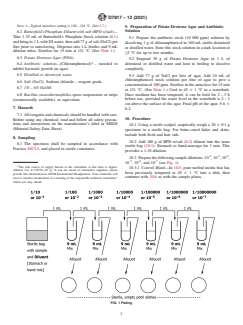
10.3 Preparethefollowingsampledilutions:10 ,10 ,10 ,
-5 -6 -7
10 ,10 , and 10 (see Fig. 1).
The sole source of supply known to the committee at this time is Sigma-
10.3.1 Control Blank—In 10.5, pour melted media that has
Aldrich, Cat. # C0378 (25 g). If you are aware of alternative suppliers, please
been previously tempered to 45 6 1 °C into a dish, then
provide this information toASTM International Headquarters.Your comments will
continue with 10.6 as with the sample plates.
receive careful consideration at a meeting of the responsible technical committee,
which you may attend.
FIG. 1 Plating
D7817 − 12 (2021)
-2 -1
Example:Toobtaina10 dilution,mixthe10 dilutionand where:
-1
pipet 1 mL of that 10 dilution into a 9-mL dilution tube.
A = number of colonies counted in step 10.10, and
NOTE 2—When transferring the aliquots between the tubes, the analyst
C = dilution factor (see Table 1).
must use a different pipet or pipet tip for each transfer.
Mold 5 B 3 C (2)
10.4 Pipet 1 mL of each dilution into the appropriate,
separate petri dishes.
where:
B = number of colonies counted in step 10.10, and
10.5 Pour prepared agar (9.3) that has been previously
C = dilution factor (see Table 1).
tempered to 4
...