

ASTM D5589-19
(Test Method)Standard Test Method for Determining the Resistance of Paint Films and Related Coatings to Algal Defacement
General Information
- Abstract
SIGNIFICANCE AND USE
4.1 Defacement of paint and coating films by algal growth is a common phenomenon under certain conditions. It is generally known that differences in the environment, lighting, temperature, substrate, and other factors in addition to the coating composition affect the susceptibility of a given painted surface. This test method attempts to provide a means to comparatively evaluate different coating formulations for their relative performance under a given set of conditions. It does not imply that a coating that resists growth under these conditions will necessarily resist growth in the actual application.
4.2 Familiarity with microbiological techniques is required. This test method should not be used by persons without at least basic microbiological training.
SCOPE
1.1 This test method covers an accelerated method for determining the relative resistance of a paint or coating film to algal growth.
Note 1: It is hoped that a ranking of relative performance would be similar to that ranked from outdoor exposures. However, this test method should not be used as a replacement for exterior exposure since many other factors, only a few of which are listed will affect those results.
Note 2: ASTM weathering standards are no longer referenced in this document, but Practices D822, D4141, D4587, D5031, and D6695 are commonly used.
1.2 The values stated in SI units are to be regarded as the standard. The values given in parentheses are for information only.
1.3 This standard does not purport to address all of the safety concerns, if any, associated with its use. It is the responsibility of the user of this standard to establish appropriate safety, health, and environmental practices and determine the applicability of regulatory limitations prior to use.
1.4 This international standard was developed in accordance with internationally recognized principles on standardization established in the Decision on Principles for the Development of International Standards, Guides and Recommendations issued by the World Trade Organization Technical Barriers to Trade (TBT) Committee.
- Status
- Published
- Publication Date
- 30-Nov-2019
- Technical Committee
- D01 - Paint and Related Coatings, Materials, and Applications
- Drafting Committee
- D01.28 - Biodeterioration
Buy Documents


ASTM D5589-19 - Standard Test Method for Determining the Resistance of Paint Films and Related Coatings to Algal Defacement
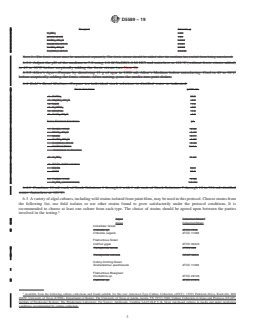
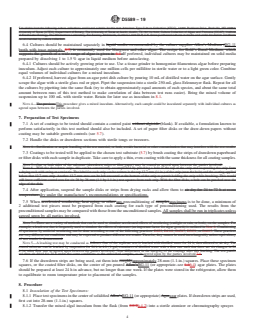
REDLINE ASTM D5589-19 - Standard Test Method for Determining the Resistance of Paint Films and Related Coatings to Algal Defacement
Overview
ASTM D5589-19 is the Standard Test Method for Determining the Resistance of Paint Films and Related Coatings to Algal Defacement. Issued by ASTM International, this standard provides a widely accepted laboratory procedure aimed at evaluating the comparative resistance of various paint and coating formulations to algal growth. Algal defacement is a common issue that affects the longevity and aesthetics of painted surfaces, especially in humid or outdoor environments. This accelerated test method provides a controlled means to assess how effectively a coating can withstand algal colonization under standardized conditions.
Key Topics
- Algal Resistance Testing: The standard describes methods to inoculate painted substrates with selected algae species and evaluates resulting growth over time.
- Accelerated Laboratory Simulation: Use of controlled environmental conditions (humidity, light, temperature) to mimic factors leading to algal growth, allowing comparison of coatings in a shorter timeframe compared to natural exposure.
- Microbiological Techniques: The method requires familiarity with basic microbiological procedures, including aseptic handling and culture maintenance.
- Performance Ranking: Provides a comparative framework for ranking different coatings by their susceptibility to algal defacement, helping stakeholders select the most suitable formulations for specific applications.
- Reporting and Evaluation: Specifies the procedures for sample preparation, incubation, assessment of algal growth, and documentation of test results.
Applications
ASTM D5589-19 is used primarily by manufacturers, researchers, and quality control professionals in the paint and coatings industry. Its applications include:
- Product Development: R&D teams utilize this standard to compare new additive formulations or paint systems for improved algal resistance, speeding up the evaluation process before moving to field trials.
- Quality Assurance: Production batches can be tested to ensure they meet predefined standards for algal resistance, helping maintain product performance and brand reputation.
- Specification Compliance: Architects, specifiers, and procurement professionals rely on D5589-19 to ensure contracted coatings offer expected resistance to algal growth, particularly for projects in humid or environmentally challenging locations.
- Research and Academic Use: The controlled, repeatable protocol serves academic laboratories or technical centers studying the interactions of coating materials and microbial organisms.
It's important to note that while ASTM D5589-19 provides useful comparative data, results may not directly translate to real-world outdoor conditions due to the complex interplay of environmental variables. Therefore, it is often used in conjunction with outdoor weathering tests or other exposure methods.
Related Standards
ASTM D5589-19 complements a variety of other ASTM practices and standard test methods related to paint durability and weathering:
- ASTM D822: Practice for Filtered Open-Flame Carbon-Arc Exposures of Paint and Related Coatings
- ASTM D4141: Practice for Conducting Black Box and Solar Concentrating Exposures of Coatings
- ASTM D4587: Practice for Fluorescent UV-Condensation Exposures of Paint and Related Coatings
- ASTM D5031: Practice for Enclosed Carbon-Arc Exposure Tests of Paint and Related Coatings
- ASTM D6695: Practice for Xenon-Arc Exposures of Paint and Related Coatings
Use of these related weathering standards in combination with ASTM D5589-19 enables a more comprehensive assessment of coating performance against environmental stressors such as sunlight, temperature fluctuations, and moisture, in addition to biological factors like algal growth.
Keywords: algal resistance, algae defacement, paint coatings, ASTM D5589-19, laboratory testing, accelerated exposure, weathering, microbiological testing, surface protection, coatings durability.
Relations
- Effective Date
- 01-Dec-2019
- Effective Date
- 01-Dec-2023
- Effective Date
- 01-Dec-2023
- Effective Date
- 01-Jun-2011
- Effective Date
- 01-Jun-2008
- Effective Date
- 01-Jul-2007
- Effective Date
- 01-Nov-2006
- Effective Date
- 01-Nov-2006
- Effective Date
- 01-Jul-2005
- Effective Date
- 10-Jul-2003
- Effective Date
- 10-Mar-2003
- Effective Date
- 10-Jan-2003
- Effective Date
- 10-Jul-2001
- Effective Date
- 10-Jul-2001
- Effective Date
- 10-Jul-2001
Buy Documents
ASTM D5589-19 - Standard Test Method for Determining the Resistance of Paint Films and Related Coatings to Algal Defacement
REDLINE ASTM D5589-19 - Standard Test Method for Determining the Resistance of Paint Films and Related Coatings to Algal Defacement
Frequently Asked Questions
ASTM D5589-19 is a standard published by ASTM International. Its full title is "Standard Test Method for Determining the Resistance of Paint Films and Related Coatings to Algal Defacement". This standard covers: SIGNIFICANCE AND USE 4.1 Defacement of paint and coating films by algal growth is a common phenomenon under certain conditions. It is generally known that differences in the environment, lighting, temperature, substrate, and other factors in addition to the coating composition affect the susceptibility of a given painted surface. This test method attempts to provide a means to comparatively evaluate different coating formulations for their relative performance under a given set of conditions. It does not imply that a coating that resists growth under these conditions will necessarily resist growth in the actual application. 4.2 Familiarity with microbiological techniques is required. This test method should not be used by persons without at least basic microbiological training. SCOPE 1.1 This test method covers an accelerated method for determining the relative resistance of a paint or coating film to algal growth. Note 1: It is hoped that a ranking of relative performance would be similar to that ranked from outdoor exposures. However, this test method should not be used as a replacement for exterior exposure since many other factors, only a few of which are listed will affect those results. Note 2: ASTM weathering standards are no longer referenced in this document, but Practices D822, D4141, D4587, D5031, and D6695 are commonly used. 1.2 The values stated in SI units are to be regarded as the standard. The values given in parentheses are for information only. 1.3 This standard does not purport to address all of the safety concerns, if any, associated with its use. It is the responsibility of the user of this standard to establish appropriate safety, health, and environmental practices and determine the applicability of regulatory limitations prior to use. 1.4 This international standard was developed in accordance with internationally recognized principles on standardization established in the Decision on Principles for the Development of International Standards, Guides and Recommendations issued by the World Trade Organization Technical Barriers to Trade (TBT) Committee.
SIGNIFICANCE AND USE 4.1 Defacement of paint and coating films by algal growth is a common phenomenon under certain conditions. It is generally known that differences in the environment, lighting, temperature, substrate, and other factors in addition to the coating composition affect the susceptibility of a given painted surface. This test method attempts to provide a means to comparatively evaluate different coating formulations for their relative performance under a given set of conditions. It does not imply that a coating that resists growth under these conditions will necessarily resist growth in the actual application. 4.2 Familiarity with microbiological techniques is required. This test method should not be used by persons without at least basic microbiological training. SCOPE 1.1 This test method covers an accelerated method for determining the relative resistance of a paint or coating film to algal growth. Note 1: It is hoped that a ranking of relative performance would be similar to that ranked from outdoor exposures. However, this test method should not be used as a replacement for exterior exposure since many other factors, only a few of which are listed will affect those results. Note 2: ASTM weathering standards are no longer referenced in this document, but Practices D822, D4141, D4587, D5031, and D6695 are commonly used. 1.2 The values stated in SI units are to be regarded as the standard. The values given in parentheses are for information only. 1.3 This standard does not purport to address all of the safety concerns, if any, associated with its use. It is the responsibility of the user of this standard to establish appropriate safety, health, and environmental practices and determine the applicability of regulatory limitations prior to use. 1.4 This international standard was developed in accordance with internationally recognized principles on standardization established in the Decision on Principles for the Development of International Standards, Guides and Recommendations issued by the World Trade Organization Technical Barriers to Trade (TBT) Committee.
ASTM D5589-19 is classified under the following ICS (International Classification for Standards) categories: 87.040 - Paints and varnishes. The ICS classification helps identify the subject area and facilitates finding related standards.
ASTM D5589-19 has the following relationships with other standards: It is inter standard links to ASTM D5589-09(2013), ASTM D822-23, ASTM D5031-23, ASTM D4587-11, ASTM D6695-08, ASTM D4141-07, ASTM D5031-01(2006), ASTM D822-01(2006), ASTM D4587-05, ASTM D6695-03b, ASTM D6695-03a, ASTM D6695-03, ASTM D822-01, ASTM D5031-01, ASTM D6695-01. Understanding these relationships helps ensure you are using the most current and applicable version of the standard.
ASTM D5589-19 is available in PDF format for immediate download after purchase. The document can be added to your cart and obtained through the secure checkout process. Digital delivery ensures instant access to the complete standard document.
Standards Content (Sample)
This international standard was developed in accordance with internationally recognized principles on standardization established in the Decision on Principles for the
Development of International Standards, Guides and Recommendations issued by the World Trade Organization Technical Barriers to Trade (TBT) Committee.
Designation: D5589 − 19
Standard Test Method for
Determining the Resistance of Paint Films and Related
Coatings to Algal Defacement
This standard is issued under the fixed designation D5589; the number immediately following the designation indicates the year of
original adoption or, in the case of revision, the year of last revision. A number in parentheses indicates the year of last reapproval. A
superscript epsilon (´) indicates an editorial change since the last revision or reapproval.
1. Scope D4587 Practice for Fluorescent UV-Condensation Expo-
sures of Paint and Related Coatings
1.1 This test method covers an accelerated method for
D5031 Practice for Enclosed Carbon-Arc Exposure Tests of
determining the relative resistance of a paint or coating film to
Paint and Related Coatings
algal growth.
D6695 Practice for Xenon-Arc Exposures of Paint and
NOTE 1—It is hoped that a ranking of relative performance would be
Related Coatings
similar to that ranked from outdoor exposures. However, this test method
should not be used as a replacement for exterior exposure since many
3. Summary of Test Method
other factors, only a few of which are listed will affect those results.
NOTE 2—ASTM weathering standards are no longer referenced in this
3.1 This test method outlines a procedure to (1) prepare a
document, but Practices D822, D4141, D4587, D5031, and D6695 are
suitable specimen for testing, (2) inoculate the specimen with
commonly used.
a mixture of the proper algal species, (3) expose the inoculated
1.2 The values stated in SI units are to be regarded as the
samples under the appropriate conditions for growth, and (4)
standard. The values given in parentheses are for information
provide a schedule and guidelines for visual growth ratings.
only.
This test method is not designed to include all the necessary
procedures to maintain the proper microbiological techniques
1.3 This standard does not purport to address all of the
required to provide the most accurate results.
safety concerns, if any, associated with its use. It is the
responsibility of the user of this standard to establish appro-
4. Significance and Use
priate safety, health, and environmental practices and deter-
mine the applicability of regulatory limitations prior to use.
4.1 Defacementofpaintandcoatingfilmsbyalgalgrowthis
1.4 This international standard was developed in accor-
a common phenomenon under certain conditions. It is gener-
dance with internationally recognized principles on standard-
ally known that differences in the environment, lighting,
ization established in the Decision on Principles for the
temperature, substrate, and other factors in addition to the
Development of International Standards, Guides and Recom-
coating composition affect the susceptibility of a given painted
mendations issued by the World Trade Organization Technical
surface. This test method attempts to provide a means to
Barriers to Trade (TBT) Committee.
comparatively evaluate different coating formulations for their
relative performance under a given set of conditions. It does
2. Referenced Documents
not imply that a coating that resists growth under these
conditions will necessarily resist growth in the actual applica-
2.1 ASTM Standards:
tion.
D822 Practice for Filtered Open-Flame Carbon-Arc Expo-
sures of Paint and Related Coatings
4.2 Familiarity with microbiological techniques is required.
D4141 Practice for Conducting Black Box and Solar Con-
This test method should not be used by persons without at least
centrating Exposures of Coatings
basic microbiological training.
5. Apparatus and Materials
This test method is under the jurisdiction of ASTM Committee D01 on Paint 5.1 Balance, capable of weighing to 0.10 g.
and Related Coatings, Materials, andApplications and is the direct responsibility of
5.2 Incubator, or other device capable of maintaining a
Subcommittee D01.28 on Biodeterioration.
Current edition approved Dec. 1, 2019. Published December 2019. Originally constant temperature between 25 6 2°C, relative humidity of
approved in 1994. Last previous edition approved in 2013 as D5589 – 09 (2013).
≥85 %, and having a constant full spectrum (see Note 3) light
DOI: 10.1520/D5589-19.
source.
For referenced ASTM standards, visit the ASTM website, www.astm.org, or
contact ASTM Customer Service at service@astm.org. For Annual Book of ASTM
5.3 Refrigerator.
Standards volume information, refer to the standard’s Document Summary page on
the ASTM website. 5.4 Petri Dishes, 100 by 15 mm (3.9 by 0.6 in.).
Copyright © ASTM International, 100 Barr Harbor Drive, PO Box C700, West Conshohocken, PA 19428-2959. United States
D5589 − 19
5.5 Autoclave.
Filamentous Bluegreen
1 3
5.6 Paint Brush, coarse bristle, 12 to 19 mm ( ⁄2 to ⁄4 in.).
Oscillatoria sp. ATCC 29135
5.7 Test Substrate, filter paper, either regular paper or glass
6.4 Cultures should be maintained separately in BG-11
fiber, approximately 4.2 cm (1.65 in.) in diameter, or draw-
broth with trace minerals. If preferred, individual cultures may
down paper (unlacquered chart paper) approximately 21.6 by
bemaintainedonsolidmediapreparedbydissolving1to1.5 %
28.0 cm (8.5 by 11 in.), cut into ten strips, approximately 21.6
agar in liquid medium before autoclaving.
by 2.8-cm (8.5 by 1.1-in.).
6.4.1 Cultures should be actively growing prior to use. Use
a tissue grinder to homogenize filamentous algae before
5.8 Tissue Grinder.
preparing inoculum. Adjust each culture to approximately one
5.9 Atomizer or Chromatography Sprayer.
million cells per millilitre in sterile water or to a light green
5.10 Sterile Glass Rods, Forceps, 250-mL Glass Erlenmeyer
color. Combine equal volumes of individual cultures for a
Flask, and other routine microbiological equipment.
mixed inoculum.
6.4.2 If preferred, harvest algae from an agar petri dish
5.11 BG-11 Medium with Trace Metals Mixture.
culturebypouring10mLofdistilledwaterontheagarsurface.
5.12 Distilled Water.
Gently scrape the algae with a sterile glass rod or pipet. Pipet
NOTE 3—Fluorescent or LED D65 bulbs, 12 hours on, 12 off. Follow
the suspension into a sterile 250-mL glass Erlenmeyer flask.
manufacturers’ recommendations regarding light bulb service life and
when to replace them. Repeat for all the cultures by pipetting into the same flask (try
to obtain approximately equal amounts of each species, and
6. Reagents and Materials
about the same total amount between runs of this test method
6.1 Purity of Reagents—Reagent grade chemicals should be to make correlation of data between test runs easier). Bring the
mixed volume of suspension up to 100 mL with sterile water.
used in all tests. Unless otherwise indicated, it is intended that
all reagents should conform to the specifications of the Retain for later use as inoculum in 8.1.
Committee on Analytical Reagents of the American Chemical
NOTE 4—This procedure gives a mixed inoculum. Alternatively, each
Society, where such specifications are available. Other grades
sample could be inoculated separately with individual cultures as agreed
may be used, provided they are first ascertained to be of
upon between the parties involved.
sufficiently high purity to permit use without decreasing the
accuracy of the determination.
7. Preparation of Test Specimens
6.2 Purity of Water—Unless otherwise indicated, references
7.1 A set of coatings to be tested should contain a control
to water are understood to mean distilled water or water of
paint (blank). If available, a formulation known to perform
equal or higher purity.
satisfactorily in this test method should also be included.Aset
of paper filter disks or the draw-down papers without coating
6.3 A variety of algal cultures, including wild strains iso-
may be suitable growth controls (see 5.7).
lated from paint films, may be used in this protocol. Choose
strains from the following list, use field isolates or use other
7.2 Handl
...
This document is not an ASTM standard and is intended only to provide the user of an ASTM standard an indication of what changes have been made to the previous version. Because
it may not be technically possible to adequately depict all changes accurately, ASTM recommends that users consult prior editions as appropriate. In all cases only the current version
of the standard as published by ASTM is to be considered the official document.
Designation: D5589 − 09 (Reapproved 2013) D5589 − 19
Standard Test Method for
Determining the Resistance of Paint Films and Related
Coatings to Algal Defacement
This standard is issued under the fixed designation D5589; the number immediately following the designation indicates the year of
original adoption or, in the case of revision, the year of last revision. A number in parentheses indicates the year of last reapproval. A
superscript epsilon (´) indicates an editorial change since the last revision or reapproval.
1. Scope
1.1 This test method covers an accelerated method for determining the relative resistance of a paint or coating film to algal
growth.
NOTE 1—It is hoped that a ranking of relative performance would be similar to that ranked from outdoor exposures. However, this test method should
not be used as a replacement for exterior exposure since many other factors, only a few of which are listed will affect those results.
NOTE 2—ASTM weathering standards are no longer referenced in this document, but Practices D822, D4141, D4587, D5031, and D6695 are commonly
used.
1.2 The values stated in SI units are to be regarded as the standard. The values given in parentheses are for information only.
1.3 This standard does not purport to address all of the safety concerns, if any, associated with its use. It is the responsibility
of the user of this standard to establish appropriate safety safety, health, and healthenvironmental practices and determine the
applicability of regulatory limitations prior to use.
1.4 This international standard was developed in accordance with internationally recognized principles on standardization
established in the Decision on Principles for the Development of International Standards, Guides and Recommendations issued
by the World Trade Organization Technical Barriers to Trade (TBT) Committee.
2. Referenced Documents
2.1 ASTM Standards:
D822 Practice for Filtered Open-Flame Carbon-Arc Exposures of Paint and Related Coatings
D4141 Practice for Conducting Black Box and Solar Concentrating Exposures of Coatings
D4587 Practice for Fluorescent UV-Condensation Exposures of Paint and Related Coatings
D5031 Practice for Enclosed Carbon-Arc Exposure Tests of Paint and Related Coatings
D6695 Practice for Xenon-Arc Exposures of Paint and Related Coatings
3. Summary of Test Method
3.1 This test method outlines a procedure to (1) prepare a suitable specimen for testing, (2) inoculate the specimen with a
mixture of the proper algal species, (3) expose the inoculated samples under the appropriate conditions for growth, and (4) provide
a schedule and guidelines for visual growth ratings. This test method is not designed to include all the necessary procedures to
maintain the proper microbiological techniques required to provide the most accurate results.
4. Significance and Use
4.1 Defacement of paint and coating films by algal growth is a common phenomenon under certain conditions. It is generally
known that differences in the environment, lighting, temperature, substrate, and other factors in addition to the coating composition
affect the susceptibility of a given painted surface. This test method attempts to provide a means to comparatively evaluate different
coating formulations for their relative performance under a given set of conditions. It does not imply that a coating that resists
growth under these conditions will necessarily resist growth in the actual application (see application.Note 1).
This test method is under the jurisdiction of ASTM Committee D01 on Paint and Related Coatings, Materials, and Applications and is the direct responsibility of
Subcommittee D01.28 on Biodeterioration.
Current edition approved Oct. 1, 2013Dec. 1, 2019. Published October 2013December 2019. Originally approved in 1994. Last previous edition approved in 20092013
as D5589 – 09.D5589 – 09 (2013). DOI: 10.1520/D5589-09R13.10.1520/D5589-19.
For referenced ASTM standards, visit the ASTM website, www.astm.org, or contact ASTM Customer Service at service@astm.org. For Annual Book of ASTM Standards
volume information, refer to the standard’s Document Summary page on the ASTM website.
Copyright © ASTM International, 100 Barr Harbor Drive, PO Box C700, West Conshohocken, PA 19428-2959. United States
D5589 − 19
4.2 Familiarity with microbiological techniques is required. This test method should not be used by persons without at least
basic microbiological training.
5. Apparatus and Materials
5.1 Balance, capable of weighing to 0.10 g.
5.2 Incubator, or other device capable of maintaining a constant temperature between 25 6 2°C, relative humidity of ≥85 %,
and having a constant fluorescent full spectrum (see Note 3) light source.
5.3 Refrigerator.
5.4 Petri Dishes, 100 by 15 mm (3.9 by 0.6 in.).
5.5 Autoclave.
1 3
5.6 Paint Brush, coarse bristle, 12 to 19 mm ( ⁄2 to ⁄4 in.).
5.7 Test Substrate, filter paper, either regular paper or glass fiber, approximately 4.2 cm (1.65 in.) in diameter, or drawdown
paper (unlaquered(unlacquered chart paper) approximately 21.6 by 28.0 cm (8.5 by 11 in.), cut into ten strips, approximately 21.6
by 2.8-cm (8.5 by 1.1-in.) strips may be used.1.1-in.).
5.8 Tissue Grinder.
5.9 Atomizer or Chromatography Sprayer.
5.10 Sterile Glass Rods, Forceps, 250-mL Glass Erlenmeyer Flask, and other routine microbiological equipment.
5.11 Allen’s Medium BG-11 Medium with Trace Metals Mixture. or Bold’s Basal Medium ingredients (see 6.3).
5.12 Distilled Water.
NOTE 3—Fluorescent or LED D65 bulbs, 12 hours on, 12 off. Follow manufacturers’ recommendations regarding light bulb service life and when to
replace them.
6. Reagents and Materials
6.1 Purity of Reagents—Reagent grade chemicals should be used in all tests. Unless otherwise indicated, it is intended that all
reagents should conform to the specifications of the Committee on Analytical Reagents of the American Chemical Society, where
such specifications are available. Other grades may be used, provided they are first ascertained to be of sufficiently high purity
to permit use without decreasing the accuracy of the determination.
6.2 Purity of Water—Unless otherwise indicated, references to water are understood to mean distilled water or water of equal
or higher purity.
6.3 Allen’s Medium—Prepare liquid medium by dissolving in 1000 mL of water the following reagents in the designated
amounts:
Reagent Amount, g/1000 mL
NaNO 1.5
K HPO 0.039
2 4
MgSO ·7H O 0.075
4 2
CaCl ·2H O 0.027
2 2
Na CO 0.020
2 3
Na SiO ·9H O 0.058
2 3 2
Citric acid 0.006
A
EDTA 0.006
B
Allen’s trace element solution 1.0 mL
Distilled water to 1000 m
Ferric citrate (see Note 2) 0.006 (see Note 2)
A
Ethylenediaminetetraacetic acid, disodium salt
B
Allen’s Trace-Element Solution:
Dissolve in 500 mL of distilled water:
Bold, H. C., Wynne, M. J., “Introduction to the Algae,” Prentiss-Hall, Englewood Cliffs, NJ, 1978, pp. 574–5.BG-11 medium, trace metals mix are available through
Sigma-Aldrich.
Kirsop B. E., and Snell J. J. S., “Maintenance of Microorganisms,” Academic Press, Harcourt Brace Jovanovich, Orlando, FL, 1984, p. 158.
Reagent Chemicals, American Chemical Society Specifications, ACS Reagent Chemicals, Specifications and Procedures for Reagents and Standard-Grade Reference
Materials, American Chemical Society, Washington, DC. For suggestions on the testing of reagents not listed by the American Chemical Society, see Analar Standards for
Laboratory Chemicals, BDH Ltd., Poole, Dorset, U.K., and the United States Pharmacopeia and National Formulary, U.S. Pharmacopeial Convention, Inc. (USPC),
Rockville, MD.
D5589 − 19
Reagent Amount, g
H BO 2.86
3 3
MnCl ·4H O 1.81
2 2
ZnSO ·7H O 0.222
4 2
Na MoO ·2H O 0.391
2 4 2
CuSO ·5H O 0.079
4 2
Co(NO ) ·6H O 0.0494
3 2 2
NOTE 2—The ferric citrate must be autoclaved separately. The ferric citrate should be added after the medium has cooled from being autoclaved.
6.3.1 Adjust the pH of the medium to 7.8 using 1.0 M NaOH/1.0 M HCl and autoclave at 121°C (without ferric citrate added)
to 45 to 50°C before aseptically adding the ferric citrate (see Note 2).
6.3.2 Allen’s Agar—Prepare by dissolving 15 g of agar in 1000 mL Allen’s Medium before autoclaving. Cool to 45 to 50°C
before aseptically adding the ferric citrate. After mixing, pour the media into petri dishes.
6.4 Bold’s Basal Medium—Prepare ten individual stock solutions in distilled water as indicated:
Stock Solutions g/400 mL
1. NaNo 10.0
2. MgSO ·7H O 3.0
4 2
3. NaCl 1.0
4. K HPO 3.0
2 4
5. KH PO 7.0
2 4
6. CaCl ·2H O 1.0
2 2
Trace Element Solutions: g/L
7. ZnSO ·7H O 8.82
4 2
MnCl ·4H O 1.44
2 2
MoO 0.71
CuSO ·5H O 1.57
4 2
Co(NO ) ·6H O 0.49
3 2 2
Distilled Water to 1 L
Autoclave to dissolve.
8. H BO 11.42
3 3
9. EDTA–KOH solution:
EDTA 50.0
KOH 31.0
10. FeSO ·7H O 4.98
4 2
H SO (concentrate) 1.0 mL
2 4
6.4.1 Combine 10 mL each of Stock Solutions 1 through 6 with 1 mL each of Stock Solutions 7 through 10 in 936 mL distilled
water. Autoclave at 121°C.
6.3 A variety of algal cultures, including wild strains isolated from paint films, may be used in this protocol. Choose strains from
the following list, use field isolates or use other strains found to grow satisfactorily under the protocol conditions. It is
recommended to choose at least one culture from each type. The choice of strains should be agreed upon between the parties
involved in the testing.
A
Algae Collection/Strain
Algae Collection/Strain
Unicellular Green
Chlorella sp. ATCC 7516
Chlorella vulgaris ATCC 11468
Filamentous Green
Ulothrix gigas ATCC 30443
Trentepohlia aurea UTEX 429
Trentepohlia odorata CCAP 483/4
Colony-forming Green
Scenedesmus quadricauda ATCC 11460
Filamentous Bluegreen
Oscillatoria sp. ATCC 29135
Calothrix sp. ATCC 27914
Available from the following culture collections and found suitable for this test: American Type Culture Collection (ATCC), 12301 Parklawn Drive, Rockville, MD
20852; University of Texas (UTEX), Department of Botany, The University of Texas at Austin, Austin, TX 78713-7640; Culture Collection of Algae and Protozoa (CCAP),
Institute of Freshwater Ecology, The Windermere Laboratory, Far Sawrey, Ambleside, Cumbria LA22 OLP, U.K. Grow purchased cultures in media and under incubation
conditions recommended by culture collection.
D5589 − 19
A
Available from the following culture collections and found suitable for this test: American Type Culture Collection (ATCC), 12301 Parklawn Drive, Rockville, MD 20852;
University of Texas (UTEX), Department of Botany, The University of Texas at Austin, Austin, TX 78713-7640; Culture Collection of Algae and Protozoa (CCAP), Institute
of Freshwater Ecology, The Windermere Laboratory, Far Sawrey, Ambleside, Cumbria LA22 OLP, U.K. Grow purchased cultures in media and under incubation conditions
recommended by culture collection.
6.4 Cultures should be maintained separately in liquid media recommended by the culture supplier. Allen’s Medium (BG-11
broth with trace minerals. 6.3) is commonly used for bluegreen and other algae. The recipe for Bold’s Basal Medium, which
supports the growth of a wide range of algae is given in 6.4. If preferred, individual cultures may be maintained on solid media
prepared by dissolving 1 to 1.5 % agar in liquid medium before autoclaving.
6.4.1 Cultures should be actively growing prior to use. Use a tissue grinder to homogenize filamentous algae before preparing
inoculum. Adjust each culture to approximately one million cells per millilitre in sterile water or to a light green
...