

ASTM C1552/C1552M-23a
(Practice)Standard Practice for Capping Concrete Masonry Units, Related Units and Masonry Prisms for Compression Testing
General Information
- Abstract
SIGNIFICANCE AND USE
4.1 This practice describes procedures for providing plane surfaces on the two bearing surfaces of units and prisms. The purpose of this standard is to provide consistent and standardized procedures for capping units and prisms for compression testing. The procedures are based on those contained (or previously contained) in Test Methods C140/C140M, Practice C617/C617M, and Test Method C1314.
Note 2: Specimens capped using this practice will vary significantly in size and weight. Appropriate care and handling may differ based on specimen size and weight. Provide care and handling as needed to provide for proper capping based on the physical characteristics of the specimen being capped.
SCOPE
1.1 This practice covers apparatus, materials, and procedures for capping concrete masonry units, related units, including coupons or other specimens obtained from such units, and masonry prisms for compression testing.
Note 1: The testing laboratory performing these test methods should be evaluated in accordance with Practice C1093.
1.2 The text of this standard refers to notes and footnotes that provide explanatory material. These notes and footnotes (excluding those in tables and figures) shall not be considered as requirements of the standard.
1.3 Units—The values stated in either SI units or inch-pound units are to be regarded separately as standard. The values stated in each system are not necessarily exact equivalents; therefore, to ensure conformance with the standard, each system shall be used independently of the other, and values from the two systems shall not be combined.
1.4 This standard does not purport to address all of the safety concerns, if any, associated with its use. It is the responsibility of the user of this standard to establish appropriate safety, health, and environmental practices and determine the applicability of regulatory limitations prior to use.
1.5 This international standard was developed in accordance with internationally recognized principles on standardization established in the Decision on Principles for the Development of International Standards, Guides and Recommendations issued by the World Trade Organization Technical Barriers to Trade (TBT) Committee.
- Status
- Published
- Publication Date
- 30-Nov-2023
- Technical Committee
- C15 - Masonry – Manufactured Masonry Units, Mortars and Grouts
- Drafting Committee
- C15.04 - Research for Masonry Units and Assemblies
Buy Documents
ASTM C1552/C1552M-23a - Standard Practice for Capping Concrete Masonry Units, Related Units and Masonry Prisms for Compression Testing
REDLINE ASTM C1552/C1552M-23a - Standard Practice for Capping Concrete Masonry Units, Related Units and Masonry Prisms for Compression Testing
Overview
ASTM C1552/C1552M-23a, titled Standard Practice for Capping Concrete Masonry Units, Related Units and Masonry Prisms for Compression Testing, is a key ASTM standard that details procedures for preparing plane bearing surfaces on concrete masonry units, related units, and masonry prisms for accurate compression tests. Developed by ASTM Committee C15, this standard ensures uniformity and comparability in compressive strength measurements, supporting quality assurance in masonry construction and materials testing.
By following this practice, laboratories and field professionals can achieve reliable and repeatable results when evaluating concrete masonry products. The procedures in ASTM C1552/C1552M-23a are aligned with internationally recognized standardization principles and reference related ASTM test methods for sample preparation, apparatus requirements, and quality control.
Key Topics
- Capping Procedures: The standard outlines processes for capping using high-strength gypsum cement and sulfur-based capping materials to produce smooth, plane, and perpendicular surfaces essential for uniform load distribution in compression testing.
- Apparatus and Materials: Requirements for capping plates, wear plates, casting plates, and capping materials are detailed to ensure proper setup and consistency.
- Specimen Preparation: Guidance on removing surface protrusions and handling different specimen sizes and weights is provided to enhance the quality and durability of caps.
- Quality Verification: The practice specifies checks for cap planeness and perpendicularity as part of routine quality control in testing laboratories.
- Safety Considerations: Specific warnings are included regarding the handling of molten sulfur capping materials and ventilation during their use to mitigate health and safety risks.
- Documentation and Compliance: Instructions for recordkeeping during daily operations, and references to laboratory accreditation standards, reinforce a compliance culture and traceability in masonry testing.
Applications
ASTM C1552/C1552M-23a is applied within:
- Construction Materials Testing Laboratories: Ensuring uniform preparation of masonry unit specimens before compression strength determination.
- Quality Assurance Programs: Supporting manufacturers and construction professionals in meeting project specifications and regulatory requirements for masonry products.
- Accreditation and Certification Processes: Laboratories seeking accreditation to ASTM C1093 incorporate these practices to demonstrate compliance with industry standards.
- Educational and Research Institutions: Providing a basis for educational demonstrations and research into masonry material properties and testing methodologies.
The standard is particularly relevant when compressive strength data are required for product acceptance, structural design verification, or research studies involving concrete masonry units, related products, and masonry prisms. By using standardized capping methods, variability in test results is minimized, delivering greater confidence in the strength and performance assessments of masonry units.
Related Standards
For comprehensive implementation and understanding, ASTM C1552/C1552M-23a should be used alongside these related ASTM standards:
- ASTM C140/C140M - Test Methods for Sampling and Testing Concrete Masonry Units and Related Units
- ASTM C617/C617M - Practice for Capping Cylindrical Concrete Specimens
- ASTM C1093 - Practice for Accreditation of Testing Agencies for Masonry
- ASTM C1314 - Test Method for Compressive Strength of Masonry Prisms
- ASTM C1232 - Terminology for Masonry
These standards, together with ASTM C1552/C1552M, support best practices in masonry testing, laboratory accreditation, and terminology consistency across the industry.
Keywords: capping concrete masonry units, compression testing, ASTM C1552/C1552M, capping materials, masonry prism testing, gypsum cement, sulfur capping, laboratory standards, masonry testing procedures.
Relations
- Effective Date
- 01-Dec-2023
- Effective Date
- 15-Dec-2023
- Effective Date
- 01-Dec-2023
- Effective Date
- 01-Dec-2023
- Effective Date
- 15-Jun-2023
- Effective Date
- 01-Jun-2023
- Effective Date
- 01-Dec-2021
- Effective Date
- 01-Apr-2015
Buy Documents
ASTM C1552/C1552M-23a - Standard Practice for Capping Concrete Masonry Units, Related Units and Masonry Prisms for Compression Testing
REDLINE ASTM C1552/C1552M-23a - Standard Practice for Capping Concrete Masonry Units, Related Units and Masonry Prisms for Compression Testing
Get Certified
Connect with accredited certification bodies for this standard

DIBt (Deutsches Institut für Bautechnik)
German Institute for Building Technology.
DIN CERTCO
DIN Group product certification.

Aboma Certification B.V.
Specialized in construction, metal, and transport sectors.
Sponsored listings
Frequently Asked Questions
ASTM C1552/C1552M-23a is a standard published by ASTM International. Its full title is "Standard Practice for Capping Concrete Masonry Units, Related Units and Masonry Prisms for Compression Testing". This standard covers: SIGNIFICANCE AND USE 4.1 This practice describes procedures for providing plane surfaces on the two bearing surfaces of units and prisms. The purpose of this standard is to provide consistent and standardized procedures for capping units and prisms for compression testing. The procedures are based on those contained (or previously contained) in Test Methods C140/C140M, Practice C617/C617M, and Test Method C1314. Note 2: Specimens capped using this practice will vary significantly in size and weight. Appropriate care and handling may differ based on specimen size and weight. Provide care and handling as needed to provide for proper capping based on the physical characteristics of the specimen being capped. SCOPE 1.1 This practice covers apparatus, materials, and procedures for capping concrete masonry units, related units, including coupons or other specimens obtained from such units, and masonry prisms for compression testing. Note 1: The testing laboratory performing these test methods should be evaluated in accordance with Practice C1093. 1.2 The text of this standard refers to notes and footnotes that provide explanatory material. These notes and footnotes (excluding those in tables and figures) shall not be considered as requirements of the standard. 1.3 Units—The values stated in either SI units or inch-pound units are to be regarded separately as standard. The values stated in each system are not necessarily exact equivalents; therefore, to ensure conformance with the standard, each system shall be used independently of the other, and values from the two systems shall not be combined. 1.4 This standard does not purport to address all of the safety concerns, if any, associated with its use. It is the responsibility of the user of this standard to establish appropriate safety, health, and environmental practices and determine the applicability of regulatory limitations prior to use. 1.5 This international standard was developed in accordance with internationally recognized principles on standardization established in the Decision on Principles for the Development of International Standards, Guides and Recommendations issued by the World Trade Organization Technical Barriers to Trade (TBT) Committee.
SIGNIFICANCE AND USE 4.1 This practice describes procedures for providing plane surfaces on the two bearing surfaces of units and prisms. The purpose of this standard is to provide consistent and standardized procedures for capping units and prisms for compression testing. The procedures are based on those contained (or previously contained) in Test Methods C140/C140M, Practice C617/C617M, and Test Method C1314. Note 2: Specimens capped using this practice will vary significantly in size and weight. Appropriate care and handling may differ based on specimen size and weight. Provide care and handling as needed to provide for proper capping based on the physical characteristics of the specimen being capped. SCOPE 1.1 This practice covers apparatus, materials, and procedures for capping concrete masonry units, related units, including coupons or other specimens obtained from such units, and masonry prisms for compression testing. Note 1: The testing laboratory performing these test methods should be evaluated in accordance with Practice C1093. 1.2 The text of this standard refers to notes and footnotes that provide explanatory material. These notes and footnotes (excluding those in tables and figures) shall not be considered as requirements of the standard. 1.3 Units—The values stated in either SI units or inch-pound units are to be regarded separately as standard. The values stated in each system are not necessarily exact equivalents; therefore, to ensure conformance with the standard, each system shall be used independently of the other, and values from the two systems shall not be combined. 1.4 This standard does not purport to address all of the safety concerns, if any, associated with its use. It is the responsibility of the user of this standard to establish appropriate safety, health, and environmental practices and determine the applicability of regulatory limitations prior to use. 1.5 This international standard was developed in accordance with internationally recognized principles on standardization established in the Decision on Principles for the Development of International Standards, Guides and Recommendations issued by the World Trade Organization Technical Barriers to Trade (TBT) Committee.
ASTM C1552/C1552M-23a is classified under the following ICS (International Classification for Standards) categories: 91.080.30 - Masonry. The ICS classification helps identify the subject area and facilitates finding related standards.
ASTM C1552/C1552M-23a has the following relationships with other standards: It is inter standard links to ASTM C1552-23, ASTM C1232-23, ASTM C140/C140M-23a, ASTM C1314-23b, ASTM C1314-23a, ASTM C140/C140M-23, ASTM C1232-21a, ASTM C617/C617M-15. Understanding these relationships helps ensure you are using the most current and applicable version of the standard.
ASTM C1552/C1552M-23a is available in PDF format for immediate download after purchase. The document can be added to your cart and obtained through the secure checkout process. Digital delivery ensures instant access to the complete standard document.
Standards Content (Sample)
This international standard was developed in accordance with internationally recognized principles on standardization established in the Decision on Principles for the
Development of International Standards, Guides and Recommendations issued by the World Trade Organization Technical Barriers to Trade (TBT) Committee.
Designation: C1552/C1552M − 23a
Standard Practice for
Capping Concrete Masonry Units, Related Units and
Masonry Prisms for Compression Testing
This standard is issued under the fixed designation C1552/C1552M; the number immediately following the designation indicates the
year of original adoption or, in the case of revision, the year of last revision. A number in parentheses indicates the year of last
reapproval. A superscript epsilon (´) indicates an editorial change since the last revision or reapproval.
1. Scope* C140/C140M Test Methods for Sampling and Testing Con-
crete Masonry Units and Related Units
1.1 This practice covers apparatus, materials, and proce-
C617/C617M Practice for Capping Cylindrical Concrete
dures for capping concrete masonry units, related units, includ-
Specimens
ing coupons or other specimens obtained from such units, and
C1093 Practice for Accreditation of Testing Agencies for
masonry prisms for compression testing.
Masonry
NOTE 1—The testing laboratory performing these test methods should
C1232 Terminology for Masonry
be evaluated in accordance with Practice C1093.
C1314 Test Method for Compressive Strength of Masonry
1.2 The text of this standard refers to notes and footnotes
Prisms
that provide explanatory material. These notes and footnotes
3. Terminology
(excluding those in tables and figures) shall not be considered
as requirements of the standard.
3.1 Terminology defined in Terminology C1232 shall apply
for this practice.
1.3 Units—The values stated in either SI units or inch-
pound units are to be regarded separately as standard. The
4. Significance and Use
values stated in each system are not necessarily exact equiva-
4.1 This practice describes procedures for providing plane
lents; therefore, to ensure conformance with the standard, each
surfaces on the two bearing surfaces of units and prisms. The
system shall be used independently of the other, and values
purpose of this standard is to provide consistent and standard-
from the two systems shall not be combined.
ized procedures for capping units and prisms for compression
1.4 This standard does not purport to address all of the
testing. The procedures are based on those contained (or
safety concerns, if any, associated with its use. It is the
previously contained) in Test Methods C140/C140M, Practice
responsibility of the user of this standard to establish appro-
C617/C617M, and Test Method C1314.
priate safety, health, and environmental practices and deter-
NOTE 2—Specimens capped using this practice will vary significantly in
mine the applicability of regulatory limitations prior to use.
size and weight. Appropriate care and handling may differ based on
1.5 This international standard was developed in accor- specimen size and weight. Provide care and handling as needed to provide
for proper capping based on the physical characteristics of the specimen
dance with internationally recognized principles on standard-
being capped.
ization established in the Decision on Principles for the
Development of International Standards, Guides and Recom-
5. Apparatus
mendations issued by the World Trade Organization Technical
5.1 Capping Plate—If used, the capping plate shall be made
Barriers to Trade (TBT) Committee.
of steel having a thickness of not less than 25 mm [1 in.], or a
polished plate of granite or diabase at least 75 mm [3 in.] thick.
2. Referenced Documents
The capping surface shall be plane within 0.05 mm in 300 mm
2.1 ASTM Standards:
[0.002 in. in 12 in.] and shall be free of gouges, grooves, and
indentations greater than 0.25 mm [0.010 in.] deep or greater
2 2
than 30 mm [0.05 in. ] in surface area. At the time of capping,
1 1
This practice is under the jurisdiction of ASTM Committee C15 on Manufac-
the capping surface shall be level within 1.5 mm [ ⁄16 in.] over
tured Masonry Units and is the direct responsibility of Subcommittee C15.04 on
the length of the plate.
Research.
5.1.1 Capping Wear Plate—If used, the capping wear plate
Current edition approved Dec. 1, 2023. Published December 2023. Originally
shall be placed directly on top of the capping plate and shall
approved in 2002. Last previous edition approved in 2023 as C1552 – 23. DOI:
10.1520/C1552_C1552M-23A.
meet the requirements of 5.2. At the time of capping, the wear
For referenced ASTM standards, visit the ASTM website, www.astm.org, or
plate surface shall be level within 1.5 mm [ ⁄16 in.] over the
contact ASTM Customer Service at service@astm.org. For Annual Book of ASTM
length of the plate. Do not use a capping wear plate with sulfur
Standards volume information, refer to the standard’s Document Summary page on
the ASTM website. capping materials.
*A Summary of Changes section appears at the end of this standard
Copyright © ASTM International, 100 Barr Harbor Drive, PO Box C700, West Conshohocken, PA 19428-2959. United States
C1552/C1552M − 23a
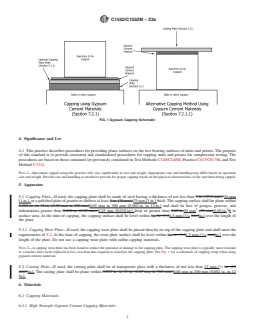
FIG. 1 Gypsum Capping Schematic
NOTE 3—A capping wear plate has been found to reduce the potential NOTE 7—Examples of materials that have been found to be unsuitable
of damage to the capping plate. The capping wear plate is typically more for capping purposes include, but are not limited to: low-strength molding
resistant to scratches and can be replaced at less cost than that required to plaster, plaster of paris, mixtures of plaster of paris and portland cement,
resurface the capping plate. See Fig. 1 for a schematic of capping setup and other cement-based materials.
when using gypsum cement materials.
6.2 Compressive Strength of Capping Materials—The com-
5.2 Casting Plate—If used, the casting plate shall be of
pressive strength of the capping material shall be at least 24
transparent glass with a thickness of not less than 13 mm [ ⁄2
MPa [3500 psi] at an age of 2 h. The cube molds and methods
in.]. The casting plate shall be plane within 0.05 mm in 300
of preparing and testing the cubes shall be in accordance with
mm [0.002 in. in 12 in.].
Practice C617/C617M. The capping material shall be placed in
the cube at capping consistency. Store the filled molds in
6. Materials
laboratory air. Remove cubes of sulfur material after solidifi-
6.1 Capping Materials: cation is complete and remove cubes of gypsum cement
material from the molds not more than 15 min prior to testing.
6.1.1 High Strength Gypsum Cement Capping Materials:
6.1.1.1 In addition to the compressive strength testing re- Test cubes at an age of 2 h 6 10 min after completing the
filling of the molds.
quired in 6.2, qualification tests shall be made to determine the
effects of water-cement ratio and age on compressive strength. 6.2.1 The strength of the capping material shall be deter-
mined on receipt of a new lot and at intervals not exceeding
Procedures used for preparing the high strength gypsum
cement capping materials shall ensure that water-cement ratios three months. If a given test of the capping material fails to
conform to the strength requirements, the package from which
used for each batch provide the required strength.
the material was sampled shall not be used unless two
NOTE 4—The water-gypsum cement ratio should typically be between
additional subsequent samples are taken from the same pack-
0.26 and 0.30. Use of low water-gypsum cement ratios and vigorous
age and both of these subsequent samples conform to the
mixing will usually permit development of 24 MPa [3500 psi] at ages of
one or two hours. Higher water-gypsum cement ratios extend working
strength requirements. If the strength tests from an individual
time, but reduce strength.
package are inadequate, randomly obtain and test three addi-
6.1.1.2 Do not add fillers or extenders to the high strength tional samples from the lot. These additional samples shall be
gypsum cement. taken from separate packages, if available. Unless these three
samples conform to the strength requirements, no part of the lot
NOTE 5—Retarders extend working time for capping materials but their
shall be used.
effects on required water-cement ratio should be determined prior to use.
NOTE 6—See Appendix X1 for more information on high-strength
7. Procedure
gypsum capping materials and product recommendations.
7.1 Preparation of Specimens for Capping—Use an abrasive
6.1.2 Sulfur Capping Materials:
stone to remove loose protrusions from the surfaces of the
6.1.2.1 Proprietary or laboratory prepared sulfur mixtures
specimens to be capped. Refer to the appropriate compression
shall contain 40 to 60 % sulfur by weight, the remainder being
test method (Test Methods C140/C140M or Test Method
ground fire clay or other suitable inert material passing a
C1314) for other specimen preparation requirements.
150-μm [No. 100] sieve with or without a plasticizer.
6.1.3 Use only capping materials identified in 6.1.1 and 7.2 Capping Test Specimens—Cap top and bottom bearing
6.1.2. Do not use other capping materials. surfaces of specimens by one of the methods in 7.2.1 or 7.2.2.
C1552/C1552M − 23a
Use alignment devices as needed to make sure the caps meet 7.2.2.4 Empty the pot and recharge with fresh materials
the requirements of 7.4. periodically to ensure that the oldest material in the pot has not
been used more than five times. Fresh sulfur capping material
NOTE 8—Various alignment devices have been demonstrated to be
shall be dry at the time it is placed in the pot as dampness may
effective. For capping with sulfur materials, which sets quickly, alignment
cause foaming. Keep water away from the molten sulfur
jigs make sure that the specimen is placed on the capping plate correctly
in the first motion. For capping with gypsum cement materials, levels capping material for the same reason.
placed across the top of specimen have proven to work well. Bullseye
7.2.2.5 Warm the capping plate before use to slow the rate
levels work particularly well with smaller specimens.
of hardening of the molten sulfur capping material and to
7.2.1 Capping Using Gypsum Cement Materials—See
permit the production of thin caps. Lightly oil the surface of the
Fig. 1 for capping setup. Spread the gypsum cement capping
capping plate (Note 9) and stir the molten sulfur capping
material evenly on the capping plate or capping wear plate that
material immediately prior to pouring each cap.
has been lightly coated with oil or sprayed with a TFE-
7.2.2.6 Form a rectangular
...
This document is not an ASTM standard and is intended only to provide the user of an ASTM standard an indication of what changes have been made to the previous version. Because
it may not be technically possible to adequately depict all changes accurately, ASTM recommends that users consult prior editions as appropriate. In all cases only the current version
of the standard as published by ASTM is to be considered the official document.
Designation: C1552 − 23 C1552/C1552M − 23a
Standard Practice for
Capping Concrete Masonry Units, Related Units and
Masonry Prisms for Compression Testing
This standard is issued under the fixed designation C1552;C1552/C1552M; the number immediately following the designation indicates
the year of original adoption or, in the case of revision, the year of last revision. A number in parentheses indicates the year of last
reapproval. A superscript epsilon (´) indicates an editorial change since the last revision or reapproval.
1. Scope*
1.1 This practice covers apparatus, materials, and procedures for capping concrete masonry units, related units, including coupons
or other specimens obtained from such units, and masonry prisms for compression testing.
NOTE 1—The testing laboratory performing these test methods should be evaluated in accordance with Practice C1093.
1.2 The text of this standard refers to notes and footnotes that provide explanatory material. These notes and footnotes (excluding
those in tables and figures) shall not be considered as requirements of the standard.
1.3 Units—The values stated in either SI units or inch-pound units are to be regarded separately as standard. The values given in
parentheses are mathematical conversions to SI units that are provided for information only and are not considered standard.stated
in each system are not necessarily exact equivalents; therefore, to ensure conformance with the standard, each system shall be used
independently of the other, and values from the two systems shall not be combined.
1.4 This standard does not purport to address all of the safety concerns, if any, associated with its use. It is the responsibility
of the user of this standard to establish appropriate safety, health, and environmental practices and determine the applicability of
regulatory limitations prior to use.
1.5 This international standard was developed in accordance with internationally recognized principles on standardization
established in the Decision on Principles for the Development of International Standards, Guides and Recommendations issued
by the World Trade Organization Technical Barriers to Trade (TBT) Committee.
2. Referenced Documents
2.1 ASTM Standards:
C140/C140M Test Methods for Sampling and Testing Concrete Masonry Units and Related Units
C617/C617M Practice for Capping Cylindrical Concrete Specimens
C1093 Practice for Accreditation of Testing Agencies for Masonry
C1232 Terminology for Masonry
C1314 Test Method for Compressive Strength of Masonry Prisms
3. Terminology
3.1 Terminology defined in Terminology C1232 shall apply for this practice.
This practice is under the jurisdiction of ASTM Committee C15 on Manufactured Masonry Units and is the direct responsibility of Subcommittee C15.04 on Research.
Current edition approved June 1, 2023Dec. 1, 2023. Published June 2023December 2023. Originally approved in 2002. Last previous edition approved in 20162023 as
C1552 – 16.C1552 – 23. DOI: 10.1520/C1552-23.10.1520/C1552_C1552M-23A.
For referenced ASTM standards, visit the ASTM website, www.astm.org, or contact ASTM Customer Service at service@astm.org. For Annual Book of ASTM Standards
volume information, refer to the standard’s Document Summary page on the ASTM website.
*A Summary of Changes section appears at the end of this standard
Copyright © ASTM International, 100 Barr Harbor Drive, PO Box C700, West Conshohocken, PA 19428-2959. United States
C1552/C1552M − 23a
FIG. 1 Gypsum Capping Schematic
4. Significance and Use
4.1 This practice describes procedures for providing plane surfaces on the two bearing surfaces of units and prisms. The purpose
of this standard is to provide consistent and standardized procedures for capping units and prisms for compression testing. The
procedures are based on those contained (or previously contained) in Test Methods C140/C140M, Practice C617/C617M, and Test
Method C1314.
NOTE 2—Specimens capped using this practice will vary significantly in size and weight. Appropriate care and handling may differ based on specimen
size and weight. Provide care and handling as needed to provide for proper capping based on the physical characteristics of the specimen being capped.
5. Apparatus
5.1 Capping Plate—If used, the capping plate shall be made of steel having a thickness of not less than 1 in. (25.4 mm), 25 mm
[1 in.], or a polished plate of granite or diabase at least 3 in. (76 mm) 75 mm [3 in.] thick. The capping surface shall be plane within
0.002 in. in 12 in. (0.05 mm in 300 mm)0.05 mm in 300 mm [0.002 in. in 12 in.] and shall be free of gouges, grooves, and
2 2
indentations greater than 0.010 in. (0.25 mm) 0.25 mm [0.010 in.] deep or greater than 0.05 in.30 mm (32 mm[0.05 in. )] in
1 1
surface area. At the time of capping, the capping surface shall be level within ⁄16 in. (1.61.5 mm [ ⁄16 mm)in.] over the length of
the plate.
5.1.1 Capping Wear Plate—If used, the capping wear plate shall be placed directly on top of the capping plate and shall meet the
1 1
requirements of 5.2. At the time of capping, the wear plate surface shall be level within ⁄16 in. (1.61.5 mm [ ⁄16 mm)in.] over the
length of the plate. Do not use a capping wear plate with sulfur capping materials.
NOTE 3—A capping wear plate has been found to reduce the potential of damage to the capping plate. The capping wear plate is typically more resistant
to scratches and can be replaced at less cost than that required to resurface the capping plate. See Fig. 1 for a schematic of capping setup when using
gypsum cement materials.
5.2 Casting Plate—If used, the casting plate shall be of transparent glass with a thickness of not less than 13 mm [ ⁄2 in. (13
mm).in.]. The casting plate shall be plane within 0.002 in. in 12 in. (0.05 mm in 300 mm).0.05 mm in 300 mm [0.002 in. in 12
in.].
6. Materials
6.1 Capping Materials:
6.1.1 High Strength Gypsum Cement Capping Materials:
C1552/C1552M − 23a
6.1.1.1 In addition to the compressive strength testing required in 6.2, qualification tests shall be made to determine the effects
of water-cement ratio and age on compressive strength. Procedures used for preparing the high strength gypsum cement capping
materials shall ensure that water-cement ratios used for each batch provide the required strength.
NOTE 4—The water-gypsum cement ratio should typically be between 0.26 and 0.30. Use of low water-gypsum cement ratios and vigorous mixing will
usually permit development of 3500 psi (24.1 MPa)24 MPa [3500 psi] at ages of one or two hours. Higher water-gypsum cement ratios extend working
time, but reduce strength.
6.1.1.2 Do not add fillers or extenders to the high strength gypsum cement.
NOTE 5—Retarders extend working time for capping materials but their effects on required water-cement ratio should be determined prior to use.
NOTE 6—See Appendix X1 for more information on high-strength gypsum capping materials and product recommendations.
6.1.2 Sulfur Capping Materials:
6.1.2.1 Proprietary or laboratory prepared sulfur mixtures shall contain 40 to 60 % sulfur by weight, the remainder being ground
fire clay or other suitable inert material passing a No. 100 (150-μm)150-μm [No. 100] sieve with or without a plasticizer.
6.1.3 Use only capping materials identified in 6.1.1 and 6.1.2. Do not use other capping materials.
NOTE 7—Examples of materials that have been found to be unsuitable for capping purposes include, but are not limited to: low-strength molding plaster,
plaster of paris, mixtures of plaster of paris and portland cement, and other cement-based materials.
6.2 Compressive Strength of Capping Materials—The compressive strength of the capping material shall be at least 3500 psi
(24.1 MPa) 24 MPa [3500 psi] at an age of 2 h. The cube molds and methods of preparing and testing the cubes shall be in
accordance with Practice C617/C617M. The capping material shall be placed in the cube at capping consistency. Store the filled
molds in laboratory air. Remove cubes of sulfur material after solidification is complete and remove cubes of gypsum cement
material from the molds not more than 15 min prior to testing. Test cubes at an age of 2 h 6 10 min after completing the filling
of the molds.
6.2.1 The strength of the capping material shall be determined on receipt of a new lot and at intervals not exceeding three months.
If a given test of the capping material fails to conform to the strength requirements, the package from which the material was
sampled shall not be used unless two additional subsequent samples are taken from the same package and both of these subsequent
samples conform to the strength requirements. If the strength tests from an individual package are inadequate, randomly obtain
and test three additional samples from the lot. These additional samples shall be taken from separate packages, if available. Unless
these three samples conform to the strength requirements, no part of the lot shall be used.
7. Procedure
7.1 Preparation of Specimens for Capping—Use an abrasive stone to remove loose protrusions from the surfaces of the specimens
to be capped. Refer to the appropriate compression test method (Test Methods C140/C140M or Test Method C1314) for other
specimen preparation requirements.
7.2 Capping Test Specimens—Cap top and bottom bearing surfaces of specimens by one of the methods in 7.2.1 or 7.2.2. Use
alignment devices as needed to make sure the caps meet the requirements of 7.4.
NOTE 8—Various alignment devices have been demonstrated to be effective. For capping with sulfur materials, which sets quickly, alignment jigs make
sure that the specimen is placed on the capping plate correctly in the first motion. For capping with gypsum cement materials, levels placed across the
top of specimen have proven to work well. Bullseye levels work particularly well with smaller specimens.
7.2.1 Capping Using Gypsum Cement Materials—See
Fig. 1 for capping setup. Spread the gypsum cement capping material evenly on the capping plate or capping wear plate that has
been lightly coated with oil or sprayed with a TFE-fluorocarbon coating (Note 9). Bring the surface of the specimen to be capped
C1552/C1552M − 23a
into contact with the capping material; firmly press down the specimen with a single motion, holding it so that its axis is at right
angles to the capping surface to comply with the requirements of 7.4. Do not disturb the specimen until the capping material has
solidified.
7.2.1.1 Alternative Capping Method Using Gypsum Cement Materials—See Fig. 1 for capping setup. Spread the gypsum cement
capping material evenly on the top surface of the specimen. Br
...