

ASTM C1314-23b
(Test Method)Standard Test Method for Compressive Strength of Masonry Prisms
General Information
- Abstract
SIGNIFICANCE AND USE
4.1 This test method provides a means of verifying that masonry materials used in construction result in masonry that meets the specified compressive strength (Note 1).
Note 1: A prism is an assembly of components used to measure (in this case, the tested compressive strength of masonry, f mt) or verify a property (in this case, the specified compressive strength of masonry, f 'm). Testing of prisms may be part of a project’s field quality control or assurance program. In these cases, prisms are built as companions to a masonry element (for example, a masonry wall, column, pilaster, or beam) at a jobsite where the masonry element is site-constructed, or within a factory or shop where the element is shop-built. While these prisms can be used to determine compliance with the specified compressive strength of masonry, f 'm, they are not intended to replicate or model all of the performance or design attributes of the as-built element. Prisms may also be fabricated in a laboratory for research purposes (Appendix X2). In each scenario (field or research) the test procedures are structured so that masonry assembly tested compressive strength (fmt) is measured in an accurate and repeatable manner.
4.2 This test method provides a means of evaluating compressive strength characteristics of in-place masonry construction through testing of prisms obtained from that construction when sampled in accordance with Practice C1532/C1532M. Decisions made in preparing such field-removed prisms for testing, determining the net area, and interpreting the results of compression tests require professional judgment.
4.3 If this test method is used as a guideline for performing research to determine the effects of various prism construction or test parameters on the compressive strength of masonry, deviations from this test method shall be reported. Such research prisms shall not be used to verify compliance with a specified compressive strength of masonry.
Note 2: The testing labo...
SCOPE
1.1 This test method covers procedures for masonry prism construction and testing, and procedures for determining the tested compressive strength of masonry, fmt, used to determine compliance with the specified compressive strength of masonry, f ′m. When this test method is used for research purposes, the construction and test procedures within serve as a guideline and provide control parameters.
1.2 This test method also covers procedures for determining the compressive strength of prisms obtained from field-removed masonry specimens.
1.3 The text of this standard refers to notes and footnotes that provide explanatory material. These notes and footnotes (excluding those in tables and figures) shall not be considered as requirements of the standard.
1.4 The values stated in inch-pound units are to be regarded as standard. The values given in parentheses are mathematical conversions to SI units that are provided for information only and are not considered standard.
1.5 This standard does not purport to address all of the safety concerns, if any, associated with its use. It is the responsibility of the user of this standard to establish appropriate safety, health, and environmental practices and determine the applicability of regulatory limitations prior to use.
1.6 This international standard was developed in accordance with internationally recognized principles on standardization established in the Decision on Principles for the Development of International Standards, Guides and Recommendations issued by the World Trade Organization Technical Barriers to Trade (TBT) Committee.
- Status
- Published
- Publication Date
- 30-Nov-2023
- Technical Committee
- C15 - Masonry – Manufactured Masonry Units, Mortars and Grouts
- Drafting Committee
- C15.04 - Research for Masonry Units and Assemblies
Overview
ASTM C1314-23b - Standard Test Method for Compressive Strength of Masonry Prisms provides a systematic approach to measuring the compressive strength of masonry assemblies. This standard is integral to verifying that masonry materials and construction meet specified performance criteria for compressive strength, which supports structural safety and compliance. ASTM C1314 explains procedures for constructing, curing, and testing masonry prisms, as well as for determining and reporting tested compressive strength, making it essential in quality assurance, field control, and research settings.
Key Topics
Scope of Application
- Covers procedures for constructing and testing masonry prisms and determining compressive strength (fmt)
- Applicable to both jobsite-constructed and laboratory-fabricated prisms
- Includes methods for prisms removed from existing masonry structures
Testing Process
- Masonry prisms are constructed to reflect the actual materials and assembly used in the project
- Detailed guidance for making, handling, and curing prisms to ensure accurate and repeatable compressive strength determination
- Testing prisms at designated ages, typically at 28 days, following removal from moisture-tight storage conditions
Evaluation and Reporting
- Calculating compressive strength by dividing the maximum load by the net cross-sectional area
- Correction factors applied based on height-to-thickness ratio (hp/tp) of the prism
- Comprehensive reporting requirements, including descriptions of specimens, test conditions, loading apparatus, and results
Quality Control and Research
- Used for field quality control or assurance-prisms serve as companion specimens to monitor construction performance
- Guidance for adapting procedures for research purposes, including proper reporting of deviations
Professional Judgement
- Importance of expert assessment in preparing field-removed prisms, determining net area, and interpreting test results
Applications
ASTM C1314-23b is widely utilized in:
Construction Quality Assurance
- Verifies that masonry construction attains required compressive strength as specified in project documents or building codes
- Field-constructed prisms provide assurance that wall, column, or beam assemblies meet structural performance requirements
Renovation and Structural Assessment
- Field-removed prisms enable in-situ evaluation of existing masonry, supporting renovation decisions or structural safety assessments
Research and Development
- Facilitates laboratory investigations into the effects of materials, construction methods, or design variations on masonry strength
- Allows for controlled testing environments to study new materials or techniques
Code Compliance
- Used by engineers, architects, and inspectors to demonstrate compliance with building regulations and material specifications
Testing Agency Accreditation
- Laboratories following ASTM C1314 ensure repeatable and reliable test results, supporting accreditation and industry recognition
Related Standards
Several ASTM standards are referenced or commonly used in conjunction with ASTM C1314, including:
- ASTM C67/C67M - Sampling and Testing Brick and Structural Clay Tile
- ASTM C140/C140M - Sampling and Testing Concrete Masonry Units
- ASTM C1552 - Practice for Capping Units and Prisms for Compression Testing
- ASTM C1716/C1716M - Compression Testing Machine Requirements
- ASTM C476 - Specification for Grout for Masonry
- ASTM C1532/C1532M - Practice for Selection, Removal, and Shipment of Masonry Units from Existing Construction
Practical Value
By adhering to ASTM C1314-23b, professionals ensure that masonry compressive strength testing is performed with consistency and accuracy, leading to safer and more reliable masonry structures. This standard is a cornerstone in the construction industry for verifying the compressive strength of masonry prisms, supporting compliance, quality control, and ongoing research in structural masonry systems.
Relations
- Effective Date
- 01-Dec-2023
- Effective Date
- 15-Dec-2023
- Effective Date
- 01-Dec-2023
- Effective Date
- 01-Jul-2023
- Effective Date
- 01-Jun-2023
- Effective Date
- 01-Jun-2023
- Effective Date
- 01-Feb-2023
- Effective Date
- 01-Aug-2022
- Effective Date
- 01-Dec-2021
- Effective Date
- 01-Dec-2021
- Effective Date
- 01-Dec-2020
- Effective Date
- 01-May-2019
- Effective Date
- 01-Dec-2018
- Effective Date
- 01-Dec-2023
- Referred By
ASTM C1298-21 - Standard Guide for Design and Construction of Brick Liners for Industrial Chimneys - Effective Date
- 01-Dec-2023
Get Certified
Connect with accredited certification bodies for this standard

DIBt (Deutsches Institut für Bautechnik)
German Institute for Building Technology.
DIN CERTCO
DIN Group product certification.

Aboma Certification B.V.
Specialized in construction, metal, and transport sectors.
Sponsored listings
Frequently Asked Questions
ASTM C1314-23b is a standard published by ASTM International. Its full title is "Standard Test Method for Compressive Strength of Masonry Prisms". This standard covers: SIGNIFICANCE AND USE 4.1 This test method provides a means of verifying that masonry materials used in construction result in masonry that meets the specified compressive strength (Note 1). Note 1: A prism is an assembly of components used to measure (in this case, the tested compressive strength of masonry, f mt) or verify a property (in this case, the specified compressive strength of masonry, f 'm). Testing of prisms may be part of a project’s field quality control or assurance program. In these cases, prisms are built as companions to a masonry element (for example, a masonry wall, column, pilaster, or beam) at a jobsite where the masonry element is site-constructed, or within a factory or shop where the element is shop-built. While these prisms can be used to determine compliance with the specified compressive strength of masonry, f 'm, they are not intended to replicate or model all of the performance or design attributes of the as-built element. Prisms may also be fabricated in a laboratory for research purposes (Appendix X2). In each scenario (field or research) the test procedures are structured so that masonry assembly tested compressive strength (fmt) is measured in an accurate and repeatable manner. 4.2 This test method provides a means of evaluating compressive strength characteristics of in-place masonry construction through testing of prisms obtained from that construction when sampled in accordance with Practice C1532/C1532M. Decisions made in preparing such field-removed prisms for testing, determining the net area, and interpreting the results of compression tests require professional judgment. 4.3 If this test method is used as a guideline for performing research to determine the effects of various prism construction or test parameters on the compressive strength of masonry, deviations from this test method shall be reported. Such research prisms shall not be used to verify compliance with a specified compressive strength of masonry. Note 2: The testing labo... SCOPE 1.1 This test method covers procedures for masonry prism construction and testing, and procedures for determining the tested compressive strength of masonry, fmt, used to determine compliance with the specified compressive strength of masonry, f ′m. When this test method is used for research purposes, the construction and test procedures within serve as a guideline and provide control parameters. 1.2 This test method also covers procedures for determining the compressive strength of prisms obtained from field-removed masonry specimens. 1.3 The text of this standard refers to notes and footnotes that provide explanatory material. These notes and footnotes (excluding those in tables and figures) shall not be considered as requirements of the standard. 1.4 The values stated in inch-pound units are to be regarded as standard. The values given in parentheses are mathematical conversions to SI units that are provided for information only and are not considered standard. 1.5 This standard does not purport to address all of the safety concerns, if any, associated with its use. It is the responsibility of the user of this standard to establish appropriate safety, health, and environmental practices and determine the applicability of regulatory limitations prior to use. 1.6 This international standard was developed in accordance with internationally recognized principles on standardization established in the Decision on Principles for the Development of International Standards, Guides and Recommendations issued by the World Trade Organization Technical Barriers to Trade (TBT) Committee.
SIGNIFICANCE AND USE 4.1 This test method provides a means of verifying that masonry materials used in construction result in masonry that meets the specified compressive strength (Note 1). Note 1: A prism is an assembly of components used to measure (in this case, the tested compressive strength of masonry, f mt) or verify a property (in this case, the specified compressive strength of masonry, f 'm). Testing of prisms may be part of a project’s field quality control or assurance program. In these cases, prisms are built as companions to a masonry element (for example, a masonry wall, column, pilaster, or beam) at a jobsite where the masonry element is site-constructed, or within a factory or shop where the element is shop-built. While these prisms can be used to determine compliance with the specified compressive strength of masonry, f 'm, they are not intended to replicate or model all of the performance or design attributes of the as-built element. Prisms may also be fabricated in a laboratory for research purposes (Appendix X2). In each scenario (field or research) the test procedures are structured so that masonry assembly tested compressive strength (fmt) is measured in an accurate and repeatable manner. 4.2 This test method provides a means of evaluating compressive strength characteristics of in-place masonry construction through testing of prisms obtained from that construction when sampled in accordance with Practice C1532/C1532M. Decisions made in preparing such field-removed prisms for testing, determining the net area, and interpreting the results of compression tests require professional judgment. 4.3 If this test method is used as a guideline for performing research to determine the effects of various prism construction or test parameters on the compressive strength of masonry, deviations from this test method shall be reported. Such research prisms shall not be used to verify compliance with a specified compressive strength of masonry. Note 2: The testing labo... SCOPE 1.1 This test method covers procedures for masonry prism construction and testing, and procedures for determining the tested compressive strength of masonry, fmt, used to determine compliance with the specified compressive strength of masonry, f ′m. When this test method is used for research purposes, the construction and test procedures within serve as a guideline and provide control parameters. 1.2 This test method also covers procedures for determining the compressive strength of prisms obtained from field-removed masonry specimens. 1.3 The text of this standard refers to notes and footnotes that provide explanatory material. These notes and footnotes (excluding those in tables and figures) shall not be considered as requirements of the standard. 1.4 The values stated in inch-pound units are to be regarded as standard. The values given in parentheses are mathematical conversions to SI units that are provided for information only and are not considered standard. 1.5 This standard does not purport to address all of the safety concerns, if any, associated with its use. It is the responsibility of the user of this standard to establish appropriate safety, health, and environmental practices and determine the applicability of regulatory limitations prior to use. 1.6 This international standard was developed in accordance with internationally recognized principles on standardization established in the Decision on Principles for the Development of International Standards, Guides and Recommendations issued by the World Trade Organization Technical Barriers to Trade (TBT) Committee.
ASTM C1314-23b is classified under the following ICS (International Classification for Standards) categories: 19.060 - Mechanical testing; 91.080.30 - Masonry. The ICS classification helps identify the subject area and facilitates finding related standards.
ASTM C1314-23b has the following relationships with other standards: It is inter standard links to ASTM C1314-23a, ASTM C1232-23, ASTM C140/C140M-23a, ASTM C780-23, ASTM C1552-23, ASTM C140/C140M-23, ASTM C476-23, ASTM C1180-22, ASTM C1716/C1716M-21, ASTM C1232-21a, ASTM C1019-20, ASTM C270-19ae1, ASTM C144-18, ASTM C1552/C1552M-23a, ASTM C1298-21. Understanding these relationships helps ensure you are using the most current and applicable version of the standard.
ASTM C1314-23b is available in PDF format for immediate download after purchase. The document can be added to your cart and obtained through the secure checkout process. Digital delivery ensures instant access to the complete standard document.
Standards Content (Sample)
This international standard was developed in accordance with internationally recognized principles on standardization established in the Decision on Principles for the
Development of International Standards, Guides and Recommendations issued by the World Trade Organization Technical Barriers to Trade (TBT) Committee.
Designation: C1314 − 23b
Standard Test Method for
Compressive Strength of Masonry Prisms
This standard is issued under the fixed designation C1314; the number immediately following the designation indicates the year of
original adoption or, in the case of revision, the year of last revision. A number in parentheses indicates the year of last reapproval. A
superscript epsilon (´) indicates an editorial change since the last revision or reapproval.
1. Scope* C67/C67M Test Methods for Sampling and Testing Brick
and Structural Clay Tile
1.1 This test method covers procedures for masonry prism
C136/C136M Test Method for Sieve Analysis of Fine and
construction and testing, and procedures for determining the
Coarse Aggregates
tested compressive strength of masonry, f , used to determine
mt
C140/C140M Test Methods for Sampling and Testing Con-
compliance with the specified compressive strength of
crete Masonry Units and Related Units
masonry, f ' . When this test method is used for research
m
C143/C143M Test Method for Slump of Hydraulic-Cement
purposes, the construction and test procedures within serve as
Concrete
a guideline and provide control parameters.
C144 Specification for Aggregate for Masonry Mortar
1.2 This test method also covers procedures for determining
C270 Specification for Mortar for Unit Masonry
the compressive strength of prisms obtained from field-
C476 Specification for Grout for Masonry
removed masonry specimens.
C780 Test Methods for Preconstruction and Construction
1.3 The text of this standard refers to notes and footnotes Evaluation of Mortars for Plain and Reinforced Unit
Masonry
that provide explanatory material. These notes and footnotes
(excluding those in tables and figures) shall not be considered C1019 Test Method for Sampling and Testing Grout for
Masonry
as requirements of the standard.
C1093 Practice for Accreditation of Testing Agencies for
1.4 The values stated in inch-pound units are to be regarded
Masonry
as standard. The values given in parentheses are mathematical
C1180 Terminology of Mortar and Grout for Unit Masonry
conversions to SI units that are provided for information only
C1232 Terminology for Masonry
and are not considered standard.
C1532/C1532M Practice for Selection, Removal, and Ship-
1.5 This standard does not purport to address all of the
ment of Manufactured Masonry Units and Masonry Speci-
safety concerns, if any, associated with its use. It is the
mens from Existing Construction
responsibility of the user of this standard to establish appro-
C1552 Practice for Capping Concrete Masonry Units, Re-
priate safety, health, and environmental practices and deter-
lated Units and Masonry Prisms for Compression Testing
mine the applicability of regulatory limitations prior to use.
C1587/C1587M Practice for Preparation of Field Removed
1.6 This international standard was developed in accor-
Manufactured Masonry Units and Masonry Specimens for
dance with internationally recognized principles on standard-
Testing
ization established in the Decision on Principles for the
C1716/C1716M Specification for Compression Testing Ma-
Development of International Standards, Guides and Recom-
chine Requirements for Concrete Masonry Units, Related
mendations issued by the World Trade Organization Technical
Units, and Prisms
Barriers to Trade (TBT) Committee.
E105 Guide for Probability Sampling of Materials
E111 Test Method for Young’s Modulus, Tangent Modulus,
2. Referenced Documents
and Chord Modulus
2.1 ASTM Standards:
3. Terminology
This test method is under the jurisdiction of ASTM Committee C15 on
3.1 Definitions:
Manufactured Masonry Units and is the direct responsibility of Subcommittee
3.1.1 For definitions of terms used in this test method, refer
C15.04 on Research.
to Terminologies C1180 and C1232.
Current edition approved Dec. 1, 2023. Published December 2023. Originally
approved in 1995. Last previous edition approved in 2023 as C1314 – 23a. DOI:
3.2 Definitions of Terms Specific to This Standard:
10.1520/C1314-23B.
For referenced ASTM standards, visit the ASTM website, www.astm.org, or 3.2.1 set—a set consists of at least three prisms constructed
contact ASTM Customer Service at service@astm.org. For Annual Book of ASTM
of the same material and tested at the same age.
Standards volume information, refer to the standard’s Document Summary page on
the ASTM website. 3.3 Notations:
*A Summary of Changes section appears at the end of this standard
Copyright © ASTM International, 100 Barr Harbor Drive, PO Box C700, West Conshohocken, PA 19428-2959. United States
C1314 − 23b
3.3.1 f ' —specified compressive strength of masonry. saw cutting flush with the surface of the unit at the base of the
m
projection. If units contain insulation inserts, remove those
3.3.2 f —tested compressive strength of masonry.
mt
inserts prior to prism construction. The resulting units shall be
3.3.3 h —prism height.
p
a fully enclosed cell or cells that will ensure a full bearing
3.3.4 t —least actual lateral dimension of prism.
p surface over the net cross-section of the prism. If saw cutting
will not result in a fully enclosed cell or cells, use full-size
4. Significance and Use
units, and, if grout is used, grout in accordance with 5.9.4. If
4.1 This test method provides a means of verifying that
prisms are used for field quality control or assurance, record
masonry materials used in construction result in masonry that
the location in the structure that corresponds to the set of
meets the specified compressive strength (Note 1).
prisms constructed.
NOTE 1—A prism is an assembly of components used to measure (in
NOTE 3—Examples of projections include flutes, ribs, and face shells of
this case, the tested compressive strength of masonry, f ) or verify a
mt open-ended units.
property (in this case, the specified compressive strength of masonry, f ’ ).
m
NOTE 4—Building codes or project specifications may require a set of
Testing of prisms may be part of a project’s field quality control or
prisms for a given square footage of construction. Recording the location
assurance program. In these cases, prisms are built as companions to a
of the structure that corresponds to a set of prisms allows the test results
masonry element (for example, a masonry wall, column, pilaster, or beam)
to be attributed to a particular portion of the structure.
at a jobsite where the masonry element is site-constructed, or within a
5.2 Construct a set of prisms for each combination of
factory or shop where the element is shop-built. While these prisms can be
used to determine compliance with the specified compressive strength of
materials and each test age at which the compressive strength
masonry, f ’ , they are not intended to replicate or model all of the
m of masonry is to be determined.
performance or design attributes of the as-built element. Prisms may also
5.3 Build each prism in an opened, moisture-tight bag large
be fabricated in a laboratory for research purposes (Appendix X2). In each
scenario (field or research) the test procedures are structured so that
enough to enclose and seal the completed prism. Construct
masonry assembly tested compressive strength (f ) is measured in an
mt
prisms on a flat, level base. Construct prisms in a location
accurate and repeatable manner.
where they will remain undisturbed until transported for
4.2 This test method provides a means of evaluating com-
testing.
pressive strength characteristics of in-place masonry construc-
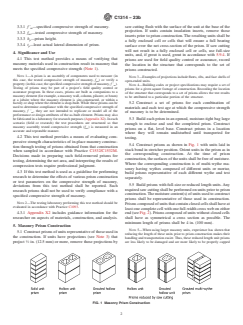
5.4 Construct prisms as shown in Fig. 1 with units laid in
tion through testing of prisms obtained from that construction
stack bond in stretcher position. Orient units in the prism as in
when sampled in accordance with Practice C1532/C1532M.
the corresponding construction. At the time of prism
Decisions made in preparing such field-removed prisms for
construction, the surfaces of the units shall be free of moisture.
testing, determining the net area, and interpreting the results of
Where the corresponding construction is of multi-wythe ma-
compression tests require professional judgment.
sonry having wythes composed of different units or mortar,
4.3 If this test method is used as a guideline for performing
build prisms representative of each different wythe and test
research to determine the effects of various prism construction
separately.
or test parameters on the compressive strength of masonry,
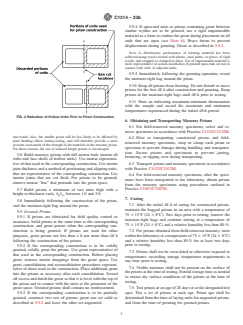
5.5 Build prisms with full-size or reduced length units. Any
deviations from this test method shall be reported. Such
required saw cutting shall be performed on units prior to prism
research prisms shall not be used to verify compliance with a
construction. The moisture content(s) of units used to construct
specified compressive strength of masonry.
prisms shall be representative of those used in construction.
NOTE 2—The testing laboratory performing this test method should be
Prisms composed of units that contain closed cells shall have at
evaluated in accordance with Practice C1093.
least one complete cell with one full-width cross web on either
4.3.1 Appendix X2 includes guidance information for the
end (see Fig. 2). Prisms composed of units without closed cells
researcher on aspects of materials, construction, and analysis.
shall have as symmetrical a cross section as possible. The
minimum length of prisms shall be 4 in. (100 mm).
5. Masonry Prism Construction
NOTE 5—When using larger masonry units, experience has shown that
5.1 Construct prisms of units representative of those used in
reducing the length of these units prior to prism construction makes their
the construction. If units have projections (see Note 3) that
handling and transportation easier. Thus, these reduced length unit prisms
project ⁄2 in. (12.5 mm) or more, remove those projections by
are less likely to be damaged and are more likely to be properly capped
FIG. 1 Masonry Prism Construction
C1314 − 23b
5.9.4 If open-end units or prisms containing grout between
similar wythes are to be grouted, use a rigid impermeable
material as a form to confine the grout during placement on all
ends that are open (see Note 6). Brace forms to prevent
displacement during grouting. Grout as described in 5.9.2.
NOTE 6—Satisfactory performance of forming material has been
achieved using wood covered with plastic, steel plates, or pieces of rigid
acrylic and strapped or clamped in place. Use of impermeable material is
more representative of actual construction if grouted open ends are not in
contact with webs of adjacent units.
5.9.5 Immediately following the grouting operation, reseal
the moisture-tight bag around the prism.
5.10 Keep all prisms from freezing. Do not disturb or move
prisms for the first 48 h after construction and grouting. Keep
prisms in the moisture-tight bags until 48 h prior to testing.
5.11 Store an indicating maximum-minimum thermometer
with the sample and record the maximum and minimum
temperatures experienced during the initial 48-h period.
FIG. 2 Reduction of Hollow Units Prior to Prism Construction
6. Obtaining and Transporting Masonry Prisms
6.1 For field-removed masonry specimens, select and re-
move specimens in accordance with Practice C1532/C1532M.
and tested. Also, the smaller prism will be less likely to be affected by
6.2 Prior to transporting constructed prisms and field-
plate bending effects during testing, and will therefore provide a more
removed masonry specimens, strap or clamp each prism or
accurate assessment of the strength of the materials in the masonry prism.
specimen to prevent damage during handling and transporta-
For these reasons, the use of reduced length prisms is encouraged.
tion. Secure prisms and specimens to prevent jarring,
5.6 Build masonry prisms with full mortar beds (mortar all
bouncing, or tipping over during transporting.
webs and face shells of hollow units). Use mortar representa-
6.3 Transport prisms and masonry specimens in accordance
tive of that used in the corresponding construction. Use mortar
joint thickness and a method of positioning and aligning units, with Practice C1532/C1532M.
that are representative of the corresponding construction. Use
6.4 For field-removed masonry specimens, after the speci-
mortar joints that are cut flush. For prisms to be grouted,
mens have been transported to the laboratory, obtain prisms
remove mortar “fins” that protrude into the grout space.
from the masonry specimens using procedures outlined in
5.7 Build prisms a minimum of two units high with a Practice C1587/C1587M.
height-to-thickness ratio, h /t , between 1.0 and 5.0.
p p
7. Curing
5.8 Immediately following the construction of the prism,
7.1 After the initial 48 h of curing for constructed prisms,
seal the moisture-tight bag around the prism.
maintain the bagged prisms in an area with a temperature of
5.9 Grouted Prisms.
75 6 15°F (24 6 8°C). Two days prior to testing, remove the
5.9.1 If prisms are fabricated for field quality control or
moisture-tight bags and continue storing at a temperature of
assurance, build prisms at the same time as the corresponding
75 6 15°F (24 6 8°C) and a relative humidity less than 80 %.
construction, and grout prisms when the corresponding con-
7.2 For prisms obtained from field-removed masonry, store
struction is being grouted. If prisms are used for other
purposes, grout prisms not less than 4 h nor more than 48 h within the laboratory at a temperature of 75 6 15°F (24 6 8°C)
and a relative humidity less than 80 % for at least two days
following the construction of the prisms.
5.9.2 If the corresponding construction is to be solidly prior to testing.
grouted, solidly grout the prisms. Use grout representative of
7.3 Prisms shall not be oven-dried or otherwise exposed to
that used in the corresponding construction. Before placing
temperatures exceeding storage temperature requirements at
grout, remove mortar droppings from the grout space. Use
any time prior to testing.
grout consolidation and reconsolidation procedures represen-
7.4 Visible moisture shall not be present on the surface of
tative of those used in the construction. Place additional grout
the prisms at the time of testing. Extend storage time as needed
into the prisms as necessary after each consolidation. Screed
to ensure dry surface conditions of the prisms at the time of
off excess and finish the grout so that it is level with the top of
testing.
the prism and in contact with the units at the perimeter of the
grout space. Grouted prisms shall contain no reinforcement. 7.5 Test prisms at an age of 28 days or at the designated test
5.9.3 If the corresponding construction is to be partially ages. Test a set of prisms at each age. Prism age shall be
grouted, construct two sets of prisms; grout one set solid as determined from the time of laying units for ungrouted prisms,
described in 5.9.2 and leave the other set ungrouted. and from the time of grouting for grouted prisms.
C1314 − 23b
8. Measurements and Determination of Net Area area if appropriate. Net area for prisms obtained from field-
removed masonry specimens is considered to be minimum
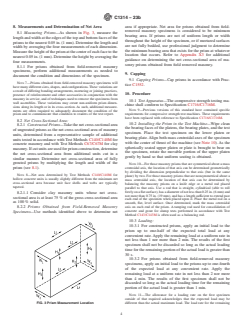
8.1 Measuring Prisms—As shown in Fig. 3, measure the
bearing area. If prisms are not of uniform length or width
length and width at the edges of the top and bottom faces of the
throughout the height of the specimen, or if mortared surfaces
prisms to the nearest 0.05 in. (1 mm). Determine the length and
are not fully bedded, use professional judgment to determine
width by averaging the four measurements of each dimension.
the minimum bearing area that exists for the prism at whatever
Measure the height of the prism at the center of each face to the
location that occurs. Refer to Appendix X3 for additional
nearest 0.05 in. (1 mm). Determine the height by averaging the
guidance on determining the net cross-sectional area of ma-
four measurements.
sonry prisms obtained from field removed masonry.
8.1.1 For prisms obtained from field-removed masonry
specimens, perform additional measurements as needed to
9. Capping
document the condition and dimensions of the specimen.
9.1 Capping Prisms—Cap prisms in accordance with Prac-
NOTE 7—Prisms obtained from field-removed masonry specimens will
tice C1552.
have many different sizes, shapes, and configurations. These variations are
a result of differing bonding arrangements, mortaring or joining practices,
10. Procedure
presence of reinforcement and other accessories in conjunction with the
masonry in service, and of techniques used to remove the specimens from
10.1 Test Apparatus—The compressive strength testing ma-
wall assemblies. These variations may create non-uniform prism dimen-
chine shall conform to Specification C1716/C1716M.
sions along its length or in its cross-section. As such, additional measure-
NOTE 9—Previous versions of this standard have contained specific
ments are often required to adequately document the condition of the
requirements for compressive strength test machines. These requirements
prism and to communicate that condition to readers of the test report.
have been replaced with reference to Specification C1716/C1716M.
8.2 Net Cross-Sectional Area:
10.2 Installing the Prism in the Test Machine—Wipe clean
8.2.1 Constructed Prisms—Take the net cross-sectional area
the bearing faces of the platens, the bearing plates, and the test
of ungrouted prisms as the net cross-sectional area of masonry
specimen. Place the test specimen on the lower platen or
units, determined from a representative sample of additional
bearing plate. Align both mass centroidal axes of the specimen
units tested in accordance with Test Methods C140/C140M for
with the center of thrust of the machine (see Note 10). As the
concrete masonry and with Test Methods C67/C67M for clay
spherically seated upper platen or plate is brought to bear on
masonry. If cut units are used for prism construction, determine
the specimen, rotate the movable portion of the upper platen
the net cross-sectional area from additional units cut in a
gently by hand so that uniform seating is obtained.
similar manner. Determine net cross-sectional area of fully
grouted prisms by multiplying the length and width of the
NOTE 10—For those masonry prisms that are symmetrical about a mass
centroidal axis, the location of that axis can be determined geometrically
prism (see 8.1).
by dividing the dimension perpendicular to that axis (but in the same
NOTE 8—Net area determined by Test Methods C140/C140M for
plane) by two. For those masonry prisms that are nonsymmetrical about a
hollow concrete units is usually slightly different from the minimum net
mass centroidal axis, the location of that axis can be determined by
cross-sectional area because unit face shells and webs are typically
balancing the masonry prisms on a knife edge or a metal rod placed
tapered.
parallel to that axis. Use a rod that is straight, cylindrical (able to roll
freely on a flat surface), has a diameter of not less than 0.25 in. (6 mm) and
8.2.1.1 Consider clay masonry units whose net cross-
not more than 0.75 in. (19 mm), and has a length sufficient to extend past
sectional area is at least 75 % of the gross cross-sectional area
each end of the specimen when placed upon it. Place the metal rod on a
as 100 % solid.
smooth, flat, level surface. Once determined, mark the mass centroidal
8.2.2 Prisms Obtained from Field-Removed Masonry
axis on each end of the prism. A tamping rod used for consolidation of
concrete and grout for slump tests performed in accordance w
...
This document is not an ASTM standard and is intended only to provide the user of an ASTM standard an indication of what changes have been made to the previous version. Because
it may not be technically possible to adequately depict all changes accurately, ASTM recommends that users consult prior editions as appropriate. In all cases only the current version
of the standard as published by ASTM is to be considered the official document.
Designation: C1314 − 23a C1314 − 23b
Standard Test Method for
Compressive Strength of Masonry Prisms
This standard is issued under the fixed designation C1314; the number immediately following the designation indicates the year of
original adoption or, in the case of revision, the year of last revision. A number in parentheses indicates the year of last reapproval. A
superscript epsilon (´) indicates an editorial change since the last revision or reapproval.
1. Scope*
1.1 This test method covers procedures for masonry prism construction and testing, and procedures for determining the tested
compressive strength of masonry, f , used to determine compliance with the specified compressive strength of masonry, f ' . When
mt m
this test method is used for research purposes, the construction and test procedures within serve as a guideline and provide control
parameters.
1.2 This test method also covers procedures for determining the compressive strength of prisms obtained from field-removed
masonry specimens.
1.3 The text of this standard refers to notes and footnotes that provide explanatory material. These notes and footnotes (excluding
those in tables and figures) shall not be considered as requirements of the standard.
1.4 The values stated in inch-pound units are to be regarded as standard. The values given in parentheses are mathematical
conversions to SI units that are provided for information only and are not considered standard.
1.5 This standard does not purport to address all of the safety concerns, if any, associated with its use. It is the responsibility
of the user of this standard to establish appropriate safety, health, and environmental practices and determine the applicability of
regulatory limitations prior to use.
1.6 This international standard was developed in accordance with internationally recognized principles on standardization
established in the Decision on Principles for the Development of International Standards, Guides and Recommendations issued
by the World Trade Organization Technical Barriers to Trade (TBT) Committee.
2. Referenced Documents
2.1 ASTM Standards:
C67/C67M Test Methods for Sampling and Testing Brick and Structural Clay Tile
C136/C136M Test Method for Sieve Analysis of Fine and Coarse Aggregates
C140/C140M Test Methods for Sampling and Testing Concrete Masonry Units and Related Units
C143/C143M Test Method for Slump of Hydraulic-Cement Concrete
C144 Specification for Aggregate for Masonry Mortar
C270 Specification for Mortar for Unit Masonry
C476 Specification for Grout for Masonry
C780 Test Methods for Preconstruction and Construction Evaluation of Mortars for Plain and Reinforced Unit Masonry
This test method is under the jurisdiction of ASTM Committee C15 on Manufactured Masonry Units and is the direct responsibility of Subcommittee C15.04 on Research.
Current edition approved June 15, 2023Dec. 1, 2023. Published June 2023December 2023. Originally approved in 1995. Last previous edition approved in 2023 as
C1314 – 23.C1314 – 23a. DOI: 10.1520/C1314-23A.10.1520/C1314-23B.
For referenced ASTM standards, visit the ASTM website, www.astm.org, or contact ASTM Customer Service at service@astm.org. For Annual Book of ASTM Standards
volume information, refer to the standard’s Document Summary page on the ASTM website.
*A Summary of Changes section appears at the end of this standard
Copyright © ASTM International, 100 Barr Harbor Drive, PO Box C700, West Conshohocken, PA 19428-2959. United States
C1314 − 23b
C1019 Test Method for Sampling and Testing Grout for Masonry
C1093 Practice for Accreditation of Testing Agencies for Masonry
C1180 Terminology of Mortar and Grout for Unit Masonry
C1232 Terminology for Masonry
C1532/C1532M Practice for Selection, Removal, and Shipment of Manufactured Masonry Units and Masonry Specimens from
Existing Construction
C1552 Practice for Capping Concrete Masonry Units, Related Units and Masonry Prisms for Compression Testing
C1587/C1587M Practice for Preparation of Field Removed Manufactured Masonry Units and Masonry Specimens for Testing
C1716/C1716M Specification for Compression Testing Machine Requirements for Concrete Masonry Units, Related Units, and
Prisms
E105 Guide for Probability Sampling of Materials
E111 Test Method for Young’s Modulus, Tangent Modulus, and Chord Modulus
3. Terminology
3.1 Definitions:
3.1.1 For definitions of terms used in this test method, refer to Terminologies C1180 and C1232.
3.2 Definitions of Terms Specific to This Standard:
3.2.1 set—a set consists of at least three prisms constructed of the same material and tested at the same age.
3.3 Notations:
3.3.1 f ' —specified compressive strength of masonry.
m
3.3.2 f —tested compressive strength of masonry.
mt
3.3.3 h —prism height.
p
3.3.4 t —least actual lateral dimension of prism.
p
4. Significance and Use
4.1 This test method provides a means of verifying that masonry materials used in construction result in masonry that meets the
specified compressive strength (Note 1).
NOTE 1—A prism is an assembly of components used to measure (in this case, the tested compressive strength of masonry, f ) or verify a property (in
mt
this case, the specified compressive strength of masonry, f ’ ). Testing of prisms may be part of a project’s field quality control or assurance program.
m
In these cases, prisms are built as companions to a masonry element (for example, a masonry wall, column, pilaster, beam, or other element) or beam)
at a jobsite where the masonry element is site-constructed, or within a factory or shop where the element is shop-built. These prisms While these prisms
can be used to determine compliance with the specified compressive strength of masonry, f ’ , they are not intended to replicate or model all of the
m
performance or design attributes of the as-built element. Prisms may also be fabricated in a laboratory for research purposes (Appendix X2). In each
scenario (field or research) the test procedures are structured so that masonry assembly tested compressive strength (f ) is measured in an accurate and
mt
repeatable manner.
4.2 This test method provides a means of evaluating compressive strength characteristics of in-place masonry construction through
testing of prisms obtained from that construction when sampled in accordance with Practice C1532/C1532M. Decisions made in
preparing such field-removed prisms for testing, determining the net area, and interpreting the results of compression tests require
professional judgment.
4.3 If this test method is used as a guideline for performing research to determine the effects of various prism construction or test
parameters on the compressive strength of masonry, deviations from this test method shall be reported. Such research prisms shall
not be used to verify compliance with a specified compressive strength of masonry.
NOTE 2—The testing laboratory performing this test method should be evaluated in accordance with Practice C1093.
4.3.1 Appendix X2 includes guidance information for the researcher on aspects of materials, construction, and analysis.
C1314 − 23b
5. Masonry Prism Construction
5.1 Construct prisms of units representative of those used in the construction. If units have projections (see Note 3) that project
⁄2 in. (12.5 mm) or more, remove those projections by saw cutting flush with the surface of the unit at the base of the projection.
If units contain insulation inserts, remove those inserts prior to prism construction. The resulting units shall be a fully enclosed
cell or cells that will ensure a full bearing surface over the net cross-section of the prism. If saw cutting will not result in a fully
enclosed cell or cells, use full-size units, and, if grout is used, grout in accordance with 5.9.4. If prisms are used for field quality
control or assurance, record the location in the structure that corresponds to the set of prisms constructed.
NOTE 3—Examples of projections include flutes, ribs, and face shells of open-ended units.
NOTE 4—Building codes or project specifications may require a set of prisms for a given square footage of construction. Recording the location of the
structure that corresponds to a set of prisms allows the test results to be attributed to a particular portion of the structure.
5.2 Construct a set of prisms for each combination of materials and each test age at which the compressive strength of masonry
is to be determined.
5.3 Build each prism in an opened, moisture-tight bag large enough to enclose and seal the completed prism. Construct prisms
on a flat, level base. Construct prisms in a location where they will remain undisturbed until transported for testing.
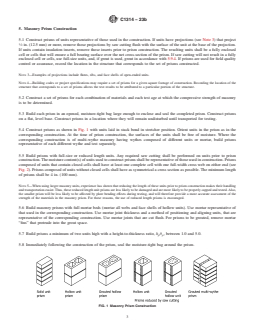
5.4 Construct prisms as shown in Fig. 1 with units laid in stack bond in stretcher position. Orient units in the prism as in the
corresponding construction. At the time of prism construction, the surfaces of the units shall be free of moisture. Where the
corresponding construction is of multi-wythe masonry having wythes composed of different units or mortar, build prisms
representative of each different wythe and test separately.
5.5 Build prisms with full-size or reduced length units. Any required saw cutting shall be performed on units prior to prism
construction. The moisture content(s) of units used to construct prisms shall be representative of those used in construction. Prisms
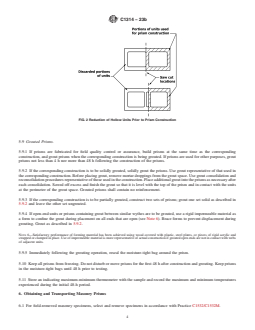
composed of units that contain closed cells shall have at least one complete cell with one full-width cross web on either end (see
Fig. 2). Prisms composed of units without closed cells shall have as symmetrical a cross section as possible. The minimum length
of prisms shall be 4 in. (100 mm).
NOTE 5—When using larger masonry units, experience has shown that reducing the length of these units prior to prism construction makes their handling
and transportation easier. Thus, these reduced length unit prisms are less likely to be damaged and are more likely to be properly capped and tested. Also,
the smaller prism will be less likely to be affected by plate bending effects during testing, and will therefore provide a more accurate assessment of the
strength of the materials in the masonry prism. For these reasons, the use of reduced length prisms is encouraged.
5.6 Build masonry prisms with full mortar beds (mortar all webs and face shells of hollow units). Use mortar representative of
that used in the corresponding construction. Use mortar joint thickness and a method of positioning and aligning units, that are
representative of the corresponding construction. Use mortar joints that are cut flush. For prisms to be grouted, remove mortar
“fins” that protrude into the grout space.
5.7 Build prisms a minimum of two units high with a height-to-thickness ratio, h /t , between 1.0 and 5.0.
p p
5.8 Immediately following the construction of the prism, seal the moisture-tight bag around the prism.
FIG. 1 Masonry Prism Construction
C1314 − 23b
FIG. 2 Reduction of Hollow Units Prior to Prism Construction
5.9 Grouted Prisms.
5.9.1 If prisms are fabricated for field quality control or assurance, build prisms at the same time as the corresponding
construction, and grout prisms when the corresponding construction is being grouted. If prisms are used for other purposes, grout
prisms not less than 4 h nor more than 48 h following the construction of the prisms.
5.9.2 If the corresponding construction is to be solidly grouted, solidly grout the prisms. Use grout representative of that used in
the corresponding construction. Before placing grout, remove mortar droppings from the grout space. Use grout consolidation and
reconsolidation procedures representative of those used in the construction. Place additional grout into the prisms as necessary after
each consolidation. Screed off excess and finish the grout so that it is level with the top of the prism and in contact with the units
at the perimeter of the grout space. Grouted prisms shall contain no reinforcement.
5.9.3 If the corresponding construction is to be partially grouted, construct two sets of prisms; grout one set solid as described in
5.9.2 and leave the other set ungrouted.
5.9.4 If open-end units or prisms containing grout between similar wythes are to be grouted, use a rigid impermeable material as
a form to confine the grout during placement on all ends that are open (see Note 6). Brace forms to prevent displacement during
grouting. Grout as described in 5.9.2.
NOTE 6—Satisfactory performance of forming material has been achieved using wood covered with plastic, steel plates, or pieces of rigid acrylic and
strapped or clamped in place. Use of impermeable material is more representative of actual construction if grouted open ends are not in contact with webs
of adjacent units.
5.9.5 Immediately following the grouting operation, reseal the moisture-tight bag around the prism.
5.10 Keep all prisms from freezing. Do not disturb or move prisms for the first 48 h after construction and grouting. Keep prisms
in the moisture-tight bags until 48 h prior to testing.
5.11 Store an indicating maximum-minimum thermometer with the sample and record the maximum and minimum temperatures
experienced during the initial 48-h period.
6. Obtaining and Transporting Masonry Prisms
6.1 For field-removed masonry specimens, select and remove specimens in accordance with Practice C1532/C1532M.
C1314 − 23b
6.2 Prior to transporting constructed prisms and field-removed masonry specimens, strap or clamp each prism or specimen to
prevent damage during handling and transportation. Secure prisms and specimens to prevent jarring, bouncing, or tipping over
during transporting.
6.3 Transport prisms and masonry specimens in accordance with Practice C1532/C1532M.
6.4 For field-removed masonry specimens, after the specimens have been transported to the laboratory, obtain prisms from the
masonry specimens using procedures outlined in Practice C1587/C1587M.
7. Curing
7.1 After the initial 48 h of curing for constructed prisms, maintain the bagged prisms in an area with a temperature of 75 6 15°F
(24 6 8°C). Two days prior to testing, remove the moisture-tight bags and continue storing at a temperature of 75 6 15°F
(24 6 8°C) and a relative humidity less than 80 %.
7.2 For prisms obtained from field-removed masonry, store within the laboratory at a temperature of 75 6 15°F (24 6 8°C) and
a relative humidity less than 80 % for at least two days prior to testing.
7.3 Prisms shall not be oven-dried or otherwise exposed to temperatures exceeding storage temperature requirements at any time
prior to testing.
7.4 Visible moisture shall not be present on the surface of the prisms at the time of testing. Extend storage time as needed to ensure
dry surface conditions of the prisms at the time of testing.
7.5 Test prisms at an age of 28 days or at the designated test ages. Test a set of prisms at each age. Prism age shall be determined
from the time of laying units for ungrouted prisms, and from the time of grouting for grouted prisms.
8. Measurements and Determination of Net Area
8.1 Measuring Prisms—As shown in Fig. 3, measure the length and width at the edges of the top and bottom faces of the prisms
to the nearest 0.05 in. (1 mm). Determine the length and width by averaging the four measurements of each dimension. Measure
the height of the prism at the center of each face to the nearest 0.05 in. (1 mm). Determine the height by averaging the four
measurements.
8.1.1 For prisms obtained from field-removed masonry specimens, perform additional measurements as needed to document the
condition and dimensions of the specimen.
FIG. 3 Prism Measurement Location
C1314 − 23b
NOTE 7—Prisms obtained from field-removed masonry specimens will have many different sizes, shapes, and configurations. These variations are a result
of differing bonding arrangements, mortaring or joining practices, presence of reinforcement and other accessories in conjunction with the masonry in
service, and of techniques used to remove the specimens from wall assemblies. These variations may create non-uniform prism dimensions along its
length or in its cross-section. As such, additional measurements are often required to adequately document the condition of the prism and to communicate
that condition to readers of the test report.
8.2 Net Cross-Sectional Area:
8.2.1 Constructed Prisms—Take the net cross-sectional area of ungrouted prisms as the net cross-sectional area of masonry units,
determined from a representative sample of additional units tested in accordance with Test Methods C140/C140M for concrete
masonry and with Test Methods C67/C67M for clay masonry. If cut units are used for prism construction, determine the net
cross-sectional area from additional units cut in a similar manner. Determine net cross-sectional area of fully grouted prisms by
multiplying the length and width of the prism (see 8.1).
NOTE 8—Net area determined by Test Methods C140/C140M for hollow concrete units is usually slightly different from the minimum net cross-sectional
area because unit face shells and webs are typically tapered.
8.2.1.1 Consider clay masonry units whose net cross-sectional area is at least 75 % of the gross cross-sectional area as 100 % solid.
8.2.2 Prisms Obtained from Field-Removed Masonry Specimens—Use methods identified above to determine net area if
appropriate. Net area for prisms obtained from field-removed masonry specimens is considered to be minimum bearing area. If
prisms are not of uniform length or width throughout the height of the specimen, or if mortared surfaces are not fully bedded, use
professional judgment to determine the minimum bearing area that exists for the prism at whatever location that occurs. Refer to
Appendix X3 for additional guidance on determining the net cross-sectional area of masonry prisms obtained from field removed
masonry.
9. Capping
9.1 Capping Prisms—Cap prisms in accordance with Practice C1552.
10. Procedure
10.1 Test Apparatus—The compressive strength testing machine shall conform to Specification C1716/C1716M.
NOTE 9—Previous versions of this standard have contained specific requirements for compressive strength test machines. These requirements have been
replaced with reference to Specification C1716/C1716M.
10.2 Installing the Prism in the Test Machine—Wipe clean the bearing faces of the platens, the bearing plates, and the test
specimen. Place the test specimen on the lower platen or bearing plate. Align both mass centroidal axes of the specimen with the
center of thrust of the machine (see Note 10). As the spherically seated upper platen or plate is brought to bear on the specimen,
rotate the movable portion of the upper platen gently by hand so that uniform seating is obtained.
NOTE 10—For those masonry prisms that are symmetrical about a mass centroidal axis, the location of that axis can be determined geometrically by
dividing the dimension perpendicular to that axis (but in the same plane) by two. For those masonry prisms that are nonsymmetrical about a mass
centroidal axis, the location of that axis can be determined by balancing the masonry prisms on a knife edge or a metal rod placed parallel to that axis.
Use a rod that is straight, cylindrical (able to roll freely on a flat surface), has a diameter of not less than 0.25 in. (6 mm) and not more than 0.75 in.
(19 mm), and has a length sufficient to extend past each end of the specimen when placed upon it. Place the metal rod on a smooth, flat, l
...