


ASTM D8248-20
(Terminology)Standard Terminology for Smart Textiles
Standard Terminology for Smart Textiles
SCOPE
1.1 Smart textiles is an emerging field. As the needs of this area develop, this standard will evolve accordingly. Its content may be referenced or adopted, or both, in whole or in part as demanded by the needs of the user.
1.2 Terminology and definitions related to smart textiles such as electrical textiles and wearable electronics will be included as well as the fiber, yarn, and fabric that compose them, and final end products.
1.3 This international standard was developed in accordance with internationally recognized principles on standardization established in the Decision on Principles for the Development of International Standards, Guides and Recommendations issued by the World Trade Organization Technical Barriers to Trade (TBT) Committee.
General Information
- Status
- Published
- Publication Date
- 31-Jan-2020
- Technical Committee
- D13 - Textiles
- Drafting Committee
- D13.50 - Smart Textiles
Relations
- Effective Date
- 01-Feb-2020
Overview
ASTM D8248-20: Standard Terminology for Smart Textiles provides internationally recognized definitions and consensus-based terminology for smart textiles, including electrical textiles and wearable electronics. As the field of smart textiles is rapidly evolving, this standard is designed to keep pace, offering language that supports innovation and clarity for manufacturers, researchers, and product developers worldwide. Developed by ASTM International’s Committee D13 on Textiles, this standard aligns with the principles of international standardization established by the World Trade Organization Technical Barriers to Trade (TBT) Committee.
Key Topics
ASTM D8248-20 covers essential terminology to ensure clear, consistent communication in the smart textiles sector. Key areas addressed include:
- Smart textile: Defined as a fiber, yarn, fabric, or end product with properties that respond to stimuli such as mechanical, thermal, chemical, electrical, or magnetic sources. Smart textiles, sometimes called intelligent textiles, change their properties by design.
- Electronic textile (e-textile): Textiles that incorporate electrical or electronic circuits, with or without processing capabilities. These are sometimes known as electromagnetic textiles and combine fabric with circuit functionality.
- Wearable electronic: An electronic device integrated into clothing or worn as an accessory, which can be standalone or incorporated as a sensor or related device.
- Technical textile: Defined as textiles that primarily provide functional performance due to material properties or treatments, not through active property change in response to stimuli.
- Metallic fiber: Manufactured fiber composed of metal or metal-coated materials, which can be processed into yarn or fabric for integration in smart textiles.
Applications
The standardized terminology in ASTM D8248-20 is foundational for various applications in the smart textiles industry, supporting:
- Product development: Ensures designers and manufacturers use a common language when specifying materials, components, and features of smart textiles such as sensors, conductive fibers, or adaptive apparel.
- Research and innovation: Facilitates global collaboration by harmonizing definitions, improving the understanding and advancement of smart textile systems and wearable electronics.
- Quality and compliance: Assists regulatory bodies and quality assurance teams in maintaining consistent standards for testing, certification, and international trade.
- Market communication: Provides marketers and technical writers with standardized terms to accurately describe features and benefits of innovative textile products, enhancing communication with customers and stakeholders.
- Education and training: Serves as a reference for educators, students, and professionals, supporting education, workforce development, and technical training in the fast-growing field of smart textiles.
Related Standards
Several other standards complement ASTM D8248-20 by contributing to best practices and quality in smart textiles and related sectors:
- ASTM D13.50: Subcommittee on Smart Textiles, responsible for developing standards relevant to smart textile products and technologies.
- ASTM International standards for technical textiles: Offering guidelines for performance, testing, and quality of fibers, yarns, and fabrics.
- ISO and IEC standards: International guidelines for electronic components, wearable electronics, and functional textile products, promoting harmonization across markets.
For organizations and professionals working with smart textiles, adopting ASTM D8248-20 ensures use of globally recognized terminology, facilitating innovation, compliance, and successful integration of smart textile technologies in various industries.




Get Certified
Connect with accredited certification bodies for this standard

Control Union Certifications
Global certification for agriculture and sustainability.

Bureau Veritas Bangladesh
Bureau Veritas certification services in Bangladesh.

ECOCERT France
Leader in organic and sustainability certification worldwide.
Sponsored listings
Frequently Asked Questions
ASTM D8248-20 is a standard published by ASTM International. Its full title is "Standard Terminology for Smart Textiles". This standard covers: SCOPE 1.1 Smart textiles is an emerging field. As the needs of this area develop, this standard will evolve accordingly. Its content may be referenced or adopted, or both, in whole or in part as demanded by the needs of the user. 1.2 Terminology and definitions related to smart textiles such as electrical textiles and wearable electronics will be included as well as the fiber, yarn, and fabric that compose them, and final end products. 1.3 This international standard was developed in accordance with internationally recognized principles on standardization established in the Decision on Principles for the Development of International Standards, Guides and Recommendations issued by the World Trade Organization Technical Barriers to Trade (TBT) Committee.
SCOPE 1.1 Smart textiles is an emerging field. As the needs of this area develop, this standard will evolve accordingly. Its content may be referenced or adopted, or both, in whole or in part as demanded by the needs of the user. 1.2 Terminology and definitions related to smart textiles such as electrical textiles and wearable electronics will be included as well as the fiber, yarn, and fabric that compose them, and final end products. 1.3 This international standard was developed in accordance with internationally recognized principles on standardization established in the Decision on Principles for the Development of International Standards, Guides and Recommendations issued by the World Trade Organization Technical Barriers to Trade (TBT) Committee.
ASTM D8248-20 is classified under the following ICS (International Classification for Standards) categories: 59.080.80 - Smart textiles. The ICS classification helps identify the subject area and facilitates finding related standards.
ASTM D8248-20 has the following relationships with other standards: It is inter standard links to ASTM D8248-19. Understanding these relationships helps ensure you are using the most current and applicable version of the standard.
ASTM D8248-20 is available in PDF format for immediate download after purchase. The document can be added to your cart and obtained through the secure checkout process. Digital delivery ensures instant access to the complete standard document.
Standards Content (Sample)
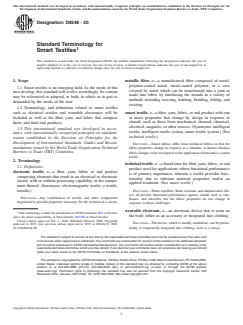
This international standard was developed in accordance with internationally recognized principles on standardization established in the Decision on Principles for the
Development of International Standards, Guides and Recommendations issued by the World Trade Organization Technical Barriers to Trade (TBT) Committee.
Designation: D8248 −20
Standard Terminology for
Smart Textiles
This standard is issued under the fixed designation D8248; the number immediately following the designation indicates the year of
original adoption or, in the case of revision, the year of last revision. A number in parentheses indicates the year of last reapproval. A
superscript epsilon (´) indicates an editorial change since the last revision or reapproval.
1. Scope metallic fiber, n—a manufactured fiber composed of metal,
polymer-coated metal, metal-coated polymer, or a core
1.1 Smart textiles is an emerging field. As the needs of this
covered by metal which can be transformed into a yarn or
area develop, this standard will evolve accordingly. Its content
made into fabric by interlacing the strands in a variety of
may be referenced or adopted, or both, in whole or in part as
methods including weaving, knitting, braiding, felting, and
demanded by the needs of the user.
twisting.
1.2 Terminology and definitions related to smart textiles
smart textile, n—a fiber, yarn, fabric, or end product with one
such as electrical textiles and wearable electronics will be
included as well as the fiber, yarn, and fabric that compose or more properties that change by design in response to
stimuli, such as those from mechanical, thermal, chemical,
them, and final end products.
electrical, magnetic, or other sources. (Synonyms: intelligent
1.3 This international standard was developed in accor-
textile, intelligent textile system, smart textile system.) (See
dance with internationally recognized principles on standard-
technical textile.)
ization established in the Decision on Principles for the
Development of International Standards, Guides and Recom-
DISCUSSION—Smart fabrics differ from technical fabrics in that the
mendations issued by the World Trade Organization Technical
fabric properties change in response to a stimulus. A thermo-chromic
Barriers to Trade (TBT) Committee. fabric changes color in response to the application of heat and is a smart
textile.
2. Terminology
technical textile, n—a broad term for fiber, yarn, fabric, or end
2.1 Definitions:
product used for applications where functional performance
electronic textile, n—a fiber, yarn, fabric or end product
is of primary importance; w
...
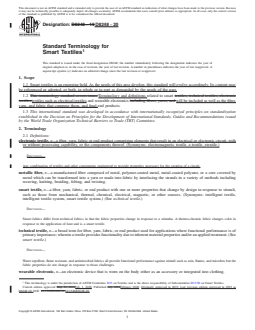
This document is not an ASTM standard and is intended only to provide the user of an ASTM standard an indication of what changes have been made to the previous version. Because
it may not be technically possible to adequately depict all changes accurately, ASTM recommends that users consult prior editions as appropriate. In all cases only the current version
of the standard as published by ASTM is to be considered the official document.
Designation: D8248 − 19 D8248 − 20
Standard Terminology for
Smart Textiles
This standard is issued under the fixed designation D8248; the number immediately following the designation indicates the year of
original adoption or, in the case of revision, the year of last revision. A number in parentheses indicates the year of last reapproval. A
superscript epsilon (´) indicates an editorial change since the last revision or reapproval.
1. Scope
1.1 Smart textiles is an emerging field. As the needs of this area develop, this standard will evolve accordingly. Its content may
be referenced or adopted, or both, in whole or in part as demanded by the needs of the user.
1.2 This terminology standard covers terms Terminology and definitions related to smart textiles, technical textiles, electronic
textiles,textiles such as electrical textiles and wearable electronics including fibers, yarns, and will be included as well as the fiber,
yarn, and fabric that compose them, and final end products.
1.3 This international standard was developed in accordance with internationally recognized principles on standardization
established in the Decision on Principles for the Development of International Standards, Guides and Recommendations issued
by the World Trade Organization Technical Barriers to Trade (TBT) Committee.
2. Terminology
2.1 Definitions:
electronic textile, n—a fiber, yarn, fabric or end product comprising elements that result in an electrical or electronic circuit, with
or without processing capability, or the components thereof. (Synonyms: electromagnetic textile, e-textile, etextile.)
DISCUSSION—
Any combination of textiles and other components engineered to provide properties necessary for the creation of a circuit.
metallic fiber, n—a manufactured fiber composed of metal, polymer-coated metal, metal-coated polymer, or a core covered by
metal which can be transformed into a yarn or made into fabric by interlacing the strands in a variety of methods including
weaving, knitting, braiding, felting, and twisting.
smart textile, n—a fiber, yarn, fabric, or end product with one or more properties that change by design in response to stimuli,
such as those from mechanical, thermal, chemical, electrical, magnetic, or other sources. (Synonyms: intelligent textile,
intelligent textile system, smart textile system.) (See t
...
Questions, Comments and Discussion
Ask us and Technical Secretary will try to provide an answer. You can facilitate discussion about the standard in here.
Loading comments...