

ASTM D3192-09(2019)
(Test Method)Standard Test Methods for Carbon Black Evaluation in NR (Natural Rubber)
General Information
- Abstract
SIGNIFICANCE AND USE
3.1 The major portion of carbon black consumed by the rubber industry is used to improve the physical properties, life expectancy, and utility of rubber products. These test methods provide a natural rubber formulation and directions for evaluating carbon black intended for use in rubber products.
3.2 These test methods may be used to characterize carbon black in terms of specific properties of the standard compound. These test methods are useful for the quality assurance of carbon black production. They may also be used for the preparation of reference compounds, to confirm the day-to-day reliability of testing operations used in the rubber industry, for the evaluation of experimental compounds, and quality control of production compounds.
SCOPE
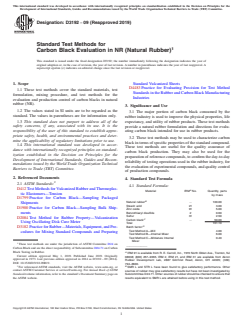
1.1 These test methods cover the standard materials, test formulation, mixing procedure, and test methods for the evaluation and production control of carbon blacks in natural rubber (NR).
1.2 The values stated in SI units are to be regarded as the standard. The values in parentheses are for information only.
1.3 This standard does not purport to address all of the safety concerns, if any, associated with its use. It is the responsibility of the user of this standard to establish appropriate safety, health, and environmental practices and determine the applicability of regulatory limitations prior to use.
1.4 This international standard was developed in accordance with internationally recognized principles on standardization established in the Decision on Principles for the Development of International Standards, Guides and Recommendations issued by the World Trade Organization Technical Barriers to Trade (TBT) Committee.
- Status
- Published
- Publication Date
- 30-Apr-2019
- Technical Committee
- D24 - Carbon Black
- Drafting Committee
- D24.71 - Carbon Black Testing in Rubber
Overview
ASTM D3192-09(2019): Standard Test Methods for Carbon Black Evaluation in NR (Natural Rubber) establishes standardized materials, formulations, mixing procedures, and test methods for the evaluation and production control of carbon blacks in natural rubber (NR). Developed by ASTM International, this standard serves the rubber industry by providing precise directions for evaluating carbon black, primarily used to enhance the physical properties, durability, and performance of rubber products. These test methods are integral to quality assurance, verification of testing operations, validation of reference compounds, and quality control in production environments.
Key Topics
- Standardized Testing Procedures: The document details sample preparation, conditioning, and mixing procedures including the use of mills and internal mixers to achieve consistent results.
- Evaluation Criteria: The test methods focus on characterizing carbon black based on its performance within a standard NR compound recipe, assessing parameters like tensile stress at 300% elongation, tensile strength, and ultimate elongation.
- Precision and Bias: Guidance is provided on repeatability and reproducibility within and across laboratories, with pooled values for critical properties to ensure test consistency.
- Quality Assurance: Through the evaluation of experimental and production compounds, manufacturers can monitor batch-to-batch consistency and production reliability.
- Reference Compounds: The use of reference rubbers and standardized formulations ensures compatibility and comparability of results between labs and across time.
- Preparation and Testing of Vulcanizates: Directions are given for preparing, curing, and testing rubber compounds using established ASTM methods, ensuring products meet specified physical property requirements.
Applications
ASTM D3192-09(2019) is widely utilized in several practical contexts within the rubber and tire industries, as well as in research and quality control laboratories. Key applications include:
- Rubber Compound Evaluation: Used to compare and validate different grades of carbon black in natural rubber formulations, ensuring optimized product performance.
- Quality Control: Manufacturers apply these methods for routine batch testing to detect inconsistencies in carbon black or compounding processes.
- Production Control: The standard helps maintain high-quality production standards for rubber products by providing criteria for accepting or rejecting production batches based on physical property data.
- Research and Development: The test methods support the development of new rubber compounds and the assessment of experimental carbon blacks under standardized conditions.
- Reference Compound Preparation: Essential for laboratories to prepare and maintain reference compounds, promoting reproducibility in daily operations and interlaboratory comparisons.
Related Standards
Several ASTM standards complement or are referenced within ASTM D3192-09(2019) for carbon black and rubber testing:
- ASTM D412: Test Methods for Vulcanized Rubber and Thermoplastic Elastomers - Tension
- ASTM D1799: Practice for Carbon Black - Sampling Packaged Shipments
- ASTM D1900: Practice for Carbon Black - Sampling Bulk Shipments
- ASTM D2084: Test Method for Rubber Property - Vulcanization Using Oscillating Disk Cure Meter
- ASTM D3182: Practice for Rubber-Materials, Equipment, and Procedures for Mixing Standard Compounds and Preparing Test Vulcanizates
- ASTM D4483: Practice for Evaluating Precision for Test Method Standards in the Rubber and Carbon Black Manufacturing Industries
These related standards provide additional protocols for sampling, preparation, mixing, curing, and evaluating the physical properties of rubber and carbon black, further supporting consistency and quality in the evaluation processes.
Summary
ASTM D3192-09(2019) is a vital standard for laboratories and manufacturers in the rubber industry focused on carbon black evaluation within natural rubber compounds. By following these test methods, organizations ensure reliable product performance, consistent quality control, and effective research and development across global production sites.
Relations
- Replaces
ASTM D3192-09(2014) - Standard Test Methods for Carbon Black Evaluation in NR (Natural Rubber) - Effective Date
- 01-May-2019
- Effective Date
- 01-Nov-2015
- Effective Date
- 01-Jun-2014
- Effective Date
- 01-May-2011
- Effective Date
- 01-Sep-2008
- Effective Date
- 01-Oct-2006
- Effective Date
- 01-Nov-2003
- Effective Date
- 10-Jun-2003
- Effective Date
- 10-Nov-2002
- Effective Date
- 10-Nov-1997
- Effective Date
- 15-Aug-1994
- Effective Date
- 01-May-2019
- Referred By
ASTM D8466-22 - Standard Guide for Recovered Carbon Black-Carbon Black Test Methods for Testing rCB - Effective Date
- 01-May-2019
- Referred By
ASTM D4122-17(2023) - Standard Practice for Carbon Black-Evaluation of an Industry Reference Black - Effective Date
- 01-May-2019
- Effective Date
- 01-May-2019
Get Certified
Connect with accredited certification bodies for this standard

DIN CERTCO
DIN Group product certification.

Smithers Quality Assessments
US management systems and product certification.
Sponsored listings
Frequently Asked Questions
ASTM D3192-09(2019) is a standard published by ASTM International. Its full title is "Standard Test Methods for Carbon Black Evaluation in NR (Natural Rubber)". This standard covers: SIGNIFICANCE AND USE 3.1 The major portion of carbon black consumed by the rubber industry is used to improve the physical properties, life expectancy, and utility of rubber products. These test methods provide a natural rubber formulation and directions for evaluating carbon black intended for use in rubber products. 3.2 These test methods may be used to characterize carbon black in terms of specific properties of the standard compound. These test methods are useful for the quality assurance of carbon black production. They may also be used for the preparation of reference compounds, to confirm the day-to-day reliability of testing operations used in the rubber industry, for the evaluation of experimental compounds, and quality control of production compounds. SCOPE 1.1 These test methods cover the standard materials, test formulation, mixing procedure, and test methods for the evaluation and production control of carbon blacks in natural rubber (NR). 1.2 The values stated in SI units are to be regarded as the standard. The values in parentheses are for information only. 1.3 This standard does not purport to address all of the safety concerns, if any, associated with its use. It is the responsibility of the user of this standard to establish appropriate safety, health, and environmental practices and determine the applicability of regulatory limitations prior to use. 1.4 This international standard was developed in accordance with internationally recognized principles on standardization established in the Decision on Principles for the Development of International Standards, Guides and Recommendations issued by the World Trade Organization Technical Barriers to Trade (TBT) Committee.
SIGNIFICANCE AND USE 3.1 The major portion of carbon black consumed by the rubber industry is used to improve the physical properties, life expectancy, and utility of rubber products. These test methods provide a natural rubber formulation and directions for evaluating carbon black intended for use in rubber products. 3.2 These test methods may be used to characterize carbon black in terms of specific properties of the standard compound. These test methods are useful for the quality assurance of carbon black production. They may also be used for the preparation of reference compounds, to confirm the day-to-day reliability of testing operations used in the rubber industry, for the evaluation of experimental compounds, and quality control of production compounds. SCOPE 1.1 These test methods cover the standard materials, test formulation, mixing procedure, and test methods for the evaluation and production control of carbon blacks in natural rubber (NR). 1.2 The values stated in SI units are to be regarded as the standard. The values in parentheses are for information only. 1.3 This standard does not purport to address all of the safety concerns, if any, associated with its use. It is the responsibility of the user of this standard to establish appropriate safety, health, and environmental practices and determine the applicability of regulatory limitations prior to use. 1.4 This international standard was developed in accordance with internationally recognized principles on standardization established in the Decision on Principles for the Development of International Standards, Guides and Recommendations issued by the World Trade Organization Technical Barriers to Trade (TBT) Committee.
ASTM D3192-09(2019) is classified under the following ICS (International Classification for Standards) categories: 83.040.20 - Rubber compounding ingredients. The ICS classification helps identify the subject area and facilitates finding related standards.
ASTM D3192-09(2019) has the following relationships with other standards: It is inter standard links to ASTM D3192-09(2014), ASTM D1900-06(2015), ASTM D1799-03a(2014), ASTM D1900-06(2011), ASTM D1799-03a(2008), ASTM D1900-06, ASTM D1799-03a, ASTM D1799-03, ASTM D1799-02, ASTM D1799-93(1997), ASTM D1900-94(2002), ASTM D8491-23, ASTM D8466-22, ASTM D4122-17(2023), ASTM D5817-20. Understanding these relationships helps ensure you are using the most current and applicable version of the standard.
ASTM D3192-09(2019) is available in PDF format for immediate download after purchase. The document can be added to your cart and obtained through the secure checkout process. Digital delivery ensures instant access to the complete standard document.
Standards Content (Sample)
This international standard was developed in accordance with internationally recognized principles on standardization established in the Decision on Principles for the
Development of International Standards, Guides and Recommendations issued by the World Trade Organization Technical Barriers to Trade (TBT) Committee.
Designation: D3192 − 09 (Reapproved 2019)
Standard Test Methods for
Carbon Black Evaluation in NR (Natural Rubber)
This standard is issued under the fixed designation D3192; the number immediately following the designation indicates the year of
original adoption or, in the case of revision, the year of last revision. A number in parentheses indicates the year of last reapproval. A
superscript epsilon (´) indicates an editorial change since the last revision or reapproval.
1. Scope Standard Vulcanized Sheets
D4483 Practice for Evaluating Precision for Test Method
1.1 These test methods cover the standard materials, test
Standards in the Rubber and Carbon Black Manufacturing
formulation, mixing procedure, and test methods for the
Industries
evaluation and production control of carbon blacks in natural
rubber (NR).
3. Significance and Use
1.2 The values stated in SI units are to be regarded as the
3.1 The major portion of carbon black consumed by the
standard. The values in parentheses are for information only.
rubber industry is used to improve the physical properties, life
1.3 This standard does not purport to address all of the
expectancy, and utility of rubber products. These test methods
safety concerns, if any, associated with its use. It is the
provide a natural rubber formulation and directions for evalu-
responsibility of the user of this standard to establish appro-
ating carbon black intended for use in rubber products.
priate safety, health, and environmental practices and deter-
3.2 These test methods may be used to characterize carbon
mine the applicability of regulatory limitations prior to use.
black in terms of specific properties of the standard compound.
1.4 This international standard was developed in accor-
These test methods are useful for the quality assurance of
dance with internationally recognized principles on standard-
carbon black production. They may also be used for the
ization established in the Decision on Principles for the
preparation of reference compounds, to confirm the day-to-day
Development of International Standards, Guides and Recom-
reliability of testing operations used in the rubber industry, for
mendations issued by the World Trade Organization Technical
the evaluation of experimental compounds, and quality control
Barriers to Trade (TBT) Committee.
of production compounds.
2. Referenced Documents
4. Standard Test Formula
2.1 ASTM Standards:
4.1 Standard Formula:
D412 Test Methods forVulcanized Rubber andThermoplas-
A
Material IRM No. Quantity, parts
tic Elastomers—Tension
by mass
D1799 Practice for Carbon Black—Sampling Packaged
B
Natural rubber . 100.00
Shipments
Stearic acid 21 3.00
D1900 Practice for Carbon Black—Sampling Bulk Ship-
Zinc oxide 91 5.00
ments Benzothiazyl disulfide 2 0.60
Sulfur 31 2.50
D2084 Test Method for Rubber Property—Vulcanization
C
Carbon black . 50.00
Using Oscillating Disk Cure Meter
Total 161.10
D
D3182 PracticeforRubber—Materials,Equipment,andPro- Batch factor:
Test Method A—Mill 4.00
cedures for Mixing Standard Compounds and Preparing
Test Method B—Internal Mixer 6.00
Test Method C—Miniature Internal 0.40
Mixer
These test methods are under the jurisdiction of ASTM Committee D24 on
_____________
Carbon Black and are the direct responsibility of Subcommittee D24.71 on Carbon
Black Testing in Rubber.
A
IRM 91 is available from R. E. Carroll, Inc., 1570 North OldenAve., Trenton, NJ
Current edition approved May 1, 2019. Published June 2019. Originally
08638; (800) 257–9365. IRM 2, IRM 21, and IRM 31 are available from Akron
approved in 1973. Last previous edition approved in 2014 as D3192 – 09 (2014).
Rubber Development Lab, 2887 Gilchrist Road, Akron, OH 44305; (330)
DOI: 10.1520/D3192-09R19.
794–6600.
B
For referenced ASTM standards, visit the ASTM website, www.astm.org, or
SMR L and STR L have been found to give satisfactory performance. Other
contact ASTM Customer Service at service@astm.org. For Annual Book of ASTM
sources of rubber may give satisfactory results but have not been investigated by
Standardsvolume information, refer to the standard’s Document Summary page on
Subcommittee D24.71. Other sources of rubber should be checked to ensure that
the ASTM website. results equivalent to SMR L are attained before using in this test method.
Copyright © ASTM International, 100 Barr Harbor Drive, PO Box C700, West Conshohocken, PA 19428-2959. United States
D3192 − 09 (2019)
C
Use 75.00 parts by mass of carbon blacks in the N-800 and N-900 series.
6.1.1.3 Cool on a flat, dry metal surface, at a temperature of
D
Weigh rubber and carbon black to the nearest 1 g, sulfur and accelerator to the
23 6 3°C for 1 to 24 h. Unless the relative humidity of the
nearest 0.02 g, and all other compounding materials to the nearest 0.1 g.
laboratory is controlled at 50 6 5 %, the sheeted stock should
5. Sampling and Sample Preparation be cooled and stored in a closed container to prevent moisture
absorption.
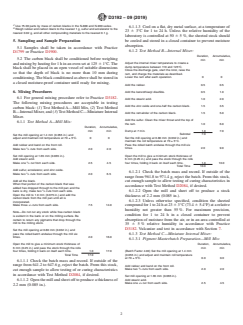
5.1 Samples shall be taken in accordance with Practice
6.1.2 Test Method B—Internal Mixer:
D1799 or Practice D1900.
Duration, Accumulative,
5.2 The carbon black shall be conditioned before weighing
min min
Adjust the internal mixer temperature to create a
and mixing by heating for1hinan oven set at 125 6 1°C.The
dump temperature between 110 and 125°C.
black shall be placed in an open vessel of suitable dimensions
Close the discharge gate, start the rotor, raise the
so that the depth of black is no more than 10 mm during
ram, and charge the materials as described.
Lower the ram after each operation. 0 0
conditioning.The black conditioned as above shall be stored in
a closed moisture-proof container until ready for mixing.
Add the rubber. 0.5 0.5
6. Mixing Procedures Add the benzothiazyl disulfide. 0.5 1.0
6.1 For general mixing procedure refer to Practice D3182.
Add the stearic acid. 1.0 2.0
The following mixing procedures are acceptable in testing
Add the zinc oxide and one-half the carbon black. 1.5 3.5
carbon black: (1) Test Method A—Mill Mix, (2) Test Method
B—Internal Mixer, and (3)Test Method C—Miniature Internal
Add the remainder of the carbon black. 1.5 5.0
Mixer.
Add the sulfur. Clean the mixer throat and the top of
6.1.1 Test Method A—Mill Mix:
the ram. 1.0 6.0
Duration, Accumulative,
Dump at 7 min. 1.0 7.0
min min
Subtotal 7.0
Set the mill opening at 1.4 mm (0.055 in.) and
adjust and maintain roll temperature at 70 ± 5°C. 0 0 Set the mill opening at 0.80 mm (0.032 in.) and
maintain the roll temperature at 70 ± 5°C.
Add rubber and band on the front roll. Pass the rolled batch endwise through the mill six
times. 2.0 9.0
Make two ⁄4 cuts from each side. 2.0 2.0
Open the mill to give a minimum stock thickness of
Set mill opening at 1.65 mm (0.065 in.).
Add stearic acid. 6 mm (0.25 in.) and pass the stock through the rolls
four times, folding it back on itself each time. 1.0 10.0
Make one ⁄4 cut from each side. 2.5 4.5
Total Time 10.0
Add sulfur, accelerator, and zinc oxide.
6.1.2.1 Check the batch mass and record. If outside of the
Make two ⁄4 cuts from each side. 2.0 6.5
range from 961.8 to 971.4 g, reject the batch. From this stock,
Add all the black.
cut enough sample to allow testing of curing characteristics in
When that portion of the carbon black that was
accordance with Test Method D2084, if desired.
added has dropped through to the mill pan and the
6.1.2.2 Open the mill and sheet off to produce a stock
bank is dry, make two ⁄4 cuts from each side.
Open the mill to 1.9 mm (0.075 in.) and add the
thickness of 2.2 mm (0.085 in.).
carbon black from the mill pan until all is
6.1.2.3 Unless otherwise specified, condition the sheeted
incorporated.
Make three ⁄4 cuts from each side. 7.5 14.0 compoundfor1to24hat23 63°C(73.4 65.4°F)atarelative
humidity not greater than 55 %. For maximum precision,
Note—Do not cut any stock while free carbon black
condition for 1 to 24 h in a closed container to prevent
is evident in the bank or on the milling surface. Be
certain to return any pigments that drop through the absorption of moisture from the air, or in an area controlled at
mill to the milling stock.
35 6 5 % relative humidity in accordance with Practice
D3182. Vulcanize and test in accordance with Section 7.
Set the mill opening at 0.80 mm (0.032 in.) and
pass the rolled batch endwise through the mill six
6.1.3 Test Method C—Miniature Internal Mixer:
times. 2.0 16.0
6.1.3.1 Pigment Masterbatch Preparation—Mill Mix:
Open the mill to give a minimum stock thickness of Duration, Accumulative,
6 mm (0.25 in.) and pass the stock through the rolls min min
four times, folding it back on itself each time. 1.0 17.0 (Batch Factor 4.00) Set the mill opening at 1.4 mm
Total Time 17.0 (0.055 in.) and adjust and maintain roll temperature
at 70 ± 5°C. 0.0 0.0
6.1.1.1 Check the batch mass and record. If outside of the
range from 641.2 to 647.6 g, reject the batch. From this stock,
Add rubber and band on the front roll.
Make two ⁄4 cuts from each side. 2.0 2.0
cut enough sample to allow testing of or curing characteristics
in accordance with Test Method D2084, if desired.
Set mill opening at 1.65 mm (0.065 in.).
6.1.1.2 Open the mill and sheet off to produce a thickness of Add stearic acid.
Make one ⁄4 cut from each side. 2.5 4.5
2.2 mm (0.085 in.).
D3192 − 09 (2019)
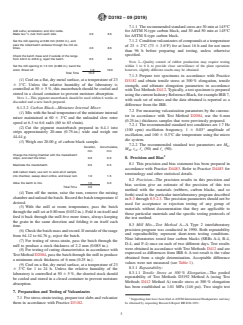
7.1.1 The recommended standard cures are 30 min at 145°C
Add sulfur, accelerator, and zinc oxide.
for ASTM N-type carbon black, and 30 and 50 min at 145°C
Make two ⁄4 cuts from each side. 2.0 6.5
for ASTM S-type carbon black.
7.1.2 Condition vulcanizates of compounds at a temperature
Set the mill opening at 0.80 mm (0.032 in.), and
pass the rolled batch endwise through the mill six
of 23 6 2°C (73 6 3.6°F) for at least 16 h and for not more
times. 2.0 8.5
than 96 h before preparing and testing, unless otherwise
specified.
Check the batch mass and if outside of the range
from 442.2 to 446.6 g, reject the batch. 0.5 9.0
NOTE 2—Quality control of rubber production may require testing
Set the mill opening to 1.5 mm (0.060 in.), band the within 1 to6hto provide close surveillance of the plant operation;
stock. Sheet off. 1.0 10.0
however, slightly different results may be obtained.
Total Time 10.0
7.1.3 Prepare test specimens in accordance with Practice
(1) Cool on a flat, dry metal surface, at a temperature of 23
D3182 and obtain tensile stress at 300 % elongation, tensile
6 3°C. Unless the relative humidity of the laboratory is
strength, and ultimate elongation parameters in accordance
controlled at 50 6 5 %, this masterbatch should be cooled and
withTestMethodsD412.Typically,atestspecimenisprepared
stored in a closed container to prevent moisture absorption.
usingthecurrentIndustryReferenceBlack,forexampleIRB7,
NOTE 1—This pigment masterbatch should be used within 6 weeks or
with each set of mixes and the data obtained is reported as a
discarded and a new batch prepared.
difference from the IRB.
6.1.3.2 Carbon Black—Miniature Internal Mixer:
7.2 For measuring vulcanization parameters by the cureme-
(1) Mix with the head temperature of the miniature internal
ter in accordance with Test Method D2084, use the 6-mm
mixer maintained at 60 6 3°C and the unloaded slow rotor
(0.25-in.) thickness samples that were previously prepared.
speed at 6.3 to 6.6 rad/s (60 to 63 r/min).
7.2.1 The recommended standard test conditions are 1.7 Hz
(2) Cut the pigment masterbatch prepared in 6.4.1 into
(100 cpm) oscillation frequency, 1 6 0.03° amplitude of
strips approximately 20-mm (0.75-in.) wide and weigh out
oscillation, and 160 6 0.3°C die temperature using the micro
44.44 g.
die system.
(3) Weigh out 20.00 g of carbon black sample.
7.2.2 The recommended standard test parameters are M ,
L
Duration, Accumulative,
M , t , t' (50) and t' (90).
H s1 c c
min min
Charge the mixing chamber with the masterbatch
8. Precision and Bias
strips, and start the timer. 0.0 0.0
8.1 This precision and bias statement has been prepared in
Masticate the masterbatch. 0.5 0.5
accordance with Practice D4483. Refer to Practice D4483 for
Add carbon black, use ram to work all of sample
terminology and other statistical details.
into chamber, sweep down orifice, and lower ram. 1.0 1.5
8.2 Precision—The precision results in this precision and
Allow the batch to mix. 1.5 3.0
bias section give an estimate of the precision of this test
Total Time 3.0
method with the materials (rubbers, carbon blacks, and so
(4) Turn off the motor, raise the ram, remove the mixing
forth) used in the particular interlaboratory program described
chamber and unload the batch. Record the batch temperature if
in 8.3 through 8.5.2.3. The precision parameters should not be
desired.
used for acceptance or rejection testing of any group of
(5) With the mill at room temperature, pass the batch
materials without documentation that they are applicable to
through the mill set at 0.80 mm (0.032 in.). Fold it on itself and
those particular materials and the specific testing protocols of
feed it back through the mill five more times, always keeping
the test method.
the grain in the same direction and folding it on itself each
8.3 Mill Mix—Test Method A—A Type 2 interlaboratory
time.
precision program was conducted in 1990. Both repeatability
(6) Checkthebatchmassandrecord.Ifoutsideoftherange
and reproducibility represent short-term testing conditions.
from 64.12 to 64.76 g, reject the batch.
Nine laboratories tested four carbon blacks (SRBs A-4, B-4,
(7) For testing of stress-strain, pass the batch through the
D-4, and F-4) once on each of two different days. Test results
mill to produce a stock thickness of 2.2 mm (0.085 in.).
were obtained in accordance with Test Methods D412 and are
(8) For testing of curing characteristics in accordance with
expressed as differences from IRB 6. A test result is the value
Test Method D2084, pass the batch through the mill to produce
obtained from a single determination. Acceptable difference
a minimum stock thickness of 6 mm (0.25 in.).
values were not measured (see Table 1).
(9) Cool on a flat, dry metal surface, at a temperature of 23
8.3.1 Repeatability:
6 3°C for 1 to 24 h. Unless the relative humidity of the
8.3.1.1 Tensile Stress at 300% Elongation—The pooled
laboratory is controlled at 50 6 5 %, the sheeted stock should
repeatability of Test Methods D3192 Method A (using Test
be cooled and stored in a closed container to prevent moisture
Methods D412 Method A) tensile stress at 300 % elongation
absorption.
has been established as 1.01 MPa (146 psi). Two single test
7. Preparation and Testing of Vulcanizates
7.1 For stress-strain testing, prepare test slabs and vulcanize
Supporting data have been filed at ASTM International Headquarters and may
them in accordance with Practice D3182. be obtained by requesting Research Report RR:D24-1031.
D3192 − 09 (2019)
A
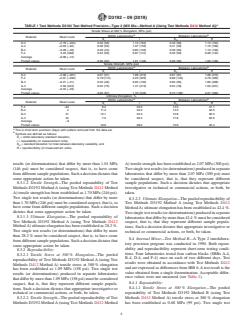
TABLE 1 Test Methods D3192 Test Method Precision—Type 2 (Mill Mix—Method A (Using Test Methods D412 Method A))
Tensile Stress at 300 % Elongation, MPa (psi)
B B
Within Laboratories Between Laboratories
Material Mean Level
S rS R
r R
D-4 −2.79 (−404) 0.40 (58) 1.13 (164) 0.40 (58) 1.13 (164)
A-4 −0.63 (−92) 0.38 (55) 1.07 (155) 0.41 (59) 1.15 (166)
B
...