

ASTM F3046-21
(Specification)Standard Specification for Wrought Titanium-3Aluminum-2.5Vanadium Alloy for Surgical Implant Applications (UNS R56320)
General Information
- Abstract
ABSTRACT
This specification establishes the chemical, physical, mechanical, and metallurgical requirements for wrought titanium-3aluminum-2.5vanadium alloy (R56320) to be used in the manufacture of surgical implants. It covers various titanium mill products that are normally formed with the conventional forging and rolling equipment found in primary ferrous and nonferrous plants. The alloy is usually multiple melted in arc furnaces (including furnaces such as plasma arc and electron beam) of a type conventionally used for reactive metals.
SCOPE
1.1 This specification covers the chemical, mechanical, and metallurgical requirements for wrought titanium-3aluminum-2.5vanadium alloy (R56320) to be used in the manufacture of surgical implants.
1.2 The values stated in either SI units or inch-pound units are to be regarded separately as standard. The values stated in each system may not be exact equivalents; therefore, each system shall be used independently of the other. Combining values of the two systems may result in nonconformance within the standard.
1.3 This standard does not purport to address all of the safety concerns, if any, associated with its use. It is the responsibility of the user of this standard to establish appropriate safety, health, and environmental practices and determine the applicability of regulatory limitations prior to use.
1.4 This international standard was developed in accordance with internationally recognized principles on standardization established in the Decision on Principles for the Development of International Standards, Guides and Recommendations issued by the World Trade Organization Technical Barriers to Trade (TBT) Committee.
- Status
- Published
- Publication Date
- 30-Sep-2021
- Technical Committee
- F04 - Medical and Surgical Materials and Devices
- Drafting Committee
- F04.12 - Metallurgical Materials
Buy Documents
ASTM F3046-21 - Standard Specification for Wrought Titanium-3Aluminum-2.5Vanadium Alloy for Surgical Implant Applications (UNS R56320)
REDLINE ASTM F3046-21 - Standard Specification for Wrought Titanium-3Aluminum-2.5Vanadium Alloy for Surgical Implant Applications (UNS R56320)
Overview
ASTM F3046-21 is the international standard specification for wrought Titanium-3Aluminum-2.5Vanadium Alloy (UNS R56320), specifically designed for surgical implant applications. Developed by ASTM, this standard outlines the chemical, mechanical, and metallurgical requirements for various forms of this titanium alloy, which is widely used in medical devices due to its strength, corrosion resistance, and biocompatibility. ASTM F3046-21 ensures consistent quality and performance in titanium alloy products manufactured for implantation in the human body.
Key Topics
- Material Composition and Purity: The standard specifies strict limits on alloying and residual elements, including aluminum, vanadium, iron, cobalt, and interstitial elements like nitrogen, oxygen, carbon, and hydrogen. Titanium remains the balance of composition.
- Mechanical Properties: Requirements for tensile strength, yield strength, elongation, and reduction of area are outlined for annealed strips, sheets, plates, bars, wire, and forgings. These properties ensure sufficient strength and ductility in surgical implants.
- Product Forms: The standard covers a range of titanium mill product forms, including:
- Strip
- Sheet
- Plate
- Bar
- Forging bar
- Wire
- Custom shapes by agreement
- Manufacturing and Heat Treatment: Material is to be produced using arc melting (including plasma and electron beam furnace technology) and formed using conventional methods. It may be furnished in the annealed or cold-worked condition.
- Quality and Certification: Producers are required to have certified quality systems (such as ISO 9001 or ISO 13485) and must provide certification that all material meets the specification.
- Testing and Inspection: The standard references several ASTM and ISO test methods for chemical analysis, mechanical testing, and ultrasonic inspection of titanium and its alloys.
Applications
ASTM F3046-21 is essential for manufacturers and suppliers of titanium alloy materials used in the production of:
- Orthopedic Implants: Hip and knee replacements, bone plates, screws, and spinal devices.
- Dental Implants: Artificial tooth roots and related surgical components.
- Cardiovascular Devices: Components for pacemakers and artificial heart valves.
- Craniofacial Reconstruction: Plates and fasteners for surgical repair of facial structures.
This specification is intended for raw material producers, component fabricators, and medical device manufacturers seeking to ensure the highest standards of safety, bio-compatibility, and device reliability in surgical applications.
Related Standards
Organizations working with ASTM F3046-21 should be aware of these important related standards:
- ASTM B367: Specification for Titanium and Titanium Alloy Castings
- ASTM E8/E8M: Test Methods for Tension Testing of Metallic Materials
- ASTM E290: Test Methods for Bend Testing of Material for Ductility
- ISO 6892: Metallic Materials Tensile Testing at Ambient Temperature
- ISO 9001: Quality Management Systems-Requirements
- ISO 13485: Medical Devices-Quality Management Systems for Regulatory Purposes
- AMS 2249 & AMS 2631: Aerospace material and inspection standards relevant for chemical analysis and ultrasonic inspection
Practical Value
Implementing ASTM F3046-21 helps ensure:
- Consistent Material Performance: By adhering to defined chemical and mechanical properties, implant materials meet rigorous safety and efficacy standards.
- Regulatory Compliance: The specification aligns with international regulations, including EU MDR and CLP requirements for medical devices.
- Enhanced Patient Safety: The documented history of biocompatibility testing and real-world clinical use supports safe outcomes in surgical implant applications.
- Streamlined Supply Chain: Clear definitions for product forms and ordering information facilitate precise communication between suppliers, manufacturers, and regulators.
Keywords: ASTM F3046-21, wrought titanium alloy, Titanium-3Aluminum-2.5Vanadium, surgical implants, medical device materials, biocompatibility, titanium alloys for surgery, orthopedic titanium standard.
Relations
- Effective Date
- 01-Jan-2024
- Effective Date
- 01-Mar-2019
- Effective Date
- 15-Jul-2016
- Effective Date
- 01-Feb-2015
- Effective Date
- 01-Jun-2013
- Effective Date
- 01-Apr-2013
- Effective Date
- 01-Dec-2011
- Effective Date
- 01-May-2011
- Effective Date
- 01-Dec-2010
- Effective Date
- 01-May-2009
- Effective Date
- 01-Mar-2009
- Effective Date
- 01-Nov-2008
- Effective Date
- 01-Oct-2008
- Effective Date
- 01-Aug-2008
- Effective Date
- 15-Jun-2008
Buy Documents
ASTM F3046-21 - Standard Specification for Wrought Titanium-3Aluminum-2.5Vanadium Alloy for Surgical Implant Applications (UNS R56320)
REDLINE ASTM F3046-21 - Standard Specification for Wrought Titanium-3Aluminum-2.5Vanadium Alloy for Surgical Implant Applications (UNS R56320)
Get Certified
Connect with accredited certification bodies for this standard

BSI Group
BSI (British Standards Institution) is the business standards company that helps organizations make excellence a habit.

TÜV Rheinland
TÜV Rheinland is a leading international provider of technical services.

TÜV SÜD
TÜV SÜD is a trusted partner of choice for safety, security and sustainability solutions.
Sponsored listings
Frequently Asked Questions
ASTM F3046-21 is a technical specification published by ASTM International. Its full title is "Standard Specification for Wrought Titanium-3Aluminum-2.5Vanadium Alloy for Surgical Implant Applications (UNS R56320)". This standard covers: ABSTRACT This specification establishes the chemical, physical, mechanical, and metallurgical requirements for wrought titanium-3aluminum-2.5vanadium alloy (R56320) to be used in the manufacture of surgical implants. It covers various titanium mill products that are normally formed with the conventional forging and rolling equipment found in primary ferrous and nonferrous plants. The alloy is usually multiple melted in arc furnaces (including furnaces such as plasma arc and electron beam) of a type conventionally used for reactive metals. SCOPE 1.1 This specification covers the chemical, mechanical, and metallurgical requirements for wrought titanium-3aluminum-2.5vanadium alloy (R56320) to be used in the manufacture of surgical implants. 1.2 The values stated in either SI units or inch-pound units are to be regarded separately as standard. The values stated in each system may not be exact equivalents; therefore, each system shall be used independently of the other. Combining values of the two systems may result in nonconformance within the standard. 1.3 This standard does not purport to address all of the safety concerns, if any, associated with its use. It is the responsibility of the user of this standard to establish appropriate safety, health, and environmental practices and determine the applicability of regulatory limitations prior to use. 1.4 This international standard was developed in accordance with internationally recognized principles on standardization established in the Decision on Principles for the Development of International Standards, Guides and Recommendations issued by the World Trade Organization Technical Barriers to Trade (TBT) Committee.
ABSTRACT This specification establishes the chemical, physical, mechanical, and metallurgical requirements for wrought titanium-3aluminum-2.5vanadium alloy (R56320) to be used in the manufacture of surgical implants. It covers various titanium mill products that are normally formed with the conventional forging and rolling equipment found in primary ferrous and nonferrous plants. The alloy is usually multiple melted in arc furnaces (including furnaces such as plasma arc and electron beam) of a type conventionally used for reactive metals. SCOPE 1.1 This specification covers the chemical, mechanical, and metallurgical requirements for wrought titanium-3aluminum-2.5vanadium alloy (R56320) to be used in the manufacture of surgical implants. 1.2 The values stated in either SI units or inch-pound units are to be regarded separately as standard. The values stated in each system may not be exact equivalents; therefore, each system shall be used independently of the other. Combining values of the two systems may result in nonconformance within the standard. 1.3 This standard does not purport to address all of the safety concerns, if any, associated with its use. It is the responsibility of the user of this standard to establish appropriate safety, health, and environmental practices and determine the applicability of regulatory limitations prior to use. 1.4 This international standard was developed in accordance with internationally recognized principles on standardization established in the Decision on Principles for the Development of International Standards, Guides and Recommendations issued by the World Trade Organization Technical Barriers to Trade (TBT) Committee.
ASTM F3046-21 is classified under the following ICS (International Classification for Standards) categories: 11.040.30 - Surgical instruments and materials. The ICS classification helps identify the subject area and facilitates finding related standards.
ASTM F3046-21 has the following relationships with other standards: It is inter standard links to ASTM E8/E8M-24, ASTM E539-19, ASTM E8/E8M-16, ASTM E8/E8M-15, ASTM E8/E8M-13, ASTM E290-13, ASTM E8/E8M-11, ASTM E539-11, ASTM E1941-10, ASTM B367-09, ASTM E1447-09, ASTM B367-08b, ASTM E29-08, ASTM B367-08a, ASTM E1409-08. Understanding these relationships helps ensure you are using the most current and applicable version of the standard.
ASTM F3046-21 is available in PDF format for immediate download after purchase. The document can be added to your cart and obtained through the secure checkout process. Digital delivery ensures instant access to the complete standard document.
Standards Content (Sample)
This international standard was developed in accordance with internationally recognized principles on standardization established in the Decision on Principles for the
Development of International Standards, Guides and Recommendations issued by the World Trade Organization Technical Barriers to Trade (TBT) Committee.
Designation:F3046 −21
Standard Specification for
Wrought Titanium-3Aluminum-2.5Vanadium Alloy for
Surgical Implant Applications (UNS R56320)
This standard is issued under the fixed designation F3046; the number immediately following the designation indicates the year of
original adoption or, in the case of revision, the year of last revision.Anumber in parentheses indicates the year of last reapproval.A
superscript epsilon (´) indicates an editorial change since the last revision or reapproval.
1. Scope* E539Test Method for Analysis of Titanium Alloys by
WavelengthDispersiveX-RayFluorescenceSpectrometry
1.1 This specification covers the chemical, mechanical, and
E1409TestMethodforDeterminationofOxygenandNitro-
metallurgical requirements for wrought titanium-3aluminum-
gen in Titanium and TitaniumAlloys by Inert Gas Fusion
2.5vanadium alloy (R56320) to be used in the manufacture of
E1447Test Method for Determination of Hydrogen in Tita-
surgical implants.
nium and Titanium Alloys by Inert Gas Fusion Thermal
1.2 The values stated in either SI units or inch-pound units
Conductivity/Infrared Detection Method
are to be regarded separately as standard. The values stated in
E1941Test Method for Determination of Carbon in Refrac-
each system may not be exact equivalents; therefore, each
toryandReactiveMetalsandTheirAlloysbyCombustion
system shall be used independently of the other. Combining
Analysis
values of the two systems may result in nonconformance
E2371Test Method for Analysis of Titanium and Titanium
within the standard.
AlloysbyDirectCurrentPlasmaandInductivelyCoupled
1.3 This standard does not purport to address all of the
Plasma Atomic Emission Spectrometry (Performance-
safety concerns, if any, associated with its use. It is the Based Test Methodology)
responsibility of the user of this standard to establish appro-
E2994Test Method for Analysis of Titanium and Titanium
priate safety, health, and environmental practices and deter- AlloysbySparkAtomicEmissionSpectrometryandGlow
mine the applicability of regulatory limitations prior to use.
Discharge Atomic Emission Spectrometry (Performance-
1.4 This international standard was developed in accor- Based Method)
dance with internationally recognized principles on standard-
2.2 ISO Standards:
ization established in the Decision on Principles for the
ISO 6892Metallic Materials Tensile Testing at Ambient
Development of International Standards, Guides and Recom-
Temperature
mendations issued by the World Trade Organization Technical
ISO 9001Quality Management Systems—Requirements
Barriers to Trade (TBT) Committee.
ISO 13485 Medical Devices—Quality Management
Systems—Requirements for Regulatory Purposes
2. Referenced Documents
2.3 Aerospace Material Specifications:
2.1 ASTM Standards:
AMS 2249Chemical Check Analysis Limits, Titanium and
B367Specification for Titanium and Titanium Alloy Cast-
Titanium Alloys
ings
AMS 2631Ultrasonic Inspection—Titanium and Titanium
E8/E8MTest Methods for Tension Testing of Metallic Ma-
Alloy Bar and Billet
terials
E29Practice for Using Significant Digits in Test Data to
3. Terminology
Determine Conformance with Specifications
3.1 Definitions of Terms Specific to This Standard:
E290Test Methods for Bend Testing of Material for Ductil-
3.1.1 beta transus, n—the minimum temperature at which
ity
the alpha-plus-beta phase can transform to 100% beta phase.
3.1.2 lot, n—the total number of mill products produced
This specification is under the jurisdiction of ASTM Committee F04 on
Medical and Surgical Materials and Devices and is the direct responsibility of
fromoneheatunderthesameconditionsatessentiallythesame
Subcommittee F04.12 on Metallurgical Materials.
time.
Current edition approved Oct. 1, 2021. Published November 2021. Originally
approved in 2013. Last previous edition approved in 2013 as F3046–13. DOI:
10.1520/F3046-21.
2 3
For referenced ASTM standards, visit the ASTM website, www.astm.org, or Available fromAmerican National Standards Institute (ANSI), 25 W. 43rd St.,
contact ASTM Customer Service at service@astm.org. For Annual Book of ASTM 4th Floor, New York, NY 10036, http://www.ansi.org.
Standards volume information, refer to the standard’s Document Summary page on AvailablefromSAEInternational(SAE),400CommonwealthDr.,Warrendale,
the ASTM website. PA 15096-0001, http://www.sae.org.
*A Summary of Changes section appears at the end of this standard
Copyright © ASTM International, 100 Barr Harbor Drive, PO Box C700, West Conshohocken, PA 19428-2959. United States
F3046−21
4. Product Classification peeled, polished, combinations of these operations, or as
specified by the purchaser. On billets, bars, plates, and
4.1 Strip—Any product under 4.75 mm [0.1875 in.] in
forgings, it is permissible to remove minor surface imperfec-
thickness and under 610 mm [24 in.] wide.
tions by grinding if the resultant area meets the dimensional
4.2 Sheet—Any product under 4.75 mm [0.1875 in.] in
and surface finish requirements of this specification.
thickness and 610 mm [24 in.] or more in width.
6.3 Condition—Material shall be furnished in the annealed
4.3 Plate—Any product 4.75 mm [0.1875 in.] thick and
or cold-worked condition. Mechanical properties for condi-
over and 250 mm [10 in.] wide and over, with widths greater
tions other than those listed in Table 1 may be established by
than five times thickness. Plate up to 101.60 mm [4.00 in.]
agreement between the supplier and the purchaser.
thick, inclusive, is covered by this specification.
7. Chemical Requirements
4.4 Bar—Round, rectangular, or other complex shaped
product delivered straightened and cut to defined lengths.
7.1 The heat analysis shall conform to the chemical com-
position specified in Table 2. Ingot analysis may be used for
4.5 Forging Bar—Bar as described in 4.4, used for produc-
reportingallchemicalrequirements,excepthydrogen.Samples
tionofforgings,maybefurnishedinthehot-workedcondition.
forhydrogenshallbetakenfromthefinishedmillproduct.The
4.6 Wire—Round, rectangular, or other complex shapes of
supplier shall not ship material with chemistry outside the
uniform cross section along its entire length furnished in coils
requirements specified in Table 2.
or on spools, reels, or other packaging as specified.
7.1.1 Requirements for the major and minor elemental
4.7 Other—Other forms and shapes may be provided by
constituents are listed in Table 2. Also listed are important
agreement between purchaser and supplier.
residualelements.AnalysisforelementsnotlistedinTable2is
not required to verify compliance with this specification.
5. Ordering Information
7.2 Product (Check) Analysis:
5.1 Include with inquiries and orders for material under this
7.2.1 Product (check) analysis tolerances shall conform to
specification the following information:
the product tolerances in Table 3 per AMS 2249 and Specifi-
5.1.1 Quantity,
cation B367. The product analysis tolerances do not broaden
5.1.2 ASTM designation and date of issue,
the specified heat (ladle or ingot) analysis requirements but
5.1.3 Form (sheet, strip, plate, bar, forging bar, or wire),
cover variations between laboratories in the measurement of
5.1.4 Condition (see 6.3),
chemical content.
5.1.5 Mechanical properties (if applicable, for special
7.2.2 Product (check) analysis limits are not for supplier’s/
conditions),
producer’s use at supplier’s/producer’s acceptance testing.
5.1.6 Finish (see 6.2),
Product (check) analysis limits are not permitted to be applied
5.1.7 Applicable dimensions including size, thickness,
to ladle or ingot analysis. The supplier/producer shall not ship
width, length, or drawing number,
material that is outside the limits specified in Table 1.
5.1.8 Special tests, if any, and
7.2.3 A product (check) analysis is one performed by the
5.1.9 Other requirements.
purchaserorsupplierofthemetalafterithasbeenworkedinto
semi-finished or finished forms or fabricated into parts, and is
6. Materials and Manufacture
either for the purpose of verifying the composition of a heat or
6.1 The various titanium mill products covered in this
manufacturinglotordeterminingvariationsinthecomposition
specification normally are formed with the conventional forg-
withintheheat.Intheanalysisoffinishedparts,thesevaluesdo
ing and rolling equipment found in primary ferrous and
not apply to elements whose percentage can be varied by
nonferrous plants. The alloy is usually multiple melted in arc
fabricating technique employed (for example, oxygen,
furnaces (including furnaces such as plasma arc and electron
nitrogen, hydrogen) unless the sample is sufficiently large to
beam) of a type conventionally used for reactive metals.
produce a reliable result.
6.2 Finish—The mill product may be furnished to the 7.2.4 Acceptance or rejection of a heat or manufacturing lot
implant manufacturer as mechanically descaled or pickled, of material may be made by the purchaser on the basis of this
abrasively blasted, chemically milled, ground, machined, product (check) analysis. Product (check) analysis outside the
TABLE 1 Annealed Mechanical Properties of Sheet, Strip, Plate, Bar, Wire, and Forgings
A
Nominal Diameter Tensile Strength Yield Strength
Elongation
B
Reduction of Area
or Distance Between min, (0.2 % offset) min, in 50 mm [2 in.],
min, %
min, %
Parallel Sides, mm [in.] MPa [psi] MPa [psi]
Under 4.75 [0.1875] thickness or diameter 620 [90 000] 485 [70 000] 15 .
4.75 [0.1875] to 101.60 [4.00], incl. 620 [90 000] 485 [70 000] 15 25
A
Elongation of material 1.6 mm [0.063 in.] greater width (W) shall be measured using a gauge length of 50.8 mm [2 in.] or 4 W. The gauge length must be reported with
the test results. The method for determining elongation of material less than 1.6 mm [0.063 in.] in thickness may be negotiated. Alternatively, a gauge length corresponding
to ISO 6892 may be used when agreed upon between supplier and purchaser. (5.65 times the square root of So, where So is the original cross sectional area.) Gauge
length shall be reported with the elongation value.
B
Applies to plate only.
F3046−21
TABLE 2 Chemical Requirements
representative of the same lot, in the same manner, for each
Composition, % failed test specimen. The lot will be considered in compliance
Element
(mass/mass)
only
...
This document is not an ASTM standard and is intended only to provide the user of an ASTM standard an indication of what changes have been made to the previous version. Because
it may not be technically possible to adequately depict all changes accurately, ASTM recommends that users consult prior editions as appropriate. In all cases only the current version
of the standard as published by ASTM is to be considered the official document.
Designation: F3046 − 13 F3046 − 21
Standard Specification for
Wrought Titanium-3Aluminum-2.5Vanadium Alloy for
Surgical Implant Applications (UNS R56320)
This standard is issued under the fixed designation F3046; the number immediately following the designation indicates the year of
original adoption or, in the case of revision, the year of last revision. A number in parentheses indicates the year of last reapproval. A
superscript epsilon (´) indicates an editorial change since the last revision or reapproval.
1. Scope Scope*
1.1 This specification covers the chemical, mechanical, and metallurgical requirements for wrought titanium-3aluminum-
2.5vanadium alloy (R56320) to be used in the manufacture of surgical implants.
1.2 The values stated in either SI units or inch-pound units are to be regarded separately as standard. The values stated in each
system may not be exact equivalents; therefore, each system shall be used independently of the other. Combining values of the
two systems may result in nonconformance within the standard.
1.3 This standard does not purport to address all of the safety concerns, if any, associated with its use. It is the responsibility
of the user of this standard to establish appropriate safety, health, and environmental practices and determine the applicability of
regulatory limitations prior to use.
1.4 This international standard was developed in accordance with internationally recognized principles on standardization
established in the Decision on Principles for the Development of International Standards, Guides and Recommendations issued
by the World Trade Organization Technical Barriers to Trade (TBT) Committee.
2. Referenced Documents
2.1 ASTM Standards:
B367 Specification for Titanium and Titanium Alloy Castings
E8/E8M Test Methods for Tension Testing of Metallic Materials
E29 Practice for Using Significant Digits in Test Data to Determine Conformance with Specifications
E290 Test Methods for Bend Testing of Material for Ductility
E539 Test Method for Analysis of Titanium Alloys by Wavelength Dispersive X-Ray Fluorescence Spectrometry
E1409 Test Method for Determination of Oxygen and Nitrogen in Titanium and Titanium Alloys by Inert Gas Fusion
E1447 Test Method for Determination of Hydrogen in Titanium and Titanium Alloys by Inert Gas Fusion Thermal
Conductivity/Infrared Detection Method
E1941 Test Method for Determination of Carbon in Refractory and Reactive Metals and Their Alloys by Combustion Analysis
E2371 Test Method for Analysis of Titanium and Titanium Alloys by Direct Current Plasma and Inductively Coupled Plasma
Atomic Emission Spectrometry (Performance-Based Test Methodology)
E2994 Test Method for Analysis of Titanium and Titanium Alloys by Spark Atomic Emission Spectrometry and Glow Discharge
Atomic Emission Spectrometry (Performance-Based Method)
This test method specification is under the jurisdiction of ASTM Committee F04 on Medical and Surgical Materials and Devices and is the direct responsibility of
Subcommittee F04.12 on Metallurgical Materials.
Current edition approved Dec. 1, 2013Oct. 1, 2021. Published January 2014November 2021. Originally approved in 2013. Last previous edition approved in 2013 as
F3046 – 13. DOI: 10.1520/F3046-13.10.1520/F3046-21.
For referenced ASTM standards, visit the ASTM website, www.astm.org, or contact ASTM Customer Service at service@astm.org. For Annual Book of ASTM Standards
volume information, refer to the standard’s Document Summary page on the ASTM website.
*A Summary of Changes section appears at the end of this standard
Copyright © ASTM International, 100 Barr Harbor Drive, PO Box C700, West Conshohocken, PA 19428-2959. United States
F3046 − 21
2.2 ISO Standards:
ISO 6892 Metallic Materials Tensile Testing at Ambient Temperature
ISO 9001 Quality Management Systems RequirementsSystems—Requirements
ISO 13485 Medical Devices—Quality Management Systems—Requirements for Regulatory Purposes
2.3 ASQ Standard:
ASQ C1 Specifications of General Requirements for a Quality Control Program
2.3 Aerospace Material Specifications:
AMS 2249 Chemical Check Analysis Limits, Titanium and Titanium Alloys
AMS 2631 Ultrasonic Inspection—Titanium and Titanium Alloy Bar and Billet
3. Terminology
3.1 Definitions of Terms Specific to This Standard:
3.1.1 beta transus, n—the minimum temperature at which the alpha plus beta alpha-plus-beta phase can transform to 100 % beta
phase.
3.1.2 lot, n—the total number of mill products produced from one heat under the same conditions at essentially the same time.
4. Product Classification
4.1 Strip—Any product under 4.75 mm (0.1875 in.)[0.1875 in.] in thickness and under 610 mm (24 in.)[24 in.] wide.
4.2 Sheet—Any product under 4.75 mm (0.1875 in.)[0.1875 in.] in thickness and 610 mm (24 in.)[24 in.] or more in width.
4.3 Plate—Any product 4.75 mm (0.1875 in.)[0.1875 in.] thick and over and 250 mm (10 in.)[10 in.] wide and over, with widths
greater than five times thickness. Plate up to 101.60 mm (4.00 in.), thick inclusive[4.00 in.] thick, inclusive, is covered by this
specification.
4.4 Bar—Round bars and flats from 4.75 mm (0.1875 in.) to 101.60 mm (4.00 in.) in diameter or thickness (other sizes and shapes
by special order).Round, rectangular, or other complex shaped product delivered straightened and cut to defined lengths.
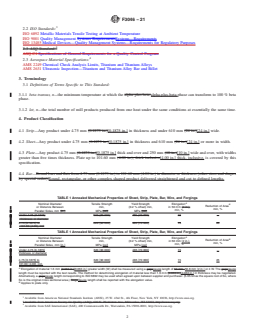
TABLE 1 Annealed Mechanical Properties of Sheet, Strip, Plate, Bar, Wire, and Forgings
A
Nominal Diameter Tensile Strength Yield Strength
Elongation
B
Reduction of Area
or Distance Between min, (0.2 % offset) min, in 50 mm (2 in.),
min, %
min, %
Parallel Sides, mm (in.) MPa (psi) MPa (psi)
Under 4.75 (0.1875) 620 (90 000) 485 (70 000) 15 .
thickness or diameter
4.75 (0.1875) to 620 (90 000) 485 (70 000) 15 25
101.60 (4.00), incl
TABLE 1 Annealed Mechanical Properties of Sheet, Strip, Plate, Bar, Wire, and Forgings
A
Nominal Diameter Tensile Strength Yield Strength
Elongation
B
Reduction of Area
or Distance Between min, (0.2 % offset) min, in 50 mm [2 in.],
min, %
min, %
Parallel Sides, mm [in.] MPa [psi] MPa [psi]
Under 4.75 [0.1875] 620 [90 000] 485 [70 000] 15 .
thickness or diameter
4.75 [0.1875] to 620 [90 000] 485 [70 000] 15 25
101.60 [4.00], incl.
A
Elongation of material 1.6 mm (0.063 in.)[0.063 in.] greater width (W) shall be measured using a gagegauge length of 50 mm. 50.8 mm [2 in.] or 4 W. The gagegauge
length must be reported with the test results. The method for determining elongation of material less than 1.6 mm (0.063 in.)[0.063 in.] in thickness may be negotiated.
Alternatively, a gagegauge length corresponding to ISO 6892 may be used when agreed upon between supplier and purchaser. (5.65 times the square root of So, where
So is the original cross sectional area.) GageGauge length shall be reported with the elongation value.
B
Applies to plate only.
Available from American National Standards Institute (ANSI), 25 W. 43rd St., 4th Floor, New York, NY 10036, http://www.ansi.org.
Available from American Society for Quality (ASQ), 600 N. Plankinton Ave., Milwaukee, WI 53203, http://www.asq.org.
Available from SAE International (SAE), 400 Commonwealth Dr., Warrendale, PA 15096-0001, http://www.sae.org.
F3046 − 21
4.5 Forging Bar—Bar as described in 4.4, used for production of forgings, may be furnished in the hot worked hot-worked
condition.
4.6 Wire—Rounds, flats,Round, rectangular, or other shapes less than 4.75 mm (0.1875 in.) in diameter.complex shapes of uniform
cross section along its entire length furnished in coils or on spools, reels, or other packaging as specified.
4.7 Other—Other forms and shapes may be provided by agreement between purchaser and supplier.
5. Ordering Information
5.1 Include with inquiries and orders for material under this specification the following information:
5.1.1 Quantity,
5.1.2 ASTM designation and date of issue,
5.1.3 Form (sheet, strip, plate, bar, forging bar, or wire),
5.1.4 Condition (see section 6.3),
5.1.5 Mechanical properties (if applicable, for special conditions),
5.1.6 Finish (see section 6.2),
5.1.7 Applicable dimensions including size, thickness, width, length, or drawing number,
5.1.8 Special tests, if any, and
5.1.9 Other requirements.
6. Materials and Manufacture
6.1 The various titanium mill products covered in this specification normally are formed with the conventional forging and rolling
equipment found in primary ferrous and nonferrous plants. The alloy is usually multiple melted in arc furnaces (including furnaces
such as plasma arc and electron beam) of a type conventionally used for reactive metals.
6.2 Finish—The mill product may be furnished to the implant manufacturer as mechanically descaled or pickled, abrasively
blasted, chemically milled, ground, machined, peeled, polished, combinations of these operations, or as specified by the purchaser.
On billets, bars, plates, and forgings, it is permissible to remove minor surface imperfections by grinding if the resultant area meets
the dimensional and surface finish requirements of this specification.
6.3 Condition—Material shall be furnished in the annealed or cold-worked condition. Mechanical properties for conditions other
than those listed in Table 1 may be established by agreement between the supplier and the purchaser.
7. Chemical Requirements
7.1 The heat analysis shall conform to the chemical composition specified in Table 2. Ingot analysis may be used for reporting
all chemical requirements, except hydrogen. Samples for hydrogen shall be taken from the finished mill product. The supplier shall
not ship material with chemistry outside the requirements specified in Table 2.
7.1.1 Requirements for the major and minor elemental constituents are listed in Table 2. Also listed are important residual
elements. Analysis for elements not listed in Table 2 is not required to verify compliance with this specification.
7.2 Product (Check) Analysis:
7.2.1 Product analysis tolerances (check) analysis tolerances shall conform to the product tolerances in Table 3 per AMS 2249 and
F3046 − 21
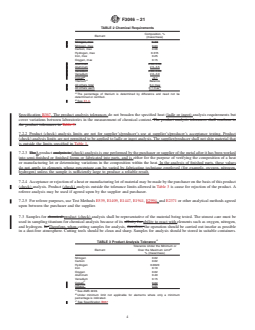
TABLE 2 Chemical Requirements
Composition, %
Element
(mass/mass)
Nitrogen, max 0.03
Nitrogen, max 0.03
Carbon, max 0.08
Hydrogen, max 0.015
Iron, max 0.25
Oxygen, max 0.15
Aluminum 2.50–3.50
Aluminum 2.5–3.5
Vanadium 2.00–3.00
Vanadium 2.0–3.0
B
Cobalt <0.1
A
Titanium Balance
All others total 0.4 max
B
All others each 0.1 max
A
The percentage of titanium is determined by difference and need not be
determined or certified.
B
See X1.4.
Specification B367. The product analysis tolerances do not broaden the specified heat (ladle or ingot) analysis requirements but
cover variations between laboratories in the measurement of chemical content. The product analysis tolerances shall conform to
the product tolerances in Table 3.
7.2.2 Product (check) analysis limits are not for supplier’s/producer’s use at supplier’s/producer’s acceptance testing. Product
(check) analysis limits are not permitted to be applied to ladle or ingot analysis. The supplier/producer shall not ship material that
is outside the limits specified in Table 1.
7.2.3 TheA product analysis is (check) analysis is one performed by the pu
...