

ASTM D4635-16
(Specification)Standard Specification for Plastic Films Made from Low-Density Polyethylene and Linear Low-Density Polyethylene for General Use and Packaging Applications
General Information
- Abstract
ABSTRACT
This specification covers unpigmented, unsupported, low-density polyethylene films (hereafter referred to as film or films) for general use and packaging applications. It is applicable to films made from polyethylene copolymers, and also applicable to films made from blends of homopolymers and copolymers, including ethylene/vinylacetate copolymers. The low-density polyethylene film shall be classified by Types 1, 2, and 3; Surfaces 1, 2, and 3; Classes 1, 2, 3, and 4; and Finishes 1, 2, 3, and 4. The film shall be made from an ethylene homopolymer, ethylene copolymers, or blends of homopolymers or copolymers, or homopolymer and copolymer, so that it meets the density and other film requirements specified. Tests shall be performed to conform to the specified properties of the material in accordance with the following test methods: conditioning; test conditions; thickness; yield; flatness; density; coefficient of friction; clarity; haze; wetting tension; impact resistance; tensile properties; heat sealability; and odor.
SCOPE
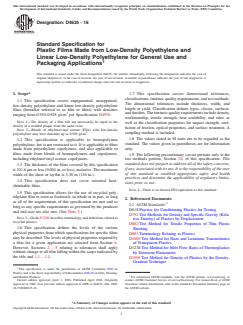
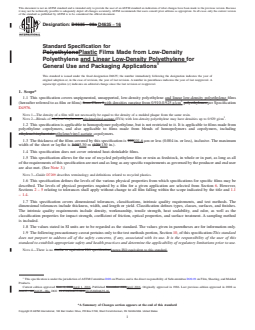
1.1 This specification covers unpigmented, unsupported, low-density polyethylene and linear low-density polyethylene films (hereafter referred to as film or films) with densities ranging from 0.910-0.925 g/cm3 per Specification D4976.
Note 1: The density of a film will not necessarily be equal to the density of a molded plaque from the same resin.
Note 2: Blends of ethylene/vinyl acetate (EVA) with low-density polyethylene may have densities up to 0.929 g/cm3.
1.2 This specification is applicable to homopolymer polyethylene, but is not restricted to it. It is applicable to films made from polyethylene copolymers, and also applicable to films made from blends of homopolymers and copolymers, including ethylene/vinyl acetate copolymers.
1.3 The thickness of the films covered by this specification is 101.6 μm or less (0.004 in. or less), inclusive. The maximum width of the sheet or layflat is 3.30 m (130 in.).
1.4 This specification does not cover oriented heat-shrinkable films.
1.5 This specification allows for the use of recycled polyethylene film or resin as feedstock, in whole or in part, as long as all of the requirements of this specification are met and as long as any specific requirements as governed by the producer and end user are also met. (See Note 3.)
Note 3: Guide D7209 describes terminology and definitions related to recycled plastics.
1.6 This specification defines the levels of the various physical properties from which specifications for specific films may be described. The levels of physical properties required by a film for a given application are selected from Section 6. However, Sections 2 – 5 relating to tolerances shall apply without change to all film falling within the scope indicated by the title and 1.1 – 1.4.
1.7 This specification covers dimensional tolerances, classifications, intrinsic quality requirements, and test methods. The dimensional tolerances include thickness, width, and length or yield. Classification defines types, classes, surfaces, and finishes. The intrinsic quality requirements include density, workmanship, tensile strength, heat sealability, and odor, as well as the classification properties for impact strength, coefficient of friction, optical properties, and surface treatment. A sampling method is included.
1.8 The values stated in SI units are to be regarded as the standard. The values given in parentheses are for information only.
1.9 The following precautionary caveat pertains only to the test methods portion, Section 10, of this specification: This standard does not purport to address all of the safety concerns, if any, associated with its use. It is the responsibility of the user of this standard to establish appropriate safety and health practices and determine the applicability of regulatory limitations prior to use.
Note 4: There is no known ISO equivalent to this standard.
- Status
- Published
- Publication Date
- 31-Mar-2016
- Technical Committee
- D20 - Plastics
- Drafting Committee
- D20.19 - Film, Sheeting, and Molded Products
Buy Documents
ASTM D4635-16 - Standard Specification for Plastic Films Made from Low-Density Polyethylene and Linear Low-Density Polyethylene for General Use and Packaging Applications
REDLINE ASTM D4635-16 - Standard Specification for Plastic Films Made from Low-Density Polyethylene and Linear Low-Density Polyethylene for General Use and Packaging Applications
Overview
ASTM D4635-16 is the Standard Specification for Plastic Films Made from Low-Density Polyethylene (LDPE) and Linear Low-Density Polyethylene (LLDPE) for General Use and Packaging Applications, published by ASTM International. This specification outlines requirements for unpigmented, unsupported polyethylene films with densities ranging from 0.910 to 0.925 g/cm³, which may include blends with ethylene/vinyl acetate copolymers. The standard provides guidance on classifications, physical property requirements, test methods, tolerances, and quality criteria, facilitating consistent and reliable use of LDPE and LLDPE films in general and packaging contexts.
Key Topics
- Material Types and Blends: Covers films from ethylene homopolymers, copolymers, or blends, including those with ethylene/vinyl acetate.
- Classification System: Films are classified by type (impact strength), surface (coefficient of friction), class (optical properties), and finish (surface treatment).
- Physical Requirements: Specifies targets for density, tensile strength, heat sealability, odor rating, impact, and optical properties such as gloss and haze.
- Dimensional Tolerances: Defines acceptable tolerances for thickness, width, and yield, ensuring uniformity and compatibility for end users.
- Recycled Content: Allows for the use of recycled polyethylene film or resin as feedstock if all performance and quality criteria are met.
- Testing Methods: Outlines required test methods for conditioning, thickness, yield, flatness, density, optical properties, impact resistance, tensile properties, heat sealability, odor, and more, referencing numerous related ASTM standards.
Applications
This specification applies primarily to polyethylene and linear low-density polyethylene films used in:
- General Packaging: Sacks, bags, liners, and protective wraps for retail, industrial, and food packaging.
- General Use Films: Sheet products in construction, agriculture, and manufacturing where clarity, strength, and finishing parameters are essential.
- Custom Film Products: Where buyer-supplier requirements for physical, optical, or surface properties need to be established and verified.
- Recycled Film Solutions: Supporting sustainability, this standard permits the inclusion of recycled resin, provided all suitability and safety criteria are met.
- Regulated Environments: For films intended to contact food, drugs, or cosmetics, compliance with relevant FDA, USDA, or other regulatory agency requirements is necessary and is referenced in the standard.
Related Standards
ASTM D4635-16 references several other ASTM methods and standards, including:
- D4976: Specification for Polyethylene Plastics Molding and Extrusion Materials
- D618: Practice for Conditioning Plastics for Testing
- D882: Test Methods for Tensile Properties of Thin Plastic Sheeting
- D1003: Test Method for Haze and Luminous Transmittance of Transparent Plastics
- D1505/D792: Test Methods for Density of Plastics
- D1894: Test Method for Coefficient of Friction of Plastic Film
- D1938/D1922: Test Methods for Tear Resistance of Plastic Film
- D2457: Test Method for Specular Gloss
- D2578: Test Method for Wetting Tension
- D4321: Test Method for Package Yield
- F88: Test Method for Seal Strength of Flexible Barrier Materials
- E96/E96M, F1249: Test Methods for Water Vapor Transmission
- E1870: Test Method for Odor Transfer
- D7209: Guide for Waste Reduction and Use of Recycled Polymeric Materials
Note: There is currently no ISO equivalent for ASTM D4635.
Practical Value
Implementing ASTM D4635-16 in the selection, testing, and procurement of LDPE and LLDPE films ensures products meet rigorous standards for mechanical strength, dimensional accuracy, optical properties, and general quality. Its classification system helps align material choice with final product performance, whether for flexible packaging, industrial barriers, or general film applications. The standard also provides a reference point for contract specifications, regulatory compliance, and quality assurance in global supply chains where polyethylene film consistency is critical.
Keywords: polyethylene films, LDPE, LLDPE, packaging films, ASTM D4635, film specification, recycled polyethylene, film classification, physical properties, plastic film testing
Relations
- Effective Date
- 01-Apr-2016
- Effective Date
- 01-Mar-2024
- Effective Date
- 01-Feb-2024
- Effective Date
- 01-Dec-2023
- Refers
ASTM D1238-23a - Standard Test Method for Melt Flow Rates of Thermoplastics by Extrusion Plastometer - Effective Date
- 15-Nov-2023
- Effective Date
- 15-Nov-2023
- Effective Date
- 15-Nov-2023
- Effective Date
- 01-Nov-2023
- Effective Date
- 01-Jun-2020
- Effective Date
- 01-Jan-2020
- Effective Date
- 01-Aug-2019
- Refers
ASTM E1870-11(2019) - Standard Test Method for Odor and Taste Transfer from Polymeric Packaging Film - Effective Date
- 01-Aug-2019
- Effective Date
- 15-Apr-2019
- Effective Date
- 01-Apr-2019
- Effective Date
- 01-Feb-2019
Buy Documents
ASTM D4635-16 - Standard Specification for Plastic Films Made from Low-Density Polyethylene and Linear Low-Density Polyethylene for General Use and Packaging Applications
REDLINE ASTM D4635-16 - Standard Specification for Plastic Films Made from Low-Density Polyethylene and Linear Low-Density Polyethylene for General Use and Packaging Applications
Get Certified
Connect with accredited certification bodies for this standard

DIN CERTCO
DIN Group product certification.

Smithers Quality Assessments
US management systems and product certification.
Sponsored listings
Frequently Asked Questions
ASTM D4635-16 is a technical specification published by ASTM International. Its full title is "Standard Specification for Plastic Films Made from Low-Density Polyethylene and Linear Low-Density Polyethylene for General Use and Packaging Applications". This standard covers: ABSTRACT This specification covers unpigmented, unsupported, low-density polyethylene films (hereafter referred to as film or films) for general use and packaging applications. It is applicable to films made from polyethylene copolymers, and also applicable to films made from blends of homopolymers and copolymers, including ethylene/vinylacetate copolymers. The low-density polyethylene film shall be classified by Types 1, 2, and 3; Surfaces 1, 2, and 3; Classes 1, 2, 3, and 4; and Finishes 1, 2, 3, and 4. The film shall be made from an ethylene homopolymer, ethylene copolymers, or blends of homopolymers or copolymers, or homopolymer and copolymer, so that it meets the density and other film requirements specified. Tests shall be performed to conform to the specified properties of the material in accordance with the following test methods: conditioning; test conditions; thickness; yield; flatness; density; coefficient of friction; clarity; haze; wetting tension; impact resistance; tensile properties; heat sealability; and odor. SCOPE 1.1 This specification covers unpigmented, unsupported, low-density polyethylene and linear low-density polyethylene films (hereafter referred to as film or films) with densities ranging from 0.910-0.925 g/cm3 per Specification D4976. Note 1: The density of a film will not necessarily be equal to the density of a molded plaque from the same resin. Note 2: Blends of ethylene/vinyl acetate (EVA) with low-density polyethylene may have densities up to 0.929 g/cm3. 1.2 This specification is applicable to homopolymer polyethylene, but is not restricted to it. It is applicable to films made from polyethylene copolymers, and also applicable to films made from blends of homopolymers and copolymers, including ethylene/vinyl acetate copolymers. 1.3 The thickness of the films covered by this specification is 101.6 μm or less (0.004 in. or less), inclusive. The maximum width of the sheet or layflat is 3.30 m (130 in.). 1.4 This specification does not cover oriented heat-shrinkable films. 1.5 This specification allows for the use of recycled polyethylene film or resin as feedstock, in whole or in part, as long as all of the requirements of this specification are met and as long as any specific requirements as governed by the producer and end user are also met. (See Note 3.) Note 3: Guide D7209 describes terminology and definitions related to recycled plastics. 1.6 This specification defines the levels of the various physical properties from which specifications for specific films may be described. The levels of physical properties required by a film for a given application are selected from Section 6. However, Sections 2 – 5 relating to tolerances shall apply without change to all film falling within the scope indicated by the title and 1.1 – 1.4. 1.7 This specification covers dimensional tolerances, classifications, intrinsic quality requirements, and test methods. The dimensional tolerances include thickness, width, and length or yield. Classification defines types, classes, surfaces, and finishes. The intrinsic quality requirements include density, workmanship, tensile strength, heat sealability, and odor, as well as the classification properties for impact strength, coefficient of friction, optical properties, and surface treatment. A sampling method is included. 1.8 The values stated in SI units are to be regarded as the standard. The values given in parentheses are for information only. 1.9 The following precautionary caveat pertains only to the test methods portion, Section 10, of this specification: This standard does not purport to address all of the safety concerns, if any, associated with its use. It is the responsibility of the user of this standard to establish appropriate safety and health practices and determine the applicability of regulatory limitations prior to use. Note 4: There is no known ISO equivalent to this standard.
ABSTRACT This specification covers unpigmented, unsupported, low-density polyethylene films (hereafter referred to as film or films) for general use and packaging applications. It is applicable to films made from polyethylene copolymers, and also applicable to films made from blends of homopolymers and copolymers, including ethylene/vinylacetate copolymers. The low-density polyethylene film shall be classified by Types 1, 2, and 3; Surfaces 1, 2, and 3; Classes 1, 2, 3, and 4; and Finishes 1, 2, 3, and 4. The film shall be made from an ethylene homopolymer, ethylene copolymers, or blends of homopolymers or copolymers, or homopolymer and copolymer, so that it meets the density and other film requirements specified. Tests shall be performed to conform to the specified properties of the material in accordance with the following test methods: conditioning; test conditions; thickness; yield; flatness; density; coefficient of friction; clarity; haze; wetting tension; impact resistance; tensile properties; heat sealability; and odor. SCOPE 1.1 This specification covers unpigmented, unsupported, low-density polyethylene and linear low-density polyethylene films (hereafter referred to as film or films) with densities ranging from 0.910-0.925 g/cm3 per Specification D4976. Note 1: The density of a film will not necessarily be equal to the density of a molded plaque from the same resin. Note 2: Blends of ethylene/vinyl acetate (EVA) with low-density polyethylene may have densities up to 0.929 g/cm3. 1.2 This specification is applicable to homopolymer polyethylene, but is not restricted to it. It is applicable to films made from polyethylene copolymers, and also applicable to films made from blends of homopolymers and copolymers, including ethylene/vinyl acetate copolymers. 1.3 The thickness of the films covered by this specification is 101.6 μm or less (0.004 in. or less), inclusive. The maximum width of the sheet or layflat is 3.30 m (130 in.). 1.4 This specification does not cover oriented heat-shrinkable films. 1.5 This specification allows for the use of recycled polyethylene film or resin as feedstock, in whole or in part, as long as all of the requirements of this specification are met and as long as any specific requirements as governed by the producer and end user are also met. (See Note 3.) Note 3: Guide D7209 describes terminology and definitions related to recycled plastics. 1.6 This specification defines the levels of the various physical properties from which specifications for specific films may be described. The levels of physical properties required by a film for a given application are selected from Section 6. However, Sections 2 – 5 relating to tolerances shall apply without change to all film falling within the scope indicated by the title and 1.1 – 1.4. 1.7 This specification covers dimensional tolerances, classifications, intrinsic quality requirements, and test methods. The dimensional tolerances include thickness, width, and length or yield. Classification defines types, classes, surfaces, and finishes. The intrinsic quality requirements include density, workmanship, tensile strength, heat sealability, and odor, as well as the classification properties for impact strength, coefficient of friction, optical properties, and surface treatment. A sampling method is included. 1.8 The values stated in SI units are to be regarded as the standard. The values given in parentheses are for information only. 1.9 The following precautionary caveat pertains only to the test methods portion, Section 10, of this specification: This standard does not purport to address all of the safety concerns, if any, associated with its use. It is the responsibility of the user of this standard to establish appropriate safety and health practices and determine the applicability of regulatory limitations prior to use. Note 4: There is no known ISO equivalent to this standard.
ASTM D4635-16 is classified under the following ICS (International Classification for Standards) categories: 83.140.10 - Films and sheets. The ICS classification helps identify the subject area and facilitates finding related standards.
ASTM D4635-16 has the following relationships with other standards: It is inter standard links to ASTM D4635-08a, ASTM E96/E96M-24, ASTM D883-24, ASTM D2103-23a, ASTM D1238-23a, ASTM E96/E96M-23, ASTM D2103-23, ASTM D883-23, ASTM F1249-20, ASTM D883-20, ASTM D883-19c, ASTM E1870-11(2019), ASTM D883-19a, ASTM D1938-19, ASTM D883-19. Understanding these relationships helps ensure you are using the most current and applicable version of the standard.
ASTM D4635-16 is available in PDF format for immediate download after purchase. The document can be added to your cart and obtained through the secure checkout process. Digital delivery ensures instant access to the complete standard document.
Standards Content (Sample)
This international standard was developed in accordance with internationally recognized principles on standardization established in the Decision on Principles for the
Development of International Standards, Guides and Recommendations issued by the World Trade Organization Technical Barriers to Trade (TBT) Committee.
Designation:D4635 −16
Standard Specification for
Plastic Films Made from Low-Density Polyethylene and
Linear Low-Density Polyethylene for General Use and
Packaging Applications
This standard is issued under the fixed designation D4635; the number immediately following the designation indicates the year of
original adoption or, in the case of revision, the year of last revision. A number in parentheses indicates the year of last reapproval. A
superscript epsilon (´) indicates an editorial change since the last revision or reapproval.
1. Scope* 1.7 This specification covers dimensional tolerances,
classifications,intrinsicqualityrequirements,andtestmethods.
1.1 This specification covers unpigmented, unsupported,
The dimensional tolerances include thickness, width, and
low-density polyethylene and linear low-density polyethylene
length or yield. Classification defines types, classes, surfaces,
films (hereafter referred to as film or films) with densities
3 andfinishes.Theintrinsicqualityrequirementsincludedensity,
ranging from 0.910-0.925 g/cm per Specification D4976.
workmanship, tensile strength, heat sealability, and odor, as
NOTE 1—The density of a film will not necessarily be equal to the
well as the classification properties for impact strength, coef-
density of a molded plaque from the same resin.
ficient of friction, optical properties, and surface treatment. A
NOTE 2—Blends of ethylene/vinyl acetate (EVA) with low-density
sampling method is included.
polyethylene may have densities up to 0.929 g/cm .
1.8 The values stated in SI units are to be regarded as the
1.2 This specification is applicable to homopolymer
standard. The values given in parentheses are for information
polyethylene, but is not restricted to it. It is applicable to films
only.
made from polyethylene copolymers, and also applicable to
films made from blends of homopolymers and copolymers,
1.9 The following precautionary caveat pertains only to the
including ethylene/vinyl acetate copolymers.
test methods portion, Section 10, of this specification: This
standard does not purport to address all of the safety concerns,
1.3 The thickness of the films covered by this specification
if any, associated with its use. It is the responsibility of the user
is 101.6 µm or less (0.004 in. or less), inclusive.The maximum
of this standard to establish appropriate safety and health
width of the sheet or layflat is 3.30 m (130 in.).
practices and determine the applicability of regulatory limita-
1.4 This specification does not cover oriented heat-
tions prior to use.
shrinkable films.
NOTE 4—There is no known ISO equivalent to this standard.
1.5 This specification allows for the use of recycled poly-
ethylene film or resin as feedstock, in whole or in part, as long
2. Referenced Documents
as all of the requirements of this specification are met and as
2.1 ASTM Standards:
long as any specific requirements as governed by the producer
D618 Practice for Conditioning Plastics for Testing
and end user are also met. (See Note 3.)
D792 Test Methods for Density and Specific Gravity (Rela-
NOTE 3—Guide D7209 describes terminology and definitions related to
tive Density) of Plastics by Displacement
recycled plastics.
D882 Test Method for Tensile Properties of Thin Plastic
1.6 This specification defines the levels of the various
Sheeting
physical properties from which specifications for specific films
D883 Terminology Relating to Plastics
maybedescribed.Thelevelsofphysicalpropertiesrequiredby
D1003 Test Method for Haze and Luminous Transmittance
a film for a given application are selected from Section 6.
of Transparent Plastics
However, Sections 2–5 relating to tolerances shall apply
D1238 Test Method for Melt Flow Rates of Thermoplastics
without change to all film falling within the scope indicated by
by Extrusion Plastometer
the title and 1.1 – 1.4.
D1505 Test Method for Density of Plastics by the Density-
Gradient Technique
This specification is under the jurisdiction of ASTM Committee D20 on
Plastics and is the direct responsibility of Subcommittee D20.19 on Film, Sheeting,
and Molded Products. For referenced ASTM standards, visit the ASTM website, www.astm.org, or
Current edition approved April 1, 2016. Published April 2016. Originally contact ASTM Customer Service at service@astm.org. For Annual Book of ASTM
approved in 1986. Last previous edition approved in 2008 as D4635 - 08a. DOI: Standards volume information, refer to the standard’s Document Summary page on
10.1520/D4635-16. the ASTM website.
*A Summary of Changes section appears at the end of this standard
Copyright © ASTM International, 100 Barr Harbor Drive, PO Box C700, West Conshohocken, PA 19428-2959. United States
D4635−16
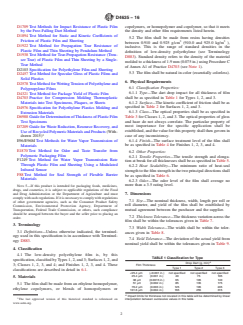
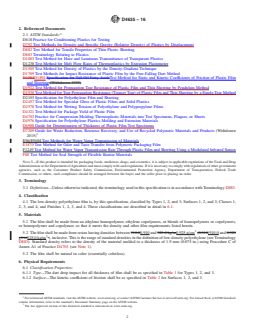
D1709 Test Methods for Impact Resistance of Plastic Film copolymers, or homopolymer and copolymer, so that it meets
by the Free-Falling Dart Method the density and other film requirements listed herein.
D1894 Test Method for Static and Kinetic Coefficients of
5.2 The film shall be made from resins having densities
Friction of Plastic Film and Sheeting 3 3
between 0.910 and 0.925 g/cm (910.0 and 925.0 kg/m ),
D1922 Test Method for Propagation Tear Resistance of
inclusive. This is the range of standard densities in the
Plastic Film and Thin Sheeting by Pendulum Method
definition of low-density polyethylene (see Terminology
D1938 Test Method for Tear-Propagation Resistance (Trou-
D883). Standard density refers to the density of the material
ser Tear) of Plastic Film and Thin Sheeting by a Single-
molded to a thickness of 1.9 mm (0.075 in.) using Procedure C
Tear Method
of Annex A1 of Practice D4703 (see Note 1).
D2103 Specification for Polyethylene Film and Sheeting
5.3 The film shall be natural in color (essentially colorless).
D2457 Test Method for Specular Gloss of Plastic Films and
Solid Plastics
6. Physical Requirements
D2578 TestMethodforWettingTensionofPolyethyleneand
6.1 Classification Properties:
Polypropylene Films
6.1.1 Type—The dart drop impact for all thickness of film
D4321 Test Method for Package Yield of Plastic Film
shall be as specified in Table 1 for Types 1, 2, and 3.
D4703 Practice for Compression Molding Thermoplastic
6.1.2 Surface—The kinetic coefficient of friction shall be as
Materials into Test Specimens, Plaques, or Sheets
specified in Table 2 for Surfaces 1, 2, and 3.
D4976 Specification for Polyethylene Plastics Molding and
6.1.3 Class—The optical properties shall be as specified in
Extrusion Materials
Table 3 for Classes 1, 2, and 3. The optical properties of gloss
D6988 GuideforDeterminationofThicknessofPlasticFilm
and haze do not always correlate. The particular property of
Test Specimens
most importance for the specific application shall be
D7209 Guide for Waste Reduction, Resource Recovery, and
established, and the value for this property shall then govern in
Use of Recycled Polymeric Materials and Products (With-
case of any inconsistency.
drawn 2015)
6.1.4 Finish—The surface treatment level of the film shall
E96/E96M Test Methods for Water Vapor Transmission of
be as specified in Table 4 for Finishes 1, 2, 3, and 4.
Materials
E1870 Test Method for Odor and Taste Transfer from
6.2 Other Properties:
Polymeric Packaging Film
6.2.1 Tensile Properties—The tensile strength and elonga-
F1249 Test Method for Water Vapor Transmission Rate
tion at break for all thicknesses shall be as specified in Table 5.
Through Plastic Film and Sheeting Using a Modulated
6.2.2 Heat Sealability—The minimum ratio of heat-seal
Infrared Sensor
strengthtothefilmstrengthinthetwoprincipaldirectionsshall
F88 Test Method for Seal Strength of Flexible Barrier
be as specified in Table 6.
Materials
6.2.3 Odor—The odor level of the film shall average no
more than a 3.5 rating level.
NOTE 5—If this product is intended for packaging foods, medicines,
drugs, and cosmetics, it is subject to applicable regulations of the Food
and Drug Administration or the Department of Agriculture and must 7. Dimensions
complywithsuchregulations.Ifitisnecessarytocomplywithregulations
7.1 Size—The nominal thickness, width, length per roll or
of other government agencies, such as the Consumer Product Safety
roll diameter, and yield of the film shall be established by
Commission, Environmental Protection Agency, Department of
Transportation, Federal Trade Commission, or others, such compliance mutual agreement between the purchaser and the supplier.
should be arranged between the buyer and the seller prior to placing an
7.2 Thickness Tolerance—Thethicknessvariationacrossthe
order.
film shall be within the tolerances given in Table 7.
3. Terminology
7.3 Width Tolerance—The width shall be within the toler-
3.1 Definitions—Unless otherwise indicated, the terminol-
ances given in Table 8.
ogy used in this specification is in accordance with Terminol-
7.4 Yield Tolerance—The deviation of the actual yield from
ogy D883.
nominal yield shall be within the tolerances given in Table 9.
4. Classification
4.1 The low-density polyethylene film is, by this
TABLE 1 Classification for Type
specification, classified byTypes 1, 2, and 3; Surfaces 1, 2, and
A
Drop Dart (g, min)
3; Classes 1, 2, 3, and 4; and Finishes 1, 2, 3, and 4. These
Film Thickness
Type 1 Type 2 Type 3
classifications are described in detail in 6.1.
<25.4 µm (<0.001 in.) not specified not specified not specified
25.4 µm (0.001 in.) 40 75 105
5. Materials
38 µm (0.0015 in.) 65 105 140
51 µm (0.002 in.) 85 135 175
5.1 The film shall be made from an ethylene homopolymer,
76.2 µm (0.003 in.) 125 195 245
ethylene copolymers, or blends of homopolymers or
101.6 µm (0.004 in.) 165 255 315
A
Impact limits for thickness not covered in this table will be determined by linear
The last approved version of this historical standard is referenced on
interpolation between successive values in this table.
www.astm.org.
D4635−16
TABLE 2 Classification for Surface
6.35mm( ⁄4in.)beyondeitheredgeoftherollorasestablished
Surface Coefficient of Friction by mutual agreement between the purchaser and the supplier.
1 >0.5 8.2.3 Rollswithcoresthatarecrushedandarenotabletobe
2 >0.2to0.5
mounted on the purchaser’s equipment are to be considered
3 0.2 or less
rejects.
8.2.4 Ridges and soft spots that result in bagginess and
looseness of the unwound film are unacceptable and shall be
TABLE 3 Optical Prope
...
This document is not an ASTM standard and is intended only to provide the user of an ASTM standard an indication of what changes have been made to the previous version. Because
it may not be technically possible to adequately depict all changes accurately, ASTM recommends that users consult prior editions as appropriate. In all cases only the current version
of the standard as published by ASTM is to be considered the official document.
Designation: D4635 − 08a D4635 − 16
Standard Specification for
PolyethylenePlastic Films Made from Low-Density
Polyethylene and Linear Low-Density Polyethylene for
General Use and Packaging Applications
This standard is issued under the fixed designation D4635; the number immediately following the designation indicates the year of
original adoption or, in the case of revision, the year of last revision. A number in parentheses indicates the year of last reapproval. A
superscript epsilon (´) indicates an editorial change since the last revision or reapproval.
1. Scope*
1.1 This specification covers unpigmented, unsupported, low-density polyethylene and linear low-density polyethylene films
(hereafter referred to as film or films) from Class 1with densities ranging from 0.910-0.925 g/cm polyethylenes per Specification
D4976.
NOTE 1—The density of a film will not necessarily be equal to the density of a molded plaque from the same resin.
NOTE 2—Blends of ethylene/vinylacetate ethylene/vinyl acetate (EVA) with low-density polyethylene may have densities up to 0.929 g/cm .
1.2 This specification is applicable to homopolymer polyethylene, but is not restricted to it. It is applicable to films made from
polyethylene copolymers, and also applicable to films made from blends of homopolymers and copolymers, including
ethylene/vinylacetate ethylene/vinyl acetate copolymers.
1.3 The thickness of the films covered by this specification is 100101.6 μm or less (0.004 in. or less), inclusive. The maximum
width of the sheet or layflat is 3.003.30 m (120(130 in.).
1.4 This specification does not cover oriented heat-shrinkable films.
1.5 This specification allows for the use of recycled polyethylene film or resin as feedstock, in whole or in part, as long as all
of the requirements of this specification are met and as long as any specific requirements as governed by the producer and end user
are also met. (See Note 3.)
NOTE 3—Guide D7209 describes terminology and definitions related to recycled plastics.
1.6 This specification defines the levels of the various physical properties from which specifications for specific films may be
described. The levels of physical properties required by a film for a given application are selected from Section 6. However,
Sections 2 – 5 relating to tolerances shall apply without change to all film falling within the scope indicated by the title and 1.1
– 1.4.
1.7 This specification covers dimensional tolerances, classifications, intrinsic quality requirements, and test methods. The
dimensional tolerances include thickness, width, and length or yield. Classification defines types, classes, surfaces, and finishes.
The intrinsic quality requirements include density, workmanship, tensile strength, heat sealability, and odor, as well as the
classification properties for impact strength, coefficient of friction, optical properties, and surface treatment. A sampling method
is included.
1.8 The values stated in SI units are to be regarded as the standard. The values given in parentheses are for information only.
1.9 The following precautionary caveat pertains only to the test methods portion, Section 10, of this specification:This standard
does not purport to address all of the safety concerns, if any, associated with its use. It is the responsibility of the user of this
standard to establish appropriate safety and health practices and determine the applicability of regulatory limitations prior to use.
NOTE 4—There is no similar or equivalent ISO specification.known ISO equivalent to this standard.
This specification is under the jurisdiction of ASTM Committee D20 on Plastics and is the direct responsibility of Subcommittee D20.19 on Film, Sheeting, and Molded
Products.
Current edition approved Nov. 1, 2008April 1, 2016. Published November 2008April 2016. Originally approved in 1986. Last previous edition approved in 2008 as
D4635 - 08.D4635 - 08a. DOI: 10.1520/D4635-08A.10.1520/D4635-16.
*A Summary of Changes section appears at the end of this standard
Copyright © ASTM International, 100 Barr Harbor Drive, PO Box C700, West Conshohocken, PA 19428-2959. United States
D4635 − 16
2. Referenced Documents
2.1 ASTM Standards:
D618 Practice for Conditioning Plastics for Testing
D792 Test Methods for Density and Specific Gravity (Relative Density) of Plastics by Displacement
D882 Test Method for Tensile Properties of Thin Plastic Sheeting
D883 Terminology Relating to Plastics
D1003 Test Method for Haze and Luminous Transmittance of Transparent Plastics
D1238 Test Method for Melt Flow Rates of Thermoplastics by Extrusion Plastometer
D1505 Test Method for Density of Plastics by the Density-Gradient Technique
D1709 Test Methods for Impact Resistance of Plastic Film by the Free-Falling Dart Method
D1984D1894 Specification for Tall Oil Fatty AcidsTest Method for Static and Kinetic Coefficients of Friction of Plastic Film
and Sheeting (Withdrawn 1999)
D1922 Test Method for Propagation Tear Resistance of Plastic Film and Thin Sheeting by Pendulum Method
D1938 Test Method for Tear-Propagation Resistance (Trouser Tear) of Plastic Film and Thin Sheeting by a Single-Tear Method
D2103 Specification for Polyethylene Film and Sheeting
D2457 Test Method for Specular Gloss of Plastic Films and Solid Plastics
D2578 Test Method for Wetting Tension of Polyethylene and Polypropylene Films
D4321 Test Method for Package Yield of Plastic Film
D4703 Practice for Compression Molding Thermoplastic Materials into Test Specimens, Plaques, or Sheets
D4976 Specification for Polyethylene Plastics Molding and Extrusion Materials
D6988 Guide for Determination of Thickness of Plastic Film Test Specimens
D7209 Guide for Waste Reduction, Resource Recovery, and Use of Recycled Polymeric Materials and Products (Withdrawn
2015)
E96/E96M Test Methods for Water Vapor Transmission of Materials
E1870 Test Method for Odor and Taste Transfer from Polymeric Packaging Film
F1249 Test Method for Water Vapor Transmission Rate Through Plastic Film and Sheeting Using a Modulated Infrared Sensor
F88 Test Method for Seal Strength of Flexible Barrier Materials
NOTE 5—If this product is intended for packaging foods, medicines, drugs, and cosmetics, it is subject to applicable regulations of the Food and Drug
Administration or the Department of Agriculture and must comply with such regulations. If it is necessary to comply with regulations of other government
agencies, such as the Consumer Product Safety Commission, Environmental Protection Agency, Department of Transportation, Federal Trade
Commission, or others, such compliance should be arranged between the buyer and the seller prior to placing an order.
3. Terminology
3.1 Definitions—Unless otherwise indicated, the terminology used in this specification is in accordance with Terminology D883.
4. Classification
4.1 The low-density polyethylene film is, by this specification, classified by Types 1, 2, and 3; Surfaces 1, 2, and 3; Classes 1,
2, 3, and 4; and Finishes 1, 2, 3, and 4. These classifications are described in detail in 6.1.
5. Materials
5.1 The film shall be made from an ethylene homopolymer, ethylene copolymers, or blends of homopolymers or copolymers,
or homopolymer and copolymer, so that it meets the density and other film requirements listed herein.
5.2 The film shall be made from resins having densities between 910.00.910 and 925.0 kg/m0.925 g/cm (0.910(910.0 and 0.925
g/cm925.0 kg/m ), inclusive. This is the range of standard densities in the definition of low-density polyethylene (see Terminology
D883). Standard density refers to the density of the material molded to a thickness of 1.9 mm (0.075 in.) using Procedure C of
Annex A1 of Practice D4703 (see Note 1).
5.3 The film shall be natural in color (essentially colorless).
6. Physical Requirements
6.1 Classification Properties:
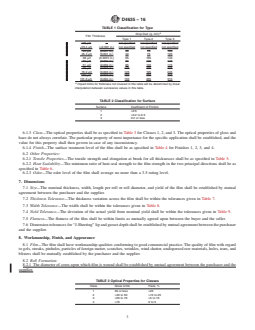
6.1.1 Type—The dart drop impact for all thickness of film shall be as specified in Table 1 for Types 1, 2, and 3.
6.1.2 Surface—The kinetic coefficient of friction shall be as specified in Table 2 for Surfaces 1, 2, and 3.
For referenced ASTM standards, visit the ASTM website, www.astm.org, or contact ASTM Customer Service at service@astm.org. For Annual Book of ASTM Standards
volume information, refer to the standard’s Document Summary page on the ASTM website.
The last approved version of this historical standard is referenced on www.astm.org.
D4635 − 16
TABLE 1 Classification for Type
A
Drop Dart (g, min)
Film Thickness
Type 1 Type 2 Type 3
<25 μm . not specified not specified not specified
<25.4 μm (<0.001 in.) not specified not specified not specified
25 μm (0.001 in.) 40 75 105
25.4 μm (0.001 in.) 40 75 105
38 μm (0.0015 in.) 65 105 140
50 μm (0.002 in.) 85 135 175
51 μm (0.002 in.) 85 135 175
75 μm (0.003 in.) 125 195 245
76.2 μm (0.003 in.) 125 195 245
100 μm (0.004 in.) 165 255 315
101.6 μm (0.004 in.) 165 255 315
A
Impact limits for thickness not covered in this table will be determined by linear
interpolation between successive values in this table.
TABLE 2 Classification for Surface
Surface Coefficient of Friction
1 >0.5
2 >0.2 to 0.5
3 0.2 or less
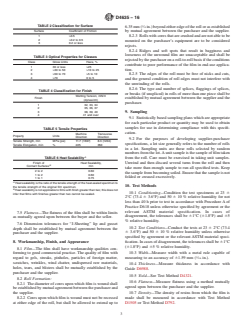
6.1.3 Class—The optical properties shall be as specified in Table 3 for Classes 1, 2, and 3. The optical properties of gloss and
haze do not always correlate. The particular property of most importance for the specific application shall be established, and the
value for this property shall then govern in case of any inconsistency.
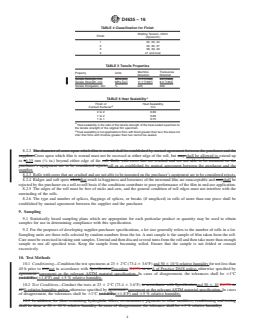
6.1.4 Finish—The surface treatment level of the film shall be as specified in Table 4 for Finishes 1, 2, 3, and 4.
6.2 Other Properties:
6.2.1 Tensile Properties—The tensile strength and elongation at break for all thicknesses shall be as specified in Table 5.
6.2.2 Heat Sealability—The minimum ratio of heat-seal strength to the film strength in the two principal directions shall be as
specified in Table 6.
6.2.3 Odor—The odor level of the film shall average no more than a 3.5 rating level.
7. Dimensions
7.1 Size—The nominal thickness, width, length per roll or roll diameter, and yield of the film shall be established by mutual
agreement between the purchaser and the supplier.
7.2 Thickness Tolerance—The thickness variation across the film shall be within the tolerances given in Table 7.
7.3 Width Tolerance—The width shall be within the tolerances given in Table 8.
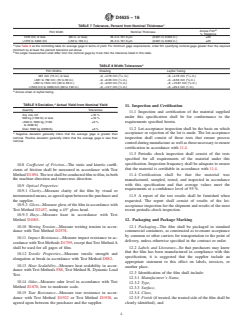
7.4 Yield Tolerance—The deviation of the actual yield from nominal yield shall be within the tolerances given in Table 9.
7.5 Flatness—The flatness of the film shall be within limits as mutually agreed upon between the buyer and the seller.
7.6 Dimension tolerances for “J-Sheeting” lip and gusset depth shall be established by mutual agreement between the purchaser
and the supplier.
8. Workmanship, Finish, and Appearance
8.1 Film—The film shall have workmanship qualities conforming to good commercial practice. The quality of film with regard
to gels, streaks, pinholes, particles of foreign matter, scratches, wrinkles, wind chatter, undispersed raw materials, holes, tears, and
blisters shall be mutually established by the purchaser and the supplier.
8.2 Roll Formation:
8.2.1 The diameter of cores upon which film is wound shall be established by mutual agreement between the purchaser and the
supplier.
TABLE 3 Optical Properties for Classes
Class Gloss Units Haze, %
1 30 or less >25
2 >30 to 50 >10 to 25
3 >50 to 70 >5 to 10
4 >70 0 to 5
D4635 − 16
TABLE 4 Classification for Finish
Wetting Tension, mN/m
Finish
(dynes/cm)
1 32, 33, 34
2 35, 36, 37
3 38, 39, 40
4 41 and over
TABLE 5 Tensile Properties
Machine Transverse
Property Units
Direction Direction
Tensile Strength, min MPa (psi) 11.7 (1700) 8.3 (1200)
Tensile Strength,
...