

ASTM C1495-16(2023)
(Test Method)Standard Test Method for Effect of Surface Grinding on Flexure Strength of Advanced Ceramics
General Information
- Abstract
SIGNIFICANCE AND USE
5.1 Surface grinding can cause a significant decrease4 in the flexure strength of advanced ceramic materials. The magnitude of the loss in strength is determined by the grinding conditions and the response of the material. This test method can be used to obtain a detailed characterization of the relationship between grinding conditions and flexure strength for an advanced ceramic material. The effect on flexure strength of varying a single grinding parameter or several grinding parameters can be measured. The method may also be used to compare and rank different materials according to their response to one or more different grinding conditions. Results obtained by this method can be used to develop an optimum grinding process with respect to maximizing material removal rate for a specified flexure strength requirement. The test method can assist in the development of improved grinding-damage-tolerant ceramic materials. It may also be used for quality control purposes to monitor and assure the consistency of a grinding process in the fabrication of parts from advanced ceramic materials. The test method is applicable to grinding methods that generate a planar surface and is not directly applicable to grinding methods that produce non-planar surfaces such as cylindrical and centerless grinding.
SCOPE
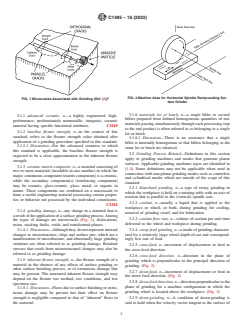
1.1 This test method covers the determination of the effect of surface grinding on the flexure strength of advanced ceramics. Surface grinding of an advanced ceramic material can introduce microcracks and other changes in the near surface layer, generally referred to as damage (see Fig. 1 and Ref. (1)).2 Such damage can result in a change—most often a decrease—in flexure strength of the material. The degree of change in flexure strength is determined by both the grinding process and the response characteristics of the specific ceramic material. This method compares the flexure strength of an advanced ceramic material after application of a user-specified surface grinding process with the baseline flexure strength of the same material. The baseline flexure strength is obtained after application of a surface grinding process specified in this standard. The baseline flexure strength is expected to approximate closely the inherent strength of the material. The flexure strength is measured by means of ASTM flexure test methods.
FIG. 1 Microcracks Associated with Grinding (Ref. (1))2
1.2 Flexure test methods used to determine the effect of surface grinding are C1161 Test Method for Flexure Strength of Advanced Ceramics at Ambient Temperatures and C1211 Test Method for Flexure Strength of Advanced Ceramics at Elevated Temperatures.
1.3 Materials covered in this standard are those advanced ceramics that meet criteria specified in flexure testing standards C1161 and C1211.
1.4 The flexure test methods supporting this standard (C1161 and C1211) require test specimens that have a rectangular cross section, flat surfaces, and that are fabricated with specific dimensions and tolerances. Only grinding processes that are capable of generating the specified flat surfaces, that is, planar grinding modes, are suitable for evaluation by this method. Among the applicable machine types are horizontal and vertical spindle reciprocating surface grinders, horizontal and vertical spindle rotary surface grinders, double disk grinders, and tool-and-cutter grinders. Incremental cross-feed, plunge, and creep-feed grinding methods may be used.
1.5 The values stated in SI units are to be regarded as standard. No other units of measurement are included in this standard.
1.6 This standard does not purport to address all of the safety concerns, if any, associated with its use. It is the responsibility of the user of this standard to establish appropriate safety, health, and environmental practices and determine the applicability of regulatory limitations prior to use.
1.7 This international standard was develop...
- Status
- Published
- Publication Date
- 31-Dec-2022
- Technical Committee
- C28 - Advanced Ceramics
- Drafting Committee
- C28.01 - Mechanical Properties and Performance
Overview
ASTM C1495-16(2023), "Standard Test Method for Effect of Surface Grinding on Flexure Strength of Advanced Ceramics," is a key international standard developed by ASTM International. This standard provides a method to evaluate how surface grinding processes affect the flexure strength of advanced ceramics-material systems widely used in demanding engineering applications due to their high strength, hardness, and wear resistance. The test enables detailed examination of the interplay between grinding parameters and mechanical performance, laying groundwork for both process optimization and quality assurance in ceramic part fabrication.
Key Topics
- Surface Grinding Impact: Surface grinding can introduce microcracks and surface defects-often collectively termed as grinding damage-that reduce the flexure strength of advanced ceramics.
- Test Methodology: The test method involves grinding specimens according to specified parameters, followed by flexure strength measurement using established ASTM procedures (C1161 and C1211). The resulting data are compared with specimens prepared under baseline grinding conditions to assess the extent of strength loss.
- Parameters Studied: The method allows the variation and study of a single or several grinding parameters, such as wheel speed, feed, grit size, and grinding direction, to determine their effect on flexure strength.
- Material Comparison: This standard can be used to compare the grinding-damage tolerance of different advanced ceramic materials, supporting material selection and process development.
- Planar Grinding Focus: Only planar grinding methods are considered, such as horizontal and vertical spindle surface grinders and double disk grinders. Non-planar processes like cylindrical or centerless grinding are outside the scope.
Applications
ASTM C1495-16(2023) is highly applicable to industries and research environments where advanced ceramics are critical, such as electronics, aerospace, energy, and biomedical devices. Practical uses include:
- Process Development: By mapping the relationship between grinding parameters and flexure strength, manufacturers can design optimum grinding processes that maximize material removal rates while retaining sufficient mechanical integrity.
- Material Qualification: The test method enables side-by-side comparison of different advanced ceramics, aiding the development and qualification of improved materials with superior resistance to grinding-induced damage.
- Quality Control: Routine testing according to this standard supports ongoing quality assurance efforts, ensuring grinding processes consistently yield parts meeting specified strength requirements.
- Root Cause Analysis: When unexpected failures occur, the method can help identify whether inadequate grinding practices or parameter drift contributed to the loss in strength.
- Research and Innovation: The standard is also useful for academic and industrial research exploring new ceramic formulations or grinding technologies.
Related Standards
The following ASTM standards are commonly referenced in conjunction with ASTM C1495-16(2023) to provide comprehensive guidance on mechanical testing and terminology for advanced ceramics:
- ASTM C1161: Standard Test Method for Flexural Strength of Advanced Ceramics at Ambient Temperatures.
- ASTM C1211: Standard Test Method for Flexural Strength of Advanced Ceramics at Elevated Temperatures.
- ASTM C1145: Terminology of Advanced Ceramics.
- ASTM C1239: Practice for Reporting Uniaxial Strength Data and Estimating Weibull Distribution Parameters for Advanced Ceramics.
- ASTM C1322: Practice for Fractography and Characterization of Fracture Origins in Advanced Ceramics.
- ASTM C1341: Test Method for Flexural Properties of Continuous Fiber-Reinforced Advanced Ceramic Composites.
By following ASTM C1495 and its related standards, manufacturers and researchers can ensure a scientifically robust and internationally recognized approach to assessing and controlling grinding-induced effects in advanced ceramic components.
Keywords: ASTM C1495, surface grinding, flexure strength, advanced ceramics, grinding damage, ceramic testing, quality control, process optimization, planar grinding, ASTM standards.
Relations
- Effective Date
- 01-Jul-2019
- Effective Date
- 01-Jul-2019
- Effective Date
- 01-Jul-2018
- Effective Date
- 01-Jul-2015
- Effective Date
- 01-Aug-2013
- Effective Date
- 01-Aug-2013
- Effective Date
- 01-Aug-2013
- Effective Date
- 15-Feb-2013
- Effective Date
- 01-Feb-2013
- Effective Date
- 01-Feb-2013
- Effective Date
- 15-Jul-2010
- Effective Date
- 01-Jan-2008
- Effective Date
- 01-Jan-2008
- Effective Date
- 01-Jan-2008
- Effective Date
- 01-Feb-2007
Frequently Asked Questions
ASTM C1495-16(2023) is a standard published by ASTM International. Its full title is "Standard Test Method for Effect of Surface Grinding on Flexure Strength of Advanced Ceramics". This standard covers: SIGNIFICANCE AND USE 5.1 Surface grinding can cause a significant decrease4 in the flexure strength of advanced ceramic materials. The magnitude of the loss in strength is determined by the grinding conditions and the response of the material. This test method can be used to obtain a detailed characterization of the relationship between grinding conditions and flexure strength for an advanced ceramic material. The effect on flexure strength of varying a single grinding parameter or several grinding parameters can be measured. The method may also be used to compare and rank different materials according to their response to one or more different grinding conditions. Results obtained by this method can be used to develop an optimum grinding process with respect to maximizing material removal rate for a specified flexure strength requirement. The test method can assist in the development of improved grinding-damage-tolerant ceramic materials. It may also be used for quality control purposes to monitor and assure the consistency of a grinding process in the fabrication of parts from advanced ceramic materials. The test method is applicable to grinding methods that generate a planar surface and is not directly applicable to grinding methods that produce non-planar surfaces such as cylindrical and centerless grinding. SCOPE 1.1 This test method covers the determination of the effect of surface grinding on the flexure strength of advanced ceramics. Surface grinding of an advanced ceramic material can introduce microcracks and other changes in the near surface layer, generally referred to as damage (see Fig. 1 and Ref. (1)).2 Such damage can result in a change—most often a decrease—in flexure strength of the material. The degree of change in flexure strength is determined by both the grinding process and the response characteristics of the specific ceramic material. This method compares the flexure strength of an advanced ceramic material after application of a user-specified surface grinding process with the baseline flexure strength of the same material. The baseline flexure strength is obtained after application of a surface grinding process specified in this standard. The baseline flexure strength is expected to approximate closely the inherent strength of the material. The flexure strength is measured by means of ASTM flexure test methods. FIG. 1 Microcracks Associated with Grinding (Ref. (1))2 1.2 Flexure test methods used to determine the effect of surface grinding are C1161 Test Method for Flexure Strength of Advanced Ceramics at Ambient Temperatures and C1211 Test Method for Flexure Strength of Advanced Ceramics at Elevated Temperatures. 1.3 Materials covered in this standard are those advanced ceramics that meet criteria specified in flexure testing standards C1161 and C1211. 1.4 The flexure test methods supporting this standard (C1161 and C1211) require test specimens that have a rectangular cross section, flat surfaces, and that are fabricated with specific dimensions and tolerances. Only grinding processes that are capable of generating the specified flat surfaces, that is, planar grinding modes, are suitable for evaluation by this method. Among the applicable machine types are horizontal and vertical spindle reciprocating surface grinders, horizontal and vertical spindle rotary surface grinders, double disk grinders, and tool-and-cutter grinders. Incremental cross-feed, plunge, and creep-feed grinding methods may be used. 1.5 The values stated in SI units are to be regarded as standard. No other units of measurement are included in this standard. 1.6 This standard does not purport to address all of the safety concerns, if any, associated with its use. It is the responsibility of the user of this standard to establish appropriate safety, health, and environmental practices and determine the applicability of regulatory limitations prior to use. 1.7 This international standard was develop...
SIGNIFICANCE AND USE 5.1 Surface grinding can cause a significant decrease4 in the flexure strength of advanced ceramic materials. The magnitude of the loss in strength is determined by the grinding conditions and the response of the material. This test method can be used to obtain a detailed characterization of the relationship between grinding conditions and flexure strength for an advanced ceramic material. The effect on flexure strength of varying a single grinding parameter or several grinding parameters can be measured. The method may also be used to compare and rank different materials according to their response to one or more different grinding conditions. Results obtained by this method can be used to develop an optimum grinding process with respect to maximizing material removal rate for a specified flexure strength requirement. The test method can assist in the development of improved grinding-damage-tolerant ceramic materials. It may also be used for quality control purposes to monitor and assure the consistency of a grinding process in the fabrication of parts from advanced ceramic materials. The test method is applicable to grinding methods that generate a planar surface and is not directly applicable to grinding methods that produce non-planar surfaces such as cylindrical and centerless grinding. SCOPE 1.1 This test method covers the determination of the effect of surface grinding on the flexure strength of advanced ceramics. Surface grinding of an advanced ceramic material can introduce microcracks and other changes in the near surface layer, generally referred to as damage (see Fig. 1 and Ref. (1)).2 Such damage can result in a change—most often a decrease—in flexure strength of the material. The degree of change in flexure strength is determined by both the grinding process and the response characteristics of the specific ceramic material. This method compares the flexure strength of an advanced ceramic material after application of a user-specified surface grinding process with the baseline flexure strength of the same material. The baseline flexure strength is obtained after application of a surface grinding process specified in this standard. The baseline flexure strength is expected to approximate closely the inherent strength of the material. The flexure strength is measured by means of ASTM flexure test methods. FIG. 1 Microcracks Associated with Grinding (Ref. (1))2 1.2 Flexure test methods used to determine the effect of surface grinding are C1161 Test Method for Flexure Strength of Advanced Ceramics at Ambient Temperatures and C1211 Test Method for Flexure Strength of Advanced Ceramics at Elevated Temperatures. 1.3 Materials covered in this standard are those advanced ceramics that meet criteria specified in flexure testing standards C1161 and C1211. 1.4 The flexure test methods supporting this standard (C1161 and C1211) require test specimens that have a rectangular cross section, flat surfaces, and that are fabricated with specific dimensions and tolerances. Only grinding processes that are capable of generating the specified flat surfaces, that is, planar grinding modes, are suitable for evaluation by this method. Among the applicable machine types are horizontal and vertical spindle reciprocating surface grinders, horizontal and vertical spindle rotary surface grinders, double disk grinders, and tool-and-cutter grinders. Incremental cross-feed, plunge, and creep-feed grinding methods may be used. 1.5 The values stated in SI units are to be regarded as standard. No other units of measurement are included in this standard. 1.6 This standard does not purport to address all of the safety concerns, if any, associated with its use. It is the responsibility of the user of this standard to establish appropriate safety, health, and environmental practices and determine the applicability of regulatory limitations prior to use. 1.7 This international standard was develop...
ASTM C1495-16(2023) is classified under the following ICS (International Classification for Standards) categories: 81.060.30 - Advanced ceramics. The ICS classification helps identify the subject area and facilitates finding related standards.
ASTM C1495-16(2023) has the following relationships with other standards: It is inter standard links to ASTM C1145-19, ASTM C1322-15(2019), ASTM C1239-13(2018), ASTM C1322-15, ASTM C1239-13, ASTM C1161-13, ASTM C1211-13, ASTM C1341-13, ASTM C1145-06(2013), ASTM C1145-06(2013)e1, ASTM C1322-05b(2010), ASTM C1211-02(2008), ASTM C1161-02c(2008)e1, ASTM C1161-02c(2008), ASTM C1239-07. Understanding these relationships helps ensure you are using the most current and applicable version of the standard.
ASTM C1495-16(2023) is available in PDF format for immediate download after purchase. The document can be added to your cart and obtained through the secure checkout process. Digital delivery ensures instant access to the complete standard document.
Standards Content (Sample)
This international standard was developed in accordance with internationally recognized principles on standardization established in the Decision on Principles for the
Development of International Standards, Guides and Recommendations issued by the World Trade Organization Technical Barriers to Trade (TBT) Committee.
Designation: C1495 − 16 (Reapproved 2023)
Standard Test Method for
Effect of Surface Grinding on Flexure Strength of Advanced
Ceramics
This standard is issued under the fixed designation C1495; the number immediately following the designation indicates the year of
original adoption or, in the case of revision, the year of last revision. A number in parentheses indicates the year of last reapproval. A
superscript epsilon (´) indicates an editorial change since the last revision or reapproval.
1. Scope and vertical spindle reciprocating surface grinders, horizontal
and vertical spindle rotary surface grinders, double disk
1.1 This test method covers the determination of the effect
grinders, and tool-and-cutter grinders. Incremental cross-feed,
of surface grinding on the flexure strength of advanced
plunge, and creep-feed grinding methods may be used.
ceramics. Surface grinding of an advanced ceramic material
can introduce microcracks and other changes in the near 1.5 The values stated in SI units are to be regarded as
surface layer, generally referred to as damage (see Fig. 1 and standard. No other units of measurement are included in this
Ref. (1)). Such damage can result in a change—most often a standard.
decrease—in flexure strength of the material. The degree of
1.6 This standard does not purport to address all of the
change in flexure strength is determined by both the grinding
safety concerns, if any, associated with its use. It is the
process and the response characteristics of the specific ceramic
responsibility of the user of this standard to establish appro-
material. This method compares the flexure strength of an
priate safety, health, and environmental practices and deter-
advanced ceramic material after application of a user-specified
mine the applicability of regulatory limitations prior to use.
surface grinding process with the baseline flexure strength of
1.7 This international standard was developed in accor-
the same material. The baseline flexure strength is obtained
dance with internationally recognized principles on standard-
after application of a surface grinding process specified in this
ization established in the Decision on Principles for the
standard. The baseline flexure strength is expected to approxi-
Development of International Standards, Guides and Recom-
mate closely the inherent strength of the material. The flexure
mendations issued by the World Trade Organization Technical
strength is measured by means of ASTM flexure test methods.
Barriers to Trade (TBT) Committee.
1.2 Flexure test methods used to determine the effect of
2. Referenced Documents
surface grinding are C1161 Test Method for Flexure Strength
of Advanced Ceramics at Ambient Temperatures and C1211
2.1 ASTM Standards:
Test Method for Flexure Strength of Advanced Ceramics at
C1145 Terminology of Advanced Ceramics
Elevated Temperatures.
C1161 Test Method for Flexural Strength of Advanced
Ceramics at Ambient Temperature
1.3 Materials covered in this standard are those advanced
C1211 Test Method for Flexural Strength of Advanced
ceramics that meet criteria specified in flexure testing standards
Ceramics at Elevated Temperatures
C1161 and C1211.
C1239 Practice for Reporting Uniaxial Strength Data and
1.4 The flexure test methods supporting this standard
Estimating Weibull Distribution Parameters for Advanced
(C1161 and C1211) require test specimens that have a rectan-
Ceramics
gular cross section, flat surfaces, and that are fabricated with
C1322 Practice for Fractography and Characterization of
specific dimensions and tolerances. Only grinding processes
Fracture Origins in Advanced Ceramics
that are capable of generating the specified flat surfaces, that is,
C1341 Test Method for Flexural Properties of Continuous
planar grinding modes, are suitable for evaluation by this
Fiber-Reinforced Advanced Ceramic Composites
method. Among the applicable machine types are horizontal
3. Terminology
3.1 Materials Related:
This test method is under the jurisdiction of ASTM Committee C28 on
Advanced Ceramics and is the direct responsibility of Subcommittee C28.01 on
Mechanical Properties and Performance.
Current edition approved Jan. 1, 2023. Published February 2023. Originally
approved in 2001. Last previous edition approved in 2016 as C1495 – 16. DOI: For referenced ASTM standards, visit the ASTM website, www.astm.org, or
10.1520/C1495-16R23. contact ASTM Customer Service at service@astm.org. For Annual Book of ASTM
The boldface numbers in parentheses refer to a list of references at the end of Standards volume information, refer to the standard’s Document Summary page on
this standard. the ASTM website.
Copyright © ASTM International, 100 Barr Harbor Drive, PO Box C700, West Conshohocken, PA 19428-2959. United States
C1495 − 16 (2023)
FIG. 2 Machine Axes for Horizontal Spindle Reciprocating Sur-
FIG. 1 Microcracks Associated with Grinding (Ref. (1))
face Grinder
3.1.6 materials lot or batch, n—a single billet or several
3.1.1 advanced ceramic, n—a highly engineered, high-
billets prepared from defined homogeneous quantities of raw
performance, predominately nonmetallic, inorganic, ceramic
materials passing simultaneously through each processing step
material having specific functional attributes. C1145
to the end product is often referred to as belonging to a single
3.1.2 baseline flexure strength, n—in the context of this
lot or batch.
standard, refers to the flexure strength value obtained after
3.1.6.1 Discussion—There is no assurance that a single
application of a grinding procedure specified in this standard.
billet is internally homogenous or that billets belonging to the
3.1.2.1 Discussion—For the advanced ceramics to which
same lot or batch are identical.
this standard is applicable, the baseline flexure strength is
3.2 Grinding Process Related—Definitions in this section
expected to be a close approximation to the inherent flexure
apply to grinding machines and modes that generate planar
strength.
surfaces. Applicable grinding machines types are identified in
3.1.3 ceramic matrix composite, n—a material consisting of
(1.4). Some definitions may not be applicable when used in
two or more materials (insoluble in one another) in which the
connection with non-planar grinding modes such as centerless
major, continuous component (matrix component) is a ceramic,
and cylindrical modes which are outside of the scope of this
while the secondary component(s) (reinforcing component)
standard.
may be ceramic, glass-ceramic, glass, metal, or organic in
3.2.1 blanchard grinding, n—a type of rotary grinding in
nature. These components are combined on a macroscale to
which the workpiece is held on a rotating table with an axis of
form a useful engineering material possessing certain proper-
rotation that is parallel to the (vertical) spindle axis.
ties or behavior not possessed by the individual constituents.
3.2.2 coolant, n—usually a liquid that is applied to the
C1341
workpiece or wheel, or both, during grinding for cooling,
3.1.4 grinding damage, n—any change in a material that is
removal of grinding swarf, and for lubrication.
a result of the application of a surface grinding process. Among
3.2.3 coolant flow rate, n—volume of coolant per unit time
the types of damage are microcracks (Fig. 1), dislocations,
delivered to the wheel and workpiece during grinding.
twins, stacking faults, voids, and transformed phases.
3.2.4 creep-feed grinding, n—a mode of grinding character-
3.1.4.1 Discussion—Although they do not represent internal
changes in microstructure, chips and surface pits, which are a ized by a relatively large wheel depth-of-cut and correspond-
ingly low rate of feed.
manifestation of microfracture, and abnormally large grinding
striations are often referred to as grinding damage. Residual
3.2.5 cross-feed, n—increment of displacement or feed in
stresses that result from microstructural changes may also be
the cross-feed direction.
referred to as grinding damage.
3.2.6 cross-feed direction, n—direction in the plane of
3.1.5 inherent flexure strength, n—the flexure strength of a
grinding which is perpendicular to the principal direction of
material in the absence of any effects of surface grinding or
grinding. (Fig. 2)
other surface finishing process, or of extraneous damage that
3.2.7 down-feed, n—increment of displacement or feed in
may be present. The measured inherent flexure strength may
the down feed direction. (Fig. 2)
depend on the flexure test method, test conditions, and test
3.2.8 down-feed direction, n—direction perpendicular to the
specimen size.
plane of grinding for a machine configuration in which the
3.1.5.1 Discussion—Flaws due to surface finishing or extra-
grinding wheel is located above the workpiece. (Fig. 2)
neous damage may be present but their effect on flexure
strength is negligible compared to that of “inherent” flaws in 3.2.9 down-grinding, n—A condition of down-grinding is
the material. said to hold when the velocity vector tangent to the surface of
C1495 − 16 (2023)
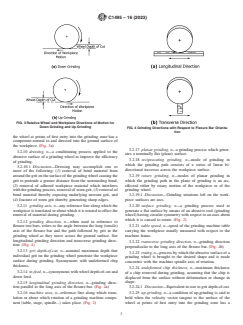
FIG. 3 Relative Wheel and Workpiece Directions of Motion for
Down Grinding and Up Grinding
FIG. 4 Grinding Directions with Respect to Flexure Bar Orienta-
tion
the wheel at points of first entry into the grinding zone has a
component normal to and directed into the ground surface of
the workpiece. (Fig. 3a)
3.2.17 planar grinding, n—a grinding process which gener-
3.2.10 dressing, n—a conditioning process applied to the
ates a nominally flat (plane) surface.
abrasive surface of a grinding wheel to improve the efficiency
3.2.18 reciprocating grinding, n—mode of grinding in
of grinding.
which the grinding path consists of a series of linear bi-
3.2.10.1 Discussion—Dressing may accomplish one or
directional traverses across the workpiece surface.
more of the following: (1) removal of bond material from
around the grit on the surface of the grinding wheel causing the 3.2.19 rotary grinding, n—modes of planar grinding in
grit to protrude a greater distance from the surrounding bond, which the grinding path in the plane of grinding is an arc,
(2) removal of adhered workpiece material which interferes effected either by rotary motion of the workpiece or of the
with the grinding process, removal of worn grit, (3) removal of grinding wheel.
bond material thereby exposing underlying unworn grit, and 3.2.19.1 Discussion—Grinding striations left on the work-
(4) fracture of worn grit thereby generating sharp edges. piece surfaces are arcs.
3.2.11 grinding axis, n—any reference line along which the 3.2.20 surface grinding, n—a grinding process used to
workpiece is translated or about which it is rotated to effect the generate a flat surface by means of an abrasive tool (grinding
removal of material during grinding. wheel) having circular symmetry with respect to an axes about
which it is caused to rotate. (Fig. 2)
3.2.12 grinding direction, n—when used in reference to
flexure test bars, refers to the angle between the long (tensile) 3.2.21 table speed, n—speed of the grinding machine table
carrying the workpiece usually measured with respect to the
axis of the flexure bar and the path followed by grit in the
grinding wheel as they move across the ground surface. See machine frame.
longitudinal grinding direction and transverse grinding direc-
3.2.22 transverse grinding direction, n—grinding direction
tion. (Fig. 4)
perpendicular to the long axis of the flexure bar. (Fig. 4b)
3.2.13 grit depth-of-cut, n—nominal maximum depth that
3.2.23 truing, n—process by which the abrasive surface of a
individual grit on the grinding wheel penetrate the workpiece
grinding wheel is brought to the desired shape and is made
surface during grinding. Synonymous with undeformed chip
concentric with the machine spindle axis of rotation.
thickness.
3.2.24 undeformed chip thickness, n—maximum thickness
3.2.14 in-feed, n—synonymous with wheel depth-of-cut and
of a chip removed during grinding, assuming that the chip is
down feed.
displaced from the surface without deformation or change in
3.2.15 longitudinal grinding direction, n—grinding direc- shape.
tion parallel to the long axis of the flexure bar. (Fig. 4a) 3.2.24.1 Discussion—Equivalent in size to grit depth-of-cut.
3.2.16 machine axes, n—reference line along which trans- 3.2.25 up-grinding, n—a condition of up-grinding is said to
lation or about which rotation of a grinding machine compo- hold when the velocity vector tangent to the surface of the
nent (table, stage, spindle.) takes place. (Fig. 2) wheel at points of first entry into the grinding zone has a
C1495 − 16 (2023)
component normal to and directed out of the ground surface of applied surface grinding process with the baseline flexure
the workpiece. (Fig. 3b) strength for the same material. The baseline flexure strength is
obtained after application of a grinding process specified in this
3.2.26 wheel depth-of-cut, n—depth of penetration of the
standard and is expected to approximate closely the inherent
grinding wheel into the workpiece surface as it moves parallel
flexure strength of the material. The user-applied surface
to the surface to remove a layer of material. (Fig. 3)
grinding process may result in a decrease in flexure strength,
3.2.26.1 Discussion—Often abbreviated to depth-of-cut.
no change in flexure strength, or in certain cases an increase in
3.2.27 wheel specifications, n—description of the grinding
flexure strength. Two procedures, A and B, are available
wheel dimensions, grit type, grit size, grit concentration, bond
depending on the objective of the measurement. Procedure A is
type, and any other properties provided by the wheel manu-
restricted to linear grinding processes obtained, for example,
facturer that characterize the grinding wheel.
by a horizontal spindle, reciprocating-table surface grinder. In
3.2.28 wheel surface speed, n—circumferential speed of the
linear grinding processes, the surface finish is usually charac-
grinding wheel surface at points which engage the workpiece
terized by straight, parallel striations. Procedure A compares
during the process of grinding.
the baseline flexure strength of a material with the flexure
3.3 Surface Finish Related:
strength (1) after grinding parallel (termed longitudinal) to the
3.3.1 lay, n—refers to the direction a non-random pattern of
long axis of the flexure test specimen and (2) after grinding
surface roughness in the plane of the surface, for example, the
perpendicular (termed transverse) to the long axis of the flexure
direction of abrasive striations on a surface prepared by
test specimen using the same grinding conditions. These two
grinding. (Fig. 2)
directions are employed because many advanced ceramics
3.3.2 roughness, n—three-dimensional variations in surface
exhibit a change in flexure strength that is a minimum when
topography characterized by wavelengths in the plane of the
grinding is in the longitudinal direction and a maximum when
surface that are small compared to the design dimensions of the
grinding is in the transverse direction. The grinding processes
workpiece.
to be evaluated need only be applied to the tensile face of the
3.3.3 waviness, n—surface topographic variations character- test specimen. However, the other faces, especially the adjacent
ized by wavelengths in the plane of the surface that are large
sides, must be prepared in such a way that they do not sustain
compared to the roughness but smaller than the design dimen-
damage that will influence the fracture process that occurs on
sions of the workpiece.
the tensile face. (Where a grinding process could result in a
substantial loss in flexure strength, it is recommended that this
3.4 Flexure Test Related:
process not be applied to adjacent faces.) Procedure A is useful
3.4.1 break force, n—force at which a test specimen frac-
for obtaining detailed information on the response of a material
tures (fails) in a flexure test.
to surface grinding and for the systematic determination of the
3.4.2 flexural strength, n—a measure of the ultimate
influence of different grinding parameters on flexure strength.
strength of a specified beam in bending. C1145
Three sets of test specimens (typically 10 to 30 test specimens
3.4.3 tensile face, n—side of a flexure test specimen that is
per set depending on statistical requirements) will be required
stressed in tension in a flexure test.
to evaluate a single grinding condition. Once the baseline
Other terms related to flexure testing can be found in C1161.
strength is determined, only two sets, longitudinal and
3.5 Fractography Related:
transverse, will be required for evaluation of additional grind-
3.5.1 crack, n—as used in fractography, a plane of fracture
ing conditions, provided there is no change in the material from
without complete separation. C1322
which the test specimens are prepared.
3.5.2 flaw, n—a structural discontinuity in an advanced
4.2 Procedure B is designed mainly for quality control
ceramic body which acts as a highly localized stress riser.
purposes but it may also be used for process development
C1322
purposes. This procedure is not restricted to linear grinding. As
3.5.3 fractography, n—means and methods for characteriz-
in Procedure A, the flexure strength of test specimens ground
ing a fractured test specimen or component. C1145
under user specified conditions is compared with the baseline
3.5.4 fracture origin, n—the source from which brittle
flexure strength of the same lot of material. Procedure B is
fracture commences. C1145
applicable to any grinding method that generates a suitably flat
3.5.5 fracture mirror, n—as used in fractography of brittle surface to meet the geometrical requirements for flexure test
materials, a relatively smooth region in the immediate vicinity specimens (1.4). The ground surface lay may consist of a
of and surrounding the fracture origin. C1322
straight-line pattern generated by linear grinding, arcs pro-
Other terms related to fractography can be found in C1322. duced by rotary modes of grinding, or any other pattern.
However, as in Procedure A, careful consideration must be
3.6 Statistical Analysis Related:
given to the directionality of the lay with respect to the tensile
Terminology related to the reporting of flexural strength data
direction of the flexure test specimen. When different grinding
and Weibull distribution parameters can be found in C1239.
parameters or different materials are to be compared, care must
4. Summary of Test Method
be taken to maintain the angle between the lay direction and the
test specimen axis for all test specimens. Alternatively, similar
4.1 This method compares the flexure strength of an ad-
vanced ceramic material that has been subjected to a user- to Procedure A, tests may be conducted to determine the
C1495 − 16 (2023)
TABLE 1 Flexure Test Specimen Configurations, Dimensions,
relationship between lay direction with respect to the test
A
and Tolerances
specimen axis and flexure strength.
Configuration Width (b), mm Depth (d), mm Length (L ) min,
T
mm
5. Significance and Use
A 2.0 (±0.05) 1.5 (±0.05) 25
B 4.0 (±0.13) 3.0 (±0.13) 45
5.1 Surface grinding can cause a significant decrease in the
C 8.0 (±0.13) 6.0 (±0.13) 90
flexure strength of advanced ceramic materials. The magnitude
A
C1161 and C1211 give complete details and graphics on parallelism,
of the loss in strength is determined by the grinding conditions
perpendicularity, chamfers, and radii.
and the response of the material. This test method can be used
to obtain a detailed characterization of the relationship between
grinding conditions and flexure strength for an advanced
variation in flaw population could be mistakenly attributed to
ceramic material. The effect on flexure strength of varying a
an effect of machining.
single grinding parameter or several grinding parameters can
6.3 Test specimen surfaces can be scratched or indented
be measured. The method may also be used to compare and
during handling, especially during mounting or clamping for
rank different materials according to their response to one or
grinding. This is most likely to occur when hard abrasive
more different grinding conditions. Results obtained by this
particles are present on the test specimen surface or on a
method can be used to develop an optimum grinding process
surface that contacts the test specimen. An extraneous scratch
with respect to maximizing material removal rate for a speci-
or indentation can act as a source of premature failure during
fied flexure strength requirement. The test method can assist in
flexure testing. In some cases it may not be possible to
the development of improved grinding-damage-tolerant ce-
distinguish between extraneous and machining induced dam-
ramic materials. It may also be used for quality control
age.
purposes to monitor and assure the consistency of a grinding
6.4 A grinding procedure is specified in this standard for
process in the fabrication of parts from advanced ceramic
materials. The test method is applicable to grinding methods measuring a reference baseline flexure strength. Damage intro-
duced by this grinding procedure is not expected to have a
that generate a planar surface and is not directly applicable to
grinding methods that produce non-planar surfaces such as significant effect on the flexure strength of most advanced
ceramic materials. For verification, fractographic examination
cylindrical and centerless grinding.
of tested baseline-test-specimens is used to ascertain the
absence of machining damage at the fracture origin. In some
6. Interferences
instances undetected grinding-induced damage may combine
6.1 The condition and properties of the grinding machine
or join with the inherent flaw that acts as the source or origin
and grinding wheel can have a significant influence on the
of fracture. This may impose a negative bias on the measured
measured flexure strength. These conditions and properties
flexure strength result. Residual stresses introduced by the
may not be easily identified, measured or controlled. Machine
specified grinding procedure can also influence the baseline
characteristics such as static and dynamic stiffness can have a
flexure strength.
substantial effect on damage introduced by grinding. These
6.5 A number of flexure test related factors can influence the
characteristics are likely to differ for different grinding ma-
value of the measured flexure strength. Among the most
chines. Grinding wheel specifications give only a qualitative
important for susceptible materials is slow crack growth due to
identification and not a detailed or precise measure of proper-
environmental moisture. This and other interferences are dis-
ties. Thus despite having common specifications, grinding
cussed in C1161 and C1211.
wheels from different manufacturers may give different results.
Wheels from the same manufacturer with the same specifica-
7. Materials
tions may also perform differently due to manufacturing
process variations. Grinding wheel condition, which is highly 7.1 This standard covers materials that are suitable for
sensitive to prior use and the truing and dressing procedure and testing by C1161 Test Method for Flexure Strength of Ad-
cycle, can also affect flexure strength. In connection with truing
vanced Ceramics at Ambient Temperatures and C1211 Test
and dressing, the greatest variation is likely to occur when Method for Flexure Strength of Advanced Ceramics at El-
these procedures are performed manually by the operator. evated Temperatures. ASTM Standards C1161 and C1211
require that the material be isotropic and homogeneous, that
6.2 Property variations in the test material may lead to
the moduli of elasticity in tension and compression be
differences in flexure strength. Such variations may be associ-
identical, and that the material be linearly elastic. It is also
ated with differences in the population of inherent flaws in the
required that the grain size be no greater than one fiftieth of the
material or to compositional and microstructural variations.
flexure test specimen thickness.
When the influence of machining damage on flexure strength
competes with the effect of inherent flaws, a material related
8. Test Specimen Dimensions
8.1 The required test specimen dimensions and tolerances
are specified in the flexure test standards (C1161 and C1211)
In some cases, an increase in flexure strength can be obtained by surface
and are given in Table 1. In preparing test specimens, allow-
grinding if a highly flawed or lower-strength surface layer is removed by grinding.
ance must be made for a thickness ≥0.4 mm to be removed
An increase can also result if a sufficiently large surface residual stress is introduced
by grinding or if a favorable phase transformation is induced. from the surface by the grinding process being tested. For most
C1495 − 16 (2023)
TABLE 2 Adjustable Machining Parameters TABLE 3 Grinding Wheel Characteristics
Wheel Speed Diameter (size range determined by machine)
Down Feed Width
Table Speed Bond type
Cross-Feed Grit Size
Grinding Direction (with respect to test specimen geometry) Grit Size distribution
Grit Concentration
Grit Characteristics (type, shape, friability, etc.)
materials this thickness will eliminate damage associated with
prior machining operations and allow a steady state condition
determine whether, indeed, a 10 % reduction in wheel speed
to be achieved for the grinding process under investigation. A has a significant effect on flexure strength of the material under
thickness smaller than 0.4 mm may be used, but tests must be
study.
carried out to determine that prior damage has been removed 9.2.1 Guidance in the choice of an appropriate set of
and steady state is achieved in the grinding process under
grinding variables is obtained by considering the two relation-
investigation. These tests will require comparison of flexure ships used to determine removal rate, Eq 1 and grit depth-of-
strength values obtained using the smaller thickness with
cut, Eq 2. For linear reciprocating surface grinding the removal
values obtained for a thickness ≥0.4 mm. rate, Q , is given by:
w
Q 5 ν ac (1)
w w w
9. Grinding Dimensions
where:
9.1 A comprehensive discussion of grinding conditions is
ν = table speed,
beyond the scope of this standard. More complete treatments
w
a = down-feed, and
can be found in the open literature and in textbooks on grinding
c = cross-feed.
(2). The following description is included mainly to assist in w
the identification and categorization of important factors. In
Increasing any or all of the independent variables will result
principle, grinding conditions comprise all grinding related in an increase in removal rate. Limits on the magnitudes of
factors that influence the measured flexure strength of the test
these parameters are imposed by the capacity of the machine in
specimen. Some factors may be inherent to the design of the terms of range of operation, available power, and operating
grinding machine and not easily or directly subject to control,
speed of the grinding wheel. The capacity of the workpiece to
for example, the static and dynamic stiffness characteristics of sustain the imposed grinding forces without failure and wheel
the machine, and vibrations inherent to the machine. Other
grit size are also limiting factors. Seeking a higher removal rate
factors such as the feed rates and wheel grit size are subject to by increasing ν or a, or both, can adversely effect surface
w
direct control. This standard is primarily concerned with the
finish, flexure strength, and wheel wear.
evaluation of the influence of the latter factors. Grinding 9.2.2 The grit depth-of-cut, h , for linear reciprocating
m
variables typically available for direct control are identified in
surface grinding can be approximated by (2):
the sections below.
½ ½
h 5 ~1/Cr! ~ν /ν ! ~a/d! 4 (2)
m w s
9.2 Directly Controlled Machining Variables—Machining
where:
variables that are subject to direct control can be placed in three
C = concentration per unit area of grit that are active during
categories: (1) machine control parameters such as down-feed
grinding,
and table speed (Table 2), (2) grinding wheel characteristics
r = is a factor describing the shape of the grit,
(Table 3), and (3) coolant variables. As with any test, there are
ν = the wheel speed, and
s
limits in the precision to which a given parameter can be
d = the wheel diameter.
controlled. These limits can vary substantially for different
machines. For example, a conventional grinding machine with Because of variations in height and location of grit on the
hydraulically operated table feeds probably will not offer as surface of the wheel, not all exposed grit will be engaged in
precise control over table speed and cross-feed as a CNC cutting under a given set of grinding conditions. Those grit
(computer numerically control) type machine with precision actually engaged in cutting are referred to as active grit.
lead screw drives and encoder feed back. The importance of a Grinding parameters should be chosen so that h is much less
m
given parameter or variable will of course depend on its than approximately ⁄3 the nominal grit size. If h is too large,
m
influence on the flexure strength of the material being tested. excessive wheel wear may occur and the grinding forces may
Low precision with respect to a parameter or variable does not reach a level that results in complete failure of the wheel or
necessarily adversely affect the application of this standard. damage to the machine or workpiece, or both. The grit
The standard can in fact be employed to assess the sensitivity depth-of-cut also plays an important role in determining
of flexure strength to a given parameter or variable. For grinding induced damage. It is reasoned that the greater the
example, for a certain machine, wheel speed is reduced by depth of penetration of the grit into the surface of the test
10 % under load during grinding due to limitations in motor specimen during material removal, the larger the cracks
speed control and power. The question may be asked, “Will this introduced, and consequently the greater the reduction in
reduction in speed influence flexure strength?” One or more flexure strength. Supporting this argument is the well-known
tests can be conducted at 20 % higher and lower speeds to fact that cracks introduced by hardness indentation increase in
evaluate sensitivity to wheel speed. The outcome will help size with increasing indentation force.
C1495 − 16 (2023)
9.2.3 Experiments have shown that flexure strength does 9.2.7 Since the waviness in the surface finish whether
indeed decrease with increasing grit depth-of-cut. However, caused by wheel imbalance, by lack of concentricity, or by
both, reflects a corresponding variation in the depth-of-cut, the
the actual relationship between flexure strength and grit depth-
potential exists for an associated adverse effect on flexure
of-cut is quite complex and must account for the introduction
strength. Instead of a constant depth-of-cut, the actual depth-
of residual stresses and thermal effects, as well as dynamic
of-cut oscillates about an average value. The maximum depth-
material response factors and other aspects of the grit work-
of-cut value is the relevant quantity with respect to assessing
piece interaction process. From Eq 2, it is seen that increasing
the influence of down-feed on flexure strength.
the grit concentration, wheel speed or wheel diameter de-
9.2.8 Because of the elastic compliance of the machine,
creases the grit depth-of-cut, while increasing the table speed
grinding wheel, and workpiece, it should be noted that the
or down-feed increases the grit depth-of-cut. The effects of
actual depth-of-cut will be less than the set down-feed value.
down-feed and wheel diameter appear as the one-fourth root
Only after several successive advances in down-feed will the
and consequently are expected to have a smaller effect relative
depth-of-cut approach the set value of down-feed. In addition
to changes in the other parameters which exhibit a square root
to elastic compliance, wheel wear also will result in a depth-
dependence. Although grit size does not explicitly appear in Eq
of-cut that is less than the set down-feed value. Accurate
2, experiment shows that grit size is the factor that is most
determination of the depth-of-cut will require direct measure-
consistent in its influence on flexure strength. Namely, there is
ment of the thickness of material removed from the test
nearly always an inverse relationship between grit size and
specimen. Finally, it should be pointed out that the above
flexure strength. This is caused primarily by the fact the Eq 2
influences on depth-of-cut might have only a minor effect on
does not explicitly account for the non-uniform height distri-
flexure strength because of the fourth root dependence of
bution of exposed grit that exists on most grinding wheels.
depth-of-cut in Eq 2.
Thus, larger heights and correspondingly greater grit depths of
9.2.9 Truing is normally done with the wheel mounted on
penetration are almost certain to occur for larger grit sizes at a
the grinding machine. For diamond grit wheels, a brake truer or
given down-feed setting.
powered rotary truing device is commonly used. Truing with
9.2.4 Grinding Wheel Condition (Balancing, Truing,
one of these devices is a grinding operation itself in which the
Dressing, and Wear)—In addition to the design characteristics
truing device is equipped with a grinding wheel of the correct
of the grinding wheel (Table 3), the condition of the grinding
grade for the wheel being trued. Truing wheels are usually
wheel can exercise a significant influence on the damage
operated at a surface speed that is different from that of the
introduced during grinding and consequently on flexure
wheel being trued. The ratio of grinding wheel surface speed to
strength. The condition of the grinding wheel can be described
truing wheel surface speed is chosen to optimize the truing
in terms of its balance, trueness, grit exposure, and state of
process, that is, to maximize the rate of volume removal from
wear.
the grinding wheel and minimize the volume lost from the
truing wheel. The run-out of an effectively trued wheel is
9.2.5 Balancing may be carried out manually by the
typically less than 2 μm. Truing is rarely, if ever, applied to
operator, or automatically if the machine is so equipped. An
single-layer plated or brazed diamond wheels.
out-of-balance wheel will result in vibration or oscillation of
9.2.10 The form of the grinding wheel is also determined by
the wheel with respect to the workpiece causing the depth-of-
truing. For planar surface grinding where the wheel periphery
cut to vary as the wheel rotates against the workpiece surface.
is the operational surface as in Fig. 2, truing is performed to
The extent of these depth variations will depend on the degree
make this surface cylindrical and concentric with the spindle
of imbalance and stiffness characteristics of the machine and
axis of rotation. Any departure in shape from a true cylinder
on grinding conditions. Out-of-balance can be detected by
will cause a variation in the depth-of-cut as the wheel engages
means of an accelerometer mounted on the grinding machine.
the workpiece surface. For rotary grinding modes, the face of
Periodic depth waves in the surface finish topography of the
the wheel is the primarily operational surface and truing is
workpiece may also be used to identify out-of-balance, how-
performed to make this surface flat and perpendicular to the
ever similar variations in surface finish may be produced by a
spindle axis. With continued use, wheel wear will eventually
wheel that is not true. Balancing of the wheel may be done
determine the steady-state form of the grinding wheel. The
statically or dynamically, or both, on or off the machine.
steady state form is specific to the wheel width, grinding
Various devices and methods are available for accomplishing
conditions, and workpiece dimensions.
this.
9.2.11 Efficient cutting requires the presence of sharp grit
9.2.6 A wheel that runs true is one that, when mounted on
that protrude fractionally above the surface of the surrounding
the machine, presents a grinding surface that exhibits circular
bond material. Dressing refers primarily to the removal of bond
symmetry with respect to the axis of rotation of the spindle. As
material from the surface of the grinding wheel thereby
noted above (9.2.5), a periodic variation in height (referred to
increasing the height at which the grit stand above the surface,
as waviness) of the workpiece surface along the direction of
removing worn grit, or allowing the exposure of fresh grit, or
grinding will result if the wheel does not possess circular
combination thereof. Several methods for dressing are avail-
symmetry. In reciprocating surface grinding, the wheel is
able. Most often dressing is accomplished by grinding a
generally trued to obtain a cylindrical form for generation of
specially formulated block of material (dressing stick) com-
flat workpiece surfaces. posed of weakly bonded abrasive grit, commonly aluminum
C1495 − 16 (2023)
oxide or silicon carbide. The type and size of the grit and nature two sets of test specimens, one for longitudinal and one for
of the bond characterizing the dressing stick is chosen for the transverse grinding, will be required for each condition.
grinding wheel. Dressing is carried out at a relatively large grit
10.1.1 Initial Test Specimen Preparation—A minimum of
depth-of-cut to enhance the abrasion of the bond material
10 test specimens per set is recommended in order to provide
surrounding the diamond grit.
a sufficiently large sample size for statistical analysis. For
9.2.12 Coolant (Grinding Fluid)—Three principal effects
rigorous statistical analyses employing Weibull probability
are provided by the coolant or grinding fluid. These are
distribution (Section 13), a minimum of 30 test specimens per
extraction of heat generated during grinding from the work-
set is recommended (see C1239). When testing is performed
piece and wheel, removal of chips from the grinding zone, and
for design or size scaling purposes, a minimum of 30 test
lubrication of the cutting zone. Any or all of these may have
specimens per set is recommended. Increasing the number of
direct and indirect influences on damage introduced by grind-
test specimens in each set will in general reduce scatter
ing and consequently on flexure strength. Perhaps the most
associated with statistical sampling effects. Ultimately, vari-
critical function of the coolant is chip removal. Without
ability in the material, in the grinding process, and in the
effective removal, chips may accumulate on the wheel inter-
flexure test will determine the measurement uncertainty.
fering with the contact between the grit and workpiece. Under
10.1.2 Flexure Test Specimen Size—Test specimens of three
extreme conditions rubbing of accumulated chips may cause
different sizes A, B, and C are specified in flexure test
excessive forces resulting in stalling or catastrophic damage to
Standards C1161 and C1211. Unless constraints are imposed
the workpiece, wheel or grinding machine. The direct effects of
by the amount and dimensions of the available material, the
cooling and lubrication on damage are not fully understood.
larger B or C size test specimen should be chosen to take
However, both cooling and lubrication can reduce wheel wear
advantage of the potential reduction in statistical variation
and in that way reduce damage, at least to the extent that wheel
resulting from the larger volume under tension during flexure
wear itself affects damage. Some grinding fluids may perform
testing with these larger test specimens.
better than others. Thus, care must be exercised in selecting a
10.1.3 Test Specimen Orientation, Identification and
grinding fluid that is appropriate to the grinding conditions and
Distribution—Depending on dimensions, one or more test
the workpiece material. If a concentrate that must be mixed
specimens may be prepared from each piece of stock material.
with water is used, an appropriate concentration, usually
In the flexure test, typically only a small region adjacent to the
recommended by the supplier, must be chosen.
tensile surface of the test specimen influences the flexure
9.2.13 In general, coolant is delivered by a nozzle that is
strength. Therefore, consideration must be given to the exis-
directed at the junction between the wheel and workpiece and
tence of property variations within each piece of the stock
carried into the contact by the rotation of the wheel. Flow rate
material and to variations among different pieces of stock
and nozzle direction may be adjustable. Some machine designs
material. Each test specimen should be marked for identifica-
may utilize more than one nozzle. For example, a second
tion and its location and orientation with respect to the stock
nozzle may be directed normal to the wheel surface using the
material geometry should be recorded. If the stock piece or
force of the coolant flow to flush accumulated chips from the
billet exhibits identifiable manufacturing features then location
surface of the wheel. Alternatively, or in addition to delivery by
and orientation should also be referenced with respect to such
nozzles, coolant may be supplied radially through holes in the
features. Preferably, all test specimens should belong to the
wheel surface.
same lot of material. The distribution of test specimens among
9.2.14 The coolant supply facility should be equipped with
the test sets should be balanced. For example, if some test
a filtration system typically capable of removing particles
specimens are derived from the center of a billet and others
greater than 5 μm in size. Large hard particles, especially
were located near the outer surface, approximately equal
diamond grit lost from the wheel, entrained in the coolant and
numbers of test specimens from each source should be as-
delivered to the wheel/workpiece contact zone may scratch the
signed to each set. Similarly, if test specimens were prepared
workpiece introducing damage that degrades flexure strength.
from five billets, each set should contain approximately the
same number of test specimens from each of the five billets.
10. Grinding Test Procedures
Furthermore, test specimens should be chosen randomly from
each source for assignment to each set. The baseline strength of
10.1 Grinding Test Procedure A—This procedure compares
each new lot of material shall be measured to establish that a
the flexure strength of a material after application of a
materials-related change in flexure strength is not attributed to
user-specified grinding condition with the baseline flexure
or mistaken for the effects of grinding damage.
strength of the same material. The baseline flexure strength is
determined using grinding conditions specified in 10.1.4. Only 10.1.4 Preparation of Test Specimens for Measurement of
planar grinding modes that generate a surface finish consisting Baseline Flexure Strength—A thickness of ≥0.4 mm must be
of nominally parallel striations are evaluated by this procedure. removed from each side of the test specimen by surface
Initially, three sets of test specimens are required to evaluate a grinding to obtain the dimensions and tolerances specified by
given grinding condition. One set of test specimens is used to the applicable flexure test standard (C1161 and C1211). Two
determine the baseline strength of the material. The second and stages of grinding are defined—rough grinding (Table 4) and
third sets are used to measure flexure strength after longitudinal finish grinding (Table 5). Only the tensile face requires finish
grinding and transverse grinding. If additional grinding condi- grinding. One face of each test specimen will be selected and
tions are to be evaluated for the same lot of material, then only identified as the tensile face in the flexure test. Rough grinding
C1495 − 16 (2023)
TABLE 4 Rough Grinding
conditions will be applied only to that surface. Unless other-
Wheel: 320 grit (270/325 mesh; FEPA 54) diamond, 75–100 wise required by the grinding conditions being evalu
...