

ASTM D5334-22ae1
(Test Method)Standard Test Method for Determination of Thermal Conductivity of Soil and Rock by Thermal Needle Probe Procedure
General Information
- Abstract
SIGNIFICANCE AND USE
5.1 The thermal conductivity of intact soil specimens, reconstituted soil specimens, and rock specimens is used to analyze and design systems involving underground transmission lines, oil and gas pipelines, radioactive waste disposal, geothermal applications, and solar thermal storage facilities, among others. Measurements can be made on site (in situ), or samples can be tested in a lab environment.
Note 2: The quality of the result produced by this standard is dependent on the competence of the personnel performing it, and the suitability of the equipment and facilities used. Agencies that meet the criteria of Practice D3740 are generally considered capable of competent and objective testing. Users of this standard are cautioned that compliance with Practice D3740 does not in itself ensure reliable results. Reliable results depend on many factors; Practice D3740 provides a means of evaluating some of those factors.
SCOPE
1.1 This test method presents a procedure for determining the thermal conductivity (λ) of soil and rock using a transient heat method. This test method is applicable for both intact specimens of soil and rock and reconstituted soil specimens, and is effective in the lab and in the field. This test method is most suitable for homogeneous materials, but can also give a representative average value for non-homogeneous materials.
1.2 This test method is applicable to dry, unsaturated or saturated materials that can sustain a hole for the sensor. It is valid over temperatures ranging from 100°C, depending on the suitability of the thermal needle probe construction to temperature extremes. However, care must be taken to prevent significant error from: (1) redistribution of water due to thermal gradients resulting from heating of the needle probe; (2) redistribution of water due to hydraulic gradients (gravity drainage for high degrees of saturation or surface evaporation); (3) phase change of water in specimens with temperatures near 0°C or 100°C.
1.3 Units—The values stated in SI units are to be regarded as the standard. No other units of measurements are included in this standard. Reporting of test results in units other than SI shall not be regarded as nonconformance with this standard.
1.4 All observed and calculated values shall conform to the guidelines for significant digits and rounding established in Practice D6026.
1.4.1 The procedures used to specify how data are collected/recorded or calculated in this standard are regarded as the industry standard. In addition, they are representative of the significant digits that generally should be retained. The procedures used do not consider material variation, purpose for obtaining the data, special purpose studies, or any considerations for the user’s objectives; and it is common practice to increase or reduce significant digits of reported data to be commensurate with these considerations. It is beyond the scope of this standard to consider significant digits used in analytical methods for engineering design.
Note 1: This test method is also applicable and commonly used for determining thermal conductivity of a variety of engineered porous materials of geologic origin including concrete, Fluidized Thermal Backfill (FTB), and thermal grout.
1.5 This standard does not purport to address all of the safety concerns, if any, associated with its use. It is the responsibility of the user of this standard to establish appropriate safety, health, and environmental practices and determine the applicability of regulatory limitations prior to use.
1.6 This international standard was developed in accordance with internationally recognized principles on standardization established in the Decision on Principles for the Development of International Standards, Guides and Recommendations issued by the World Trade Organization Technical Barriers to Trade (TBT) Committee.
- Status
- Published
- Publication Date
- 30-Sep-2022
- Technical Committee
- D18 - Soil and Rock
- Drafting Committee
- D18.12 - Rock Mechanics
Overview
ASTM D5334-22ae1 is an internationally recognized ASTM standard that defines a test method for determining the thermal conductivity of soil and rock using the thermal needle probe procedure. Thermal conductivity values obtained via this method support the analysis and design of systems where knowledge of heat transfer through geologic materials is essential. The procedure can be applied both in laboratory settings and in situ (field environments), and it is effective for intact soil and rock specimens, as well as reconstituted soil. The standard primarily utilizes a transient heat method with a thermal needle probe, making it suitable for homogeneous materials and providing average representative values for non-homogeneous materials.
Key Topics
- Thermal Needle Probe Procedure: The core of the test relies on a probe with a heating element and temperature sensor inserted into the specimen. The temperature response to a controlled heat input is analyzed to determine thermal conductivity.
- Specimen Types: Applicable to intact and reconstituted soils and rocks, as well as some engineered porous materials like concrete, fluidized thermal backfill (FTB), and thermal grout.
- Measurement Conditions: The method accommodates dry, unsaturated, or saturated conditions and can be used for materials that sustain probe insertion.
- Temperature Range: Valid over a wide range, generally between below 0°C and above 100°C, contingent on probe construction.
- Critical Factors: Care must be taken to minimize errors from water redistribution (thermal or hydraulic gradients) and phase changes near freezing or boiling points.
- Reporting: Results must be stated in SI units, following the guidelines for significant digits and rounding as established in ASTM Practice D6026.
Applications
This standard is vital for professionals involved in thermal analysis and geotechnical design, including:
- Underground Power Transmission: Accurate measurement of soil and rock thermal conductivity ensures proper thermal management for underground cables and pipelines.
- Oil & Gas Pipelines: Effective thermal analysis guides insulation and burial depth decisions for pipeline safety and efficiency.
- Radioactive Waste Disposal: Assessing the thermal properties of geologic media helps ensure the safe storage and management of nuclear materials.
- Geothermal Systems: Designers rely on precise thermal conductivity data for system optimization and performance evaluation.
- Solar Thermal Storage: Accurate soil and rock measurements underpin the design of underground thermal energy storage installations.
- Engineered Backfills and Grouts: Commonly used for verifying the performance of custom backfills in energy infrastructure.
By following ASTM D5334-22ae1, users can ensure credible, reproducible thermal conductivity measurements of soils and rocks, directly supporting risk assessment, energy efficiency, and longevity in infrastructure and environmental engineering projects.
Related Standards
When implementing ASTM D5334-22ae1, consider referencing the following ASTM standards for consistency and comprehensive reporting:
- ASTM D653: Terminology Relating to Soil, Rock, and Contained Fluids
- ASTM D2216: Test Methods for Laboratory Determination of Water (Moisture) Content of Soil and Rock by Mass
- ASTM D3740: Practice for Minimum Requirements for Agencies Engaged in Testing and/or Inspection of Soil and Rock
- ASTM D4753: Guide for Evaluating, Selecting, and Specifying Balances and Standard Masses
- ASTM D6026: Practice for Using Significant Digits and Data Records in Geotechnical Data
Practical Value
Using ASTM D5334-22ae1 ensures reliable and precise assessment of thermal conductivity in soils, rocks, and select engineered materials. This is critical for infrastructure safety, optimization of energy systems, and compliance with international best practices in geotechnical and civil engineering. The method, when followed by trained personnel and with suitable equipment, provides consistent results essential for regulatory compliance and engineering design.
Keywords: ASTM D5334, thermal conductivity test, needle probe, soil testing, rock testing, geotechnical standards, in situ testing, laboratory testing, underground transmission, geothermal analysis, pipeline heat transfer.
Relations
- Effective Date
- 01-Oct-2022
- Effective Date
- 01-Feb-2024
- Effective Date
- 01-Nov-2023
- Effective Date
- 01-Oct-2019
- Effective Date
- 01-May-2015
- Effective Date
- 01-Oct-2022
- Effective Date
- 01-Oct-2022
- Referred By
ASTM D4612-16 - Standard Test Method for Calculating Thermal Diffusivity of Rock and Soil - Effective Date
- 01-Oct-2022
Get Certified
Connect with accredited certification bodies for this standard

CIS Institut d.o.o.
Personal Protective Equipment (PPE) certification body. Notified Body NB-2890 for EU Regulation 2016/425 PPE.

Kiwa BDA Testing
Building and construction product certification.
Kmetijski inštitut Slovenije
Agricultural Institute of Slovenia. Soil testing, plant health, agricultural product analysis.
Sponsored listings
Frequently Asked Questions
ASTM D5334-22ae1 is a standard published by ASTM International. Its full title is "Standard Test Method for Determination of Thermal Conductivity of Soil and Rock by Thermal Needle Probe Procedure". This standard covers: SIGNIFICANCE AND USE 5.1 The thermal conductivity of intact soil specimens, reconstituted soil specimens, and rock specimens is used to analyze and design systems involving underground transmission lines, oil and gas pipelines, radioactive waste disposal, geothermal applications, and solar thermal storage facilities, among others. Measurements can be made on site (in situ), or samples can be tested in a lab environment. Note 2: The quality of the result produced by this standard is dependent on the competence of the personnel performing it, and the suitability of the equipment and facilities used. Agencies that meet the criteria of Practice D3740 are generally considered capable of competent and objective testing. Users of this standard are cautioned that compliance with Practice D3740 does not in itself ensure reliable results. Reliable results depend on many factors; Practice D3740 provides a means of evaluating some of those factors. SCOPE 1.1 This test method presents a procedure for determining the thermal conductivity (λ) of soil and rock using a transient heat method. This test method is applicable for both intact specimens of soil and rock and reconstituted soil specimens, and is effective in the lab and in the field. This test method is most suitable for homogeneous materials, but can also give a representative average value for non-homogeneous materials. 1.2 This test method is applicable to dry, unsaturated or saturated materials that can sustain a hole for the sensor. It is valid over temperatures ranging from 100°C, depending on the suitability of the thermal needle probe construction to temperature extremes. However, care must be taken to prevent significant error from: (1) redistribution of water due to thermal gradients resulting from heating of the needle probe; (2) redistribution of water due to hydraulic gradients (gravity drainage for high degrees of saturation or surface evaporation); (3) phase change of water in specimens with temperatures near 0°C or 100°C. 1.3 Units—The values stated in SI units are to be regarded as the standard. No other units of measurements are included in this standard. Reporting of test results in units other than SI shall not be regarded as nonconformance with this standard. 1.4 All observed and calculated values shall conform to the guidelines for significant digits and rounding established in Practice D6026. 1.4.1 The procedures used to specify how data are collected/recorded or calculated in this standard are regarded as the industry standard. In addition, they are representative of the significant digits that generally should be retained. The procedures used do not consider material variation, purpose for obtaining the data, special purpose studies, or any considerations for the user’s objectives; and it is common practice to increase or reduce significant digits of reported data to be commensurate with these considerations. It is beyond the scope of this standard to consider significant digits used in analytical methods for engineering design. Note 1: This test method is also applicable and commonly used for determining thermal conductivity of a variety of engineered porous materials of geologic origin including concrete, Fluidized Thermal Backfill (FTB), and thermal grout. 1.5 This standard does not purport to address all of the safety concerns, if any, associated with its use. It is the responsibility of the user of this standard to establish appropriate safety, health, and environmental practices and determine the applicability of regulatory limitations prior to use. 1.6 This international standard was developed in accordance with internationally recognized principles on standardization established in the Decision on Principles for the Development of International Standards, Guides and Recommendations issued by the World Trade Organization Technical Barriers to Trade (TBT) Committee.
SIGNIFICANCE AND USE 5.1 The thermal conductivity of intact soil specimens, reconstituted soil specimens, and rock specimens is used to analyze and design systems involving underground transmission lines, oil and gas pipelines, radioactive waste disposal, geothermal applications, and solar thermal storage facilities, among others. Measurements can be made on site (in situ), or samples can be tested in a lab environment. Note 2: The quality of the result produced by this standard is dependent on the competence of the personnel performing it, and the suitability of the equipment and facilities used. Agencies that meet the criteria of Practice D3740 are generally considered capable of competent and objective testing. Users of this standard are cautioned that compliance with Practice D3740 does not in itself ensure reliable results. Reliable results depend on many factors; Practice D3740 provides a means of evaluating some of those factors. SCOPE 1.1 This test method presents a procedure for determining the thermal conductivity (λ) of soil and rock using a transient heat method. This test method is applicable for both intact specimens of soil and rock and reconstituted soil specimens, and is effective in the lab and in the field. This test method is most suitable for homogeneous materials, but can also give a representative average value for non-homogeneous materials. 1.2 This test method is applicable to dry, unsaturated or saturated materials that can sustain a hole for the sensor. It is valid over temperatures ranging from 100°C, depending on the suitability of the thermal needle probe construction to temperature extremes. However, care must be taken to prevent significant error from: (1) redistribution of water due to thermal gradients resulting from heating of the needle probe; (2) redistribution of water due to hydraulic gradients (gravity drainage for high degrees of saturation or surface evaporation); (3) phase change of water in specimens with temperatures near 0°C or 100°C. 1.3 Units—The values stated in SI units are to be regarded as the standard. No other units of measurements are included in this standard. Reporting of test results in units other than SI shall not be regarded as nonconformance with this standard. 1.4 All observed and calculated values shall conform to the guidelines for significant digits and rounding established in Practice D6026. 1.4.1 The procedures used to specify how data are collected/recorded or calculated in this standard are regarded as the industry standard. In addition, they are representative of the significant digits that generally should be retained. The procedures used do not consider material variation, purpose for obtaining the data, special purpose studies, or any considerations for the user’s objectives; and it is common practice to increase or reduce significant digits of reported data to be commensurate with these considerations. It is beyond the scope of this standard to consider significant digits used in analytical methods for engineering design. Note 1: This test method is also applicable and commonly used for determining thermal conductivity of a variety of engineered porous materials of geologic origin including concrete, Fluidized Thermal Backfill (FTB), and thermal grout. 1.5 This standard does not purport to address all of the safety concerns, if any, associated with its use. It is the responsibility of the user of this standard to establish appropriate safety, health, and environmental practices and determine the applicability of regulatory limitations prior to use. 1.6 This international standard was developed in accordance with internationally recognized principles on standardization established in the Decision on Principles for the Development of International Standards, Guides and Recommendations issued by the World Trade Organization Technical Barriers to Trade (TBT) Committee.
ASTM D5334-22ae1 is classified under the following ICS (International Classification for Standards) categories: 13.080.20 - Physical properties of soils. The ICS classification helps identify the subject area and facilitates finding related standards.
ASTM D5334-22ae1 has the following relationships with other standards: It is inter standard links to ASTM D5334-22a, ASTM D4753-24, ASTM D3740-23, ASTM D3740-19, ASTM D4753-15, ASTM D7294-13(2021), ASTM C1903-21, ASTM D4612-16. Understanding these relationships helps ensure you are using the most current and applicable version of the standard.
ASTM D5334-22ae1 is available in PDF format for immediate download after purchase. The document can be added to your cart and obtained through the secure checkout process. Digital delivery ensures instant access to the complete standard document.
Standards Content (Sample)
This international standard was developed in accordance with internationally recognized principles on standardization established in the Decision on Principles for the
Development of International Standards, Guides and Recommendations issued by the World Trade Organization Technical Barriers to Trade (TBT) Committee.
´1
Designation: D5334 − 22a
Standard Test Method for
Determination of Thermal Conductivity of Soil and Rock by
Thermal Needle Probe Procedure
This standard is issued under the fixed designation D5334; the number immediately following the designation indicates the year of
original adoption or, in the case of revision, the year of last revision. A number in parentheses indicates the year of last reapproval. A
superscript epsilon (´) indicates an editorial change since the last revision or reapproval.
ε NOTE—Editorially corrected dry density units in October 2023.
1. Scope* commensurate with these considerations. It is beyond the scope
of this standard to consider significant digits used in analytical
1.1 This test method presents a procedure for determining
methods for engineering design.
the thermal conductivity (λ) of soil and rock using a transient
NOTE 1—This test method is also applicable and commonly used for
heat method. This test method is applicable for both intact
determining thermal conductivity of a variety of engineered porous
specimens of soil and rock and reconstituted soil specimens,
materials of geologic origin including concrete, Fluidized Thermal Back-
and is effective in the lab and in the field. This test method is
fill (FTB), and thermal grout.
most suitable for homogeneous materials, but can also give a
1.5 This standard does not purport to address all of the
representative average value for non-homogeneous materials.
safety concerns, if any, associated with its use. It is the
responsibility of the user of this standard to establish appro-
1.2 This test method is applicable to dry, unsaturated or
priate safety, health, and environmental practices and deter-
saturated materials that can sustain a hole for the sensor. It is
mine the applicability of regulatory limitations prior to use.
valid over temperatures ranging from <0 to >100°C, depending
1.6 This international standard was developed in accor-
on the suitability of the thermal needle probe construction to
dance with internationally recognized principles on standard-
temperature extremes. However, care must be taken to prevent
ization established in the Decision on Principles for the
significant error from: (1) redistribution of water due to thermal
Development of International Standards, Guides and Recom-
gradients resulting from heating of the needle probe; (2)
mendations issued by the World Trade Organization Technical
redistribution of water due to hydraulic gradients (gravity
Barriers to Trade (TBT) Committee.
drainage for high degrees of saturation or surface evaporation);
(3) phase change of water in specimens with temperatures near
2. Referenced Documents
0°C or 100°C.
2.1 ASTM Standards:
1.3 Units—The values stated in SI units are to be regarded
D653 Terminology Relating to Soil, Rock, and Contained
as the standard. No other units of measurements are included in
Fluids
this standard. Reporting of test results in units other than SI
D2216 Test Methods for Laboratory Determination of Water
shall not be regarded as nonconformance with this standard.
(Moisture) Content of Soil and Rock by Mass
1.4 All observed and calculated values shall conform to the
D3740 Practice for Minimum Requirements for Agencies
guidelines for significant digits and rounding established in
Engaged in Testing and/or Inspection of Soil and Rock as
Practice D6026.
Used in Engineering Design and Construction
1.4.1 The procedures used to specify how data are collected/
D4753 Guide for Evaluating, Selecting, and Specifying Bal-
recorded or calculated in this standard are regarded as the
ances and Standard Masses for Use in Soil, Rock, and
industry standard. In addition, they are representative of the
Construction Materials Testing
significant digits that generally should be retained. The proce-
D6026 Practice for Using Significant Digits and Data Re-
dures used do not consider material variation, purpose for
cords in Geotechnical Data
obtaining the data, special purpose studies, or any consider-
3. Terminology
ations for the user’s objectives; and it is common practice to
increase or reduce significant digits of reported data to be
3.1 Definitions—For definitions of common technical terms
used in this standard, refer to Terminology D653.
This test method is under the jurisdiction of ASTM Committee D18 on Soil and
Rock and is the direct responsibility of Subcommittee D18.12 on Rock Mechanics. For referenced ASTM standards, visit the ASTM website, www.astm.org, or
Current edition approved Oct. 1, 2022. Published October 2022. Originally contact ASTM Customer Service at service@astm.org. For Annual Book of ASTM
approved in 1992. Last previous edition approved in 2022 as D5334 – 22. DOI: Standards volume information, refer to the standard’s Document Summary page on
10.1520/D5334-22AE01. the ASTM website.
*A Summary of Changes section appears at the end of this standard
Copyright © ASTM International, 100 Barr Harbor Drive, PO Box C700, West Conshohocken, PA 19428-2959. United States
´1
D5334 − 22a
3.2 Definitions of Terms Specific to This Standard: 6.6 Drilling Device—(for rock specimens) A drill capable of
3.2.1 heat input, n—power consumption of heater wire in making a straight axial hole having a diameter equivalent to
watts per unit length that is assumed to be the equivalent of that of the needle and to a depth equivalent to the length of the
heat output per unit length of wire. needle.
3.2.2 thermal epoxy, n—heat conductive resin material hav-
6.7 Balance—A balance that meets the requirements of
ing a value of λ > 0.5 W/(m·K).
Guide D4753 and has a readability of 0.01 g for specimens
having a mass of up to 200 g and a readability of 0.1 g for
3.2.3 thermal grease, n—heat conductive lubricating mate-
specimens with a mass over 200 g. However, the balance used
rial having a value of λ > 1.5 W/(m·K).
may be controlled by the number of significant digits needed.
4. Summary of Test Method
7. Specimen Preparation
4.1 Thermal conductivity is determined by a variation of the
line source test method using a needle probe having a large 7.1 General Specimen Preparation Guidelines:
length to diameter ratio to simulate conditions for an infinitely 7.1.1 The main factors affecting the accuracy of a thermal
long, infinitely thin heating source. The probe consists of a
conductivity reading include the density and water content of
heating element and a temperature measuring element and is the sample, the size of the specimen, the sensitivity and
inserted into the specimen. A known current and voltage are
accuracy of temperature measurements, the amount of heat
applied to the probe heating element over a period of time and applied, and the relative conductivities of the needle and the
the temperature rise is recorded. The temperature decay with
sample. Annex A1 contains more information for configuring
time after the cessation of heating can also be included in the the test.
analysis. Thermal conductivity is obtained from an analysis of
7.1.2 Because the density and water content of the sample
the temperature time series data during the heating cycle and
are major factors in its thermal conductivity, take care to make
(optionally) the cooling cycle, by comparing it to a theoretical
the specimen the same density and water content as the
curve using non-linear least-squares inversion technique.
material it represents, whether that is the undisturbed soil or the
installed state of a backfill. As a general reference, a density of
5. Significance and Use
more than 2000 kg/m is necessary for resistivity to be under
50 °C·cm/W.
5.1 The thermal conductivity of intact soil specimens,
7.1.3 The specimen radius needs to be large enough that a
reconstituted soil specimens, and rock specimens is used to
heat pulse is not reflected off the outside boundary, and so that
analyze and design systems involving underground transmis-
the surroundings do not factor into the reading. The diffusivity
sion lines, oil and gas pipelines, radioactive waste disposal,
of the sample determines how fast heat can travel through it,
geothermal applications, and solar thermal storage facilities,
independent of its conductivity or the temperature difference at
among others. Measurements can be made on site (in situ), or
the source. By assuming that a 99 % heat reduction at distance
samples can be tested in a lab environment.
r is sufficiently small to have a negligible effect on the reading,
NOTE 2—The quality of the result produced by this standard is
dependent on the competence of the personnel performing it, and the
curves delineating the minimum size of the specimen (that is,
suitability of the equipment and facilities used. Agencies that meet the
the radius, and also the approximate length beyond the end of
criteria of Practice D3740 are generally considered capable of competent
the needle) can be derived empirically from Eq 3 parameter-
and objective testing. Users of this standard are cautioned that compliance
ized by the diffusivity (D) of the specimen, time duration (t) of
with Practice D3740 does not in itself ensure reliable results. Reliable
results depend on many factors; Practice D3740 provides a means of the reading including heating and cooling if included, and the
evaluating some of those factors.
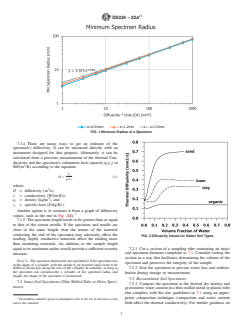
radius of the needle. Fig. 1 plots three such curves generated
for probe sizes selected to span common needle radii. Given
6. Apparatus
the product of the sample diffusivity (D) and reading time
duration (t) on the x-axis, the minimum specimen radius can be
6.1 Thermal Needle Probe—A device that creates a linear
read off the y-axis. In addition, a power law equation approxi-
heat source and incorporates a thermocouple or thermistor to
mates the results for each of the curves. For other needle radii,
measure the variation of temperature at a point along the line.
interpolation or generating a new curve may be appropriate.
The construction of a suitable device is described in Appendix
0.4382
X1.
r 5 3.971 D □□a 5 2mm (1)
~ !
t
6.2 Constant Current Source—A device to produce a con-
0.4526
r 5 3.5453~D ! □□a 5 1.2mm
t
stant current.
0.4623
r 5 3.2392~D ! □□a 5 0.64mm
6.3 Temperature Readout Unit or Recorder—A device to
t
record the temperature from the thermocouple or thermistor
where:
with a readability of 0.01 K or better.
r = distance from the heated needle (mm) (minimum radius
6.4 Digital Multimeter (DMM)—A device to read voltage
of the specimen),
and current to the nearest 0.01 V and 0.001 A.
D = thermal diffusivity of the specimen (mm /s),
t = time from the beginning of heating to the end of the test
6.5 Timer—A clock, stopwatch, digital timer, or integrated
(s), and
electronic timer capable of measuring to the nearest 0.1 s or
a = radius of the needle.
better for the duration of the measurement.
´1
D5334 − 22a
FIG. 1 Minimum Radius of a Specimen
7.1.4 There are many ways to get an estimate of the
specimen’s diffusivity. It can be measured directly with an
instrument designed for that purpose. Alternately, it can be
calculated from a previous measurement of the thermal Con-
ductivity and the specimen’s volumetric heat capacity (ρ c ) in
s s
MJ/(m ·K) according to the equation:
λ
D 5 (2)
ρ c
s s
where:
D = diffusivity (m /s),
λ = conductivity (W/(m·K)),
ρ = density (kg/m ), and
s
c = specific heat (J/(kg·K)).
s
Another option is to estimate it from a graph of diffusivity
values, such as the one in Fig. 2(1).
7.1.5 The specimen length needs to be greater than or equal
to that of the sensor needle. If the specimen and needle are
close to the same length, then the nature of the material
contacting the end of the specimen may adversely affect the
FIG. 2 Diffusivity Values for Select Soil Types
reading; highly conductive materials affect the reading more
than insulating materials. An addition to the sample length
7.2.1 Cut a section of a sampling tube containing an intact
equal to its minimum radius would provide a sufficient security
soil specimen diameter compliant to 7.1. Consider cutting the
measure.
section in a way that facilitates determining the volume of the
NOTE 3—The specimen dimensions are specified as if the specimen was
specimen and preserves the integrity of the sample.
in the shape of a cylinder, with the needle to be inserted (and a hole to be
7.2.2 Seal the specimen to prevent water loss and redistri-
drilled if necessary) along the axis of the cylinder. In actuality, as long as
the specimen can circumscribe a cylinder of the specified radius and bution during storage or measurement.
length, the shape of the specimen is immaterial.
7.3 Reconstituted Soil Specimens:
7.2 Intact Soil Specimens (Thin-Walled Tube or Drive Speci-
7.3.1 Compact the specimen to the desired dry density and
mens):
gravimetric water content in a thin-walled metal or plastic tube
that complies with the size guidelines in 7.1 using an appro-
priate compaction technique (compaction and water content
The boldface numbers given in parentheses refer to the list of references at the
end of this standard. both affect the thermal conductivity). For further guidance on
´1
D5334 − 22a
the effect of the various compaction techniques on thermal depth equal to the length of the probe. Make sure the thermal
conductivity, refer to Mitchell et al. (2). probe shaft is fully embedded in the specimen and not left
partially exposed. See Note 4.
7.4 In Situ Soil Specimens:
NOTE 4—If it is necessary to drill a hole in the specimen, drill the hole
7.4.1 Dig a pit or trench to the depth of the desired
after measuring the mass. The diameter of the hole should be equivalent
measurement. Prepare a flat, even soil face for sensor insertion.
to the diameter of the needle probe to make sure there is a tight fit. To
7.4.2 Make sure to make the thermal measurements soon
provide better thermal contact between the specimen and the probe, the
after excavating or exposing the soil face to avoid non- probe may be coated with a thin layer of thermal grease. A device such as
a drill press may be used to drill the hole and to insert the probe in a
homogenous moisture conditions due to evaporation from the
straight line, thus increasing contact between the specimen and probe, and
exposed face.
reducing void spaces.
7.5 Rock Specimens:
9.4 Allow the specimen to stabilize at the selected testing
7.5.1 Select the specimen to comply with the size guidelines
temperature and allow the probe to come to equilibrium inside
in 7.1, to avoid fractures and inconsistencies, and follow
the specimen. Stability and equilibrium can be estimated by
provide a good locale to drill a hole for the needle that will give
observing the temperature over a period of time.
a representative reading.
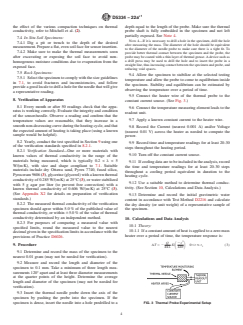
9.5 Connect the heater wire of the thermal probe to the
8. Verification of Apparatus
constant current source. (See Fig. 3.)
8.1 Every month or after 50 readings check that the appa-
9.6 Connect the temperature measuring element leads to the
ratus is working correctly. Evaluate the integrity and condition
readout unit.
of the sensor/needle. Observe a reading and confirm that the
9.7 Apply a known constant current to the heater wire.
temperature values are reasonable, that they increase in a
smooth non-decreasing curve during the heating cycle, and that
9.8 Record the Current (nearest 0.001 A) and/or Voltage
the expected amount of heating is taking place (using a known
(nearest 0.01 V) across the heater as needed to compute the
sample would be helpful).
power.
8.2 Yearly, conduct the test specified in Section 9 using one
9.9 Record time and temperature readings for at least 20-30
of the verification standards specified in 8.2.1.
steps throughout the heating period.
8.2.1 Verification Standard—One or more materials with
9.10 Turn off the constant current source.
known values of thermal conductivity in the range of the
materials being measured, which is typically 0.2 < λ < 5
9.11 If cooling data are to be included in the analysis, record
W/(m·K), with size and shape compliant to 7.1. Suitable
the time and temperature readings for at least 20-30 steps
materials include dry Ottawa sand, Pyrex 7740, fused silica,
throughout a cooling period equivalent in duration to the
Pyroceram 9606 (3), glycerine (glycerol) with a known thermal
heating cycle.
conductivity of 0.285 W/(m·K) at 25°C (3), or water stabilized
9.12 Use a suitable method to determine thermal conduc-
with 5 g agar per liter (to prevent free convection) with a
tivity. (See Section 10, Calculations and Data Analysis.)
known thermal conductivity of 0.606 W/(m·K) at 25°C (3).
(See Appendix X2 for details on preparation of verification
9.13 Determine and record the initial gravimetric water
standards.)
content in accordance with Test Method D2216 and calculate
8.2.2 The measured thermal conductivity of the verification
the dry density (or unit weight) of a representative sample of
specimen should agree within 5.0 % of the published value of
the specimen.
thermal conductivity, or within 65.0 % of the value of thermal
conductivity determined by an independent method.
10. Calculations and Data Analysis
8.2.3 For purposes of comparing a measured value with
10.1 Theory:
specified limits, round the measured value to the nearest
10.1.1 If a constant amount of heat is applied to a zero mass
decimal given in the specification limits in accordance with the
heater over a period of time, the temperature response is:
provisions of Practice D6026.
Q 2r
9. Procedure ∆T 5 2 Ei 0,t # t (3)
S D
4πλ 4Dt
9.1 Determine and record the mass of the specimen to the
nearest 0.01 gram (may not be needed for verification).
9.2 Measure and record the length and diameter of the
specimen to 0.1 mm. Take a minimum of three length mea-
surements 120° apart and at least three diameter measurements
at the quarter points of the height. Determine the average
length and diameter of the specimen (may not be needed for
verification).
9.3 Insert the thermal needle probe down the axis of the
specimen by pushing the probe into the specimen. If the
specimen is dense, insert the needle into a hole predrilled to a FIG. 3 Thermal Probe Experimental Setup
´1
D5334 − 22a
where: Because these equations (generally with t = 0) are easily
inverted to obtain conductivity, they are almost universally
t = time from the beginning of heating (s),
used to obtain thermal conductivity from probe temperature
ΔT = change in temperature from time zero (K),
Q = heat input (heat per unit length of heater, W/m), data.
r = distance from the center of the heater (m), 10.1.5 Blackwell (5) produced an exact solution in the
D = thermal diffusivity (m /s),
Laplace domain for the finite probe sizes actually used for
λ = thermal conductivity (W/(m·K)),
measurements. Knight et al. (6) transformed that solution to the
Ei = exponential integral, and
time domain using the Stefest algorithm. Using the Blackwell/
t = heating time (s).
Knight model in inverse mode to find thermal conductivity is
difficult and opaque, but their model allows us to compare Eq
10.1.2 The change in temperature after the heat input is
5 and Eq 6 to actual probe performance. Conclusions from
turned off is given by:
those comparisons are:
2 2
q 2r 2r
∆T 5 2 2Ei 1Ei t.t (4) (1) Eq 5 and Eq 6 model finite probes better than Eq 3 and
F S D S DG
4πλ 4Dt 4D~t 2 t !
Eq 4, so no advantage is gained by using exponenti
...