

ASTM C1077-24
(Practice)Standard Practice for Agencies Testing Concrete and Concrete Aggregates for Use in Construction and Criteria for Testing Agency Evaluation
General Information
- Abstract
SIGNIFICANCE AND USE
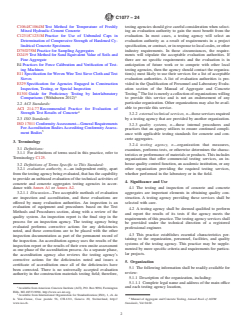
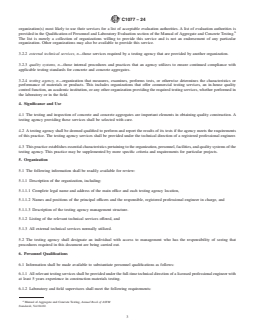
4.1 The testing and inspection of concrete and concrete aggregates are important elements in obtaining quality construction. A testing agency providing these services shall be selected with care.
4.2 A testing agency shall be deemed qualified to perform and report the results of its tests if the agency meets the requirements of this practice. The testing agency services shall be provided under the technical direction of a registered professional engineer.
4.3 This practice establishes essential characteristics pertaining to the organization, personnel, facilities, and quality systems of the testing agency. This practice may be supplemented by more specific criteria and requirements for particular projects.
SCOPE
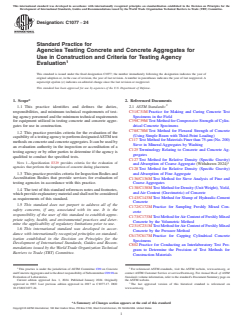
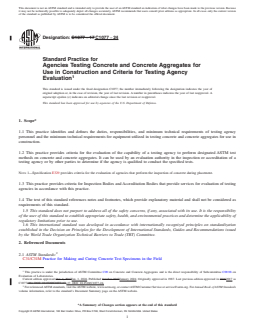
1.1 This practice identifies and defines the duties, responsibilities, and minimum technical requirements of testing agency personnel and the minimum technical requirements for equipment utilized in testing concrete and concrete aggregates for use in construction.
1.2 This practice provides criteria for the evaluation of the capability of a testing agency to perform designated ASTM test methods on concrete and concrete aggregates. It can be used by an evaluation authority in the inspection or accreditation of a testing agency or by other parties to determine if the agency is qualified to conduct the specified tests.
Note 1: Specification E329 provides criteria for the evaluation of agencies that perform the inspection of concrete during placement.
1.3 This practice provides criteria for Inspection Bodies and Accreditation Bodies that provide services for evaluation of testing agencies in accordance with this practice.
1.4 The text of this standard references notes and footnotes, which provide explanatory material and shall not be considered as requirements of this standard.
1.5 This standard does not purport to address all of the safety concerns, if any, associated with its use. It is the responsibility of the user of this standard to establish appropriate safety, health, and environmental practices and determine the applicability of regulatory limitations prior to use.
1.6 This international standard was developed in accordance with internationally recognized principles on standardization established in the Decision on Principles for the Development of International Standards, Guides and Recommendations issued by the World Trade Organization Technical Barriers to Trade (TBT) Committee.
- Status
- Published
- Publication Date
- 31-Dec-2023
- Technical Committee
- C09 - Concrete and Concrete Aggregates
- Drafting Committee
- C09.98 - Evaluation of Laboratories
Buy Documents
ASTM C1077-24 - Standard Practice for Agencies Testing Concrete and Concrete Aggregates for Use in Construction and Criteria for Testing Agency Evaluation
REDLINE ASTM C1077-24 - Standard Practice for Agencies Testing Concrete and Concrete Aggregates for Use in Construction and Criteria for Testing Agency Evaluation
Overview
ASTM C1077-24: Standard Practice for Agencies Testing Concrete and Concrete Aggregates for Use in Construction and Criteria for Testing Agency Evaluation is a globally recognized standard developed by ASTM International. This standard defines the minimum technical requirements, practices, and procedures for agencies involved in testing concrete and concrete aggregates for construction applications. ASTM C1077-24 outlines critical organizational, personnel, facility, and quality system requirements to ensure reliable and consistent materials testing, fostering high standards in the construction industry.
The standard serves as a benchmark for selecting qualified testing agencies and provides evaluation criteria for accreditation and inspection authorities. By adhering to ASTM C1077-24, testing agencies can demonstrate competence, consistency, and compliance with industry best practices.
Key Topics
- Agency Qualification: Establishes requirements for testing agency organization, management structure, and technical service offerings, ensuring oversight by a registered professional engineer.
- Personnel Requirements: Details mandatory qualifications and certifications for laboratory and field personnel, including experience, training, and periodic evaluations.
- Test Methods and Equipment: Specifies essential ASTM test methods and practices for concrete and aggregate testing, along with requirements for equipment calibration, verification, and maintenance.
- Records and Reporting: Outlines documentation processes, data traceability, and retention policies for test results, equipment calibrations, certifications, and corrective actions.
- Quality Systems: Requires agencies to maintain a robust quality manual, internal quality control, proficiency sample program participation, and complaints handling procedures.
- Evaluation and Accreditation: Defines the procedures and responsibilities for both inspection bodies and accreditation bodies, including frequency, scope, and reporting of inspections and assessments.
- Conformance with International Standards: Developed in accordance with the World Trade Organization (WTO) TBT Committee principles, ensuring global applicability.
Applications
ASTM C1077-24 is a vital reference for multiple stakeholders in construction and infrastructure development:
- Construction Material Testing Laboratories: To establish and maintain accreditation, and ensure their practices meet recognized industry standards for concrete and aggregate testing.
- Accreditation and Inspection Bodies: To assess and certify the competence and capability of testing agencies, supporting quality assurance across construction projects.
- Project Owners and Specifiers: To select qualified, compliant testing agencies for quality assurance in materials testing, ensuring project safety and durability.
- Regulatory Authorities: To set requirements for public and private construction projects, using ASTM C1077-24 as a basis for code compliance and contract specifications.
- Engineering Consultants and Contractors: To verify the credibility and reliability of testing data, supporting sound engineering decisions and risk mitigation.
Adoption of ASTM C1077-24 enhances transparency, reliability, and integrity in construction material testing, and forms the foundation for quality-focused project delivery.
Related Standards
Agencies seeking compliance with ASTM C1077-24 or involved in concrete and aggregate testing may also reference:
- ASTM E329 - Specification for agencies engaged in construction inspection, testing, or special inspection.
- ASTM C31/C31M - Practice for making and curing concrete test specimens in the field.
- ASTM C39/C39M - Test method for compressive strength of cylindrical concrete specimens.
- ASTM C78/C78M - Test method for flexural strength of concrete.
- ASTM C117, C128, C136/C136M - Test methods for aggregate analysis.
- ISO 17011 - Conformity assessment for accreditation bodies accrediting conformity assessment organizations.
- ACI 214-77 - Practice for evaluation of strength test results of concrete.
For comprehensive and current industry compliance, agencies should maintain access to relevant ASTM, ISO, and ACI standards.
By following ASTM C1077-24, organizations ensure the highest level of competence, credibility, and quality assurance in the testing of concrete and concrete aggregates, supporting safer, more durable construction outcomes worldwide.
Relations
- Effective Date
- 01-Jan-2024
- Refers
ASTM C31/C31M-24a - Standard Practice for Making and Curing Concrete Test Specimens in the Field - Effective Date
- 01-Apr-2024
- Effective Date
- 01-Jan-2024
- Refers
ASTM C31/C31M-24 - Standard Practice for Making and Curing Concrete Test Specimens in the Field - Effective Date
- 01-Jan-2024
- Effective Date
- 01-Jan-2024
- Effective Date
- 01-Dec-2023
- Effective Date
- 15-Nov-2023
- Effective Date
- 01-Sep-2023
- Effective Date
- 01-Jun-2022
- Refers
ASTM C39/C39M-21 - Standard Test Method for Compressive Strength of Cylindrical Concrete Specimens - Effective Date
- 01-Mar-2021
- Effective Date
- 01-Oct-2017
- Effective Date
- 01-Aug-2017
- Effective Date
- 01-Feb-2016
- Referred By
ASTM C29/C29M-23 - Standard Test Method for Bulk Density (“Unit Weight”) and Voids in Aggregate - Effective Date
- 01-Jan-2024
- Effective Date
- 01-Jan-2024
Buy Documents
ASTM C1077-24 - Standard Practice for Agencies Testing Concrete and Concrete Aggregates for Use in Construction and Criteria for Testing Agency Evaluation
REDLINE ASTM C1077-24 - Standard Practice for Agencies Testing Concrete and Concrete Aggregates for Use in Construction and Criteria for Testing Agency Evaluation
Get Certified
Connect with accredited certification bodies for this standard

DIBt (Deutsches Institut für Bautechnik)
German Institute for Building Technology.
DIN CERTCO
DIN Group product certification.

Aboma Certification B.V.
Specialized in construction, metal, and transport sectors.
Sponsored listings
Frequently Asked Questions
ASTM C1077-24 is a standard published by ASTM International. Its full title is "Standard Practice for Agencies Testing Concrete and Concrete Aggregates for Use in Construction and Criteria for Testing Agency Evaluation". This standard covers: SIGNIFICANCE AND USE 4.1 The testing and inspection of concrete and concrete aggregates are important elements in obtaining quality construction. A testing agency providing these services shall be selected with care. 4.2 A testing agency shall be deemed qualified to perform and report the results of its tests if the agency meets the requirements of this practice. The testing agency services shall be provided under the technical direction of a registered professional engineer. 4.3 This practice establishes essential characteristics pertaining to the organization, personnel, facilities, and quality systems of the testing agency. This practice may be supplemented by more specific criteria and requirements for particular projects. SCOPE 1.1 This practice identifies and defines the duties, responsibilities, and minimum technical requirements of testing agency personnel and the minimum technical requirements for equipment utilized in testing concrete and concrete aggregates for use in construction. 1.2 This practice provides criteria for the evaluation of the capability of a testing agency to perform designated ASTM test methods on concrete and concrete aggregates. It can be used by an evaluation authority in the inspection or accreditation of a testing agency or by other parties to determine if the agency is qualified to conduct the specified tests. Note 1: Specification E329 provides criteria for the evaluation of agencies that perform the inspection of concrete during placement. 1.3 This practice provides criteria for Inspection Bodies and Accreditation Bodies that provide services for evaluation of testing agencies in accordance with this practice. 1.4 The text of this standard references notes and footnotes, which provide explanatory material and shall not be considered as requirements of this standard. 1.5 This standard does not purport to address all of the safety concerns, if any, associated with its use. It is the responsibility of the user of this standard to establish appropriate safety, health, and environmental practices and determine the applicability of regulatory limitations prior to use. 1.6 This international standard was developed in accordance with internationally recognized principles on standardization established in the Decision on Principles for the Development of International Standards, Guides and Recommendations issued by the World Trade Organization Technical Barriers to Trade (TBT) Committee.
SIGNIFICANCE AND USE 4.1 The testing and inspection of concrete and concrete aggregates are important elements in obtaining quality construction. A testing agency providing these services shall be selected with care. 4.2 A testing agency shall be deemed qualified to perform and report the results of its tests if the agency meets the requirements of this practice. The testing agency services shall be provided under the technical direction of a registered professional engineer. 4.3 This practice establishes essential characteristics pertaining to the organization, personnel, facilities, and quality systems of the testing agency. This practice may be supplemented by more specific criteria and requirements for particular projects. SCOPE 1.1 This practice identifies and defines the duties, responsibilities, and minimum technical requirements of testing agency personnel and the minimum technical requirements for equipment utilized in testing concrete and concrete aggregates for use in construction. 1.2 This practice provides criteria for the evaluation of the capability of a testing agency to perform designated ASTM test methods on concrete and concrete aggregates. It can be used by an evaluation authority in the inspection or accreditation of a testing agency or by other parties to determine if the agency is qualified to conduct the specified tests. Note 1: Specification E329 provides criteria for the evaluation of agencies that perform the inspection of concrete during placement. 1.3 This practice provides criteria for Inspection Bodies and Accreditation Bodies that provide services for evaluation of testing agencies in accordance with this practice. 1.4 The text of this standard references notes and footnotes, which provide explanatory material and shall not be considered as requirements of this standard. 1.5 This standard does not purport to address all of the safety concerns, if any, associated with its use. It is the responsibility of the user of this standard to establish appropriate safety, health, and environmental practices and determine the applicability of regulatory limitations prior to use. 1.6 This international standard was developed in accordance with internationally recognized principles on standardization established in the Decision on Principles for the Development of International Standards, Guides and Recommendations issued by the World Trade Organization Technical Barriers to Trade (TBT) Committee.
ASTM C1077-24 is classified under the following ICS (International Classification for Standards) categories: 91.100.30 - Concrete and concrete products. The ICS classification helps identify the subject area and facilitates finding related standards.
ASTM C1077-24 has the following relationships with other standards: It is inter standard links to ASTM C1077-17, ASTM C31/C31M-24a, ASTM C231/C231M-24, ASTM C31/C31M-24, ASTM C173/C173M-24, ASTM C1064/C1064M-23, ASTM C117-23, ASTM C173/C173M-23, ASTM C231/C231M-22, ASTM C39/C39M-21, ASTM C1064/C1064M-17, ASTM C117-17, ASTM C173/C173M-16, ASTM C29/C29M-23, ASTM C1116/C1116M-23. Understanding these relationships helps ensure you are using the most current and applicable version of the standard.
ASTM C1077-24 is available in PDF format for immediate download after purchase. The document can be added to your cart and obtained through the secure checkout process. Digital delivery ensures instant access to the complete standard document.
Standards Content (Sample)
This international standard was developed in accordance with internationally recognized principles on standardization established in the Decision on Principles for the
Development of International Standards, Guides and Recommendations issued by the World Trade Organization Technical Barriers to Trade (TBT) Committee.
Designation: C1077 − 24
Standard Practice for
Agencies Testing Concrete and Concrete Aggregates for
Use in Construction and Criteria for Testing Agency
Evaluation
This standard is issued under the fixed designation C1077; the number immediately following the designation indicates the year of
original adoption or, in the case of revision, the year of last revision. A number in parentheses indicates the year of last reapproval. A
superscript epsilon (´) indicates an editorial change since the last revision or reapproval.
This standard has been approved for use by agencies of the U.S. Department of Defense.
1. Scope* 2. Referenced Documents
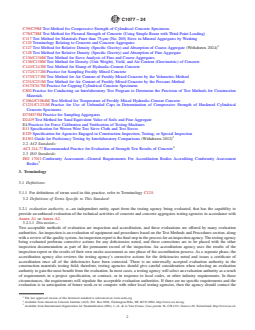
2.1 ASTM Standards:
1.1 This practice identifies and defines the duties,
responsibilities, and minimum technical requirements of test- C31/C31M Practice for Making and Curing Concrete Test
ing agency personnel and the minimum technical requirements Specimens in the Field
for equipment utilized in testing concrete and concrete aggre- C39/C39M Test Method for Compressive Strength of Cylin-
gates for use in construction. drical Concrete Specimens
C78/C78M Test Method for Flexural Strength of Concrete
1.2 This practice provides criteria for the evaluation of the
(Using Simple Beam with Third-Point Loading)
capability of a testing agency to perform designated ASTM test
C117 Test Method for Materials Finer than 75-μm (No. 200)
methods on concrete and concrete aggregates. It can be used by
Sieve in Mineral Aggregates by Washing
an evaluation authority in the inspection or accreditation of a
C125 Terminology Relating to Concrete and Concrete Ag-
testing agency or by other parties to determine if the agency is
gregates
qualified to conduct the specified tests.
C127 Test Method for Relative Density (Specific Gravity)
NOTE 1—Specification E329 provides criteria for the evaluation of
and Absorption of Coarse Aggregate (Withdrawn 2024)
agencies that perform the inspection of concrete during placement.
C128 Test Method for Relative Density (Specific Gravity)
1.3 This practice provides criteria for Inspection Bodies and
and Absorption of Fine Aggregate
Accreditation Bodies that provide services for evaluation of
C136/C136M Test Method for Sieve Analysis of Fine and
testing agencies in accordance with this practice.
Coarse Aggregates
C138/C138M Test Method for Density (Unit Weight), Yield,
1.4 The text of this standard references notes and footnotes,
and Air Content (Gravimetric) of Concrete
which provide explanatory material and shall not be considered
C143/C143M Test Method for Slump of Hydraulic-Cement
as requirements of this standard.
Concrete
1.5 This standard does not purport to address all of the
C172/C172M Practice for Sampling Freshly Mixed Con-
safety concerns, if any, associated with its use. It is the
crete
responsibility of the user of this standard to establish appro-
C173/C173M Test Method for Air Content of Freshly Mixed
priate safety, health, and environmental practices and deter-
Concrete by the Volumetric Method
mine the applicability of regulatory limitations prior to use.
C231/C231M Test Method for Air Content of Freshly Mixed
1.6 This international standard was developed in accor-
Concrete by the Pressure Method
dance with internationally recognized principles on standard-
C617/C617M Practice for Capping Cylindrical Concrete
ization established in the Decision on Principles for the
Specimens
Development of International Standards, Guides and Recom-
C802 Practice for Conducting an Interlaboratory Test Pro-
mendations issued by the World Trade Organization Technical
gram to Determine the Precision of Test Methods for
Barriers to Trade (TBT) Committee.
Construction Materials
1 2
This practice is under the jurisdiction of ASTM Committee C09 on Concrete For referenced ASTM standards, visit the ASTM website, www.astm.org, or
and Concrete Aggregates and is the direct responsibility of Subcommittee C09.98 on contact ASTM Customer Service at service@astm.org. For Annual Book of ASTM
Evaluation of Laboratories. Standards volume information, refer to the standard’s Document Summary page on
Current edition approved Jan. 1, 2024. Published January 2024. Originally the ASTM website.
approved in 1987. Last previous edition approved in 2017 as C1077-17. DOI: The last approved version of this historical standard is referenced on
10.1520/C1077-24. www.astm.org.
*A Summary of Changes section appears at the end of this standard
Copyright © ASTM International, 100 Barr Harbor Drive, PO Box C700, West Conshohocken, PA 19428-2959. United States
C1077 − 24
C1064/C1064M Test Method for Temperature of Freshly testing agencies should give careful consideration when select-
Mixed Hydraulic-Cement Concrete ing an evaluation authority to gain the most benefit from the
C1231/C1231M Practice for Use of Unbonded Caps in evaluation. In most cases, a testing agency will select an
Determination of Compressive Strength of Hardened Cy- evaluation authority as a result of requirements in a project
lindrical Concrete Specimens specification, or contract, or in response to local codes, or other
D75/D75M Practice for Sampling Aggregates industry requirements. In those circumstances, the require-
D2419 Test Method for Sand Equivalent Value of Soils and ments will stipulate the acceptable evaluation authorities. If
Fine Aggregate there are no specific requirements and the evaluation is in
E4 Practices for Force Calibration and Verification of Test- anticipation of future work or to compete with other local
ing Machines testing agencies, then the agency should contact the organiza-
E11 Specification for Woven Wire Test Sieve Cloth and Test tion(s) most likely to use their services for a list of acceptable
Sieves evaluation authorities. A list of evaluation authorities is pro-
E329 Specification for Agencies Engaged in Construction vided in the Qualification of Personnel and Laboratory Evalu-
Inspection, Testing, or Special Inspection ation section of the Manual of Aggregate and Concrete
E1301 Guide for Proficiency Testing by Interlaboratory Testing. The list is merely a collection of organizations willing
Comparisons (Withdrawn 2012) to provide this service and is not an endorsement of any
particular organization. Other organizations may also be avail-
2.2 ACI Standards:
able to provide this service.
ACI 214-77 Recommended Practice for Evaluation of
Strength Test Results of Concrete
3.2.2 external technical services, n—those services required
by a testing agency that are provided by another organization.
2.3 ISO Standards:
ISO 17011 Conformity Assessment—General Requirements
3.2.3 quality systems, n—those internal procedures and
For Accreditation Bodies Accrediting Conformity Assess-
practices that an agency utilizes to ensure continued compli-
ment Bodies
ance with applicable testing standards for concrete and con-
crete aggregates.
3. Terminology
3.2.4 testing agency, n—organization that measures,
3.1 Definitions:
examines, performs tests, or otherwise determines the charac-
3.1.1 For definitions of terms used in this practice, refer to
teristics or performance of materials or products. This includes
Terminology C125.
organizations that offer commercial testing services, an in-
house quality control function, an academic institution, or any
3.2 Definitions of Terms Specific to This Standard:
other organization providing the required testing services,
3.2.1 evaluation authority, n—an independent entity, apart
whether performed in the laboratory or in the field.
from the testing agency being evaluated, that has the capability
to provide an unbiased evaluation of the technical activities of
4. Significance and Use
concrete and concrete aggregates testing agencies in accor-
dance with Annex A1 or Annex A2. 4.1 The testing and inspection of concrete and concrete
aggregates are important elements in obtaining quality con-
3.2.1.1 Discussion—Two acceptable methods of evaluation
are inspection and accreditation, and these evaluations are struction. A testing agency providing these services shall be
offered by many evaluation authorities. An inspection is an selected with care.
evaluation of equipment and procedures based on the Test
4.2 A testing agency shall be deemed qualified to perform
Methods and Procedures section, along with a review of the
and report the results of its tests if the agency meets the
quality system. An inspection report is the final step in the
requirements of this practice. The testing agency services shall
process for an inspection agency. The testing agency being
be provided under the technical direction of a registered
evaluated performs corrective actions for any deficiencies
professional engineer.
noted, and these corrections are to be placed with the other
4.3 This practice establishes essential characteristics per-
inspection documentation as part of the permanent record of
taining to the organization, personnel, facilities, and quality
the inspection. An accreditation agency uses the results of the
systems of the testing agency. This practice may be supple-
inspection report or the results of their own onsite assessment
mented by more specific criteria and requirements for particu-
as one phase of the accreditation process. As a separate phase,
lar projects.
the accreditation agency also reviews the testing agency’s
corrective actions for the deficiencies noted and issues a
5. Organization
certificate of accreditation once all of the deficiencies have
5.1 The following information shall be readily available for
been corrected. There is no universally accepted evaluation
review:
authority in the construction materials testing field; therefore,
5.1.1 Description of the organization, including:
5.1.1.1 Complete legal name and address of the main office
and each testing agency location,
Available from American Concrete Institute (ACI), P.O. Box 9094, Farmington
Hills, MI 48333-9094, http://www.aci-int.org.
Available from International Organization for Standardization (ISO), 1, ch. de
la Voie-Creuse, Case postale 56, CH-1211, Geneva 20, Switzerland, http:// Manual of Aggregate and Concrete Testing, Annual Book of ASTM
www.iso.ch. Standards, Vol 04.02.
C1077 − 24
5.1.1.2 Names and positions of the principal officers and the 6.1.4.4 The certification body shall establish the period of
responsible, registered professional engineer in charge, and certification but not to exceed five years.
5.1.1.3 Description of the testing agency management struc-
6.1.4.5 The period for which the certification is valid shall
ture.
be clearly and prominently stated on any documents that attest
5.1.2 Listing of the relevant technical services offered, and
to the certification(s) held by the individual.
5.1.3 All external technical services normally utilized.
7. Test Methods and Procedures
5.2 The testing agency shall designate an individual with
access to management who has the responsibility of seeing that
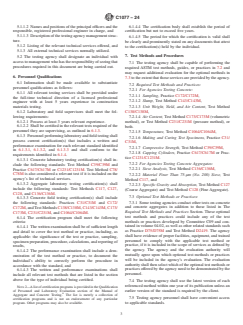
7.1 The testing agency shall be capable of performing the
procedures required in this document are being carried out.
required ASTM test methods, guides, or practices in 7.2 and
may request additional evaluation for the optional methods in
6. Personnel Qualifications
7.3 to the extent that those services are provided by the agency.
6.1 Information shall be made available to substantiate
7.2 Required Test Methods and Practices:
personnel qualifications as follows:
7.2.1 For Agencies Testing Concrete:
6.1.1 All relevant testing services shall be provided under
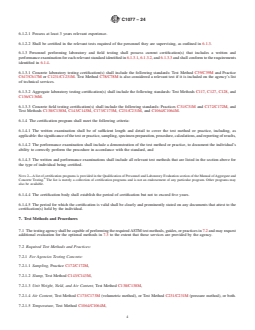
7.2.1.1 Sampling, Practice C172/C172M,
the full-time technical direction of a licensed professional
7.2.1.2 Slump, Test Method C143/C143M,
engineer with at least 5 years experience in construction
7.2.1.3 Unit Weight, Yield, and Air Content, Test Method
materials testing.
C138/C138M,
6.1.2 Laboratory and field supervisors shall meet the fol-
lowing requirements:
7.2.1.4 Air Content, Test Method C173/C173M (volumetric
6.1.2.1 Possess at least 3 years relevant experience.
method), or Test Method C231/C231M (pressure method), or
6.1.2.2 Shall be certified in the relevant tests required of the
both.
personnel they are supervising, as outlined in 6.1.3.
7.2.1.5 Temperature, Test Method C1064/C1064M,
6.1.3 Personnel performing laboratory and field testing shall
7.2.1.6 Making and Curing Test Specimens, Practice C31/
possess current certification(s) that includes a written and
C31M,
performance examination for each relevant standard identified
7.2.1.7 Compressive Strength, Test Method C39/C39M,
in 6.1.3.1, 6.1.3.2, and 6.1.3.3 and shall conform to the
7.2.1.8 Capping Cylinders, Practice C617/C617M or Prac-
requirements identified in 6.1.4.
tice C1231/C1231M.
6.1.3.1 Concrete laboratory testing certification(s) shall in-
7.2.2 For Agencies Testing Concrete Aggregates:
clude the following standards: Test Method C39/C39M and
7.2.2.1 Sieve Analysis, Test Method C136/C136M,
Practice C617/C617M or C1231/C1231M. Test Method C78/
C78M is also considered a relevant test if it is included on the
7.2.2.2 Material Finer Than 75-μm (No. 200) Sieve, Test
agency’s list of technical services.
Method C117, and
6.1.3.2 Aggregate laboratory testing certification(s) shall
7.2.2.3 Specific Gravity and Absorption, Test Method C127
include the following standards: Test Methods C117, C127,
(Coarse Aggregate) and Test Method C128 (Fine Aggregate).
C128, and C136/C136M.
7.3 Optional Test Methods or Practices:
6.1.3.3 Concrete field testing certification(s) shall include
7.3.1 Some testing agencies conduct other tests on concrete
the following standards: Practices C31/C31M and C172/
and concrete aggregates in addition to those listed in The
C172M, and Test Methods C138/C138M, C143/C143M, C173/
Required Test Methods and Practices Section. These optional
C173M, C231/C231M, and C1064/C1064M.
test methods and practices could include any of the test
6.1.4 The certification program shall meet the following
methods or practices developed by Committee C09 and con-
criteria:
tained in volume 04.02, as well as other related standards such
6.1.4.1 The written examination shall be of sufficient length
as Practice D75/D75M and Test Method D2419. The agency
and detail to cover the test method or practice, including, as
shall have evidence of proper facilities, equipment, and trained
applicable: the significance of the test or practice, sampling,
personnel to comply with the applicable test method or
specimen preparation, procedure, calculations, and reporting of
practice, if it is included in the scope of services as defined by
results,
the agency. The agency and the evaluation authority will
6.1.4.2 The performance examination shall include a dem-
mutually agree upon which optional test methods or practices
onstration of the test method or practice, to document the
will be included in the agency’s evaluation. The evaluation
individual’s ability to correctly perform the procedure in
authority shall then select which of the optional test methods or
accordance with the standard, and
practices offered by the agency need to be demonstrated by the
6.1.4.3 The written and performance examinations shall
personnel.
include all relevant test methods that are listed in the section
above for the type of individual being certified.
7.4 The testing agency shall use the latest version of each
referenced method within one year of its publication unless an
NOTE 2—A list of certification programs is provided in the Qualification
earlier version of the standard is required by the client.
of Personnel and Laboratory Evaluation section of the Manual of
Aggregate and Concrete Testing. The list is merely a collection of
7.5 Testing agency personnel shall have convenient access
certification programs and is not an endorsement of any particular
program. Other programs may also be available. to applicable standards.
C1077 − 24
8. Facilities, Equipment, and Supplemental Procedures be able to document that it obtained the appropriate equipment
and that the equipment was calibrated, standardized, or veri-
8.1 General—The testing agency shall have facilities and
fied.
equipment conforming to the requirements of the applicable
test method. This section contains equipment requirements and 8.6 All equipment listed in this section shall be calibrated or
procedures that clarify certain provisions of the test methods. verified before being placed in service. Equipment not in
operating condition or out of tolerance shall be marked as such
8.2 Procedures Related to Required Test Methods—In addi-
and taken out of service until corrected.
tion to standard test method requirements, the conditions listed
in 8.3 and 8.4 shall be met.
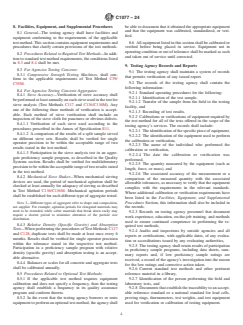
9. Testing Agency Records and Reports
8.3 For Agencies Testing Concrete:
9.1 The testing agency shall maintain a system of records
8.3.1 Compressive Strength Testing Machines, shall con-
that permits verification of any issued report.
form to the applicable requirements of Test Method C39/
9.2 The records of the testing agency shall contain the
C39M.
following information:
8.4 For Agencies Testing Concrete Aggregates:
9.2.1 Standard operating procedures for the following:
8.4.1 Sieve Accuracy—Verification of sieve accuracy shall
9.2.1.1 Identification of the test sample,
be performed at least annually on each sieve used in the test for
9.2.1.2 Transfer of the sample from the field to the testing
sieve analysis (Test Methods C117 and C136/C136M). Any
facility, and
one of the following three methods of verification is accept-
9.2.1.3 Recording of test results.
able. Each method of sieve verification shall include an
9.2.2 Calibrations or verifications of equipment required by
inspection of the sieve cloth for punctures or obvious defects.
the test method for all of the tests offered in the scope of the
8.4.1.1 Verification of each sieve used according to the
testing agency’s services. The records shall include:
procedures prescribed in the Annex of Specification E11.
9.2.2.1 The identification of the specific piece of equipment,
8.4.1.2 A comparison of the results of a split sample sieved
9.2.2.2 The identification of the equipment used to perform
on different sieve sets. Results shall be verified for single
the calibration or verification,
operator precision to be within the acceptable range of two
9.2.2.3 The name of the individual who performed the
results stated in the test method.
calibration or verification,
8.4.1.3 Participation in the sieve analysis test in an aggre-
9.2.2.4 The date the calibration or verification was
gate proficiency sample program, as described in the Quality
performed,
Systems section. Results shall be verified for multilaboratory
9.2.2.5 The quantity measured by the equipment (such as
precision to be within the acceptable range of two results stated
length, force, or mass), and
in the test method.
9.2.2.6 The associated accuracy of the measurement or a
8.4.2 Mechanical Sieve Shaker—When mechanical sieving
comparison of the measured quantity with the associated
devices are used, the period of mechanical agitation shall be
allowable tolerances, as necessary to verify that the equipment
checked at least annually for adequacy of sieving as described
complies with the requirements in the relevant standards.
in Test Method C136/C136M. Mechanical agitation periods
Where additional calibration or verification requirements have
shall be established for each different type of aggregate tested.
been listed in the Facilities, Equipment, and Supplemental
Procedures Section, this information shall also be included in
NOTE 3—Different types of aggregate refer to shape and composition,
not supplier. For example, agitation periods for elongated materials may
the records.
need to be extended, while softer materials that break down easily may
9.2.3 Records on testing agency personnel that document
require a shorter period to minimize alteration of the particle size
work experience, education, on-the-job training, and methods
distribution.
used to ensure continued competence in performing the re-
8.4.3 Relative Density (Specific Gravity) and Absorption
quired test methods,
Tests—When performing the procedures of Test Methods C127
9.2.4 Audits and inspections by outside agencies and all
and C128, duplicate tests shall be made at least once every 6
reports or certifications, with applicable dates, of any evalua-
months. Results shall be verified for single operator precision
tion or accreditations issued by any evaluating authorities,
within the tolerance stated in the respective test method.
9.2.5 The testing agency shall retain results of participation
Participation in a proficiency sample program with relative
in proficiency sample programs, including data sheets, sum-
density (specific gravity) and absorption testing is an accept-
mary reports and, if low proficiency sample ratings are
able alternative.
received, a record of the agency’s investigation into the reason
8.4.4 Balances or scales for all concrete and aggregate tests
for the low ratings and corrective action taken.
shall be calibrated annually.
9.2.6 Current standard test methods and other pertinent
8.5 Procedures Related to Optional Test Methods: reference material in a library,
8.5.1 If the applicable test method requires equipment 9.2.7 Identification of the person performing the field and
calibration and does not specify a frequency, then the testing laboratory tests, and
agency shall establish a frequency in its quality assurance 9.2.8 Documents that establish the traceability to an accept-
program and conform thereto. able reference standard or a national standard for load cells,
8.5.2 In the event that the testing agency borrows or rents proving rings, thermometers, test weights, and test equipment
equipment to perform an optional test method, the agency shall used for verification or calibration of testing equipment.
C1077 − 24
9.3 Agency test reports shall accurately and clearly present inventory shall include the equipment description, identifica-
the specified test results and all pertinent data. tion number, and next date of calibration or verification.
9.4 Test reports shall include the following information: NOTE 6—The inventory should include equipment
...
This document is not an ASTM standard and is intended only to provide the user of an ASTM standard an indication of what changes have been made to the previous version. Because
it may not be technically possible to adequately depict all changes accurately, ASTM recommends that users consult prior editions as appropriate. In all cases only the current version
of the standard as published by ASTM is to be considered the official document.
Designation: C1077 − 17 C1077 − 24
Standard Practice for
Agencies Testing Concrete and Concrete Aggregates for
Use in Construction and Criteria for Testing Agency
Evaluation
This standard is issued under the fixed designation C1077; the number immediately following the designation indicates the year of
original adoption or, in the case of revision, the year of last revision. A number in parentheses indicates the year of last reapproval. A
superscript epsilon (´) indicates an editorial change since the last revision or reapproval.
This standard has been approved for use by agencies of the U.S. Department of Defense.
1. Scope*
1.1 This practice identifies and defines the duties, responsibilities, and minimum technical requirements of testing agency
personnel and the minimum technical requirements for equipment utilized in testing concrete and concrete aggregates for use in
construction.
1.2 This practice provides criteria for the evaluation of the capability of a testing agency to perform designated ASTM test
methods on concrete and concrete aggregates. It can be used by an evaluation authority in the inspection or accreditation of a
testing agency or by other parties to determine if the agency is qualified to conduct the specified tests.
NOTE 1—Specification E329 provides criteria for the evaluation of agencies that perform the inspection of concrete during placement.
1.3 This practice provides criteria for Inspection Bodies and Accreditation Bodies that provide services for evaluation of testing
agencies in accordance with this practice.
1.4 The text of this standard references notes and footnotes, which provide explanatory material and shall not be considered as
requirements of this standard.
1.5 This standard does not purport to address all of the safety concerns, if any, associated with its use. It is the responsibility
of the user of this standard to establish appropriate safety, health, and environmental practices and determine the applicability of
regulatory limitations prior to use.
1.6 This international standard was developed in accordance with internationally recognized principles on standardization
established in the Decision on Principles for the Development of International Standards, Guides and Recommendations issued
by the World Trade Organization Technical Barriers to Trade (TBT) Committee.
2. Referenced Documents
2.1 ASTM Standards:
C31/C31M Practice for Making and Curing Concrete Test Specimens in the Field
This practice is under the jurisdiction of ASTM Committee C09 on Concrete and Concrete Aggregates and is the direct responsibility of Subcommittee C09.98 on
Evaluation of Laboratories.
Current edition approved Oct. 1, 2017Jan. 1, 2024. Published October 2017January 2024. Originally approved in 1987. Last previous edition approved in 20162017 as
C1077-16a. DOI: 10.1520/C1077-17.-17. DOI: 10.1520/C1077-24.
For referenced ASTM standards, visit the ASTM website, www.astm.org, or contact ASTM Customer Service at service@astm.org. For Annual Book of ASTM Standards
volume information, refer to the standard’s Document Summary page on the ASTM website.
*A Summary of Changes section appears at the end of this standard
Copyright © ASTM International, 100 Barr Harbor Drive, PO Box C700, West Conshohocken, PA 19428-2959. United States
C1077 − 24
C39/C39M Test Method for Compressive Strength of Cylindrical Concrete Specimens
C78/C78M Test Method for Flexural Strength of Concrete (Using Simple Beam with Third-Point Loading)
C117 Test Method for Materials Finer than 75-μm (No. 200) Sieve in Mineral Aggregates by Washing
C125 Terminology Relating to Concrete and Concrete Aggregates
C127 Test Method for Relative Density (Specific Gravity) and Absorption of Coarse Aggregate (Withdrawn 2024)
C128 Test Method for Relative Density (Specific Gravity) and Absorption of Fine Aggregate
C136/C136M Test Method for Sieve Analysis of Fine and Coarse Aggregates
C138/C138M Test Method for Density (Unit Weight), Yield, and Air Content (Gravimetric) of Concrete
C143/C143M Test Method for Slump of Hydraulic-Cement Concrete
C172/C172M Practice for Sampling Freshly Mixed Concrete
C173/C173M Test Method for Air Content of Freshly Mixed Concrete by the Volumetric Method
C231/C231M Test Method for Air Content of Freshly Mixed Concrete by the Pressure Method
C617/C617M Practice for Capping Cylindrical Concrete Specimens
C802 Practice for Conducting an Interlaboratory Test Program to Determine the Precision of Test Methods for Construction
Materials
C1064/C1064M Test Method for Temperature of Freshly Mixed Hydraulic-Cement Concrete
C1231/C1231M Practice for Use of Unbonded Caps in Determination of Compressive Strength of Hardened Cylindrical
Concrete Specimens
D75/D75M Practice for Sampling Aggregates
D2419 Test Method for Sand Equivalent Value of Soils and Fine Aggregate
E4 Practices for Force Calibration and Verification of Testing Machines
E11 Specification for Woven Wire Test Sieve Cloth and Test Sieves
E329 Specification for Agencies Engaged in Construction Inspection, Testing, or Special Inspection
E1301 Guide for Proficiency Testing by Interlaboratory Comparisons (Withdrawn 2012)
2.2 ACI Standards:
ACI 214-77 Recommended Practice for Evaluation of Strength Test Results of Concrete
2.3 ISO Standards:
ISO 17011 Conformity Assessment—General Requirements For Accreditation Bodies Accrediting Conformity Assessment
Bodies
3. Terminology
3.1 Definitions:
3.1.1 For definitions of terms used in this practice, refer to Terminology C125.
3.2 Definitions of Terms Specific to This Standard:
3.2.1 evaluation authority, n—an independent entity, apart from the testing agency being evaluated, that has the capability to
provide an unbiased evaluation of the technical activities of concrete and concrete aggregates testing agencies in accordance with
Annex A1 or Annex A2.
3.2.1.1 Discussion—
Two acceptable methods of evaluation are inspection and accreditation, and these evaluations are offered by many evaluation
authorities. An inspection is an evaluation of equipment and procedures based on the Test Methods and Procedures section, along
with a review of the quality system. An inspection report is the final step in the process for an inspection agency. The testing agency
being evaluated performs corrective actions for any deficiencies noted, and these corrections are to be placed with the other
inspection documentation as part of the permanent record of the inspection. An accreditation agency uses the results of the
inspection report or the results of their own onsite assessment as one phase of the accreditation process. As a separate phase, the
accreditation agency also reviews the testing agency’s corrective actions for the deficiencies noted and issues a certificate of
accreditation once all of the deficiencies have been corrected. There is no universally accepted evaluation authority in the
construction materials testing field; therefore, testing agencies should give careful consideration when selecting an evaluation
authority to gain the most benefit from the evaluation. In most cases, a testing agency will select an evaluation authority as a result
of requirements in a project specification, or contract, or in response to local codes, or other industry requirements. In those
circumstances, the requirements will stipulate the acceptable evaluation authorities. If there are no specific requirements and the
evaluation is in anticipation of future work or to compete with other local testing agencies, then the agency should contact the
The last approved version of this historical standard is referenced on www.astm.org.
Available from American Concrete Institute (ACI), P.O. Box 9094, Farmington Hills, MI 48333-9094, http://www.aci-int.org.
Available from International Organization for Standardization (ISO), 1, ch. de la Voie-Creuse, Case postale 56, CH-1211, Geneva 20, Switzerland, http://www.iso.ch.
C1077 − 24
organization(s) most likely to use their services for a list of acceptable evaluation authorities. A list of evaluation authorities is
provided in the Qualification of Personnel and Laboratory Evaluation section of the Manual of Aggregate and Concrete Testing.
The list is merely a collection of organizations willing to provide this service and is not an endorsement of any particular
organization. Other organizations may also be available to provide this service.
3.2.2 external technical services, n—those services required by a testing agency that are provided by another organization.
3.2.3 quality systems, n—those internal procedures and practices that an agency utilizes to ensure continued compliance with
applicable testing standards for concrete and concrete aggregates.
3.2.4 testing agency, n—organization that measures, examines, performs tests, or otherwise determines the characteristics or
performance of materials or products. This includes organizations that offer commercial testing services, an in-house quality
control function, an academic institution, or any other organization providing the required testing services, whether performed in
the laboratory or in the field.
4. Significance and Use
4.1 The testing and inspection of concrete and concrete aggregates are important elements in obtaining quality construction. A
testing agency providing these services shall be selected with care.
4.2 A testing agency shall be deemed qualified to perform and report the results of its tests if the agency meets the requirements
of this practice. The testing agency services shall be provided under the technical direction of a registered professional engineer.
4.3 This practice establishes essential characteristics pertaining to the organization, personnel, facilities, and quality systems of the
testing agency. This practice may be supplemented by more specific criteria and requirements for particular projects.
5. Organization
5.1 The following information shall be readily available for review:
5.1.1 Description of the organization, including:
5.1.1.1 Complete legal name and address of the main office and each testing agency location,
5.1.1.2 Names and positions of the principal officers and the responsible, registered professional engineer in charge, and
5.1.1.3 Description of the testing agency management structure.
5.1.2 Listing of the relevant technical services offered, and
5.1.3 All external technical services normally utilized.
5.2 The testing agency shall designate an individual with access to management who has the responsibility of seeing that
procedures required in this document are being carried out.
6. Personnel Qualifications
6.1 Information shall be made available to substantiate personnel qualifications as follows:
6.1.1 All relevant testing services shall be provided under the full-time technical direction of a licensed professional engineer with
at least 5 years experience in construction materials testing.
6.1.2 Laboratory and field supervisors shall meet the following requirements:
Manual of Aggregate and Concrete Testing, Annual Book of ASTM
Standards, Vol 04.02.
C1077 − 24
6.1.2.1 Possess at least 3 years relevant experience.
6.1.2.2 Shall be certified in the relevant tests required of the personnel they are supervising, as outlined in 6.1.3.
6.1.3 Personnel performing laboratory and field testing shall possess current certification(s) that includes a written and
performance examination for each relevant standard identified in 6.1.3.1, 6.1.3.2, and 6.1.3.3 and shall conform to the requirements
identified in 6.1.4.
6.1.3.1 Concrete laboratory testing certification(s) shall include the following standards: Test Method C39/C39M and Practice
C617/C617M or C1231/C1231M. Test Method C78/C78M is also considered a relevant test if it is included on the agency’s list
of technical services.
6.1.3.2 Aggregate laboratory testing certification(s) shall include the following standards: Test Methods C117, C127, C128, and
C136/C136M.
6.1.3.3 Concrete field testing certification(s) shall include the following standards: Practices C31/C31M and C172/C172M, and
Test Methods C138/C138M, C143/C143M, C173/C173M, C231/C231M, and C1064/C1064M.
6.1.4 The certification program shall meet the following criteria:
6.1.4.1 The written examination shall be of sufficient length and detail to cover the test method or practice, including, as
applicable: the significance of the test or practice, sampling, specimen preparation, procedure, calculations, and reporting of results,
6.1.4.2 The performance examination shall include a demonstration of the test method or practice, to document the individual’s
ability to correctly perform the procedure in accordance with the standard, and
6.1.4.3 The written and performance examinations shall include all relevant test methods that are listed in the section above for
the type of individual being certified.
NOTE 2—A list of certification programs is provided in the Qualification of Personnel and Laboratory Evaluation section of the Manual of Aggregate and
Concrete Testing. The list is merely a collection of certification programs and is not an endorsement of any particular program. Other programs may
also be available.
6.1.4.4 The certification body shall establish the period of certification but not to exceed five years.
6.1.4.5 The period for which the certification is valid shall be clearly and prominently stated on any documents that attest to the
certification(s) held by the individual.
7. Test Methods and Procedures
7.1 The testing agency shall be capable of performing the required ASTM test methods, guides, or practices in 7.2 and may request
additional evaluation for the optional methods in 7.3 to the extent that those services are provided by the agency.
7.2 Required Test Methods and Practices:
7.2.1 For Agencies Testing Concrete:
7.2.1.1 Sampling, Practice C172/C172M,
7.2.1.2 Slump, Test Method C143/C143M,
7.2.1.3 Unit Weight, Yield, and Air Content, Test Method C138/C138M,
7.2.1.4 Air Content, Test Method C173/C173M (volumetric method), or Test Method C231/C231M (pressure method), or both.
7.2.1.5 Temperature, Test Method C1064/C1064M,
C1077 − 24
7.2.1.6 Making and Curing Test Specimens, Practice C31/C31M,
7.2.1.7 Compressive Strength, Test Method C39/C39M,
7.2.1.8 Capping Cylinders, Practice C617/C617M or Practice C1231/C1231M.
7.2.2 For Agencies Testing Concrete Aggregates:
7.2.2.1 Sieve Analysis, Test Method C136/C136M,
7.2.2.2 Material Finer Than 75-μm (No. 200) Sieve, Test Method C117, and
7.2.2.3 Specific Gravity and Absorption, Test Method C127 (Coarse Aggregate) and Test Method C128 (Fine Aggregate).
7.3 Optional Test Methods or Practices:
7.3.1 Some testing agencies conduct other tests on concrete and concrete aggregates in addition to those listed in The Required
Test Methods and Practices Section. These optional test methods and practices could include any of the test methods or practices
developed by Committee C09 and contained in volume 04.02, as well as other related standards such as Practice D75/D75M and
Test Method D2419. The agency shall have evidence of proper facilities, equipment, and trained personnel to comply with the
applicable test method or practice, if it is included in the scope of services as defined by the agency. The agency and the evaluation
authority will mutually agree upon which optional test methods or practices will be included in the agency’s evaluation. The
evaluation authority shall then select which of the optional test methods or practices offered by the agency need to be demonstrated
by the personnel.
7.4 The testing agency shall use the latest version of each referenced method within one year of its publication unless an earlier
version of the standard is required by the client.
7.5 Testing agency personnel shall have convenient access to applicable standards.
8. Facilities, Equipment, and Supplemental Procedures
8.1 General—The testing agency shall have facilities and equipment conforming to the requirements of the applicable test method.
This section contains equipment requirements and procedures that clarify certain provisions of the test methods.
8.2 Procedures Related to Required Test Methods—In addition to standard test method requirements, the conditions listed in 8.3
and 8.4 shall be met.
8.3 For Agencies Testing Concrete:
8.3.1 Compressive Strength Testing Machines, shall conform to the applicable requirements of Test Method C39/C39M.
8.4 For Agencies Testing Concrete Aggregates:
8.4.1 Sieve Accuracy—Verification of sieve accuracy shall be performed at least annually on each sieve used in the test for sieve
analysis (Test Methods C117 and C136/C136M). Any one of the following three methods of verification is acceptable. Each
method of sieve verification shall include an inspection of the sieve cloth for punctures or obvious defects.
8.4.1.1 Verification of each sieve used according to the procedures prescribed in the Annex of Specification E11.
8.4.1.2 A comparison of the results of a split sample sieved on different sieve sets. Results shall be verified for single operator
precision to be within the acceptable range of two results stated in the test method.
C1077 − 24
8.4.1.3 Participation in the sieve analysis test in an aggregate proficiency sample program, as described in the Quality Systems
section. Results shall be verified for multilaboratory precision to be within the acceptable range of two results stated in the test
method.
8.4.2 Mechanical Sieve Shaker—When mechanical sieving devices are used, the period of mechanical agitation shall be checked
at least annually for adequacy of sieving as described in Test Method C136/C136M. Mechanical agitation periods shall be
established for each different type of aggregate tested.
NOTE 3—Different types of aggregate refer to shape and composition, not supplier. For example, agitation periods for elongated materials may need to
be extended, while softer materials that break down easily may require a shorter period to minimize alteration of the particle size distribution.
8.4.3 Relative Density (Specific Gravity) and Absorption Tests—When performing the procedures of Test Methods C127 and
C128, duplicate tests shall be made at least once every 6 months. Results shall be verified for single operator precision within the
tolerance stated in the respective test method. Participation in a proficiency sample program with relative density (specific gravity)
and absorption testing is an acceptable alternative.
8.4.4 Balances or scales for all concrete and aggregate tests shall be calibrated annually.
8.5 Procedures Related to Optional Test Methods:
8.5.1 If the applicable test method requires equipment calibration and does not specify a frequency, then the testing agency shall
establish a frequency in its quality assurance program and conform thereto.
8.5.2 In the event that the testing agency borrows or rents equipment to perform an optional test method, the agency shall be able
to document that it obtained the appropriate equipment and that the equipment was calibrated, standardized, or verified.
8.6 All equipment listed in this section shall be calibrated or verified before being placed in service. Equipment not in operating
condition or out of tolerance shall be marked as such and taken out of service until corrected.
9. Testing Agency Records and Reports
9.1 The testing agency shall maintain a system of records that permits verification of any issued report.
9.2 The records of the testing agency shall contain the following information:
9.2.1 Standard operating procedures for the following:
9.2.1.1 Identification of the test sample,
9.2.1.2 Transfer of the sample from the field to the testing facility, and
9.2.1.3 Recording of test results.
9.2.2 Calibrations or verifications of equipment required by the test method for all of the tests offered in the scope of the testing
agency’s services. The records shall include:
9.2.2.1 The identification of the specific piece of equipment,
9.2.2.2 The identification of the equipment used to perform the calibration or verification,
9.2.2.3 The name of the individual who performed the calibration or verification,
9.2.2.4 The date the calibration or verification was performed,
9.2.2.5 The quantity measured by the equipment (such as length, force, or mass), and
C1077 − 24
9.2.2.6 The associated accuracy of the measurement or a comparison of the measured quantity with the associated allowable
tolerances, as necessary to verify that the equipment complies with the requirements in the relevant standards. Where additional
calibration or verification requirements have been listed in the Facilities, Equipment, and Supplemental Procedures Section, this
information shall also be included in the records.
9.2.3 Records on testing agency personnel that document work experience, education, on-the-job training, and methods used to
ensure continued competence in performing the required test methods,
9.2.4 Audits and inspections by outside agencies and all reports or certifications, with applicable dates, of any evaluation or
accreditations issued by any evaluating authorities,
9.2.5 The testing agency shall retain results of participation in proficiency sample programs, including data sheets, summary
reports and, if low proficiency sample ratings are received, a record of the agency’s investigation into the reason for the low ratings
and corrective action taken.
9.2.6 Current standard test methods and other pertinent reference material in a library,
9.2.7 Identification of the person performing the field and laboratory tests, and
9.2.8 Documents that establish the traceability to an acceptable reference standard or a national standard for load cells, proving
rings, thermometers, test weights, and test equipment used for verification or calibration of testing equipment.
9.3 Agency test reports shall accurately and clearly present the specified test results and all pertinent data.
9.4 Test reports shall include the following information:
9.4.1 Name and address of the testing agency,
9.4.2 Identification of the report and the date issued,
9.4.3 Name of the client,
9.4.4 Project identification,
9.4.5 Sample identification,
9.4.6 Identification of the standard test method used, a notation of all known deviations from the test method, and all requirements
of the test method that
...