

ASTM A1076/A1076M-20
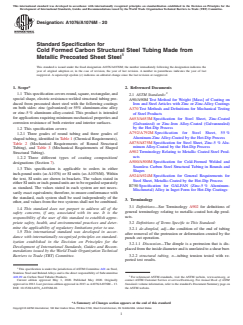
(Specification)Standard Specification for Cold Formed Carbon Structural Steel Tubing Made from Metallic Precoated Sheet Steel
General Information
- Abstract
ABSTRACT
This specification covers electric-resistance-welded structural tubing with round, square, rectangular, and special shapes and produced from precoated sheet steel with zinc (galvanized) or 55% aluminum-zinc alloy as coatings on both sides. This product is intended for applications requiring minimum mechanical properties and corrosion resistance of both exterior and interior surfaces. The standard addresses product size, material classification, ordering information, coating properties, chemical composition, mechanical properties of finished tube, flattening test, and oiling.
SCOPE
1.1 This specification covers round, square, rectangular, and special shape, electric-resistance-welded structural tubing produced from precoated sheet steel with the following coatings on both sides: zinc (galvanized) or 55% aluminum-zinc alloy or zinc-5 % aluminum alloy-coated. This product is intended for applications requiring minimum mechanical properties and corrosion resistance of both exterior and interior surfaces.
1.2 This specification covers:
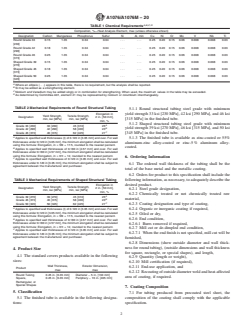
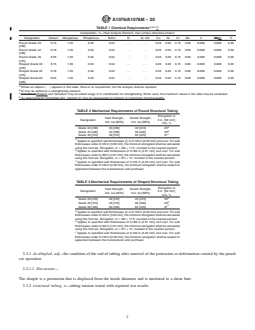
1.2.1 Three grades of round tubing and three grades of shaped tubing, identified in Table 1 (Chemical Requirements), Table 2 (Mechanical Requirements of Round Structural Tubing), and Table 3 (Mechanical Requirements of Shaped Structural Tubing).
1.2.2 Three different types of coating composition/designations (Section 7).
1.3 This specification is applicable to orders in either inch-pound units (as A1076) or SI units (as A1076M). Within the text, SI units are shown in brackets. The values stated in either SI units or inch-pound units are to be regarded separately as standard. The values stated in each system are not necessarily exact equivalents; therefore, to ensure conformance with the standard, each system shall be used independently of the other, and values from the two systems shall not be combined.
1.4 This standard does not purport to address all of the safety concerns, if any, associated with its use. It is the responsibility of the user of this standard to establish appropriate safety, health, and environmental practices and determine the applicability of regulatory limitations prior to use.
1.5 This international standard was developed in accordance with internationally recognized principles on standardization established in the Decision on Principles for the Development of International Standards, Guides and Recommendations issued by the World Trade Organization Technical Barriers to Trade (TBT) Committee.
- Status
- Published
- Publication Date
- 30-Apr-2020
- Technical Committee
- A01 - Steel, Stainless Steel and Related Alloys
- Drafting Committee
- A01.09 - Carbon Steel Tubular Products
Buy Documents


ASTM A1076/A1076M-20 - Standard Specification for Cold Formed Carbon Structural Steel Tubing Made from Metallic Precoated Sheet Steel

REDLINE ASTM A1076/A1076M-20 - Standard Specification for Cold Formed Carbon Structural Steel Tubing Made from Metallic Precoated Sheet Steel
Overview
ASTM A1076/A1076M-20 is the standard specification developed by ASTM International for cold formed carbon structural steel tubing made from metallic precoated sheet steel. This specification covers electric-resistance-welded structural tubing available in round, square, rectangular, and custom shapes, utilizing sheet steel precoated with zinc (galvanized), 55% aluminum-zinc alloy, or zinc-5% aluminum alloy on both sides. Designed to ensure minimum mechanical properties and enhanced corrosion resistance on both exterior and interior surfaces, this standard provides guidelines for dimensions, material selection, coating properties, mechanical requirements, and testing procedures.
By complying with ASTM A1076/A1076M-20, manufacturers and end-users can reliably specify and obtain structural tubing products suitable for demanding environments where corrosion resistance and structural integrity are critical.
Key Topics
Scope of Application
- Covers round, square, rectangular, and special-shaped tubing formed by electric-resistance welding.
- Utilizes metallic-coated sheets with zinc, 55% aluminum-zinc alloy, or zinc-5% aluminum as the coating.
Grades and Types
- Three grades of round tubing and three grades of shaped tubing, each with defined chemical and mechanical requirements.
- Coating types include galvanized, 55% aluminum-zinc, and zinc-5% aluminum alloy coatings.
Dimensions and Classifications
- Tubing sizes: up to 5 inches (130 mm) in diameter for rounds and up to 16 inches (405 mm) periphery for shapes.
- Wall thickness limits and dimensional tolerances align with industry needs.
Ordering Information
- Orders should specify steel grade, type and thickness of coating, end finish, dimensions, certification requirements, and intended application.
Testing and Quality Assurance
- Mechanical properties are verified per referenced ASTM testing methods (A370, A924/A924M).
- Flattening tests required for round tubing to ensure weld integrity.
- Coating properties referenced to ASTM standards for each type of metallic coating.
Safety and Regulatory Guidance
- Users are responsible for compliance with safety, health, and environmental regulations.
Applications
ASTM A1076/A1076M-20 structural steel tubing is widely used in applications where durability, structural reliability, and corrosion protection are essential. Key uses include:
Construction and Infrastructure
- Structural frameworks for buildings, bridges, and industrial projects.
- Supports, columns, and beams that require strong yet lightweight corrosion-resistant materials.
Transportation
- Components for trailers, automotive frames, and railings leveraging enhanced resistance to environmental exposure.
Agricultural and Utility Structures
- Equipment frames, fencing, and support structures used in outdoor or corrosive settings.
General Fabrication
- Enclosures, racks, and custom-engineered structures where specification to ASTM A1076/A1076M-20 ensures reliability and longevity.
Related Standards
Familiarity with related ASTM and industry standards is essential for proper use and specification of precoated steel tubing:
- ASTM A90/A90M: Test method for coating weight of zinc or zinc-alloy on steel articles.
- ASTM A370: Test methods and definitions for mechanical testing of steel products.
- ASTM A653/A653M: Specification for galvanized steel sheet.
- ASTM A792/A792M: Specification for 55% aluminum-zinc alloy-coated steel sheet.
- ASTM A875/A875M: Specification for zinc-5% aluminum alloy-coated steel sheet.
- ASTM A500/A500M: Specification for cold-formed carbon steel structural tubing.
- ASTM A924/A924M: General requirements for metallic-coated steel sheet.
- ASTM A902: Terminology relating to metallic coated steel products.
Adherence to these standards ensures tubing meets industry specifications for quality, performance, and safety, supporting robust performance across diverse structural applications.
Relations
- Effective Date
- 01-May-2020
- Effective Date
- 01-Mar-2024
- Effective Date
- 01-Nov-2023
- Effective Date
- 01-Jul-2019
- Refers
ASTM A370-17a - Standard Test Methods and Definitions for Mechanical Testing of Steel Products - Effective Date
- 15-Nov-2017
- Effective Date
- 01-Jan-2017
- Effective Date
- 01-Nov-2015
- Effective Date
- 15-May-2014
- Effective Date
- 15-Nov-2013
- Refers
ASTM A370-12a - Standard Test Methods and Definitions for Mechanical Testing of Steel Products - Effective Date
- 15-Oct-2012
- Effective Date
- 01-May-2012
- Effective Date
- 15-Mar-2012
- Refers
ASTM A370-11a - Standard Test Methods and Definitions for Mechanical Testing of Steel Products - Effective Date
- 15-Nov-2011
- Effective Date
- 01-Oct-2010
- Effective Date
- 15-Jun-2010
Buy Documents
ASTM A1076/A1076M-20 - Standard Specification for Cold Formed Carbon Structural Steel Tubing Made from Metallic Precoated Sheet Steel
REDLINE ASTM A1076/A1076M-20 - Standard Specification for Cold Formed Carbon Structural Steel Tubing Made from Metallic Precoated Sheet Steel
Get Certified
Connect with accredited certification bodies for this standard

Institut za varilstvo d.o.o. (Welding Institute)
Slovenia's leading welding institute since 1952. ISO 3834, EN 1090, pressure equipment certification, NDT personnel, welder qualification. Only IIW Au
Sponsored listings
Frequently Asked Questions
ASTM A1076/A1076M-20 is a technical specification published by ASTM International. Its full title is "Standard Specification for Cold Formed Carbon Structural Steel Tubing Made from Metallic Precoated Sheet Steel". This standard covers: ABSTRACT This specification covers electric-resistance-welded structural tubing with round, square, rectangular, and special shapes and produced from precoated sheet steel with zinc (galvanized) or 55% aluminum-zinc alloy as coatings on both sides. This product is intended for applications requiring minimum mechanical properties and corrosion resistance of both exterior and interior surfaces. The standard addresses product size, material classification, ordering information, coating properties, chemical composition, mechanical properties of finished tube, flattening test, and oiling. SCOPE 1.1 This specification covers round, square, rectangular, and special shape, electric-resistance-welded structural tubing produced from precoated sheet steel with the following coatings on both sides: zinc (galvanized) or 55% aluminum-zinc alloy or zinc-5 % aluminum alloy-coated. This product is intended for applications requiring minimum mechanical properties and corrosion resistance of both exterior and interior surfaces. 1.2 This specification covers: 1.2.1 Three grades of round tubing and three grades of shaped tubing, identified in Table 1 (Chemical Requirements), Table 2 (Mechanical Requirements of Round Structural Tubing), and Table 3 (Mechanical Requirements of Shaped Structural Tubing). 1.2.2 Three different types of coating composition/designations (Section 7). 1.3 This specification is applicable to orders in either inch-pound units (as A1076) or SI units (as A1076M). Within the text, SI units are shown in brackets. The values stated in either SI units or inch-pound units are to be regarded separately as standard. The values stated in each system are not necessarily exact equivalents; therefore, to ensure conformance with the standard, each system shall be used independently of the other, and values from the two systems shall not be combined. 1.4 This standard does not purport to address all of the safety concerns, if any, associated with its use. It is the responsibility of the user of this standard to establish appropriate safety, health, and environmental practices and determine the applicability of regulatory limitations prior to use. 1.5 This international standard was developed in accordance with internationally recognized principles on standardization established in the Decision on Principles for the Development of International Standards, Guides and Recommendations issued by the World Trade Organization Technical Barriers to Trade (TBT) Committee.
ABSTRACT This specification covers electric-resistance-welded structural tubing with round, square, rectangular, and special shapes and produced from precoated sheet steel with zinc (galvanized) or 55% aluminum-zinc alloy as coatings on both sides. This product is intended for applications requiring minimum mechanical properties and corrosion resistance of both exterior and interior surfaces. The standard addresses product size, material classification, ordering information, coating properties, chemical composition, mechanical properties of finished tube, flattening test, and oiling. SCOPE 1.1 This specification covers round, square, rectangular, and special shape, electric-resistance-welded structural tubing produced from precoated sheet steel with the following coatings on both sides: zinc (galvanized) or 55% aluminum-zinc alloy or zinc-5 % aluminum alloy-coated. This product is intended for applications requiring minimum mechanical properties and corrosion resistance of both exterior and interior surfaces. 1.2 This specification covers: 1.2.1 Three grades of round tubing and three grades of shaped tubing, identified in Table 1 (Chemical Requirements), Table 2 (Mechanical Requirements of Round Structural Tubing), and Table 3 (Mechanical Requirements of Shaped Structural Tubing). 1.2.2 Three different types of coating composition/designations (Section 7). 1.3 This specification is applicable to orders in either inch-pound units (as A1076) or SI units (as A1076M). Within the text, SI units are shown in brackets. The values stated in either SI units or inch-pound units are to be regarded separately as standard. The values stated in each system are not necessarily exact equivalents; therefore, to ensure conformance with the standard, each system shall be used independently of the other, and values from the two systems shall not be combined. 1.4 This standard does not purport to address all of the safety concerns, if any, associated with its use. It is the responsibility of the user of this standard to establish appropriate safety, health, and environmental practices and determine the applicability of regulatory limitations prior to use. 1.5 This international standard was developed in accordance with internationally recognized principles on standardization established in the Decision on Principles for the Development of International Standards, Guides and Recommendations issued by the World Trade Organization Technical Barriers to Trade (TBT) Committee.
ASTM A1076/A1076M-20 is classified under the following ICS (International Classification for Standards) categories: 23.040.10 - Iron and steel pipes. The ICS classification helps identify the subject area and facilitates finding related standards.
ASTM A1076/A1076M-20 has the following relationships with other standards: It is inter standard links to ASTM A1076/A1076M-13, ASTM A370-24, ASTM A500/A500M-23, ASTM A370-19, ASTM A370-17a, ASTM A370-17, ASTM A370-15, ASTM A370-14, ASTM A370-13, ASTM A370-12a, ASTM B750-12, ASTM A370-12, ASTM A370-11a, ASTM A500/A500M-10a, ASTM A370-10. Understanding these relationships helps ensure you are using the most current and applicable version of the standard.
ASTM A1076/A1076M-20 is available in PDF format for immediate download after purchase. The document can be added to your cart and obtained through the secure checkout process. Digital delivery ensures instant access to the complete standard document.
Standards Content (Sample)
This international standard was developed in accordance with internationally recognized principles on standardization established in the Decision on Principles for the
Development of International Standards, Guides and Recommendations issued by the World Trade Organization Technical Barriers to Trade (TBT) Committee.
Designation:A1076/A1076M −20
Standard Specification for
Cold Formed Carbon Structural Steel Tubing Made from
Metallic Precoated Sheet Steel
This standard is issued under the fixed designation A1076/A1076M; the number immediately following the designation indicates the
year of original adoption or, in the case of revision, the year of last revision. A number in parentheses indicates the year of last
reapproval. A superscript epsilon (´) indicates an editorial change since the last revision or reapproval.
1. Scope* 2. Referenced Documents
1.1 This specification covers round, square, rectangular, and
2.1 ASTM Standards:
special shape, electric-resistance-welded structural tubing pro-
A90/A90M Test Method for Weight [Mass] of Coating on
duced from precoated sheet steel with the following coatings
Iron and Steel Articles with Zinc or Zinc-Alloy Coatings
on both sides: zinc (galvanized) or 55% aluminum-zinc alloy
A370 Test Methods and Definitions for Mechanical Testing
or zinc-5 % aluminum alloy-coated. This product is intended
of Steel Products
for applications requiring minimum mechanical properties and
A653/A653M Specification for Steel Sheet, Zinc-Coated
corrosion resistance of both exterior and interior surfaces.
(Galvanized) or Zinc-Iron Alloy-Coated (Galvannealed)
by the Hot-Dip Process
1.2 This specification covers:
A792/A792M Specification for Steel Sheet, 55 %
1.2.1 Three grades of round tubing and three grades of
Aluminum-Zinc Alloy-Coated by the Hot-Dip Process
shaped tubing, identified in Table 1 (Chemical Requirements),
A875/A875M Specification for Steel Sheet, Zinc-5 % Alu-
Table 2 (Mechanical Requirements of Round Structural
minum Alloy-Coated by the Hot-Dip Process
Tubing), and Table 3 (Mechanical Requirements of Shaped
A902 Terminology Relating to Metallic Coated Steel Prod-
Structural Tubing).
ucts
1.2.2 Three different types of coating composition/
A500/A500M Specification for Cold-Formed Welded and
designations (Section 7).
Seamless Carbon Steel Structural Tubing in Rounds and
1.3 This specification is applicable to orders in either
Shapes
inch-pound units (as A1076) or SI units (as A1076M). Within
A924/A924M Specification for General Requirements for
the text, SI units are shown in brackets. The values stated in
Steel Sheet, Metallic-Coated by the Hot-Dip Process
eitherSIunitsorinch-poundunitsaretoberegardedseparately
B750 Specification for GALFAN (Zinc-5 % Aluminum-
as standard. The values stated in each system are not neces-
,
Mischmetal) Alloy in Ingot Form for Hot-Dip Coatings
sarily exact equivalents; therefore, to ensure conformance with
the standard, each system shall be used independently of the
3. Terminology
other, and values from the two systems shall not be combined.
3.1 Definitions—See Terminology A902 for definitions of
1.4 This standard does not purport to address all of the
general terminology relating to metallic-coated hot-dip prod-
safety concerns, if any, associated with its use. It is the
ucts.
responsibility of the user of this standard to establish appro-
priate safety, health, and environmental practices and deter-
3.2 Definitions of Terms Specific to This Standard:
mine the applicability of regulatory limitations prior to use.
3.2.1 de-dimpled, adj—the condition of the end of tubing
1.5 This international standard was developed in accor-
after removal of the protrusion or deformation created by the
dance with internationally recognized principles on standard-
punch cut operation.
ization established in the Decision on Principles for the
3.2.1.1 Discussion—The dimple is a protrusion that is dis-
Development of International Standards, Guides and Recom-
placedfromtheinsidediameterandisunrelatedtoashearburr.
mendations issued by the World Trade Organization Technical
3.2.2 structural tubing, n—tubing tension tested with re-
Barriers to Trade (TBT) Committee.
ported test results.
This specification is under the jurisdiction of ASTM Committee A01 on Steel,
Stainless Steel and Related Alloys and is the direct responsibility of Subcommittee
A01.09 on Carbon Steel Tubular Products. For referenced ASTM standards, visit the ASTM website, www.astm.org, or
Current edition approved May 1, 2020. Published May 2020. Originally contact ASTM Customer Service at service@astm.org. For Annual Book of ASTM
approved in 2012. Last previous edition approved in 2013 as A1076/A1076M – 13. Standards volume information, refer to the standard’s Document Summary page on
DOI: 10.1520/A1076_A1076M-20. the ASTM website.
*A Summary of Changes section appears at the end of this standard
Copyright © ASTM International, 100 Barr Harbor Drive, PO Box C700, West Conshohocken, PA 19428-2959. United States
A1076/A1076M−20
A,B,C,D
TABLE 1 Chemical Requirements
Composition, %—Heat Analysis Element, max (unless otherwise shown)
Designation Carbon Manganese Phosphorus Sulfur Si Al, min Cu Ni Cr Mo V Nb Ti
Round Grade 33 0.15 1.35 0.04 0.04 . . . . . . 0.25 0.20 0.15 0.06 0.008 0.008 0.03
[230]
Round Grade 42 0.18 1.35 0.04 0.04 . . . . . . 0.25 0.20 0.15 0.06 0.008 0.008 0.03
[290]
Round Grade 46 0.25 1.35 0.04 0.04 . . . . . . 0.25 0.20 0.15 0.06 0.008 0.008 0.03
[315]
Shaped Grade 39 0.15 1.35 0.04 0.04 . . . . . . 0.25 0.20 0.15 0.06 0.008 0.008 0.03
[270]
Shaped Grade 46 0.18 1.35 0.04 0.04 . . . . . . 0.25 0.20 0.15 0.06 0.008 0.008 0.03
[315]
Shaped Grade 50 0.25 1.35 0.04 0.04 . . . . . . 0.25 0.20 0.15 0.06 0.008 0.008 0.03
[345]
A
Where an ellipsis (. . .) appears in this table, there is no requirement, but the analysis shall be reported.
B
Si may be added as a strengthening element.
C
Niobium and Vanadium may be added singly or in combination for strengthening. When used, the maximum values in the table may be exceeded.
D
As determined by Committee A01, element 41 may be represented by niobium or columbium interchangeably.
TABLE 2 Mechanical Requirements of Round Structural Tubing
5.1.1 Round structural tubing steel grade with minimum
Elongation in yield strength 33 ksi [230 MPa], 42 ksi [290 MPa], and 46 ksi
Yield Strength, Tensile Strength,
Designation 2 in. [50 mm],
[315 MPa] in the finished tube.
min, ksi [MPa] min, ksi [MPa]
min, %
5.1.2 Shaped structural tubing steel grade with minimum
A
Grade 33 [230] 33 [230] 45 [310] 25
B
yield strength 39 ksi [270 MPa], 46 ksi [315 MPa], and 50 ksi
Grade 42 [290] 42 [290] 58 [400] 23
C
Grade 46 [315] 46 [315] 62 [425] 21 [345 MPa] in the finished tube.
A
Applies to specified wall thicknesses (t) of 0.120 in [3.05 mm] and over. For wall 5.1.3 The finished tube is available as zinc-coated or 55%
thicknesses under 0.120 in [3.05 mm], the minimum elongation shall be calculated
aluminum-zinc alloy-coated or zinc-5 % aluminum alloy-
using this formula: Elongation, in
...
This document is not an ASTM standard and is intended only to provide the user of an ASTM standard an indication of what changes have been made to the previous version. Because
it may not be technically possible to adequately depict all changes accurately, ASTM recommends that users consult prior editions as appropriate. In all cases only the current version
of the standard as published by ASTM is to be considered the official document.
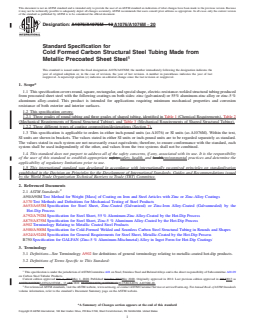
Designation: A1076/A1076M − 13 A1076/A1076M − 20
Standard Specification for
Cold Formed Carbon Structural Steel Tubing Made from
Metallic Precoated Sheet Steel
This standard is issued under the fixed designation A1076/A1076M; the number immediately following the designation indicates the
year of original adoption or, in the case of revision, the year of last revision. A number in parentheses indicates the year of last
reapproval. A superscript epsilon (´) indicates an editorial change since the last revision or reapproval.
1. Scope*
1.1 This specification covers round, square, rectangular, and special shape, electric-resistance-welded structural tubing produced
from precoated sheet steel with the following coatings on both sides: zinc (galvanized) or 55% aluminum-zinc alloy or zinc-5 %
aluminum alloy-coated. This product is intended for applications requiring minimum mechanical properties and corrosion
resistance of both exterior and interior surfaces.
1.2 This specification covers:
1.2.1 Three grades of round tubing and three grades of shaped tubing, identified in Table 1 (Chemical Requirements), Table 2
(Mechanical Requirements of Round Structural Tubing), and Table 3 (Mechanical Requirements of Shaped Structural Tubing).
1.2.2 Three different types of coating composition/designations (Section 7).
1.3 This specification is applicable to orders in either inch-pound units (as A1076) or SI units (as A1076M). Within the text,
SI units are shown in brackets. The values stated in either SI units or inch-pound units are to be regarded separately as standard.
The values stated in each system are not necessarily exact equivalents; therefore, to ensure conformance with the standard, each
system shall be used independently of the other, and values from the two systems shall not be combined.
1.4 This standard does not purport to address all of the safety concerns, if any, associated with its use. It is the responsibility
of the user of this standard to establish appropriate safety safety, health, and healthenvironmental practices and determine the
applicability of regulatory limitations prior to use.
1.5 This international standard was developed in accordance with internationally recognized principles on standardization
established in the Decision on Principles for the Development of International Standards, Guides and Recommendations issued
by the World Trade Organization Technical Barriers to Trade (TBT) Committee.
2. Referenced Documents
2.1 ASTM Standards:
A90/A90M Test Method for Weight [Mass] of Coating on Iron and Steel Articles with Zinc or Zinc-Alloy Coatings
A370 Test Methods and Definitions for Mechanical Testing of Steel Products
A653/A653M Specification for Steel Sheet, Zinc-Coated (Galvanized) or Zinc-Iron Alloy-Coated (Galvannealed) by the
Hot-Dip Process
A792/A792M Specification for Steel Sheet, 55 % Aluminum-Zinc Alloy-Coated by the Hot-Dip Process
A875/A875M Specification for Steel Sheet, Zinc-5 % Aluminum Alloy-Coated by the Hot-Dip Process
A902 Terminology Relating to Metallic Coated Steel Products
A500/A500M Specification for Cold-Formed Welded and Seamless Carbon Steel Structural Tubing in Rounds and Shapes
A924/A924M Specification for General Requirements for Steel Sheet, Metallic-Coated by the Hot-Dip Process
,
B750 Specification for GALFAN (Zinc-5 % Aluminum-Mischmetal) Alloy in Ingot Form for Hot-Dip Coatings
3. Terminology
3.1 Definitions—See Terminology A902 for definitions of general terminology relating to metallic-coated hot-dip products.
3.2 Definitions of Terms Specific to This Standard:
This specification is under the jurisdiction of ASTM Committee A01 on Steel, Stainless Steel and Related Alloys and is the direct responsibility of Subcommittee A01.09
on Carbon Steel Tubular Products.
Current edition approved Oct. 1, 2013May 1, 2020. Published October 2013May 2020. Originally approved in 2012. Last previous edition approved in 20122013 as
A1076/A1076MA1076/A1076M – 13.–12. DOI: 10.1520/A1076_A1076M-13.10.1520/A1076_A1076M-20.
For referenced ASTM standards, visit the ASTM website, www.astm.org, or contact ASTM Customer Service at service@astm.org. For Annual Book of ASTM Standards
volume information, refer to the standard’s Document Summary page on the ASTM website.
*A Summary of Changes section appears at the end of this standard
Copyright © ASTM International, 100 Barr Harbor Drive, PO Box C700, West Conshohocken, PA 19428-2959. United States
A1076/A1076M − 20
A,B,C,D
TABLE 1 Chemical Requirements
Composition, %—Heat Analysis Element, max (unless otherwise shown)
Designation Carbon Manganese Phosphorus Sulfur Si Al, min Cu Ni Cr Mo V CbNb Ti
Round Grade 33 0.15 1.35 0.04 0.04 . . . . . . 0.25 0.20 0.15 0.06 0.008 0.008 0.03
[230]
Round Grade 42 0.18 1.35 0.04 0.04 . . . . . . 0.25 0.20 0.15 0.06 0.008 0.008 0.03
[290]
Round Grade 46 0.25 1.35 0.04 0.04 . . . . . . 0.25 0.20 0.15 0.06 0.008 0.008 0.03
[315]
Shaped Grade 39 0.15 1.35 0.04 0.04 . . . . . . 0.25 0.20 0.15 0.06 0.008 0.008 0.03
[270]
Shaped Grade 46 0.18 1.35 0.04 0.04 . . . . . . 0.25 0.20 0.15 0.06 0.008 0.008 0.03
[315]
Shaped Grade 50 0.25 1.35 0.04 0.04 . . . . . . 0.25 0.20 0.15 0.06 0.008 0.008 0.03
[345]
A
Where an ellipsis (. . .) appears in this table, there is no requirement, but the analysis shall be reported.
B
Si may be added as a strengthening element.
C
Columbium Niobium and Vanadium may be added singly or in combination for strengthening. When used, the maximum values in the table may be exceeded.
D
As determined by Committee A01, element 41 may be represented by niobium or columbium interchangeably.
TABLE 2 Mechanical Requirements of Round Structural Tubing
Elongation in
Yield Strength, Tensile Strength,
Designation 2 in. [50 mm],
min, ksi [MPa] min, ksi [MPa]
min, %
A
Grade 33 [230] 33 [230] 45 [310] 25
B
Grade 42 [290] 42 [290] 58 [400] 23
C
Grade 46 [315] 46 [315] 62 [425] 21
A
Applies to specified wall thicknesses (t) of 0.120 in [3.05 mm] and over. For wall
thicknesses under 0.120 in [3.05 mm], the minimum elongation shall be calculated
using this formula: Elongation, in = 56t + 17.5, rounded to the nearest percent.
B
Applies to specified wall thicknesses of 0.180 in [4.57 mm] and over. For wall
thicknesses under 0.180 in [4.57 mm], the minimum elongation shall be calculated
using this formula: Elongation, in = 61t + 12, rounded to the nearest percent.
C
Applies to specified wall thicknesses of 0.120 in [3.05 mm] and over. For wall
thicknesses under 0.120 in [3.05 mm], the minimum elongation shall be subject to
agreement between the manufacturer and purchaser.
TABLE 3 Mechanical Requirements of Shaped Structural Tubing
Elongation in
Yield Strength, Tensile Strength,
Designation 2 in. [50 mm],
min, ksi [MPa] min, ksi [MPa]
min, %
A
Grade 39 [270] 39 [270] 45 [310] 25
B
Grade 46 [315] 46 [315] 58 [400] 23
C
Grade 50 [345] 50 [345] 62 [425] 21
A
Applies to specified wall thicknesses (t) of 0.120 in [3.05 mm] and over. For wall
thicknesses under 0.120 in [3.05 mm], the minimum elongation shal
...